Below 200 meters, where sunlight disappears completely, lies the largest living space on Earth. Among the fish that live there, none embody "deep-sea-ness" as intensely as the anglerfish family. A glowing lantern dangles from a rod growing out of the head, teeth long enough to nearly reach the mouth's own opening, and — the male ends his life fused into the female's body.
This strangeness isn't some tasteless coincidence. The odds of encountering food, and the odds of encountering a mate, are both extraordinarily low. Under these harsh conditions, the results of betting everything on "being found" and "never letting go" are the glowing fishing rod and the fusion-based reproductive strategy. In recent years, both filming of living individuals by deep-sea exploration vehicles and molecular-level clarification through genome analysis have advanced simultaneously, rewriting textbook descriptions one after another.
This article starts with the taxonomy and habitat of ceratioid anglerfishes, then works through the relationship between the esca (light organ) and its symbiotic bacteria, their ambush-style hunting, and finally sexual parasitism and the evolution of their immune systems, all based on actual research papers and deep-sea observation records. For deep-sea bioluminescence in general, also see a thorough guide to deep-sea bioluminescence.
What you'll learn in this article
- The real mechanism behind the anglerfish's glowing "lantern" (esca), and why it's not the fish itself but symbiotic bacteria that glow
- How "energy-saving" ambush hunting in the dark ocean ties into the deep sea's energy economics
- The stages of "sexual parasitism," in which the male bites the female and fuses skin and blood vessels into one, and which species this occurs in
- Why no rejection reaction occurs after fusion — the extreme evolutionary step of discarding core immune genes
- How deep-sea exploration vehicles and imaging technology have rewritten the image of the anglerfish over the past 30 years
What is an anglerfish? 168 "anglers" scattered across the deep sea
"Anglerfish" is sometimes used as the name of a single species, but biologically it refers to a large group, the suborder Ceratioidei, within the order Lophiiformes. This suborder currently includes 168 known species, divided into 11 families and 35 genera. They are related to the edible anglerfish (such as the blackmouth angler) that lurk on shallow seabeds, but their way of life is entirely different. Rather than the seabed, they live drifting through the mid-water darkness, distant from both the seafloor and the sea surface.
Deep-sea ceratioid anglerfishes are distributed across nearly all the world's oceans. Multiple species have been recorded in Japan's coastal waters too, including the sackspine seadevil (Cryptopsaras couesii), and it's not uncommon for specimens accidentally caught by fishery workers to be preserved as academic records, as with the "rare fish collection reports" from the Tokyo Metropolitan Islands Area Research and Development Center for Agriculture, Forestry and Fisheries. This shows well how understanding the distribution of deep-sea fish remains, even today, a field supported by reports from actual fishing operations.
A quadruple hardship: darkness, cold, high pressure, and food scarcity
The environment they live in is hard to imagine by everyday, land-based standards. Sunlight is essentially gone by 200 meters, and past 1,000 meters it's complete darkness. Water temperature is roughly 2–4°C, and pressure increases by about 1 atmosphere for every 10 meters of depth, reaching about 100 atmospheres at 1,000 meters. And the biggest problem is food scarcity. The deep sea has no place for photosynthesis by phytoplankton, so most organic matter depends on "marine snow" sinking down from the layers above.
| Environmental factor | Approximate condition around 1,000m depth | What it means for life there |
|---|---|---|
| Light | Effectively zero sunlight | Can't rely on vision / value emerges in producing your own light |
| Water temperature | About 2–4°C | Slow metabolism, slow growth |
| Water pressure | About 100 atmospheres | Requires special adaptations for swim bladders and body tissue |
| Food | Depends on sinking organic matter, extremely sparse | Ambush and big-eating predation becomes advantageous |
| Population density | Extremely low | Extremely low chance of encountering a mate |
These conditions make the strategy of "swimming around in search" extremely disadvantageous. Continuing to swim in search of prey could easily cost more energy than it gains. Adaptation among deep-sea creatures in general is covered in detail in the remarkable adaptive strategies of deep-sea creatures, and among them, the anglerfish stands out as a representative example that went all the way in the direction of "not moving."

A body built for waiting
The female's body is built entirely around ambush. There's little muscle, and the tissue is gelatinous; the skeleton is thin too. In exchange for weak swimming ability, the cost of maintaining the body is kept low. The mouth, on the other hand, is extremely large, and the teeth curve inward so that once seized, prey can't escape. The stomach stretches enormously, and in some species can swallow prey equal to or larger than the anglerfish's own body size. It's a body built to reliably seize and make the most of a single chance that might come at any time.
A history of the male being mistaken for "a different creature"
The very history of anglerfish research tells the story of how difficult deep-sea research is. In the early 20th century, every large specimen caught in nets was female. Because no males were ever found, they were initially classified as fish belonging to an entirely different family, and the small protrusions attached to some females' bodies were thought to be parasites or tumors. It was only after repeated dissection and tissue observation of specimens that these were understood to be males of the same species.
Behind this lies a constraint common to deep-sea biology research in general. Only individuals caught in nets can be observed, so nothing is known of their living behavior. With small population numbers, statistical discussion is also difficult. Among deep-sea anglerfish species, some are known from only a dozen or so specimens across all the world's museums combined, and there are even species whose living males have never once been observed. It's important not to forget the premise that what we know is only a small fraction of these fish.
Key points on anglerfish taxonomy
- Taxonomically, they belong to the suborder Ceratioidei within the order Lophiiformes: 168 species, 11 families, 35 genera
- Their main habitat depth is 200–2,000m, with some records exceeding 4,000m depending on species
- Rather than swimming around, they follow an energy-saving lifestyle of ambush predation
- The "classic anglerfish" image we see in photographs is, in every case, the female
The truth behind the glowing lantern (esca): it's not the fish, but bacteria, that glow
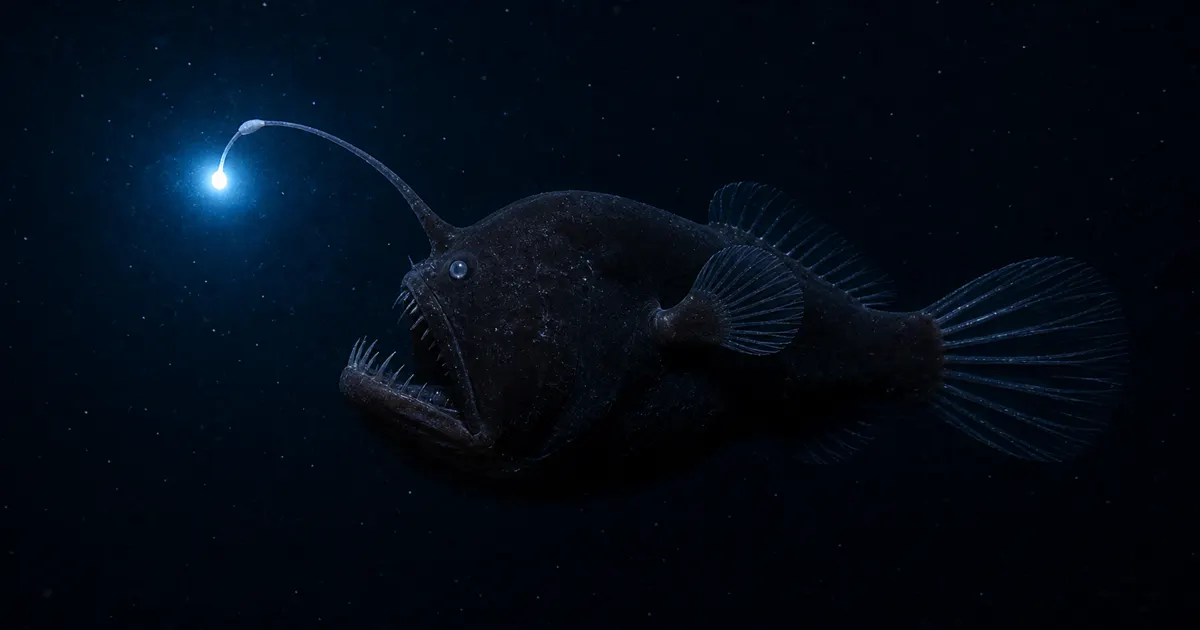
The anglerfish's iconic "lantern" consists of the rod-shaped organ formed from a modified first dorsal spine, called the illicium, and the luminous bulb attached at its tip, called the esca. In Latin, illicium means "something that lures," and esca means "bait" — the names themselves describe the function.
It can't glow on its own — symbiosis with bioluminescent bacteria
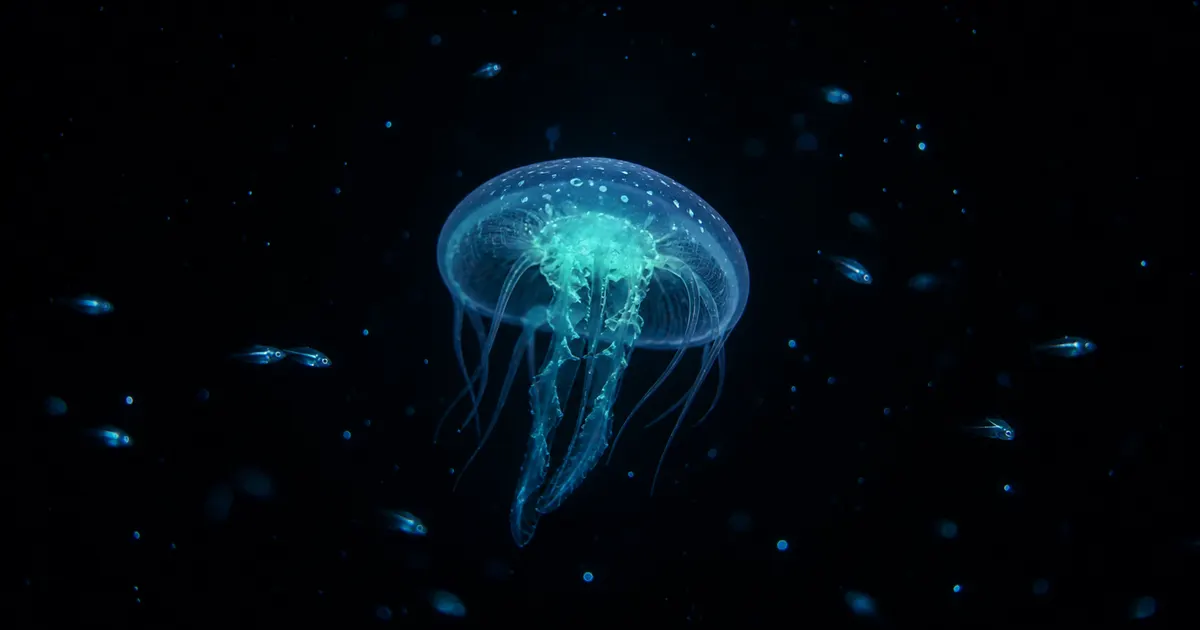
What matters is that most deep-sea ceratioid anglerfishes do not produce light with their own bodies. Inside the esca is a cavity where bioluminescent bacteria are cultured at high density. The fish provides the bacteria with a safe home and nutrients, and the bacteria provide light in return — a classic example of mutualism. This is fundamentally different from organisms like fireflies or certain jellyfish that glow using their own luminescent substance (luciferin).
The outer wall of the esca is partially transparent or translucent, structured to let the bacteria's light inside leak outward. Depending on species, it may also feature pigment layers, reflective layers, and filament-like protrusions, which are thought to control the direction and spread of the light and how it appears to flicker or pulse. The shape of the esca varies remarkably among species and serves as an important clue for taxonomic classification.

Symbiotic bacteria that discarded half their genome
This symbiotic relationship has left deep traces on the bacteria's side too. In a study reported by Hendry et al. in the journal mBio in 2018, the genomes were analyzed of Candidatus Enterovibrio luxaltus, which lives symbiotically with Cryptopsaras couesii, and Ca. Enterovibrio escacola, which lives symbiotically with Melanocetus johnsonii. The result showed that these symbiotic bacteria's genomes had shrunk by about 50% compared with closely related free-living bacteria. What's more, an unusually large number of transposon remnants were found, indicating that this genome reduction is still ongoing today.
Genome reduction is a phenomenon commonly seen in bacteria that live dependent on a host. If the host supplies nutrients, the bacteria no longer needs the genes to synthesize its own amino acids. Genes that go unused break down and are lost over generations. In other words, these bacteria are, in a sense, in the middle of adapting to their relationship with the anglerfish so deeply that there's "no going back."
Meanwhile, a study published in the journal eLife in 2019 revealed a surprising fact: multiple anglerfish species, distantly separated on the evolutionary tree, share a common, genetically reduced bioluminescent symbiotic bacterium, which appears to be acquired from the environment rather than inherited from parent to offspring. Passing through a stage of drifting in seawater while still undergoing genome reduction — this is drawing attention as "a third form of symbiosis," different from both typical intracellular symbiosis and typical external symbiosis.
Key points in research on symbiotic bacteria
- The symbiotic bacteria's genome has shrunk by about 50% compared with free-living, closely related species (Hendry et al., 2018, mBio)
- Many transposon remnants exist, showing the reduction process is still ongoing
- Multiple anglerfish species, phylogenetically distinct, share a common symbiotic bacterium, possibly acquired from the environment (Baker et al., 2019, eLife)
- A relationship still evolving that can't be explained from the perspective of either the host or the symbiont alone
Who is actually controlling the light?
The bacteria's luminescence is essentially continuous, but anglerfish appear to "use light selectively." It's thought that they create the appearance of flickering or pulsing by varying the amount of blood sent to the esca, covering or exposing it with surrounding pigment tissue, or moving the rod itself to shake the light. It's easiest to understand this as a division-of-labor lighting system, with the bacteria as the light source and the fish as the controller.
Hunting by luring with light: an ocean where staying still becomes the optimal solution
What is the esca's light lit for? The most likely explanation is its function as a lure to draw in prey. In the deep sea, even a small light becomes a strong stimulus. Small shrimp and fish mistake the light for something edible, or a signal from a fellow creature, and approach — only to be swallowed by the enormous mouth waiting there.
The energy budget of ambush predation
This strategy works in the deep sea simply as a matter of energy budgeting. With slow metabolism due to the cold, an anglerfish can push its energy consumption to the absolute minimum by barely moving at all. If prey can be drawn in through the mere "investment" of light, the cost of predation drops dramatically. Rather than swimming in search of prey, it's the prey that does the searching. This reversal is the very essence of the anglerfish's hunting.
| Hunting method | Energy consumption | Encounter frequency | Suitability for the mid-water deep sea |
|---|---|---|---|
| Active pursuit, swimming to search | High | Rises in proportion to range covered | Budget doesn't balance when food is sparse |
| Passive drifting on currents | Low | Left to chance | Too dependent on luck |
| Ambush with a bioluminescent lure | Very low | Compensated by the pull of the light | Well suited to a dark environment with sparse food |
Swallowing prey once, reliably, and whole
Since chances are rare, failure isn't an option. Anglerfish practice "suction feeding," opening their mouths wide and drawing in prey along with the surrounding water, and their inward-curving teeth prevent escape. In species where the stomach can expand greatly, there are records of them swallowing prey equal in size to their own body. Eating in bulk to last through long stretches of scarcity — a rational design for a world where food arrives only irregularly.

What do they actually eat?
Stomach content surveys have found crustaceans (krill and shrimp), small lanternfish, and cephalopods, among others. Particularly notable is the presence of lanternfish. These fish stay deep during the day and rise to the surface at night to feed, sinking again toward dawn — a pattern called "diel vertical migration." This movement, said to be the largest-scale migration of living creatures on Earth, carries energy gained at the surface down into the deep sea, and the anglerfish sits at the receiving end of that flow.
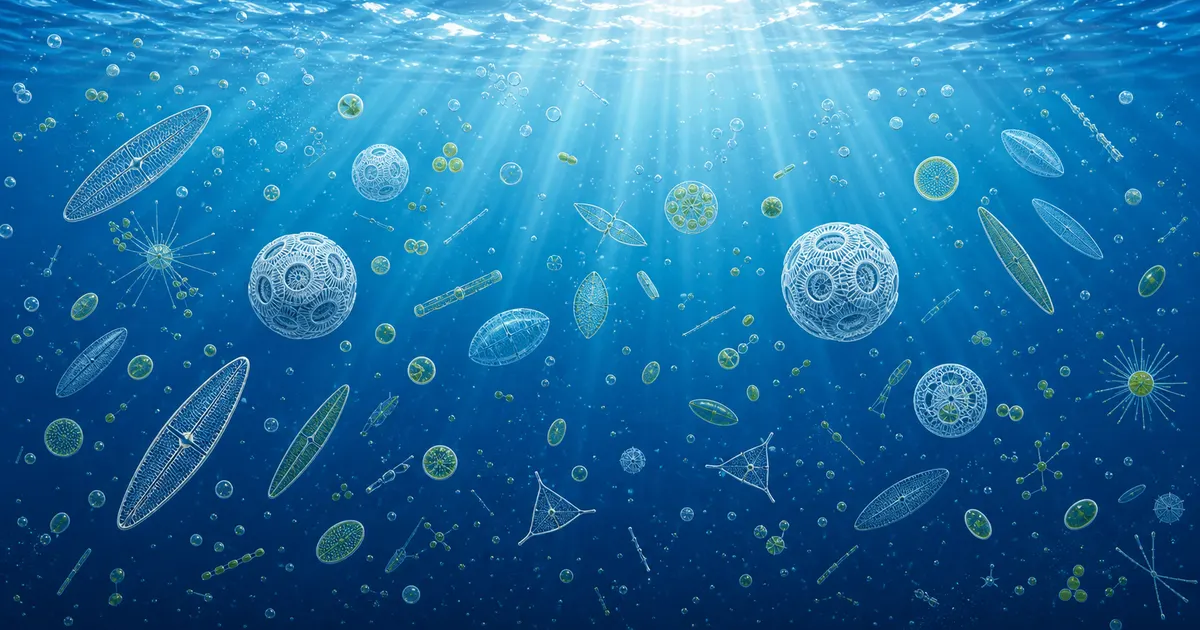
In other words, even an anglerfish that appears to be sitting alone, motionless in the dark, is actually connected to the far end of an enormous cycle of matter that begins with photosynthesis at the surface. Deep-sea ecosystems don't exist independently — they're supported by the flow of carbon and energy that begins at the sea surface. The ocean food chain that starts with phytoplankton is covered in detail in how phytoplankton produces half of Earth's oxygen.
Does the lure serve any role beyond hunting?
Functions beyond predation have also been proposed for the esca's light. Since the shape and glow of the esca differ by species, it may work as a marker for recognizing members of the same species, or it could serve to confuse or intimidate predators. However, direct observation in the deep sea is extremely difficult, and these possibilities are still being verified today. It has become clear that light-using deep-sea creatures use light for predation, defense, and communication alike, and cannot be reduced to a single function.
Don't assume "glowing = always for hunting"
While the esca functioning as a predatory lure is widely supported, there isn't sufficient evidence to limit the light's role to predation alone. Behavioral observations of deep-sea creatures are limited both in the number of individuals and observation time, so interpretations of function should remain cautious.
An ocean where you can't meet anyone: the challenge of finding a mate in the deep sea
An even more serious problem than hunting is encountering a mate for reproduction. In the vast mid-water deep sea, individuals exist only very sparsely. There are no landmarks, no light reaches, and there's no room to form schools. They must confront the odds of whether they'll ever meet a mate even once in a lifetime.
Males and females are so different they look like separate creatures
The answer to this problem was extreme sexual dimorphism. The "typical anglerfish appearance" we see in field guides and footage is, in every case, the female. Males have an entirely different body. In Ceratias holboelli, females reach up to about 1.2 meters, while males remain a mere 6cm or so — a body-length ratio of about 20:1, and the difference becomes even more extreme when converted to volume or weight.
| Item | Female | Male (dwarf male) |
|---|---|---|
| Body length (example: Ceratias holboelli) | Up to about 1.2m | About 6cm |
| Light organ (esca) | Present | Absent |
| Mouth and teeth | Large, with teeth for seizing prey | Small; some species have gripping jaw teeth instead |
| Digestive tract | Well developed | Regressed; some species can barely feed themselves |
| Olfactory organ | Standard | Remarkably well developed |
| Eyes | Small in most species | Relatively large in most species |
The male's body is built almost like a device for finding a mate. In particular, the development of the olfactory organ (nose) is striking, and it's thought to detect pheromones released by females at extremely low concentrations. In species with relatively large eyes, it has also been suggested that the light of the female's esca may serve as a clue. Narrow down the general direction by scent, then make the final approach by light — a two-stage search.

Once found, never let go
Many males have a regressed digestive tract, making it difficult for them to survive alone for long. In other words, the male has no time to spare. He must find a female within his limited lifespan, and once he does, he must never let go under any circumstances — this urgent condition leads to the extreme solution described next: sexual parasitism.
The full picture of "sexual parasitism," where the male fuses into the female
Sexual parasitism is the phenomenon in which a dwarf male bites into the female's body surface, and the tissue then fuses so they can no longer separate, eventually connecting even their circulatory systems into one. Starting with old specimen descriptions by Danish researchers, this was systematically organized through a series of studies by Theodore W. Pietsch of the University of Washington. Pietsch reported precocious sexual parasitism in the sackspine seadevil (Cryptopsaras couesi) in the journal Nature in 1975, and published a comprehensive review of reproductive modes in the journal Ichthyological Research in 2005.
How does the fusion actually proceed?
- Searching: the dwarf male uses his developed sense of smell and eyes to locate a female.
- Attachment: the male bites into the female's body surface (a preferred site, such as the belly or flank, varies by species) with his jaws.
- Fusion: the skin tissue at the bite site fuses together, becoming physically inseparable.
- Vascular connection: the circulatory systems of both individuals connect, and the male begins receiving nutrients and oxygen from the female's blood.
- Regression: the male's eyes, fins, and most internal organs regress, and ultimately only organs centered on the testes remain functional.
- Supply: he continues supplying sperm timed to the female's spawning.
By the final stage, the male is no longer really an independent individual so much as a reproductive organ incorporated into the female's body. Once a female has fused with a male, she no longer needs to search for a mate for subsequent reproduction, and individuals with multiple males attached have been recorded.

Not every species fuses
This is a point often misunderstood. Anglerfish are often described broadly as "fish where the male fuses into the female," but permanent fusion is limited to only some species. According to Pietsch's review, males confirmed to attach permanently are found in only 5 of the 11 families, 10 of the 35 genera, and 23 of the roughly 160 species recognized at the time.
| Reproductive mode | Description | Extent of distribution |
|---|---|---|
| Non-attaching (free-living dwarf males) | The male doesn't attach to the female, mating only upon encounter | Seen in many families |
| Temporary attachment | Bites during mating, but tissue doesn't permanently fuse | Confirmed in multiple families |
| Permanent attachment (sexual parasitism) | Tissue and blood vessels fuse, never separating for life | 5 of 11 families, 10 of 35 genera, about 23 species |
Correcting common misconceptions
- ✗ "In anglerfish, the male always fuses with the female" → ✓ Permanent fusion is limited to only some species
- ✗ "The male is purely a parasite exploiting the female's nutrients" → ✓ The female secures a mate for reproduction. The term is "parasitism," but from a reproductive standpoint, both sides benefit
- ✗ "Males don't exist at all" → ✓ Males do exist, but because they are extremely small and look so different, they were long mistaken for a different species
Why did this strategy survive?
In an environment where the odds of encounter are extremely low, the value of "reliably leaving offspring when you do meet" rises dramatically. The male gives up his own body in exchange for guaranteeing his chance to reproduce. The female is freed from the cost of continued searching in exchange for feeding part of another body. It's thought that the constraints of the deep sea turned an extreme asymmetry, which would normally be disadvantageous, into an advantage.
Why doesn't rejection occur? The fish that discarded its immune system
Sexual parasitism held a major biological mystery: why isn't fused tissue from another individual rejected? Vertebrates, including humans, recognize another individual's tissue as "non-self" and attack it fiercely — this is exactly why immunosuppressants are indispensable in organ transplants. Yet male and female anglerfish share even their blood vessels without any rejection occurring.
2020: the answer revealed in the journal Science
The answer to this mystery came from joint research by Germany's Max Planck Institute of Immunobiology and Epigenetics (Freiburg) and researchers in the United States. The paper "The immunogenetics of sexual parasitism," published in the journal Science on July 30, 2020, compared the genomes of multiple anglerfish species and reached a striking conclusion. Rather than suppressing rejection, they had lost the very mechanism that causes rejection.
- In the genomes of temporarily attaching species, the aicda gene, essential for antibody affinity maturation, had lost its function.
- In permanently fusing species, the change went further — in some species, even the rag gene, the core of adaptive immunity, had lost its function.
- The rag gene is essential for the genetic rearrangement that generates the diversity of antibodies and T-cell receptors; without it, adaptive immunity essentially cannot form.
In other words, to make fusion possible, anglerfish gave up the very foundation of the vertebrate immune system. By the conventional wisdom of immunology, this is an abnormal state of affairs. Losing adaptive immunity should leave them defenseless against infection, yet they thrive in the deep sea nonetheless. The research team pointed out the possibility that innate immunity (the defense mechanisms present from birth) has been strengthened, and noted that this could hint at treatment strategies for human patients suffering from congenital or acquired immunodeficiency.

Evolution can also proceed by "discarding"
What this discovery shows is that evolution doesn't necessarily proceed only by adding functions — it can also proceed through loss. Symbiotic bacteria shrinking their genome to half by discarding unneeded metabolic genes, and the host discarding immune genes to make fusion possible, are two sides of the same logic. A function no longer used under a given environment becomes disadvantageous by the cost of maintaining it, and is eventually lost. Anglerfish are a rare example where "evolution by discarding" has proceeded simultaneously in both host and symbiont.
Key points on immunity and fusion
- Tissue fusion with another individual isn't rejected because immune genes were lost, not because immunity is being suppressed
- The aicda gene lost function in temporarily attaching species, and the rag gene lost function in some permanently fusing species (Science, 2020)
- It has been suggested that the loss of adaptive immunity may be compensated by strengthened innate immunity
- Possible applications to treating human immunodeficiency have been suggested, though this remains at the basic research stage
The frontier of observation history: footage that rewrote the image of the anglerfish
Anglerfish research has long relied on dead specimens caught in nets. Individuals hauled up from the deep sea have their bodies crushed by the change in pressure and lose their color. The image we've held of a "grotesque deep-sea monster" was, in part, shaped by the condition of these specimens. What changed this situation was the filming of living individuals by deep-sea exploration vehicles (ROVs and manned submersibles).
2014: the first footage of a living black seadevil
On November 17, 2014, a research team from the Monterey Bay Aquarium Research Institute (MBARI) in the United States encountered a female black seadevil (Melanocetus johnsonii) at a depth of about 580 meters, while surveying Monterey Canyon with the ROV "Doc Ricketts." The individual, about 9cm long, drifted quietly, slowly moving its fins. Bruce Robison, a senior scientist at MBARI, stated that this is believed to be the first footage of this species filmed alive in the deep sea. Far from the ferocious impression suggested by specimens, it drifted in surprising stillness.
Released in 2018: the world's first footage of a mating pair
Even more striking was footage of the act of sexual parasitism itself. Kirsten and Joachim Jakobsen (of the Rebikoff-Niggeler Foundation) filmed a pair of a species of fanfin anglerfish (Caulophryne jordani) with an attached dwarf male during a long dive with a submersible at a depth of about 800 meters off São Jorge Island in the Portuguese Azores. Released in 2018, this footage became the first record showing how a female accompanied by a fused male swims under natural conditions. Drifting with its long, thread-like fins spread radially, it was a sight impossible to imagine from specimens alone.
2025: a black seadevil appears near the sea surface
Then, on January 26, 2025, off Tenerife in Spain's Canary Islands, a team led by marine photographer David Jara Boguñá of the NGO Condrik Tenerife filmed a black seadevil (a relative of the black seadevil) swimming near the sea surface for about an hour. It's extremely unusual for a fish that normally lives at 200–2,000 meters depth to appear near the bright surface, and it became a major topic of discussion. This individual died shortly afterward. Why it surfaced hasn't been confirmed, but disease and changes in the marine environment have been discussed as possible factors.

| Year | Event | Location / depth |
|---|---|---|
| 1975 | Pietsch reports precocious sexual parasitism in the sackspine seadevil, in Nature | Specimen research |
| 2005 | Pietsch publishes a comprehensive review of reproductive modes (Ichthyological Research) | Specimen / literature research |
| 2014 | MBARI films a living black seadevil for the first time | Monterey Canyon, about 580m |
| 2018 | Footage of a mating pair with an attached dwarf male released (Caulophryne jordani) | Off the Azores, about 800m |
| 2018–2019 | Genome reduction and environmental acquisition of symbiotic bioluminescent bacteria reported (mBio / eLife) | Genome analysis |
| 2020 | Loss of the immune genes enabling sexual parasitism reported (Science) | Genome analysis |
| 2025 | A black seadevil filmed near the sea surface | Off Tenerife, near the surface |
Changes in the deep sea and what anglerfish research means
Anglerfish aren't eaten and aren't a direct target of fishing. But the mid-water deep sea where they live has now begun to feel the effects of human activity.
Three pressures closing in on the deep sea
- Deep-seabed mineral resource mining: plans to mine manganese nodules and cobalt-rich crusts are proceeding, and there is concern that plumes of stirred-up sediment could affect mid-water ecosystems.
- Expansion of mid-water trawling: resource use of mesopelagic fish such as lanternfish is under consideration, which could affect the anglerfish's food base.
- Ocean warming and deoxygenation: rising water temperature and falling dissolved oxygen affect the distribution and metabolism of organisms living in mid-water.
The deep sea isn't "some distant place that has nothing to do with us." As shown by cases where deep-sea corals were lost to bottom trawling (see what are cold-water corals?), deep-sea ecosystems, with their extremely slow growth and recovery, don't return on a human timescale once damaged. With many organisms still not even fully described, the current reality is a shortage of basic data for assessing impact.

Basic research reaches unexpected places
Anglerfish research isn't merely an inquiry into "the strange habits of an unusual fish." The mechanism that lets them survive after losing immune genes offers clues to immunology; the genome reduction of their symbiotic bacteria offers clues to the theory of symbiotic evolution; and the molecular mechanism of their bioluminescence offers clues to bioimaging technology. The answers life has produced under the utterly different conditions of the deep sea teach us about options that lie outside our own common assumptions.
We believe this is the first footage of this species filmed alive in the deep sea.
— Bruce Robison (senior scientist, MBARI), on the 2014 black seadevil footage
To go one step further into the deep-sea world
- Check the size of real specimens at deep-sea creature exhibits in aquariums and museums
- Watch deep-sea exploration footage published by MBARI or JAMSTEC, and compare living appearances against specimens
- Follow news coverage on marine protected areas and rule-making for deep-seabed mining, and note that these decisions are still being made
- Broaden your understanding of ocean bioluminescence with this related article
Conclusion: an extreme answer born of constraints
The anglerfish's form is an extreme but rational answer to the constraints of the deep sea: darkness, cold, food scarcity, and the scarcity of encounters. The job of producing light is outsourced to bacteria; hunting is committed entirely to waiting; and reproduction is made certain by fusing with a mate. For this, they even gave up adaptive immunity. Each seemingly strange aspect of their life is etched with the logic of the deep-sea environment — and much of that logic has only just begun to be deciphered over the past decade or so, through advances in exploration technology and genome analysis.
References and sources
- Science (2020) The immunogenetics of sexual parasitism – The original paper reporting the loss of immune genes (aicda, rag) that enable sexual parasitism
- Max Planck Institute of Immunobiology and Epigenetics – The institute's explanatory page on the above Science paper
- mBio (2018) Hendry et al., genome reduction of bioluminescent symbiotic bacteria – A study showing that the symbiotic bacteria's genome has shrunk to about half that of free-living, closely related species
- eLife (2019) A common bioluminescent symbiotic bacterium and environmental acquisition – Reports the possibility that phylogenetically distinct anglerfishes acquire a common, genetically reduced symbiotic bacterium from the environment
- Ichthyological Research (2005) Pietsch, Dimorphism, parasitism, and sex revisited – A comprehensive review of reproductive modes in the suborder Ceratioidei; the source for the number of families, genera, and species confirmed to show permanent attachment
- Nature (1975) Precocious sexual parasitism in Cryptopsaras couesi – The classic paper reporting precocious sexual parasitism in the sackspine seadevil
- MBARI | Amazing black seadevil anglerfish observed in Monterey Bay – A record of footage of a living black seadevil filmed at about 580m depth in November 2014
- National Geographic Japan | Deep-sea monster fish black seadevil filmed near the sea surface – Coverage of a case in which an individual was filmed swimming near the surface off Tenerife in January 2025
- FishBase | Ceratias holboelli – Basic data on body length, distribution, and habitat depth
- Tokyo Metropolitan Islands Area Research and Development Center for Agriculture, Forestry and Fisheries | Rare Fish Collection Report: sackspine seadevil – An example collection record from Japan's coastal waters
*Listed in order of reliability: government/academic institutions > peer-reviewed papers > specialist organizations > reputable media