⚡ The answer in 30 seconds
- Ocean literacy is the ability to understand, communicate and judge how the ocean affects you and how you affect the ocean.
- The shared international framework is the seven Essential Principles introduced by IOC-UNESCO, spanning science, society and culture.
- Japan has advanced school ocean education through the Basic Act on Ocean Policy (2007), the Second Basic Plan (2013) and Pioneer Schools.
- Even inland schools can start from rivers, water, the dinner table and litter.
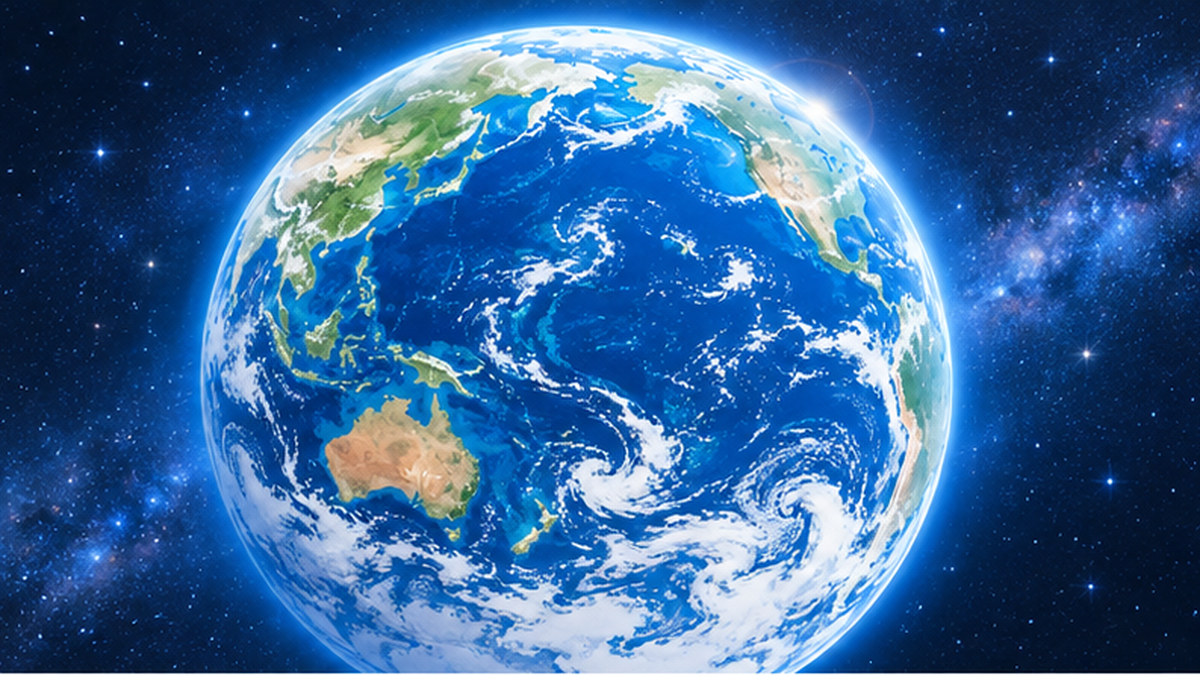
The ocean covers about 70% of Earth and supports our lives through climate, food and transport. The foundation for protecting and making good use of it is a concept called "ocean literacy."
Although Japan is surrounded by sea, opportunities to learn about it systematically at school have not been sufficient. In recent years, international frameworks and domestic grants have gradually changed the situation.
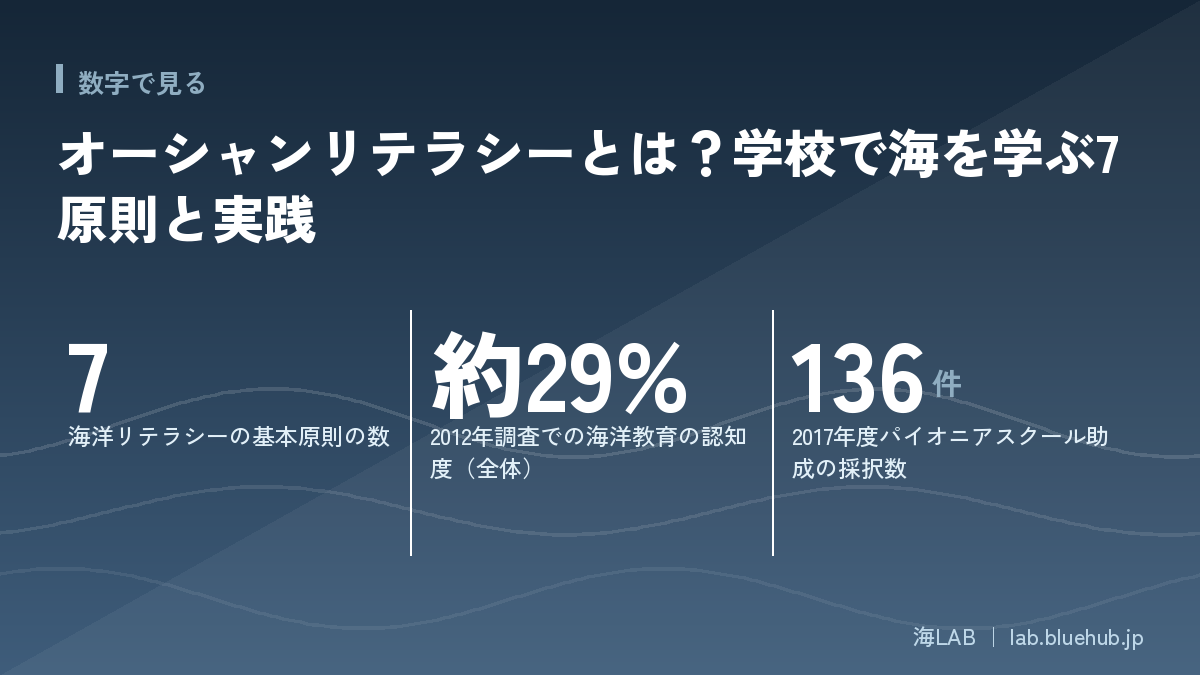
This article organizes, based on primary sources, the meaning of ocean literacy, the seven principles, developments in Japan and abroad, and practical examples for schools and households.
What you will learn
- Definition of ocean literacy and why it is needed
- Content of the seven IOC-UNESCO essential principles
- History and policy of ocean education in Japan
- Differences among initiatives worldwide
- Concrete practice at school, home and in the community
- Future challenges and what we can do
What Is Ocean Literacy? Understanding How the Ocean and People Affect Each Other
Definition: understanding the ocean's influence on you and your influence on the ocean
Put simply, ocean literacy is an understanding of the ocean's influence on you, and your influence on the ocean. The idea was developed in the United States in the 2000s by scientists and educators, and was later adopted as an international framework by the Intergovernmental Oceanographic Commission of UNESCO (IOC-UNESCO). It is not about knowing a lot of ocean facts; it includes being able to understand the ocean, communicate about it, and make responsible decisions.
For example, it means not only knowing what happens when sea surface temperature rises, but also using that knowledge to think about shopping, eating, voting and community activities, and being able to explain it clearly to family and friends. Understanding, communicating and deciding: when all three come together, we can call it literacy.
Why is ocean literacy needed now?
The ocean covers about 70% of Earth's surface and underpins our lives through climate regulation, oxygen, food, transport and tourism. Yet problems such as global warming, ocean acidification, plastic pollution, overfishing and habitat loss are caused by the accumulated activities of life on land. Ocean problems are not only problems of the sea; they are continuous with our daily lives.
Most ocean problems cannot be solved by experts or governments alone. Fishers, companies, schools and households each need to change their behavior with conviction, and the basis for that is society-wide understanding of the ocean. Education is also positioned as an essential means of achieving SDG 14, "Life Below Water."
Key points
- Ocean literacy = the ability to understand, communicate and judge how the ocean and people affect each other
- What matters is understanding that leads to action, not the quantity of knowledge
- Achieving SDG 14 requires society-wide understanding of the ocean
How it differs from similar terms: ocean education and environmental education
In Japan, terms such as "ocean education," "ocean literacy" and "marine environmental education" have been used in parallel. A helpful distinction: ocean education refers to the educational activities themselves, while ocean literacy refers to the target outcome that such education aims to build. Environmental education covers nature in general, whereas ocean literacy takes the ocean as its entry point and spans science, society, culture and economics.
A paper by researchers at the Tokyo University of Marine Science and Technology notes that in Japan there is no commonly agreed definition of "ocean literacy." Because usage varies among organizations and researchers, this article uses the framework presented by IOC-UNESCO as its baseline.
The Seven Essential Principles: A Shared "Map" for Ocean Learning
Background of the principles
At the core of ocean literacy are the seven Essential Principles of Ocean Literacy. They began when scientists and educators in the United States compiled what citizens should minimally understand about the ocean, around 2005. They then spread to classrooms in many countries and were introduced as an international framework in IOC-UNESCO's Ocean Literacy for All: A Toolkit (IOC Manuals and Guides, 80; 2017).
The Center for Ocean Education at the University of Tokyo translated this booklet into Japanese (published February 2020 with a grant from The Nippon Foundation), so teachers and citizens in Japan can consult it.
The seven principles at a glance
| Principle | Content (summary) | Connection to daily life |
|---|---|---|
| 1 | Earth has one big ocean with many features | The world's oceans are connected; coastal litter can travel far |
| 2 | The ocean and life in the ocean shape the features of Earth | Landforms, sediments and rocks are shaped by the sea |
| 3 | The ocean is a major influence on weather and climate | Typhoons, the rainy season, heat waves, Kuroshio meanders |
| 4 | The ocean made Earth habitable | Much of Earth's oxygen is thought to come from marine phytoplankton |
| 5 | The ocean supports a great diversity of life and ecosystems | Seafood, coral reefs, seaweed beds, deep-sea life |
| 6 | The ocean and humans are inextricably interconnected | Food, shipping, tourism, energy, disaster prevention, culture |
| 7 | The ocean is largely unexplored | The deep sea, unknown organisms, new observation technologies |
How to read the principles: not only science
Principles 1–5 mainly concern natural science (earth science, meteorology, biology), principle 6 concerns social science and the humanities (people's relationship with the ocean), and principle 7 concerns exploration and the future of science. The framework therefore spans science, social studies, language arts, home economics, moral education and integrated studies.
Each principle also comes with "Fundamental Concepts," detailed learning items that serve as a basis for deciding how far to teach at each grade or developmental stage.
Japan's Ocean Education Journey: From the Basic Act on Ocean Policy to the Curriculum Guidelines
A nation surrounded by sea, with few chances to learn about it
Japan is surrounded by ocean on all sides and, including its exclusive economic zone, holds one of the world's largest sea areas. Even so, opportunities to learn about the ocean systematically at school were limited. A paper from the Tokyo University of Marine Science and Technology describes a period when words containing "sea" almost disappeared from the Courses of Study from fiscal 1977, with limited coverage even in revisions after the Basic Act on Ocean Policy.
A 2012 nationwide survey involving The Nippon Foundation and the Ocean Policy Research Foundation (now the Ocean Policy Research Institute of the Sasakawa Peace Foundation) reported that awareness of ocean education was only about 29% overall, and that about 70% of school staff said they did not know about ocean education. Even in coastal areas, ocean lessons were not necessarily part of daily teaching.
The Basic Act on Ocean Policy and the Basic Plans on Ocean Policy
The Basic Act on Ocean Policy was enacted in 2007, creating a framework for comprehensive national ocean policy. Education became one pillar of the subsequent Basic Plans, and the Second Basic Plan on Ocean Policy (2013) called for enriching ocean-related education in elementary, lower-secondary and upper-secondary schools in line with the Courses of Study. Commentary notes that the Courses of Study announced in 2017 enriched ocean-related content, mainly in social studies.
Timeline of ocean education in Japan
- 2007: Basic Act on Ocean Policy enacted
- 2013: Second Basic Plan on Ocean Policy calls for enriched ocean education in schools
- FY2016: "Ocean Education Pioneer School Program" begins
- 2017: IOC-UNESCO publishes Ocean Literacy for All
- 2020: Japanese translation published by the University of Tokyo
- 2021–2030: UN Decade of Ocean Science for Sustainable Development
Pioneer Schools: building practice from the classroom up
In fiscal 2016, The Nippon Foundation, the University of Tokyo's Center for Ocean Education, and the Ocean Policy Research Institute of the Sasakawa Peace Foundation jointly launched the Ocean Education Pioneer School Program. It funds initiatives by elementary, lower- and upper-secondary and special-needs schools nationwide, and aims to collect and share the unit plans, lesson plans and curricula that result. In fiscal 2017, 136 activities with a total of about 87.93 million yen were selected.
The University of Tokyo center proposed three pillars for ocean education, "Life," "Environment" and "Security," and in 2019 published a guidebook for elementary and lower-secondary schools, Learning about the Sea at School.
Ocean Literacy Education Worldwide: The UN Decade and the EU
The UN Decade of Ocean Science and ocean literacy
The United Nations has designated 2021–2030 the UN Decade of Ocean Science for Sustainable Development, with IOC-UNESCO at the center of implementation. Raising public ocean literacy is listed as one pillar for delivering scientific results to society.
UNESCO materials also note that ocean literacy activities have shifted from a focus on STEM (science, technology, engineering and mathematics) teaching resources toward approaches tied to Education for Sustainable Development (ESD) since SDG 14.
Developments in Europe: EU4Ocean and Blue Schools
In 2021 the European Commission launched the "EU4Ocean" coalition, which spreads understanding of the ocean through networks of citizens, schools, businesses and young people. It includes a "Blue Schools" scheme for schools that take the ocean as a theme. Its design allows even inland schools to take part, a perspective useful for Japan as well.
Differences by country
Even on the same seven principles, countries handle them differently. A 2025 study analyzing science curriculum documents in China and the United States reported that both include content related to the seven principles, while also showing differences in emphasis and placement. It is natural that weighting changes with a country's distance from the sea, industrial structure and culture.
| Region / body | Main efforts | Characteristics |
|---|---|---|
| International (IOC-UNESCO) | Ocean Literacy for All; Ocean Decade | Made the seven principles a common international language |
| Europe (EU) | EU4Ocean coalition; Blue Schools | Network type spanning schools, citizens and companies |
| United States | Drafting the seven principles; grade-level scope and sequence | Framework built by scientists and educators together |
| Japan | Ocean Education Pioneer Schools; teaching materials | Spreading through grants and accumulated classroom practice |
Classroom Practice: Learning About the Ocean Across Subjects
Finding an entry point in each subject
Ocean literacy can be woven naturally into existing subjects without creating a new one. Below are examples of entry points by subject (details vary by school and grade).
| Subject | Ocean learning examples | Related principles |
|---|---|---|
| Science | Tides, seawater properties, plankton observation, climate and currents | 1, 3, 4, 5 |
| Social studies | Fisheries, ports and logistics, territorial waters and EEZ, disaster prevention | 6 |
| Japanese language | Sea-related literature and haiku, writing newspapers from interviews | 6 |
| Home economics | Ways of eating fish, seafood distribution, thinking about food loss | 5, 6 |
| Integrated studies | Local coast surveys, interviews with fishers, litter surveys | 1, 5, 6 |
| Art and music | Paintings of the sea, crafts from marine debris, sea songs | 6 |
What about inland prefectures and urban schools?
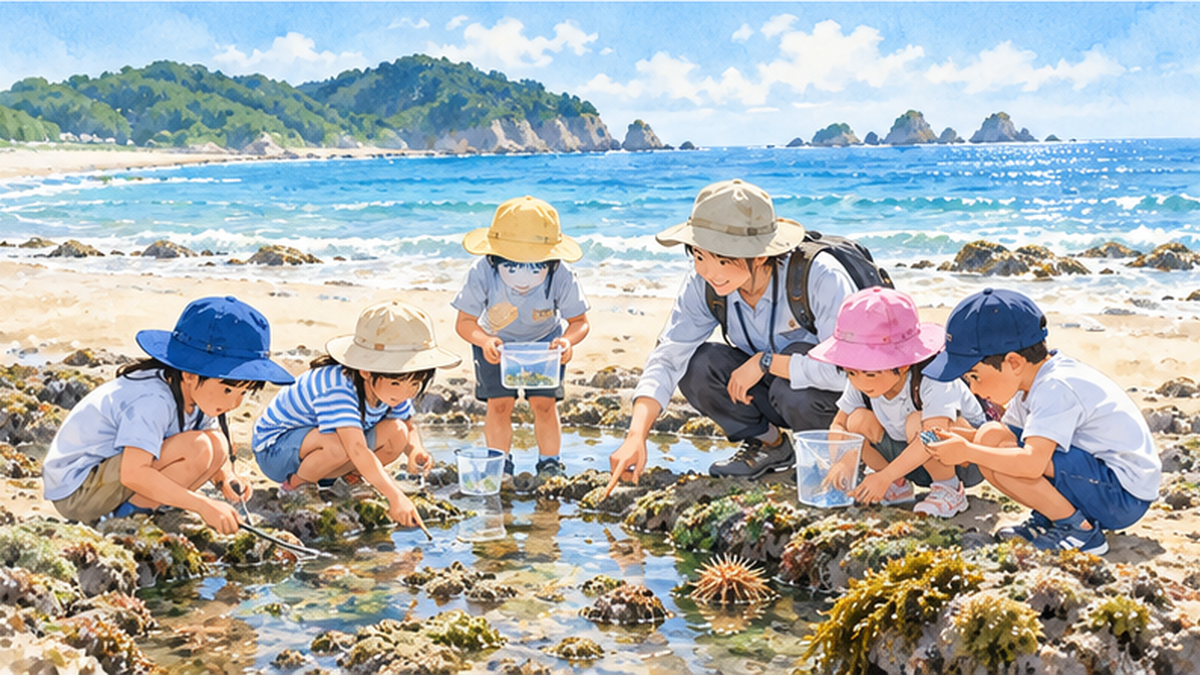
It is easy to think ocean learning is hard far from the sea, but rivers, rainwater, sewage, fish on the dinner table, plastic bottles and microplastics all connect to the ocean. Even inland schools can begin simply by tracing the flow of water. Partnerships with museums, aquariums, universities, fishery cooperatives and NPOs, as well as online lessons and specimen or video-based lessons, are effective.
Combining hands-on and digital learning
Direct experience of the sea greatly deepens understanding and memory, but safety, travel costs and weather impose limits. In recent years more schools have used public data from ocean research institutions, live cameras and environmental DNA survey results (see What Is Environmental DNA? How a Glass of Water Reveals Marine Life).
Inquiry-based learning: ask, investigate, act
School education now emphasizes posing your own questions, investigating, presenting and linking to action rather than only receiving answers. Ocean topics, where regional, generational and interest differences are visible, suit inquiry. Starting from familiar questions such as "What litter is most common on our town's coast?" or "Why have local fish catches declined?", students can gather data, interpret it and develop proposals.
Concrete Topics: Seaweed Beds, Biodiversity and Climate
Seaweed beds and blue carbon: how the ocean stores carbon
Blue carbon, in which seaweed beds and mangroves store carbon, is a good topic related to principle 3 (ocean and climate) and principle 5 (ecosystems). What Is Blue Carbon? How Mangroves and Seagrass Beds Store Carbon in the Sea, and Japan's Challenge explains the mechanism and domestic developments. In class, students can compare with land forests or investigate why seaweed beds decline.
Isoyake and food webs: feeling the links in an ecosystem
"Isoyake" (barren seabeds), where sea urchins multiply and consume all the seaweed, is a suitable topic for learning about food webs. Causes and Countermeasures for Isoyake and Why Are Sea Otters the Ocean's Keystone? use concrete examples to show how disruption of one part ripples through the whole ecosystem.
Japan's marine diversity: rediscovering your own area
Japan's seas, where the Kuroshio and Oyashio meet and an archipelago extends north to south, host diverse life. Why Are Japan's Seas Among the World's Most Biodiverse? offers background for reconsidering the local sea. Lessons can start from a local specialty or fish and ask why a certain species lives in this region.
Small first steps for lesson design
- Look up where local fish (school lunches or shops) come from
- Trace on a map where river and gutter water flows
- Sort beach litter and infer where it came from
- Request outreach lessons from fishery cooperatives, aquariums or universities
What Households, Communities and Companies Can Do: Learning Beyond School
At home
Ocean literacy is not built only at school. Talking at the table about where fish come from, what is in season and how it was caught, observing creatures while swimming or shell-gathering, or discussing a visit to an aquarium all lay a foundation. Sorting waste and reducing single-use plastic are also entry points to feeling that "my actions are connected to the ocean."
Communities, NPOs, aquariums and museums
Beach cleanups, fishing experiences and shore-life observation events run by local groups provide hands-on settings that schools alone cannot. Events are held around Marine Day (the third Monday of July) across Japan, and many welcome families.
The role of companies and government
Companies in fisheries, shipping, tourism, food and energy can offer learning opportunities through their own activities. Government can bridge boards of education, ocean-related institutions and researchers. Having a local "connector" between ocean policy and classrooms is important for sustaining efforts.
Using AI and digital tools
Efforts are spreading to use AI to answer ocean questions or create learning materials from the latest papers and reports. Because AI answers can contain errors, the habit of checking sources must be nurtured alongside; this too is part of modern ocean literacy (the ability to read information critically).
Challenges and Outlook: Measure, Connect, Sustain
Challenge 1: How to measure understanding
Ocean literacy includes knowledge, attitudes and behavior, so paper tests alone measure it poorly. Surveys of citizens have been conducted in Europe, and universities and organizations in Japan have built their own items. Without a common yardstick, it is hard to compare the effects of initiatives.
Challenge 2: Teacher workload and expertise
Introducing new ocean lessons requires time for material research and expert support. Teachers should not carry this alone; mechanisms for working with research institutions and local experts, and sharing ready-to-use lesson plans and materials, matter. Initiatives like the Pioneer Schools that collect and publish results help.
Challenge 3: Sustainability and regional gaps
Grant projects have fixed terms, and activities sometimes end when funding does. Gaps also tend to arise between areas near and far from the sea, and between municipalities with and without budgets and staff. Online materials and broad networks are expected to narrow these gaps.
Summary
- Ocean literacy is the ability to understand, communicate and judge how the ocean and people affect each other
- The shared international framework is the seven Essential Principles
- In Japan it has spread through the Basic Act on Ocean Policy, the Basic Plans and the Pioneer Schools
- Cooperation among schools, households, communities and companies over time is key
A first step we can take
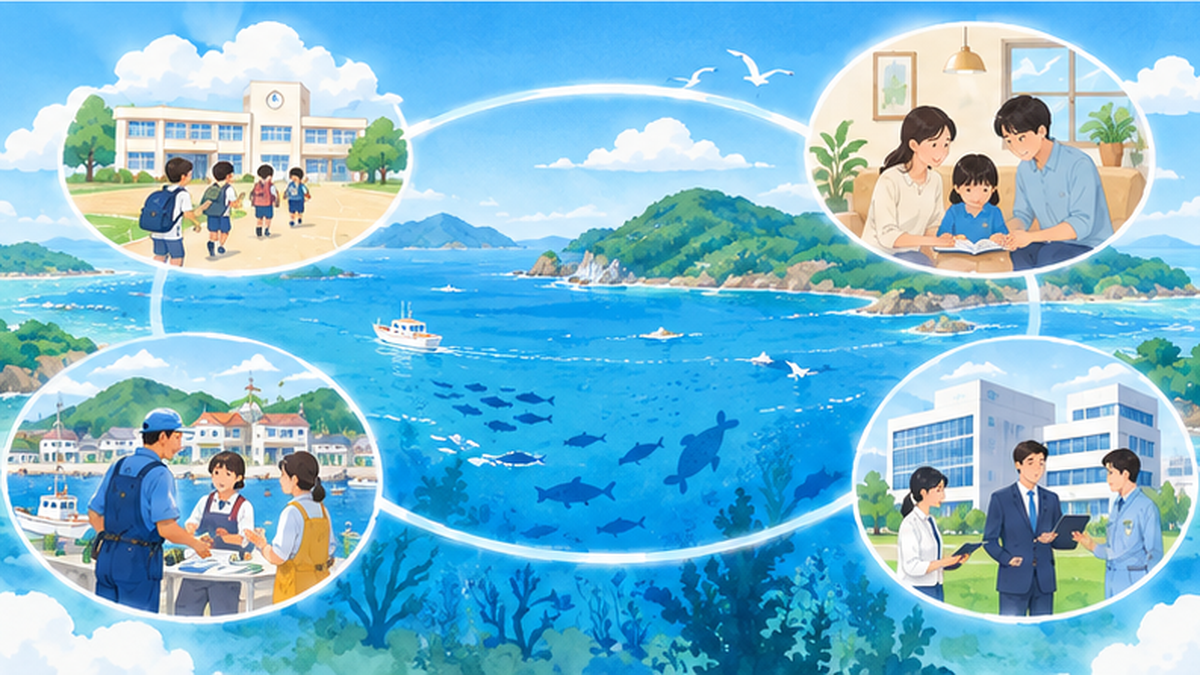
Start by finding one link between your life and the ocean: the fish you ate today, the plastic you used, the sea surface temperature in the weather forecast. Any of them is an entry point. Interest in the ocean spreading from one person to family, school and community is the surest path to rooting ocean literacy in society.
References and Sources
- IOC-UNESCO, Ocean Literacy for All: A Toolkit (IOC Manuals and Guides, 80) – Seven principles of ocean literacy and the international framework (2017)
- GCED Clearinghouse: Ocean Literacy for All overview – Overview of the booklet
- University of Tokyo: Ocean Literacy for All, Japanese translation (1st ed.) – Center for Ocean Education, February 2020
- Tokyo University of Marine Science and Technology research report (Katsumata) – The concept of ocean literacy in Japan and the Courses of Study
- Sasakawa Peace Foundation, Ocean Policy Research Institute: Ocean education – Pioneer Schools, etc.
- Ocean Education Pioneer Schools: FY2017 selected schools – Sasakawa Peace Foundation
- Cabinet Office, Secretariat of the Headquarters for Ocean Policy: ocean education materials – Survey on ocean education
- UN Ocean Decade (UNESCO-IOC) – 2021–2030
- EU4Ocean (European Commission) – Ocean literacy coalition
* Listed in order of reliability: government and academic institutions > peer-reviewed papers > specialist organizations > reliable media