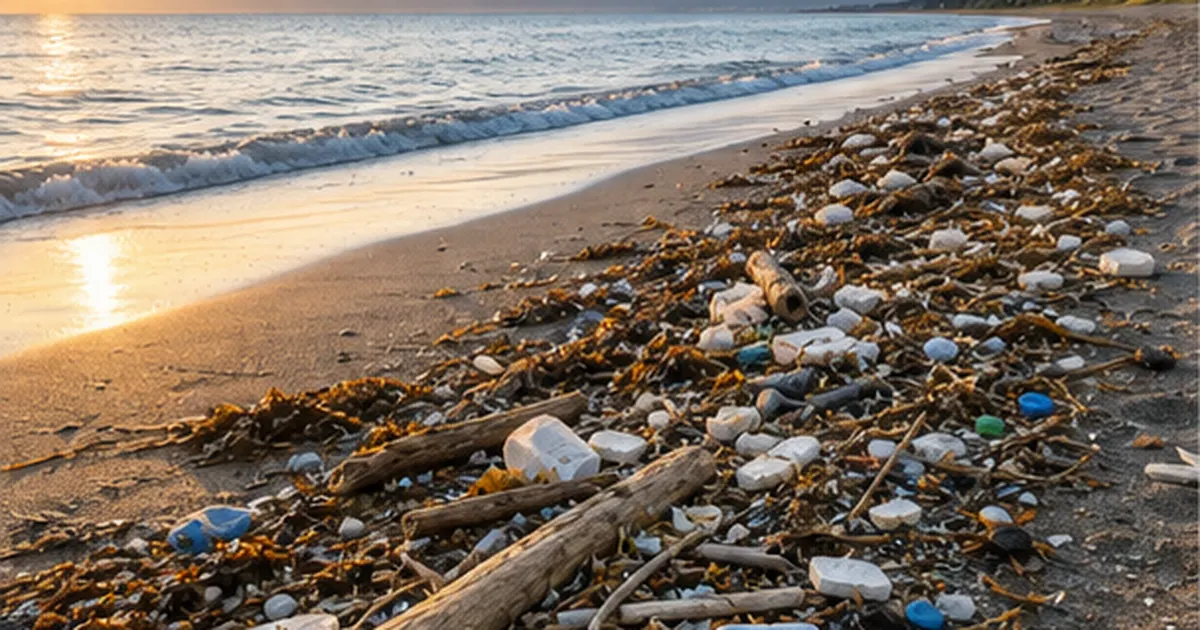
Plastic bottles and shopping bags washed up on the beach — most of them were not thrown away at sea, but travelled down rivers from towns far inland. According to Japan's Ministry of the Environment, 70–80% of marine litter originates on land, making rivers the main highway that carries plastic waste to the ocean.
A study published in 2017 estimated that 1.15–2.41 million tonnes of plastic flow from the world's rivers into the ocean every year. A 2021 study went further, showing that about 80% of that outflow comes from more than 1,000 rivers, and that small and mid-sized urban rivers — not just the great rivers — are the main sources. In other words, the familiar rivers in our own neighbourhoods are the "entrance" to the marine plastic problem.
Drawing on the latest research from around the world and Japan, this article lays out how plastic waste travels from rivers to the sea, explains the new strategy of "stopping it at the river," and shows what each of us can do starting today.
What you will learn in this article
- Why 70–80% of marine plastic litter originates on land, and the role rivers play
- The estimates from the two major studies (2017 and 2021) on riverine plastic emissions, and how to read them
- The reality of microplastic pollution in Japan's rivers and estimates of Japan's outflow
- The mechanism by which heavy rain carries plastic out to sea all at once
- Measures to "stop it at the river" in the world and Japan, and actions individuals can take today
Marine Plastic Litter Comes from the Land
When people hear "marine plastic problem," many picture waste dumped from ships or fishing gear lost at sea. In reality, however, most marine litter is generated on land. Japan's Ministry of the Environment explains that 70–80% of marine litter originates inland and flows to the sea via rivers and waterways.
Millions of tonnes flow from land to sea every year
The first study to quantify this problem on a global scale was published in the journal Science in 2015 by Dr. Jenna Jambeck of the University of Georgia and colleagues. Covering 192 coastal countries, it estimated that 4.8–12.7 million tonnes of land-based plastic waste entered the ocean in 2010 alone. The mid-range figure of "about 8 million tonnes a year" has been cited again and again in international discussions ever since.
Behind this lies the explosive growth of plastic production itself. According to the OECD (Organisation for Economic Co-operation and Development), global plastic production reached 460 million tonnes a year in 2019, nearly doubling in the roughly two decades since 2000. As production and consumption grow, so does the amount that escapes into the environment without proper treatment. Especially in regions where waste collection and recycling infrastructure has not kept pace with economic growth, some of the waste generated has nowhere to go and is washed into waterways by the rain.
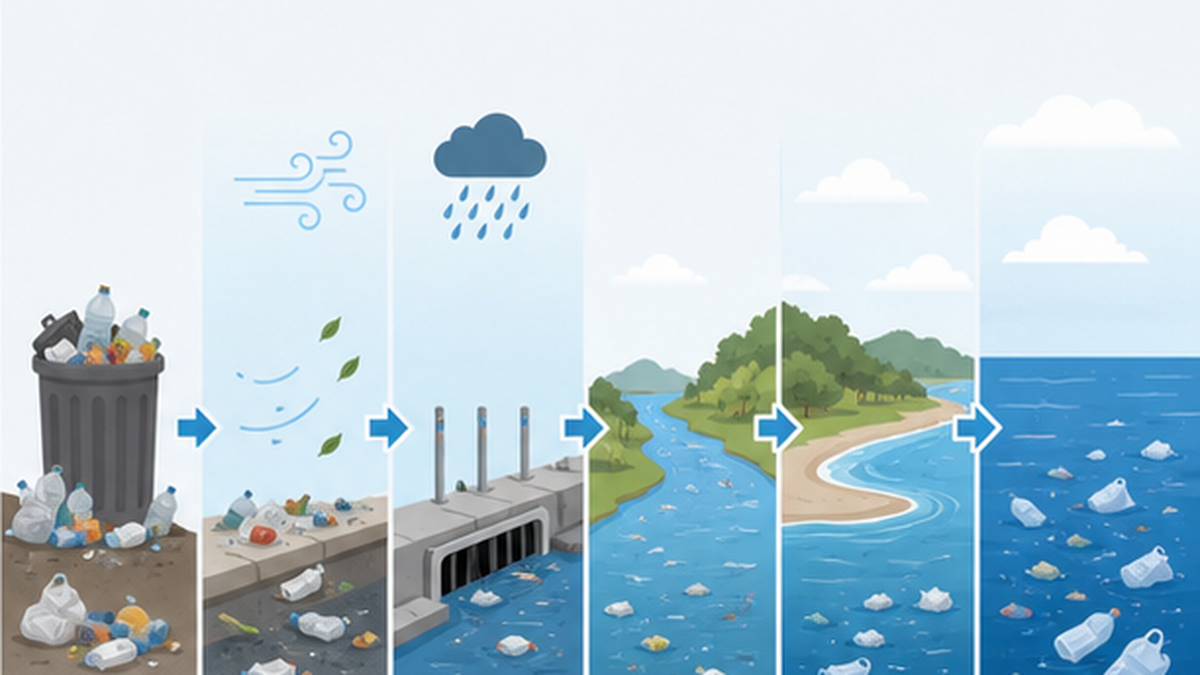
Why litter escapes even without littering
The important point is that deliberate littering is not the only source. Bags spilling out of collection points, containers left outdoors and blown away by the wind, light plastic fragments left on roads and at event venues — all of these are washed by rain into gutters and drainage channels, and eventually join a river. Because plastic is light and buoyant, once it rides the current it can travel long distances and ultimately reach the ocean.
Beach litter surveys in Japan likewise report many sites where everyday items such as plastic bottles, food containers and shopping bags make up the bulk of the debris. Most of the litter found on beaches was not dropped there by beachgoers; it is the accumulation of items that leaked, little by little, from life inland. It is tempting to think "I live far from the sea, so this has nothing to do with me" — but every gutter and irrigation channel ultimately connects to the ocean. Marine plastic is not a coastal problem; it is a problem for everyone who lives in a watershed.
Why plastic is so troublesome
Unlike paper or wood waste, plastic takes an extremely long time to break down in nature. It is light, so wind and water carry it far; many types float, so it rides river currents easily. And even when it shatters, it does not disappear — it lingers in the environment as ever-smaller fragments. "Easily transported, never gone" — the combination of these two properties means a single plastic bottle discarded inland can still be drifting in some ocean decades later. That is exactly why cutting off the flow close to the source — at the river stage — matters so much.
Key points
- 70–80% of marine litter originates on land (Ministry of the Environment)
- An estimated 4.8–12.7 million tonnes of land-based plastic entered the ocean in 2010 alone (Jambeck et al. 2015)
- Not just deliberate dumping — scattered litter carried by wind and rain is a major source
How Much Flows Out of the World's Rivers: Two Major Studies
So how much plastic actually flows out of the rivers that serve as the "corridor" from land to sea? Two landmark studies have tackled this question.
Study 1: 1.15–2.41 million tonnes a year, 67% from the top 20 rivers (2017)
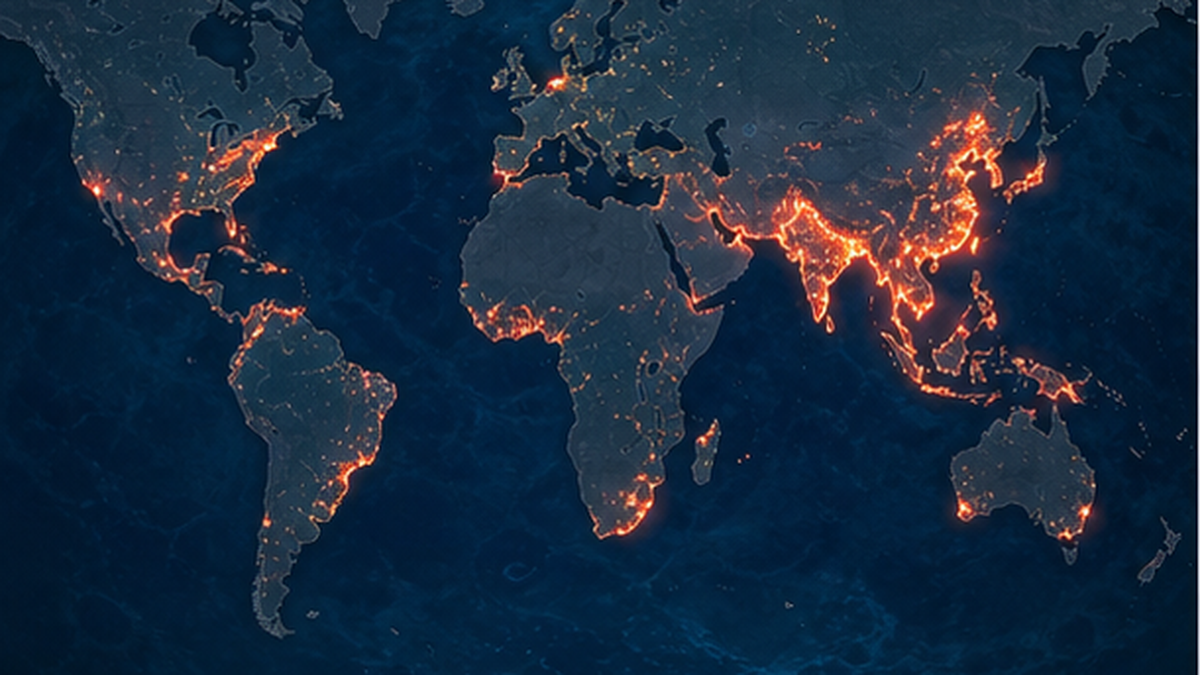
A study by Dr. Lebreton and colleagues, published in Nature Communications in 2017, used a global model based on waste-management data, population density and hydrology to estimate riverine plastic emissions to the ocean at 1.15–2.41 million tonnes per year. Most of the top 20 emitting rivers were concentrated in Asia, and those 20 rivers alone were estimated to account for 67% of the global total. The study also showed that 74% of emissions occur between May and October, meaning monsoon rainfall strongly drives the outflow.
Behind the concentration in Asia lies a structural issue: waste collection and treatment infrastructure has not kept up with rapid economic growth and population increase. Plastic consumption has expanded to developed-country levels, while waste left outside the collection network is flushed into rivers all at once by seasonal downpours. This pattern echoes the pollution problems Japan itself faced during its period of rapid economic growth. It is important to understand this not as a question of any country's morals, but as an infrastructure challenge that many countries confront at a certain stage of development.
Study 2: "80% from over 1,000 rivers" — the 2021 study that changed the picture
Four years later, a research team at the Dutch non-profit The Ocean Cleanup (Dr. Meijer and colleagues) published a study in Science Advances that substantially revised this view. After refining the model with more detailed geographic data and field observations, they estimated emissions at 0.8–2.7 million tonnes per year, with about 80% coming from more than 1,000 rivers. In contrast to the earlier view that a handful of great rivers dominated, pollution sources turned out to be spread across vastly more rivers — and small and mid-sized urban rivers flowing through densely populated areas emerged as the main emitters. The single largest source identified in the study was the Pasig River, which flows through Manila, the capital of the Philippines.
Why would small urban rivers outrank great rivers? There are two reasons. First, urban river basins concentrate both population and waste generation. Second, because these rivers are short and close to the sea, litter has fewer chances to get stranded on banks along the way — waste that enters them reaches the ocean with high probability. On a long river, much of the litter generated upstream settles along the way and never reaches the sea, whereas a short river through a coastal city becomes a "direct express from source to sea." This discovery transformed the approach to countermeasures: targeting only a few great rivers is not enough — action is needed in each and every urban river around the world.
| Study | Year & journal | Estimated annual emissions | Key findings |
|---|---|---|---|
| Lebreton et al. | 2017, Nature Communications | 1.15–2.41 million tonnes | Top 20 rivers account for 67%; 74% of emissions concentrated in May–October |
| Meijer et al. | 2021, Science Advances | 0.8–2.7 million tonnes | 1,000+ rivers account for ~80%; small and mid-sized urban rivers are the main sources |
The finding that "small and mid-sized urban rivers are the main sources" is far from irrelevant to those of us living in Japan. Most of Japan's big cities face the sea, with numerous short rivers threading through their urban areas into the bays. Dense population, short distance to the sea — precisely the conditions for high emission efficiency. Though they may be tiny dots on a world map, each river flowing into Tokyo Bay or Osaka Bay genuinely figures in the global marine plastic budget.
Why the estimates have such wide ranges
"1.15–2.41 million tonnes," "0.8–2.7 million tonnes" — both estimates carry wide ranges. That is because measuring the litter in every river on Earth is impossible, so researchers model emissions from data on waste management, land use, rainfall and wind. The ranges themselves reflect scientific honesty, and both studies agree on the conclusion that rivers are the main corridor for marine plastic. Note also that the "80% from over 1,000 rivers" figure from the 2021 study refers to 80% of riverine emissions — not 80% of all marine plastic. Grasping precisely what the numbers mean is the first step toward understanding the problem correctly.
Good to know
- The estimates are model-based and carry ranges, but both studies agree rivers are the main outflow route
- The 2021 study validated its model with field observations, showing sources spread across far more rivers than previously thought
- Smaller urban rivers have higher emission efficiency: dense populations and short distances to the sea
How Plastic Travels Down a River
Five steps from source to sea
- Generation: littering, spillage from waste collection points, materials left outdoors blowing away — plastic enters the outdoor environment
- Transport: carried by wind and washed by rain into roadside gutters and drainage channels
- Confluence: from gutters and channels into small rivers, then merging into the main stream
- Stranding and fragmentation: temporarily accumulating on riverbanks, in reed beds and at weirs, degrading under UV light and breaking into fragments
- Outflow: swept away all at once during high water, exiting the river mouth into the sea
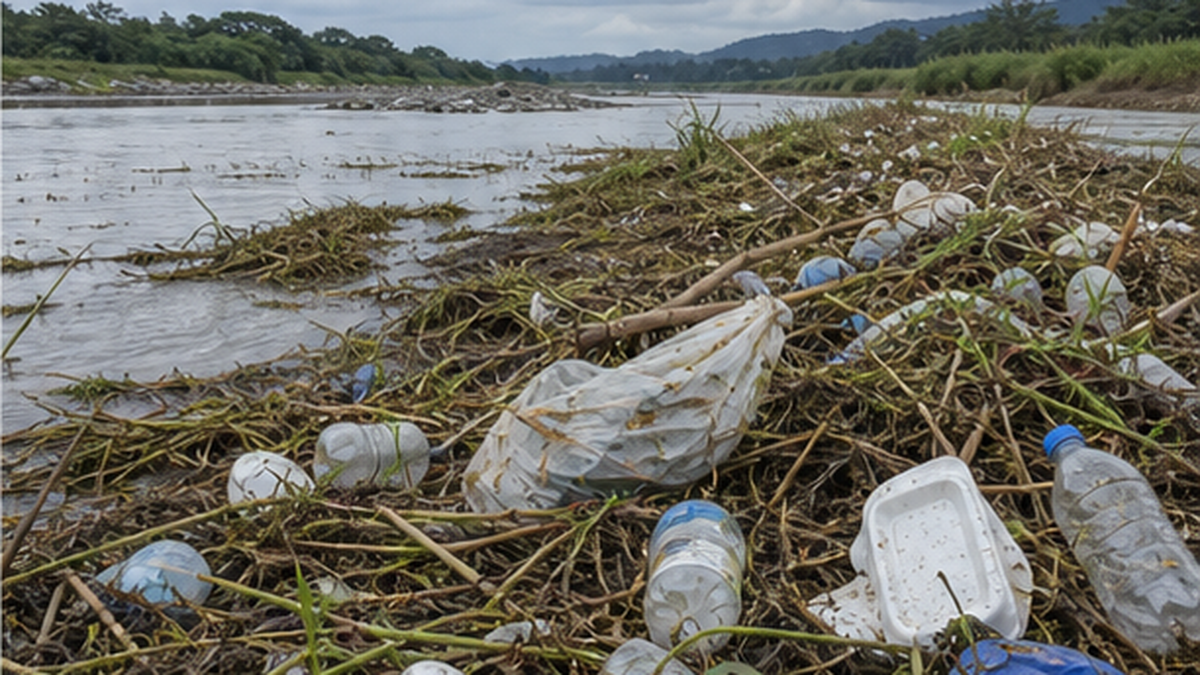
What deserves attention is that a river is not merely a "corridor" but also a "temporary depot." In normal conditions the flow is gentle, and most litter is caught in bankside grass, reed beds, around bridge piers and upstream of weirs. Walk along a river and you will often see shopping bags and plastic bottles tangled in the grass — that is litter that has not yet reached the sea, in effect a reserve army of marine litter. While it sits there, UV radiation keeps degrading the plastic, making it brittle and prone to shattering. The longer plastic stays in the river, the more likely it is to head out to sea already broken into small fragments that are far harder to recover.
Most rainwater flows to rivers untreated
You might assume that urban litter gets filtered out at sewage treatment plants — but that is not necessarily so. Japan's sewer systems come in two types: "separate" systems that carry sewage and stormwater in different pipes, and "combined" systems that share one pipe. In areas with separate systems, road runoff bypasses the treatment plant entirely and is discharged straight into rivers and the sea through storm drains. In other words, once rain washes litter and fragments off the street, they reach the river essentially unchecked. Even in areas with combined systems, when heavy rain exceeds treatment capacity, stormwater mixed with sewage can be released into rivers untreated. "Street litter becomes river litter when it rains" — internalising that is the first step in tackling sources.
Heavy rain triggers mass transport
One thing you cannot overlook in riverine plastic transport is the effect of heavy rain. A research group led by Professor Yasuo Nihei of Tokyo University of Science confirmed through field observations that plastic concentrations in river water rise dramatically as discharge increases during heavy rain. In research announced in February 2026, one of the rivers surveyed showed that about 90% of the annual transport of mesoplastics (fragments roughly 5 mm to a few centimetres) was concentrated in just 43 days of storm-driven high water.
This is consistent with the global research. Dr. Lebreton's study likewise found that 74% of global riverine emissions occur in the rainy months of May to October. In calm weather a river quietly stockpiles litter, and with each typhoon or downpour it disgorges the accumulated load into the sea all at once — that is the true picture of plastic transport by rivers.
Indeed, across Japan, after typhoons and torrential rains, large amounts of plastic litter repeatedly wash up with driftwood on beaches near river mouths and inside bays. Beach-cleanup veterans even say "the days after heavy rain are the crunch time." This "stockpile in calm weather, mass-release at high water" behaviour offers an important hint for timing countermeasures: clearing litter from riverbanks before the rainy season and typhoon season is the most efficient way to prevent outflow.
Points of caution
- After typhoons and heavy rain, large amounts of litter tend to wash up on riverbanks and beaches
- Picking up riverbank litter before high water acts as "prevention," stopping outflow to the sea
- However, entering riverbanks during or right after high water is dangerous — clean up only after levels have fully receded
The Reality in Japan: Microplastics in Familiar Rivers
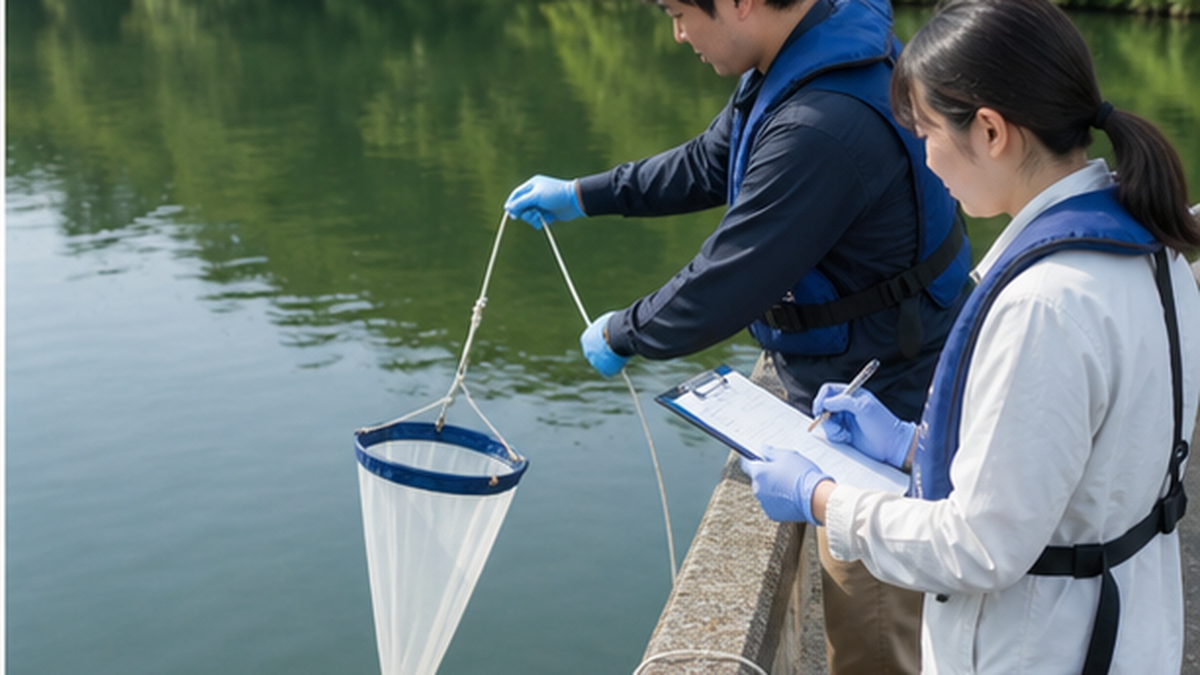
It is tempting to assume riverine plastic outflow is "a problem for developing countries in Asia" — but Japan is no exception. Since 2015, the group led by Professor Nihei at Tokyo University of Science has been conducting field surveys of microplastics (plastic fragments under 5 mm) at 90 sites on 70 rivers nationwide, documenting the pollution in Japan's rivers.
How much flows out of Japan into the sea?
In the high-resolution 1-km-grid map of plastic emissions across Japan that the group published in 2020, total plastic emissions from Japan's land area into the ocean were estimated at 210–4,776 tonnes per year. Emissions were highest in heavily populated urban areas such as Tokyo, Osaka and Nagoya — confirming in Japan the global pattern that the more people live in a watershed, the greater the outflow.
The Ministry of the Environment, meanwhile, estimates Japan's outflow using two methods: a bottom-up approach by source and item, and an approach based on macro statistics. Its fiscal 2023 review put the figures at 11,000–27,000 tonnes per year by the bottom-up method and 2,300–24,000 tonnes per year by the macro-statistical method. The ranges vary with methodology, but Japan too appears to send thousands to tens of thousands of tonnes of plastic into the sea every year.
| Estimating body | Method | Estimated annual outflow |
|---|---|---|
| Tokyo University of Science (Nihei laboratory) | Emission map based on measurements in 70 rivers nationwide (published 2020) | 210–4,776 tonnes |
| Ministry of the Environment | Bottom-up estimate by source and item (FY2023) | 11,000–27,000 tonnes |
| Ministry of the Environment | Estimate from macro statistics (FY2023) | 2,300–24,000 tonnes |
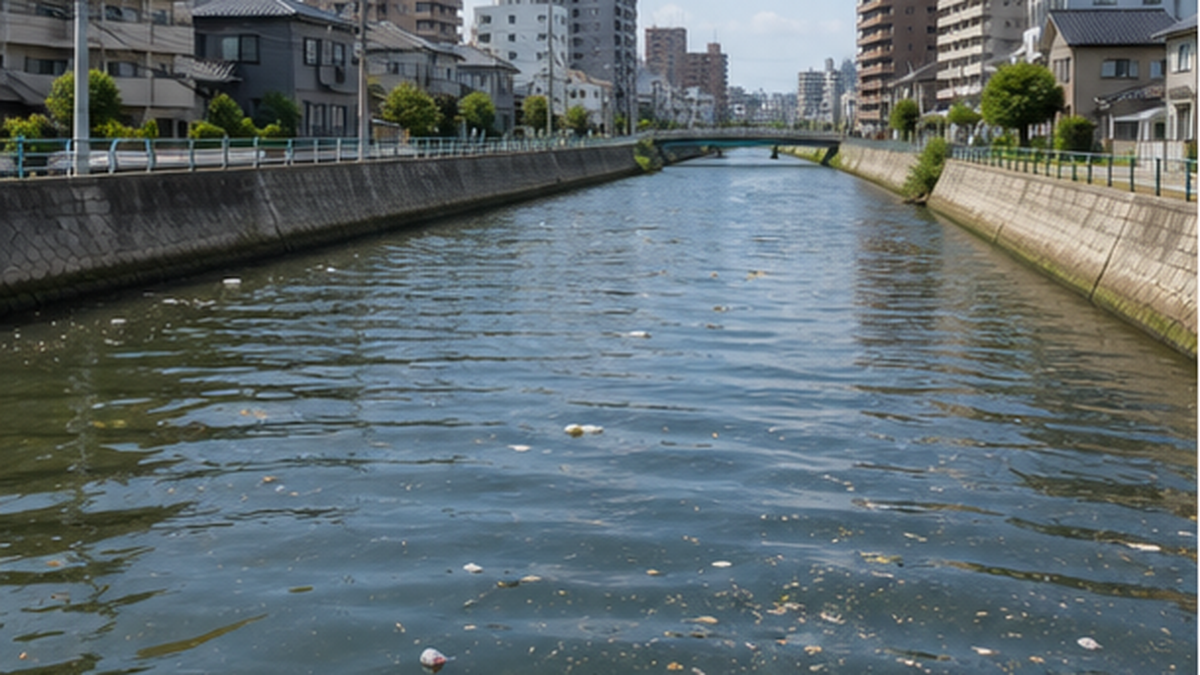
Compared with the global scale of one to two million tonnes a year, Japan's outflow may look small. Japan has high waste-collection rates and well-developed waste-management infrastructure, so the great majority of waste is properly processed. Even so, the small fraction that slips through the collection net accumulates into thousands to tens of thousands of tonnes a year. Japan is also one of the world's largest consumers of plastic, ranking near the top globally in per-capita packaging-plastic waste. The fact that "even a country with solid infrastructure leaks this much" underscores the importance of reducing plastic at the source itself.
Microplastics found in almost every river surveyed
The nationwide surveys have detected microplastics at the majority of sites, in cities and rural areas alike. The sources go beyond fragmented litter: turf infill from artificial sports pitches, plastic capsules from coated fertilisers used on farmland, and synthetic fibres shed from clothing with every wash, among others. Pollution in Japan's rivers, in other words, is caused not by any particular "villain" but arises as the sum total of our everyday lives.
Surveys that map this reality watershed by watershed are also under way. Under the Nippon Foundation's "Umi to Nippon Project" (The Ocean and Japan Project), surveys have been conducted in river basins across four prefectures on the Seto Inland Sea with the aim of reducing marine plastic, tracing where river litter originates and how it moves toward the sea. Once we know, river by river, "what kind of litter comes from where," countermeasures can target the sources precisely instead of picking up litter at random.
Stop It at the River, Save the Ocean: Global Challenges
Recovering plastic once it has dispersed across the open ocean takes enormous cost and effort. Rivers, by contrast, are narrow and their litter pathways predictable, so stopping plastic at the river before it reaches the sea is far more efficient. Measures built on this idea are spreading rapidly around the world.
The Ocean Cleanup's "Interceptor"
The flagship example is the "Interceptor," a river cleanup system developed by the Dutch non-profit The Ocean Cleanup. A solar-powered device that uses the river's current to guide litter along a float barrier onto a conveyor for automatic collection, it is said to be capable of recovering up to about 100 tonnes of litter per day under the right conditions. Interceptors have been deployed on heavily polluted rivers around the world — in Indonesia, Malaysia, Vietnam, the Dominican Republic, Guatemala, Los Angeles in the United States, Thailand and elsewhere.
The organisation is best known for its offshore cleanup of the Pacific "garbage patch," but as its work progressed it concluded that collecting at sea could never keep up — the inflow itself had to be cut off — and pivoted decisively to rivers. The "80% of emissions from 1,000+ rivers" research described above was carried out by the organisation's own research team precisely to identify which rivers would yield the greatest impact per device. Let science set the priorities, then tackle the most polluted rivers first — a rational approach for taking on a planetary problem with limited funds.
See this initiativeRivers • The Interceptor | The Ocean CleanupOfficial page of the international NPO that installs "Interceptor" cleanup systems on the world's most plastic-polluted rivers, recovering litter before it reaches the sea.🔗 theoceancleanup.com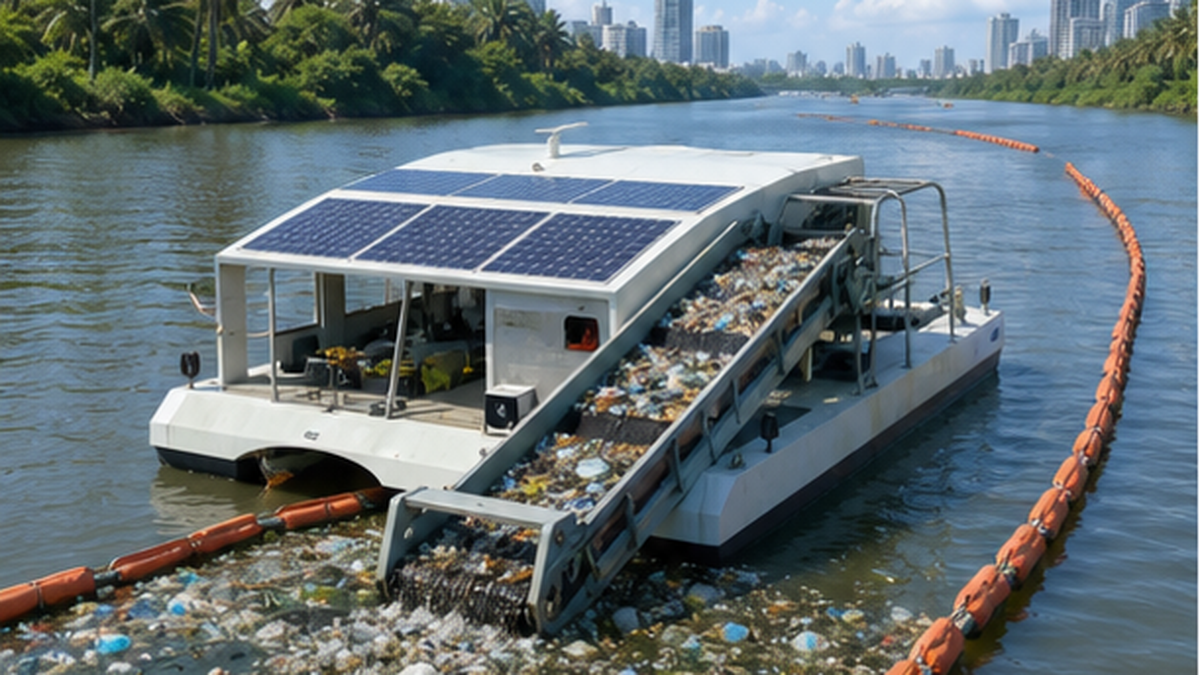
River-interception systems around the world
- Float barriers (boom type): a floating line across the water that halts litter and guides it to the bank for collection; easy to introduce on smaller rivers
- Litter traps (net or basket type): mesh devices at the outlets of drainage channels and tributaries that catch litter as it flows past
- Cleanup vessels: patrol harbours and river mouths, scooping up floating debris
- Storm-drain filters: filters installed in urban catch basins that stop litter at the gutter stage
In Japan too, surface-cleaning vessels operated by the national government and port authorities collect floating debris in harbours and river mouths, while local governments, companies and NPOs are trialling float barriers and litter traps on rivers around the country. Device-based collection is more sustainable than manual labour and has the added value of generating data on what kinds of litter flow past, and in what quantities. Pursuing collection and research together also provides a "yardstick" for measuring how well upstream source-reduction measures are working.
Good to know
- Collection is overwhelmingly more efficient in rivers than at sea
- Collection devices treat the symptoms; the fundamental cure is source reduction — building a society that does not leak waste
- Design must extend to the processing and recycling of what is collected
Japan's Measures: Surveys, Cleanups and Source Reduction
National and local government initiatives
To track the volume and composition of litter flowing from inland through rivers to the ocean over time, the Ministry of the Environment has produced survey guidelines and casebooks for river litter, supporting surveys by local governments. Marine plastic policy tends to be associated with beach cleanups, but its centre of gravity is steadily expanding "upstream."
Japan has also pushed land-side measures, including rivers, in international frameworks. At the G20 Summit held in Osaka in 2019, leaders shared the "Osaka Blue Ocean Vision," which aims to reduce additional pollution from marine plastic litter to zero by 2050, setting a direction for countries to improve waste management and prevent leakage. With emission sources scattered across the world's rivers, such international coordination and the upgrading of each country's own waste management are two wheels of the same cart.
Citizens protecting the river: 30 years of cleanups on the Arakawa
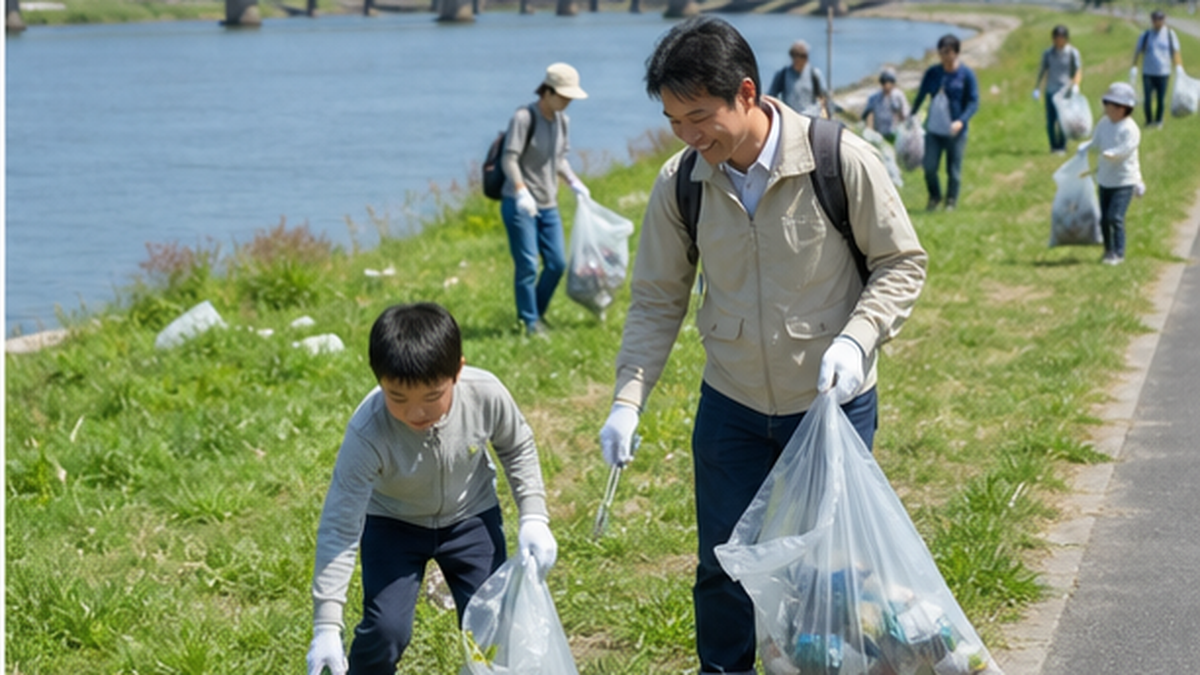
The pioneer of citizen river cleanups in Japan is "Arakawa Clean Aid" on the Arakawa River, which flows through Tokyo and Saitama. Running since 1994, the activity is distinguished by "investigative litter picking" — recording the types and numbers of items while collecting them — and the accumulated data has informed source countermeasures and policy proposals. Riverbank litter is the "reserve army of marine litter" that will flow out with the next flood; cleaning up along rivers is marine plastic action in the most direct sense.
Join the activityArakawa Clean Aid ForumA citizen-participation litter cleanup running in the Arakawa basin since 1994. By picking litter while surveying it, the group identifies sources and drives waste reduction across the watershed.🔗 cleanaid.jpSuch citizen action is spreading nationwide. Many municipalities have enacted anti-littering ordinances and introduced "adopt" programmes, in which residents and companies take ongoing responsibility for cleaning and beautifying designated stretches of road or riverbank, nurturing community systems that watch over local rivers. And the significance of cleanups goes beyond removing litter: people who have actually picked up litter from a river become far more conscious about not producing it. Hands-on experience is the surest path to the fundamental solution — reducing waste at the source.
Actions you can start today
- Search for a local river cleanup (Clean Aid, river beautification events and the like) and take part
- Try "plogging" — picking up litter while walking or jogging
- Record and share the types of litter you collect, as a prompt for thinking about sources
Why "Stopping It at the River" Is So Decisive
Plastic countermeasures come in three stages — reduce generation, stop it at the river, recover it at sea — and the river is the cost-effective "last line of defence" among them. The reason: once plastic reaches the sea, recovery becomes nearly impossible.
Once at sea, dispersal, sinking and fragmentation begin
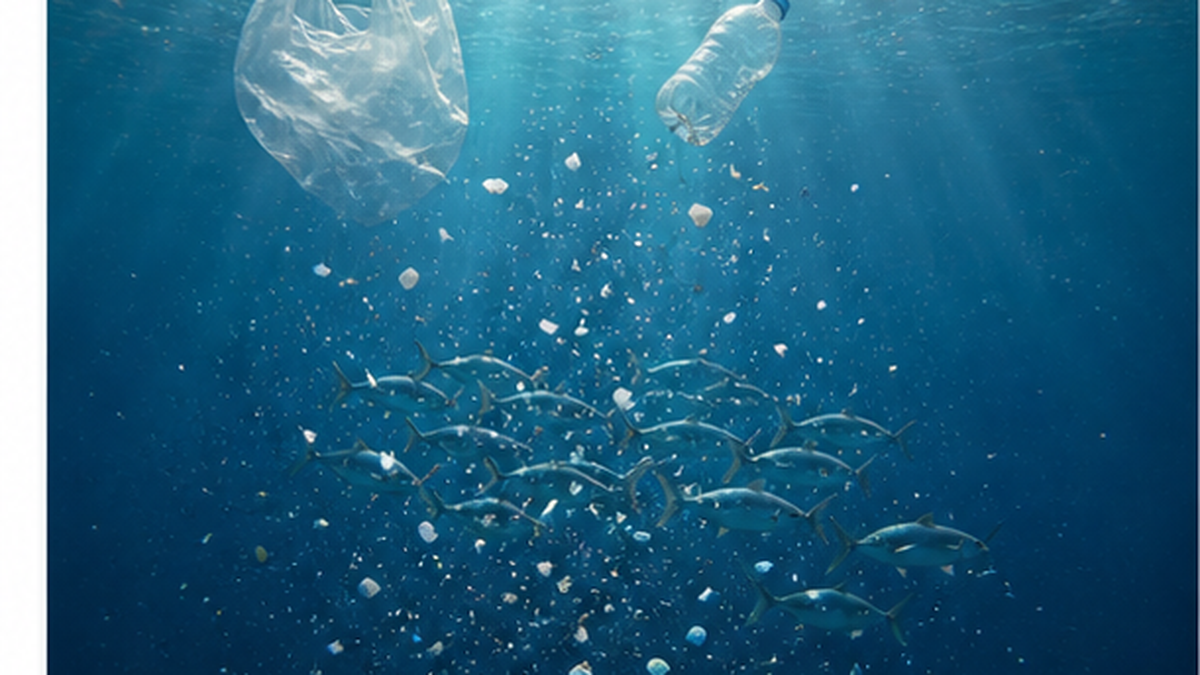
Plastic that reaches the sea rides the currents, dispersing across vast areas and degrading into countless fragments. How plastic broken down by UV light and wave action changes over time is covered in detail in our article "How Does Plastic Break Down in the Ocean?" — but once it becomes microplastic, no realistic method exists with current technology to recover it from the sea.
Moreover, these fine particles enter the food chain and, researchers point out, can reach the human body through seafood. The latest research on health effects is covered in "Microplastics and Human Health," and the reality of litter that sinks from the surface to its final destination in the deep sea in "Deep-Sea Plastic Pollution." Read together, they bring the meaning of stopping plastic at the river into sharper, more three-dimensional focus.
Harm to marine life begins as soon as plastic flows out
The impact of plastic entering the sea from rivers begins even before it fragments. Sea turtles swallow plastic bags they mistake for jellyfish; seabirds feed drifting plastic fragments to their chicks; marine mammals are injured by bags and cord entangling their bodies — harm from ingestion and entanglement has been reported extensively across the world's oceans. River mouths and coastal waters are also the "cradle of the sea," where many fish spawn and juveniles grow. Litter from rivers arrives first in precisely these most delicate places.
Turning off the tap
When a bathtub is overflowing, the first thing to do is not to mop the floor but to turn off the tap. In the marine plastic problem, that tap is the river. As global research has shown, emission sources are scattered across countless rivers worldwide — which is exactly why each country and each region taking responsibility for its own rivers is the shortest route to protecting the ocean as a whole.
Key points
- Plastic that reaches the sea disperses, sinks and fragments, making recovery nearly impossible
- Rivers are narrow with predictable flows — the cost-effective "last line of defence" for collection
- Because sources are spread across countless rivers, action on your local river connects to the world's oceans
Conclusion: Your Local River Is the Front Line for the Ocean
As we have seen, the main battleground of the marine plastic problem is not the open ocean but our own towns and the rivers that run through them. Global research shows that emission sources are spread across countless rivers. Turned around, that means if each of us keeps doing what we can in our own watershed, global emissions will surely fall. No special technology or major investment is needed — there are actions you can start today.
Five everyday actions
- Keep waste out of the wind and rain: follow garbage-day rules and never leave waste or light plastic items outdoors
- Cut single-use plastics: reusable bottles and bags shrink the source itself
- Join river and street cleanups: picking up riverbank litter is a reliable way to stop marine litter "before it leaves"
- Stay alert on rainy days: remember that gutters and channels connect to rivers and the sea, and don't walk past street litter
- Learn and share: tell family and friends that 70–80% of ocean litter comes from the land
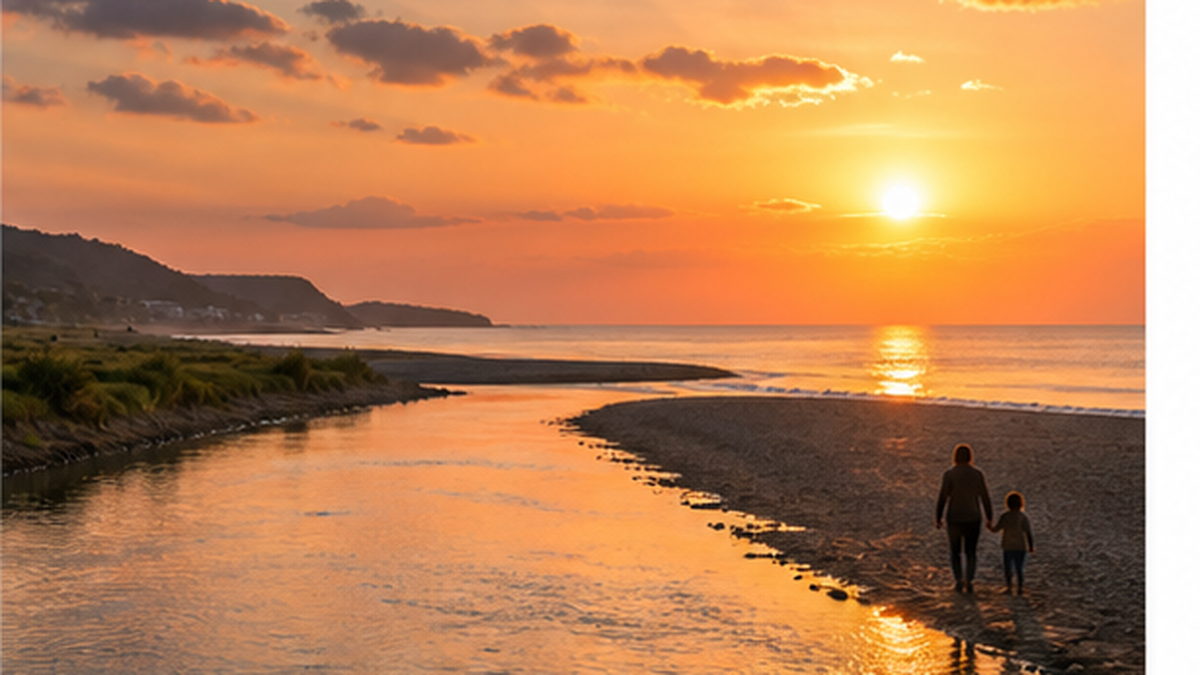
Rivers are the Earth's blood vessels, linking mountains, towns and the sea. May what rides their currents be rich nutrients and living creatures, not litter — and that is no unreachable ideal. The data has shown us the scale of the problem, and also exactly where to intervene. Picking up one piece of litter from the riverbank before the next rain — that small act connects directly to protecting the sea turtles and whales of distant oceans.
Summary of this article
- 70–80% of marine litter originates on land and flows to the sea through rivers (Ministry of the Environment)
- Global riverine emissions are estimated at 1.15–2.41 million tonnes a year (2017 study) or 0.8–2.7 million tonnes (2021 study)
- The 2021 study found 1,000+ rivers account for about 80% of the outflow, with small and mid-sized urban rivers the main sources
- In Japan too, surveys of 70 rivers nationwide have widely detected microplastics, with annual outflow estimated at thousands to tens of thousands of tonnes
- Plastic transport concentrates during heavy rain — riverbank cleanups before high water are effective "prevention"
- Once at sea, recovery is nearly impossible; "stopping it at the river" is the cost-effective last line of defence
References & Sources
- Ministry of the Environment, Japan – Estimates of marine plastic litter outflow from Japan (FY2023 review)
- Ministry of the Environment, Japan – Survey guidelines and materials on marine plastic litter (river litter surveys)
- Lebreton et al. (2017) Nature Communications – River plastic emissions to the world's oceans (global riverine emission estimates)
- Meijer et al. (2021) Science Advances – More than 1000 rivers account for 80% of global riverine plastic emissions into the ocean
- Jambeck et al. (2015) Science – Plastic waste inputs from land into the ocean (land-based input estimates)
- Tokyo University of Science – High-resolution 1-km-grid map of plastic emissions across Japan (2020)
- Tokyo University of Science – Revealing plastic transport in rivers during heavy rain (2026)
- The Ocean Cleanup – Rivers • The Interceptor (river cleanup initiative)
- UNEP (United Nations Environment Programme) – Riverine plastic pollution
- Arakawa Clean Aid Forum – Citizen-participation cleanup and survey activities in the Arakawa basin (since 1994)
* Ordered by reliability: government and academic institutions > peer-reviewed papers > specialist organisations > trusted media