⚡ The answer in 30 seconds
- Ministry of the Environment survey (2015): municipalities that tracked leftovers reported an average leftover rate of 6.9%, and about 17.2 kg of food waste per pupil per year.
- Leftovers stem mainly from short eating time, portions that do not match appetite, taste and smell, food that is hard to eat, and the classroom setting.
- Local ingredients, fish menus, visible leftover data and food education help; the goal is gratitude and self-managed portions, not forced plate-cleaning.
Leftover school lunch is one front line of Japan's food loss problem, and also a daily classroom in which children learn what it means to waste or not waste food. Using figures from official surveys, this article looks at why food is left over and how it can be reduced.
According to a Ministry of the Environment survey, municipalities that tracked their leftover rate reported an average of 6.9%, and about 17.2 kg of food waste was generated per pupil per year. Yet only about 30% of municipalities were measuring leftovers at all, which shows that simply “measuring” is a major challenge.
We then cover local sourcing, fish-based menus, food and environmental education, and ideas from the field, and finish with what families and communities can do. Rather than pressuring children to finish everything, the aim is to nurture gratitude for food and the ability to judge a suitable portion.
What You Will Learn
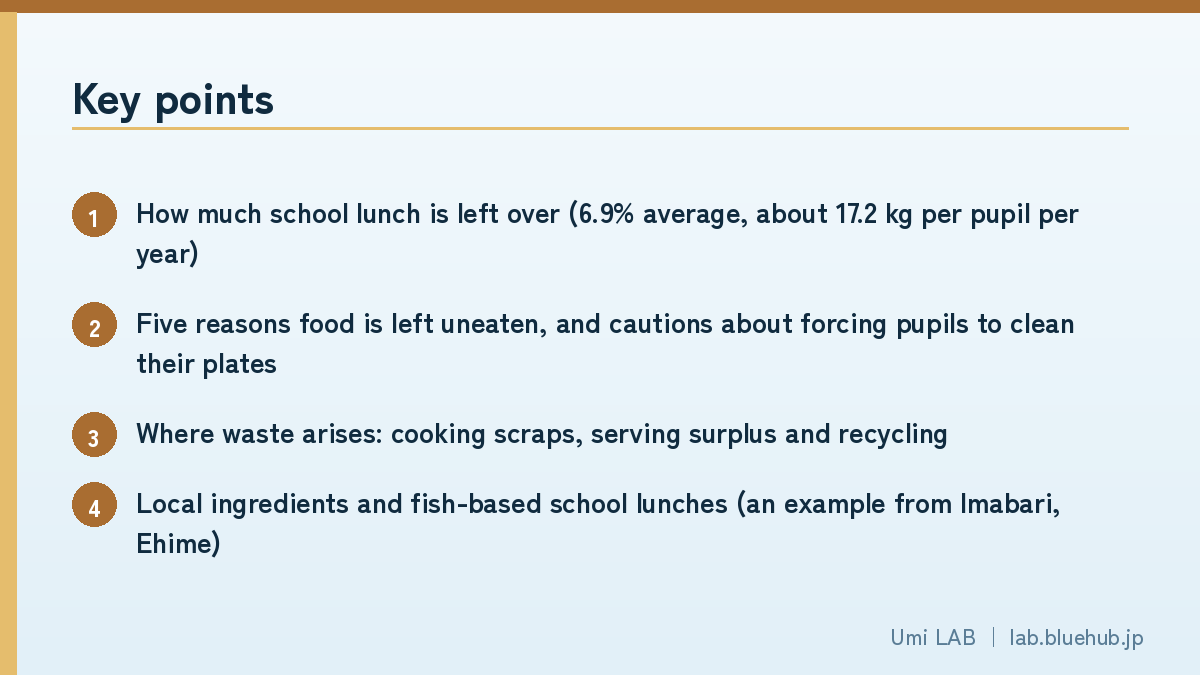
- How much school lunch is left over (6.9% average, about 17.2 kg per pupil per year)
- Five reasons food is left uneaten, and cautions about forcing pupils to clean their plates
- Where waste arises: cooking scraps, serving surplus and recycling
- Local ingredients and fish-based school lunches (an example from Imabari, Ehime)
- Food education, environmental education and practical reduction ideas
- What families and communities can do
How Much School Lunch Is Left Over? A Look at the Numbers
School Lunch Is Part of Japan's Overall Food Loss
According to estimates by the Ministry of the Environment and the Ministry of Agriculture, Forestry and Fisheries, Japan's food loss in FY2023 was about 4.64 million tonnes: roughly 2.33 million tonnes from households and 2.31 million tonnes from business activities. That is about 80,000 tonnes less than the 4.72 million tonnes of FY2022, but a gap remains to the government's FY2030 targets (a 50% cut for households and a 60% cut for businesses, both from the FY2000 level).
School lunch is included in part of this business-related food loss. It runs on a system unlike homes or restaurants: a large number of meals prepared at once at a fixed time every day. That gives leftovers a pattern of their own. This article checks the reality of leftover school lunch against official survey figures, and considers why food is left over and how to reduce it, including the perspectives of local sourcing and fish-based school lunches.
What the “Leftover Rate” Measures
The figure most often used when discussing leftover school lunch is the leftover rate (zanshoku-ritsu). It is the share of food left uneaten relative to the amount prepared for the number of pupils present. For example, if rice for 100 people is prepared and the equivalent of 6 portions is left, the leftover rate for rice is 6%.
Note that the leftover rate varies greatly by dish and by day. Many schools and municipalities report that it is low on days with popular curry or fried food, and tends to be higher on days with soups, dressed salads and fish dishes. Looking only at a term-long average hides these day-to-day swings.
What the Ministry of the Environment Survey Shows
The Ministry of the Environment, with the cooperation of the Ministry of Education, Culture, Sports, Science and Technology (MEXT), surveyed municipal boards of education nationwide about food loss from school lunches and published the results. The survey was carried out in January 2015 with a response rate of about 80%. The main figures that can be read from it are shown below.
| Item | Result (approximate) |
|---|---|
| Annual food waste generated per pupil | ≈17.2 kg (FY2013) |
| Municipalities that tracked their leftover rate | About 30% |
| Average leftover rate among those municipalities | ≈6.9% |
| Recycling rate of food waste | ≈59% (about 40% turned into fertilizer, about 18% into animal feed) |
| Municipalities taking steps to cut leftovers (improved cooking methods, menu changes) | About 70% of municipalities |
| Municipalities running food or environmental education to cut leftovers | About 65% of municipalities |
What stands out is that only about 30% of municipalities were tracking their leftover rate. If you do not measure, you cannot tell whether leftovers are shrinking or growing. The survey shows that the first step in reduction is to make leftovers visible.
Note the age of the data
The Ministry of the Environment survey introduced here dates from January 2015. Since then, efforts to reduce food loss in school lunches have spread, and in March 2023 MEXT published a research report titled “Research on Reducing Food Loss in School Lunches.” For the latest figures, please check the MEXT report and the publications of your own municipality or board of education.
Leftovers Are Not the Only “Loss” in School Lunch
Food waste from school lunches includes not only leftovers left by pupils, but also cooking scraps generated during preparation (vegetable peels and stems, fish bones and skin) and surplus from serving. In MEXT-related estimates, food loss in school lunches is said to be in the tens of thousands of tonnes a year, and leftovers are often described as accounting for roughly 40% of it. Looking at leftovers alone therefore shows only about half of the picture.
In the following chapters, we first look at why leftovers occur, then at losses in the cooking stage, local ingredients and fish-based menus, food education, and finally what families can do.
Why Is School Lunch Left Over? Five Reasons
Reason 1: Not Enough Time to Eat
In many schools, lunchtime including serving and cleaning up fits into about 40 minutes, and the time actually spent eating can be only half of that. For pupils who talk while eating or eat slowly, lack of time is the most direct cause of leftovers. Studies and municipal reports on leftover amounts also list securing enough time to eat as a factor that affects leftovers.
On days when time runs short, soups and side dishes often come back untouched. Pupils start with the staple and main dishes that require the most bites, and whatever is left for last becomes too much to finish.
Reason 2: Portions Do Not Match Appetite
School lunch portions are set according to nutritional standards for each grade. But even within one grade, there are large individual differences in build, activity level and condition on the day. Some pupils on sports teams want larger servings, while others have skipped breakfast, have no appetite or simply eat little. When everyone gets the same amount, some children inevitably get too much while others get too little.
Reason 3: Dislike of Taste, Texture or Smell
Foods children dislike are said to cluster around bitter vegetables, the smell and bones of fish, and distinctive textures such as hijiki seaweed and konnyaku. Taste preferences also change with experience, so leftovers rise when unfamiliar dishes appear or when an ingredient rarely served at home is on the menu.
Reason 4: Menu Combinations and Ease of Eating
Even the same ingredient can be easier or harder to eat depending on the cooking method, presentation and how much liquid there is. A grilled fish with bones, for example, is hard to eat and takes time to debone. A thick, chunky soup that is hard to scoop is another small factor that affects leftovers. Nutrition teachers, school dietitians and cooks work daily on such “ease of eating.”
Reason 5: Classroom Atmosphere and Attitude Toward Meals
Whether pupils were moving around before eating, whether the classroom is calm, and whether a teacher eats with them all affect leftovers. Some reports say that treating lunch not as a gap between lessons but as a time to learn about food changes how children approach meals.
| Reason | How it shows up | Direction of effective responses |
|---|---|---|
| Short time | Soups and side dishes are left | Securing eating time, more efficient serving |
| Portions do not fit | Staples and mains are left, or portions fall short | A way to adjust portions before eating |
| Dislike of taste or texture | Vegetables, fish and dressed dishes are left | Start small, vary cooking methods |
| Hard to eat | Fish with bones, chunky soups | Boneless processing, careful presentation |
| Environment and habits | Leftover amounts vary greatly by day | Food education, encouragement, adults who eat with the children |
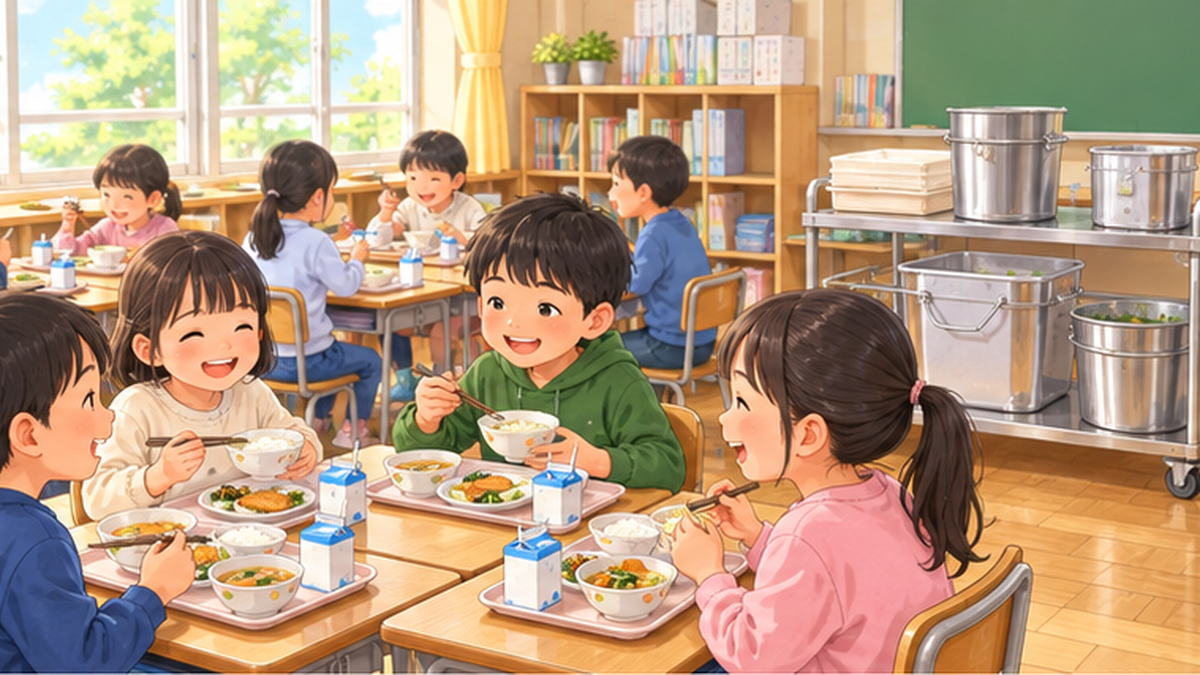
Is Telling Pupils to “Finish Everything” Really Good?
There are also cautious views about strongly demanding that pupils “eat everything” for the sake of cutting food loss. For children who want to eat but cannot, who have allergies or are unwell, or who feel anxiety about eating, being forced to finish can be painful and can even make them dislike meals themselves.
In the approach to food education promoted by MEXT as well, the goal is not to “make children eat” but to foster gratitude for food and the ability to judge and eat an amount that suits oneself. Efforts to cut leftovers must always go hand in hand with protecting children's physical and mental health.
Cutting food loss is not about forcing pupils to finish
- Never force children with allergies or who are unwell to eat
- For disliked foods, emphasise getting used to them in small amounts
- Turn the experience of finishing a reduced portion into the joy of leaving nothing
- Do not judge children or classes only by leftover-rate figures
Where Losses Arise in School Lunch: Cooking, Serving and Recycling
Cooking Scraps: From Vegetable Peels to Fish Bones
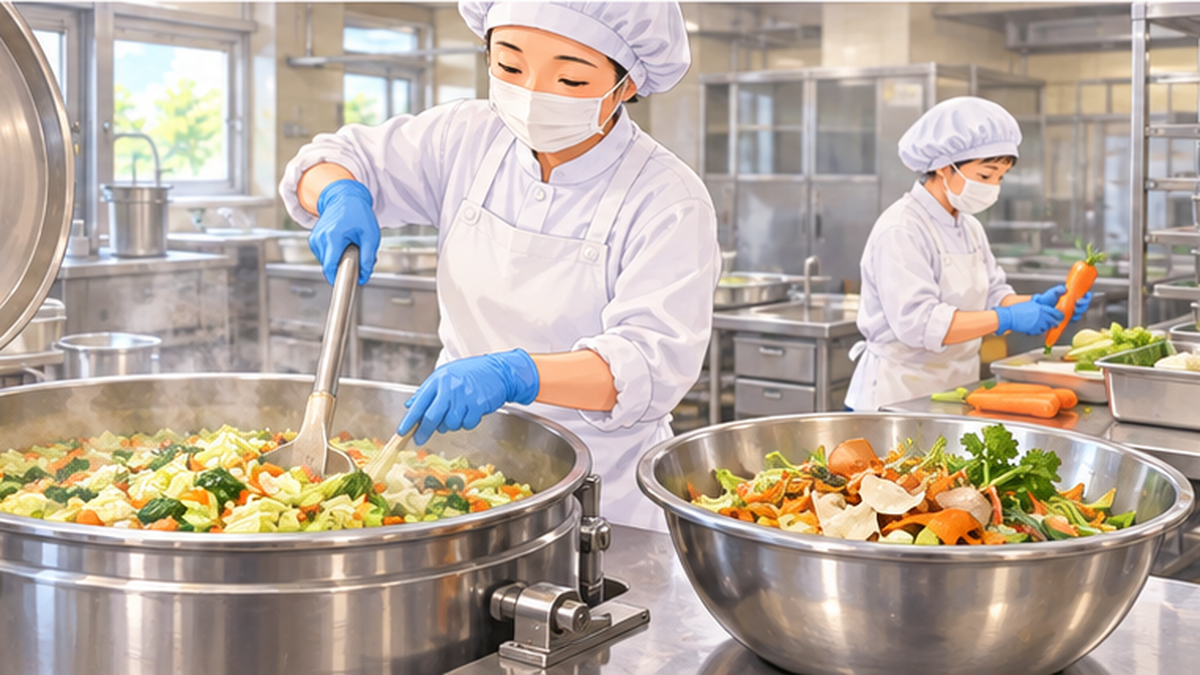
School kitchens prepare meals for hundreds to more than a thousand people at once every day. Cooking scraps such as vegetable peels, stems and root ends, fish bones and skin, and eggshells tend to add up. Recently, many school lunch centers have introduced ways to use every part of an ingredient, such as turning daikon peels or broccoli stems into stir-fried side dishes or soup.
Much of the scrap can be reduced by not wasting the edible parts of ingredients. From the standpoint of hygiene, however, damaged parts and inedible parts cannot simply be used. A balance between using everything and keeping food safe is required.
Serving Losses: Absences, Events and Miscounted Quantities
School lunch is prepared for a headcount fixed in the morning. Absences, early departures, class closures and event-related changes on the day can leave prepared food over. Because quantities are hard to adjust once cooking has begun, how to handle surplus is a challenge.
For hygiene reasons, re-serving surplus lunch to pupils or letting them take it home is generally not permitted. This is an important rule to prevent food poisoning, and even when the purpose is to cut food loss, hygiene risks must take priority. Some municipalities have introduced ways to tell the kitchen about schedule changes early and to fine-tune ordering quantities.
Where Leftovers Go: Recycling and Disposal
In the Ministry of the Environment survey, the recycling rate of food waste from school lunches was about 59%, of which roughly 40% was turned into fertilizer (compost) and about 18% into animal feed. The rest is thought to be incinerated or otherwise disposed of. Some municipalities practise “food cycles” in which composted leftovers are used in school flower beds and local farmland, and the vegetables grown appear in school lunches again.
Recycling, however, is only the “exit” for food loss. Waste prevention (reduce), keeping leftovers and cooking scraps from arising in the first place, is the top priority. Under Japan's Food Recycling Act as well, the basic order for food waste is prevention first, then recycling (fertilizer, feed and so on), and heat recovery or volume reduction for whatever remains.
Priority for handling food waste (the idea behind the Food Recycling Act)
- 1. Prevention: do not over-prepare; serve amounts that can be finished
- 2. Recycling: circulate as fertilizer, feed and the like
- 3. Heat recovery and volume reduction: the last resort for what still remains
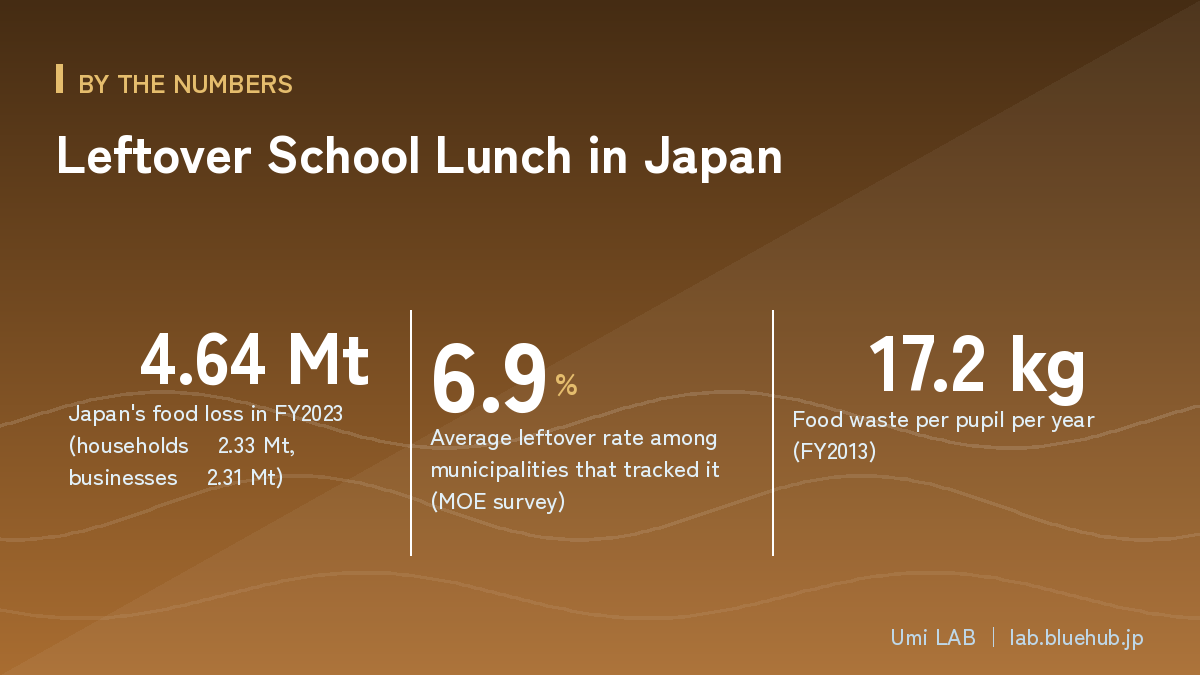
As seen at the start, even the overall estimates show millions of tonnes of food loss arising every year from both households and business activities. The current state of food loss in Japan can be checked on the Ministry of the Environment page on reducing food loss and food waste and on the Consumer Affairs Agency's page announcing the estimates. School lunch is only one site among them, but because it is where children experience leaving or not leaving food every day, it carries great educational significance.
Local Sourcing and School Lunch: Do Local Ingredients Change Leftovers?
The Current Use of Local and Domestic Ingredients in School Lunch
Using locally produced ingredients (jiba sanbutsu) and domestic ingredients in school lunch is promoted jointly by the Ministry of Agriculture, Forestry and Fisheries and MEXT. The Fourth Basic Plan for the Promotion of Shokuiku (food education) sets a target that at least 90% of prefectures maintain or improve their usage rate of local and domestic ingredients in school lunch (by value) from the FY2019 level. The FY2019 national averages by value were about 52.7% for local products and about 87% for domestic ingredients.
MEXT surveys this situation every year; the FY2022 survey covered five days in the third weeks of June and November 2022. The calculation of usage rates has also been changed from an ingredient-count basis to a value basis, which better reflects the efforts of producers and school lunch staff.
Local Products as “Living Teaching Material”
A guide to using local products in school lunches published by the Ministry of Agriculture, Forestry and Fisheries positions local products as “living teaching material” for food education. They are expected to deepen understanding of regional culture and industry, and, through contact with local producers, to nurture appreciation for producers' efforts and gratitude for food.
Main aims of using local products in school lunch
- Can be used as “living teaching material” for food education
- Deepens understanding of local culture and industry
- Contact with producers nurtures gratitude for food
- Opens sales channels for local producers and businesses, contributing to the local economy
- Shorter transport distances may reduce environmental impact
The ministry also publishes a guidebook for getting started (“Starting with Small Steps: Using Local Products in School Lunches”), case studies from 12 regions across Japan, and practical calculation tools. It is designed so that even schools and municipalities that find the barrier high can begin with something like “one day a month when local ingredients are used.”
Local Fish in School Lunch: An Example from Imabari, Ehime
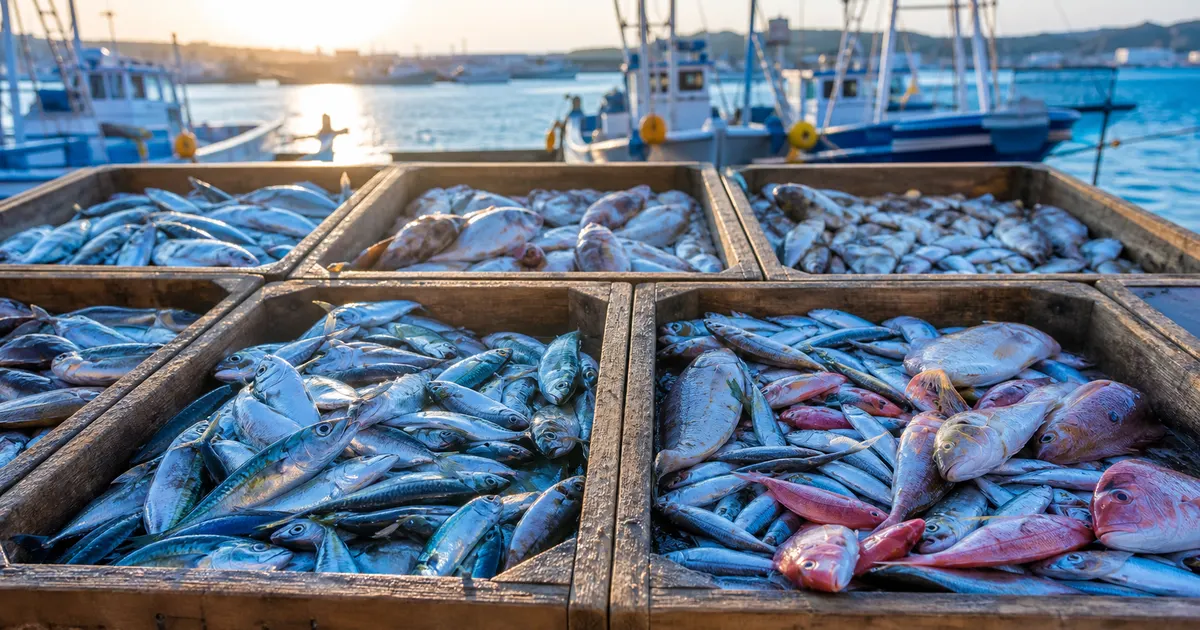
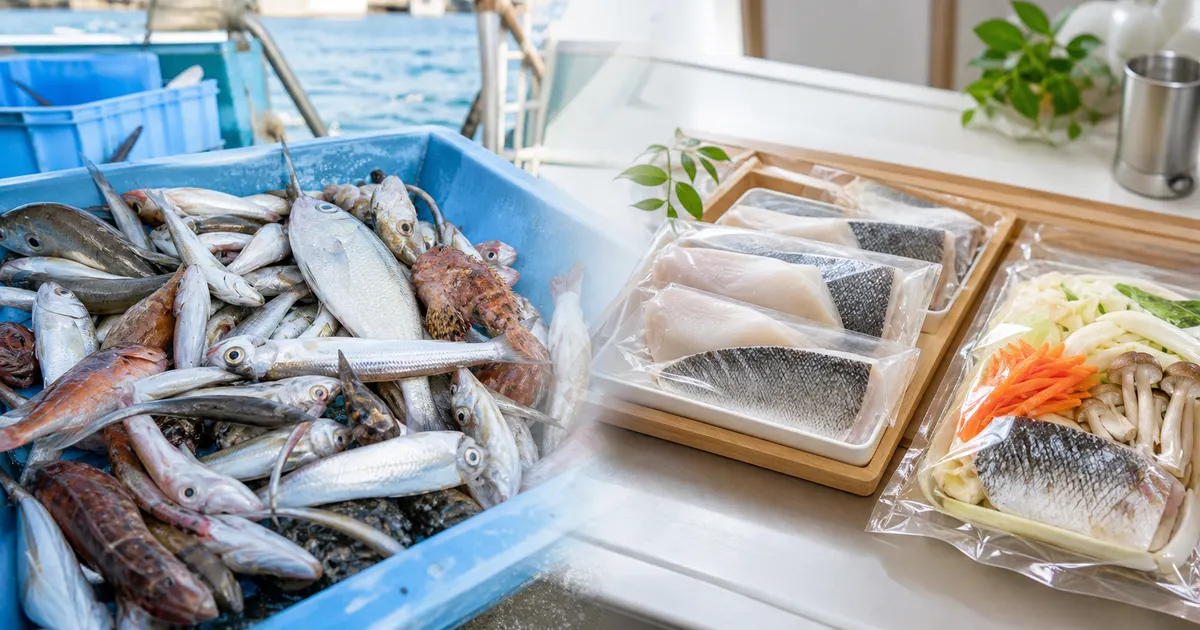
In Imabari, Ehime Prefecture, the use of local fish has been increased since fiscal 2009 with the cooperation of the local fishery cooperative. By processing the fish into fillets and freezing them at a seafood processing plant, the city built a system that can supply large quantities, and it serves school lunches made with wild red sea bream (madai) to all elementary and junior high school pupils in the city about three times a year.
What this case shows is that the biggest hurdles to putting fish into school lunch are “quantity” and “processing,” and that the fishery cooperative, processors and kitchens solved them together. Preparing fish dishes for thousands of meals at once requires uniformly sized fillets, bone handling, frozen storage and hygiene management to all be in place.
Challenges: Hygiene, Specifications, Stable Supply and Time
Using local products has its challenges too. The Ministry of Agriculture, Forestry and Fisheries lists hygiene management, ingredient specifications, time limits on cooking and delivery, and stable production and supply of agricultural products as the main ones. Poor weather can mean no vegetables, and irregular shapes may not suit cooking machinery. Solving these requires working step by step, together with local producers and distributors, not only with education staff.
Using local products does not necessarily reduce leftovers. Still, many schools report that on days when ingredients come from producers whose faces are known, or fish from the local sea, children start asking “Which farm did these vegetables come from?” or “Which sea was this fish caught in?”, and their attitude toward food changes.
Fish in School Lunch: Overcoming the Barriers of Smell and Bones
Why Is Fish Often Left Over in School Lunch?
Fish is a nutritious food. In addition to high-quality protein, oily fish contain fats such as DHA and EPA, and fish provide calcium and vitamin D. On the other hand, it is said that fish dishes tend to be left over more often than meat dishes in school lunch. There are three main reasons.
- Smell: some children dislike the smell of cooked fish
- Bones: small bones make fish hard to eat and raise worries about choking
- Unfamiliarity: fish is eaten less often at home, so children are not used to the taste and texture
Household fish consumption is said to be declining in recent years, and in some areas school lunch is one of the few chances children have to meet fish. That is why both the meaning of serving fish and ways to make it easier to eat matter.
Cooking and Processing Ideas to Make Fish Easier to Eat
The Fish Eating Promotion Center run by the Japan Fisheries Association (Dainippon Suisankai) publishes fish recipes for school lunches, collecting practical information on handling bones, seasoning and cooking methods. Typical ideas are summarised below.
| Challenge | Example approach | Expected effect |
|---|---|---|
| Smell is a concern | Season beforehand with ginger, spring onion or miso; fry, or use in curry or stew | The smell softens and the fish becomes easier to eat |
| Bones are a concern | Use deboned fillets, or make fish paste or fish balls | Less worry about bones, so the fish can be eaten safely |
| Dislike of texture | Make fried fish, nuggets or patties | Easier entry for children not used to fish |
| Unfamiliar | Start with small amounts; serve as event food or regional dishes | More chances to encounter the taste of fish |
“Disliking fish” can change with cooking and experience
Many schools report that even children who dislike the smell or bones of fish can eat it more readily when the cooking method changes, for example fried, simmered or made into fish paste. Building experiences of “that was delicious” in an easy-to-eat form is the shortest path to getting used to fish.
Effects of Fish Meals: Contact with Producers and Fewer Fish-Averse Children
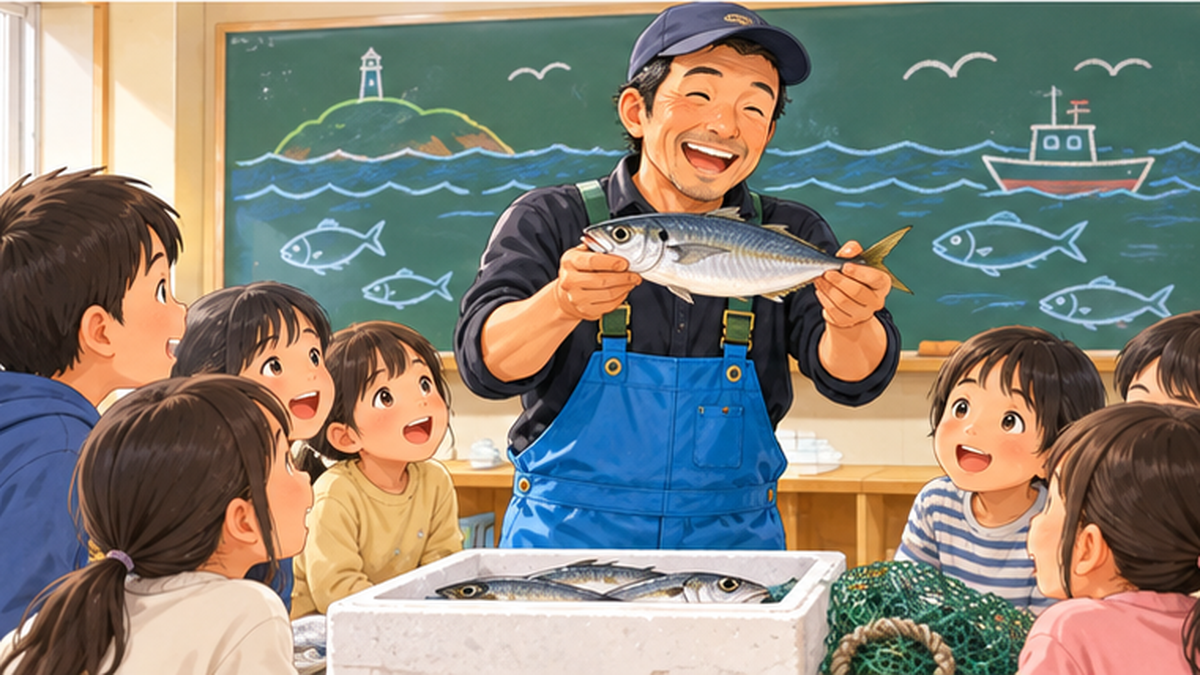
In municipalities that actively put local agricultural, forestry and fishery products into school lunch, contact between producers and children develops, and multiple effects such as fewer children who dislike fish have been reported. When fishers or fishery cooperative staff visit schools to talk about how fish are caught and the hardships of the work, or demonstrate filleting, children come to see fish not just as “ingredients” but as “life from the sea.”
Seafood Loss and Our Connection to the Sea
Using fish in school lunch is also connected to seafood food loss. Some caught fish are hard to sell at market because they are small or irregular in shape. Efforts to process such unused or under-used fish for school lunches are under way in various places. The whole picture of seafood loss is set out in detail in Reducing Seafood Food Loss.
Also, in the recovery from the Great East Japan Earthquake, the fishing industry of Sanriku has worked to rebuild aquaculture and processing. That story is told in The Path of Sanriku's Fisheries Recovery. Bringing the bounty of the local sea to children's tables is deeply connected to the recovery of the fishing industry and to sustainable fishing.
Eating up the fish in school lunch is also a way of showing respect for the fisheries that take life from the sea and for efforts to protect its resources. Using a whole fish without waste is a first step toward protecting the sea, whose resources are limited.
Changing Awareness and Behavior Through Food and Environmental Education
Food Education Starts with Learning a Food's “Journey”
In the Ministry of the Environment survey, about 65% of municipalities were running food and environmental education aimed at cutting leftovers. Simply urging children to “finish everything” has limits in reducing school lunch leftovers; it is considered important that children themselves understand why it is better not to leave food.
Initiatives carried out at schools include the following.
- Making leftovers visible: weigh leftovers by class and by day, and post them as graphs in the classroom
- Lessons on a food's journey: learn how ingredients travel from fields and the sea to the school kitchen
- Contact with producers and cooks: come to know the faces and thoughts of the people who make the food
- Explanations by nutrition teachers: convey the nutrition in the day's menu and its relation to the body
- Links to environmental learning: think about the relationship between food loss, greenhouse gases and waste treatment
Weighing Leftovers Changes Children's Behavior
In various places, classes weigh and record leftovers every day and children themselves consider how they relate to the day's menu and the time available. Once shown as numbers, children begin to find patterns on their own, such as “There are more leftovers on fish days” or “Soup is left when there was little time.”
What matters is not to turn the numbers into competition between classes. Common to successful schools is using them not to blame classes with many leftovers, but as material for thinking together about “how can we make it easier to eat?” and “what can we try?”
Dialogue with Cooks and Nutrition Teachers Changes the Menu
Two-way efforts are also spreading in which pupils send messages and requests to cooks and nutrition teachers, and menus and seasoning are improved in response. For children it is an experience of their voice being reflected in school lunch, raising their sense of ownership. For the kitchen side, feedback from the field clarifies concrete causes of difficulty in eating and offers clues to improvement.
Examples of initiatives easy to start at school
- Weigh and post each class's leftovers for just one week
- Make a “disliked ingredients ranking” and think about cooking improvements together with children
- Review the timetable to see whether lunchtime can be extended a little
- Hold an exchange lesson with local producers or fishery cooperatives, even once a year
- Compost leftovers and use them in flower beds or gardens to experience the cycle
Teaching the Connection with the Sea
Within food education, dealing with the connection to the sea has special meaning. The fish and seaweed we eat depend on the marine ecosystem and on the work of the fishers who support it. Simply learning the names, origins and catching methods of the fish served at school lunch can lead children to avoid wasting food. In schools near the sea, some combine beach cleanups and fishing experiences with lessons on school lunch.
Getting to know seasonal ingredients is also a useful entry point for thinking about the link between food and nature. For seasonal ingredients and the rhythm of nature, see also What Does Eating in Season Mean?.
Ideas from the Field: Menus, Serving, Time and Systems
Adjusting Portions: A System Where Pupils Can “Adjust” for Themselves
Many schools use methods in which pupils adjust their own portions before serving, instead of giving everyone the same amount. For example, they can choose “large, regular or small” servings of staples and side dishes, or be given time to reduce amounts before eating. Combined with seconds after eating, this satisfies children who need more.
What matters is that teachers repeatedly convey the message that “reducing is not a bad thing.” The ability to estimate for oneself how much one can eat also leads directly to cutting food loss as an adult.
Menus: Improving Items That Tend to Be Left
Recording leftover-rate data by dish reveals which menus tend to be left. Once patterns are clear, measures such as changing seasoning, cutting ingredients smaller or pairing with popular dishes become possible. Some reports say that using local and seasonal ingredients reduced leftovers thanks to better flavor.
| Situation | Example approach | Key point |
|---|---|---|
| Menu planning | Review seasoning and cooking methods of items often left | Keep records and grasp trends |
| Serving | Choose from “large, regular, small” portions | Create an atmosphere that accepts taking less |
| Mealtime | Secure eating time (more efficient serving) | Timetable adjustments can help |
| Cooking | Adopt recipes that use vegetable peels and stems | Use everything, with hygiene as a precondition |
| Schedule changes | Tell the kitchen early about absences and event changes | Directly adjusts the amount cooked |
| Review | Weigh and post leftovers and share the trends | Use as material for improvement, not competition |
Community Systems: Composting and Food Cycles
Some municipalities have set up systems that turn leftovers and cooking scraps into compost used by local farmers and school gardens. Such food cycles not only reduce waste but also become teaching material in which children experience “the food we left becomes nutrients for the next crop.” Composting, however, comes with challenges such as odor, insects and collection and transport costs, and cooperation with local farmers and businesses is indispensable.
Using Data: From “Measuring” Leftovers to “Using” Them
MEXT's March 2023 research report collects examples of reducing food loss in school lunches. Efforts from across the country give hints for choosing what suits one's own school. Recording leftover data daily and checking monthly and termly trends confirms the effect of initiatives and helps maintain motivation.
School lunch food loss reduction: key points from the field
- First, “measure” leftover amounts and trends by dish
- Reduce both too much and too little with systems where pupils adjust their own portions
- Work on ease of eating, and raise interest through local ingredients and fish
- Through food and environmental education, let children themselves think about why not to leave food
- Foster gratitude and self-management, not forced plate-cleaning
What Families and Communities Can Do: Making School Lunch Waste Personal
At Home: Don't Blame Dislikes, Increase “Delicious” at the Table
Leftover school lunch is also related to eating habits at home. If children rarely eat fish or vegetables at home, they are not used to them when they appear at school and are more likely to leave them. Yet scolding “Finish your food!” tends to backfire. At home, you can start with the following.
- On a day off, watch together how fish is cleaned and grilled
- Serve seasonal fish and local vegetables and talk about where they come from and the season
- Try disliked foods several times in small amounts and with different cooking methods
- Look at the school lunch menu together and talk about the day's ingredients
- When a child says “I can't finish it,” accept adjusting the amount
The reality of household food loss and concrete ways to reduce it are covered in detail in The Reality of Household Food Loss: 2.36 Million Tonnes a Year.
In the Community: Connecting Producers, Fishery Cooperatives and Schools
Local government, PTAs and community NPOs can also play the role of connecting schools with local producers, fishery cooperatives, agricultural cooperatives and food processors. Creating a contact point that brings local ingredients to school lunch, inviting producers to schools, and holding cooking classes using school lunch ingredients all help protect local food culture.
Food loss is not only a school issue. Convenience stores and retailers are also advancing reduction efforts, such as managing expiry dates and improving demand forecasting. For business-side efforts, see also Food Loss at Convenience Stores.
Summary: Balancing “Reducing” and “Nurturing” in Leftover School Lunch
Leftover school lunch does not account for a large share of Japan's overall food loss. But because it is a place where children face food every day, its educational impact is very large. What efforts to cut leftovers aim for is not “making children finish everything,” but nurturing gratitude for food and the ability to think about an amount that suits oneself.
Bringing local ingredients and fish into school lunch and learning the background of food through contact with producers is not only a way to reduce food loss, but also an opportunity to think about local industry and the marine environment. Why not consider the links among our food, the sea and the future from a single school lunch plate?
References and Sources
- Ministry of the Environment: Survey results on food loss from school lunches – Average leftover rate ≈6.9%, ≈17.2 kg per pupil per year, etc.
- MEXT: Research on Reducing Food Loss in School Lunches (March 2023) – Research report and case examples on food loss reduction
- Ministry of the Environment: Announcement of Japan's estimated food loss (FY2023) – Breakdown of the ≈4.64 million tonnes of food loss in FY2023
- Consumer Affairs Agency: Announcement of FY2023 food loss estimates – Food loss estimates and reduction targets
- Ministry of the Environment: Reducing food loss and food waste – Food loss reduction policy and priorities
- MAFF: Using local products in school lunches – Guide to using local products; 12 regional case studies
- MEXT: FY2022 survey on use of local and domestic ingredients in school lunch – Survey of usage rates of local and domestic ingredients
- MHLW: Fourth Basic Plan for the Promotion of Shokuiku – Targets for usage rates of local and domestic ingredients in school lunch
- Fish Eating Promotion Center (Japan Fisheries Association): School lunch fish recipes – Fish dish recipes for school lunches
- Imabari City: Local production for local consumption in school lunches – Efforts to use local fish, such as wild sea bream in school lunches
* Listed in order of reliability: government agencies and academic institutions > peer-reviewed papers > specialist organisations > reliable media