The Great East Japan Earthquake of March 2011 dealt an unimaginable blow to the waters of Sanriku, one of Japan's premier fishing regions. Aquaculture rafts were swept away without a trace, processing plants were submerged, and fishing ports and markets alike were reduced to rubble. And yet people returned to the sea. This article traces more than a decade of Sanriku's fisheries recovery — from restarting wakame, scallop, and oyster farming, through rebuilding the processing industry and recovering sales channels, to creating added value through sixth-industrialization and branding — drawing on official statistics and on-the-ground efforts.
Recovery was never simply a story of "restoring what was there." Producers boldly thinned out overcrowded aquaculture rafts to balance environment and quality. They took on processing and sales themselves, reclaiming control over pricing. They turned sea urchins, stunted by kelp-forest degradation, into a resource. The disaster was destruction, but it also became an opportunity to rethink what a fishing region could be.
And now, a new trial has arrived for the seas of Sanriku. Since 2023, sea temperatures off Sanriku have remained roughly 6°C above normal, one of the largest such anomalies recorded anywhere in the world. Just as the region achieves recovery, it must now confront a sea that keeps changing. Let's trace the journey so far, and the challenge that lies ahead.
What you'll learn in this article
- The scale of the damage the Great East Japan Earthquake inflicted on Sanriku's fisheries, and the road to restarting aquaculture
- How far wakame, scallop, and oyster harvests have recovered toward pre-disaster levels, in concrete figures
- The Group Subsidy that supported the rebuilding of the processing industry, and the "second wall" of recovering sales channels
- How sixth-industrialization and branding are generating added value
- Pioneering, sustainability-focused case studies such as sea urchin regenerative aquaculture in Hirono and ASC certification in Minamisanriku
- The new challenges of rising sea temperature and shifting fish species that now stand beyond recovery
Unprecedented Damage — What the Seas of Sanriku Lost
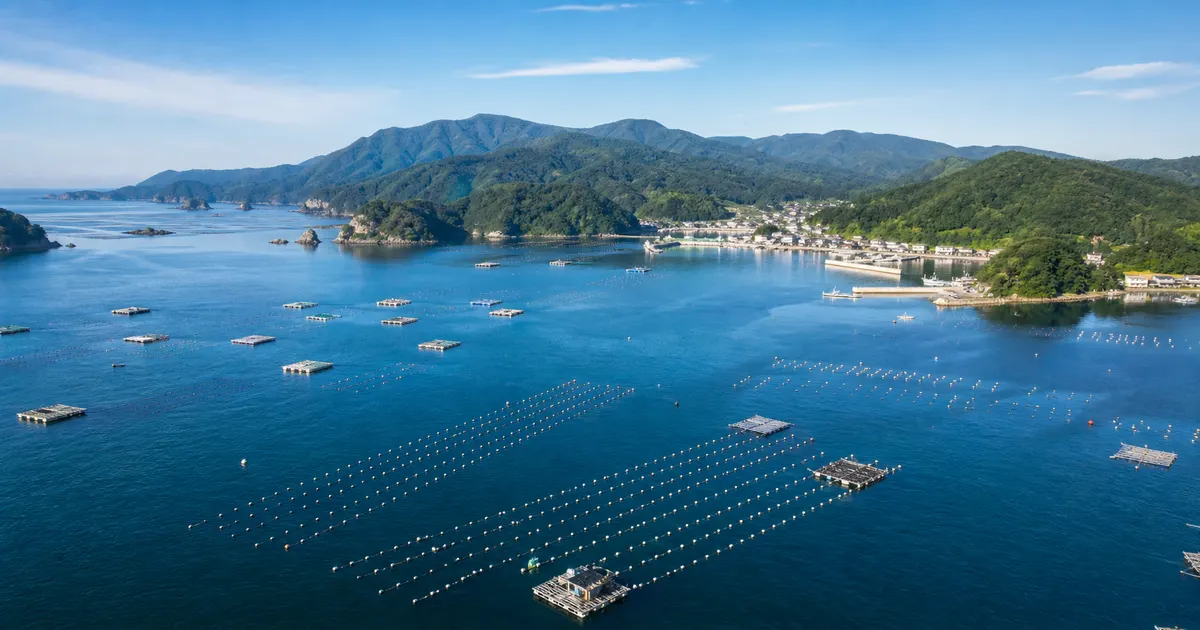
The Sanriku coast, centered on the rias coastline stretching from Iwate Prefecture into northern Miyagi Prefecture, is one of Japan's leading fishing regions. Its intricately indented inlets provide calm waters well suited to aquaculture, and its proximity to the tidal boundary where the nutrient-rich Oyashio Current flowing from the north meets the Kuroshio Current from the south makes it rich in plankton, nurturing both fish and seaweed. Wakame, kelp, scallops, oysters, sea squirts, coho salmon — a diverse range of aquaculture has thrived here, and many fishing communities have built their livelihoods on this sea.
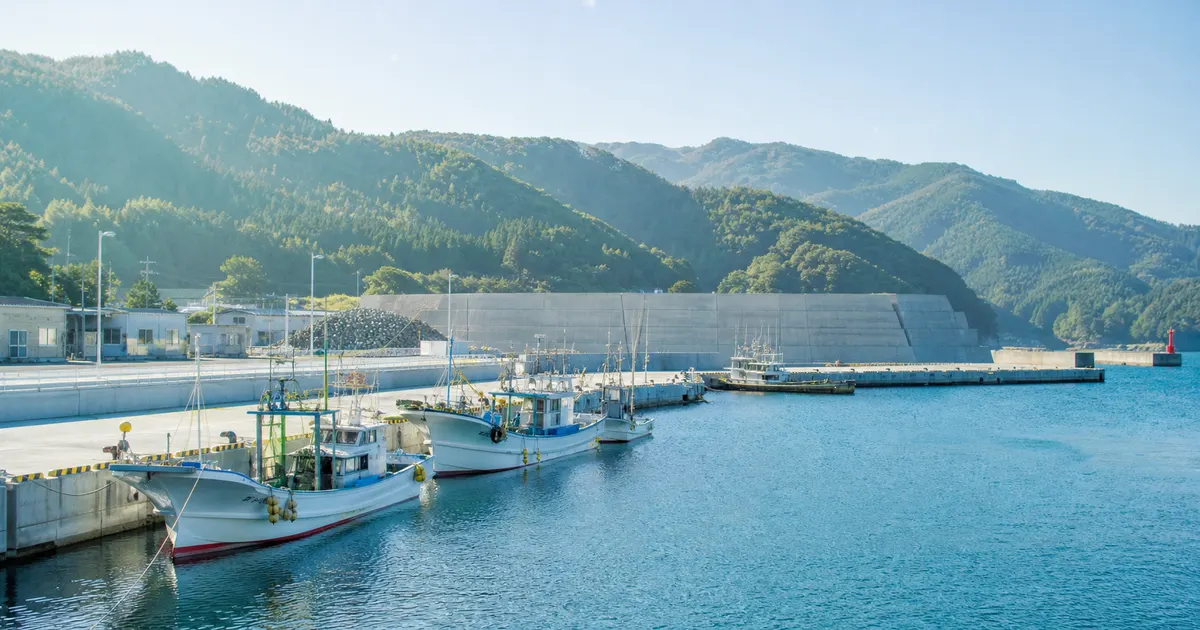
On March 11, 2011, the Great East Japan Earthquake struck, and a massive tsunami hit the Sanriku coast. Aquaculture rafts floating on the surface were swept away, and seed stock and farmed products were almost entirely lost. On land, seafood processing plants, refrigeration and freezing facilities, ice-making plants, fishing ports, and fish-sorting facilities — every foundation supporting the fishing industry — were destroyed. Many fishing boats were also lost, severing the entire chain from production through processing and distribution all at once. Sanriku's fishing industry functions as a single chain linking aquaculture rafts at sea to processing plants, cold storage, and markets on land. The fact that nearly every link in that chain was severed simultaneously, rather than just one point, made recovery from this disaster especially difficult.
The Scale of the Damage, in Numbers
The damage was so severe that the word "catastrophic" barely captures it. In Iwate Prefecture alone, damage to aquaculture facilities and farmed products is said to have reached the scale of tens of billions of yen, compounded by losses across diverse farmed species including coho salmon, scallops, oysters, sea squirts, kelp, wakame, and nori. Because aquaculture takes years from seeding to harvest, repairing facilities does not immediately bring landings back. Shellfish such as oysters and scallops, which take several years to raise, require even more time after facilities are rebuilt before the first full harvest. Recovery required two distinct kinds of time working together: "restoring equipment" and "rebuilding the production cycle."

Why the Seas of Sanriku Are Special
- The inlets of the rias coastline have calm waters well suited to aquaculture
- Close proximity to the tidal boundary where the Oyashio and Kuroshio currents meet provides abundant nutrients
- Diverse aquaculture thrives here, including wakame, kelp, scallops, oysters, sea squirts, and coho salmon
- A major industrial cluster formed encompassing not just production but processing, ice-making, and freezing
The Choice to "Return to the Sea"
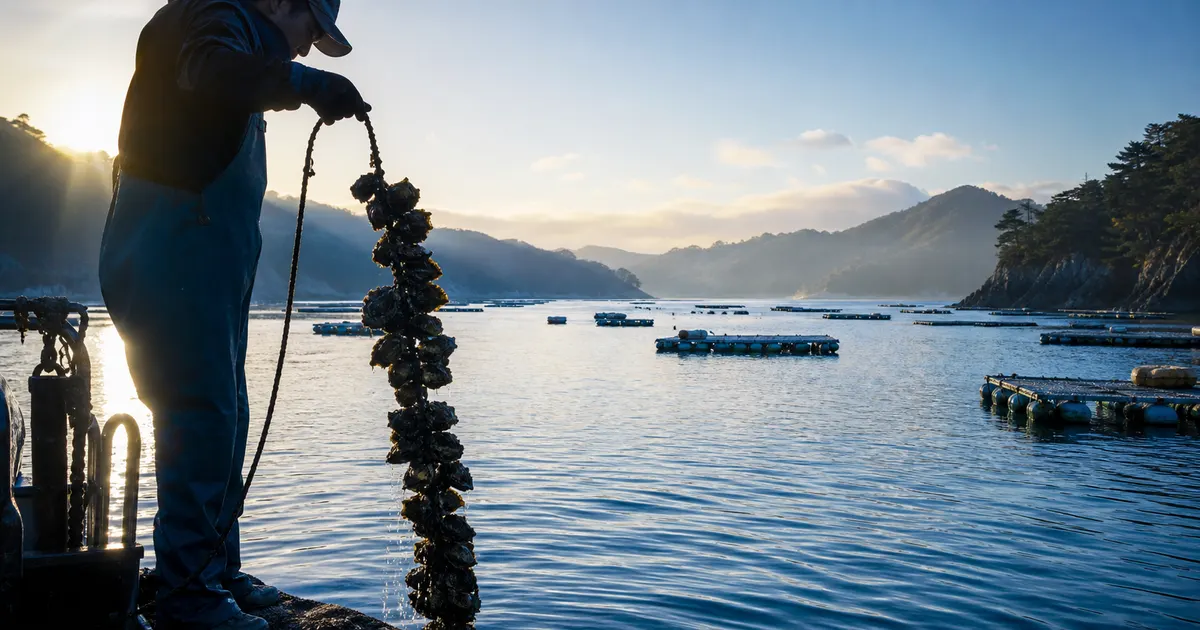
Even so, within just a few months of the disaster, many fishers began returning to the sea. One oyster and wakame farmer in Minamisanriku Town took on the role of chair of the oyster growers' section at the fishery cooperative branch just three months after the disaster, and began charting a path to restart together with colleagues. For people who had lost both home and boat to the tsunami, this was not an easy decision. Not a few elderly fishers chose to retire at this juncture, accelerating a decline in the workforce that had already been underway before the earthquake. Even so, the conviction of those who chose to stay with the sea — "the sea will surely come back someday" — became the starting point of a long recovery.
It wasn't individual will alone that drove the restart. Aquaculture in Sanriku has long been run through community structures centered on fishery cooperatives, organized by shoreline. Who uses which stretch of water, how seed stock and materials are shared — the fishery cooperatives and production sections that coordinate these matters helped pull together shorelines that had come close to falling apart. Damage that no individual could recover from alone became surmountable through collective effort. Sanriku's culture of yui — mutual aid — became the invisible foundation of recovery.
The resilience of the marine ecosystem itself also supported recovery. The recuperative power of coastal environments such as tidal flats, seaweed beds, and wetlands is discussed in more detail in our article on tidal flat conservation and the role of living organisms. The tsunami churned up the seabed, but Sanriku's nutrient-rich waters relatively quickly regained their living creatures, supplying enough plankton to feed the resumed aquaculture. The process by which a broken sea reclaimed its capacity to nurture life quietly overlapped with the recovery of human livelihoods.
Restarting Aquaculture — Until Wakame, Scallops, and Oysters Came Back
The first priority in recovery was restoring aquaculture facilities: securing the anchors and ropes that hold the rafts in place, the floats, and the seed stock, and rebuilding the lost "fields" of the sea. The national government supported the rebuilding of jointly used fisheries facilities through recovery assistance for shared-use facilities. Iwate Prefecture used recovery budgets to gradually restore the number of aquaculture facilities, and it is reported that facility construction was completed by the end of March 2014 for every aquaculture operator who wished to resume.
Wakame — Sanriku's Star That Announces Spring
Sanriku's wakame is seeded offshore in autumn, grown through winter into spring, and harvested in early spring. Even in the year of the disaster, many fishers set out to restart "wakame first." With its relatively short growing period, wakame — where seeding could bring the prospect of a harvest as early as the following season — became the first foothold for fishers whose income had been cut off, helping them rebuild their livelihoods. As the first fruit of recovery, wakame played a symbolic role. According to figures compiled by the Fisheries Agency, wakame harvests in the 2016 season reached about 71% of pre-disaster levels. Farmed coho salmon also returned to about 82% in the same year, demonstrating that Sanriku's aquaculture was steadily regaining its strength.

Scallops and Oysters — Shellfish That Take Time to Raise
Scallops and oysters take longer to raise than wakame. Even so, as facility restoration and seed-stock supply progressed, landings steadily recovered. In the 2015 season, scallops reached about 83% of pre-disaster levels, and oysters about 59%. Oysters vary considerably by producing area and year, but showed a clear upward trend in recovery.
| Species | Recovery rate (vs. pre-disaster) | Fishing season |
|---|---|---|
| Wakame | About 71% | 2016 season |
| Coho salmon | About 82% | 2016 season |
| Scallops | About 83% | 2015 season |
| Oysters | About 59% | 2015 season |
The Reverse Idea of "Reducing" — Oysters of Tokura, Minamisanriku
Recovery didn't stop at simply restoring the status quo. In the Tokura district of Minamisanriku Town, Miyagi Prefecture, producers made the bold decision to cut the number of oyster aquaculture rafts, which had been overcrowded before the disaster, to about one-third. With fewer rafts, nutrients and oxygen reach each oyster more fully, improving the meat content. As a result, the farming period, once 2-3 years, shortened to about one year, and quality improved as well. "Reduce, and grow richer" — a clear answer from the field to the question the disaster had forced upon them.
What Tokura's Oyster Aquaculture Demonstrated
- Cut the number of rafts to about one-third, lowering density
- More nutrients and oxygen reach each raft, improving meat content
- Farming period shortened from 2-3 years to about one year
- Labor burden also eased, contributing to a more sustainable way of working
This "shift from quantity to quality" carries significant implications for modern fisheries, buffeted as they are by rising sea temperatures and shifting resources. The impact of ocean environmental change on fisheries is also discussed in Ocean Warming and Its Impact on Fisheries. Avoiding overcrowding and adjusting production to match the sea's capacity is becoming a basic principle of aquaculture going forward.
Rebuilding the Processing Industry — Another Recovery, on Land
Sanriku's fishing industry isn't built on aquaculture and fishing at sea alone. The seafood processing industry, which turns landed catch into fillets, dried goods, fish paste products, frozen goods, and canned goods, has long provided major employment and economic support to the region. Especially in port towns such as Ishinomaki, Kesennuma, Ofunato, and Kamaishi, processing has been one of the largest sources of local employment, including many women and part-time workers. The tsunami struck this land-based industry directly as well, with many factories completely destroyed or flooded. If processing plants don't operate, then even if aquaculture and fishing resume, there's no way to turn the catch into products and sell it, and employment doesn't return either. Rebuilding the processing industry carried weight equal to — and, in terms of rebuilding the local community, arguably even greater than — rebuilding production itself.
Rebuilding processing plants involved difficulties different from those on the production side. Refrigeration and freezing equipment and processing machinery are expensive, and buildings must meet hygiene standards. What's more, processed seafood products can only be made once raw fish has actually been landed. Without the resumption of fishing, the restoration of markets, and the recovery of infrastructure such as electricity and water, repairing the factory alone doesn't allow operations to resume. Recovery was an area-wide challenge that could not be completed by the efforts of individual businesses alone.
The Group Subsidy: A Major Pillar of Support
The central program that supported the rebuilding of processing and other small and medium-sized businesses was the Subsidy Program for Restoring Facilities of SME Groups (commonly known as the Group Subsidy). Companies playing a core role in the local economy form a "group," create a recovery business plan, and once approved by the prefecture, receive support covering three-quarters of the cost of restoring facilities and equipment, funded jointly by the national government and the prefecture. Approvals under this program have reached 10,244 to date, contributing greatly to the early resumption of business for affected operators.

Even so, recovery isn't complete simply because the "box" of the factory has returned. Even with new equipment installed, the business partners from before the earthquake may have already switched to a different producing region, or gone out of business. If supply is cut off for months or years, supermarkets and restaurant chains secure other suppliers. Once a spot on the shelf is lost, winning it back is not easy. Being able to make products again doesn't mean the buyers come back — processors faced this "loss of sales channels" as a wall entirely separate from facility restoration.
We rebuilt the factory. The machines were installed. But our old business partners were already sourcing from somewhere else. It was starting over from zero.
— Testimony (paraphrased) from an affected seafood processing operator
The Role Seafood Processing Plays
- Converts the catch into forms that can be preserved and distributed (frozen, dried, fish paste products, etc.)
- Serves as an important source of local employment
- Forms the core of the value chain connecting production to consumption areas
- Is strongly affected by fluctuations in the raw-material fish supply
Recovery at a Different Pace in Every Port Town
Even within Sanriku as a whole, the pace of recovery varied greatly from one port town to another. Factors such as the degree of land subsidence, damage to the fishing port, the main species and processed products handled, and the age profile of business owners all shaped the speed of restart. In large freezing and processing hubs, operators had to wait for the restoration of infrastructure overall, which took time. In smaller fishing communities, on the other hand, quick decision-making by a small number of people sometimes led to an earlier restart in some cases. Recovery was never uniform; each place moved forward gradually while confronting its own particular circumstances.

Moreover, in recent years, the very species being landed have been changing alongside climate change and shifts in ocean currents, and processors now face the new challenge of securing a stable supply of raw material. Plants that had long focused on Pacific saury or salmon as their main raw material have, in some cases, been unable to secure supply amid record poor catches of these species and have had to switch to handling different fish. Recovery from the earthquake and adaptation to environmental change are, in reality, proceeding simultaneously in Sanriku's processing industry today.
Recovering Sales Channels — The "Second Wall"
Even once facilities were restored and production came back, a business cannot survive without buyers. "Sales-channel recovery" — winning back business partners lost in the disaster and cultivating new customers — was, for many affected operators, the greatest challenge of recovery. Winning back a business partner who has once left can sometimes be even harder than selling a product from scratch.
A Dedicated Support System for Sales-Channel Recovery
To address this challenge, the Center for Promoting Sales Channel Recovery for the Recovering Seafood Processing Industry was established. It dispatches, free of charge, sales-channel recovery advisors with expertise in business negotiations and exhibition participation, providing hands-on support for sales strategy and product improvement. Alongside this, a program was set up to subsidize equipment recognized as necessary for sales-channel recovery, up to two-thirds of the required expenses.
- Hands-on support through free dispatch of sales-channel recovery advisors
- Support for participating in trade shows and business-matching events
- Subsidies for equipment necessary for sales-channel recovery (up to 2/3 of costs)
- Advice on new product development and upgrading quality and hygiene management

Where Recovery Stands Now — Full Recovery Is Still Halfway There
Thanks to this support, many businesses have managed to get back on their feet, but recovery for the region as a whole is still only halfway there. Even as of 2023, marine catch volumes in the three affected prefectures and aquaculture harvest volumes in Iwate and Miyagi Prefectures had not returned to pre-disaster (2010) levels. Processed seafood production also, while varying by item, has generally not surpassed pre-disaster levels.
Compound Factors Hindering Recovery
- Not all of the business partners and sales channels lost in the disaster have come back
- Labor shortages from population decline and aging
- Fluctuations in landed species and raw-material shortages from changing ocean conditions
- Rising production costs for fuel, materials, and electricity
In the process of recovering sales channels, a movement to pioneer new markets spread, beyond simply chasing down lost business partners. Spurred by the disaster, operators emerged one after another who connected directly with restaurants and department stores in the Tokyo metropolitan area and the Kansai region they'd had no prior ties with, who ventured into overseas exports, and who sold directly to consumers through internet retail. Efforts also progressed to rethink the products themselves — rather than shipping raw materials as-is, offering pre-prepared, time-saving products or high-value-added gift items. From "restoring the old sales channels" to "creating new ways to sell" — the recovery of sales channels pushed the region's thinking significantly forward.
In other words, Sanriku's fishing industry carries two challenges simultaneously: "recovery from the earthquake" and "adaptation to structural headwinds." As the domestic market shrinks with population decline, raw materials grow unstable and costs rise. To survive under these harsh conditions, simply restoring the old volume is not enough. Transforming into a region that can turn a profit even with a smaller catch — this thinking leads directly into the sixth-industrialization and branding we'll look at next.
Sixth-Industrialization — Grow It, Process It, Sell It Yourself
Sixth-industrialization refers to producers in agriculture, forestry, and fisheries (primary industry) taking on processing (secondary industry) and distribution, sales, and services (tertiary industry) as an integrated whole, capturing the added value for themselves. The name comes from the multiplication "1st x 2nd x 3rd = 6th." In fisheries, rather than fishery cooperatives or fishers simply shipping out raw materials, finishing them into processed goods and delivering them directly to consumers and restaurants allows producers to regain control over pricing.
Why Recovery and Sixth-Industrialization Are a Good Match
Under the traditional flow, fishers bring their catch to market and prices are set by supply and demand. Sometimes a bumper catch crashes prices; sometimes rising fuel costs cannot be passed on to fish prices. If producers take on processing and sales themselves, they can soften the impact of price fluctuations and stabilize revenue. The experience of having distribution cut off by the earthquake made the region acutely aware of the risk of relying too heavily on external sales channels.

Direct Sales and E-Commerce — A New Outlet
The spread of internet retail gave a major boost to sixth-industrialization. Fishers and processors in Sanriku deliver live scallops, fresh wakame, and oysters directly from the producing region to dining tables across the country. Bypassing intermediary distribution allows freshness and story to be conveyed directly, and lets producers set their own prices. The direct-from-producer brands and online shops that emerged after the disaster were a clear symbol of this movement.
- Fishery cooperatives and fishers own processing facilities and handle production through to finished goods
- Sell directly to consumers through direct-from-producer e-commerce sites
- Trade directly with restaurants and hotels, delivering the region's story along with the product
- Circulate revenue and employment within the local community, drawing in new workers
The Aim of Sixth-Industrialization
- Reclaim control over pricing for producers
- Keep the profits from processing and sales within the region
- Differentiate through freshness, traceability, and story
- Generate new employment and attract younger workers
In Sanriku, cases have emerged where fishery cooperatives themselves have moved into processing and sales. For example, some fishery cooperatives in northern Miyagi Prefecture have taken on all three stages of production, processing, and sales as an integrated whole, marketing local fish under their own brand. It is not easy for fishers to take on processing and sales as well, but changing from within a structure that had long left pricing to outside distributors carries great significance. The disaster took much away, but it also became an opportunity for the region to reclaim "how to sell" for itself.
Sixth-industrialization is no magic wand. It demands capabilities different from primary-industry work — capital investment in processing equipment, hygiene management, marketing, logistics — and failures are not uncommon. Many producers who are skilled at growing find themselves running up against the wall of being unskilled at selling. Even so, in regions where things have begun to click, a new model is taking shape: turning a solid profit even with a smaller catch. That achievement is embodied in the "branding" we'll look at next.
Building Added Value Through Branding — Taking Sanriku's Name to the World
Even the same wakame can carry different value depending on where and how it was grown, and what quality it delivers, once that story reaches the buyer. Branding is the work of tying trust and story to the name of a producing region or producer, creating "a reason to be chosen." Sanriku has both the blessed natural environment and the compelling story of having overcome the disaster as a foundation for this.
Sanriku Wakame — The Name Behind Roughly 70% of Domestic Supply
Sanriku is a major producing region accounting for about 70% of domestically produced wakame. Miyagi Prefecture alone accounts for more than 40% of the national share, and Iwate Prefecture also ranks among the leading production areas nationally. Nurtured by the abundant nutrients the Oyashio Current brings and churned by the powerful currents where the two tides collide, Sanriku wakame grows thick, resilient, and rich in flavor. Producing areas strictly manage quality through grading inspections, upholding standards worthy of the "Sanriku wakame" name. Individual regional brands such as "Masaki wakame" have also developed, advancing multi-layered value creation across the region.

Kitasanriku Factory — Turning Kelp-Forest-Destroying Sea Urchins Into a Resource
Kitasanriku Factory, based in Hirono Town, Iwate Prefecture, is drawing attention as a pioneering case that combines branding with environmental regeneration. The company focused on undernourished, low-meat-content sea urchins, which are also a cause of isoyake — the kelp-forest die-off in which seaweed is eaten bare, leaving the sea floor barren. It collects these urchins from the sea, fattens them through regenerative aquaculture, raises them into delicious urchin, and sells them at a premium. If they sell, it becomes income for fishers; if the sea urchin population declines, seaweed returns and seaweed beds recover — a mechanism that turns a nuisance into both a resource and a driver of environmental regeneration.
The company markets both wild-caught "Hirono Uni Ranch Four-Year Urchin" and regeneratively farmed "Hagukumu Uni" as brands, and has supplied them to Michelin-starred restaurants in Japan. Furthermore, in December 2024, it obtained Japan's first HACCP certification for export to the EU for sea urchin, opening a path to exports. In 2025, it began full-scale demonstration operations for a large-scale land-based sea urchin aquaculture system in partnership with Yanmar Holdings, and in 2026 it completed a demonstration facility in Hirono Town, moving into year-round production of "sea urchin that helps counter kelp-forest die-off the more you eat it."
The Model Kitasanriku Factory Demonstrates
- Collects and regeneratively farms undernourished sea urchin, one cause of kelp-forest die-off
- Raises it into delicious sea urchin, sold at high added value
- As sea urchin numbers decline, seaweed beds recover and the ecosystem regenerates
- EU HACCP certification enables exports; land-based aquaculture enables year-round production
This effort is also deeply connected to the significance of protecting and nurturing seaweed beds, the forests of the sea. The role seaweed beds and seaweed play in absorbing and storing carbon dioxide is explained in detail in our article on blue carbon ecosystems. Sea urchin regenerative aquaculture can be seen as a symbolic challenge that draws a single line connecting the seafood business with climate action and biodiversity conservation.
Tokura Oysters, Minamisanriku — Japan's First ASC Certification
The oyster aquaculture of Tokura, Minamisanriku Town, introduced earlier, achieved more than just quality improvement through reducing raft numbers. In March 2016, Tokura's oyster farming became the first in Japan to obtain ASC (Aquaculture Stewardship Council) farm certification. ASC certification is an aquaculture equivalent of an international "seal of sustainability," assessed on criteria such as reduced environmental impact, sustainable use of resources, and consideration for labor conditions and local communities. Minamisanriku Town also became the world's first municipality to obtain both this and forest FSC certification.
"Having lost it once in the disaster, this time let's build aquaculture that can coexist with the environment" — Tokura's choice, backed by the international standard of certification, crystallized into the brand "Minamisanriku Tokurakko Oysters." A decision that, on the surface, looked like sacrificing income by reducing rafts, instead created a virtuous cycle of quality improvement, shortened farming periods, international certification, and branding. It stands as a case that anticipated an era in which sustainability itself becomes a reason to be chosen.
What Branding Brings to a Producing Region
Sanriku wakame, Hirono's sea urchin, and Tokura's oysters — what these branding efforts have in common is that the goal was never simply to "sell at a higher price." Once a brand is established, prices stabilize and become less vulnerable to swings between bumper and poor catches. Producers retain the motivation to pursue quality, and it becomes work younger workers can take pride in continuing. Furthermore, a producing region's name becoming known brings benefits back to the community as a whole, through disaster-area tourism and support-purchasing consumption. A brand becomes an asset that supports the region itself, beyond any single product.
Branding, of course, doesn't bear fruit overnight. It rests on the accumulation of steady effort: maintaining reliable quality unwaveringly over many years, continuing to tell the story carefully, and protecting the name from imitation and misrepresentation of origin. Sanriku has both the natural capital of a blessed sea and the unique story of having overcome disaster. The ability to combine these two is precisely the greatest strength of the Sanriku brand.
A Sea That Keeps Changing — A New Trial Beyond Recovery
Even as facilities have returned, brands have grown, and the region regains its strength, the sea of Sanriku itself has begun to change dramatically. Just as the region moves toward completing its recovery, it must confront the more fundamental challenge of "changes in the marine environment."
One of the Largest Sea Temperature Rises in the World
A research team from Tohoku University has revealed that since 2023, sea surface temperatures off Sanriku have remained roughly 6°C above normal. This ranks among the largest sea temperature anomalies ever recorded in the world's oceans. The cause identified is an anomalous path taken by the Kuroshio Extension, which flows eastward along Japan's southern coast. Beginning to meander northward around the end of 2022, the Kuroshio Extension had reached as far as offshore Aomori Prefecture by spring 2024, creating a situation in which warm seawater settled persistently off Sanriku. The findings have also been published in the English-language journal of the Oceanographic Society of Japan.

Fish Species Are Changing, and Salmon Aren't Returning
Rising water temperature is quietly but surely changing which fish are caught. Autumn salmon, once a symbol of autumn in Sanriku, has seen its stocks decline sharply since the 2000s amid changing ocean conditions, with record poor catches continuing. Pacific saury has followed a similar path. Meanwhile, the very locations where fish live are shifting, as seen in the northward expansion of largehead hairtail, once mainly caught in southern waters, all the way to Sanriku. The challenge processors now face — "the raw material is changing" — is a direct consequence of this change in the sea.
| Change | Details | Impact on fisheries |
|---|---|---|
| Rising sea temperature | About +6°C vs. normal since 2023 | Changes in suitable aquaculture sites and growing conditions |
| Meandering Kuroshio Extension | Warm water reaching off Sanriku | Changes in fish distribution and migration routes |
| Poor autumn salmon and saury catches | Record decline in stock levels | Sharp drop in landings of key species |
| Isoyake (kelp-forest die-off) | Decline of seaweed, bare seafloor | Deterioration of rocky-shore resources such as sea urchin and abalone |
This rapid change in sea temperature is also closely related to the phenomenon of marine heatwaves. Marine heatwaves — periods when part of the ocean falls into an abnormally high-temperature state — are increasing in both frequency and intensity in waters around Japan too, and are an essential perspective for considering the impact of climate change on fisheries. For more on the relationship between sea temperature and fishery resources, see also Ocean Warming and Its Impact on Fisheries.
A Wall Standing Beyond Recovery
- Poor catches of once-dominant autumn salmon and saury are straining businesses
- Rising water temperature is shifting suitable aquaculture sites and seasons
- Progressing isoyake is lowering coastal productivity
- Processing and distribution struggle to keep pace with changing raw materials
Toward a Region That "Adapts" to Change
Stopping the changes in the sea is beyond the power of any single producing region. That is precisely why Sanriku has begun exploring "adaptation" — restructuring livelihoods on the premise that the sea will keep changing. Testing aquaculture species resilient to rising water temperature, and growing methods using earlier timing or deeper waters than before. Processing newly abundant species into new products. Turning kelp-forest-stunted sea urchin into a resource. Using ocean observation data to anticipate growing conditions and adjust the timing of seeding. Rather than simply lamenting a "sea that has changed," the region is remaking its technology and products to match that sea — that is the path a region that has achieved recovery has now chosen next.
This kind of adaptation is not something other regions of Japan, or coastal fisheries around the world, can afford to treat as someone else's problem. Rising sea temperatures and shifting fish species are now progressing on a planetary scale. Sanriku's effort to recover swiftly from an extreme crisis such as the earthquake also serves as a valuable precedent for how fisheries should conduct themselves in an era of climate change.
Toward a Sustainable Sanriku — The Next Sea That Recovery Opened Up
Sanriku's fisheries recovery was never simply a story of restoring the original form. Loosening overcrowding to raise quality, taking on processing through to sales themselves, and turning sustainability into "a reason to be chosen" — the destruction of the disaster, ironically, became an opportunity for the region to rethink new ways of engaging with the sea going forward.
Reconnecting Environmental Regeneration and Livelihoods
What Kitasanriku Factory's sea urchin regenerative aquaculture and Tokura's ASC-certified oysters demonstrate is a new equation: "protecting the sea leads to earning a living." Stop the kelp-forest die-off, and seaweed beds recover; as seaweed beds recover, the sea's productivity rises, which in turn becomes income for fishers. The idea of reconnecting environment and economy as a cycle, rather than pitting them against each other, is what will shape Sanriku's future. Seaweed beds, as forests of the sea, also contribute to climate action as blue carbon.

Passing the Torch to the Next Generation
The greatest challenge, in the end, is people. As population decline and aging progress, who will carry on the seas of Sanriku? This is where sixth-industrialization and branding come into play. If profitability rises through taking on processing and sales, the industry becomes attractive to younger generations too. Shifting toward lower-environmental-impact aquaculture also enhances the sustainability of the work itself. "Profitable, a source of pride, and gentle on the sea" — only once all three of these align will recovery truly be handed on to the next generation.
The sea will surely come back someday. So we want to make sure it's a sea we won't be ashamed of, when it does.
— Words (paraphrased) of a Sanriku aquaculture fisher
What Consumers Can Do
Recovery and building a sustainable sea are not challenges for the producing region alone. The choices we make as consumers surely change the sea too. Choosing wakame, scallops, and oysters from Sanriku. Paying attention to ASC certification and direct-from-producer brands. Eating seasonal fish fully, without waste. The accumulation of such small choices supports environmentally conscious producers, and gives the region the confidence that "being sustainable pays off." Each of us is connected to the distant seas of Sanriku through our dining tables.
Support You Can Give From the Dining Table
- Consciously choose seafood from Sanriku and other domestic producers
- Pay attention to products with ASC certification or eco-labels
- Support direct-from-producer e-commerce and products whose producers' stories are visible
- Learn what's in season, and eat fish fully without waste (reducing food loss)
The journey of Sanriku goes beyond the framework of disaster recovery, offering one answer to a question shared around the world: how should coastal fisheries survive in an era of climate change? Avoiding overcrowding, reducing environmental impact, communicating value through certification and story, and taking on processing and sales themselves — this is a prescription applicable to any coastal region in Japan, and to fishing regions worldwide. The wisdom of continuing to use the sea's bounty while protecting it also resonates with efforts in tidal flat conservation and marine protection. A future that only a region that has experienced destruction could envision is now taking root in the seas of Sanriku.
Conclusion — Sanriku's Recovery, Told Through Numbers and the Field
The Great East Japan Earthquake stripped Sanriku's fishing industry down to nothing, but people returned to the sea, restarted aquaculture, rebuilt their factories, and won back lost sales channels. And in that process, they gained something beyond mere restoration — a "shift toward quality" through sixth-industrialization, branding, and the new value of sustainability. Recovery is still only halfway there, and the region now also faces the new trial of rising sea temperature. Even so, Sanriku continues to lead the way toward the fisheries of the next era, even as it confronts a sea that keeps changing.
What this journey of over fifteen years teaches us is that recovery is not "turning the clock back to before the disaster." Loosening overcrowding to raise quality, building mechanisms where protecting the environment leads to profit, and turning a producing region's story into value — the people of Sanriku have, one by one, given shape to a new way of engaging with the sea that they could only see because of what they lost. That challenge offers real hints to every sea facing the shared global issues of rising temperature and shifting resources.
Looking Back on the Journey of Recovery
Looking back chronologically, Sanriku's fisheries recovery has passed through roughly three stages. First, the physical restoration of infrastructure such as aquaculture facilities, processing plants, and fishing ports. Second, recovering sales channels — winning back lost business partners and cultivating new buyers. And third, the stage of raising the value of the producing region itself through sixth-industrialization, branding, and environmental certification. Now, as this third stage advances, the region finds itself in a compound phase, with adaptation to the new variable of rising sea temperature added on top.
- [Restoration phase] Rebuilding the foundations — aquaculture facilities, processing plants, fishing ports
- [Recovery phase] Winning back lost sales channels and cultivating new markets
- [Value creation phase] Raising added value through sixth-industrialization, branding, and environmental certification
- [Adaptation phase] Remaking practices to match the new conditions of the sea — rising temperature and shifting species
Key Points of This Article
- The earthquake destroyed production, processing, and distribution in Sanriku simultaneously; in Iwate Prefecture alone, aquaculture-related damage reached the scale of tens of billions of yen
- Aquaculture recovered in stages; wakame in the 2016 season reached about 71% of pre-disaster levels, and scallops about 83%
- Processing was supported by the Group Subsidy (10,244 approvals, three-quarters subsidy rate) and sales-channel recovery assistance, but recovery is still only halfway there
- Sixth-industrialization and branding are shifting the region toward one that can profit even with a smaller catch
- Pioneering, sustainability-focused cases are taking root, such as sea urchin regenerative aquaculture in Hirono Town and ASC-certified oysters in Minamisanriku
- Since 2023, waters off Sanriku have faced one of the largest sea temperature rises in the world, about +6°C above normal, and recovery and environmental adaptation are now proceeding side by side
The seas of Sanriku ask us how to rebuild our relationship with a broken nature. This is not a story for the disaster area alone — it is a question relevant to everyone living alongside the sea in an era of climate change. Supporting producers' efforts from the dining table is also a legitimate form of participation open to all of us. Umi Lab will continue to follow the ongoing journey of recovery and the marine environment on the ground.
Recommended Reading
For those who want to understand Sanriku's recovery in the broader context of the marine environment, we also recommend the following articles: Ocean Warming and Its Impact on Fisheries, which examines how rising sea temperature affects fisheries; Marine Heatwaves, which explores marine heatwaves in waters around Japan in depth; and Blue Carbon Ecosystems, which explains the role seaweed beds play. You'll begin to see how Sanriku's story connects to challenges facing the ocean as a whole.
A Step to Take From This Article
- Next time you shop, try picking up a Sanriku or domestic seafood product
- Look into what certification labels such as ASC and MSC actually mean
- Check out the e-commerce sites or social media of a producing region that caught your interest
- Take an interest in news about changing sea temperatures and fishery resources
References and Sources
- Fisheries Agency of Japan - Fisheries White Paper, "The Status of Restoration and Recovery in the Fishing Industry"
- Fisheries Agency of Japan - Current Status and Challenges Toward the Recovery of the Fishing Industry from the Great East Japan Earthquake
- Tohoku Bureau of Economy, Trade and Industry - Current Status of Industrial Recovery from the Great East Japan Earthquake and Efforts in the Second Reconstruction and Revitalization Period (February 2026)
- Tohoku University - Since 2023, the Sea Temperature Rise off Sanriku Has Been the Largest in the World — What the Anomalous Path of the Kuroshio Extension Reveals About the Future
- Center for Promoting Sales Channel Recovery for the Recovering Seafood Processing Industry - Support Program for Sales Channel Recovery in the Seafood Processing Industry
- Iwate Prefecture - Wakame (Iwate Prefectural Pride)
- WWF Japan - Completion Report of the Minamisanriku Responsible Aquaculture Promotion Project (Tokura's ASC-Certified Oysters)
- Kitasanriku Factory Co., Ltd. - Sea Urchin Regenerative Aquaculture / Hirono Uni Ranch Four-Year Urchin
- nippon.com - Seven Years After the Great East Japan Earthquake: Recovery of the Fishing Industry in Southern Sanriku, and New-Generation Fishing Efforts
* Listed in order of reliability: government and academic institutions > peer-reviewed papers > specialist organizations > trusted media