⚡ In short
Pacific bluefin tuna was downgraded to Near Threatened on the IUCN Red List in 2021. We trace the stock's decline, international catch limits, the rebuilding target, and the debate over higher quotas, based on primary sources.
International catch limits have allowed Pacific bluefin tuna to recover, and in 2021 its Red List assessment was downgraded.
How did a fish whose spawning stock fell below 10% of its unfished level manage to recover?
This article explains what the regulations did, what the IUCN change means, and the latest debate over higher catch limits.
What you will learn
- Why the bluefin tuna stock declined sharply
- How international management such as WCPFC works
- What the catch limits protecting small fish involve
- What the IUCN reassessment means
- The debate over higher limits and remaining challenges
Has Pacific bluefin tuna really recovered?
From "Endangered" to "Near Threatened"
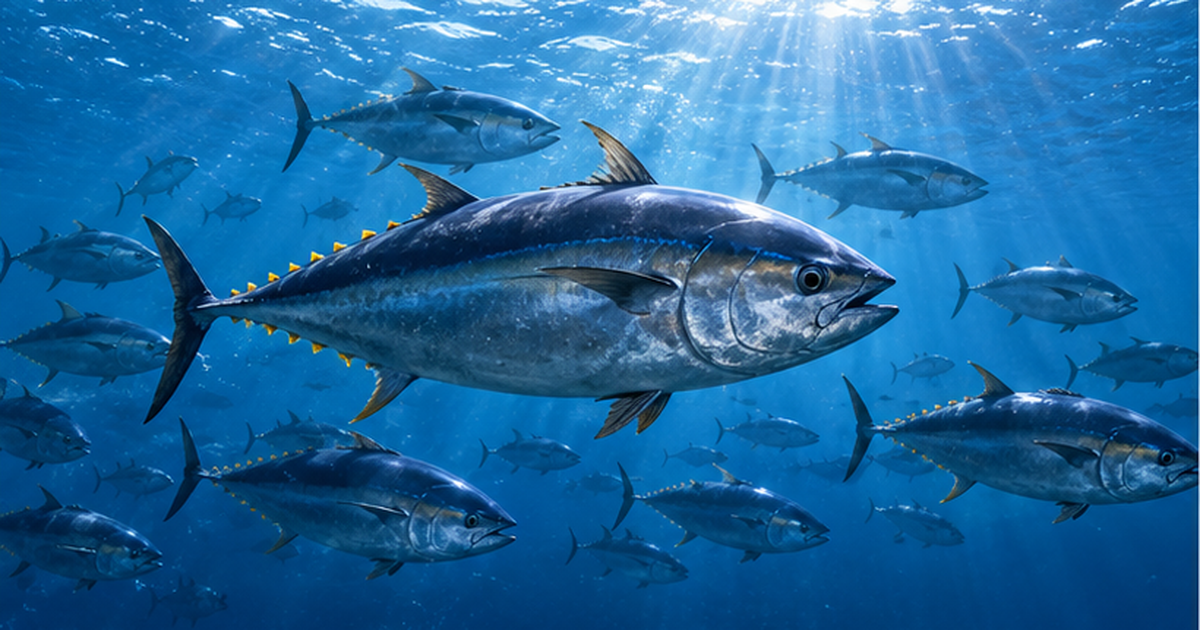
Pacific bluefin tuna, a familiar fish in sushi and sashimi (scientific name Thunnus orientalis), was assessed in 2014 as a threatened species (Vulnerable, VU) on the IUCN Red List. In the 2021 update, however, its assessment was lowered one rank to Near Threatened (NT). Many people still wonder whether it is now a fish we can keep eating and whether the regulations worked.
In short, the stock has clearly recovered thanks to management, but it is not yet at a stage where we can say "all is safe." Behind the recovery lie international catch limits, quantity management by Japanese fishers, and accumulated scientific stock assessments.
Scope of this article
This article covers the decline, the international management framework, achievement of the rebuilding target, the IUCN reassessment, and the recent debate over raising catch limits, in chronological order. For the species' ocean-crossing ecology, see The Science of Bluefin Tuna's Great Migration.
Key points
- The IUCN change does not declare that the stock is safe; it means a recovery trend was confirmed and the estimated extinction risk fell.
- The increase in catch limits is being discussed as the next stage after the rebuilding target was met.
Why the stock fell to a historic low
Fishing pressure on a slow-maturing fish
Bluefin tuna take about 3 to 5 years to mature. When large numbers of young fish (juveniles) are caught before spawning, future spawners cannot grow and the stock shrinks. In the 2000s, catches of small fish known as "yokowa" by purse seine fisheries, including in the Sea of Japan, were large and have been pointed to as accelerating the decline of the spawning stock.
The drop in spawning stock biomass shown by assessments
According to stock assessments by the International Scientific Committee (ISC), the spawning stock biomass of Pacific bluefin tuna fell to a historic low of less than 10% of its level before fishing began (unfished biomass). With fewer spawners, fewer eggs are produced and recruitment (the new generation entering the fishery) also becomes unstable.

The responsibility of consuming nations
Japan is both a major catching nation and a consuming nation of Pacific bluefin tuna, and internationally Japan has been strongly held responsible for stock management. The threat that illegal, unreported and unregulated (IUU) fishing poses to stocks is covered in What Is IUU Fishing?.
How international management works: the roles of WCPFC and IATTC
Two regional fisheries management bodies
Tunas in the Pacific are managed by the Western and Central Pacific Fisheries Commission (WCPFC), which covers the west and central Pacific, and the Inter-American Tropical Tuna Commission (IATTC), which covers the eastern Pacific. Because bluefin tuna migrate across the wide Pacific, cooperation between the two bodies is essential.
| Organization | Area covered | Main role |
|---|---|---|
| WCPFC | Western and central Pacific | Sets catch limits and management measures for Japan, Korea, Taiwan and others |
| IATTC | Eastern Pacific | Manages catches by Mexico, the United States and others |
| ISC | Entire North Pacific | Provides stock assessments by scientists |
Dividing roles between science and policy
Scientists at the ISC conduct the stock assessment, and the WCPFC Northern Committee discusses management measures based on the results, which are formally adopted at the annual meeting. Establishing a process in which limits are set on scientific evidence became the foundation of the recovery.
Catch limits: quantity management that protects small fish
Separate limits for small and large fish
Management centers on setting separate catch limits for small fish under 30 kg and large fish of 30 kg or more. Because protecting juveniles is the most effective way to rebuild spawners, measures sharply reduced the catch of small fish in particular.

Quantity management within Japan
In Japan, the limits agreed internationally are allocated to fishery types and prefectures, and a system was put in place to manage the catch of each fisher. When a limit is close to being exceeded, cooperation on the water is required, such as voluntarily suspending operations.
Management challenges
- Set nets can catch bluefin tuna that were not targeted, and handling this "bycatch" is a challenge
- Operational details are needed, such as adjusting the following year's limit after an overrun and ensuring fish are released
- Regulations now also extend to recreational fishing
About checking figures
- Specific limit quantities are reviewed every year. Check the latest values in official announcements from the Fisheries Agency and the WCPFC.
Reaching the rebuilding target and the IUCN reassessment
A two-stage rebuilding target
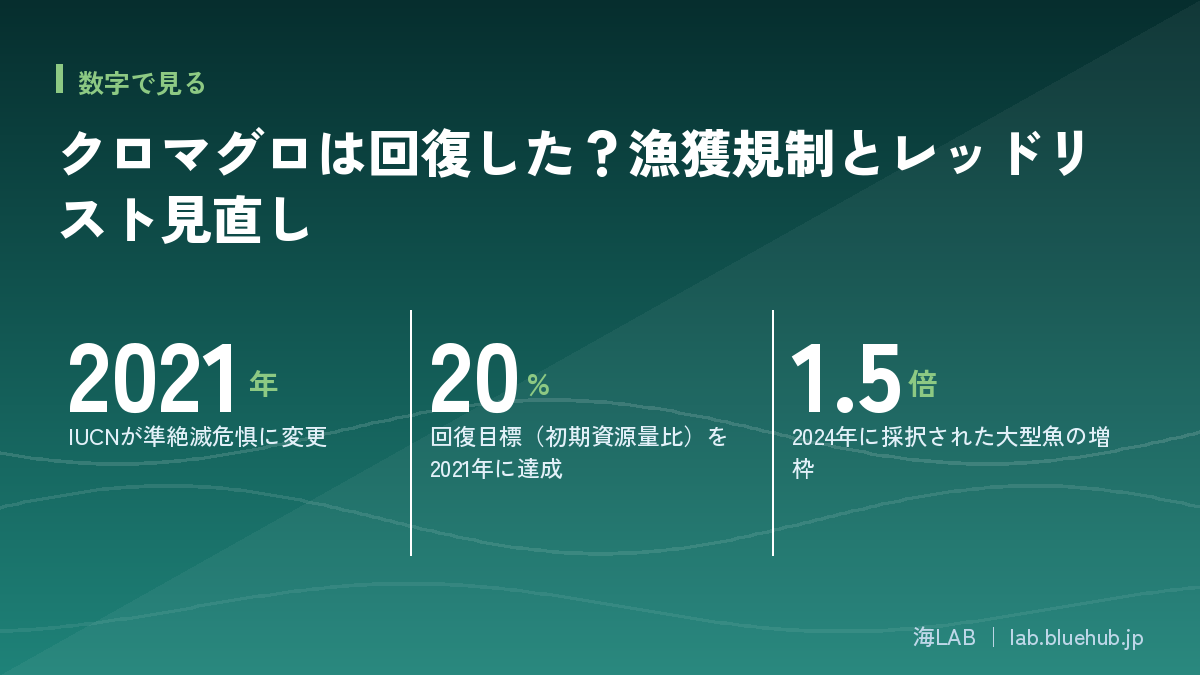
The WCPFC set its rebuilding targets in stages. The first interim target was to restore the historical median of spawning stock biomass, and the more ambitious next target is "20% of unfished biomass." The ISC assessment confirmed that this 20% target was reached in 2021.
The 2021 IUCN assessment change
In the September 2021 update of the IUCN Red List, Pacific bluefin tuna was lowered from Vulnerable (VU) to Near Threatened (NT). Rankings of other tuna species were also revised in the same update. The reason was that the latest stock assessment data and models were in place and the estimated extinction risk had fallen.
| Year | Event |
|---|---|
| 2014 | IUCN assesses Pacific bluefin tuna as threatened (VU) |
| 2015 | Management begins under an international agreement, including halving the catch of small fish |
| 2021 | Spawning stock confirmed to have reached the 20% target of unfished biomass / IUCN changes assessment to Near Threatened (NT) |
| 2024 | WCPFC annual meeting adopts an increase in catch limits |

For general lessons on stock collapse from overfishing and how to recover, see Why Do Fish Stocks Collapse from Overfishing? as well.
The debate over higher catch limits
The 2024 decision to raise limits
At the WCPFC annual meeting at the end of November 2024, an increase of 1.1 times for small fish and 1.5 times for large fish was reportedly adopted. The basis is that the stock recovered steadily from a historic low.
Talks on 2027 and beyond
On limits for 2027 and beyond, Japan sought a 25% increase for large fish in the western and central Pacific, and coordination with Mexico, which sought an increase for the eastern Pacific, proved difficult. In the later renegotiation, a plan to raise large fish by 25% and cut small fish by 6%, applied for two years from 2027, was reported. Japan's specific allocation is expected to be decided in talks with Korea and Taiwan.
Information based on press reports
- The outcome of the renegotiation is based on press reports. Check official documents from the Fisheries Agency and WCPFC for the formal measures.
What it means to "increase large fish and reduce small fish"
Protecting small fish that become future spawners while allowing more room for large fish that can already spawn is an approach that protects the stock while improving the sustainability of fisheries.
Remaining challenges and what we can do
Challenges to protecting the recovery
- Uncertainty about how rising sea temperatures from climate change affect spawning grounds and prey distribution
- IUU fishing and the difficulty of reaching agreement between countries and regions
- Stock assessments involve uncertainty and depend on fluctuations in new generations (recruitment)
Choices for consumers
When eating bluefin tuna, one approach is to be aware of whether the fish was caught under stock management and, for farmed fish, whether environmental considerations were made. For mercury in tunas, see Why Does Mercury Concentrate in Tuna?.
What you can do today
- Check the latest management information, such as catch limits, in Fisheries Agency materials.
- Choose seafood that takes stock management and certification into account.
- Share with those around you that "recovered" is not the same as "can now be caught without limit."
Summary: recovery is the result of management; the next step is to sustain it
Through international catch limits that protect small fish and the accumulation of scientific stock assessments, the spawning stock reached its rebuilding target and the IUCN assessment was lowered to Near Threatened. This can be called a success of resource management through international cooperation.
However, raising catch limits created a new challenge: how to use the recovered stock sustainably. With climate change and the difficulty of agreement, it is important that careful, science-based operation continues.
Summary of this article
- The IUCN assessment changed to Near Threatened in 2021.
- The spawning stock reached the rebuilding target of 20% of unfished biomass.
- Higher limits are now under discussion, but sustainable management remains essential.
References
- Fisheries Agency – Management of Pacific bluefin tuna
- Western and Central Pacific Fisheries Commission (WCPFC) – Conservation and management measures
- IUCN Red List – Thunnus orientalis
- Inter-American Tropical Tuna Commission (IATTC) – Management of the eastern Pacific
- International Scientific Committee (ISC) – Stock assessments of North Pacific tunas
- Japan Fisheries Research and Education Agency – Bluefin tuna stock assessment
* Listed in order of reliability: government agencies and academic institutions > peer-reviewed papers > specialist organizations > reliable media