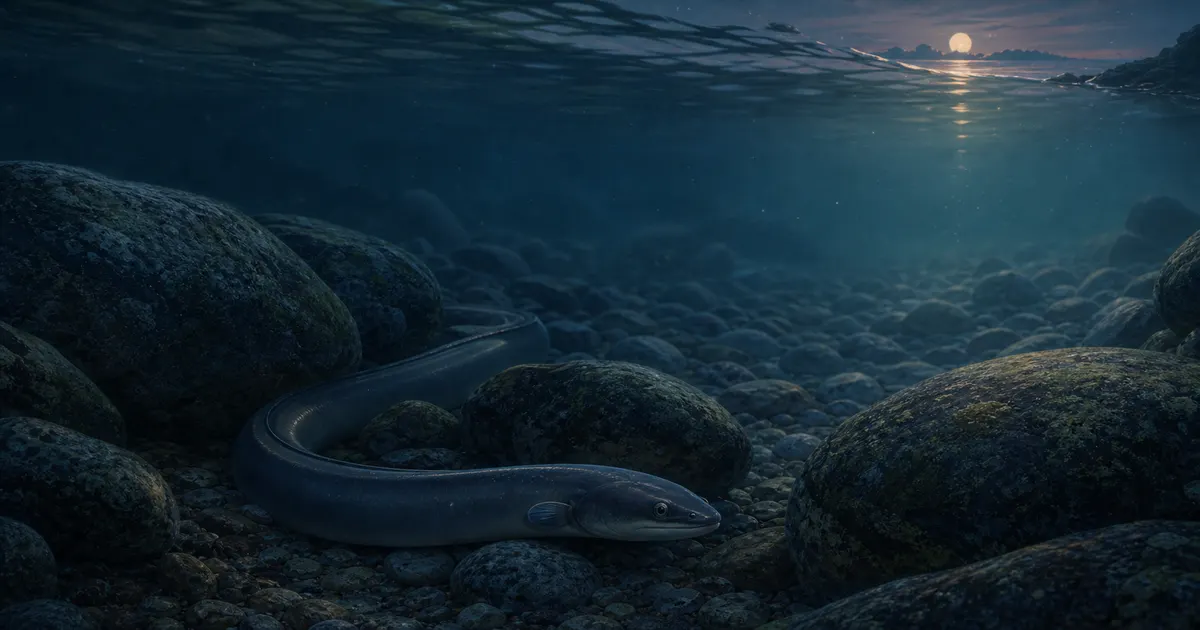
On the summer Day of the Ox, drawn in by the fragrant smell of grilled sauce, many people eat eel. The star of that dish, the Japanese eel, is in fact a bona fide endangered species - listed as "Endangered" by the International Union for Conservation of Nature (IUCN), and given the same "Endangered" classification by Japan's Ministry of the Environment. Every year, as a matter of course, we eat a creature at risk of extinction.
At the root of this contradiction lies the extraordinary life of the Japanese eel. After spending several years in Japan's rivers, it travels thousands of kilometers south to the Mariana Ridge to spawn, and its offspring ride the Kuroshio Current back to Japan. If even one link in this grand migration is severed, the population can collapse easily. And in fact, catches of glass eels - the juveniles that make it back from spawning - have fallen by more than 95% over the past 60 years.
This article traces the mystery of the spawning migration, the overfishing of glass eels and the loss of their habitat, the promising technology of full-cycle aquaculture, and what sustainable consumption might look like - drawing on primary sources from the Ministry of the Environment, the Fisheries Agency, the Japan Fisheries Research and Education Agency, and universities. If there is a future in which we can keep eating eel, where does the key to it lie?
What you'll learn in this article
- Why the Japanese eel was listed as Endangered - the scientific basis in decline rates
- The mystery of the spawning migration: a 6,000 km round trip to the Mariana Ridge, guided by the new moon and a salinity front
- Why glass eel catches have fallen more than 95% in 60 years, and the resource management mechanism of pond-stocking caps
- How estuary weirs and concrete embankments took away eel habitat, and regeneration efforts like stone-basket shelters
- From the world's first full-cycle aquaculture in 2010 to a cost cut to one-twentieth - the barriers before artificial seedlings reach the dinner table
- The reality of illegal fishing and unreported distribution, and the consumer's perspective of "which eel to choose"
Just How Precarious Is the Japanese Eel Right Now?
Hearing that "eel is an endangered species" surprises many people. Grilled eel lines the shelves of supermarkets and specialty shops, and it's consumed in large quantities each season. And yet, by scientific criteria, the Japanese eel has been assessed as a species with "a high risk of extinction in the wild in the near future." Being abundantly available on the market and having a healthy population are two entirely different things.
The "Endangered" Listing by the IUCN and the Ministry of the Environment
In 2014, the IUCN classified the Japanese eel on its Red List as "Endangered (EN)." Ahead of this, in February 2013, Japan's Ministry of the Environment had already raised its status in the 4th Red List from "Data Deficient" to Endangered. Endangered denotes a rank "not as severe as Critically Endangered, but with a high risk of extinction in the wild in the near future" - a serious category that places the eel alongside species such as the Japanese giant salamander and the rock ptarmigan.
The reasons cited for the listing broadly break down into excessive fishing, degradation of habitat (rivers and coastal areas), and fluctuations in ocean conditions such as changing currents. Why the eel's numbers have declined cannot be explained by a single cause - multiple factors from river to sea overlap. This "complexity of causes" is precisely what makes countermeasures difficult. If there were a single culprit, catching it would suffice, but when multiple factors are intertwined, resolving just one of them won't bring the population back.
Moreover, the Japanese eel is not the only species in crisis. The European eel fell into serious decline even earlier and has its international trade regulated under CITES (the Washington Convention). Concerns exist over American eel stocks as well. The fact that eel species around the world are declining across the board shows that this is not a problem for Japan alone, but a structural issue that calls into question the relationship between people, rivers, and the sea itself.
"Rate of Decline" as a Scientific Yardstick
What underpins the endangered assessment is the speed of population decline. Eels are thought to take roughly 4-15 years to mature, and using this lifespan, catch data spanning three generations (roughly 12-45 years) was used to estimate the change in population, arriving at a decline rate of 72-92%. In other words, over the past several decades, eel populations may have shrunk not just by half, but by nearly a tenth in the broadest estimate.

Assessing eel populations is difficult because they spend most of their lives out of sight, on riverbeds or in the sea, and their spawning grounds lie thousands of kilometers from Japan. The eel is a symbolic presence when discussing Japan's marine biodiversity, but because of this "invisibility," we have tended to be slow to notice its decline. Indeed, it was only in 2009 that the spawning site was scientifically confirmed. We have continued to consume, on a massive scale, a fish whose ecology remains largely shrouded in mystery.
The Contradiction of "Eating an Endangered Species"
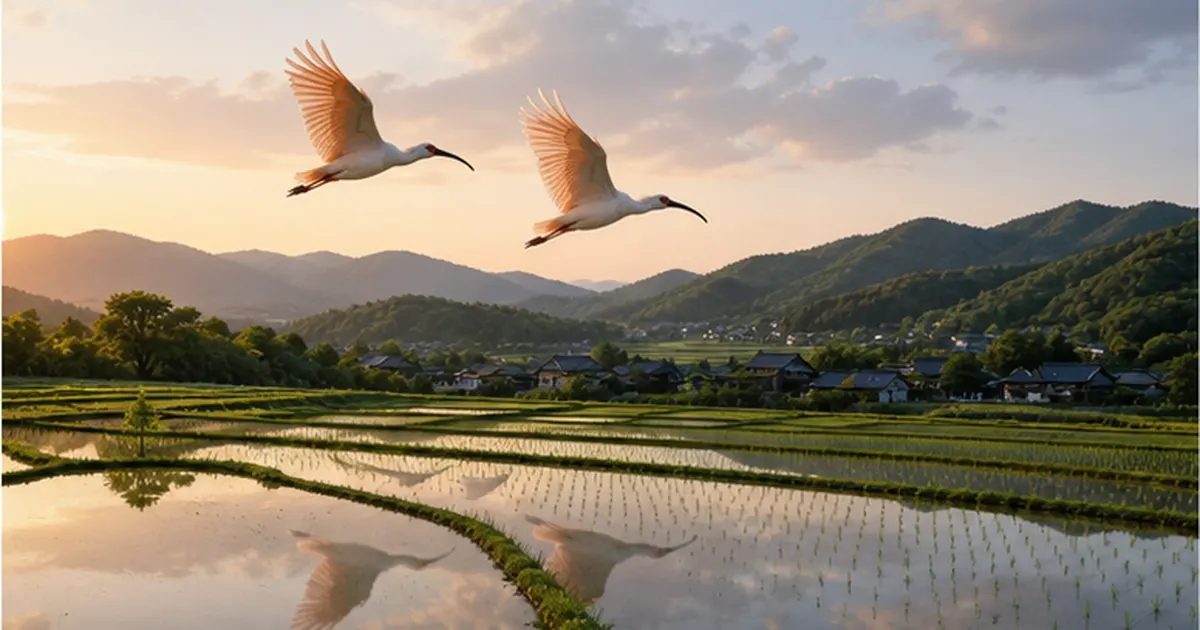
Let's pause here to think for a moment. When people hear that the crested ibis or the Oriental stork is endangered, most immediately understand them as "birds that must be protected." Yet with eel, despite carrying the same Endangered classification, we eat it in large quantities as a seasonal tradition. This gap arises from the eel's dual nature as both a "wild creature" and a "food ingredient / commodity." The difficult question of how to balance conservation with use is condensed into this one fish.
What must not be misunderstood is that this is not simply a matter of "you shouldn't eat an endangered species." Most experts believe the path forward is to scientifically manage the population and protect it while using it in a sustainable way. Rather than a binary choice between prohibition and consumption, the question of how to reconcile food culture with resource conservation runs through this entire article.
Key Points of This Section
- The Japanese eel is listed as Endangered (EN) by both the IUCN and Japan's Ministry of the Environment
- The listing is based on a high population decline rate of 72-92% over the past three generations (roughly 12-45 years)
- The causes of decline are a combination of overfishing, habitat degradation, and ocean environmental change, making a single cause hard to pin down
The 6,000 km Mystery — Spawning Migration and the Mariana Spawning Grounds
To protect the Japanese eel, we must first know where it is born and how it lives. And yet, for a long time, its life history was one of the greatest mysteries in biology. Everyone knows the adult eels living in rivers, but until quite recently, no one had ever seen the site where they lay their eggs.
A "Catadromous" Fish That Moves Between River and Sea
The Japanese eel is a catadromous fish - born in the sea, raised in rivers, and returning to the sea to spawn. Individuals that have grown for 5-15 years in Japan's rivers and estuaries transform in autumn into silver-tinged "silver eels" and, without feeding, set out on a one-way journey south across the Pacific. In this respect of long-distance movement, the eel is, like whales that migrate thousands of kilometers, a grand traveler with the ocean as its stage.
It is thought that adult eels, once they have finished spawning, end their lives there. Just once in a lifetime, they set out on a journey that exhausts all their strength, solely to leave offspring in a distant sea - the eel's life is designed with this kind of drama built in. To swim thousands of kilometers without feeding, the eel stores up ample energy in its body while still in the river. The rich fattiness of grilled eel is, in part, preparation for this long journey.
Even more remarkably, whether an eel goes up a river at all is itself flexible. Not every individual heads upstream; some stay and grow in estuaries or coastal areas. This flexibility to change its way of life according to the environment has allowed the eel to adapt to a wide range of temperate and tropical waters around the world. But even with this adaptability, it can no longer sustain its population in the face of today's rapid environmental change and overfishing.
The Spawning Ground Katsumi Tsukamoto and Colleagues Tracked Down
The research group that kept tackling this mystery was led by Professor Emeritus Katsumi Tsukamoto of the University of Tokyo. After decades of surveys, by around 2005 the team had, using tiny leptocephalus larvae (willow-leaf-shaped juveniles) as clues, narrowed down the spawning grounds to the area near the western Mariana Ridge and Suruga Seamount, west of Guam. Then, in May 2009, they finally succeeded in collecting 31 wild eel eggs. It was the moment humanity first witnessed the "spawning site" of the Japanese eel.

New Moon and Salinity Front — A Hypothesis for Spawning Timing
What the research revealed is that spawning does not appear to happen by chance, but is guided by a number of cues. The eggs collected were all concentrated in the days just before a new moon. Dark nights may make it harder for predators to spot the newly hatched larvae, helping them survive - this is the "new moon hypothesis." The very fact that deep-sea spawning appears synchronized to the rhythm of the moon's phases evokes a sense of wonder at the mysteries of life.
The research team further considered that, because the eggs were found near where a "salinity front" - the boundary where high-salinity and low-salinity seawater meet - crosses a chain of seamounts, eels might be using this front as a landmark to locate their spawning grounds. That a single point where three conditions - new moon, salinity front, and seamount chain - overlap can be found at the end of a 6,000 km round trip is nothing short of astonishing in its precision. Exactly how eels sense this point, and what sensory organs they use to read the environment, remains not fully understood even today.
Identifying this spawning ground is more than a mere academic discovery. If we know where eggs are laid and what ocean currents carry the larvae, we can predict how changes in sea temperature or the Kuroshio Current will affect the population. To read the recent poor glass eel catches not only through fishing pressure but also through the lens of ocean conditions, understanding the spawning migration serves as a foundation for conservation.
- Newly hatched larvae (leptocephali) ride the Kuroshio Current, taking several months to reach the coasts of East Asia
- As they approach the coast, they metamorphose into the transparent juvenile form, the "glass eel," and swim upriver to settle
- After growing for 5-15 years in the river, mature adults become silver eels and head back down to the Mariana region to spawn
Leptocephali and Glass Eels
For a while after hatching, baby eels take the form of a special larva called a "leptocephalus" - transparent and shaped like a willow leaf. This metamorphoses along the coast into the slender "glass eel" (juvenile), which then swims upriver. This unique metamorphosis is itself one of the major reasons full-cycle aquaculture, discussed later, has proven so difficult.
Why Did the Juveniles Disappear? — Glass Eel Overfishing and Resource Management
Eel farming is not, in the mainstream approach, a matter of raising eels from eggs, but of catching wild glass eels that have returned to rivers and raising them. In other words, even though it's called "aquaculture," its starting point depends entirely on wild resources. That is precisely why a decline in glass eels translates directly into a resource crisis.
Glass Eels Down More Than 95% in 60 Years
Domestic glass eel catches exceeded 200 tons a year in the 1960s. By the 1980s they had fallen to the 20-40 ton range, and in recent years the situation has grown even more severe. According to Fisheries Agency statistics, domestic catches in 2024 fell to about 7.1 tons. That's a decline of more than 95% from the peak, showing just how thin the number of juveniles returning to rivers has become.
Wild catches of grown yellow eels have also continued to decline, hitting a record low of 52 tons in 2024. Both juveniles and adults are declining together - a fact that speaks not to a single bad year, but to a structural shrinking of the population as a whole.

Not Overfishing Alone — Compound Factors
The cause of the decline cannot be attributed to fishing alone. Many researchers point out that excessive fishing overlaps with degradation of river and estuary environments, discussed later, and global-scale changes in ocean currents. In particular, fluctuations in the Kuroshio Current's path and sea temperature affect whether larvae can successfully reach Japan. The eel's poor catches are tied not just to the waters around Japan but to environmental conditions across the entire Pacific.
The way rising sea temperature is shifting fish distribution and stock size is a structure shared with the poor catches of Pacific saury and Japanese flying squid. Eels, too, are caught up in the great wave of climate change. Even a slight change in ocean conditions near the spawning grounds could substantially shift the proportion of larvae that successfully reach Japan. Behind the "poor catch" we see in rivers and fishing ports lies an invisible change unfolding in a sea far to the south.
Another point that must not be overlooked is that what's being caught is "the future parents that would go on to spawn." Glass eels are the generation that swims up rivers, grows into adults, and eventually heads out to spawn. The more of these juveniles are caught, the fewer parents remain to lay the next generation's eggs, eroding the population's very capacity to recover. The reason overfishing does such serious damage to the resource lies in this structure of "consuming the future in advance."
Resource Management Through "Pond-Stocking Caps"
In response to this crisis, Japan, China, Taiwan, and South Korea have held ongoing international consultations since 2012 and introduced "pond-stocking quantity management," which sets a cap on the amount of juveniles that can be placed into aquaculture ponds. Within Japan, the 2024 pond-stocking cap was set at 24.2 tons (11 tons for Japanese eel, 13.1 tons for other species). However, actual pond-stocking in the 2024 fishing season was 15.8 tons, much of it dependent on imports, with domestic catches accounting for only about 5 tons.
Setting a cap on pond-stocking volume is meaningful as a first step in resource management. But challenges remain. Because the cap itself has been set higher than the actual recent pond-stocking volumes, there are pointed criticisms that "even with a cap in place, it isn't functioning as a real constraint." Furthermore, if unreported glass eels mix into the distribution chain, discussed below, it undermines the accuracy of the statistics that quantity management depends on. The management framework exists, but improving its precision to make it truly effective remains homework for the future.
| Category | Approximate amount (around 2024) | Notes |
|---|---|---|
| Domestic catch in the 1960s | Over 200 tons | Peak-era level |
| Domestic catch in 2024 | About 7.1 tons | Down more than 95% from peak |
| 2024 pond-stocking cap | 24.2 tons | 11 tons Japanese eel + 13.1 tons other species |
| Actual pond-stocking in the 2024 season | About 15.8 tons | Of which about 10.5 tons imported, about 5 tons domestic catch |
Key Points of This Section
- Domestic glass eel catches fell from over 200 tons in the 1960s to about 7.1 tons in 2024 (down more than 95%)
- Wild catches of yellow eel also hit a record low of 52 tons in 2024
- Japan, China, Taiwan, and South Korea manage stocks through pond-stocking caps, but in practice this relies on imports as domestic catches keep shrinking
Eels Disappearing From Rivers — Habitat Degradation and Restoration
In the story of eel decline, overfishing of juveniles tends to get the spotlight, but we must not forget that the very places where they grow up have been disappearing. Even if juveniles do swim up a river, without an environment where they can safely hide, feed, and grow large, the population cannot recover.
The "Homes" Taken Away by Estuary Weirs and Embankments
Since the period of rapid economic growth, Japan's rivers have been dramatically reshaped for flood control and water use. Estuary weirs and dams block the path juveniles use to swim upriver, and concrete embankments have taken away the gaps between riverbank stones and the aquatic plants that once served as eel hiding places. According to Ministry of the Environment materials, in places where the water's edge is covered seamlessly in concrete, eel population density is lower, and the organisms they feed on also decline, resulting in poorer growth.
During the day, eels hide in the gaps between large stones, rocks, and concrete blocks, in aquatic plants, and in accumulated fallen leaves. The loss of these "gaps" amounts to a housing crisis for eels. The straightening and homogenization of rivers has, like the reclamation of tidal flats, quietly whittled away habitat for living creatures.
Estuaries and brackish zones are also an important growing environment for eels. This zone where river and sea waters mix is rich in food, and many young eels grow there. But estuary weirs cut off this brackish zone, and land reclamation and infilling eliminate the feeding grounds themselves. Because the eel's life is built on skillfully using the boundary between fresh and salt water, the impact of destroying that boundary environment is significant.

The Ministry of the Environment's "Habitat Conservation Concept" and Stone-Basket Shelters
The Ministry of the Environment has published its "Concept for Habitat Conservation of the Japanese Eel," setting out guidelines for how to protect and restore environments that serve as hiding places and feeding grounds. One concrete measure is the stone-basket shelter (ishikura kago). By packing wire-mesh baskets with stones and sinking them to the riverbed, these create artificial hiding places for eels, and installations are progressing in rivers across the country.
That said, some researchers point out that it must be carefully determined whether stone-basket shelters actually "increase" eels, or merely "concentrate" eels already present nearby. If eels gather locally without the population of the river as a whole increasing, it cannot be called true recovery. Habitat restoration is a long-term effort that should proceed while scientifically verifying its effectiveness.
Fish Ladders That Help Upstream Migration, and a Whole-Watershed Perspective
Alongside creating hiding places, another important step is securing a "passage" that lets juveniles travel from the sea to the upper reaches of a river. Even where weirs and dams exist, installing a fish ladder (a channel fish can climb) alongside them allows eels to reach upstream areas again. Eels are highly capable of wriggling their bodies to climb wet slopes, so a modest bit of engineering can greatly expand the range they can reach. What's needed is a perspective that considers river management and resource conservation together, across the whole watershed rather than in isolation.
These efforts don't produce visible results quickly. Even after restoring a river that juveniles can climb, it will be years before those individuals head off to spawn. That is precisely why, rather than reacting to short-term catch figures alone, it's essential to nurture the river environment - the very foundation that generates the resource - with a long-term perspective. Just like creating marine protected areas, habitat conservation is an investment that spans generations.

- Estuary weirs and dams block juveniles from swimming upstream, keeping eels away from the upper reaches of rivers
- Concrete embankments reduce hiding places and food organisms, taking away growing grounds
- Creating hiding places such as stone-basket shelters, and installing fish ladders at weirs, are advancing as restoration measures
The Easily Overlooked "Land-Side Factor"
The eel crisis is often told as a story of "overfishing at sea," but the degradation of rivers as habitat carries just as much weight. Resource management to protect juveniles and environmental conservation to restore rivers must advance together, as two wheels of the same cart, or neither will be effective on its own.
The Dream of Raising From Eggs — The Journey of Full-Cycle Aquaculture Research
As long as it relies on wild juveniles, eel farming will always be at risk from a resource crisis. So could we instead raise juveniles by hand from eggs, creating aquaculture that doesn't depend on wild resources at all? That is the dream of "full-cycle aquaculture." Japanese researchers have kept tackling this challenge for half a century.
2010: The World's First Success in Full-Cycle Aquaculture
A major milestone came in 2010. The then-Fisheries Research Agency (now the Japan Fisheries Research and Education Agency) became the first in the world to succeed in "full-cycle aquaculture" - taking eggs from artificially raised adult eels, hatching those eggs, and obtaining the next generation. Producing a new eel from an eel born in the laboratory - this achievement, closing the loop of the life cycle by human hand, is etched into the history of eel research as a landmark accomplishment.
Furthermore, in October 2023, Kindai University announced it had become the first university to succeed in full-cycle aquaculture of the Japanese eel. The involvement of this university, known for full-cycle bluefin tuna aquaculture, shows the research base broadening, with the technology no longer confined to a single institution. A framework is taking shape in which national research institutes, universities, and private companies each bring their strengths, and what was once a pipe dream - "raising eel from eggs" - is beginning to rise as a real industry.
This journey has not been a quick one. Japan's research into artificial eel breeding dates back to the 1960s, and for a long time, even getting eggs to hatch was difficult. After passing through an era in which no one knew what the larvae ate, and many individuals died without reaching food, survival rates were gradually raised, until the life-cycle loop was finally closed in 2010. The length of this half-century speaks to just how formidable an opponent this technology proved to be.

Why Is Artificial Breeding of Eels So Difficult?
The reason full-cycle eel aquaculture proved such a formidable challenge lies in its unique life history. First, adult eels do not naturally mature in aquaculture ponds, and inducing them to spawn requires assistance such as hormone administration. And the biggest wall of all is the "food" for the hatched leptocephalus larvae. These larvae are thought to feed on marine snow (fine particles such as plankton remains) in the ocean, and it took an enormous amount of time to work out what to feed them so they would grow.
The feed eventually developed through research is a paste-like substance based on ingredients such as spiny dogfish eggs, difficult to handle and manage. Because even a slight disruption in water quality can weaken the larvae, raising them requires meticulous care. Whether this stage can be overcome reliably is the single biggest key to the "mass production" discussed next. There is a far greater gap than one might imagine between the technology to raise a single individual and the technology to raise tens of thousands of them efficiently.
What's interesting is that this very difficulty speaks to the depth of the eel as a creature. Among marine animals, some species, like sea turtles, have seen significant progress in human-assisted breeding and protection, but the eel's complex metamorphosis and long-distance migration did not make this easy. Full-cycle aquaculture, which finally closed the loop after half a century, is an achievement made possible only through the accumulation of patient, fundamental research.
The technology to raise a single eel born in the laboratory, and the technology to reliably mass-produce tens of thousands of them, are entirely different challenges.
— From a common point of discussion in full-cycle aquaculture research
"Full-Cycle Aquaculture" and "Artificial Seedlings"
Full-cycle aquaculture refers to establishing a cycle in which eggs are taken from artificially raised parents to produce the next generation. The juveniles produced this way are called "artificial seedlings." The technology was established in 2010, but whether it can replace wild glass eels depends on whether these artificial seedlings can be produced cheaply and in large quantities.
The Wall of Mass Production and Cost — When Will Artificial Seedlings Reach the Table?
There is a deep gap between full-cycle aquaculture being "possible" and it being "commercially viable." Even if a single eel can be raised in a laboratory, if the cost is dozens of times higher than wild juveniles, it won't reach the table. Recent progress amounts to a fight to close precisely this cost gap.
From ¥40,000 per Fish to About ¥1,800
According to the Japan Fisheries Research and Education Agency, the production cost of artificial seedlings was as high as about ¥40,000 per fish in fiscal 2016. Through technical improvements, that has fallen to about ¥1,800 in fiscal 2023 - a dramatic improvement to less than one-twentieth. Furthermore, projections suggest the cost could fall below ¥1,000 by fiscal 2027. Once it approaches the trading price of wild glass eels, artificial seedlings will become a realistic option.

Mass-Production Tanks and Automation Technology
Underpinning this cost reduction is the evolution of rearing equipment. In 2025, the Japan Fisheries Research and Education Agency, Yanmar Holdings, and Marino Forum 21 announced they had developed a new mass-production tank capable of producing glass eels at low cost. By refining the water flow and feeding suited to raising larvae, more juveniles can be raised with less labor. Automated feeding systems and the selective breeding of hardy, easy-to-raise strains are also advancing in parallel. In the research field, efforts approaching what could be called "eel breed improvement" are beginning to come into view.
Behind this cost reduction lies an accumulation of such steady improvements. Reworking the feed formula, refining tank shape and water flow, and establishing husbandry practices that prevent disease - each step is small on its own, but combined, they pushed "¥40,000 per fish" down to "about ¥1,800." It wasn't a single flashy invention but the sum of countless rounds of trial and error that produced this one-twentieth figure.
Concrete Moves Toward Commercialization
The government, too, is stepping up its support. The Fisheries Agency has invested about ¥700 million in a "project to commercialize a mass-production system for eel seedlings," working with private companies to build out mass-production capacity. Some companies have already entered the stage of stably producing more than 10,000 artificial seedlings a year, and with the 2026 Day-of-the-Ox sales season as one target, trial sales of grilled eel from artificially hatched fish are coming into view. The fruits of laboratory research are finally on the verge of reaching a plate on the counter.

| Fiscal year / period | Cost / production of artificial seedlings | Status |
|---|---|---|
| FY2016 | About ¥40,000 per fish | Research stage - cost far too high |
| FY2023 | About ¥1,800 per fish | Reduced to less than one-twentieth |
| FY2027 (projected) | Under ¥1,000 per fish | Practical-use threshold |
| 2024 onward | Stable production of over 10,000 per year | Entry point to commercialization |
Even so, against the reality that several tons of wild glass eels are consumed annually, artificial seedling production is still only in the "tens of thousands" range. A single glass eel weighs only about 0.2 grams, so several tons amounts to tens of millions of individuals. For full-cycle aquaculture to fundamentally rescue the resource from crisis, production scale needs to be raised by several more orders of magnitude. Hope has certainly grown, but it will still take time before it can replace dependence on wild stock.
Even so, the significance this technology holds is great. If full-cycle aquaculture were mass-produced and eels could be raised without relying on wild juveniles, that would create room to leave juveniles returning to rivers undisturbed. Artificial seedlings could become not merely a "substitute ingredient," but a trump card that supports the recovery of wild populations. The ultimate goal of this research is to achieve, at the same time, both continuing to eat eel and protecting wild eels.
Key Points of This Section
- The production cost of artificial seedlings fell from ¥40,000 in fiscal 2016 to about ¥1,800 in fiscal 2023, to less than one-twentieth
- The Fisheries Agency has invested about ¥700 million to support commercialization technologies such as mass-production tanks and automated feeding
- Stable production of over 10,000 fish a year has begun, but scaling up remains the challenge to replace wild dependence
Poaching, Illegal Distribution, and International Regulation — Which Eel Should You Choose?
Resource management, habitat restoration, and full-cycle aquaculture are none of them a magic solution on their own. And there's another major problem lying on the side of consumption and distribution: for much of the eel we eat, where and how it was caught remains opaque.
"White Diamonds," Poaching, and Unreported Catches
Now-scarce glass eels trade at high prices and are sometimes called "white diamonds." As a result, poaching and unreported distribution have run rampant. According to WWF Japan and others, an estimated 40-50% of domestically caught glass eels are of "unreported," unknown origin, and in some years the majority of imported volume was of unknown origin as well. Without an accurate grasp of the numbers, it isn't even possible to properly manage the resource in the first place. A vicious cycle is at work in the world of eels: because it's an endangered species, prices soar, and those high prices in turn invite more poaching.
This is IUU fishing (illegal, unreported, and unregulated fishing) itself - catching fish in violation of rules on prohibited areas or seasons. Like ghost gear left behind in the sea, activity outside the rules is quietly eroding the effort put into resource management. No matter how solid a pond-stocking cap is set, if some unknown percentage of the juveniles entering it are "of unknown origin," the very foundation of that management becomes a house of cards.
Tougher Penalties and Mandatory Traceability
Countermeasures are also moving forward. The 2018 revision of the Fisheries Act significantly toughened penalties for poaching designated aquatic species, and for glass eels, starting in December 2023, heavy penalties of up to three years' imprisonment or a fine of 30 million yen now apply. Furthermore, starting in December 2025, glass eels will be added as a covered item under the framework of the Act on Ensuring the Proper Distribution of Specified Marine Products, making it mandatory to create and retain trade records from catch through pond-stocking and to pass along catch identification numbers. A system for tracing where eels come from is finally moving into full gear.

The Battle Over CITES (the Washington Convention)
Eel management has now also entered the arena of international politics. In 2025, the EU (European Union) proposed listing all eel species, including the Japanese eel, in Appendix II of CITES (the Washington Convention) to regulate international trade. Behind the proposal lay concerns over "laundering" - European eels caught illegally and traded in East Asia under falsified origin. The CITES Secretariat had recommended that the proposal be adopted.
However, Japan, arguing that "the Japanese eel's stock is secure and there is no risk of extinction through international trade," strongly opposed the proposal alongside China and South Korea. At the 20th Conference of the Parties (COP20), held in Samarkand, Uzbekistan, from November to December 2025, the EU's proposal to list all species was rejected by a wide margin, 35 in favor to 100 against. Regulation has been shelved for now, but the underlying problem of illegal distribution hasn't disappeared, and discussion is expected to continue.
This episode brought the differences in positions surrounding eel into sharp relief. The view that international trade should be tightly regulated to protect the resource, versus the view that real effectiveness can only be secured through coordinated pond-stocking management among the four countries - both agree on not wanting to see eels go extinct. The problem is that agreement on the means to achieve that has not yet been reached. This standoff underscored once again the fact that protecting a fish that migrates across borders requires cooperation that also crosses borders.
Changing How We Eat Is the Surest Vote We Can Cast
Discussions of systems and technology are large and complex, but there is something surprisingly close to home that we as consumers can do. First, choose eel that is properly labeled with its origin and its catch or farming method. Not jumping at cheap products of unclear origin is the most direct action we can take to avoid, through demand, lending support to illegal and unreported distribution. This connects directly with awareness around reducing seafood food loss.
Taking it a step further, there is also the choice to "reconsider the amount we eat itself." The pattern of selling eel in large quantities on the Day of the Ox, with unsold stock discarded, creates both pressure on the resource and food loss at the same time. Considering what's in season and how much we need, and eating only the amount we can truly enjoy - the accumulation of these small individual decisions ultimately becomes a force that protects eels in rivers and seas. A consumer's choice is a quiet but real vote cast in the market.
What You Can Do as a Consumer
- Check labeling on origin and catch method, and choose eel with a clear source
- Refer to sustainability information such as WWF's seafood guide
- Don't jump at "cheapness" alone - be aware of the resource and labor conditions behind the price
- Consider what's in season and how much you need, and reconsider the amount you eat (avoid overeating and overbuying)
Conclusion: The Day of the Ox, and the Eel's Future
The Japanese eel is a fish deeply rooted in Japan's food culture, and at the same time, an endangered species listed as Endangered. This crisis has arisen from multiple problems overlapping across the sea, rivers, and society: the 6,000 km journey to the Mariana Ridge spawning grounds, overfishing of glass eel juveniles, degradation of rivers as habitat, and opaque distribution.
There is hope, too. Since the world's first full-cycle aquaculture in 2010, the cost of artificial seedlings has dropped to less than one-twentieth, standing at the threshold of commercialization. Resource management through pond-stocking caps, restoration of river habitat, and countermeasures against poaching along with mandatory traceability are all advancing, step by step. The technology and systems to protect eels are certainly taking root.
Even so, this is not a problem that can be solved by relying on any single measure. Not overfishing juveniles, restoring rivers, refining the technology to raise eels from eggs, and each of us thinking about "which eel, and how much, we eat" - only when all of these move together at once will eel remain on the tables of the future. Sustainable consumption begins with the awareness that the bite of eel we savor on the Day of the Ox is, in fact, a bite of an endangered species.
For the Japanese, eel is not merely a source of protein. It appears in the Man'yoshu as a food effective against summer fatigue, the craft of grilling it was refined in the Edo period, and the custom of the Day of the Ox took root. Whether we can pass on this food culture, carried forward for over a thousand years, to the next generation, depends on the imagination to see that a single eel spawning on a new-moon night in the distant Mariana Sea is genuinely connected to our own dinner tables.
How we share the ocean's resources and pass them on to the next generation - the story of the eel, like marine protected areas and seafood food loss, is also a question we must ask of ourselves: how do we reconcile "eating" with "protecting"?
Summary of This Article
- The Japanese eel is Endangered (EN), with a scientific basis of a 72-92% decline over three generations
- The spawning ground is near the western Mariana Ridge and Suruga Seamount; eels travel a 6,000 km round trip, guided by the new moon and a salinity front
- Domestic glass eel catches fell from over 200 tons in the 1960s to about 7.1 tons in 2024 (down more than 95%)
- Habitat degradation from estuary weirs and embankments is also severe; river restoration efforts such as stone-basket shelters are needed as well
- Full-cycle aquaculture achieved its first success worldwide in 2010; artificial seedling costs have dropped from ¥40,000 to about ¥1,800, at the threshold of commercialization
- Illegal and unreported distribution runs deep, and tougher penalties and mandatory traceability are advancing; a CITES listing proposal was rejected in 2025
- Advancing resource management, habitat restoration, full-cycle aquaculture, and sustainable consumption together is the key to keeping eel around
References and Sources
- Ministry of the Environment - Announcement of the 4th Red List (Brackish and Freshwater Fish) / Listing the Japanese Eel as Endangered
- Ministry of the Environment, Nature Conservation Bureau - Concept for Habitat Conservation of the Japanese Eel
- Fisheries Agency of Japan - Information on Eel (Resource Management, Pond-Stocking Quantity, Full-Cycle Aquaculture)
- Fisheries Agency of Japan / Japan Fisheries Research and Education Agency - Status of International Fishery Resources 83: Japanese Eel (FY2025)
- Japan Fisheries Research and Education Agency - Information on Artificial Eel Seedling Production Technology (Full-Cycle Aquaculture, Artificial Seedlings)
- Fisheries Agency of Japan - Summary of Results of the Demonstration Project for Mass Production Systems Toward Commercialization of Eel Seedlings (FY2017-2023)
- The University of Tokyo - Research Findings, "Discovery of the Spawning Site of the Japanese Eel" (Katsumi Tsukamoto et al.)
- Kindai University - First University Success in Full-Cycle Aquaculture of the Japanese Eel (October 2023)
- WWF Japan - Toward Improving the Opaque Distribution of Glass Eels / The Extinction Crisis of the Eel
- Fisheries Agency of Japan - Results of the 20th Conference of the Parties to CITES (the Washington Convention) (2025)
* Listed in order of reliability: government and academic institutions > peer-reviewed papers > specialist organizations > trusted media