⚡ In short
Kin, the last Japanese-born crested ibis, died in 2003. Just over two decades later, roughly 500 wild ibises live on Sado Island. Descended from seven birds from China, supported by farmers who rewrote how they grow rice, the species reached the skies of Honshu in 2026.
On 10 October 2003, Kin, the last crested ibis born in Japan, died at an estimated age of 36. With her death, the Japanese lineage of a bird that had lived on these islands for millennia came to a complete end. Two decades later, roughly 500 crested ibises fly over Sado Island.
This recovery was neither a miracle nor an accident. Seven birds received from China, farmers who decided to halve the agrochemicals on their paddies, and researchers and residents who counted nests for more than twenty years: the ibis returned because people rebuilt, piece by piece, an environment people had dismantled.
Then, on 31 May 2026, the first release on Honshu took place in Hakui City, Ishikawa Prefecture, 56 years after the bird vanished from the mainland in 1970. Drawing on primary sources including the Ministry of the Environment's Crested Ibis Reintroduction Roadmap 2030, this article follows the full arc from extinction to recovery, and the problems that still lie behind the numbers.
What you will learn from this article
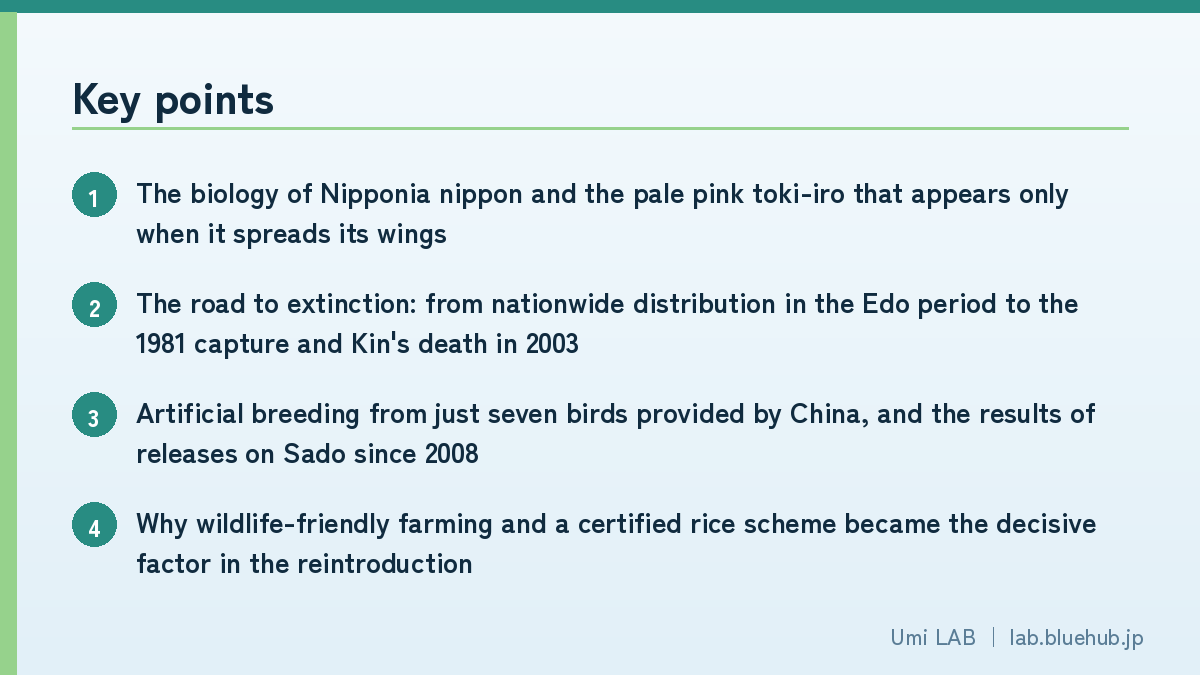
- The biology of Nipponia nippon and the pale pink toki-iro that appears only when it spreads its wings
- The road to extinction: from nationwide distribution in the Edo period to the 1981 capture and Kin's death in 2003
- Artificial breeding from just seven birds provided by China, and the results of releases on Sado since 2008
- Why wildlife-friendly farming and a certified rice scheme became the decisive factor in the reintroduction
- The four problems that remain: low genetic diversity, skewed distribution, friction with residents, and depopulation
- The first mainland release in Hakui, Ishikawa in 2026, and the path to 2035 laid out in Roadmap 2030
Nipponia nippon: the bird named twice for Japan
The crested ibis carries the scientific name Nipponia nippon. Both the genus and the species name mean Japan, a rarity among the world's birds. It belongs to the family Threskiornithidae in the order Pelecaniformes, measures about 75 centimetres in length, and spans 130 to 140 centimetres with its wings open. Adults weigh around 1.5 kilograms, males slightly more, with a maximum of about two kilograms.
The pink that appears only in flight
At rest, a crested ibis looks almost entirely white. Open the wings, however, and a pale pink spreads across the inner flight feathers. That colour is called toki-iro and has become a traditional Japanese colour name. The pigment behind it is thought to be a carotenoid derived from prey such as freshwater crabs. It is at its most vivid just after the autumn moult, and its intensity shifts with the seasons.
Turning grey for the breeding season
The species has a habit rarely seen in other white birds. Around December, ahead of the breeding season, the skin on the neck flakes off as a black powder, and the bird rubs that powder over its own body, staining itself grey from head to back. This is the breeding plumage. A pure white bird deliberately colouring itself grey is, for observers, one of the surest signs that the season has turned.
A hunter that works by touch, not sight
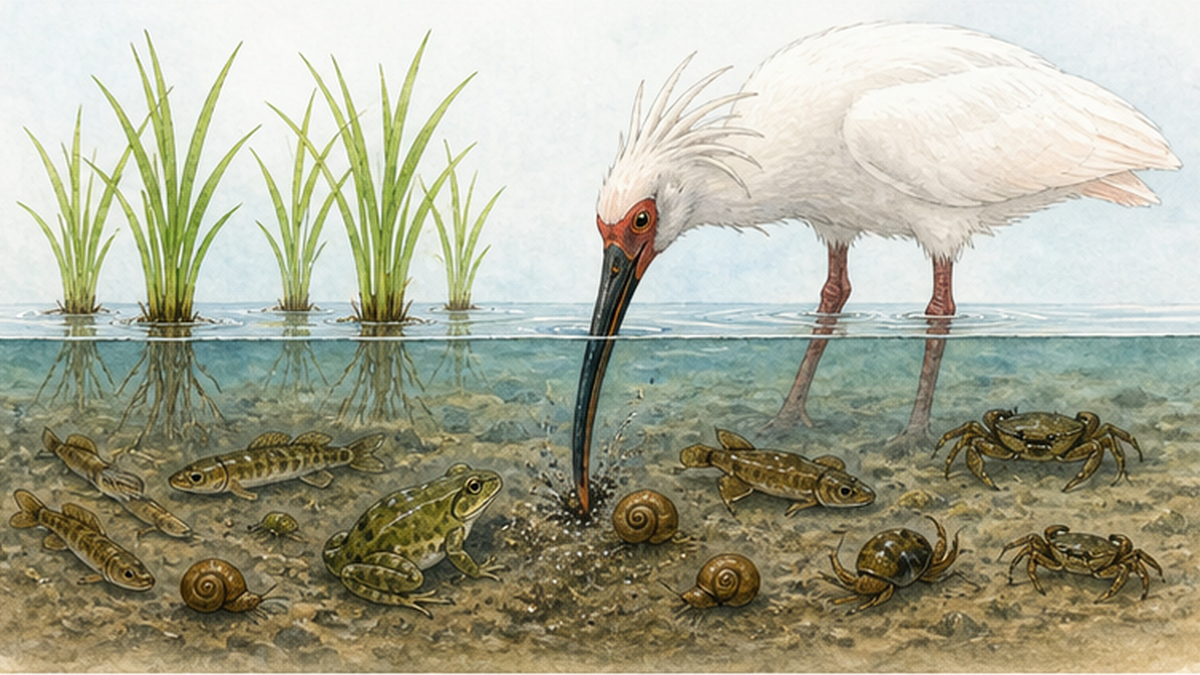
Its foraging is highly distinctive. The ibis pushes its long, downcurved bill into soft mud in shallow water and locates prey by touch rather than sight. Its diet is dominated by frogs, loaches and pond snails, supplemented by crabs and shrimp on the coast and by insects in season. It eats almost no plant matter.
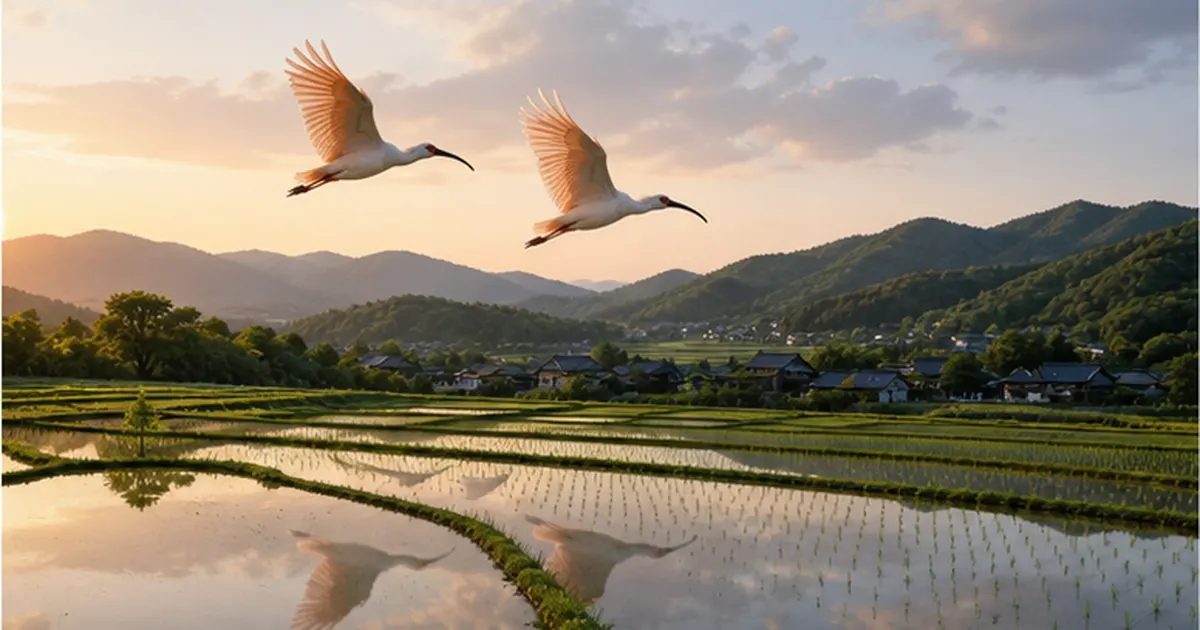
The implication is simple but heavy. A crested ibis needs shallow water, soft mud, and small animals living in it. In Japan, that description fits one habitat above all others: a flooded rice paddy. The ibis is called a bird of the satoyama not for poetic reasons, but because of the structure of its food supply.
A bird that became a colour name
Toki-iro has been handed down as one of Japan's traditional colour names. That the name survives in dyeing and kimono colour charts means this bird was once common enough to name a colour after. That a species carrying Japan in its name twice, and lending its name to a colour, could go extinct in the wild at home says a great deal about how much the country's environment changed in a single century.
Ibises forage in paddies and roost and nest in large trees near settlements: Japanese red pine, Japanese black pine, konara oak and cedar. Paddies, woodland and houses standing close together, in other words the very structure of the satoyama, is this bird's living space. Roadmap 2030 states explicitly that stable persistence in the wild requires keeping the entire ecosystem network in good condition, from feeding grounds such as paddies to the large trees used for roosting and nesting.
| Item | Details |
|---|---|
| Scientific name | Nipponia nippon |
| Classification | Order Pelecaniformes, family Threskiornithidae |
| Length / wingspan | About 75 cm / about 130-140 cm |
| Weight | Around 1.5 kg (up to about 2 kg) |
| Main prey | Frogs, loaches, pond snails, freshwater crabs, shrimp, insects |
| Foraging method | Probing mud with the long bill, locating prey by touch |
| Main habitat | Rice paddies, wetlands, riverbeds, satoyama |
| Breeding season | Roughly February to July |
| Legal status in Japan | Special Natural Monument (1952), National Endangered Species (1993) |
| Red List | Critically Endangered (CR), Ministry of the Environment Red List 2019 |
Three keys to understanding the crested ibis
- The pale pink inside the wings, toki-iro, comes from carotenoid pigments in its prey
- In the breeding season it rubs black powder from its neck skin over its body, turning from white to grey
- Paddies with shallow water, mud and small animals are its lifeline, so it can only be protected together with farming
Disappearing from the sky: a century of decline
According to Ministry of the Environment records, the crested ibis lived across almost all of Japan during the Edo period. From Hokkaido to Honshu, Shikoku and Kyushu, it was an ordinary bird wherever there were paddies and wetlands. In less than a hundred years it was gone.
Meiji-era overhunting: a pest, and a source of beautiful feathers
The turning point was the Meiji Restoration. Once hunting was liberalised, the ibis was shot for two reasons: it was regarded as a pest that trampled rice paddies, and its feathers fetched high prices as ornaments. Ishikawa Prefecture's records likewise note that the bird became a target of hunting from the Meiji period onward and declined sharply.
Protected status did not stop the decline
In 1908 the crested ibis was designated a protected bird under hunting regulations. It still did not recover. A 1926 survey of Niigata Prefecture's natural products recorded the species as extinct due to overhunting. In 1952 it was designated a Special Natural Monument, but by then only a handful of birds remained on Sado Island and the Noto Peninsula.
There is a lesson here that conservation biology has confirmed again and again. Banning capture does not stop a decline if habitat continues to disappear. Postwar pesticide use, the drying of paddies through land consolidation, and the concreting of irrigation channels quietly stripped away the places where loaches and frogs, the ibis's prey, could live.
Thirty-five birds in 1950, gone from Honshu by 1970
Ministry figures put the wild population at just 35 birds in 1950. In 1970 the last individual on the mainland, a bird named Nori, was rescued in Anamizu Town, Ishikawa Prefecture and moved to Sado Island. With that, the crested ibis vanished from Honshu entirely.
1981: the decision to capture the last five
In 1981 the government made a heavy decision. All five wild crested ibises remaining on Sado Island were captured, and full-scale artificial breeding began. At that moment the wild crested ibis disappeared from Japan. Ending the wild population in order to protect the species was controversial at the time, but the judgement was that leaving the birds in place meant certain extinction within a few years.
10 October 2003: the death of Kin
Artificial breeding of the captured birds never succeeded. When Midori died in 1995, only the female Kin remained. On the morning of 10 October 2003 she was found dead inside her cage. The cause was head trauma from suddenly taking flight and colliding with the cage door; she was an estimated 36 years old. The Japanese lineage of the crested ibis ended there.
Why protected status was not enough
- A ban on shooting cannot sustain a population if shallow wetland feeding grounds vanish
- Drained paddies and three-sided concrete channels caused loaches and frogs to collapse in number
- A population reduced to a few individuals can be wiped out by a single breeding failure or accident
- Leaving a place where a species can live is far harder than simply not killing it
Seven birds from China: the foundation of a cross-border recovery
In 1981, the same year Japan captured its last five birds, the opposite was happening in China. Seven wild crested ibises, a species presumed extinct there, were rediscovered in Yangxian County, Shaanxi Province. Those seven birds would become the foundation of the recovery in Japan.
From the 1985 loans to the birth of Yuyu in 1999
Japan began borrowing Chinese birds in 1985, and from 1995 cooperated on habitat surveys and protection for wild ibises inside China under a joint conservation project. The breakthrough came in 1999. Youyou, a male, and Yangyang, a female, were presented by China, and their chick Yuyu became the first crested ibis successfully bred artificially in Japan.
Every ibis in Japan descends from seven birds
Further birds followed, and in October 2018 two more, Loulou and Guanguan, arrived in Japan. Roadmap 2030 states the fact plainly: every crested ibis in Japan, in captivity and in the wild, descends from just seven founders provided by China: Youyou, Yangyang, Meimei, Huayang, Yishui, Loulou and Guanguan.
| Founder | Notes |
|---|---|
| Youyou | Presented by China in 1999. Father of Yuyu, the first artificially bred bird in Japan |
| Yangyang | Presented by China in 1999. Mother of Yuyu |
| Meimei | A key early breeder; one of the lineages with the largest genetic contribution |
| Huayang | Relatively low share of the gene pool, prioritised for breeding |
| Yishui | Likewise a rare lineage within the population |
| Loulou | Arrived October 2018. Few descendants, so paired on a priority basis |
| Guanguan | Arrived October 2018. Same policy applies |
The same roadmap notes that this composition means the population may have low resilience as a group to environmental change and disease, and sets out a policy of dispersed captive breeding at geographically separate facilities and priority pairing for Loulou and Guanguan, whose descendants are few. Numbers can grow, but the narrowness of the genetic starting point does not go away.
China reached 12,000 birds in 45 years, and Korea has reintroduced the species too
In China, where the birds were rediscovered, conservation has produced dramatic results. Chinese state media report that by the end of 2025 the global crested ibis population exceeded 12,000 birds and its range expanded beyond 20,000 square kilometres, with stable populations established across 15 provinces and regions in China. Since the 1990s the national nature reserve in Yangxian has supplied more than 300 breeding birds to seven provinces within China, as well as to Japan and South Korea.
The crested ibis today survives in only three countries: Japan, China and South Korea. All three recovered the species from the brink through captive breeding and reintroduction, and the Ministry of the Environment states its intention to keep sharing information with both neighbours. The ibis story was international from the very beginning.
Check the primary sourceCrested Ibis | Ministry of the Environment, JapanThe ministry's official page on the crested ibis conservation and breeding programme, with release records, roadmaps and links to primary documents.🔗 www.env.go.jp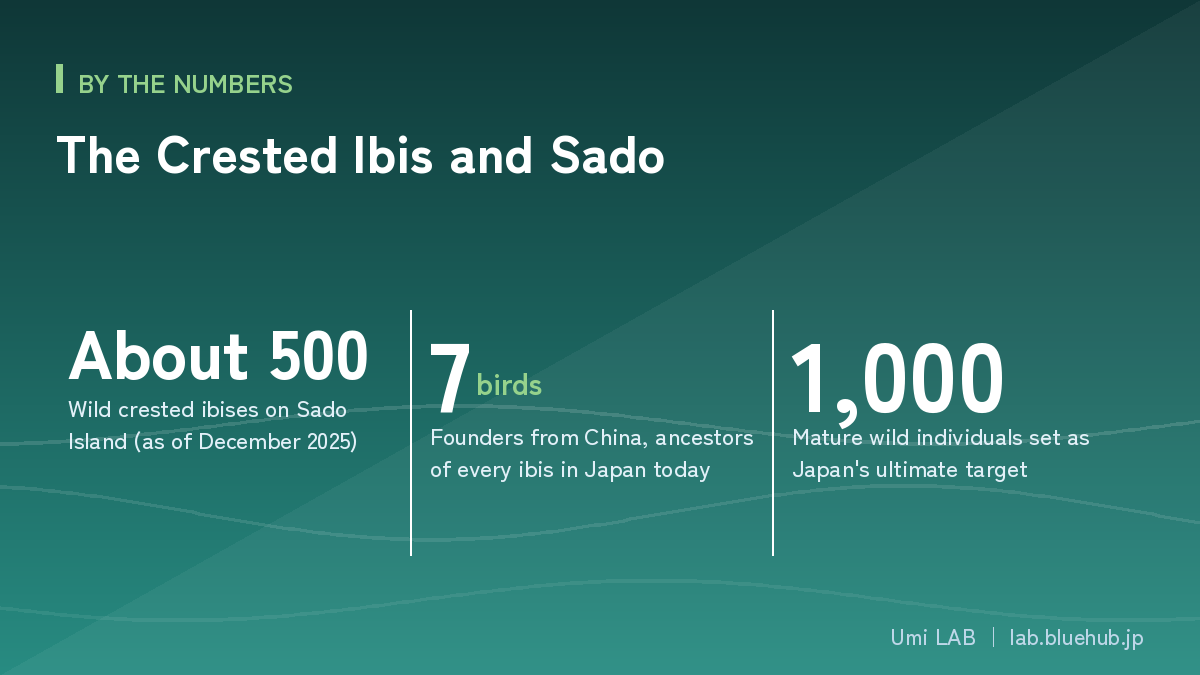
September 2008: a long experiment in the skies over Sado
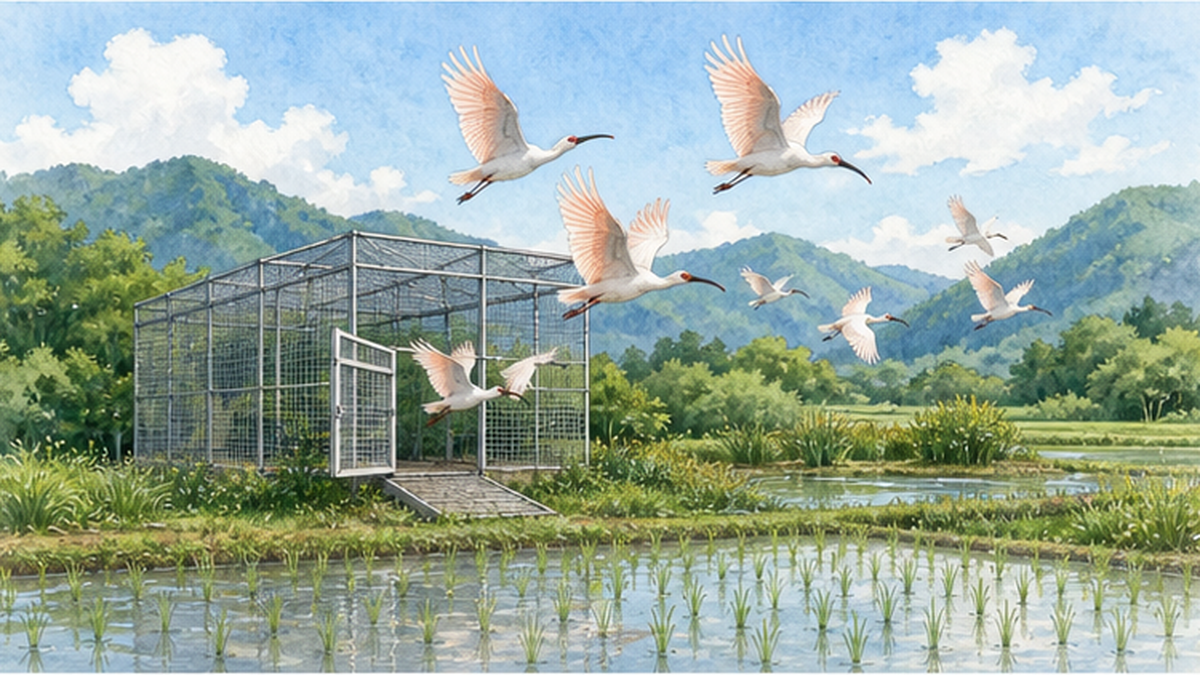
In 2003 the Ministry of the Environment worked with local stakeholders to produce the Sado Regional Environmental Restoration Vision, and set out a Crested Ibis Reintroduction Roadmap as the schedule for reaching its targets step by step. On 25 September 2008 the first release took place on Sado Island. Ten birds, five males and five females, were set free by hard release, straight from the acclimatisation cage. It was the first time in 27 years, since the 1981 capture, that a crested ibis flew free in Japan.
2012: the first chicks in 36 years
A release is not the end of the story. Only when released birds survive outdoors, form pairs and fledge young does a population exist. For the first few years, wild breeding failed. The fledging rate was zero per cent in both 2010 and 2011.
The turning point came in 2012. Four nests built by six released birds produced eight chicks, the first born in the wild in 36 years, and the first fledging in 38 years. The fledging rate that year was 18.8 per cent. Low as a figure, but it was the year that proved generations could connect outdoors.
2016: wild-born pairs began raising young
A larger milestone came in 2016. For the first time, a pair in which both parents had been born and raised in the wild bred successfully. A generation that had never once been handled by humans was producing the next. Then in 2018, the number of surviving wild-born birds overtook the number of surviving released birds. The population had changed hands.
Targets met two years ahead of schedule
The roadmap targets were revised one after another. The first goal, settling 60 birds in the eastern Kosado area by around 2015, was achieved. The follow-up target in Roadmap 2020, adopted in March 2016, was to settle 220 birds on Sado Island by around 2020, and it was reached in June 2018, two years early. As of 16 October 2019 the count stood at an estimated 433 wild birds and 179 in captivity. By that point, 21 releases had put a cumulative 364 birds into the wild since 2008.
From 7 per cent to 77 per cent: a decade of learning
The difficulty of reintroduction shows most clearly in the breeding data over time. Ministry figures put the fertile egg rate in the wild at just 7 per cent in 2011. Released birds had grown up in cages with almost no experience of courtship, mating, nest building or incubation outdoors. For the first few years, eggs were laid but not fertilised.
The rate then climbed rapidly: 33 per cent in 2012, 40 per cent in 2013, 71 per cent in 2014, reaching 77 per cent in 2018. The analysis attributes this to released birds gaining experience and wild-born birds joining the breeding population. Pair formation, nesting females and successful nests rose as follows.
| Breeding year | Pairs formed | Hatching rate | Fledging rate |
|---|---|---|---|
| 2010 | 6 | 0.0% | 0.0% |
| 2011 | 7 | 0.0% | 0.0% |
| 2012 | 18 | 18.8% | 18.8% |
| 2013 | 24 | 23.8% | 9.5% |
| 2014 | 35 | 43.8% | 34.4% |
| 2015 | 38 | 36.4% | 24.2% |
| 2016 | 53 | 47.2% | 35.8% |
| 2017 | 65 | 55.4% | 47.7% |
| 2018 | 77 | 44.4% | 37.5% |
| 2019 | 99 | 40.2% | 35.9% |
What stands out is that hatching and fledging rates have eased back since a 2017 peak even as pair formation keeps rising. As numbers grow and density increases, success per pair falls. Growth does not make things easier; the data says so plainly.
The discovery of colony breeding
Monitoring revealed another notable trend. In recent years about half of all pairs breed in colonies, and colony breeding shows a higher fledging rate than solitary nests. By 2019, loose-colony nests accounted for 59 per cent of all nests.
Nesting together means predators are spotted sooner. But if nesting woodland is concentrated in a few places, so is the damage when one of those woods is lost. Colony breeding is an advantage and, at the same time, the flip side of the skewed distribution discussed below.
2019: a change on the Red List
The recovery was reflected in the threat category. Until the Red List 2018 published in May 2018, the crested ibis was classified as Extinct in the Wild (EW). Because mature individuals had appeared in the wild from 2014 and the species had failed to meet the EW criteria for more than five years, it was reclassified as Critically Endangered (CR) in the Red List 2019 published in January 2019.
Moving from Extinct in the Wild to Endangered may look like a downgrade. In conservation, it is one of the few unambiguous records of progress.
| Year | Event |
|---|---|
| 1981 | All five wild birds on Sado captured; Japan's wild population ends / seven wild birds rediscovered in Yangxian, China |
| 1999 | Youyou and Yangyang presented by China; Yuyu becomes the first artificially bred chick in Japan |
| 2003 | Kin, the last Japanese-born ibis, dies at an estimated 36 / Sado Regional Environmental Restoration Vision published |
| 2008 | 25 September: first release on Sado Island (10 birds) |
| 2012 | Eight chicks hatch in the wild, the first in 36 years; first fledging in 38 years |
| 2016 | First successful breeding by a pair of wild-born birds |
| 2018 | June: Roadmap 2020 target of 220 birds met two years early / wild-born survivors overtake released survivors |
| 2019 | January: reclassified from Extinct in the Wild (EW) to Critically Endangered (CR) |
| 2025 | 32nd release: nine birds in total (four hard release, five soft release) |
| 2026 | March: Roadmap 2030 adopted / 31 May: first mainland release in Hakui City, Ishikawa |
Rice paddies made it possible: the invention of wildlife-friendly farming
One protagonist has yet to appear. It was not the ministry or the researchers who put the ibis back in the sky, but the farmers of Sado. The reason is simple: released birds cannot survive without food.
The Toki to Kurasu Sato certification scheme
Sado City established a certification scheme for environmentally friendly farming with two stated aims: securing feeding grounds for the ibis, and rice growing that supports biodiversity. The main requirements for the certified rice, branded Toki to Kurasu Sato (village living with the crested ibis), are as follows.
- Cut synthetic pesticides and chemical fertiliser by at least 50 per cent against Sado's conventional cultivation standard during the growing season (pesticide-free, 80 per cent reduction or 50 per cent reduction)
- Apply no herbicide to paddy levees and similar margins
- Adopt the techniques of wildlife-friendly farming
- Every participant surveys the creatures living in the paddy twice a year
Four techniques of wildlife-friendly farming
The heart of the scheme is not sentiment but concrete engineering and water management. Sado City highlights four measures.
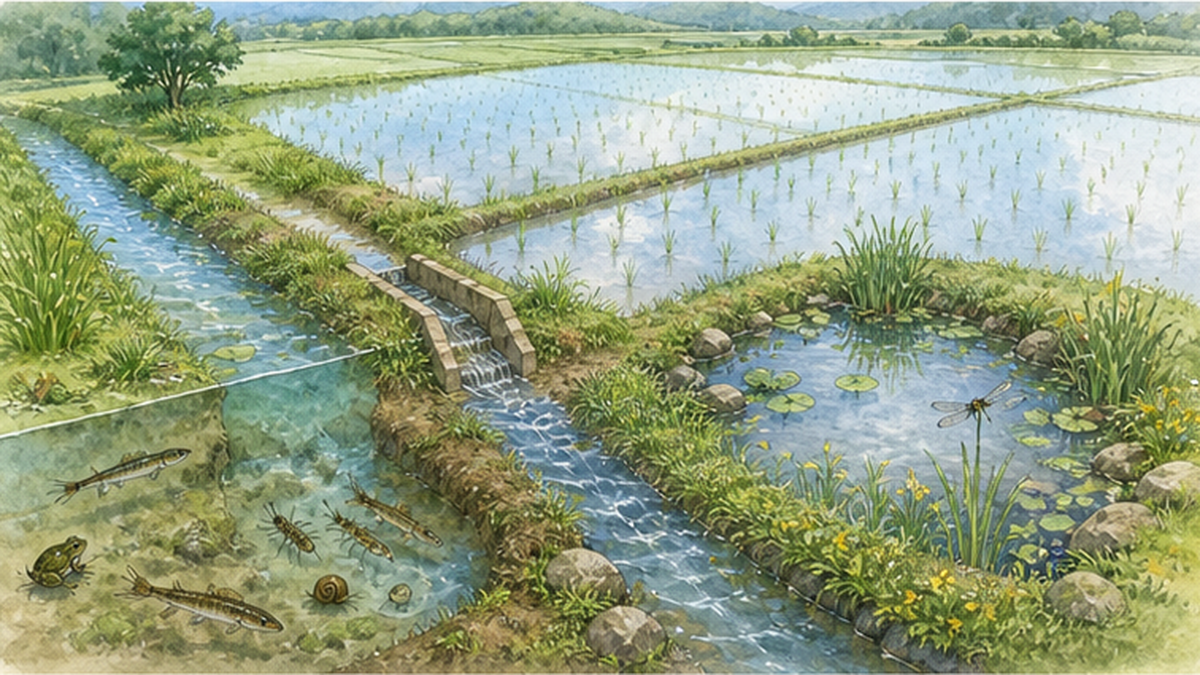
- The e (refuge ditch): a narrow channel dug in one corner of the paddy so that aquatic animals have water to retreat into during midsummer draining
- Winter flooding: keeping water in the paddy after harvest so it functions as wetland year-round
- Fish ladders: gentle passages between paddy and drainage channel so loaches and other species can move between them
- Biotopes: fallow paddies kept flooded all year as habitat
Modern land consolidation drained paddies and cut them off from channels in order to improve drainage and allow machinery in. Refuge ditches, fish ladders and winter flooding all partially reverse that severing. Loaches and frogs, the ibis's prey, can only complete their life cycles when paddy and channel are connected.
It began with 256 farms and 426 hectares
According to the Ministry of the Environment's casebook on payments for ecosystem services, 256 farms covering 426 hectares joined in the first year. The work is clearly harder. It spread anyway because the story reached consumers and because there was a material return: farms in the scheme saw income rise by roughly 1,000 yen per 60-kilogram bag of rice.
The logic closely mirrors the satoumi concept from the Seto Inland Sea, the idea that appropriate human intervention can raise, rather than lower, biological productivity and diversity. Rather than returning to untouched nature, it is human activity that gets redesigned.
See how the scheme worksSado City certified rice Toki to Kurasu SatoSado City's official explanation of the certification requirements, the wildlife-friendly farming techniques and the twice-yearly creature surveys.🔗 www.city.sado.niigata.jpA Globally Important Agricultural Heritage System
The effort won international recognition. In June 2011 Sado was designated a Globally Important Agricultural Heritage System (GIAHS) by the Food and Agriculture Organization of the United Nations, as the Satoyama Coexisting with the Crested Ibis. Together with Noto's Satoyama and Satoumi in Ishikawa, designated at the same time, it was the first such recognition in Japan and the first in any developed country.
Many of Sado's terraced paddies exist because the development of the Sado gold and silver mines from the seventeenth century caused the population to grow rapidly, pushing rice cultivation onto coastal slopes and into the hills. A landscape created by mining history was, four centuries later, valued as habitat for an endangered species. That coincidence captures both the difficulty and the appeal of the satoyama concept.
See the heritage programmeGIAHS Satoyama Coexisting with the Crested Ibis, SadoThe official site for the agricultural system recognised as GIAHS in 2011, covering the conservation plan and wildlife-friendly farming.🔗 sado-giahs.jpFour techniques that bring life back to paddies
- Refuge ditch: keeps water during midsummer draining, sheltering loaches and frogs
- Winter flooding: water stays through winter, making the paddy a year-round wetland
- Fish ladder: reconnects paddy and channel so animals can move between them
- Biotope: a fallow paddy kept flooded all year as permanent habitat
The numbers behind the recovery, and four problems that remain
The Ministry of the Environment's Crested Ibis Reintroduction Roadmap 2030, adopted on 31 March 2026, describes the situation as follows: as of December 2025, about 170 birds are held in captivity and roughly 500 live in the wild, and the population may be moving into something of a stable phase.
That cautious phrasing captures the character of the programme, because the same document immediately lists four concerns.
Problem 1: low genetic diversity does not go away
However many birds there are, the starting point was seven. The roadmap states that because the population went through a severe historical bottleneck, genetic diversity is low, and given the group's resilience to environmental change and disease it is necessary both to secure as stable a population size as possible and to maintain genetic diversity in captivity and in the wild. The gene pool is heavily weighted towards the Youyou, Yangyang and Meimei lineages, while the contribution of Yishui and Huayang remains small. Hence the priority given to pairing Loulou and Guanguan, whose descendants are few.
Problem 2: skewed distribution and density effects
Numbers on Sado have grown steadily, but the range is concentrated in the Kuninaka and Hamochi plains and their surroundings. Nesting also tends to cluster in particular woods, and although nest numbers keep rising, a decline in breeding success attributed to density effects has been observed. Higher density also raises the risk of infectious disease.
Breeding data show how sharply success varies with how a bird was raised.
| Pair (male-female) | Fledging rate |
|---|---|
| Hand-reared - hand-reared | 0% |
| Parent-reared - hand-reared | 11% |
| Hand-reared - parent-reared | 27% |
| Parent-reared - parent-reared | 29% |
| Released - released | 21% |
| Wild-born - released | 38% |
| Released - wild-born | 43% |
| Wild-born - wild-born | 53% |
The pattern is clear. Birds raised by their parents until fledging show higher survival and breeding success in the wild than hand-reared birds, and success rises further when at least one member of a pair is wild-born. That evidence is why Roadmap 2030 sets parent-rearing as the default wherever possible.
A less visible problem: females that cannot breed
Sex ratio matters too. Among ringed birds in the field, while the number of breeding-age individuals (two years and older) has risen, the number of females not participating in breeding has increased since 2015. When suitable nesting woods and partners are limited, growth leaves birds without a place. Total counts alone cannot measure the health of a population.
Problem 3: friction with local residents
This one is easy to overlook and hard to solve. The roadmap states frankly that friction with residents over trampled rice and similar damage is a concern. The ibis forages in paddies, so it treads on rice. That is precisely the phenomenon that led people in the Meiji era to call it a pest.
Five hundred birds are tolerated because of nearly two decades of public engagement and because a mechanism exists that returns real benefit to farmers. The hardest part of reintroduction is not breeding but building local consent, and that may be the more important lesson from Sado.
Problem 4: depopulation and ageing on Sado
The largest uncertainty lies on the human side. The roadmap warns that depopulation and ageing on Sado Island are pronounced, raising concern over whether the paddies, levees and biotopes that provide feeding grounds, and the satoyama woodland used for roosting and nesting, can be maintained in future.
Digging refuge ditches, flooding paddies in winter, running creature surveys twice a year: all of it takes hands. If more farms stop cultivating, the ibis loses its feeding grounds automatically. The same structure applies to tidal flat conservation, where an ageing workforce has become the greatest risk to protection.
Why recovery is not the finish line
- Recovering numbers and recovering genetic diversity are two different measures
- A range concentrated in a small area raises the risk of losing everything to disease or disaster
- Parent-reared and wild-born pairs fledge more young, so less human handling is better
- Whether conservation continues is ultimately determined by local population and the viability of farming
To the mainland: May 2026, the ibis returns to Noto
Having confirmed that the crested ibis can live stably on Sado, the Ministry of the Environment worked towards expanding its range to Honshu. On 31 May 2026 the first release on the mainland took place in Hakui City, Ishikawa Prefecture, with eight birds set free by hard release.
The last wild ibis in Ishikawa, Nori, was rescued in Anamizu Town in 1970. It had been 56 years since the bird flew over Noto. At the commemorative ceremony in Hakui, local primary school pupils read out a declaration on building Noto's future with the crested ibis. Eighteen birds were scheduled for release in Hakui in total; those not freed on 31 May spent about two weeks in a soft-release cage before being let go in stages.
Why Noto
The mainland site was not chosen at random. In fiscal 2022 the ministry invited applications and selected areas working on satochi landscapes that coexist with the crested ibis, and habitat improvement has proceeded in the chosen locations since. Noto received GIAHS recognition for its satoyama and satoumi in 2011, the same year as Sado, and retains a continuous landscape of paddies, ponds and nesting woodland. It is also a region still recovering from the 2024 Noto Peninsula earthquake.
See the Noto programmeNoto Regional Council for Crested Ibis Release | Ishikawa PrefectureOfficial site covering habitat preparation for the mainland release, progress reports and what to do if you encounter a crested ibis.🔗 www.pref.ishikawa.jpThe ibis had already been reaching Honshu
The mainland release is an institutional milestone, but the birds had been crossing the sea long before it. Ministry records document 25 arrivals on Honshu from Sado: two males, 18 females and five of unknown sex. The imbalance is striking.
The reason lies in behaviour. Unpaired males tend to fixate on a nesting wood they like and wait there for a female to arrive, while unpaired females move between nesting woods searching for a partner. As a result, the birds that leave the island and travel far are overwhelmingly female. Sightings have been recorded hundreds of kilometres from Sado, from the Hokuriku region to Tohoku.
Reintroduction on the mainland is therefore not starting from zero. The birds already had the behaviour needed to expand their range; what was missing was the environment and the consent on the receiving side.
What Roadmap 2030 sets out
The Crested Ibis Reintroduction Roadmap 2030, adopted on 31 March 2026, sets the following targets as the schedule through fiscal 2030.
| Horizon | Sado Island | Honshu and elsewhere |
|---|---|---|
| Short term (to FY2030) | A wild population of about 500 birds maintained without overcrowding, with no marked decline in genetic diversity | Released birds living in two or more areas totalling about 50 individuals, with breeding confirmed in at least one area |
| Medium term (to around 2035) | As above, about 500 birds maintained | Two or more populations formed that include wild-born individuals, totalling about 100 birds |
| Ultimate goal | Crested ibises in Japan persisting stably in a natural state | At least 1,000 mature wild individuals, multiple regional populations, genetic exchange between them, and no overcrowding |
What 1,000 mature individuals means
The figure of 1,000 in the ultimate goal has a precise basis. Under Red List category criteria, a species estimated at 250 or more but fewer than 1,000 mature individuals is assessed as Vulnerable (VU). A target of 1,000 or more therefore marks the line at which the crested ibis would leave the threatened categories altogether.
Mature individuals here are not simply a head count. The figure is defined as the sum of released birds that have bred successfully in the wild and whose offspring have survived to breeding age (two years) and birds born in the wild that have reached breeding age. Only individuals with proof that generations have connected outdoors are counted, which is an extremely strict measure.
Roadmap 2030 states that releases will focus on Honshu and elsewhere for the time being, with releases on Sado carried out as needed to spread birds within the island. A release in Izumo City, Shimane Prefecture is planned for the first half of fiscal 2027. The crested ibis is moving from the story of a single island to a national programme linking multiple regional populations.
What we can do, before going to see one
The reintroduction is a national programme and, at the same time, a long-term project involving local communities and consumers. Here is what people far from Sado can still do.
1. If you find one, keep your distance
As reintroduction advances on the mainland, sightings around the country are expected to increase. Sado City and the council for building an island where people and ibises coexist have produced rules for coexisting with the crested ibis, along with a pamphlet that explains them from an observer's point of view. The basics are simple: do not enter nesting areas, do not park and watch for long periods, and never feed the birds. If people approach during the breeding season, parents may abandon the nest.
Sado Island has facilities where the birds can be watched without significant disturbance, including a dedicated observation terrace and roadside viewing points. If you want to see them, using those facilities is the reliable option.
2. Choosing rice is protecting feeding grounds
The most direct form of support is buying the certified rice. Buying Toki to Kurasu Sato means paying for a paddy that has cut synthetic pesticides and fertiliser by at least half, applies no herbicide to its levees, maintains refuge ditches and fish ladders, and surveys its wildlife twice a year. If the market does not absorb the extra work, the method cannot continue.
The structure is the same for tidal flats and seagrass beds: whether conservation continues depends on whether the livelihoods that maintain the environment hold up. As with protecting stopover sites for migratory shorebirds, the central question is always who bears the cost of keeping wildlife alive.
3. Meet them at a dispersed breeding facility
You do not have to travel to Sado to see a crested ibis. Ishikawa Zoo, the Nagaoka City breeding centre, the Izumo City breeding centre and the Sado City ibis interaction facility all hold public displays under ministry guidance. In addition, a public display using birds kept for life is planned at Tama Zoological Park during fiscal 2026. Dispersed breeding is also insurance against losing the captive population all at once to disease or disaster.
4. Funding the habitat work
Roadmap 2030 notes that habitat conservation and restoration will proceed in coordination with activities supported by Niigata Prefecture's crested ibis conservation fund, Sado City's support for ibis biotopes, and assistance for wildlife-friendly farming. Digging biotopes, installing fish ladders and maintaining nesting woodland all cost materials and labour.
In practice, protecting the crested ibis consists mostly of unglamorous earthworks, mowing and survey work. How that work gets funded will decide whether the bird is still here in twenty years.
5. Know the people who keep measuring
The behaviour, breeding and habitat of wild crested ibises are monitored continuously with the cooperation of Niigata University, wildlife protection area rangers and volunteers. Ringing wild-born chicks is targeted at 30 birds a year, which makes it possible to track survival, estimate population size and confirm genetic exchange between regional populations.
The ministry's Sado Nature Conservation Office publishes information through official social media, its website and a regular bulletin. Publishing the numbers means publishing the failures too. The zero per cent fledging rates of 2010 and 2011 are on the record, and that is exactly what gives the eight chicks of 2012 their meaning.
Summary
- The crested ibis (Nipponia nippon) lived across Japan in the Edo period but collapsed under Meiji-era overhunting and habitat loss; the last five wild birds were captured in 1981
- Kin, the last Japanese-born bird, died in 2003. Every ibis in Japan today descends from seven founders provided by China
- Releases began on Sado in September 2008; the first wild chicks in 36 years came in 2012, the first wild-born pair bred in 2016, and the Red List moved the species from Extinct in the Wild to Critically Endangered in 2019
- As of December 2025 there are about 170 birds in captivity and roughly 500 in the wild, supported by wildlife-friendly farming and a certified rice scheme
- Four problems remain: low genetic diversity, skewed distribution and density effects, friction with residents, and depopulation that threatens the satoyama
- The first mainland release took place in Hakui, Ishikawa on 31 May 2026. The ultimate goal is at least 1,000 mature wild individuals with genetic exchange between multiple regional populations
References and sources
- Ministry of the Environment, Japan – Crested Ibis Reintroduction Roadmap 2030 (adopted 31 March 2026)
- Ministry of the Environment, Japan – Crested Ibis: nature and biodiversity (programme history and latest information)
- Ministry of the Environment, Japan – Overview of the Crested Ibis Conservation and Breeding Programme (population, breeding and fledging data)
- Kanto Regional Environment Office – Crested ibis conservation and breeding programme / review of the 2025 releases
- Ishikawa Prefecture – History and ecology of the crested ibis
- Noto Regional Council for Crested Ibis Release, Ishikawa Prefecture – Preparations for and progress of the first mainland release
- Sado City – Sado City certified rice Toki to Kurasu Sato
- Sado City – Guide to the Toki to Kurasu Sato certification scheme (requirements and farming techniques)
- GIAHS Satoyama Coexisting with the Crested Ibis – Content of the GIAHS designation and the conservation plan
- Niigata Prefecture – Sado Japanese Crested Ibis Conservation Center
* Listed in order of reliability: government and academic institutions > peer-reviewed papers > specialist bodies > trusted media