"Nature is richest when left untouched" — that is what many people believe. Yet along Japan's coasts there are seas where actively involving human hands has instead increased the number of living creatures and raised biodiversity. The word for this is "Satoumi". Corresponding to "satoyama" on land, this idea was born in the Seto Inland Sea in 1998 and has since become a Japan-born concept known internationally as "Satoumi."
What Satoumi asks is a simple yet profound question: "What does a rich sea mean?" Merely reducing pollution to make the water clean does not necessarily make the sea rich. Without enough nutrients, fish and seaweed cannot grow, and once people stop being involved, tidal flats and eelgrass beds quietly disappear. To pass the sea's blessings on to the next generation, we need to redesign the right relationship between people and the sea — this is what Satoumi teaches us.
This article carefully traces, based on primary sources from the Ministry of the Environment, the Fisheries Agency, and others, the meaning and origin of the word Satoumi, what it shares with satoyama, the Seto Inland Sea's transformation from a "polluted sea" to a sea "too clean," and concrete efforts such as managing nutrient salt balance and restoring eelgrass beds.
What you will learn from this article
- That "Satoumi" refers not to untouched nature but to a sea enriched by human involvement
- How satoyama and satoumi are connected by the same idea of "secondary nature"
- The history of how the Seto Inland Sea flipped from a polluted sea into a nutrient-poor sea that is "too clean"
- How the nutrient salt management system works and what it aims to achieve
- The reality of Satoumi-building with residents as the protagonists, such as eelgrass bed restoration in Hinase
- The idea of sustainable coastal use, connected to blue carbon and nurturing the next generation of caretakers
What Is Satoumi — The Paradox That Human Hands Enrich the Sea
Satoumi refers to coastal waters where biological productivity and diversity have increased through human involvement. It is the opposite of the common image that "the more people get involved, the more nature is destroyed" — its core idea is that the sea becomes richer precisely through appropriate human involvement. Rather than pristine, untouched nature, the word Satoumi highlights the richness maintained as a result of a long relationship between people and the sea.
1998, a word born in the Seto Inland Sea
The concept of Satoumi was proposed in 1998 by Tetsuo Yanagi, an oceanographer at Kyushu University. Yanagi defined Satoumi as "a coastal sea area where biological productivity and biodiversity have increased due to human involvement." Having long studied the environment of the Seto Inland Sea, Yanagi coined this term to explain a richness of the sea that pollution countermeasures alone could not restore — and it is symbolic that the stage for this was the Seto Inland Sea.
This word has spread beyond Japan, and is introduced overseas as well, romanized as "Satoumi" or "Sato-umi." Because it carries a distinctive philosophy that is hard to translate, it is often used untranslated in Japanese, and recognition is spreading internationally as a Japan-born concept originating in the Seto Inland Sea. While Western nature conservation has often idealized "protecting pristine nature free of human hands," Satoumi actively values "nature maintained through human involvement." This perspective — treating people and nature not as opposites but as partners in coexistence — is drawing interest as a suggestive idea for many countries facing population decline and aging societies.

The Ministry of the Environment's definition of Satoumi
Satoumi is also clearly positioned in an administrative context. Japan's Ministry of the Environment defines Satoumi as "a coastal sea area where material cycle functions are properly maintained through the unified and comprehensive management of land and coastal areas by human hands, achieving high productivity and the conservation of biodiversity, while being deeply connected to people's livelihoods and traditional culture, and where people and nature coexist." What matters here is the perspective of managing land and sea, connected by rivers, as one unit, rather than looking at the sea alone.
In other words, Satoumi is not merely a slogan for nature conservation, but a concrete management philosophy for simultaneously sustaining material cycles, ecosystems, and people's livelihoods. Protecting marine life also supports Japan's marine biodiversity.
The three elements that support Satoumi-building
The Ministry of the Environment has organized the elements that make up Satoumi-building. The following three are the targets of conservation and restoration, and Satoumi is only realized when the "places" and "actors" that support them are also in place.
- Material cycles: nutrients such as nitrogen and phosphorus circulating in the right balance from land to sea and among living creatures
- Ecosystems: diverse habitats such as tidal flats, seaweed beds, and sandy beaches, and the connections among the creatures living there, being maintained
- Human contact: a culture where people keep engaging with the sea, through fishing, leisure, and environmental education
None of these three works well if pursued alone. Even if nutrients (material cycles) are in order, if tidal flats or seaweed beds (ecosystems) that serve as spawning grounds are lost, fish will not increase; and even if the environment is well maintained, if the people involved with the sea (human contact) disappear, the management itself cannot continue. Satoumi is only realized when material cycles, ecosystems, and human contact support one another. And it is the "places" that serve as the stage for activity, and the "actors" — fishers, residents, government, researchers, and businesses — who actually drive these three elements.
Why Satoumi is drawing attention now
There are several reasons Satoumi is back in the spotlight. First, changes in the sea that cannot be restored by pollution countermeasures alone — oligotrophication, examined in detail later — have surfaced as a real problem. Second, seaweed beds and tidal flats are being reconsidered in the context of climate change measures as "blue carbon" that stores carbon dioxide. And third, there is a sense of crisis that, as fishers age and decline in number, the very caretakers who put hands into the sea may be lost. Satoumi is being called for again now as a word that reframes these multiple challenges within a single framework.
Key points
- Satoumi = coastal waters made more productive and diverse through human involvement
- A Japan-born concept proposed in 1998 by Tetsuo Yanagi against the backdrop of the Seto Inland Sea
- Managing land and sea as one, balancing material cycles, ecosystems, and human contact
Satoyama and Satoumi — A Shared Philosophy of "Secondary Nature"
The quickest way to understand Satoumi is to consider it alongside "satoyama" on land. In fact, Satoumi is often explained as "the ocean version of satoyama," and both can be seen as expressing the same philosophy on land and at sea. The shared thread running through both is nature maintained through moderate human intervention.
What is satoyama?
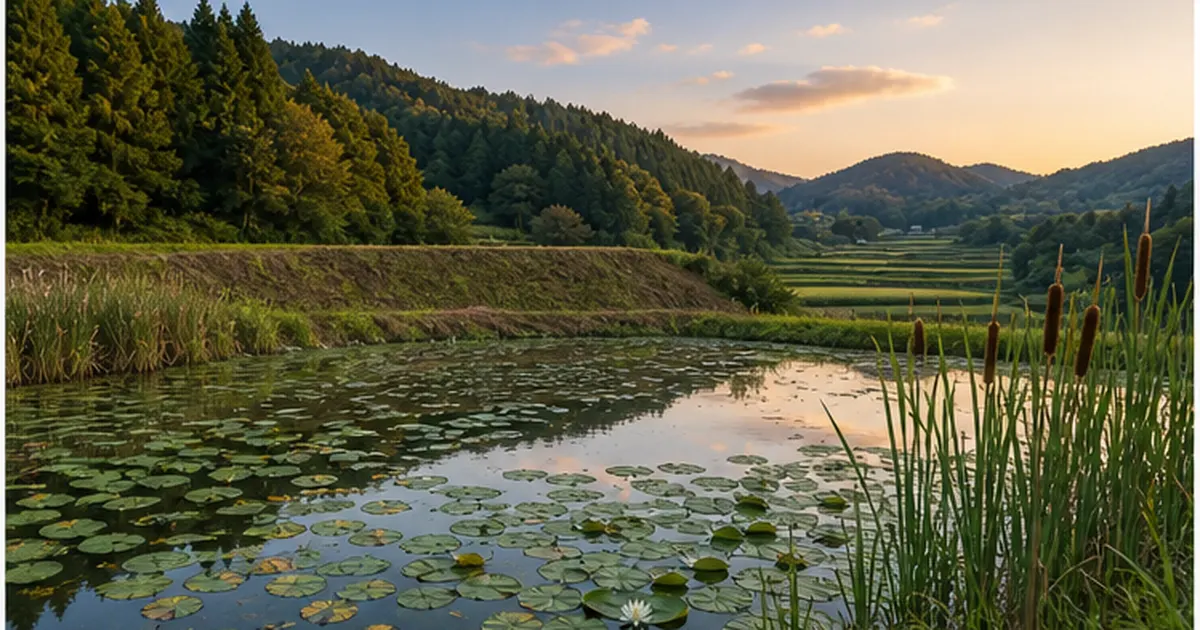
Japan's Ministry of the Environment defines satoyama areas as "regions positioned between urban areas and pristine nature, where the environment has been shaped through various forms of human intervention," treating them as a concept encompassing coppice woodlands (secondary forests) surrounding settlements mixed with farmland, irrigation ponds, and grasslands. Cutting trees for firewood and charcoal, gathering fallen leaves, and tilling fields — such human activity created bright forest floors and mosaic-like environments, supporting habitats for diverse creatures.
Their extent is surprisingly large: the secondary forests that make up satoyama cover about 8 million hectares, and satoyama farmland covers about 7 million hectares, together accounting for roughly 40% of Japan's land area. Much of Japan's biodiversity is supported by this human-touched nature. Many familiar creatures that color satoyama — katakuri (dogtooth violet), Gifu butterflies, medaka fish, dragonflies — are in fact species that adapted to the bright environments created by human activity, and are among the first to disappear once people withdraw their hands.
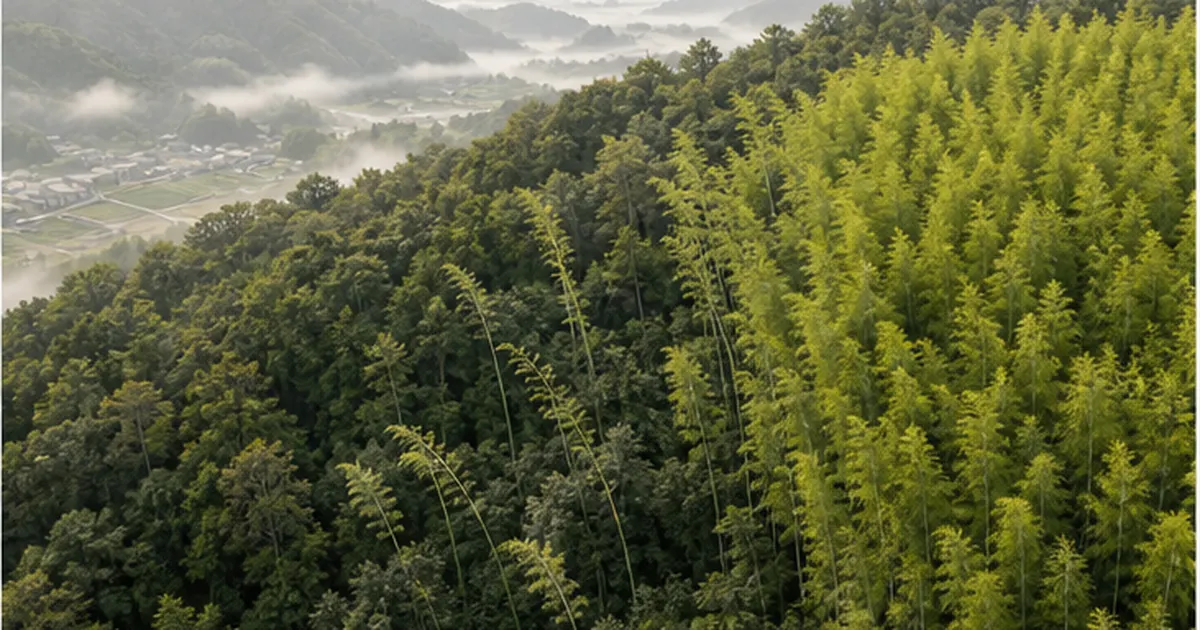
But after the war, as daily life shifted from firewood and charcoal to gas and electricity, and the shape of agriculture changed, the need to tend satoyama faded. Abandoned forests grew dark and overgrown, bamboo spread, and creatures that favor the bright environments unique to satoyama declined. Ironically, it was "no longer being used" that invited the crisis of satoyama. The same structure is playing out at sea: as the number of fishers who work the sea declines, satoumi too quietly grows thin. The path satoyama has walked is a mirror reflecting the future of satoumi.

The correspondence between satoyama and satoumi
Lining up satoyama and satoumi with matching keywords makes their correspondence easy to see. The table below contrasts the two philosophies.
| Aspect | Satoyama (land) | Satoumi (sea) |
|---|---|---|
| Main sites | Coppice woodland, farmland, irrigation ponds, grassland | Tidal flats, seaweed beds, sandy beaches, shallow bays |
| Human intervention | Felling, undergrowth clearing, farm work | Fishing, seabed tilling, seaweed bed restoration, cleanup |
| Causes of loss | Abandoned management, depopulation, aging | Pollution, land reclamation, abandoned management, depopulation |
| Shared philosophy | Secondary nature maintained through human involvement | Secondary nature enriched through human involvement |
The "Satoyama and Satoumi of Noto" in Ishikawa Prefecture was recognized in 2011 as Japan's first Globally Important Agricultural Heritage System (GIAHS), as a landscape in which satoyama and satoumi have been inherited together as one. It is an example of a distinctively Japanese view of nature — living close to both mountains and sea, moving between the two — that has also been recognized internationally. Tending fields and mountains while also fishing in the sea right in front of them, and protecting seaweed beds — this whole way of life spanning land and sea is exactly the richness embodied in the term "satoyama-satoumi."
Land and sea are connected by rivers
Satoyama and satoumi are not separate things — they are connected into one by rivers. As the saying goes, "the forest is the sea's lover": nutrients nurtured by the forest are carried through rivers to the sea, nourishing plankton and seaweed. Conversely, if mountains are no longer well tended, or rivers are lined with concrete, the balance of nutrients and sediment reaching the sea also changes. The reason satoumi emphasizes "managing land and coastal areas as one" is precisely because it looks at this connection across the entire watershed. Problems of the sea are often problems of the land as well.
The risk of "not laying a hand on it"
Whether on land or at sea, a common challenge in recent years is a decline in human involvement. In satoyama, forests left untended grow wild, bamboo encroaches, and once-bright forest floors darken, causing the creatures that lived there to disappear. In satoumi as well, as fishers age and decline in number, seaweed beds and tidal flats go unmanaged, and the ecosystem quietly grows thin. The idea that "leaving things alone in order to protect them" does not work for some kinds of nature is exactly the biggest message that the satoyama-satoumi way of thinking poses to us. Richness is maintained only through the effort of continued involvement.
The idea of secondary nature
It is not only pristine forests or untouched seas that hold value — "secondary nature," created through the long relationship between people and nature, also has its own distinctive richness. Both satoyama and satoumi stand on this idea.
Why the Seto Inland Sea Is the Origin of Satoumi
It is no coincidence that the word Satoumi was born in the Seto Inland Sea. The Seto Inland Sea is a representative enclosed sea with limited exchange of water with the open ocean, making it a sea readily affected — for better or worse — by human activity. For this reason, it has experienced both pollution and restoration in their most dramatic forms. The philosophy of Satoumi can be said to have been distilled from this sea's bitter history.
The fate of being an enclosed sea
The Seto Inland Sea is an inland sea surrounded by Honshu, Shikoku, and Kyushu, dotted with numerous islands. Because the straits connecting it to the open ocean are narrow, substances that flow in do not easily flow back out, and it takes a long time for the seawater to be replaced. This "closed" nature made the Seto Inland Sea special in two senses. One is that pollution and nutrients released by people tend to accumulate, and their effects tend to be amplified. The other is that, precisely because of this, the sea's condition can change greatly depending on how people manage it — in other words, the effects of management show up readily. The idea of Satoumi grew up in the Seto Inland Sea precisely because this was a sea inseparable from human activity.
Rapid economic growth and a "dying sea"
During the period of rapid economic growth in the 1960s, factories lined the coast of the Seto Inland Sea, and large volumes of industrial and domestic wastewater flowed in. Excess nutrients caused red tides (eutrophication) to occur frequently, and mass fish die-offs followed one after another. Transparency declined, and the sea came to be called a "dying sea." As a result of placing too heavy a burden on the sea, the very blessings of the sea were on the verge of being lost.

Water quality improvement through law
Japan responded to this crisis through legislation. In 1973, the "Law concerning Special Measures for Conservation of the Environment of the Seto Inland Sea (Provisional Measures)" was enacted, and in 1978 it was made permanent as the "Law concerning Special Measures for Conservation of the Environment of the Seto Inland Sea" (Seto Inland Sea Act). In addition to wastewater regulations for individual factories, the concept of "total load reduction," which reduces the total amount of pollution across the entire sea area, was introduced, and the inflow of nitrogen and phosphorus was gradually tightened.
The effect shows up clearly in the numbers. As a result of long-term efforts, the nitrogen flowing into the Seto Inland Sea fell to roughly half its peak level, and phosphorus to roughly a third. The occurrence of red tides also decreased greatly, and the sea's transparency recovered. As a pollution countermeasure, this was an unmistakable success. At the same time, large-scale land reclamation also caused much of the coastal tidal flats and shallows to be lost — another major change etched into the Seto Inland Sea of this era. Shallow, gently sloping seas were reclaimed one after another for factory sites and harbors, and spawning grounds for fish and nature's own water-purifying filters disappeared.

After becoming clean
Yet a new anomaly began to appear in the now-clean sea. Nutrients had decreased too much, and this time fish and seaweed became harder to grow. Reducing pollution and enriching the sea are not the same thing — it was this realization that made the idea of Satoumi necessary. The next chapter looks in detail at this paradox of a "too clean" sea.
The path of the Seto Inland Sea was also a turning point for environmental policy itself. For a long time, Japan's marine environmental measures focused on a single point: "how not to pollute." That was the right prescription in the era of industrial pollution, but once pollution had largely subsided, the sea needed a different yardstick. What kind of sea should we aim for, and what does richness mean — the Seto Inland Sea posed this fundamental question to Japanese society, leading to the new principle set out in the amended Seto Inland Sea Act: a "clean and rich sea." Satoumi can be said to have been a philosophy that anticipated this principle.
The Seto Inland Sea was once called a dying sea, and its water quality improved greatly under strict wastewater regulations. But now nutrient scarcity has become a new challenge.
— Summary based on Hyogo Prefecture materials
The Paradox of a "Too Clean" Sea — Oligotrophication, Sand Lance, and Nori
A state in which the sea's nutrients have decreased too much is called oligotrophication. A reversal has occurred in which the Seto Inland Sea, once suffering from eutrophication, is now troubled by oligotrophication. A sea lacking nutrients looks beautifully clear, but within that water the base of the food chain grows thin, causing serious impacts on fisheries. This phenomenon confronts us with the fact that the simple image "a clean sea equals a rich sea" is not necessarily correct.
What matters here is that both eutrophication and oligotrophication are states in which "the balance has broken down." Too many nutrients cause creatures to die from red tides and oxygen depletion; too few cause the food chain to grow thin and fish to fail to grow. The sea's richness is maximized when nutrients sit neither at zero nor in excess, but within just the right range. The reason Satoumi values "management" is precisely to maintain this delicate balance by human hand. It is not enough to simply eliminate pollution — continually seeking the appropriate level is required.
The base of the food chain grows thin
Nutrients in the sea (such as nitrogen and phosphorus) first support the growth of phytoplankton. Zooplankton eat the phytoplankton, small fish eat the zooplankton, and the chain continues up to larger fish. When nutrients decrease, the bottom of this chain grows thin, and even the fish positioned above it grow thin as well. Nutrient salts are a matter of balance — neither too much nor too little is good.

The sharp decline of sand lance
Symbolizing oligotrophication is the Japanese sand lance in the eastern Seto Inland Sea. This fish, familiar as the ingredient for the spring dish "kugini," has seen its catch fall dramatically. Catches in the eastern area, which had stayed above 10,000 tons a year through 2016, plunged to roughly a tenth of the previous year's level in 2017, and have not recovered since, remaining at a low level below 2,000 tons in recent years.
As a cause, it has been suggested that a decline in nutrient salts reduced the zooplankton that sand lance feed on, affecting their growth and spawning. Meanwhile, research from Hiroshima University has also shown that environmental changes may have made sand lance more likely to be preyed upon by other fish, indicating the cause is not singular. In any case, it was a symbolic event showing the severity of the impact that a collapse in nutrient balance and environmental change can have on fishery resources. Changes in the sea are also intricately entangled with the issue of rising sea temperatures and fisheries, making this a difficult matter that cannot be explained by simple causation.
Sand lance have the unusual habit of burrowing into sand during the high-temperature summer months in a kind of "summer dormancy," and they require good-quality sandy spawning grounds. Not only has the shortage of food due to nutrient scarcity been an issue, but the degradation of spawning grounds due to sand extraction and changes to the seabed environment is also thought to be a factor making the recovery of this resource difficult. Behind the sharp decline of a single fish species lie multiple overlapping factors: food, spawning grounds, water temperature, and predation.
The "discoloration" of nori
Another representative form of damage is the "discoloration" of farmed nori seaweed. Nori absorbs dissolved inorganic nitrogen (DIN) in seawater to grow into a deep black color, but when nitrogen is insufficient, the color fades to a reddish-brown, greatly lowering its taste, quality, and price. In the eastern Seto Inland Sea, damage from this discoloration has occurred repeatedly since the late 1990s. Nori farming is an important industry along the Seto Inland Sea coast, and discoloration hits fishing households' livelihoods directly. The sea having "become too clean" is showing up directly as a problem of people's livelihoods.
According to surveys by Hyogo Prefecture and others, some sea areas have seen the concentration of inorganic nitrogen, an indicator of nutrient levels, fall below the level needed for nori to grow. Once nutrient concentrations have fallen, it is not easy to restore them, and even with ingenuity in operating sewage treatment plants, some sea areas continue to fall short of the target level. While "reducing" can be achieved through systems and technology, "restoring to an appropriate level" is far more difficult — this asymmetry speaks to the difficulty of the challenge of oligotrophication.
| Period | State of the Seto Inland Sea | Main challenge |
|---|---|---|
| 1960s–70s | Eutrophication (excess nutrients) | Frequent red tides, mass fish die-offs |
| 1980s–90s | Water quality improves | Nutrients decline through total load reduction |
| 2000s onward | Oligotrophication (nutrient scarcity) | Discoloration of nori, sharp decline of sand lance |
An easily overlooked paradox
"The cleaner the sea, the better" is not always true. In a sea where nutrients have become too scarce, fish and seaweed can no longer grow. What is needed is appropriate management of nutrients that achieves both not polluting and not letting the sea grow thin.
Managing the Nutrient Salt Balance — The Amended Seto Inland Sea Act and the Nutrient Salt Management System
In response to the new challenge of oligotrophication, Japan shifted the very philosophy of its legislation. Rather than only "reducing" pollution through regulation, it shifted its focus to "maintaining" nutrients at an appropriate level through management. Symbolizing this is the 2021 amendment to the Seto Inland Sea Act.
The Seto Inland Sea Act, amended in 2021, enforced in 2022
The amended Law concerning Special Measures for Conservation of the Environment of the Seto Inland Sea was promulgated on June 9, 2021, and enforced on April 1, 2022. The centerpiece of this amendment is the "nutrient salt management system." A law that had previously focused solely on reducing nutrients gained a mechanism enabling nutrients to be appropriately supplied in certain areas. It is a turning point at which the law's basic stance took a major step from "regulation" to "regulation plus management."

How the system works
Under the nutrient salt management system, prefectural governors can formulate a "nutrient salt management plan." This makes it possible to supply nutrient salts to specific sea areas within a range compatible with marine environmental conservation, with the distinguishing feature of managing nutrients in fine detail by sea area and by season. For example, it becomes possible to keep nitrogen levels somewhat higher in a specific bay during the winter, when nori farming is active.
- Prefectures set the target sea area and the target nutrient salt level
- The volume of nutrient supply is adjusted seasonally, such as through the operation of sewage treatment plants
- The condition of the sea is monitored, and management continues so that adverse effects such as red tides do not occur
Ingenuity in the field — seasonal operation
Hyogo Prefecture has been a forerunner of this system. Sewage treatment plants and factories in the prefecture have worked on "seasonal operation," changing the amount of nitrogen contained in treated water depending on the season. During periods when nori farming or fish growth requires nutrients, water is discharged deliberately without removing too much nitrogen, as a way to deliver nutrients to the sea. Here lies a shift in thinking, in which wastewater treatment facilities also take on the role of "devices that send nutrients to the sea."
However, management that increases nutrients is not simple. Even when trying to keep nitrogen somewhat higher, once concentrations have fallen it is difficult to restore them, and careful fine-tuning is required to avoid triggering red tides. Managing nutrient salts is a task that requires even more delicate science and monitoring than reducing pollution.
The concept of adaptive management
Essential to managing nutrient salts is an approach called "adaptive management." Rather than deciding on a perfect answer in advance and executing it, this method supplies a small amount of nutrients, observes the sea's response, and fine-tunes the next operation based on the results — repeating execution, observation, and adjustment to gradually approach the optimal solution. The sea is a system in which living creatures and physics and chemistry are intricately intertwined, and no single decision produces the answer. That is precisely why continuous monitoring of water quality and biological data is the lifeline of the system.
The Fisheries Agency is also working on research to understand the dynamics of nutrient salts in the Seto Inland Sea and to manage the nutrients needed for nori farming and other purposes. Without scientifically clarifying where, when, and how much nutrients are lacking, appropriate supply is not possible. The nutrient salt management system can be described as a mechanism of "co-management of the sea," in which government, research institutions, and fishers operate the sea while sharing data. Continually seeking the right level, neither excessive nor insufficient, is at the core of Satoumi's water management.
From regulation to management
- The amended Seto Inland Sea Act was promulgated in 2021 and enforced in April 2022
- Governors can formulate nutrient salt management plans by sea area and season
- Seasonal operation of sewage treatment and other measures shifted the direction toward "maintaining" nutrients
Reclaiming Eelgrass Beds — Satoumi-Building in Hinase
If managing the nutrient balance is an intervention on "the water of the sea," the other pillar is reclaiming "places in the sea." Representative of this is the restoration of eelgrass beds (seagrass meadows), which serve as spawning grounds and habitats for fish. A well-known model of Satoumi-building is the effort in Hinase, in Bizen City, Okayama Prefecture.
Eelgrass beds, a "cradle of the sea"
Eelgrass is a seed plant (seagrass) that grows in sandy areas of shallow seas. Its beds serve as hiding places and spawning grounds for small fish, juvenile fish, shrimp, and crabs, and are called a "cradle of the sea." Eelgrass beds also purify water by absorbing nutrients in the water, soften waves to curb coastal erosion, and fix carbon dioxide through photosynthesis. They are truly a place where the functions of Satoumi are concentrated, and restoring eelgrass beds (seagrass meadows) has become an important theme in many regions.

From 590 hectares to 12 hectares
The eelgrass beds of Hinase were once abundant. Around 1950, they are said to have spread across roughly 590 hectares (more than 100 Tokyo Domes' worth). But due to land reclamation and deteriorating water quality, they had plunged to just 12 hectares by 1980. As the eelgrass beds disappeared, the catch also declined, and local fishers felt a strong sense of crisis.
The seed-sowing started by fishers
From around 1985, fishers of the Hinase Fisheries Cooperative began the steady work of sowing eelgrass seeds to restore the beds. At first, the eelgrass did not take root as hoped, with a series of trial and error: sown seeds were washed away by waves, or shoots failed to grow in cloudy water. The turning point was an on-site discovery unique to the fishers: "areas of the seabed with accumulated oyster shells have less turbidity and eelgrass grows well there." By combining oyster farming with eelgrass restoration, the beds recovered to about 70 hectares in around five years. Putting a byproduct of fishing — oyster shells — to use in restoring the sea: this is precisely the wisdom of Satoumi, in which the fisher's observational eye, honed by daily watching of the sea, opened the way before scientific theory did.
It is also important that this restoration did not end with a single success. Although eelgrass is a perennial, it can still decline due to environmental changes if left alone, so the work of collecting, selecting, and sowing seeds must be repeated every year. The people of Hinase have steadily kept up the cycle of gathering flowering eelgrass plants, extracting seeds, and sowing them the following season. This effort teaches us that Satoumi-building is not a one-time event, but rather an accumulation of "continuing."
| Year | Eelgrass bed area | Event |
|---|---|---|
| Around 1950 | About 590 ha | The era when eelgrass beds were richest |
| 1980 | About 12 ha | Sharp decline due to land reclamation and worsening water quality |
| From around 1985 | Restoration begins | Seed-sowing activities by fishers begin |
| 2007 | About 80 ha | Recovery accelerates through the use of oyster shells |
| 2015 | About 250 ha | Expansion through collaboration among residents, government, and schools |
Junior high school students carry it on
The restoration effort steadily bore fruit, and the eelgrass beds recovered to about 80 hectares in 2007, about 200 hectares in 2011, and about 250 hectares by 2015. Meanwhile, as fishers aged, a shortage of labor became a challenge. Students of the local Hinase Junior High School then began working on sowing and growing eelgrass as part of their classes. The students got involved starting from collecting seeds, and at the National Eelgrass Summit held in 2016, they went so far as to present this effort through a play. Passing the sea's restoration on to the next generation — the "passing on of caretakers" that Satoumi-building aims for has taken on a solid form here.
Satoumi-building in Hinase is not limited to restoring eelgrass beds. It combines multiple layers of collaboration among fishers, citizens, and children, including rule-making about the use of the sea surface and environmental education for children built around oyster farming and eelgrass beds. Reframing the sea not just as "something to protect," but as "a place for everyone to use and nurture together," has made this town's effort sustainable. Satoumi is both the restoration of an ecosystem and, at the same time, the restoration of a community.
The restoration of eelgrass beds has been advanced not only by fishers but through the collaboration of citizens and children.
— From Satoumi-building efforts in Hinase, Okayama Prefecture
What Hinase has shown
- Eelgrass beds shrank from 590 ha to 12 ha, then recovered to about 250 ha under resident-led restoration
- On-site wisdom connecting fishing and restoration, such as making use of oyster shells
- Junior high school students take part through class activities, passing the sea's restoration on to the next generation
The Sustainable Coastal Use That Satoumi Opens Up
Satoumi is not limited to individual efforts such as nutrient management or eelgrass bed restoration. It is also a philosophy that paints an overall picture of sustainable coastal use — using the sea's blessings while protecting them, and handing them down to the next generation. Here, we look at the possibilities Satoumi opens up from three perspectives.
A tailwind called blue carbon
In recent years, what has further raised the value of Satoumi is attention to blue carbon ecosystems. Blue carbon refers to the carbon absorbed and stored by marine ecosystems such as eelgrass beds, tidal flats, and seaweed forests. Restoring seaweed beds and tidal flats through Satoumi-building not only increases living creatures but also contributes to mitigating climate change. Activities that enrich the sea can, as they are, also become efforts toward decarbonization — Satoumi is becoming a nexus connecting the environment and the economy.

Tidal flats and shallows, a multifunctional site
Alongside eelgrass beds, tidal flats and shallows are key to Satoumi. Conserving tidal flats simultaneously supports multiple functions: water purification, biodiversity, fisheries, and habitat for migratory birds. The clams, polychaete worms, and countless microorganisms living in tidal flats form a "natural purification system" that takes in and breaks down organic matter and nutrients in seawater, and are also an irreplaceable feeding ground for migratory birds. Land reclamation and shoreline development have greatly reduced shallow areas such as seaweed beds and tidal flats in many places, including the Seto Inland Sea. Reclaiming these remains a central site of Satoumi-building.
The blessings that these seaweed beds and tidal flats generate — water purification, disaster prevention, fisheries, and leisure — are collectively called "ecosystem services." If we tried to replace these blessings, which normally carry no price tag, with artificial facilities, it would cost an enormous sum. Protecting Satoumi is also protecting this great value that nature provides free of charge. Activities that enrich the sea support the foundations of our lives — disaster prevention, food, and tourism — and seen this way, Satoumi-building is clearly not a matter for only a limited group of stakeholders.
How to nurture the next generation of caretakers
The biggest challenge facing Satoumi actually lies not so much in the ecosystem itself as in "people." As fishers age and decline in number, the very caretakers who put hands into the sea are at risk of being lost. That is precisely why efforts to widen the base of diverse people engaging with the sea are indispensable — linking with school education as in Hinase, or partnering with citizen volunteers and businesses. Continuing to engage with the sea as a whole community, as seen in the revival of Sanriku's fisheries industry, which recovered the sea's blessings, becomes a force that supports Satoumi.
- Fishers: the caretakers who know the sea's condition best through their daily fishing work
- Government and research institutions: responsible for planning, monitoring, and scientific grounding
- Citizens, schools, and businesses: widen the base through cleanup, planting, and environmental education
- Consumers: support the effort economically by choosing to buy products of Satoumi
Receiving information about the sea neutrally
In considering sustainable coastal use, it is also important to maintain a calm attitude in receiving various kinds of information about the sea. For example, regarding the ALPS-treated water from the Fukushima Daiichi Nuclear Power Plant, monitoring of seawater and fish has continued even after the release, and the results have been made public. Separating scientific facts, monitoring data, and the problem of rumor-based harm, and trying to understand them calmly without jumping to conclusions or making snap judgments, is an attitude that is indispensable when thinking, over the long term, about "the relationship between people and the sea," as with Satoumi.
Ways we can get involved with Satoumi
- Try joining activities such as nearby beach cleanups or eelgrass planting
- Choose locally caught, seasonal seafood to support the Satoumi economy
- Make a habit of confirming information about the sea through primary sources (Ministry of the Environment, Fisheries Agency, and others)
- Observe creatures with children on tidal flats and rocky shores, and get closer to the sea
Conclusion — Designing the Right Relationship Between People and the Sea
Satoumi gently shakes the assumption that "nature is best left untouched." There is a sea that becomes richer precisely because people are appropriately involved — this idea was born from the bitter experience of the Seto Inland Sea, which suffered from pollution and then faced nutrient scarcity. Achieving both not polluting and not letting the sea grow thin, reclaiming lost seaweed beds and tidal flats, and passing that work on to the next generation. Satoumi can be described as an attempt to redesign the right distance between people and the sea.
Whether it is a new mechanism like the nutrient salt management system, or steady work in the field like the eelgrass bed restoration in Hinase, the same question lies at the root: "What is a rich sea, and how should we engage with it to achieve that?" Each of us facing this question is the first step toward carrying Japan's coasts into the future.
Satoumi is not a distant, specialized topic about the sea. The fish and nori on our dinner tables, the beach we visit on a day off, the small creatures a child finds on the rocky shore — all of it is connected to Satoumi. The more people who get involved with the sea, the richer the sea becomes in response to that involvement. Richness is born not from keeping distance, but from continuing to engage. The Japan-born philosophy of Satoumi invites us to reconsider our very way of relating to nature. Next time you stand at the seaside, take a moment to remember that the sea before you is sustained by someone's involvement.

Summary of this article
- Satoumi refers to coastal waters where productivity and biodiversity have increased through human involvement
- A Japan-born concept, paired with satoyama, proposed in 1998 by Tetsuo Yanagi against the backdrop of the Seto Inland Sea
- The Seto Inland Sea flipped from eutrophication to oligotrophication, causing a sharp decline in sand lance and the discoloration of nori
- The nutrient salt management system, enforced in 2022, shifted from "reducing" nutrients to "appropriately maintaining" them
- The eelgrass beds of Hinase recovered from 12 ha to about 250 ha, with junior high school students taking over as caretakers
- Including blue carbon and nurturing the next generation of caretakers, Satoumi is also a philosophy of sustainable coastal use
References and Sources
- Ministry of the Environment, Satoumi Net – What is Satoumi? / Satoumi Q&A (definition, three elements, and practical examples of Satoumi)
- Ministry of the Environment – On the law amending the Act on Special Measures concerning Conservation of the Environment of the Seto Inland Sea (nutrient salt management system)
- Ministry of the Environment, Nature Conservation Bureau – Conservation and use of satoyama areas (definition and area of satoyama)
- Fisheries Agency – Research on nutrient salt countermeasures (nutrient salt dynamics in the Seto Inland Sea and nori farming)
- Hyogo Prefecture – Hyogo Prefecture Nutrient Salt Management Plan: Aiming for a Rich and Beautiful Satoumi
- Hinase Fisheries Cooperative – Eelgrass bed restoration plan (area trends and restoration efforts)
- Ocean Policy Research Institute, Sasakawa Peace Foundation – Ocean Newsletter, "The Decline of Sand Lance and Oligotrophication"
- Hiroshima University – Research findings, "Approaching the Mystery of Why Sand Lance Suddenly Declined in the Seto Inland Sea"
- EIC Net – Environmental term glossary, "Nutrient Salt Management System" (explanation of the amended Seto Inland Sea Act)
※ Listed in order of reliability: government and academic institutions > peer-reviewed papers > specialized institutions > reliable media