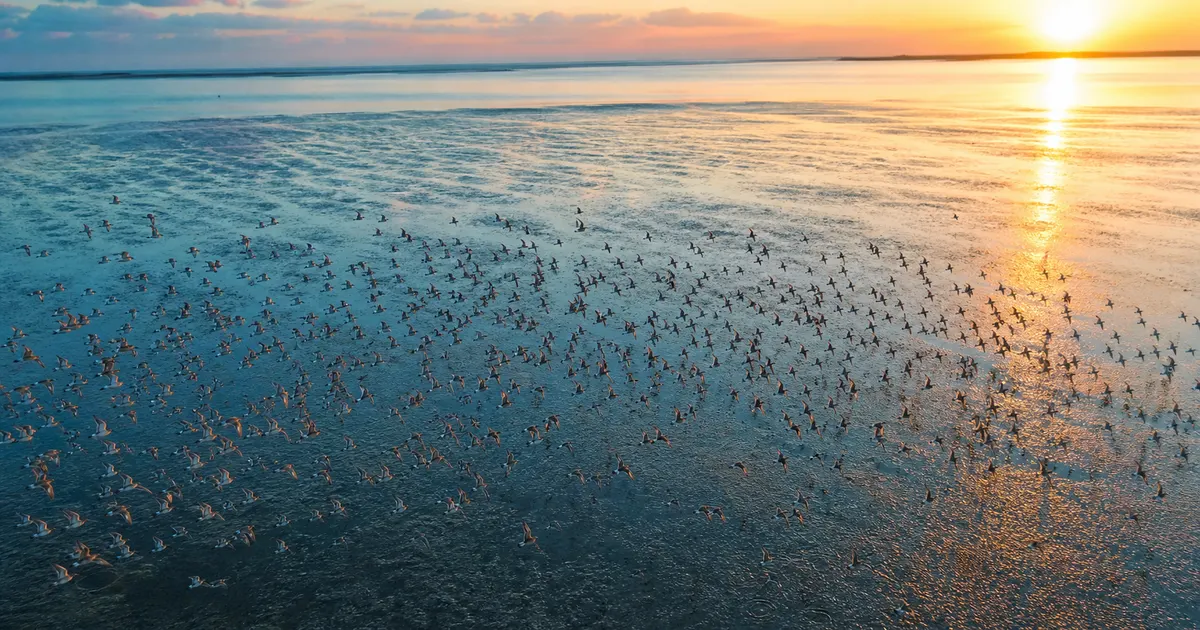
Every spring and autumn, small travelers arrive at Japan's tidal flats from both the north and the south. They are migratory shorebirds — known in Japanese as shigi-chidori. Some of these birds cover one-way distances of several thousand to more than ten thousand kilometers between their breeding grounds in Alaska and Siberia and their wintering grounds in Southeast Asia and Australia. Along this extraordinary journey, they need a filling station where they can recover their strength and refuel — and that filling station is the tidal flat.
But today, these filling stations are disappearing rapidly around the world. Along the coast of the Yellow Sea — the great artery of this migration — roughly 65% of intertidal mudflats were lost to land reclamation and other development between the 1960s and the 2010s. In Japan too, the total shorebird population has declined by around 58% in spring compared to fiscal year 2000. Every time a stopover site vanishes, the odds of surviving this life-or-death journey drop a little further.
This article explores, with reliable data, what kind of birds shorebirds are, how the East Asian–Australasian Flyway functions as a migratory corridor, and why the loss of tidal flats has such a severe impact. We'll also look at the Ramsar Convention, international partnerships, and the concrete steps each of us can take toward conservation.
What you'll learn in this article
- What shorebirds are, and why tidal flats are their lifeline
- How the East Asian–Australasian Flyway, a migratory corridor spanning over 10,000 km, works
- How land reclamation in the Yellow Sea and the loss of stopover sites are driving shorebirds toward crisis
- The latest figures on how much Japan's shorebird populations have declined over the past few decades
- The crisis facing the Spoon-billed Sandpiper, a flagship species, and the hidden time lag behind population decline
- The Ramsar Convention, the EAAFP, on-the-ground conservation in Japan, and what we can do
What Are Shorebirds? Master Travelers of the Tidal Flats
"Shorebirds" — or shigi-chidori in Japanese — is not the name of a single species but an umbrella term for a group of small to medium-sized migratory birds that live along the water's edge. In Japan, dozens of species have been recorded, including the Dunlin, Bar-tailed Godwit, Grey Plover, Kentish Plover, Grey-tailed Tattler, and Red-necked Stint, and most of them make open wetlands such as tidal flats, estuaries, sandy beaches, and rice paddies their primary habitat. What they share in common is that they migrate long distances and feed on small creatures living on and in the mud.
If you had to sum them up in one phrase, it would be "master travelers." They breed in high-latitude regions to the north, such as Siberia and Alaska, and winter in the south, in places like Southeast Asia, Australia, and New Zealand. Twice a year, they travel between these regions as if crossing the globe from top to bottom. The very fact that birds weighing only a few dozen grams can cover such enormous distances is itself a biological marvel.
What Bills and Legs Reveal About Division of Labor
If you watch shorebirds closely as they land on a tidal flat, you'll notice that the length and shape of their bills, along with their leg length, differ slightly from species to species. This is no coincidence. Species with long bills probe deep into the mud for polychaete worms and bivalves, while short-billed species peck at small crustaceans near the surface. Even on the same tidal flat, the birds skillfully divide up feeding locations and prey, avoiding direct competition for limited resources.

Why Tidal Flats Are a Lifeline
Tidal flats are stretches of mud and sand that are submerged under the sea and exposed to the air twice a day as the tide rises and falls. Because nutrients carried by rivers meet the productivity of the sea here, benthic organisms — polychaete worms, crabs, shellfish, and small crustaceans — thrive in extraordinary abundance. For migratory shorebirds, a tidal flat is essentially an "all-you-can-eat rest stop." Here, they eat enormous amounts in a short period, storing fat as fuel to prepare for the next long-distance flight.
- Tidal flats are where river and ocean nutrients converge, giving benthic organisms extremely high productivity
- Migratory birds gain substantial weight within days to weeks, storing fat as flight fuel
- Benthic organisms on tidal flats also purify water quality, benefiting human life as well
- The loss of even a single tidal flat means one migratory "filling station" disappears
The value of tidal flats is not limited to migratory birds. Polychaete worms and bivalves such as Manila clams take in organic matter from the water, contributing to water purification as well. These wetland benefits share something in common with the carbon-storing function of seagrass meadows and salt marshes. How marine ecosystems circulate carbon and nutrients is also becoming clearer through the lens of blue carbon ecosystems.
What deserves special attention is that the productivity of tidal flats is sustained by an "invisible cycle." When the tide comes in, fish and shrimp move onto the flat and feed on the benthic organisms; when the tide goes out, the birds feed on those same organisms. On the surface of the mud, microscopic algae such as diatoms photosynthesize vigorously in the sunlight, and this primary production forms the foundation of the entire food web. In other words, tidal flats are a "natural production factory," continuously generating enormous amounts of food for birds and fish using the power of the sun and the tides. It is precisely this productivity that allows thousands to tens of thousands of migratory birds to concentrate on a single, relatively small tidal flat.
The Diverse Cast of Characters on the Tidal Flats
The shorebirds found on Japan's tidal flats are remarkably diverse. The most commonly seen species nationwide is the Dunlin, which repeatedly probes the mud with its bill to catch small shellfish and worms. The larger Bar-tailed Godwit has a long, upward-curving bill that it uses to search for prey deep in the mud. The round-bodied Grey Plover walks across the flat, pauses, spots prey by sight, and pecks quickly. On deep, muddy flats like those of the Ariake Sea, the endangered Black-faced Spoonbill and Saunders's Gull also visit. The fact that so many different species can coexist on a single tidal flat is itself evidence of that site's health.
Key Points of This Chapter
- Shorebirds are not a single species but a collective term for migratory birds that live along the water's edge
- Differences in bill and leg shape enable species to divide food resources and coexist on the same tidal flat
- Tidal flats are "filling stations" rich in benthic organisms, serving as a lifeline for migration
The East Asian–Australasian Flyway: An Aerial Corridor That Connects Life
Migratory birds travel back and forth along roughly fixed, band-shaped routes on the map. This aerial corridor is called a "flyway." There are several major flyways in the world, and most of the shorebirds that visit Japan's tidal flats use the East Asian–Australasian Flyway (EAAF).
This flyway stretches across roughly 22 countries and territories, from the Russian Far East and Alaska in the north, through East and Southeast Asia, down to Australia and New Zealand in the south. More than 200 species of migratory waterbirds are believed to travel this route, with a total population estimated at 50 million. The Japanese archipelago sits right in the middle of this vast corridor, serving as a crucial stopover zone.

Stopover Sites Form a Chain of Stepping Stones
The key to understanding a flyway is the image of "stepping stones." Migratory birds don't fly from their breeding grounds to their wintering grounds in a single leap; instead, they move by hopping across wetlands along the way, like stepping stones. At each stopover site they refuel and prepare for the next flight — and it's this repeated pattern that makes the long journey possible.
This structure has a weakness. If even one stepping stone is missing, the birds that relied on it lose their place to go, and the entire migration can collapse. In particular, if a "keystone stopover site," where large numbers of individuals concentrate, is lost, the damage ripples across the whole flyway. The tidal flats of the Yellow Sea were exactly this kind of keystone stopover site.
| Category | Main regions | Role |
|---|---|---|
| Breeding grounds | Russian Far East, Alaska, Siberia | Nesting and raising chicks in summer |
| Stopover sites | Yellow Sea coast, Japanese archipelago, Korean Peninsula | Refueling and resting during migration |
| Wintering grounds | Southeast Asia, Australia, New Zealand | Overwintering and building up strength |
The Role Japan's Archipelago Plays
Japan is home to internationally important shorebird sites scattered across locations such as the Ariake Sea, Tokyo Bay, Ise Bay, and Mikawa Bay. These tidal flats are among the few safe havens where birds can reliably stop over during their long journey along the flyway. Protecting Japan's tidal flats is directly linked not just to preserving domestic nature, but to supporting the entire flyway and, by extension, biodiversity across East Asia and Oceania. For more on the richness of Japan's marine life, see our article on Japan's marine biodiversity.
There are said to be around nine major flyways in the world, and the East Asian–Australasian Flyway is known for containing a particularly large number of endangered species. One reason is that the stopover sites along this flyway overlap with some of the world's most densely populated regions. Coastal areas of China, Korea, Japan, and Southeast Asia are also centers of economic development, and their tidal flats have been under constant pressure from development. The crisis facing migratory birds and the concentration of human activity overlap geographically.
The Flyway Approach
Migratory birds are not divided by national borders. That's precisely why the "flyway approach" — international cooperation among countries that host breeding grounds, stopover sites, and wintering grounds — is so important. The efforts of a single country alone cannot protect migratory birds.
An Astonishing Migration: The Science Behind Nonstop 10,000-km Flights and Refueling
Looking at specific records makes clear just how grueling shorebird migration can be. The Bar-tailed Godwit is known as the world record holder for "nonstop flight" — flying without drinking water, eating food, or sleeping. One individual flew from Alaska to New Zealand, crossing the Pacific Ocean without a single rest.
Recent tracking studies have reported even more astonishing records. A juvenile bird only five months old flew a total distance of about 13,560 kilometers from Alaska to Tasmania, taking 11 days and one hour without a single stop. This was a feat accomplished by an inexperienced young bird with no one to teach it the way.
These records have come to light thanks to advances in technology that attach ultra-small transmitters to birds and track their positions via satellite. In the past, leg-band surveys could only tell us isolated points — where a bird was released and where it was later found — but now researchers can trace the entire migratory route as a continuous line. As a result, the fact that shorebirds fly over the ocean for days on end, and their strong dependence on specific tidal flats, have been confirmed one data point after another. Technological progress has dramatically advanced the scientific foundation of shorebird conservation.
The Red Knot is another species known for long-distance migration, with round-trip annual distances sometimes exceeding 15,000 kilometers, making it one of the world's foremost long-distance travelers. What these birds have in common is that they rely heavily on just a small number of stopover sites to recover their strength along the way. Precisely because so few reliable tidal flats exist, the loss of even one is immeasurably damaging. Here lies an ironic relationship: the longer a species' migration, the more vulnerable it becomes to the loss of stopover sites.
Nonstop Flight Records
The Bar-tailed Godwit's nonstop flight record spans roughly 11,000 to 13,500 km — a distance covered without sleeping or eating, ranking among the longest known migratory flights in the bird world.

Turning the Body Into a Fuel Tank
What makes such flights possible is intensive refueling on tidal flats before migration. At stopover sites, shorebirds spend days to weeks continuously feeding on benthic organisms, gaining substantial body weight. Much of this added weight is fat, which serves as the energy source for long-distance flight. In some species, it's known that they temporarily shrink their digestive organs before flight and enlarge their breast flight muscles by a corresponding amount — a remarkable internal restructuring of the body.
In other words, for migratory birds a tidal flat is not merely a "rest stop" but a "supply base" that determines the success or failure of the next flight. If a bird cannot gain enough weight here, it may fail to reach its next destination and run out of strength along the way. The quality and quantity of stopover sites determine matters of life and death for the entire migration.
- Arrive at a stopover tidal flat and feed intensively on benthic organisms
- Gain substantial weight within days to weeks, storing fat
- Shrink the digestive organs and develop the flight muscles to optimize for flight
- Fly long distances toward the next destination, fueled by the stored fat
What Happens When the All-You-Can-Eat Buffet Disappears
Flip this mechanism around, and the precariousness of stopover sites becomes clear. If the area of a tidal flat shrinks and benthic organisms become scarce, birds are forced to crowd into the same spot and compete fiercely for food. Individuals forced to depart without gaining enough weight may run out of strength mid-migration, or arrive at the breeding grounds without enough energy left to lay eggs. In ways that are hard to see, the degradation of stopover sites even lowers the breeding success rate at distant breeding grounds.
The timing of migration is also managed with astonishing precision. Birds must arrive at their northern breeding grounds in sync with the brief summer when insects and plants are most abundant — otherwise there won't be enough food to raise chicks. Arrive too early, and the land is still locked in snow and ice. To manage this, migratory birds combine cues such as changing day length with their internal clocks to decide when to depart. Whether they can refuel on schedule at a stopover site is also tied to whether this entire precise timetable holds together. If a tidal flat is depleted and a stopover drags on longer than planned, arrival at the breeding grounds is delayed, potentially costing the bird that year's breeding season entirely.
Seen this way, shorebird migration can be likened to an "unbroken chain." Breeding, the southward migration, wintering, and the northward migration — only when every single link connects does a flock return to the tidal flats the following year. If even one link weakens, the entire chain breaks. Tidal flats, as stopover sites, are a particularly high-stress, keystone link in this chain. Trying to understand the full lives of migratory birds is nothing less than understanding the connectedness of nature itself — across sea and land, and across national borders.
Key Points of This Chapter
- The Bar-tailed Godwit holds the migration record for nonstop flights of over 10,000 km
- Migratory birds turn their bodies into "fuel tanks" on tidal flats before taking flight
- Without gaining enough weight at stopover sites, both migration and breeding are more likely to fail
Vanishing Tidal Flats: Land Reclamation in the Yellow Sea and the Stopover Crisis
The heart of the East Asian–Australasian Flyway is the vast expanse of tidal flats in the Yellow Sea (and Bohai Sea), surrounded by China and the Korean Peninsula. This was truly a "keystone stopover site," intensively used by many shorebirds as the turning point of their migration. But large-scale loss of tidal flats has progressed across this entire region.
According to research, approximately 65% of intertidal mudflats along the Yellow Sea and Bohai Sea coasts were lost between the early 1960s and the mid-2010s. The main causes were land reclamation for industrial sites and ports, along with conversion to aquaculture ponds and salt fields. One estimate found that in just the 15 years from 2000 to 2015 alone, about 1,795 square kilometers — roughly 29% of coastal wetlands — were lost to development. For migratory birds, this was equivalent to watching most of their stepping stones disappear from the sea.
There's a reason the Yellow Sea's tidal flats were especially important. This region contains some of the most extensive tidal flats in the world, with benthic organisms in extraordinary abundance thanks to nutrients carried by great rivers. Positioned exactly midway between Arctic breeding grounds and Southern Hemisphere wintering grounds, it served as an indispensable "turning point" that divided the long migration in two for many species. Without adequate refueling here, neither the onward flight nor breeding at the destination would be possible. It is no exaggeration to say that the tidal flats of a single sea held the fate of the entire flyway in their hands.

Dependence on Stopover Sites Predicts the Rate of Decline
The impact of Yellow Sea tidal flat loss on migratory birds has been backed up scientifically. Multiple studies have shown that the extent of a species' decline can be predicted, to a certain degree, by how heavily that species depends on the Yellow Sea's tidal flats. In other words, species that relied more heavily on the Yellow Sea are declining more rapidly. This is considered strong evidence that the loss of stopover sites is a primary cause of population decline.
The loss of tidal flats is not unrelated to the degradation of water quality and ecosystems. As eutrophication progresses in enclosed inland seas, red tides and hypoxic water masses can develop, worsening the habitat for benthic organisms themselves. We cover this mechanism of coastal environmental degradation in more detail in our article on red tides and eutrophication.
The Many Threats Facing Japan's Stopover Sites
The situation regarding tidal flats within Japan is not encouraging either. Back in the 1960s and 70s, the main cause of decline was the physical loss of tidal flats themselves through large-scale coastal reclamation and land reclamation projects. Today, large-scale reclamation has decreased, but population decline still hasn't stopped. If anything, the threats have become more diverse and compounded.
- Declining function of secondary wetlands, such as rice paddies and lotus fields, that migratory birds have long relied on
- Shortened flooding periods due to farmland improvement projects
- Shrinking tidal flats and wetlands due to the construction of seawalls
- Erosion of beaches and tidal flats caused by sea level rise and insufficient sediment supply
- Declining quality of resting sites due to human intrusion and development
In short, even as visible, large-scale development has decreased, habitat quality continues to erode gradually. What's needed now is not just "protecting" tidal flats, but a mindset of "restoring and improving their quality." We explore Japan's tidal flat conservation efforts further in our article on tidal flat conservation.

The shrinking of tidal flats cannot be separated from the livelihoods of the people who live there. Rich tidal flats are also fishing grounds that nurture Manila clams, nori seaweed, and seafood, and if tidal flats are lost, coastal fishery resources are diminished as well. We also address the impact of ocean environmental change on fisheries in our article on ocean warming and fisheries. Protecting migratory birds and protecting coastal livelihoods are never separate issues.
Beware of Hard-to-See Crises
The crisis facing tidal flats doesn't only take obvious forms like land reclamation. Slow-moving changes — sea level rise, reduced sediment supply, wetland desiccation — quietly erode habitat quality. By the time the numbers show it, it's often already too late.
Populations Cut in Half: A Silent Extinction Told in Numbers
The loss and degradation of tidal flats show up clearly in shorebird numbers. Long-term monitoring surveys conducted by the Ministry of the Environment and others at major sites nationwide reveal this change in stark figures. Japan's total shorebird population declined by approximately 58.2% in spring, 53.0% in autumn, and 55.3% in winter by the end of fiscal year 2022, compared to fiscal year 2000. In just a little over two decades, the population has fallen by roughly half.
What's even more serious is that the decline is still continuing. Especially since fiscal year 2010, the population has kept falling at a rapid pace of roughly 6% per year. A 6% annual decline means that, left unchecked, the population would halve again in just over a decade or so. This is not considered a temporary fluctuation but a structural downward trend.

Decline Is Also Progressing Across the Entire Flyway
This trend is not unique to Japan. Across the entire East Asian–Australasian Flyway, the population of migratory waterbirds is estimated to be declining at a rate of roughly 5–9% per year. About 38% of the flyway's shorebird populations are trending downward, and 20 populations are classified as threatened on the International Union for Conservation of Nature (IUCN) Red List. The crisis facing migratory birds spans the scale of the entire East Asia–Oceania region. In particular, species that winter far from their breeding grounds, in places like Australia and New Zealand, tend to show especially pronounced declines, since they are exposed to more dangers across the full length of their migration.
Behind this decline lies not only the direct factor of tidal flat loss, but also the long-term pressure of climate change. In the Arctic breeding grounds, warming is shifting the timing of snowmelt and insect emergence, raising concerns about a "mismatch" in which food supplies have already peaked by the time migratory birds arrive. At stopover tidal flats, sea level rise further shrinks available habitat. With multiple pressures acting simultaneously at every stage of migration, population recovery is becoming increasingly difficult.
| Indicator | Value | Source and date |
|---|---|---|
| Japan, spring population decline | About 58.2% decline | vs. FY2000, as of end of FY2022 (Ministry of the Environment monitoring) |
| Japan, decline rate since FY2010 | About 6% per year | Monitoring Site 1000, etc. |
| Flyway-wide decline rate | About 5–9% per year | International waterbird surveys |
| Share of declining populations | About 38% | Shorebird populations across the flyway |
The Weight of the Phrase "Silent Extinction"
The decline of tidal flat birds isn't reported dramatically, the way a forest fire or an oil spill would be. But the way their numbers steadily and surely fall a little more each year is often called a "silent extinction." Because it lacks drama, the sense of crisis is harder to share, and by the time people notice, the population may have already fallen to a level from which recovery is difficult — that is what makes this problem so tricky. That's precisely why the steady work of long-term monitoring, which makes these changes visible, is the starting point for conservation.
It's also worth noting that Japan's monitoring is supported by the eyes of many volunteers. Across tidal flats nationwide, citizen observers have patiently continued counting the birds that arrive each spring and autumn. It's precisely because of these years of records that we can state, with solid numbers, the fact that populations have been cut roughly in half over the past couple of decades. The accumulation of this painstaking work — counting birds one by one — has become the evidence that moves policy and international negotiations. Citizen science can be called the hidden foundation of shorebird conservation.
Key Points of This Chapter
- Japan's shorebird populations have declined by roughly half over the past couple of decades
- Since fiscal year 2010, they have continued declining at about 6% per year
- About 38% of populations across the entire flyway are also trending downward
The Spoon-billed Sandpiper: A Warning Bell From a Few Hundred Birds Worldwide
One bird that symbolizes the crisis facing migratory birds is the Spoon-billed Sandpiper. As its name suggests, it's a small sandpiper with a distinctive bill that flattens and widens like a spoon at the tip, and its charming appearance has endeared it to researchers and bird lovers around the world. Yet today, the Spoon-billed Sandpiper is considered one of the birds closest to extinction on Earth.
The Spoon-billed Sandpiper breeds in northeastern Siberia and winters in Southeast Asian countries such as Myanmar and Bangladesh. Its round trip spans more than 15,000 kilometers, using the Yellow Sea and Japan's tidal flats as stopover sites along the way. Yet the world population has already fallen to just a few hundred birds, and it is listed as Critically Endangered (IA) — the most critical category — on the Ministry of the Environment's Red List. Reports indicate that the global population has declined sharply over roughly the past decade, and warnings say that, left unchecked, the risk of extinction in the near future is extremely high.

What 70 Years of Data Revealed About the Time Lag
In 2026, a research group at Hokkaido University published findings analyzing the factors behind the Spoon-billed Sandpiper's decline using roughly 70 years of data. What makes this research especially important is that it revealed a "time lag of more than a decade" before changes in habitat are reflected in population numbers. Long-term habitat shrinkage over the past 50 years was more strongly linked to the current decline than environmental changes over just the past 10 years.
The study also showed that observed Spoon-billed Sandpiper numbers declined by about 90% from the 1970s to the 2020s, and that over the same period tidal flats shrank by about 54%, sandy beaches by about 58%, and artificial alternative habitats were lost at a rate of fully 93%. The existence of this time lag offers us a sobering lesson: even if we protect tidal flats now, the effects may not show up in the numbers for another decade or more — which, conversely, means that the cost of tidal flats we lose today will come back to bite us as an even more severe decline a decade or more from now.
It takes at least ten years or more for changes in habitat to be reflected in population numbers. Long-term habitat shrinkage over 50 years was more strongly linked to the current decline than changes over the past 10 years.
— Research by Associate Professor Masayuki Senzaki and colleagues, Hokkaido University (Estuarine, Coastal and Shelf Science, 2026)
What It Means to Protect a Flagship Species
Efforts to save the Spoon-billed Sandpiper have spread across national borders. In the Russian Far East breeding grounds, a technique called "headstarting" has been tried — hatching wild eggs artificially in a safe environment, raising the chicks to a certain point, and then releasing them into the wild — as an ongoing effort to boost chick survival rates. In the Southeast Asian wintering grounds, activities are underway to provide local hunters with alternative livelihoods in order to prevent poaching. Precisely because the species cannot be saved if even one of the breeding, stopover, or wintering sites is lost, cooperation across the entire flyway is essential.
Efforts to protect a flagship species like the Spoon-billed Sandpiper do not save just that one species. A tidal flat healthy enough to support the Spoon-billed Sandpiper is also good habitat for many other creatures that depend on the same environment, such as the Dunlin, Bar-tailed Godwit, and Black-faced Spoonbill. Protecting habitat under the banner of a flagship species means the entire ecosystem beneath that "umbrella" is protected as well — this is what conservation biology calls the "umbrella effect." The movement to designate the Spoon-billed Sandpiper's wintering grounds as protected areas in various countries is based exactly on this idea. The concept of protecting marine biodiversity as a whole also resonates with our article on Japan's marine biodiversity.
What Is the Umbrella Effect?
When a flagship species that requires a large habitat or special environment is protected, many other creatures that depend on the same environment are protected together, as if under its umbrella. Conserving the Spoon-billed Sandpiper serves as a gateway to protecting the entire tidal flat ecosystem.
Protecting Tidal Flats: The Ramsar Convention, International Cooperation, and Grassroots Efforts
The crisis is serious, but no one is standing idly by. Because migratory birds cross national borders, an international framework is essential to their conservation. At the core of this framework are the Ramsar Convention, aimed at conserving wetlands, and the East Asian–Australasian Flyway Partnership (EAAFP), which focuses specifically on the migratory bird flyway.
The Ramsar Convention and "Wise Use"
The Ramsar Convention is an international treaty for protecting wetlands of international importance as waterbird habitat. Rather than simply banning development, it emphasizes the concept of "wise use" — protecting wetlands while using them in sustainable ways. In Japan, the Yatsu tidal flat in Chiba Prefecture became the first tidal flat registered under the convention in 1993, followed by a succession of important shorebird stopover sites, including Fujimae tidal flat (2002) and Higashiyoka tidal flat in Saga Prefecture (2015).
Citizen action played a particularly large role in the registration of Fujimae tidal flat. This tidal flat was once slated to be reclaimed as a landfill site, but a persistent campaign by citizens and researchers who argued for its importance as a migratory bird site led to the plan's withdrawal, and the site was subsequently registered as a Ramsar wetland. A tidal flat that was once on the verge of being lost was protected and internationally recognized for its value — a symbolic case showing that community interest and action can achieve real conservation results. Tidal flats like Yatsu, preserved in the middle of a city, are only passed on to the future when many people grow attached to them and keep watch over them.
| Wetland | Location | Year registered under Ramsar |
|---|---|---|
| Yatsu tidal flat | Narashino City, Chiba Prefecture (Tokyo Bay) | 1993 |
| Fujimae tidal flat | Nagoya City, Aichi Prefecture (Ise Bay) | 2002 |
| Higashiyoka tidal flat | Saga Prefecture (Ariake Sea) | 2015 |

International Cooperation to Protect the Entire Flyway
The EAAFP is an international partnership for migratory waterbirds established in 2006. Countries along the flyway from the Russian Far East to Australia and New Zealand, along with international organizations and NGOs, participate with the goal of conserving important migratory bird habitats as a network. Within Japan, 34 sites had joined this network as of 2023, including Lake Utonai, Lake Furen and Shunkunitai, and the Tokyo Port Wild Bird Park. It's a mechanism for supporting migratory birds — which cannot be protected by any single country alone — across the entire flyway.

Conservation is moving beyond just "protecting" and entering a phase of "restoration" as well. Efforts have begun in various places to restore previously lost tidal flats by opening sections of levees to let seawater back in, and to replenish sediment on depleted tidal flats to recover habitat for benthic organisms. This mindset of actively regenerating coastal ecosystems has something in common with efforts to restore seagrass meadows. Marine ecosystems, even once lost, hold the potential to be gradually recovered if the right conditions are put in place.
There are also encouraging signs within international efforts. According to an IUCN report, the pace of tidal flat loss in the Yellow Sea has been slowing since around 2013, and moves toward protection are also emerging, such as China registering coastal wetlands as a UNESCO World Heritage site. Of course, lost tidal flats won't simply return, and urgent action is still needed — but the fact that the direction is starting to shift can be seen as a source of hope.
What We Can Do
Conserving migratory birds and tidal flats is not the sole responsibility of experts and government agencies. Each individual's interest and action supports the larger movement. You can start simply by visiting a nearby tidal flat and actually seeing shorebirds for yourself. Understanding the richness of these creatures and the ocean's bounty that sustains them becomes more three-dimensional when viewed through the lens of Japan's marine biodiversity and blue carbon ecosystems.
A Step You Can Take Starting Today
- Visit a nearby tidal flat or Ramsar-registered wetland and observe the migratory birds
- Participate in citizen activities such as birdwatching events, cleanups, or monitoring at tidal flats
- Pay attention to and stay informed about tidal flat reclamation and development plans
- Learn about and support the activities of conservation organizations such as the Wild Bird Society of Japan and WWF
- Share the value of tidal flats and the crisis facing migratory birds with family and friends
Conclusion: Keeping the Stepping Stones From Disappearing
The migration of shorebirds is a drama of life unfolding on a planetary scale. Tiny birds weighing only a few dozen grams complete journeys of several thousand to over ten thousand kilometers twice a year. What sustains this miracle are the tidal flats scattered along the way — the "stepping stones" — and the intensive refueling that takes place there.
But now, these stepping stones are being lost around the world. In the Yellow Sea, about 65% of intertidal mudflats have vanished, and Japan's shorebirds have declined by roughly half over the past couple of decades. As the Spoon-billed Sandpiper research showed, the effects of tidal flat loss appear with a time lag of a decade or more. In other words, whether we act now will determine the fate of migratory birds a decade or more from now.
The crisis facing tidal flats is connected to other challenges facing our oceans. Coastal eutrophication, the environmental changes and recovery experienced by the seas off Sanriku, and the restoration of seagrass meadows and salt marshes — these ocean-related issues are all interconnected. Stories of coastal recovery, like the restoration of the Sanriku sea, can also offer hints for reclaiming lost nature. Reconsidering the ocean from the perspective of migratory birds is, in fact, a way of reconsidering our entire coastal environment.
At the same time, seeds of hope are certainly growing — the slowing pace of loss in the Yellow Sea, and international cooperation through the Ramsar Convention and the EAAFP. Migratory birds are a shared treasure that visit us across national borders. Preserving as many stepping stones as possible, and improving their quality, is a solid step toward passing on the sight of flocks dancing over tidal flats to the future. The next time you visit a tidal flat, please remember that those small travelers busily working their bills in the mud are in the middle of an epic journey connecting the far reaches of the Arctic to the Southern Hemisphere. What supports each and every one of their journeys is none other than the tidal flat beneath our own feet.
Summary of This Article
- Shorebirds are master travelers that migrate over 10,000 km while "refueling" on tidal flats
- About 65% of the Yellow Sea's tidal flats have been lost, rapidly eliminating migratory "stepping stones"
- Japan's shorebird populations have declined by roughly half over the past couple of decades and continue to decline at about 6% per year
- The Spoon-billed Sandpiper has declined to just a few hundred birds worldwide, with effects appearing with a time lag of a decade or more
- International cooperation through the Ramsar Convention and EAAFP, along with individual action and interest, are key
References and Sources
- Biodiversity Center of Japan, Ministry of the Environment – Monitoring Site 1000 Shorebird Survey (fixed-point survey report)
- Ministry of the Environment, Japan – East Asian–Australasian Flyway Partnership (EAAFP)
- Ministry of the Environment, Japan – The Ramsar Convention and Ramsar wetlands (including Fujimae tidal flat)
- Hokkaido University – Elucidating the causes of decline in the endangered Spoon-billed Sandpiper using 70 years of data (Associate Professor Masayuki Senzaki)
- Bird Research – Japan's shorebirds as seen through long-term monitoring
- IUCN – New IUCN report shows loss of tidal wetlands in Yellow Sea slowing since 2013
- Nature Communications – Rapid population decline in migratory shorebirds relying on Yellow Sea tidal mudflats as stopover sites
- WWF Japan – Protecting a paradise for migratory birds remaining in the Yellow Sea, where 100,000 waterbirds gather
- Wild Bird Society of Japan – Spoon-billed Sandpiper conservation efforts
* Listed in order of reliability: government and academic institutions > peer-reviewed papers > specialized organizations > reputable media