⚡ The answer in 30 seconds
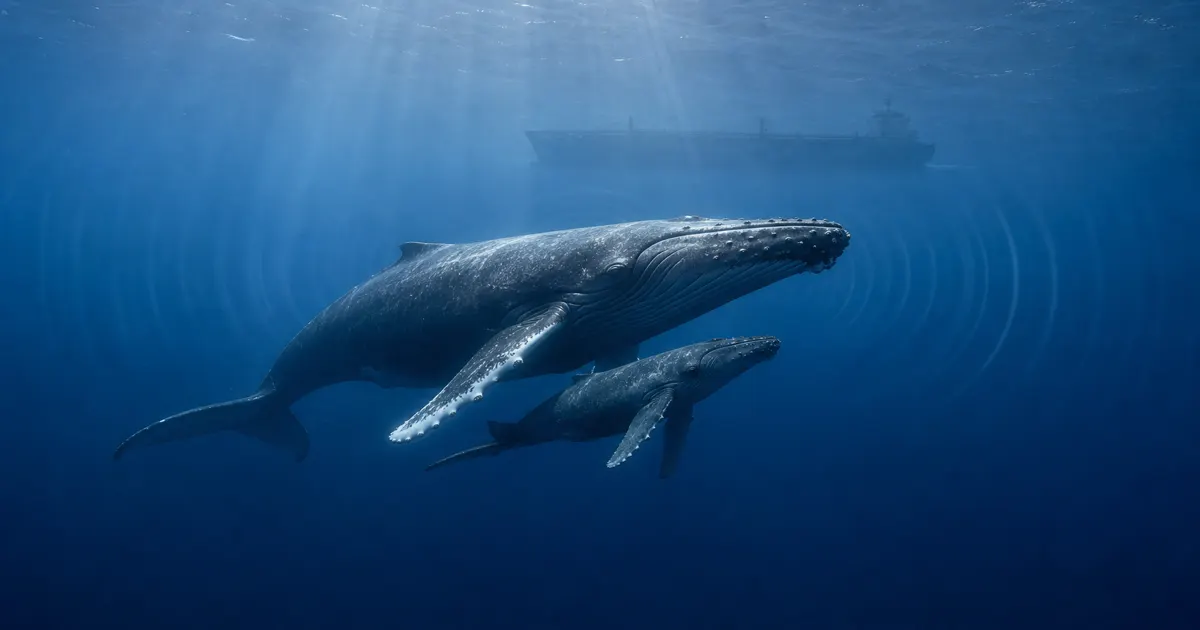
- Ocean noise is a problem in which human sounds from ships and other activities disrupt marine life that communicates and finds food by sound.
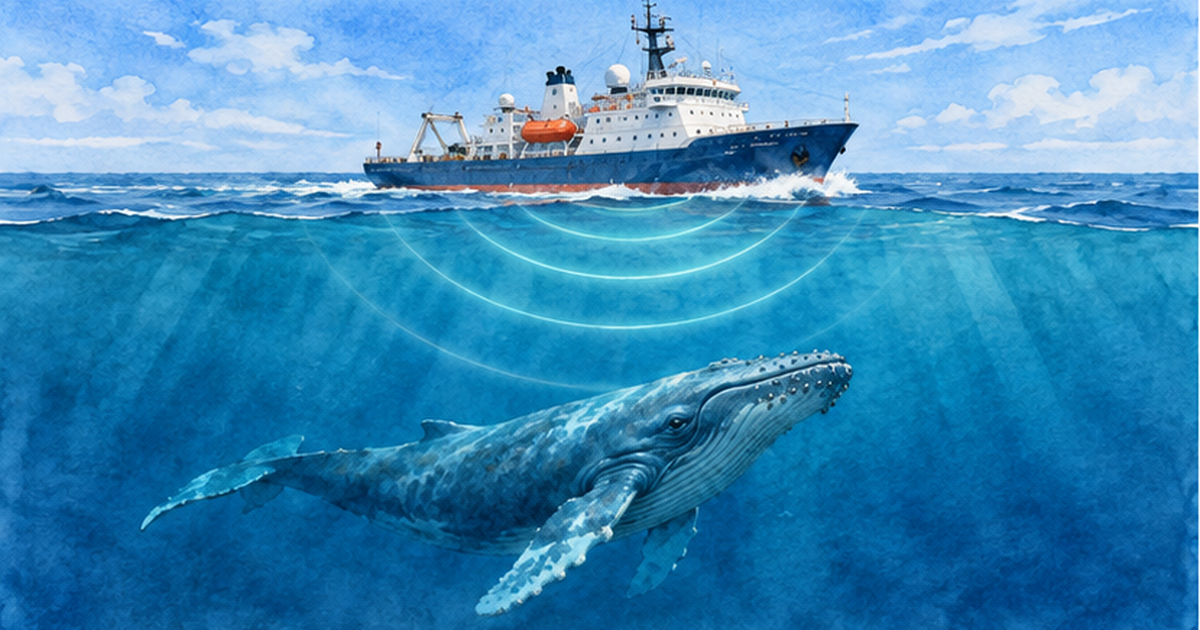
- Commercial ships are the largest continuous source; their 5–300 Hz low-frequency sound overlaps the communication band of large whales and causes masking.
- Noise is a type of pollution that can be reduced fairly quickly by stopping the source, and measures such as slowing ships have shown effects.
- Japan is still building its measurement and assessment methods, while the IMO revised its ship noise reduction guidelines in 2023.
The sea is not a silent world. Whales and many other marine animals rely on sound to communicate, find food and avoid danger in waters where light does not reach. When the sounds of ships, construction and resource surveys are added, the animals' "conversations" may become hard to hear.
Based on primary sources such as NOAA, the IMO and academic studies, this article organizes how underwater noise works, its effects, measures around the world and the situation in Japan. We separate what is scientifically known from what is not yet known.
Often called an "invisible pollution", underwater noise differs from plastic waste in that it can improve relatively quickly once the source is stopped. Let us also look at the hopeful side.
What you will learn in this article
- Why underwater sound matters so much to marine life
- The main sources of underwater noise: ships, construction, surveys, military
- Masking, stress and other effects on whales and dolphins; limits of the research
- Global measures such as IMO guidelines and the slowdown trial results
- Japan's situation and what each of us can do
The sea is not a "silent world": basics of underwater sound
Sound travels farther than light in the sea
In the sea, light fades rapidly within tens to hundreds of meters, and below about 200 m it is almost dark. Sound, however, travels about 4.4 times faster in water than in air (roughly 1,500 m per second) and under good conditions can reach hundreds or even thousands of kilometers. Many marine animals therefore use sound rather than sight as their main sense for communicating, finding food, sensing danger and orienting themselves.
Toothed whales (dolphins, sperm whales and others) have "echolocation", the ability to sense prey and terrain from the echoes of sounds they emit. Baleen whales (blue whales, humpback whales and others) are thought to keep in touch with distant companions using low calls of tens to hundreds of hertz. Among fish, some species hear using the swim bladder and otoliths, and males of some species call to attract mates in the breeding season. Studies also suggest that larvae looking for a place to settle use the "sound" of reefs as a guide.
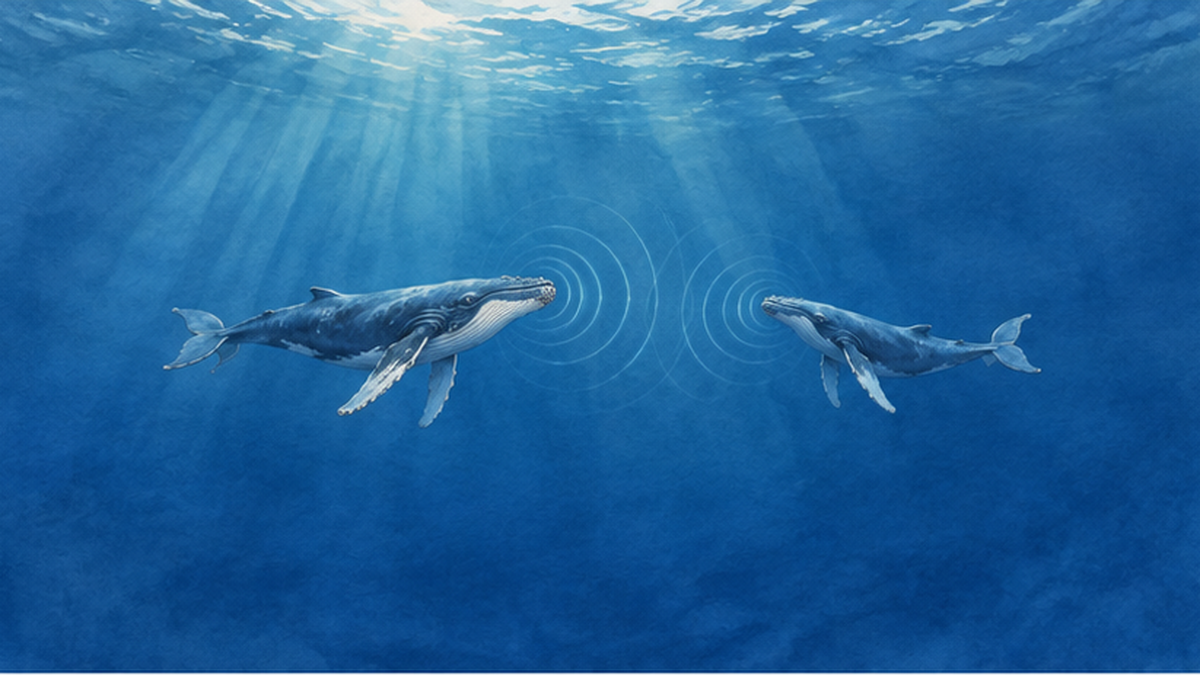
In other words, the underwater sound environment is both an "invisible road sign" and a "communication line" for marine life. What happens when human sounds are added? That is the theme of this article. For how whale song works, see also Ocean Sound and Whale Song.
The decibel trap: water and air cannot be compared simply
The decibel (dB), used to express loudness, has a pitfall: the reference differs between water and air. Air uses 20 micropascals and water uses 1 micropascal, so the same sound is shown as about 26 dB larger in water. Because the way sound travels (acoustic impedance) also differs, it is wrong to think "160 dB in water" is as loud as "160 dB in air".
Another key point is that the dB is a logarithmic unit. A 3 dB increase roughly doubles the sound energy (intensity), 10 dB makes it 10 times, and 20 dB makes it 100 times. Conversely, lowering the level by 3 dB cuts the sound energy by about half. This is why a reduction of just 2–3 dB in the slowdown efforts described later is significant.
| Change in dB | Change in sound energy (approx.) |
|---|---|
| +3 dB | About 2× |
| +6 dB | About 4× |
| +10 dB | 10× |
| +20 dB | 100× |
| −3 dB | About half |
Natural sounds and human sounds
Of course the sea was never completely quiet. Waves, wind, rain, cracking ice, earthquakes and volcanic activity, and the voices of living things (snapping shrimp, whale song, fish choruses) blend into a natural "soundscape". Animals evolved in this background and acquired ways of hearing and calling suited to it.
The problem is that human sound is chronic (always present) and widespread. NOAA explains that commercial shipping is the main source of continuous sound in the ocean, and that growth in shipping is a key contributor to the rise in chronic background underwater noise.
Key points of this chapter
- Sound travels much farther than light underwater, so many marine animals use sound as their main sense
- The dB is logarithmic; a 3 dB difference means about twice the energy
- Human sound differs from natural sound in being chronic and widespread
The main sources of underwater noise: ships, construction, surveys, military
1. Commercial ships: the largest continuous source
Most of the world's trade is carried by sea, and container ships, tankers, bulk carriers, car carriers, cruise ships and ferries sail day and night. According to NOAA, the sound from their propellers, engines and machinery is concentrated at low frequencies (roughly 5–300 Hz). This band overlaps the one large baleen whales such as blue and fin whales use to communicate.
Low-frequency sound attenuates little and travels far. The essential issue is therefore less the sound of a single ship than the way the sounds of ships around the world add up and raise the "background hum" of the whole ocean.
Cavitation: the biggest noise source from propellers
The largest cause of ship noise is said to be cavitation, the formation and collapse of bubbles around the propeller. When a propeller spins fast, water pressure drops on the back of the blade and tiny bubbles form; when they collapse in higher-pressure areas they produce strong sound. Basic countermeasures are therefore optimizing propeller shape, designing the flow around the hull, and keeping surfaces smooth through maintenance.
2. Construction: pile driving and dredging
Pile driving to set foundations for offshore wind farms, harbor works, submarine cable laying and dredging also produce strong sound. Pile driving in particular emits very loud impulsive sound in a short time, raising concern for nearby marine life; in Europe mitigation such as "bubble curtains" that block sound with air bubbles has been put to practical use. As renewable energy spreads, this is also drawing attention as an environmental consideration for offshore wind power.
3. Resource surveys: air guns
In offshore oil and gas exploration, "air guns" release compressed air at once to create strong sound waves, and the reflections reveal underground structures. Air guns fire repeatedly every few seconds, and the sound is said in some cases to reach hundreds to thousands of kilometers. In Japan, the Ministry of the Environment has also worked on literature reviews and guidelines for mitigation concerning the effects of acoustic surveys such as air guns on living things.
4. Military sonar and fishing acoustic equipment
Naval mid-frequency sonar has been discussed internationally in connection with strandings of beaked whales and others. Since around 2000, whale strandings have been reported, and momentum for research on the effects of underwater noise and for regulation has grown. Fish finders used on fishing and survey vessels and acoustic deterrent devices used to prevent fishery damage have also been pointed out as possibly affecting particular species.
| Source | Characteristics of the sound | Main targets of concern |
|---|---|---|
| Commercial ships | Low frequency, continuous, wide-ranging | Baleen whales, fish (masking of communication) |
| Pile driving and construction | High intensity, impulsive, short repeated bursts | Fish, porpoises and others |
| Air gun surveys | High intensity, repeated every few seconds | Baleen whales, fish, invertebrates |
| Military sonar | Mid frequency, high intensity | Deep-diving whales such as beaked whales |
| Fishing acoustic equipment | Specific frequencies, local | Target species and nearby cetaceans |
Note: greater energy does not simply mean greater effect
- Not only brief, very loud sounds but also relatively quiet sounds that continue for a long time (chronic noise) may affect animals' behavior and stress. The level that causes "no effect" differs by species, age and situation, and this remains a field with scientific uncertainty.
Effects on whales and dolphins: masking, stress and behavior change
Masking: conversations can no longer be heard
The most basic effect of noise is masking. NOAA explains that noise at the frequencies animals normally use blocks their "channel" so that sounds important for finding food, taking shelter and avoiding predators cannot be heard. It is like not hearing the person next to you when loud music plays at a party.

Baleen whales that communicate at low frequencies are thought to be prone to masking because their frequencies overlap with ship noise. In noisy waters, whales have been reported to raise the volume of their calls, shift frequencies, or change the time of day they call. However, raising the voice costs energy, and the distance over which they can communicate shrinks anyway.
Evidence of chronic stress: the "natural experiment" left by 9/11
A study published in 2012 (Rolland et al., Proceedings of the Royal Society B) is a valuable example linking noise and stress. After the September 11, 2001 attacks, air and sea traffic temporarily decreased, and underwater noise in Canada's Bay of Fundy fell by 6 dB (significantly below 150 Hz). When stress hormone (glucocorticoid) metabolites in the feces of the endangered North Atlantic right whale living there were examined, levels in autumn 2001, when noise was low, were lower than in other years.
This is known as the first evidence that exposure to low-frequency ship noise may be associated with chronic stress in whales. However, the study is a "natural experiment" using an accidental event, and the acoustic and hormone data came from separate research projects. It cannot be repeated, so some point out that evaluation needs caution.
Effects on foraging
Recent studies also examine how noise affects whales' food acquisition. In the Haro Strait off Vancouver, Canada, research on the foraging of the endangered Southern Resident killer whales was carried out alongside the ship slowdown trial (next chapter), and a tendency for more foraging when ship noise is lower was reported (Williams et al.). Killer whales find salmon by sound, so noise is thought to hinder their search for food.
Links to strandings
Mass strandings of beaked whales in areas where military sonar was used have been discussed as possibly involving abnormal surfacing behavior (disturbed diving) in response to strong sound. However, strandings often have multiple causes, and in many cases noise cannot be named as the cause with certainty. Carefully confirming causation scientifically is important for the credibility of countermeasures.
"There is an effect" and "how large the effect is" are different questions
- Much research deals with measurable indicators such as short-term behavior change and hormone levels. How these connect to long-term population decline is not yet well understood. Rather than lumping everything as "noise is dangerous", it is important to look carefully by species, type of sound and exposure time.
Effects on fish, invertebrates and coral reefs
Fish: it is not only about "not hearing"
Fish sense sound and vibration through the inner ear (otoliths), the lateral line and the swim bladder. Many fish hear low frequencies well, so many species have a hearing range that overlaps ship noise. Studies have reported behavior changes in fish exposed to noise, such as slower alarm responses to predators, lower foraging efficiency and disrupted calling during the breeding season. However, many of these results come from tanks or limited field settings, and further research is needed on how they affect populations in the real sea.
Invertebrates: shrimp, crabs, shellfish and squid
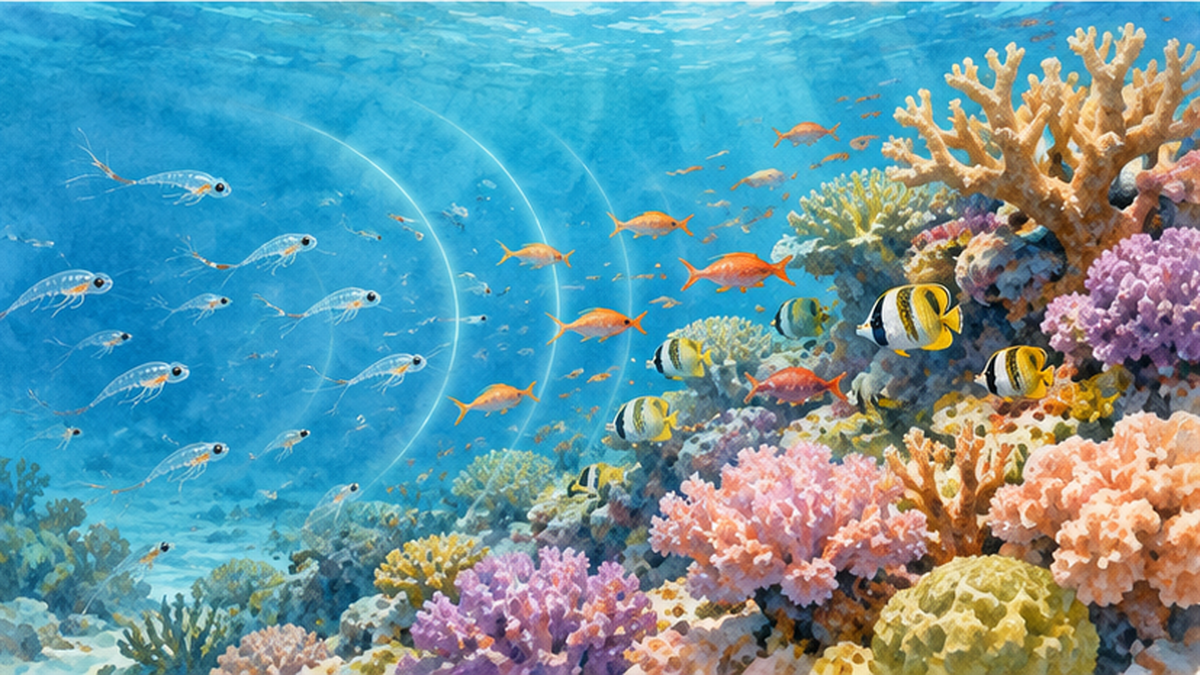
Invertebrates such as shrimp, crabs, bivalves, squid and octopus do not so much "hear" sound as sense vibration of water particles. Recent reports include changes in growth and behavior of bivalves exposed to construction or ship noise, changes in crustacean feeding, and damage to the balance organs (statocysts) of cephalopods, raising attention on these overlooked animals. The IMO also points out that ship noise may affect not only marine mammals but also fish and invertebrates.
Coral reef larvae and the "sound of the reef"
A healthy coral reef is a "lively" place filled with sounds made by fish and shrimp. Studies suggest that fish larvae and coral larvae use these sounds to find a reef to settle on. Reefs degraded by bleaching become "quiet", and their power to attract larvae may weaken. Against this background, experiments playing reef sound to bring larvae back, "restoration by sound", are being done around the world. For coral reef conservation, together with the problem of fishing gear, it is important to consider both the physical and acoustic environment of the sea.
Key points of this chapter
- Noise effects may extend beyond cetaceans to fish and invertebrates
- Much of the evidence is from laboratories or limited field data; effects on populations are still being studied
- On coral reefs, studies suggest the "sound" of the reef is a cue for larval settlement
Global measures: IMO guidelines and the results of slowdowns
The IMO's "ship noise reduction guidelines"
In 2014 the International Maritime Organization (IMO) adopted voluntary guidelines to reduce underwater radiated noise from ships (MEPC.1/Circ.833). Revision work reflecting technical progress and new knowledge followed, and the revised guidelines were approved at the 80th session of the Marine Environment Protection Committee (MEPC 80) in July 2023, replacing the 2014 version (MEPC.1/Circ.906). In 2024, Rev.1, which adds a reference chart for noise reduction planning, became applicable from December 1. These guidelines are not a treaty with legal force but a "voluntary" guide, showing designers, shipyards and shipowners how to build and operate quieter ships.
The IMO also launched the two-year "GloNoise Partnership" project to support developing countries, working on awareness, capacity building and data on ship noise.
| Year | Main developments |
|---|---|
| 2014 | IMO adopts its first ship noise reduction guidelines (MEPC.1/Circ.833) |
| July 2023 | MEPC 80 approves the revised guidelines (MEPC.1/Circ.906) |
| December 1, 2024 | Rev.1 with a reference chart becomes applicable |
Two pillars: design and operation
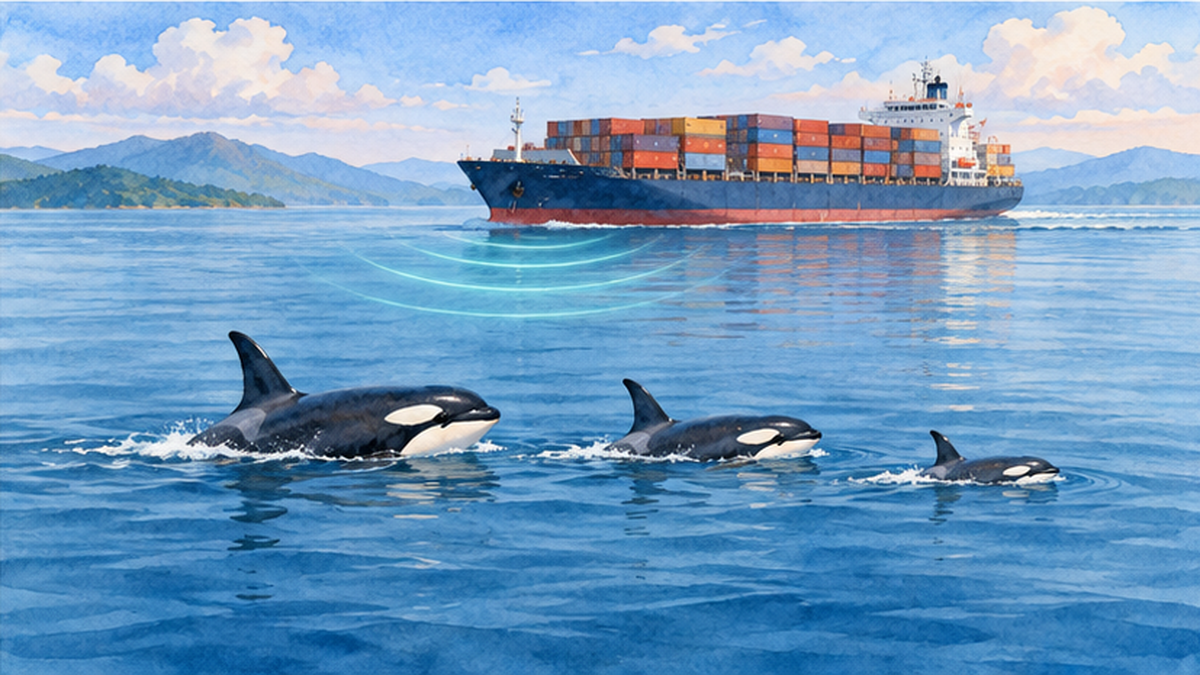
Methods to reduce noise fall into two broad groups.
- Design measures: propeller design that suppresses cavitation, optimizing flow around the hull, vibration isolation of engines and auxiliary machinery, and regular maintenance to keep the hull surface smooth
- Operational measures: reducing speed (slowdown), setting routes that avoid noise-sensitive areas, and reducing unnecessary acceleration and deceleration
Slowing down in particular is attracting worldwide attention as an effective measure that can be applied to existing ships right away. Reducing speed makes propeller rotation gentler and reduces cavitation, and it cuts fuel use and emissions (greenhouse gases), so it is also called a "win-win for the environment".
The ECHO program: the Haro Strait slowdown trial
The most famous example is the ECHO (Enhancing Cetacean Habitat and Observation) program led by the Vancouver Fraser Port Authority in Canada. In 2017, in the Haro Strait, habitat of endangered killer whales, a trial of about two months asked large ships passing through to voluntarily slow down to about 11 knots (about 20 km/h).
According to reports, underwater noise by ship type fell by about 11.5 dB for container ships, 10.5 dB for cruise ships, 9.3 dB for car carriers, 6.1 dB for tankers and 5.9 dB for bulk carriers. Participation was only 50–60%, yet the background noise of the whole strait fell by about 2.5 dB on average. As noted earlier, 3 dB corresponds to about half the sound energy, so the cooperation of just over half the ships visibly improved the sound environment of the strait.
The program later expanded to a larger slowdown area (2019) and trials targeting tug and barge fleets, and some cases reported reductions in broadband noise of up to about 7 dB.
What the ECHO trial teaches
- Even the cooperation of just over half the ships, not all, produced environmental improvement
- Slowing down also cuts fuel use and emissions, not only noise
- Even voluntary efforts can produce measurable results when port authorities, shipping companies and researchers cooperate
Japan's situation and challenges: building the "yardstick" for measurement and assessment
The seas around Japan are a hub of maritime traffic
The waters around Japan carry major routes linking East Asian ports, and Tokyo Bay, Ise Bay, the Seto Inland Sea and the Kanmon Strait see very heavy ship traffic. Meanwhile, even in areas where whales can be seen, such as the Ogasawara Islands, Okinawa and the Shiretoko and Hokkaido coasts, whale watching boats and cargo ships come and go.
Current research and efforts in Japan
The Japan Ship Technology Research Association (JSTRA), with a grant from the Nippon Foundation, has carried out measurements of underwater noise from ships and surveys of cetacean reactions to ship operation. The Marine Acoustics Society of Japan published guidance on "measurement and assessment of underwater sound" in 2021, reportedly because methods for measuring underwater sound and assessing its effects are not sufficiently developed in Japan.
In short, Japan can be said to be at the stage of following international discussion while advancing data accumulation and standardization of methods. Ministry of the Environment materials also deal with literature reviews and mitigation guidelines for the effects of acoustic surveys such as air guns, but we could not confirm a framework that directly regulates ship noise itself at present.
Links to international trends
Meetings of the UN Convention on Biological Diversity (CBD) have also pointed to the need for measures against human-made underwater noise such as that from ships. Goal 14 of the UN Sustainable Development Goals (SDGs), "Life Below Water", calls for reducing marine pollution, and underwater noise is increasingly positioned as a new "invisible pollution". Technologies that can both reduce fuel use and noise, such as wind-assisted propulsion using sails, may become options for Japan's shipping in the future.
| Challenge | Details |
|---|---|
| Lack of data | Long-term measurements of underwater sound around Japan are limited |
| Standardization of methods | Guidance on measurement and assessment is still being developed |
| Regulatory framework | No domestic regulation dealing directly with ship noise could be confirmed |
| Public awareness | Little public awareness of it as an "invisible pollution" |
What can be done along Japan's coasts
- In whale watching and tourist boats, voluntary rules such as keeping distance from whales and slowing down have been introduced in various places. Participants can also help reduce noise by being mindful of quietly watching.
What we can do, and the path to a future "quiet sea"
Technological progress: quiet ships and "visualization"
Many technologies to reduce underwater noise are already at a practical stage: optimal propeller design, using air bubbles to smooth flow around the hull or block sound, and lower engine noise through electrification and hybrids. Wind-assisted propulsion and the spread of electric ships powered by renewable energy may allow decarbonization and quieter operation at the same time.
Another important point is "visualization". NOAA is building a network of listening stations to observe underwater sound over the long term and understand long-term trends in noise. On the US West Coast, limited data suggest low-frequency sound rose by about 10 dB from the mid-1960s to the early 2000s, and a study off central California reported increases of 2–3 dB per decade over 50 years. Only with data can the effect of countermeasures be measured.
Policy and systems: making it something to "manage"
Moves are spreading to treat ocean noise as pollution to be managed, like plastic waste and oil pollution. NOAA created the "Ocean Noise Strategy Roadmap", a 10-year plan that coordinates multiple offices. The European Union's Marine Strategy Framework Directive also includes underwater noise as an indicator. In Japan too, progress in standardizing measurement and reflecting it in environmental impact assessment is expected, with reference to international standards and methods.
What citizens and consumers can do
- Know: talk about the "invisible pollution" of underwater noise with family, school and work
- Choose: choose environmentally conscious shipping and port efforts and quiet tourism (such as whale watching that follows the rules)
- Support: support citizen participation in ocean surveys and the work of research institutions and NPOs
- Enjoy: build interest in the sound environment of the sea through experiences of listening underwater, such as diving, hydrophones and sound archives
For citizen science, see also the article Citizen Science in Ocean Monitoring.
Summary: a quiet sea can be regained
Unlike plastic waste or chemical pollution, underwater noise is pollution that disappears relatively quickly once the source is stopped. The case in which noise fell after 9/11 and whale stress fell, and the case in which the Haro Strait slowdown cut background noise by about half, show that the sound environment of the sea can improve if behavior changes. Changing ship design, slowing down, planning routes carefully and collecting data: such steady accumulation protects the "voices" of marine life.
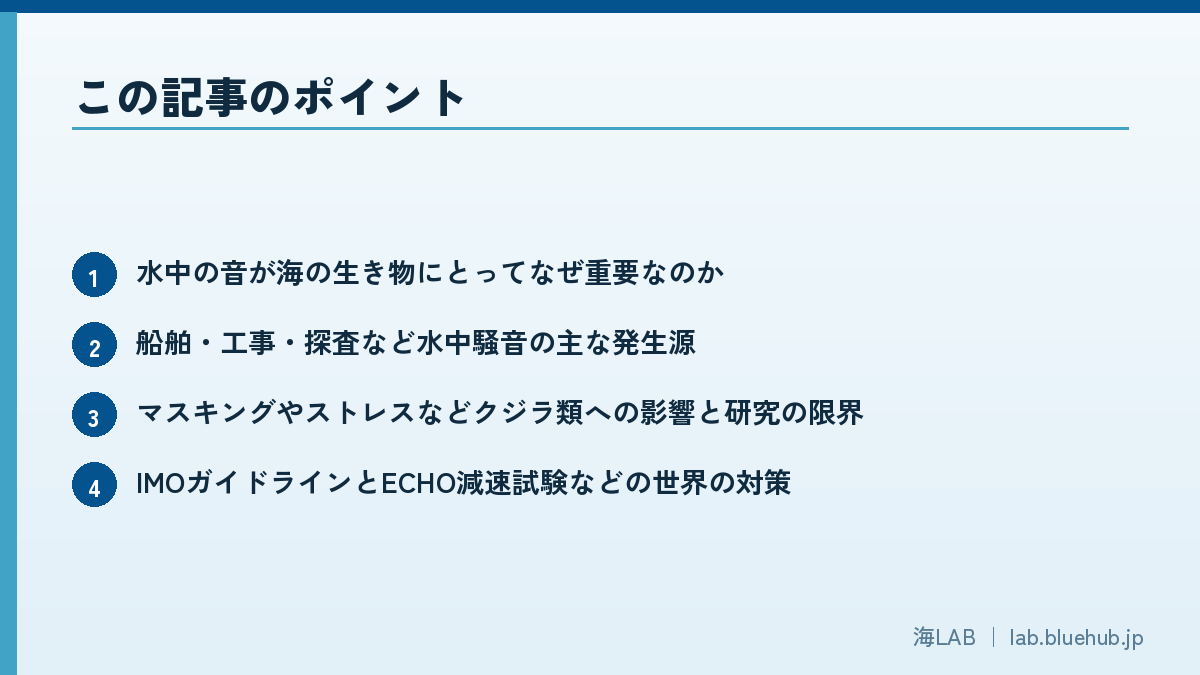
Summary of this article
- Marine life relies mainly on sound, and chronic low-frequency human noise (mainly from ships) may affect communication, foraging and stress
- Scientific uncertainty remains about the size of effects, but studies after 9/11 and the ECHO trial show that reducing noise improves conditions
- The IMO revised its ship noise reduction guidelines in 2023 (Rev.1 in 2024); in Japan, measurement and assessment methods are being developed
- Slowing down, better design, route planning and continuous data observation are the keys to a quiet sea
References and sources
- NOAA: Soundcheck ocean noise – Basics and long-term trends of ocean noise
- NOAA Fisheries: Whales' world of sound – Explanation of cetaceans and sound, and masking
- NOAA: Ocean Noise Strategy Roadmap – Ocean Noise Strategy Roadmap (10-year plan)
- IMO: SDC 9 meeting summary – Agreement on the draft revised ship noise guidelines
- Rolland et al. (2012) Evidence that ship noise increases stress in right whales – Noise drop after 9/11 and stress in right whales
- Frontiers in Marine Science (2021): Haro Strait vessel slowdown – Results of the Haro Strait slowdown trial
- Georgia Strait Alliance: Slowdown trial summary – Preliminary results of the 2017 slowdown trial
- Marine Acoustics Society of Japan: guidance on measuring and assessing underwater sound – Domestic guidance published in 2021
- Sasakawa Peace Foundation, Ocean Policy Research Institute: Ocean Newsletter – Explanation of underwater noise
* Listed in order of reliability: government and academic institutions > peer-reviewed papers > specialist organizations > reliable media