⚡ The answer in 30 seconds
- Fishing ports use much electricity for landing, ice-making and cold storage, so rooftop solar and self-consumption renewables are a good fit
- Fisheries Agency materials record solar of 10–40 kW and wind of 550–1,000 kW, with benefits in lower electricity bills and electricity sales
- Salt damage, lightning and maintenance costs are challenges, and wind has heavy upkeep. On-site PPA, as at Hamada, can avoid the upfront burden
Fishing ports are places that use a great deal of electricity to protect seafood. Solar and wind power generation is quietly spreading across their roofs and grounds.
A 2014 Fisheries Agency report records the capacity, electricity savings and maintenance struggles at six fishing ports that actually introduced solar and wind.
Using those figures and the recent case of Hamada Fishing Port, this article explains where fishing-port decarbonization stands today and what challenges remain.
What you will learn in this article
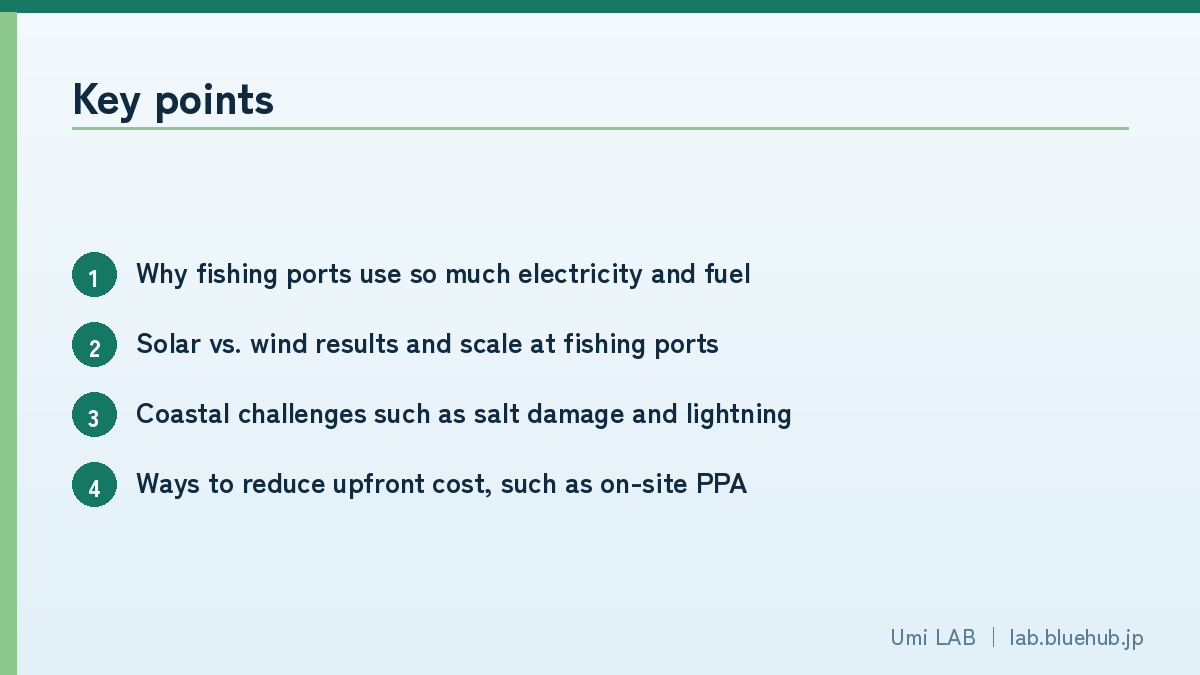
- Why fishing ports use so much electricity and fuel
- Solar vs. wind results and scale at fishing ports
- Coastal challenges such as salt damage and lightning
- Ways to reduce upfront cost, such as on-site PPA
- Available systems such as the rural renewable energy law
Why are fishing ports "places that use huge amounts of energy"?
Fishing ports are hubs for distribution and processing of seafood
Many people picture a quiet harbor lined with fishing boats. In reality, a fishing port is an industrial hub where landed fish are sorted, chilled, frozen and shipped. Refrigeration at the landing hall runs constantly to keep fish fresh, ice plants keep producing huge amounts of ice, and freezers and cold stores run 24 hours a day. Lighting for night landings and shipments is also essential.
The Fisheries Agency's "Fishing Port Eco-ification Policy (Renewable Energy Introduction Edition)" of March 2014 describes fishing ports as hubs for distribution and processing of seafood, home to facilities that consume much electricity and fuel, and where fuel is supplied to fishing boats. In other words, energy consumption and greenhouse gas emissions occur together, and reducing them is called an "urgent issue."
Electricity and fuel costs squeeze fishing businesses
Decarbonization is not only about the global environment. Fishing is strongly affected by energy costs such as fuel and electricity, and the introduction to the same policy notes that rising fuel and other costs have put fishing management in a difficult position. Generating energy locally, or using less of it, is also a way to protect the finances of cooperatives and fishers.
- Landing halls: refrigeration, air conditioning and hygiene equipment for low-temperature control
- Ice-making and ice storage: power to make ice and cooling equipment to store it
- Freezers and cold stores: electricity needed 24 hours a day to store seafood
- Fueling facilities for boats: fuel supply and quay and lighting equipment
- Markets, direct-sales shops and processing plants: air conditioning and display refrigeration for visitors
Key points of this article
- Fishing ports are "industrial hubs for seafood" that use large amounts of electricity and fuel
- Introducing renewables helps both decarbonization and cost reduction
- Solar uses roofs and wind uses the grounds: making use of the "space of a fishing port"
- Real cases record maintenance challenges alongside the benefits
Japan's decarbonization goals and the place of fishing ports
On October 26, 2020, the then prime minister declared in a policy speech that Japan would aim for carbon neutrality by 2050. In fisheries, the Green Food System Strategy formulated by the Ministry of Agriculture, Forestry and Fisheries in May 2021 lists CO2 reduction through electrification and hydrogen use for fishing boats and the promotion of blue carbon. The Fishery Port and Fishing Ground Development Long-Term Plan approved by the Cabinet in March 2022 also names "greening" as a common issue and aims to contribute to lower environmental impact and decarbonization.
Electricity and fuel: how to think about the two kinds of consumption
Energy use at fishing ports can be divided into two broad kinds: electricity used in facilities, and fuel used by boats, vehicles and cargo-handling machines. The former covers cooling for landing halls, ice-making and freezing plants, plus lighting and air conditioning, and is easy to replace directly with renewable energy. The latter needs other technologies such as electric boats and fuel switching, and takes time. For that reason, port decarbonization is often described as moving first to renewable electricity and then to electrification and fuel conversion.
The Fisheries Agency policy also summarizes energy saving methods that cut energy costs and emissions, so that ports located where renewables are unsuitable can still use it. Even ports without good sunlight or wind have actions they can start right away, such as switching to LED lighting and reviewing how freezers are operated.
The idea of "eco-ification"
The Fisheries Agency calls environmental measures at fishing ports "fishing port eco-ification." A technical committee released an interim summary in April 2012, and the renewable energy edition followed in March 2014. Eco-ification consists of four approaches: energy saving, reducing fossil fuel use through electrification, using renewable energy, and effective use of biomass. Renewables are only one part, and their effect grows when combined with the others.
In this context, this article follows how renewable energy such as solar and wind has been introduced at fishing ports, focusing on real figures in Fisheries Agency materials.
Three reasons to bring renewable energy to fishing ports
Reason 1: Cutting greenhouse gases
Replacing facility electricity with renewables reduces fossil-fuel-based power use by the same amount. Fisheries Agency materials sort measures available at fishing ports into four: energy saving, reducing fossil fuel use through electrification, using renewable energy, and effective use of biomass. Renewables are the measure on the "producing" side of energy.
Reason 2: Lower electricity bills and stable management
At ports that run cooling and freezing equipment day and night, electricity is a heavy fixed cost. Using power generated on the roof directly inside the facility reduces purchased electricity and lowers bills. In the Kokuya case described later, cutting peak demand even lowered the basic charge.
Reason 3: Local image and disaster resilience
Renewable equipment visibly shows a port's commitment to the environment. At Hasaki Fishing Port, "more efficient cooperative management and a better image for the port" were among the aims. Combined with batteries, such systems may also help secure power during outages. The experience of fishing ports badly hit by the Noto Peninsula Earthquake, covered in When a port became land: Noto fisheries and livelihood recovery after the earthquake, is also an important viewpoint for keeping port functions running.
| Purpose | Specific effect | Main equipment |
|---|---|---|
| Decarbonization | Lower CO2 emissions by reducing purchased electricity | Solar, wind, batteries |
| Cost reduction | Lower electricity and basic charges | Rooftop solar, self-consumption |
| Local value | Environmental messaging, links to tourism and direct sales | Display panels, roadside-station tie-ins |
Solar power: using the roofs of landing halls and ice plants
Why solar suits fishing ports
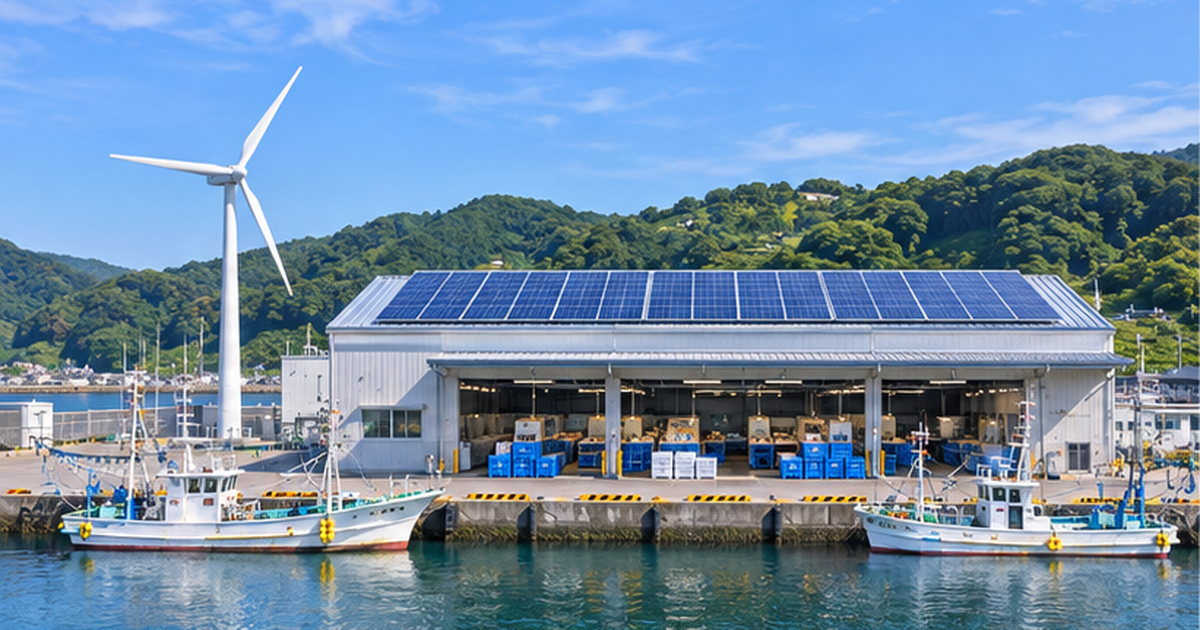
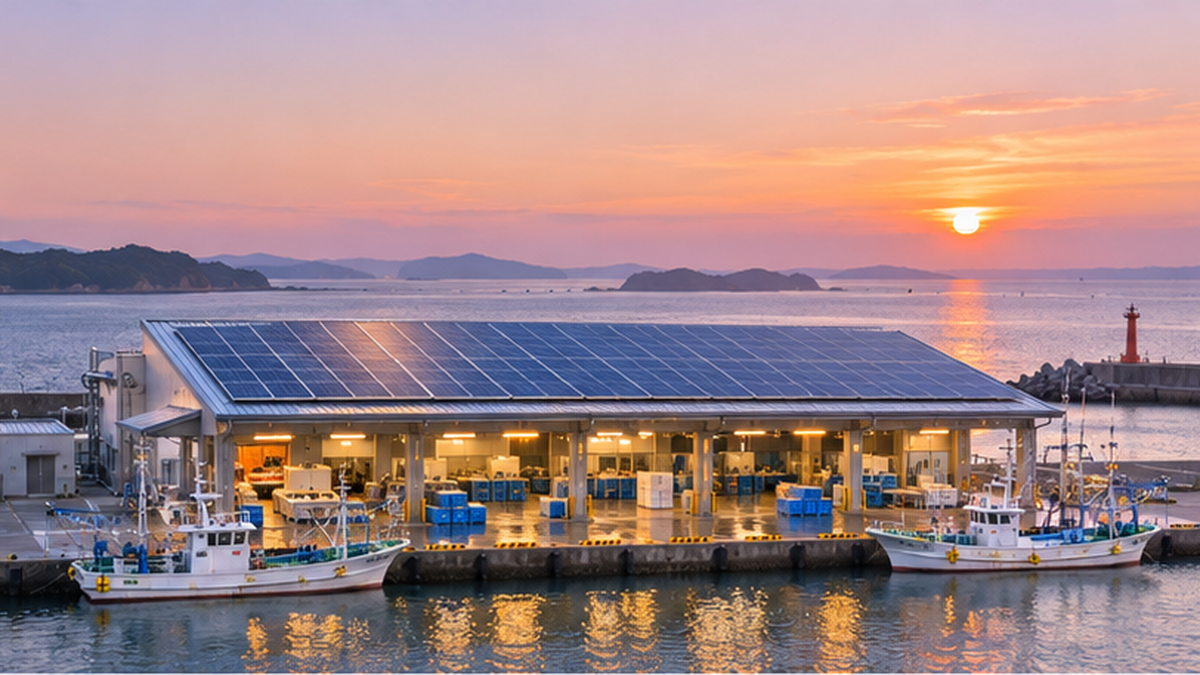
Fishing ports gather large facilities with wide roofs, such as landing halls, ice plants and cold stores, and they use much electricity during the day. That makes them a good match for self-consumption, generating in the daytime and using on site. The Fisheries Agency policy also sets out the order for solar studies: initial study, how to use the power, the scale that can be installed, and then profitability.
Case 1: Shiranuka, Kadogawa and Kokuya
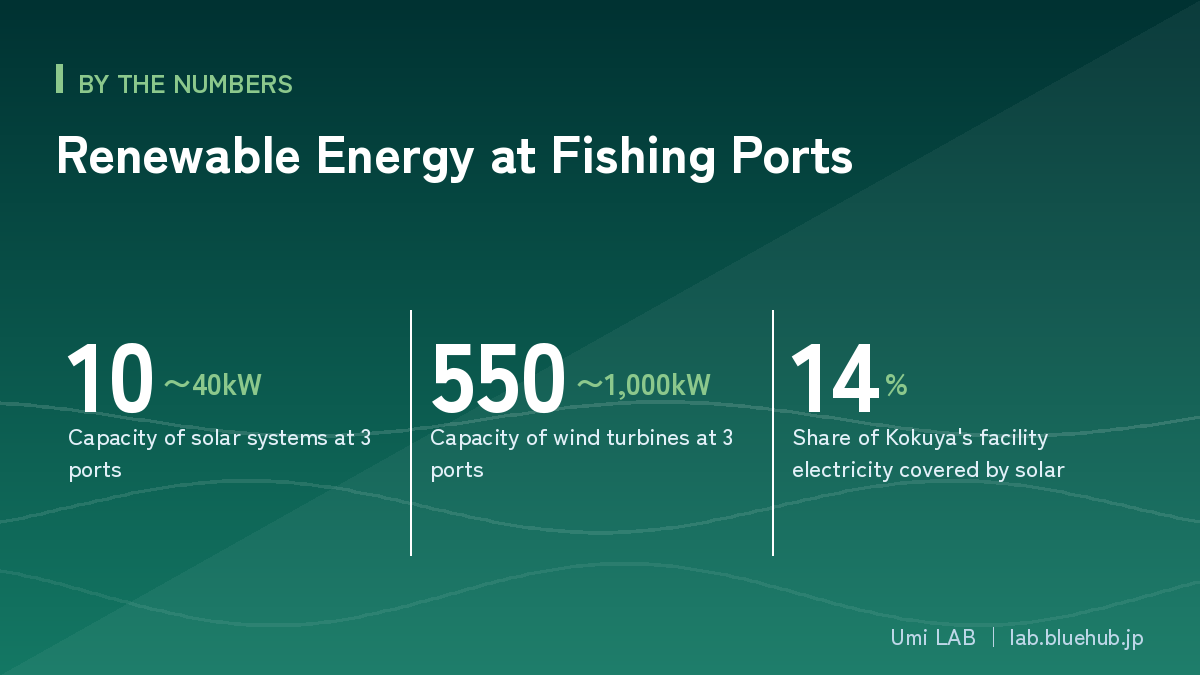
The Fisheries Agency's "Fishing Port Eco-ification Policy (Renewable Energy Introduction Edition)" records the results of three ports that introduced solar. Capacities ranged from 10 to 40 kW, and all used subsidy programs.
| Port | Location | Capacity | Installation site | Start of operation |
|---|---|---|---|---|
| Shiranuka Fishing Port | Higashidori, Aomori | 10 kW | Roof of live-fish holding facility | 2001 |
| Kadogawa Fishing Port | Kadogawa, Miyazaki | 40 kW | Roof of landing hall | 2006 |
| Kokuya Fishing Port | Setouchi, Kagoshima | 27.5 kW | Roof of the Umi-no-Eki (port station) | 2007 |
At every port, the power is fed to facilities within the port area and consumed on site. Electricity savings ranged widely from about 72,000 yen to about 750,000 yen a year. At Kokuya, annual generation was 32,933 kWh, covering 14% of the facility's yearly electricity use. Because the high-output hours of 13:00–14:00 in July–August overlap with the station's peak demand, the peak-cut effect also lowered the basic charge by about 330,000 yen a year.
Case 2: Hamada Fishing Port's on-site PPA
A recent example is Hamada Fishing Port in Hamada, Shimane. According to the Fisheries Agency's FY2024 White Paper, solar equipment was installed in 2023 on the roof of a high-hygiene landing hall completed in 2020. The method used was an on-site PPA: a power producer installs, owns and maintains the equipment at its own cost and supplies the electricity generated on the customer's roof.
Hamada City and others signed with a consortium led by Kagura Denryoku, and the power is supplied to the landing hall, the Hamada fish market and the freezing and ice plant of JF Shimane at prices lower than ordinary procurement. EV charging at the market was also included. The advantage of this model is that cooperatives and municipalities can adopt it without paying the initial cost. The white paper does not give figures for generation capacity or emission reductions.
What is an on-site PPA?
A method in which a power producer installs and owns solar equipment on a customer's roof and sells the electricity to that customer. The customer can use renewable electricity with no initial investment, and the producer handles maintenance.
Solar challenges: salt damage, dirt and maintenance
The records of the three ports candidly describe on-site challenges. Against salt damage, some ports chose salt-resistant panels or makers with many installations in salty areas. Kokuya secured roof strength against strong winds and installed with a method that withstands 60 m/s. At Kadogawa, bird droppings were still found even with bird-deterrent spikes on the panel edges, and equipment problems are hard to notice on a roof. At Kokuya, output has fallen year by year six years after installation, thought to be caused by dirt on the panels, but the roof shape makes safe cleaning difficult.
What the numbers show
Let's read the Kokuya figures. Annual generation of 32,933 kWh equals 14% of the facility's yearly electricity use, so total consumption can be estimated at about 235,000 kWh (32,933 ÷ 0.14). Even with a 27.5 kW system, a facility with cold storage and air conditioning covered more than a tenth of its power.
Adding the electricity savings (about 616,000 yen) and the basic-charge savings (about 330,000 yen) gives a total annual saving of roughly 950,000 yen. The initial cost was about 31.5 million yen, half of it subsidized, so simple arithmetic suggests it would take decades to recover the post-subsidy burden. Solar is a long game if judged only on payback, so it is important to weigh it together with its value for decarbonization and local initiatives.
What to check before introducing
People at Shiranuka said they were uneasy about the effect because no environmental survey such as solar irradiance was done before installation. That is a lesson for ports considering it now. The Fisheries Agency policy attaches irradiance and average wind speed maps and a feasibility sheet, so a port can estimate its own conditions in advance.
| Item to check | What to look at |
|---|---|
| Solar irradiance | Average irradiance is 3.3 kWh/m²/day at Shiranuka and 3.75 at Kadogawa and Kokuya |
| Roof strength and shape | Kokuya was built to withstand 60 m/s; on a sloped roof, safe cleaning is a challenge |
| How power is used | Is daytime use high? Do the generation peak and demand overlap? |
| Salt and bird damage | Choice of salt-resistant panels, bird deterrents and cleaning methods |
| Subsidies and PPA | Install with own funds, or leave installation to an operator? |
- Carry out an environmental survey such as irradiance before installing
- Choose equipment and construction on the assumption of salt, strong wind and lightning
- Plan from the start for locations and procedures that make cleaning and inspection easy
- Set aside funds for major renovation and renewal
Wind power: turbines of hundreds to 1,000 kW in port areas
Case: Hasaki, Nadachi and Aoura
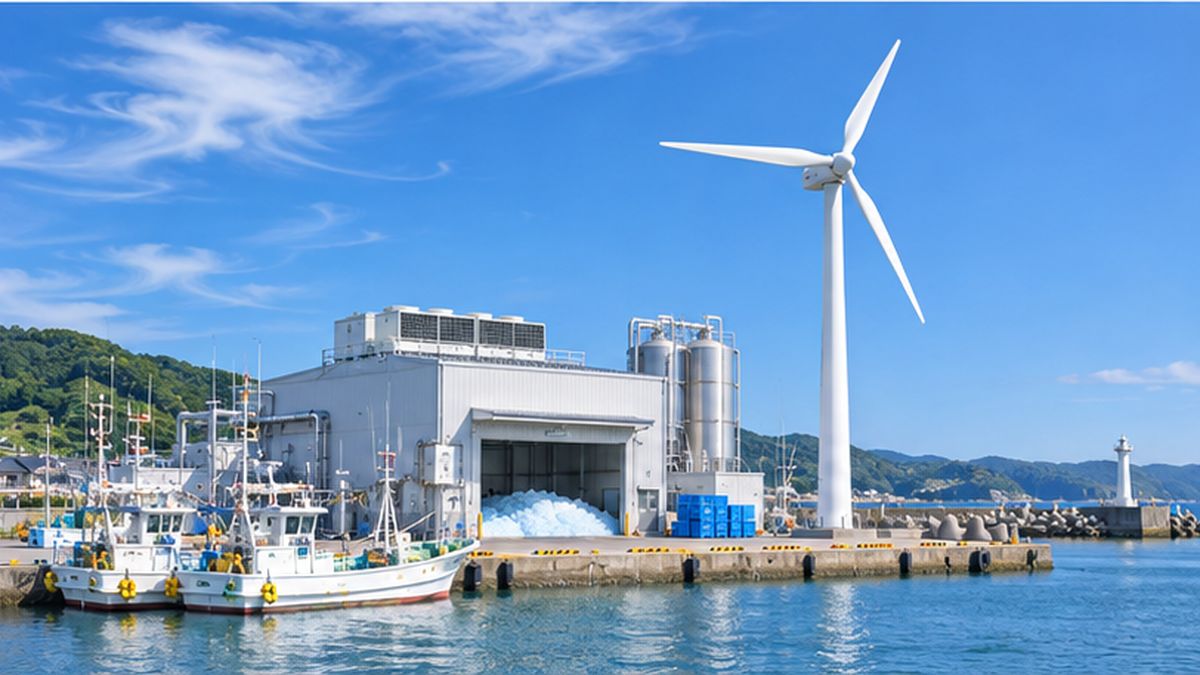
Wind power suits ports with strong sea winds, but it is larger than solar and its challenges are heavier. The three ports in Fisheries Agency records have capacities of 550–1,000 kW, all within the port area and all introduced with subsidies. That is an order of magnitude larger than the 10–40 kW of solar.
| Port | Location | Capacity | Average wind speed (30 m height) | Start of operation | How power is used |
|---|---|---|---|---|---|
| Hasaki Fishing Port | Kamisu, Ibaraki | 1,000 kW | 6.5 m/s | 2005 | Deemed self-consumption (ice making, landing hall, quay lighting) |
| Nadachi Fishing Port | Joetsu, Niigata | 600 kW | 5.5 m/s | 2006 | All power sold to the roadside station and the utility |
| Aoura Fishing Port | Matsuura, Nagasaki | 550 kW | 6.2 m/s | 2002 | All power sold to the utility |
Nadachi's annual generation was 582,804 kWh (FY2012), sold to the roadside station and the utility, for annual sales of about 6.94 million yen. Aoura sold 1,150,376 kWh a year for about 14.47 million yen, and since December 2012 it has sold at 22 yen per kWh under the feed-in tariff (FIT).
Wind challenges: lightning and maintenance costs
The same materials show that wind maintenance is a heavy burden. Management costs ran 4–11 million yen a year and repair costs 6–7 million yen a year, and lightning damage occurred at every port. At Aoura, lightning strikes occur once or twice a month, and repairs sometimes take about two months. Nadachi installed a lightning sensor on its generator that stops the blades when it detects thunderclouds.
On management, Hasaki said that large repair costs, including removal, must be set aside, and that considering life-cycle cost there is no profit. Nadachi also records that comparing maintenance costs with sales shows a deficit, and even in profitable years, bond repayments mean it is not really in the black.
Two walls that are easy to overlook with wind
- Ports have no power grid, so generated electricity sometimes cannot be sold (a point raised at Hasaki).
- Breakdowns from lightning or strong wind halt generation while the turbine is stopped. Rising insurance premiums also need attention.
"Deemed self-consumption" and "selling all power"
Two patterns of power use appeared. Hasaki sells the generated power once and buys what it needs from the utility, called "deemed self-consumption." It was introduced as an adjunct to the ice plant and supplies the ice plant, landing hall and quay lighting, with 2,456,818 kWh sold. Nadachi and Aoura, by contrast, chose to sell all their power.
Nadachi's sales scheme is somewhat complex: 70% of generation is sold to the roadside station's operator at 10.50–11.50 yen per kWh, and the remaining 30% is sold to Tohoku Electric under FIT at 22 yen/kWh. At Aoura, power has been sold at 22 yen/kWh under FIT since December 2012, and at 11.5 yen/kWh before that. Revenue from the same output can nearly double depending on the system.
Why the power grid matters for wind
People at Hasaki said that ports have no grid, so power cannot be sold, and that building grid infrastructure is important for wider adoption. A large turbine cannot use its scale if it cannot connect to a grid to send power out. While solar works easily as a "use it on the spot" design, wind depends on its relationship with the power grid for viability.
Comparing solar and wind
| Item | Solar (3 ports) | Wind (3 ports) |
|---|---|---|
| Capacity | 10–40 kW | 550–1,000 kW |
| Main use | Self-consumption | Deemed self-consumption / selling all power |
| Bill savings / sales revenue | About 72,000–750,000 yen saved a year | About 6.94–14.47 million yen sold a year |
| Maintenance | Little (but cleaning and spotting faults are challenges) | Management and repair costs of millions of yen a year |
| Main risks | Salt damage, bird damage, dirty panels | Lightning, strong wind, major repair costs |
How to make renewables at fishing ports succeed
First decide the purpose, then the use
The Fisheries Agency policy sets out the study steps: clarify the purpose, choose the type of renewable, then check how the power will be used, the scale that can be installed, and profitability. The clearer the use, as with Kokuya covering 14% of its station's electricity, the easier the effect is to measure.
- Clarify the purpose (decarbonization, lower bills, or both)
- Survey irradiance and wind conditions (Shiranuka did not survey beforehand and was left uneasy)
- Decide how to use the power (self-consumption or sale)
- Confirm the installable scale and estimate profitability (initial cost, upkeep, payback years)
- Compare funding methods such as subsidies and PPA
- Plan inspection, cleaning and renewal after introduction
Funding: choosing between subsidies and PPA
All six cases were introduced with subsidy programs. Initial costs were about 9.98 million yen for Shiranuka solar, about 43.54 million yen for Kadogawa, and about 31.5 million yen for Kokuya, while Hasaki wind cost about 266.83 million yen. More recently, ports such as Hamada avoid the upfront burden with on-site PPA. Which suits best depends on the cooperative's finances and who takes on maintenance.
Policy: using the rural renewable energy law
The Ministry of Agriculture, Forestry and Fisheries aims to use solar, wind, small hydro, geothermal and biomass in rural, mountain and fishing villages to raise local income and revitalize communities. The underlying Act (the Act on Promotion of Renewable Energy Power Generation in Harmony with the Healthy Development of Agriculture, Forestry and Fisheries) was enacted in November 2013 and took effect on May 1, 2014. The ministry's page also describes budget and tax support and individual consultation by experts.
A checklist for cooperatives and municipalities before introduction
1. Who installs and who maintains?
Installers were cooperatives (Kadogawa, Hasaki, Aoura) or municipalities (Shiranuka = Higashidori, Kokuya = Setouchi, Nadachi = Joetsu). At Nadachi, it was noted that when a municipality owns the turbine, maintenance must be outsourced and costs rise. Deciding up front who is responsible for operation and upkeep shapes long-term running.
2. Renewal costs after subsidies end
All the equipment in the cases was introduced with subsidies, but Shiranuka cites funding for major renovation due to salt damage and aging as a challenge. Hasaki says funds for major repairs, including removal, must be set aside. A subsidy can pay to build, but the cost of protecting and renewing is often your own.
3. Insurance and preparing for natural disasters
At Hasaki, using insurance for lightning repairs raised premiums by about 3 million yen over five years. At Aoura, 9 million of 11 million yen in management costs was paid by insurance. How insurance is designed also affects the balance sheet.
- Has irradiance or wind been surveyed?
- Are the installer and maintainer decided?
- Is the use of power (self-consumption or sale) clear?
- Do designs include measures against salt, lightning and strong wind?
- Is there a plan to set aside renewal and removal costs?
- Were funding options such as subsidies and PPA compared?
If you start small
- Make the roofs of daytime power users, such as landing halls and ice plants, the first candidates
- Focus on self-consumption to avoid grid and sales constraints
- Survey irradiance and estimate profitability before introducing, and decide with renewal costs included
FAQ: what about effects on fisheries and the sea?
Equipment in port areas and offshore wind are different matters
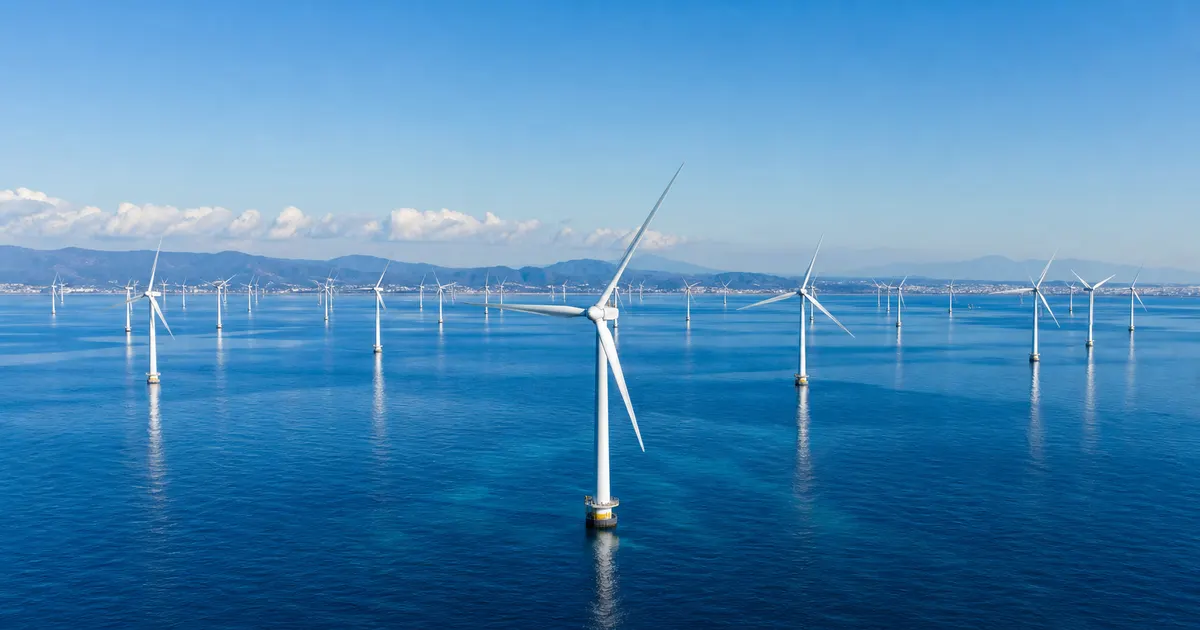
The wind power introduced in this article is turbines of hundreds to 1,000 kW on land or near the quay within port areas. Offshore wind built at sea differs in scale and in the range of fishers involved. For offshore wind, coordination with fisheries is a key issue, and a March 2024 case book by the Agency for Natural Resources and Energy and the Ports and Harbours Bureau introduces cases of fishers taking part in offshore wind work and of overseas cooperatives supplying fuel to offshore wind vessels.
Do renewables at fishing ports "leave the sea unharmed"?
Solar on a port roof generates power without new reclamation or use of fishing grounds, so it competes little with the marine environment or fisheries. For wind, effects on birds, landscape and noise are generally discussed. The case materials record no specific harm, but gaining local understanding before introduction is important.
A note for readers
The figures for port cases in this article are past results from a Fisheries Agency survey published in 2014. Electricity prices, sales prices and subsidy programs change over time. Real introduction decisions need up-to-date information and expert estimates.
Fishing ports and renewable energy from now on
Combining electrification, storage and hydrogen
Renewables become more effective when linked with other decarbonization measures at ports. The Global Warming Countermeasures Plan approved by the Cabinet in February 2025 aims to establish technologies for electrifying and hydrogenating boats, in addition to making fishing boats more energy efficient. Using electricity generated at a port for future electric fishing boats and cargo-handling machines is one possible idea. On hydrogen and ammonia hubs at ports, see Carbon-neutral ports: hydrogen and ammonia hubs and electrified cargo handling, and on cutting the electricity used for cooling, see Decarbonizing the seafood cold chain.
Community efforts and offshore wind at ports
Ministry of the Environment materials on decarbonization leading areas state that Sai Village in Aomori plans to install solar equipment and batteries within its fishing port facilities (this is a plan). For larger-scale renewables, there is offshore wind. According to the White Paper on Land, Infrastructure, Transport and Tourism, in January 2024 the second large commercial offshore wind farm in Japan began operating at Ishikari Bay New Port. Systems differ between fishing ports and commercial ports, but how to make offshore power coexist with local fisheries is a shared issue. For details, see Offshore wind in Japan: fixed vs. floating and the 2040 target.
What we can do
- Find out what renewable energy your local fishing port or market is working on
- Choose seafood from cooperatives and areas that care for the environment
- Visit port events and direct-sales shops to learn about local efforts
- Read about blue carbon for a fuller picture of ocean decarbonization
For carbon absorption by the sea, see What is blue carbon? How mangroves and seagrass store carbon and Japan's efforts. Renewables at ports are about "reducing emissions" and blue carbon about "absorbing" them, and ocean decarbonization moves forward only when both are in place.
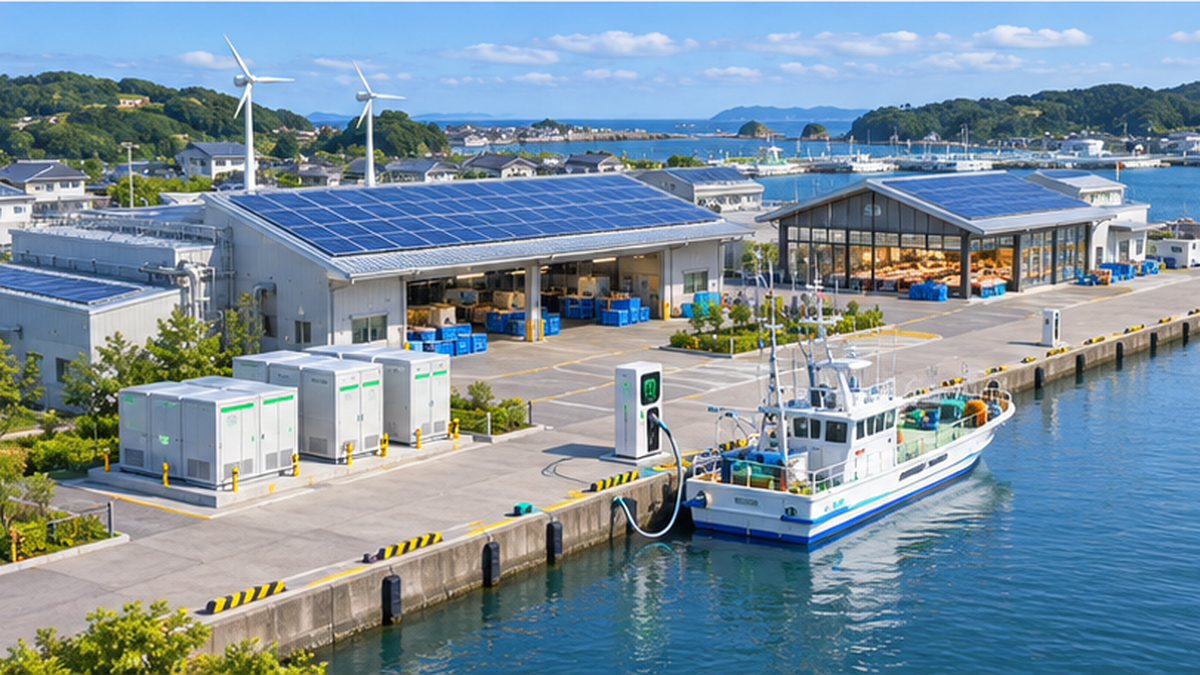
Summary: renewables at fishing ports should "start small and grow while protecting"
The real cases in Fisheries Agency materials show the following about introducing renewables at ports.
- Even at 10–40 kW, solar can cut electricity bills when roofs and self-consumption are combined
- Wind at 550–1,000 kW brings large sales revenue, but lightning and upkeep are heavy
- Both need measures against salt, lightning and dirt built in from the start
- Recently, methods that lower upfront cost, such as on-site PPA, have appeared
Summary
- Fishing ports are industrial hubs using much electricity and fuel, with plenty of room for renewables
- Solar suits self-consumption and wind suits sales: their roles differ by scale
- The challenge is equipment maintenance, and post-introduction inspection and renewal plans are key
- Usable systems such as the rural renewable energy law and PPA are increasing
Renewable equipment is not "install and forget." Building a setup that cooperatives and local people can keep using for a long time is what makes port decarbonization real. Because the cases in this article include figures from the Fisheries Agency's 2014 survey, please check each agency's latest information for the current situation and systems.
References and sources
- Fisheries Agency, "Fishing Port Eco-ification Policy (Renewable Energy Introduction Edition)" (March 2014) – Cases at Shiranuka, Kadogawa, Kokuya, Hasaki, Nadachi and Aoura
- Fisheries Agency, FY2024 White Paper, Section 4: Measures against future changes in the marine environment – Hamada Fishing Port on-site PPA case
- MAFF, "Introduction of renewable energy in rural areas" – The rural renewable energy law and support measures
- Fisheries Agency, "Fishing Port Eco-ification Policy (Interim Summary)" (April 2012) – The concept of fishing port eco-ification
- Fisheries Agency, FY2024 Fishery Infrastructure Survey Report (March 2025) – Carbon neutrality promotion and the Fishery Port Development Long-Term Plan
- Ministry of the Environment, "Overview of Decarbonization Leading Area Selection (7th round)" – Plans by Sai Village, Aomori and others
- MLIT, "White Paper on Land, Infrastructure, Transport and Tourism 2025" – Offshore wind at Ishikari Bay New Port
* Listed in order of reliability: government agencies and academic institutions > peer-reviewed papers > specialist organizations > reliable media