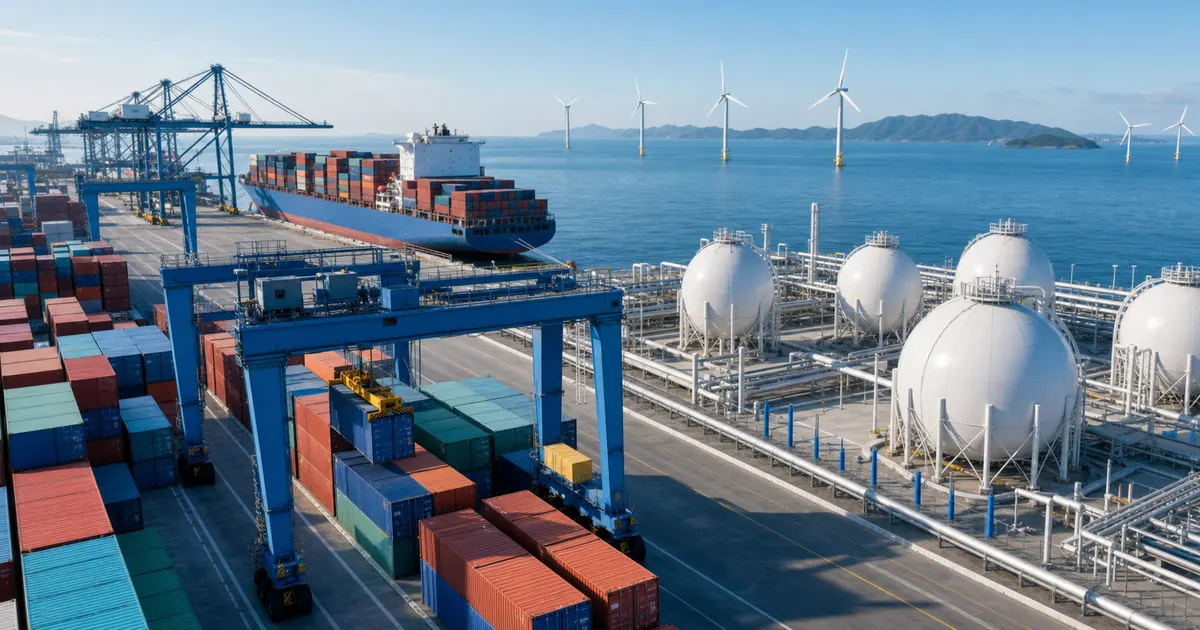
The smartphones we use every day, the clothes we wear, and much of the food we eat all arrive on ships from a port. Japan is a maritime nation that depends on shipping for nearly all of its trade (about 99.6% by weight), and the ports that serve as its gateways are, in fact, also among the places where the most carbon dioxide (CO2) is concentrated domestically. That is because energy-intensive industries such as power plants, oil refineries, steelmakers, and chemical plants cluster along the coast so they can use imported fuel as soon as it arrives.
A national effort called the Carbon Neutral Port (CNP) concept aims to turn these "ports where CO2 concentrates" into, conversely, "ports that distribute decarbonized fuel." The idea is to receive, store, and deliver large volumes of hydrogen and fuel ammonia to nearby factories and ships, while at the same time switching the cranes, forklifts, and other cargo-handling equipment that work at the port from diesel to electricity or hydrogen. In short, the goal is to make the port as a whole carbon neutral.
This article carefully unpacks why CNP is becoming the linchpin of Japan's decarbonization, starting from the CO2 emissions numbers. It then introduces frontline cases such as the world-first demonstration of a hydrogen-engine crane at Kobe Port and the fuel-cell crane at Yokohama Port, along with the roles played by the hydrogen supply chain and fuel ammonia, and the remaining challenges of cost and safety, written to be accessible from junior-high students to adults.
What you'll learn in this article
- That the Carbon Neutral Port (CNP) concept is about "turning ports into receiving hubs for hydrogen and ammonia"
- That about 60% of Japan's CO2 emissions come from industries in ports and coastal areas, which is why ports are key to decarbonization
- Why electrifying and hydrogenizing cargo-handling equipment such as RTG cranes that move containers matters so much
- The difference between Kobe Port's hydrogen-engine RTG (a world first: zero CO2 at combustion, about 70% less NOx) and Yokohama Port's fuel-cell RTG
- The roles played by the hydrogen supply chain and fuel ammonia, and the remaining challenges of cost and safety
What is a Carbon Neutral Port (CNP)?
A Carbon Neutral Port (CNP) is an initiative that brings the CO2 emitted by ports close to net zero while upgrading the port into an energy hub that supports the entire decarbonized society. Led by Japan's Ministry of Land, Infrastructure, Transport and Tourism, it is being advanced at ports across the country toward the national goal of carbon neutrality by 2050.
The key point is that it is not simply about "cutting a port's CO2." CNP broadly rests on three pillars. One is building the environment to receive fuel so that decarbonized fuels such as hydrogen and fuel ammonia can be imported, stored, and delivered in large, stable, and low-cost volumes. Another is decarbonizing port functions themselves, such as cranes and terminals. And the third is cooperation with coastal industries clustered around the port.
From a "port that cuts emissions" to a "port that distributes fuel"
Until now, environmental measures have often carried the image of "enduring cuts to emissions." But CNP's thinking is a little different. Ports have long played the role of importing fuel and delivering it around the country. If that function is put to use, and ports switch from handling oil and coal to handling decarbonized fuels such as hydrogen and ammonia, ports can become "distributors of energy" that push Japan's overall decarbonization forward.
This idea is also closely tied to the decarbonization of ocean-going ships, which are switching their fuel to ammonia or hydrogen. For a ship to use a new fuel, the port must be able to supply that fuel. Ports and ships need to change at the same time.
CNP as a framework the government is promoting
In 2021, the Ministry of Land, Infrastructure, Transport and Tourism held "CNP study meetings" at seven ports in six regions nationwide, and advanced discussions on CO2 emissions from port areas and on measures for using hydrogen and fuel ammonia. The knowledge gained here has become the foundation for the subsequent system-building and demonstration projects. CNP is not a story limited to a few advanced ports; it is a nationwide policy, with planning underway at many ports from Hokkaido to Kyushu.
Behind this lies the nationwide goal of "carbon neutrality by 2050," declared by Japan in October 2020. To bring CO2 emissions effectively to zero, it is necessary to cut the CO2 emitted not only from generating electricity but from every industrial activity, including making steel, making chemical products, and moving goods. In fields that need high heat or heavy motive power that is hard to replace with electricity alone, "combustible decarbonized fuels" such as hydrogen and ammonia become the ones to rely on. And the place where they first come ashore is precisely the port.
Port greening is advancing worldwide too
The move to turn ports into decarbonization hubs is not unique to Japan. In Europe, the Port of Rotterdam and others are advancing the development of hydrogen import and production hubs and facilities that supply shore power to berthed ships. As major ports around the world race to shift toward becoming "green ports," decarbonizing ports is, for Japan, which depends on shipping for its trade, both an environmental measure and an industrial strategy for winning the competition among international ports. A port that cannot handle decarbonization risks, in the future, being passed over by ships that run on decarbonized fuel.
Three points to grasp first
- CNP is a concept that advances both "cutting a port's CO2" and "turning it into a hub that distributes decarbonized fuel" together
- Its three pillars are "receiving hydrogen and ammonia," "decarbonizing port functions," and "cooperating with coastal industries"
- It is a national effort led by the Ministry of Land, Infrastructure, Transport and Tourism, with planning underway at ports nationwide

In short, CNP is the idea of positioning a port as both a "testing ground for decarbonization" and an "energy hub." Ports have long been a mirror reflecting a country's industry and energy. In the age of coal, coal supported the nation through its ports; in the age of oil, it was oil. If the next protagonist is to be hydrogen or ammonia, then that shift, too, should begin at the port. In the next chapter, let's take one more step into the CO2 emissions numbers to see exactly why ports, of all things, matter so much.
Why ports are key to decarbonization: about 60% of CO2 comes from coastal areas
Being told that ports are key to decarbonization may not feel intuitive at first. A port itself is a logistics site where cranes and trucks move around, and it does not look like a place that emits an especially huge amount of CO2. But look at what surrounds the port, and the picture changes completely.
Energy-intensive industries cluster along the coast
Power plants, oil refineries, steelworks, chemical plants — all of these import large volumes of fuel and raw materials by ship and ship out large volumes of product by ship as well. Naturally, then, they have gathered along the coast facing the sea. According to Ministry of Land, Infrastructure, Transport and Tourism materials, many of the industries that account for about 60% of Japan's CO2 emissions are located in ports and coastal areas.
Japan's total CO2 emissions were about 1.04 billion tons in fiscal 2020. Looking at the breakdown, power plants and oil refineries account for about 420 million tons (about 40%), steel for about 110 million tons (about 11%), and the chemical industry for about 50 million tons (about 5%). A defining feature of Japan's energy structure is that these major-emitting industries are concentrated along the coast.
| Sector | CO2 emissions (FY2020) | Share of total |
|---|---|---|
| Power plants, oil refineries, etc. | About 420 million tons | About 40% |
| Steel | About 110 million tons | About 11% |
| Chemical industry | About 50 million tons | About 5% |
| Other | About 460 million tons | About 44% |
| Japan total | About 1.04 billion tons | 100% |
Change the port, and you can change industry too
Flip this structure around, and it is also a great opportunity. If a port becomes able to receive decarbonized fuels such as hydrogen and ammonia, the oil refineries, power plants, and factories right next to it will find it easier to switch fuels. By securing that one point — the port — you can push forward the energy transition of the huge cluster of industries around it all at once. This is CNP's strategic aim.
Ports matter most for "hard-to-abate industries"
Industries such as steel, chemicals, and cement are known to be especially hard to decarbonize. Making steel, for instance, requires a large amount of reducing agent to strip oxygen from iron ore, and coke made from coal has traditionally played that role. Decarbonizing this process is expected to hinge on switching to "hydrogen reduction ironmaking," which uses hydrogen instead of coal, but that presupposes a supply network that can deliver an enormous, stable volume of hydrogen. If the port becomes the receiving point for that hydrogen, a path opens for transforming even these difficult industries.
Likewise, thermal power plants are demonstrating "co-firing," in which ammonia is mixed in with coal for combustion, and efforts to mix hydrogen into natural gas. Gradually raising the co-firing ratio can cut CO2 while still making use of existing power plants. Here, too, the key is whether fuel can be supplied stably and in bulk. A port's receiving capacity governs the speed of decarbonization around it.

The ocean's perspective: warming reaches the sea too
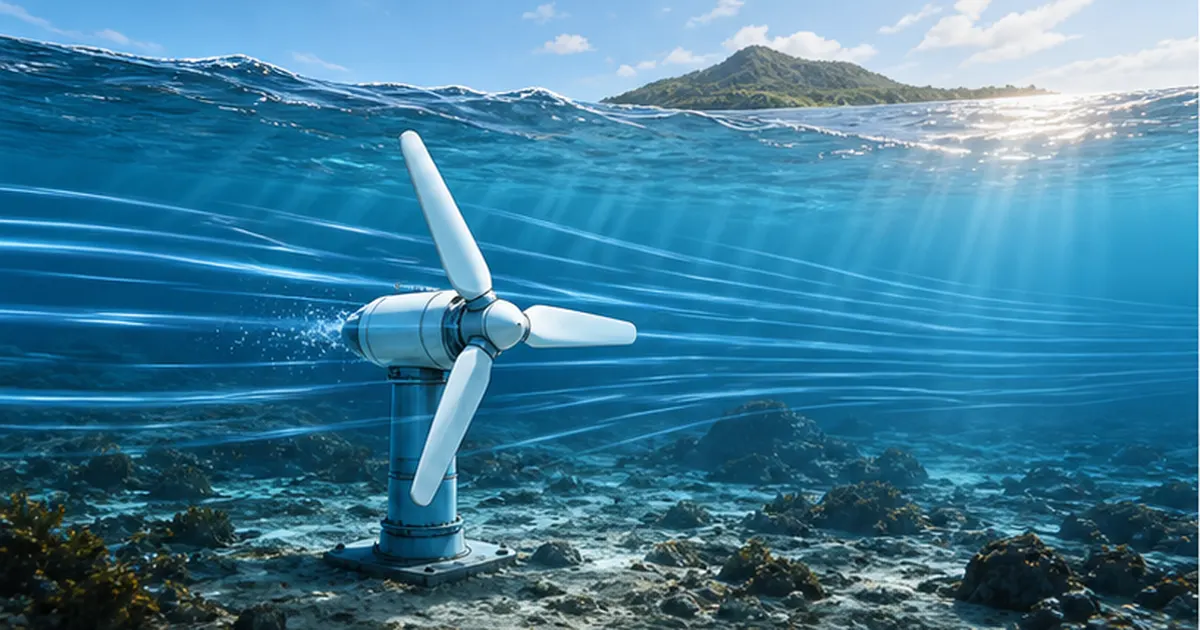
CO2 from coastal areas affects not only the atmosphere but the ocean as well. CO2 absorbed by the sea drives ocean acidification, and rising water temperatures shake up fisheries and marine ecosystems. Decarbonizing ports is directly tied to protecting the sea that supports our dinner tables.
Why electrification alone is not enough
You might think, "Then why not just run everything on electricity?" It is true that electrification is advancing for cars and household energy use. But the temperatures above a thousand degrees needed to make steel, and the powerful motive force needed to move a large ship over a long distance, are areas that are difficult to cover with electricity and batteries alone. Batteries are heavy, and storing a large amount of energy in them requires them to become impractically huge. Filling this "hard-to-electrify" gap is exactly the role of hydrogen and ammonia, which produce no CO2 when burned, and of the ports that deliver them.
The fact that ports are "the point where Japan's CO2 emissions concentrate" is the single biggest reason CNP is treated as a matter of national policy. So what role do hydrogen and fuel ammonia — the keys held by these ports — actually play?
Toward ports that receive hydrogen and fuel ammonia
CNP's first pillar is building the environment to receive hydrogen and fuel ammonia. "Receiving" here refers to the whole flow: safely unloading fuel carried by tanker onto land, storing it in tanks, and delivering it to the surrounding area by pipeline or tank truck. The port handles this "entry point."
Why hydrogen and ammonia are drawing attention in the first place
Whether burned or converted to electricity in a fuel cell, hydrogen produces only water, no CO2. Ammonia (NH3) contains no carbon in its molecule, so it too is a fuel that can be used without emitting CO2 when burned. On top of that, ammonia has the practical advantage of being easier to liquefy and transport than hydrogen, making it easier to leverage existing transport and storage technology. For this reason, ammonia is also expected to serve as a "container for carrying hydrogen" — a hydrogen carrier.
- Hydrogen: zero CO2 whether burned or used in a fuel cell. However, it is a gas at room temperature, making transport and storage difficult
- Ammonia: zero CO2 because its molecule contains no carbon. Easy to liquefy and suited to mass transport. Also promising as a hydrogen carrier
- For both, "producing them without emitting CO2" (green/blue hydrogen and ammonia) is the precondition for decarbonization
The government's introduction targets
The Basic Hydrogen Strategy, revised in June 2023, set targets to expand Japan's domestic hydrogen introduction to about 3 million tons a year by 2030, 12 million tons by 2040, and around 20 million tons by 2050. For fuel ammonia too, a target of about 3 million tons a year by 2030 has been set. Handling volumes of this scale is impossible without developing ports as the gateway for import and supply.
| Year | Hydrogen introduction target | Notes |
|---|---|---|
| 2030 | About 3 million tons/year | Fuel ammonia also about 3 million tons/year |
| 2040 | About 12 million tons/year | Newly set as an interim target |
| 2050 | About 20 million tons/year | At the point carbon neutrality is achieved |
The big wall called cost
The key to adoption is, after all, cost. The Basic Hydrogen Strategy sets targets to bring down the imported hydrogen supply cost (CIF) to about 30 yen/Nm3 by 2030 and about 20 yen/Nm3 by 2050. At present it is more expensive than fossil fuels, and closing that gap is the biggest challenge. The path envisioned is to handle large volumes together at ports and bring costs down through economies of scale.
The technology behind "ease of transport"
Because hydrogen is light and bulky, it cannot be transported efficiently as-is in gas form. A number of transport technologies have therefore been developed: "liquefied hydrogen," cooled to minus 253 degrees Celsius to turn it into a liquid; "organic hydride (MCH)," in which hydrogen is attached to a substance that is liquid at room temperature; and methods that convert hydrogen into ammonia for transport. Each method has its own trade-offs, and ports need tanks and facilities suited to each. Which form to receive hydrogen in is an important design decision for each individual port.
| Transport method | Characteristics | Example facilities needed at the port |
|---|---|---|
| Liquefied hydrogen | Can compress volume to about 1/800th, but requires ultra-low-temperature management | Ultra-low-temperature tanks, dedicated pier |
| Ammonia | Easy to liquefy and suited to mass transport. Requires measures against toxicity | Ammonia tanks, safety equipment |
| Organic hydride (MCH) | A liquid at room temperature and pressure, easy to handle, but extracting the hydrogen requires heat | Dehydrogenation equipment, storage tanks |

If "how it's made" isn't clean, it defeats the purpose
If making hydrogen or ammonia emits CO2 by using fossil fuels in the production process, that defeats the purpose. It is a precondition for decarbonization that they be "green" — made with renewable energy — or "blue" — made by capturing and storing the CO2. A port is both the gateway for imports and a place where the question of how the fuel it handles was produced comes under scrutiny.
The field challenge of electrifying and hydrogenizing cargo-handling equipment
CNP's other pillar is decarbonizing port functions themselves. The symbol of this is the electrification and hydrogenization of the massive machines that load and unload containers — the "cargo-handling equipment." This is the front line of CNP, where change is happening right now on the actual ground of the port.
Diesel machines at work all over the port
At a container terminal, many machines run around the clock. Among the most representative is the RTG (Rubber Tired Gantry crane), which runs on tires and straddles stacks of containers to move them. Conventional RTGs have long generated electricity with a diesel-engine generator and used that electricity to turn a motor. In other words, they are like a diesel power plant on wheels.
Besides RTGs, ports have many other machines: trailers and straddle carriers that move containers, forklifts used in warehouses, and more. As long as these run by burning diesel fuel, CO2 from ports will never reach zero. That is precisely why decarbonizing cargo-handling equipment is placed at the center of efforts within CNP.
Three approaches to electrification
There are broadly three ways to decarbonize cargo-handling equipment. One is electrification via external power supply, drawing electricity from overhead lines or cables. Another is installing batteries. And the third is hydrogenization, using hydrogen as fuel. Hydrogenization itself further splits into two approaches: burning hydrogen in an engine, and converting it to electricity with a fuel cell.
| Method | Mechanism | Characteristics |
|---|---|---|
| External power supply (electrification) | Supplies electricity via overhead lines or cables | Range of movement is constrained, but easy to bring emissions to zero |
| Battery | Carries a large-capacity battery | Can move freely, but charging time and weight are challenges |
| Hydrogen engine | Burns hydrogen to turn a generator | Easy to retrofit onto an existing machine's generator |
| Hydrogen fuel cell | Generates electricity from hydrogen to turn a motor | Quiet and highly efficient, but the equipment is expensive |

Electricity from the port for berthed ships too
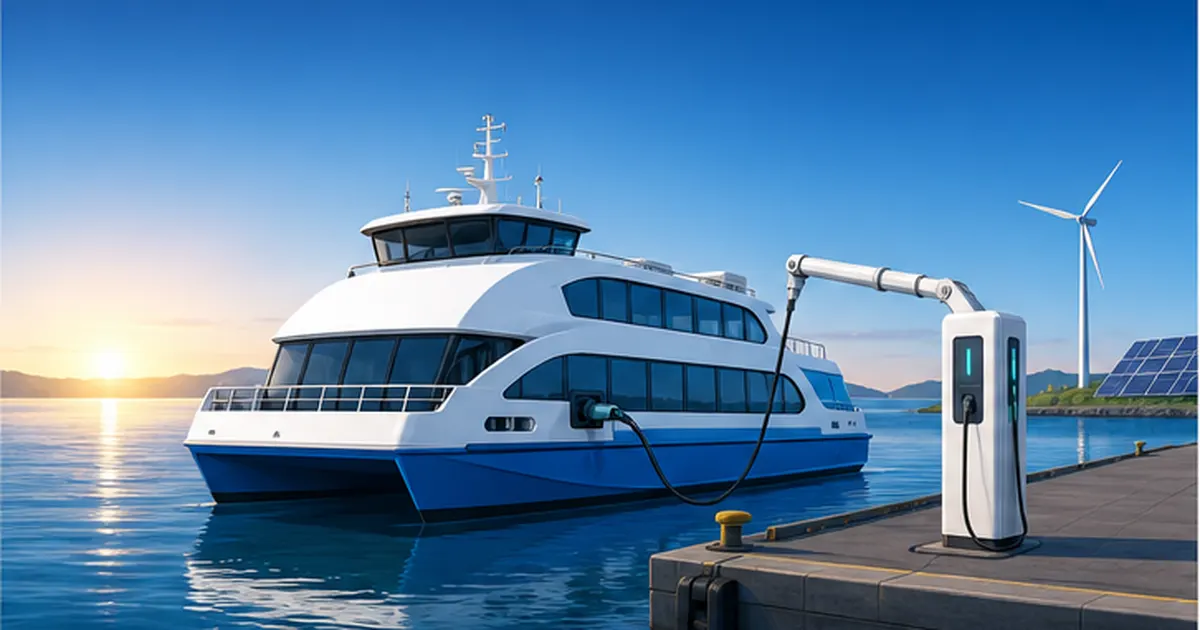
It is not only land-based machinery that needs to be decarbonized. Ships berthed at a port also keep running their own engines to generate electricity for lighting, air conditioning, and cargo handling, and this is one cause of exhaust around the port. This is why shore power supply (ship-to-shore power) — supplying electricity from land to berthed ships — is attracting attention. If a ship turns off its engine and uses the port's electricity instead, CO2, air pollutants, and noise while berthed can all be reduced together. Electrifying cargo-handling equipment and supplying shore power are, together, the two wheels that make the port's own ground quiet and clean.
Decarbonizing a port advances as a "surface," not a single "point"
RTG cranes, trailers, forklifts, berthed ships — a port has multiple scattered sources of CO2. Rather than tackling them one at a time, CNP treats the whole port as a single system, decarbonizing it as a "surface" by combining electrification, hydrogenization, and shore power supply.
In this field, Japan has begun to take the lead worldwide. In the next two chapters, let's look concretely at two contrasting demonstrations actually carried out at Kobe Port and Yokohama Port.
Kobe Port's demonstration: the world's first hydrogen-engine RTG achieves zero CO2 at combustion and about 70% less NOx
In 2025, a world-first demonstration was carried out at Kobe Port (Hanshin Port). The diesel generator of an RTG crane working at a container terminal was retrofitted with a hydrogen-only engine generator and run through actual cargo-handling operations. Cargo handling by an RTG powered by a hydrogen engine generator is said to be the world's first such effort.
An all-Japan public-private team
This "demonstration project to upgrade cargo-handling equipment at Hanshin Port container terminals" brought together many companies and organizations. The project was led by Hanshin International Port Corporation. Mitsui O.S.K. Lines, which operates the terminal; Shosen Koun, which owns and operates the RTG; Mitsui E&S, the RTG manufacturer; iLabo, which handles the hydrogen engine; and Iwatani Corporation, which supplies and fills the hydrogen, all cooperated — truly an all-Japan effort.
- Hanshin International Port Corporation: project lead
- Mitsui O.S.K. Lines: operates the container terminal
- Shosen Koun: operator that owns and operates the RTG
- Mitsui E&S: RTG manufacturer
- iLabo: development of the hydrogen-only engine
- Iwatani Corporation: supply and filling of hydrogen
Zero CO2 at combustion and about 70% less NOx than diesel
In this demonstration, the existing diesel-engine generator was replaced with a hydrogen-only engine that runs on nothing but hydrogen. The on-site demonstration ran from April through the end of June 2025, operating about three days a week, to check fuel efficiency, cost, hydrogen filling, and other operational issues. Because a hydrogen-only engine produces no CO2 when burned, CO2 emissions during operation become zero (zero emission). Alongside this, a result was obtained showing that NOx (nitrogen oxides), which causes air pollution, can also be cut by about 70% compared with the diesel generator at rated operation.
Summary of the Kobe Port demonstration
- A world first: a demonstration of an RTG running on a hydrogen engine generator
- Method: retrofitting an existing RTG's diesel generator with a "hydrogen-only engine"
- Result: zero CO2 during operation (zero emission), and about 70% less NOx than diesel at rated operation
- Period: demonstration run about three days a week from April through the end of June 2025

"Retrofitting" as a practical choice
The clever part of Kobe Port's approach is that, instead of replacing the entire crane with a brand-new unit, only the generator — its heart — was swapped out. An RTG is very expensive equipment, and replacing it takes major cost and time. If the existing machine can be reused while only the generator is made hydrogen-compatible, the hurdle for rolling this out to ports nationwide drops considerably. The operational know-how gained from the demonstration becomes valuable data for this kind of horizontal expansion.
The diesel-engine generator of the RTG is replaced with a hydrogen-engine generator, and this demonstration of cargo-handling operations by an RTG powered by a hydrogen-engine generator is a world first.
— Ministry of Land, Infrastructure, Transport and Tourism, Kinki Regional Development Bureau, press release
Why Kobe Port
Kobe Port is one of Japan's leading container ports. It has large-scale terminals with many cranes working around the clock, making it possible to verify the effects and challenges of hydrogenization at a large scale. In addition, the surrounding area has a concentration of companies and research related to hydrogen, creating an environment where cooperation on fuel supply and technology development is easier to obtain. Being able to test a world-first machine on an actual working site, in between real cargo-handling operations, carries a persuasiveness that no desk study can match. Kobe Port's results serve as a valuable model for ports at home and abroad facing the same challenges.

Yokohama Port's demonstration: an RTG powered by fuel cells, a different answer
Where Kobe Port took on the challenge with "an engine that burns hydrogen," Yokohama Port chose a different approach: "a fuel cell that generates electricity from hydrogen." Even within the same hydrogenization effort, the method differs, and by running the two demonstrations in parallel, Japan as a whole can compare which method suits which conditions.
The fuel-cell RTG operational demonstration launched at Minami Honmoku Pier
On June 2, 2025, the Ministry of Land, Infrastructure, Transport and Tourism announced that it had begun an on-site operational demonstration of an RTG powered by a hydrogen fuel cell at MC-2 in the Minami Honmoku Pier district of Yokohama Port. The diesel-engine generator was retrofitted with a hydrogen fuel cell, and the RTG is filled with hydrogen and actually operated while data is gathered and analyzed. Because a fuel cell generates electricity through a chemical reaction between hydrogen and oxygen, it involves no combustion, and is characterized by quiet operation and high efficiency.
| Item | Kobe Port | Yokohama Port |
|---|---|---|
| Method | Hydrogen engine (burning) | Fuel cell (converting to electricity) |
| Target machine | RTG (generator retrofit) | RTG (generator retrofit) |
| Demonstration start | April 17, 2025 | June 2, 2025 |
| Characteristics | Easy to make use of existing machines | Quiet and highly efficient |
Why test two different approaches
Hydrogen engines and fuel cells each have their own strengths and weaknesses. A hydrogen engine has a structure close to an existing diesel generator, making it easier to reuse parts and maintenance know-how, and it tends to have an advantage in durability and cost. A fuel cell, on the other hand, has no combustion, so its exhaust is cleaner and its efficiency higher, and it also excels at noise reduction. Rather than deciding in advance which is the right answer, the strategy in Japan's demonstrations is to run both on the ground and judge their strengths and weaknesses from actual results.

Hydrogenizing cargo-handling equipment is not a story limited to Kobe and Yokohama alone. A demonstration running an RTG on a fuel cell is also underway at Tokyo Port, and Japan's major ports are moving in step to develop next-generation cargo-handling equipment. If the electricity used at ports itself can be covered by renewable energy such as offshore wind, the decarbonization effect will be even greater.
An issue that cannot be avoided when running on hydrogen is how to supply it. In Kobe Port's demonstration too, emphasis was placed on verifying operational matters such as how much time and effort it takes to fill a crane with hydrogen, and whether the necessary volume can be delivered stably. For a crane to keep running all day without stopping, a system that never lets the fuel run out is essential. Here again, it becomes clear that CNP's receiving-hub function — accepting and supplying large volumes of fuel — is firmly connected to the hydrogenization of cargo-handling equipment. The demonstrations are also a place to verify not just a single machine but the whole flow, "from fuel supply to machine operation," as one continuous process.
Testing two different methods at two different ports also serves to spread risk. If one method fails to develop as hoped, the other remains. In the future, it is likely that hydrogen engines, fuel cells, batteries, or external power supply will each be chosen depending on a port's scale, the volume of cargo it handles, and the type of hydrogen available nearby. What matters is keeping options open rather than betting everything on just one. The demonstrations at Kobe Port and Yokohama Port are also laying the groundwork for cultivating those options within Japan.
The demonstrations are at the stage of confirming "whether it works"
Both Kobe Port and Yokohama Port are still at the "demonstration" stage. A limited number of cranes are run over a limited period, while fuel efficiency, durability, the effort required to fill hydrogen, safety, and more are carefully checked. The path ahead is to use the data gained here to develop technical standards and move toward full-scale adoption.
The system that is changing ports: the revised Port and Harbor Act and CNP formation plans
Technology alone will not change a port. A "system" is needed to back it up — who draws up the plan, and how the public and private sectors get in step with each other. Over the past few years, Japan has been building out the legal and planning framework to advance CNP.
The 2022 revision of the Port and Harbor Act
In November 2022, a law partially revising the Port and Harbor Act was enacted and promulgated, with part of it taking effect in December of the same year. This revision made it possible for port managers (the local governments and others that manage ports) to hold a "Council for the Promotion of Port Decarbonization," in which coastal companies and logistics operators participate, and, based on its discussions, to draw up a "Port Decarbonization Promotion Plan." Port decarbonization has thus begun moving forward as formal planning positioned within the law.
The significance of the public and private sectors sitting at the same table
Decarbonizing a port cannot be achieved by the port manager alone. It involves many players in different positions: terminal operating companies, cargo-handling equipment manufacturers, energy companies that supply fuel, and neighboring oil refineries and factories. By having everyone share the same plan in the council, they can align steps such as "the port will handle this fuel" and "so the factory will switch over during this period." The essence of CNP lies precisely in this mechanism for building consensus.
- The port manager establishes a "Council for the Promotion of Port Decarbonization," with public- and private-sector stakeholders participating
- Based on discussions in the council, a "Port Decarbonization Promotion Plan (CNP formation plan)" is drawn up
- Based on the plan, receiving facilities are built, cargo-handling equipment is electrified, and industry cooperation is advanced step by step
Under this framework, plans are being developed at many ports nationwide, including Yokohama Port and Kobe Port. Yokohama Port formulated its Port Decarbonization Promotion Plan in March 2025 and revised it the following year. Kobe Port, Tokyo Port, and others have also put forward their own plans. From Hokkaido to Kyushu, many ports large and small are now beginning to face in the same direction.
Plans need to be backed by numbers
Drawing up a Port Decarbonization Promotion Plan starts with measuring "how much CO2 is currently emitted from that port and its surroundings." This means grasping emissions not only from cargo-handling equipment and berthed ships but also from factories in the coastal area, and then mapping out, in numbers, by when, by what means, and by how much these will be cut. The Ministry of Land, Infrastructure, Transport and Tourism has published manuals for calculating emissions and for drawing up plans, so that ports nationwide can build their plans using the same yardstick. Proceeding based on measurable numbers, rather than vague goals, is what underpins the reliability of these plans.
The CO2 that ports reduce this way can, in the future, be combined with natural carbon sinks such as blue carbon absorbed by seagrass beds and tidal flats, making the decarbonization of a whole region even more solid. Efforts to change port facilities and efforts to protect and nurture marine ecosystems are two wheels of the same cart, heading toward the same goal of "carbon neutrality."
To keep a plan from ending up as a picture of a rice cake that no one can eat, financial backing is essential as well. Under the GX (Green Transformation) framework, which supports the transition to a decarbonized society, the government is building mechanisms to support the supply of hydrogen and ammonia and the decarbonization of port facilities. Until new fuels can compete on price with fossil fuels, this kind of public support plays a role in drawing in private investment. Only when port managers, companies, and the government align on both plans and funding does CNP move forward from demonstration to full implementation.

Key points on the system side
- The 2022 revision of the Port and Harbor Act put the "council" and "promotion plan" mechanisms on a legal footing
- The public and private sectors share the same plan, aligning steps for receiving fuel and switching industries over
- Plans are being developed at ports nationwide, including Yokohama, Kobe, and Tokyo
Remaining challenges, and what we can do
As we have seen so far, CNP is steadily moving forward. But the success of demonstrations does not mean ports nationwide will become carbon neutral overnight. A number of challenges still remain to be overcome.
Cost: still higher than fossil fuels
The biggest wall is, after all, cost. At present, hydrogen and ammonia cost more than oil and natural gas. The Basic Hydrogen Strategy sets goals to gradually bring costs down, but that requires scaling up: producing more, transporting more, and using more. Handling fuel together at ports is a first step toward that scale-up, but closing the price gap requires both time and policy support. There is also a difficulty resembling "which came first, the chicken or the egg": if the number of users doesn't grow, prices won't fall, and if prices don't fall, the number of users won't grow. To break this vicious cycle, the government and ports are first taking the lead in creating demand as a kind of priming water.
Safety and standard-setting
Hydrogen is an extremely light gas that spreads easily if it leaks. Ammonia is toxic. Both are dangerous fuels if handled improperly, and using them safely in a place as dense with people and machinery as a port requires newly developing equipment standards and work procedures. Data gained from the demonstrations is also used for building out these technical standards. Only once safety rules are firmly established does full-scale adoption become possible. This is precisely why the demonstrations at Kobe Port and Yokohama Port are being advanced together with a review of technical standards for port facilities, from fiscal 2025 into the following fiscal year. Knowledge of "where you need to be careful for safety," which only becomes clear once you actually run the equipment, is being fed back into the rules.

- Cost: hydrogen and ammonia are more expensive than fossil fuels; how far scale-up and policy support can bring costs down is key
- Safety: equipment standards and work procedures must be developed to address hydrogen's tendency to leak and ammonia's toxicity
- Supply chain: can the whole chain — from producing country, to transporting, to storing, to distributing — be built without emitting CO2?
- Human resources: training engineers and workers who can handle new fuels and machines
Our lives, connected to the sea
Decarbonizing ports is not a distant story confined to industry. Cutting CO2 at ports eases atmospheric warming, and in turn helps hold down the risks of sea-level rise and storm surges that threaten our daily lives. Watching the scenery of ports quietly turn clean is also, in its own way, an act of protecting our future as people who live alongside the sea.

What we can do
- Stay interested in news about ports, ships, and hydrogen and ammonia, and learn the accurate facts
- Rethink how we use energy, and cut demand itself through everyday energy saving
- Engage with learning opportunities on marine environments and decarbonization, and talk about them with family and friends
Summary: ports becoming the front line of decarbonization
The Carbon Neutral Port (CNP) is an initiative to transform ports — the point where Japan's CO2 emissions concentrate — conversely into energy hubs that drive decarbonization forward. Through three pillars — receiving hydrogen and fuel ammonia, electrifying and hydrogenizing cargo-handling equipment, and cooperating with coastal industries — it is changing the port as a whole.
At Kobe Port, the world's first hydrogen-engine RTG demonstrated zero CO2 at combustion (zero emission) and about a 70% cut in NOx, while at Yokohama Port, an operational demonstration of a fuel-cell RTG has been advancing. On the systemic side too, the 2022 revision of the Port and Harbor Act put the planning mechanism in place, and ports nationwide are now moving. Challenges of cost and safety remain, but ports are certainly becoming the front line of decarbonization.
Summary of this article
- CNP is a national concept to turn ports from "places that emit CO2" into "hubs that distribute decarbonized fuel"
- Industries accounting for about 60% of Japan's CO2 are concentrated in coastal areas, which is why ports are key to decarbonization
- Receiving hydrogen and ammonia, and electrifying and hydrogenizing cargo-handling equipment such as RTGs, are the two major themes
- Kobe Port achieved the world's first demonstration of zero CO2 at combustion and about 70% less NOx with a hydrogen engine, while Yokohama Port demonstrated a fuel cell
- The 2022 revision of the Port and Harbor Act put planning on a legal footing, and it is spreading to ports nationwide
- Cost, safety, and supply chains remain challenges. Decarbonizing ports is an effort to protect the sea and our lives
Next time you pass by a port, take a fresh look at the towering cranes and the tanks lined up. Each and every one of them is quietly transforming, standing at the front line of Japan's seas as they turn toward decarbonization. Behind the goods we receive every day, ports are, right now, in the process of being reborn as the gateway to energy for the next hundred years.
References and sources
- Ministry of Land, Infrastructure, Transport and Tourism, Ports and Harbours Bureau – Formation of Carbon Neutral Ports (CNP)
- Ministry of Land, Infrastructure, Transport and Tourism – Direction of Measures Toward the Formation of Carbon Neutral Ports (CNP), Interim Summary (August 2021)
- Ministry of Land, Infrastructure, Transport and Tourism, Kinki Regional Development Bureau – World-first demonstration at Kobe Port: on-site operational demonstration of cargo-handling equipment powered by a hydrogen engine begins
- Ministry of Land, Infrastructure, Transport and Tourism – Demonstration begins at Yokohama Port toward port carbon neutralization: on-site operational demonstration of cargo-handling equipment powered by a hydrogen fuel cell begins
- Mitsui O.S.K. Lines – Launch of the demonstration project to upgrade cargo-handling equipment at Hanshin Port container terminals (RTG hydrogen-engine retrofit)
- Agency for Natural Resources and Energy (Ministry of Economy, Trade and Industry) – Basic Hydrogen Strategy (revised June 6, 2023)
- Ministry of Land, Infrastructure, Transport and Tourism, Ports and Harbours Bureau – Port Decarbonization Promotion Plan Preparation Manual (March 2023)
- iLabo – Launch of the on-site demonstration for the project to upgrade cargo-handling equipment at Hanshin Port container terminals (world-first hydrogen-only RTG)
- City of Yokohama, Port and Harbor Bureau – Carbon Neutral Port initiatives and Yokohama Port's Port Decarbonization Promotion Plan
* Listed in order of reliability: government and academic institutions > peer-reviewed papers > specialist organizations > reputable media