⚡ In short
A clear introduction to tidal stream and tidal range power. Because the moon and sun drive the tides, output can be predicted decades ahead and is barely affected by the weather. Covers Japan's first commercial-scale 1,100 kW turbine at Naru Strait in Goto, Nagasaki, the UK's MeyGen, comparisons with wave power, costs and environmental impacts.
The sea holds a source of electricity that arrives twice a day, without fail: the tides. Solar power stops at night, and whether the wind will blow is not known until the day before. Tides, however, are set by the geometry of the moon, Earth and sun, so we can calculate the date, the hour and the strength of the flow in any given strait a century from now. That built-in timetable is exactly why tidal stream and tidal range power have a value no other renewable can offer.
Japan is also well supplied with this resource. The current in the Naruto Strait reaches 10.5 knots (about 19.4 km/h), and together with the Kurushima and Kanmon straits it forms what Japan calls its three great tidal races. The Seto Inland Sea and the tangled islands off western Kyushu contain countless narrow channels where the tide is squeezed and accelerated. At Naru Strait in Goto City, Nagasaki, a commercial-scale 1,100 kW tidal stream turbine has been generating real electricity and feeding the island grid since 2025.
At the same time, tidal stream power is not a technology that is about to become a mainstream power source. Generation costs are several times those of offshore wind, and the machines sit on a seabed that is battered by salt and current without pause. This article sets out what generating electricity from the tide really involves, including both the promise and the limits, moving from the physics to real projects in Japan and abroad, then to costs and environmental impacts. For the wider picture of marine renewables, our article on the growth of offshore wind in Japan makes a useful companion piece.
What you will learn
- How the tides are produced by the gravitational pull of the moon and sun, and why they can be predicted accurately decades in advance
- The difference between tidal stream power (which uses the flow) and tidal range power (which uses the height difference), and what each is good and bad at
- The substance and results of Japan's first commercial-scale demonstration at Naru Strait in Goto City, Nagasaki (500 kW to 1,100 kW)
- How far the world has come, including MeyGen in the UK, La Rance in France and Sihwa Lake in South Korea
- Strengths compared with wave power and offshore wind (predictability and a high capacity factor) and weaknesses (generation cost)
- The social questions that remain before commercial use: effects on fish and marine mammals, and coordination with fisheries and shipping lanes
Why the Tides Happen: A Flow with a Timetable, Written by the Moon and Sun
To understand tidal stream power, you first have to understand the tide itself. The sea surface rises and falls roughly twice a day because the moon and the sun pull on the water. The key point is that this motion is governed by celestial mechanics, not by weather. A weather forecast is stretched at a week; a tide table can be produced years ahead.
The Moon's Gravity and Centrifugal Force Lift the Sea on Both Sides
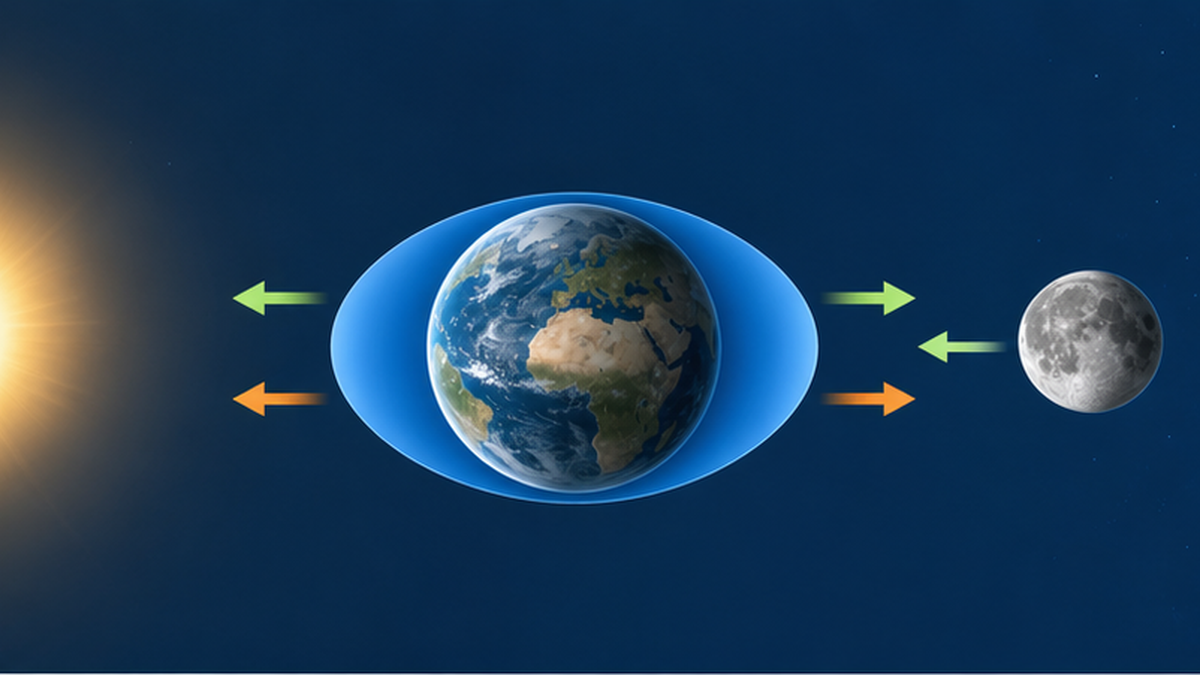
The Earth and the moon both orbit their common centre of mass. Water on the side facing the moon is pulled strongly towards it and bulges outward; water on the far side is dominated instead by the centrifugal effect of that orbital motion and bulges outward too. The ocean therefore takes on two bulges, like a rugby ball, one towards the moon and one directly away from it. The Earth rotates through this shape in about a day, so from any given point the bulges pass roughly twice daily. That is what the two daily high and low tides really are.
The force that moves the sea in this way is called the tide-generating force. The sun produces one as well, but because it is so far away the solar tide-generating force is only about 45% of the moon's. That is still far from negligible, and it is why the size of the tide changes with the relative positions of the moon and the sun.
Spring and Neap Tides Alternate About Every 15 Days
At new moon and full moon, the moon, Earth and sun line up almost exactly and the two tide-generating forces add together. The tidal range is then at its greatest, which is called a spring tide. At the half moons of the first and last quarter, the two forces act at right angles and partly cancel, giving the small tidal range of a neap tide. Spring and neap tides alternate roughly every 15 days, half the lunar cycle of about 29.5 days.
For tidal stream power this spring-neap cycle is a large swing in output. During spring tides the flow is fast and output rises; during neaps it falls away. What matters, though, is that we know in advance exactly when each swing will come.
In Japan, the Japan Coast Guard publishes annual tide tables for major ports, and the Japan Meteorological Agency releases predicted tide levels. When an angler says the spring tide is running today, or a skipper waits for slack water before leaving harbour, they are relying on those calculations. Tidal stream power simply adds a new use, power generation, on top of the same arithmetic.
| Term | Meaning | Effect on tidal stream power |
|---|---|---|
| Tide-generating force | The force with which the moon and sun move seawater; the sun contributes about 45% of the moon's share | The fundamental force that sets the size of the resource itself |
| Spring tide | Around new and full moon, when tidal range and current speed peak | Generation peaks during these periods |
| Neap tide | Around the half moons, when tidal range and current speed are smallest | Output falls, but the timing is known in advance |
| Slack water | The period around high and low tide when the flow almost stops | Generation drops close to zero several times a day |
| Tidal range | The difference in sea level between high and low tide | Determines the output of barrage-type tidal range plants |
The Decisive Advantage of a Renewable You Can Predict
The greatest weakness of solar and wind is that their output cannot be read reliably. When forecasts miss, utilities must keep thermal plants on standby or fill the gap with batteries, and that cost ends up on the electricity bill. Tidal stream power is different. Given the machine's performance curve, you can work out almost exactly how many kilowatts it will produce at three in the afternoon on a specific day a year from now.
Three kinds of certainty the tide provides
- The timing of generation is fixed, so supply-demand planning and maintenance scheduling can be set out in advance
- Balancing costs are lower, because less reserve capacity is needed to cover forecast error
- Output can be smoothed across sites: combining sea areas whose tidal phases differ fills in each other's gaps
That last point matters especially. One strait may be at slack water and generating nothing while another, a few hours out of phase, is at full output. Such combinations are geographically possible, and a country with a coastline as convoluted as Japan's has real room to design around these phase differences.
How Tidal Stream and Tidal Range Power Differ: Two Distinct Approaches
Generating power from the tide sounds like one thing, but technically there are two completely different methods. English distinguishes them clearly as tidal stream and tidal range (or barrage), while everyday Japanese often blurs the line. Confusing the two means comparing technologies whose scale, cost and environmental impact are all entirely different.
Tidal Stream: Taking Kinetic Energy from the Flow with an Underwater Turbine
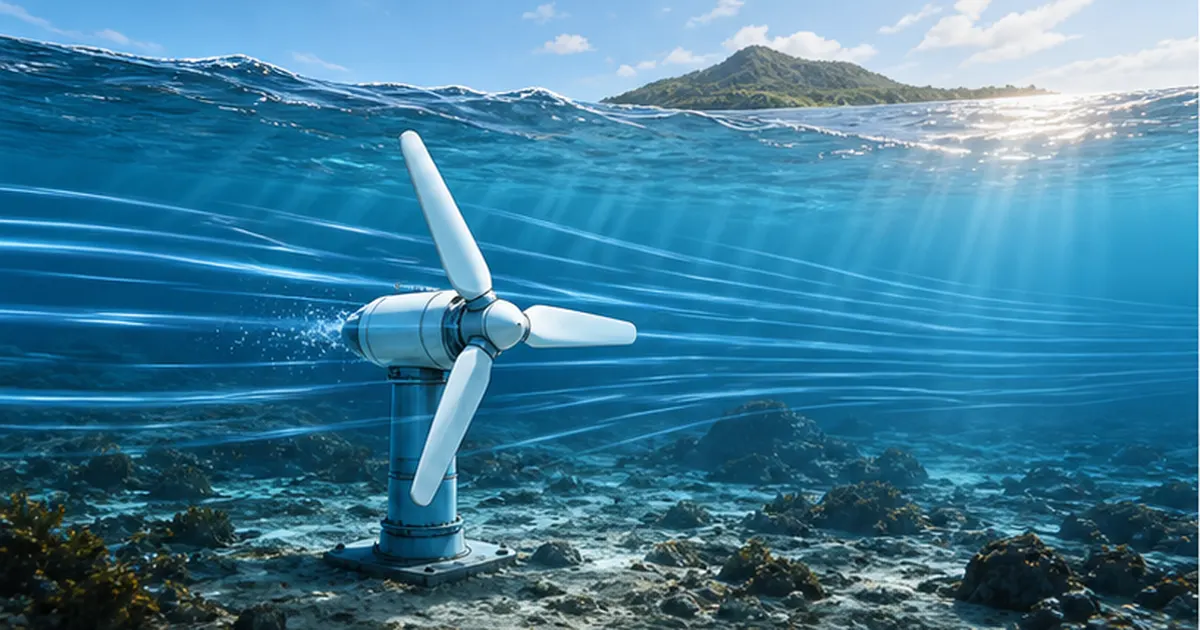
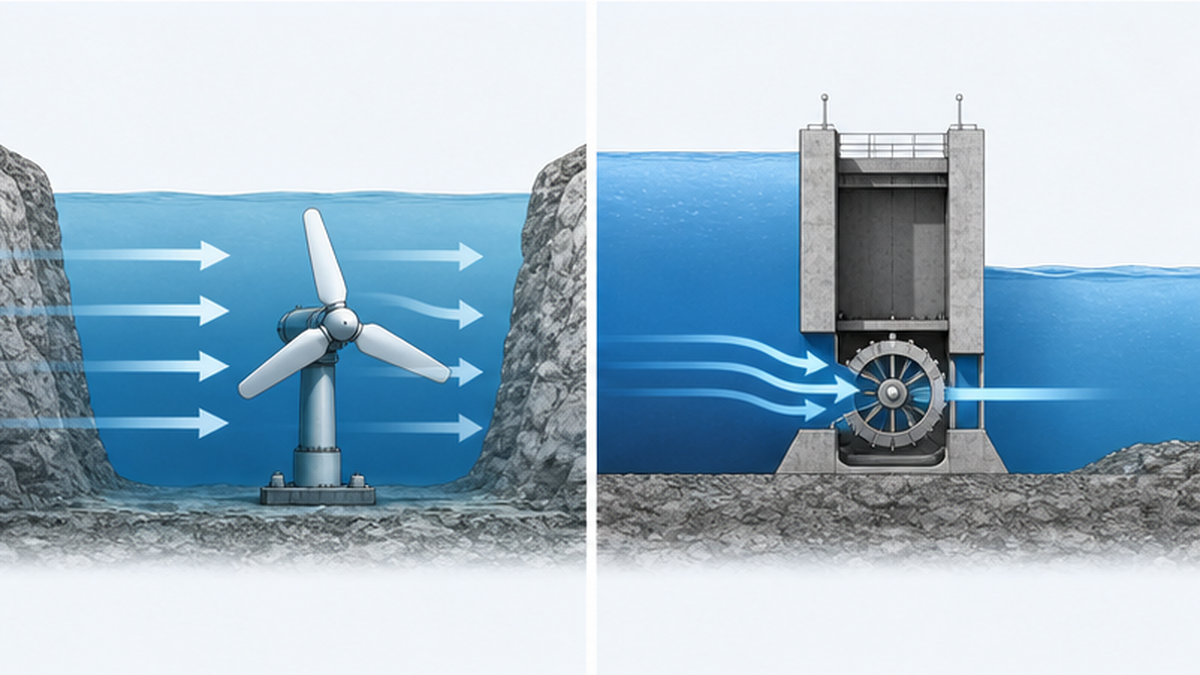
Tidal stream power places a turbine that closely resembles a wind turbine in places where the tide runs fast, such as straits and narrow channels. The flow turns the rotor, a gearbox and generator convert it to electricity, and a subsea cable carries it ashore. Because nothing dams the sea, the local geography is left largely unchanged. This is where research and development is now concentrated worldwide.
There are several installation styles. Seabed-mounted devices are fixed with gravity bases or piles, floating devices hang beneath a surface platform, and submerged floating devices are tethered by mooring lines and hover in mid-water. The Goto demonstration machine is seabed-mounted; IHI's Kairyu, discussed later, is a submerged floating design.
Tidal Range: Walling Off a Bay and Using the Potential Energy of the Level Difference
Tidal range power closes off an estuary or bay with a barrage, stores water at high tide, releases it at low tide and turns turbines with the head created. It is closest in principle to a conventional dam hydro plant. The La Rance tidal power station in France, which began operating in 1966 with a maximum output of 240 MW and annual generation of around 600 GWh, is the classic example, and the technology now has more than half a century of service behind it.
Tidal range power carries one decisive constraint, however: it needs both a large tidal range and a geography that can be dammed. Around La Rance the maximum tidal range is 13.5 m and the average 8.5 m, among the largest anywhere. Walling off a bay also reduces the exchange of seawater and alters ecosystems and sedimentation, so new construction has become extremely rare worldwide.
How Ocean Current and Wave Power Fit In
Marine energy includes other families as well. To avoid confusion, it helps to lay out the four main methods. The distinguishing question is which form of energy is being taken, and where.
| Method | Energy source | Nature of variability | Typical suitable sites |
|---|---|---|---|
| Tidal stream | Horizontal flow produced by the rise and fall of the tide | Cycles several times a day; fully predictable | Narrow straits and channels (Naruto, Kurushima, Goto and similar) |
| Tidal range | The level difference between high and low tide (potential energy) | As above, though operation can be adjusted by storing water | Bays and estuaries with a large tidal range (La Rance, Sihwa Lake) |
| Ocean current | Large permanent currents such as the Kuroshio | Nearly steady, though the path shifts seasonally and year to year | Along the Kuroshio's route (off the Tokara Islands and similar) |
| Wave power | The kinetic and potential energy of wind-generated waves | Highly variable, since it originates in the weather | Open coasts and harbour breakwaters facing the open ocean |
A distinction worth remembering
Tidal stream power uses the flow and does not wall off the sea; tidal range power uses the level difference and does wall off a bay. Whenever a news report simply says tidal power, checking which of the two it means will keep your understanding straight.
Why Water Is Such a Good Medium: 800 Times the Density and the Cube of Velocity
In photographs, a tidal stream device looks far smaller than an offshore wind turbine. That it still delivers meaningful output comes down to the difference in the properties of air and water. Once that is clear, the engineers' attachment to underwater turbines makes sense.
Seawater Is About 800 Times as Dense as Air
The energy that can be taken from a flow is proportional to the density of the fluid. Seawater has a density of roughly 1,025 kg/m³ and air roughly 1.2 kg/m³, a difference of about 800 times. At the same speed, water is carrying 800 times as much energy. That is why a turbine tens of metres across underwater can aim for output comparable to a wind turbine over 100 m across.
Energy Is Proportional to the Cube of Flow Speed
The second key relationship is that the energy in a flow scales with the cube of its speed. Double the speed and the energy is eight times greater; triple it and the energy is twenty-seven times greater. Read the other way, this means that a small shortfall in speed destroys the economics outright. The cube law is precisely why suitable tidal stream sites are limited to narrow channels with fast water.
- 1.5 m/s: generation is possible, but the economics are difficult without a much larger machine
- 2.5 m/s: widely regarded as the threshold for practical use, and the band in which major overseas projects sit
- 3.0 m/s and above: world-class sites, though construction and maintenance difficulty rises sharply too
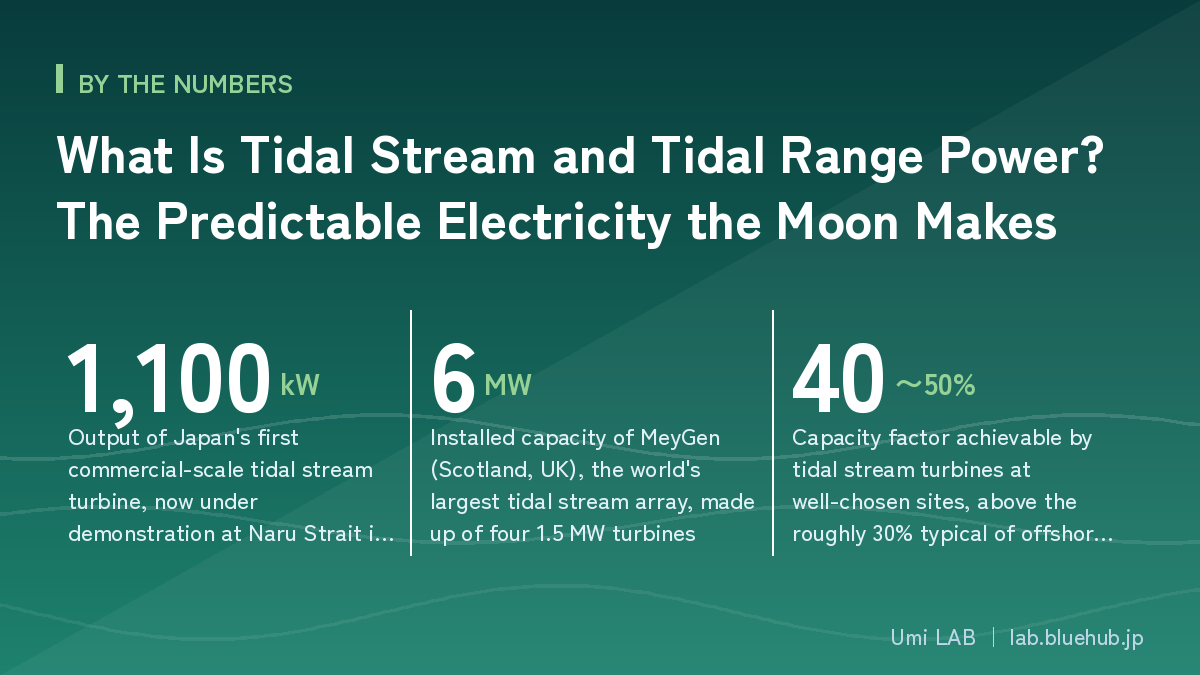
For reference, Japan Coast Guard figures put the peak current in Japan's three great tidal races at 10.5 knots in the Naruto Strait (about 19.4 km/h, or 5.4 m/s), 10.3 knots in the Kurushima Strait and 9.4 knots in the Kanmon Strait. These are exceptionally fast by world standards, but they are also critical shipping corridors, which is precisely why they cannot simply be turned into power stations.
In Return, the Sea Is a Brutal Place for Machinery
High water density also means large loads on the structure. The sea adds corrosion from salt, biofouling, impacts from drifting debris and, above all, the constraint that inspection and repair require a vessel, good weather and slack water at the same time. Work that a crane would finish in a few hours on a land-based turbine becomes a multi-day operation on the seabed.
The cost structure that underwater installation creates
- Installation and removal need specialised work vessels, so each offshore campaign is expensive
- Work is confined to slack water and to days when sea conditions are calm
- A fault cannot be attended to the same day, so outages tend to run long
- Materials and scheduled maintenance for corrosion and biofouling add further cost
Naru Strait in Goto, Nagasaki: Japan's First Commercial-Scale Tidal Stream Project
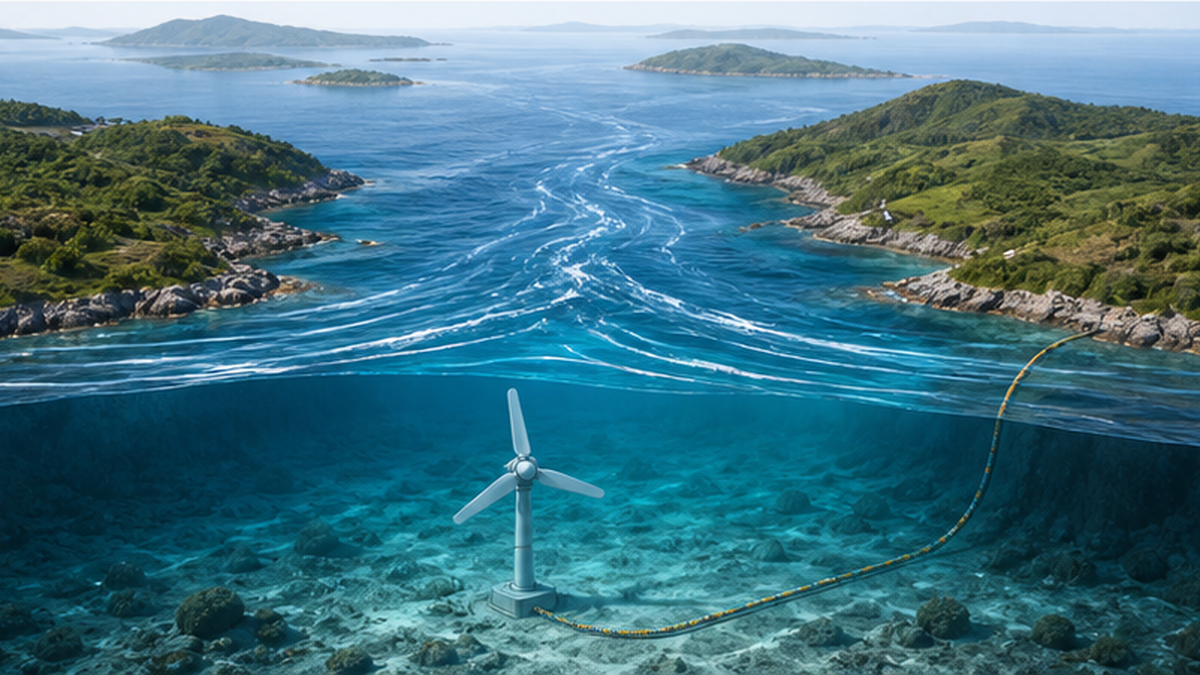
No account of tidal stream power in Japan can skip Naru Strait in Goto City, Nagasaki. In this fast-running channel between Naru Island and Hisaka Island, Kyuden Mirai Energy, part of the Kyushu Electric Power group, has advanced a staged demonstration of Japan's first large tidal stream turbine under Ministry of the Environment programmes.
Phase 1 (500 kW): Japan's First Large Turbine Starts Generating in 2021
The first stage ran under the Ministry of the Environment's programme to bring tidal stream technology into practical use. On 23 January 2021 Japan's first large tidal stream turbine, rated at 500 kW, was installed on the seabed of Naru Strait and began generating. Installation used a self-propelled multipurpose vessel, and Japanese marine construction technique cleared the difficult task of placing the machine in fast-running water.
The construction side deserves attention in its own right. Setting a structure of several hundred tonnes on the seabed in fast water, in exactly the right position and orientation, is a different order of difficulty from heavy plant work on land. Work is possible only in the short window of slack water, and any deterioration in sea state halts it immediately. That Japanese marine civil engineering carried this out was itself part of what the demonstration proved.
The results were concrete. In a little over three months from the start of the demonstration the turbine produced about 80,000 kWh, equivalent to the monthly consumption of 360 ordinary households. The figure may look modest, but proving that a large tidal stream turbine can keep turning safely in Japanese waters and deliver electricity was a significant milestone.
Phase 2 (1,100 kW): Commercial Scale from 2025
The second stage stepped up to a commercial-scale machine rated at 1,100 kW (1.1 MW). It was installed on the seabed of Naru Strait in February 2025, and after commissioning adjustments the project received its pre-use inspection certificate under the Electricity Business Act from the Ministry of Economy, Trade and Industry, dated 23 May 2025. Demonstration operation began on 26 May 2025.
Read the operator's announcementDemonstration operation begins for a commercial-scale large tidal stream turbine (Kyuden Mirai Energy)Press release dated 26 May 2025, announcing the pre-use inspection pass and the start of demonstration operation for the 1,100 kW machine at Naru Strait.🔗 q-mirai.co.jpThe decisive difference from Phase 1 is that the machine is connected to the Kyushu Electric Power Transmission and Distribution grid and actually supplying Goto City. Rather than simply turning underwater as a test rig, it operates as a grid-connected source delivering electricity to island life. Generation data are to be collected and analysed through fiscal 2025, after which the machine is scheduled to be removed and recovered.
Why Islands Are the Right Place to Start: The Local Decarbonization Context
Goto City is pursuing tidal stream power for more than the speed of its tides. Remote islands face a genuine problem of electricity self-sufficiency. On islands far from the mainland, fuel must be shipped in, generation costs are high, and fuel price swings are felt directly. Producing electricity from the local tide reduces that exposure.
Goto City is also known as a leader in floating offshore wind, and tidal stream power is positioned as a complement to it. The tide always moves, even on a day with little wind; conversely, the turbines may be turning during the slack-water hours when the tide pauses. If that combination holds, island electricity becomes far steadier. In the same island decarbonization context, work on electric ferries and zero-emission ships is proceeding in parallel.
The path of Goto's tidal stream demonstration
- FY2019-2021 (Phase 1): a 500 kW machine was installed and confirmed to operate safely in Japanese waters
- 23 January 2021: Japan's first large tidal stream turbine begins generating, producing about 80,000 kWh in a little over three months
- FY2022: selected for the Ministry of the Environment's programme to build a regional decarbonization model around tidal stream power
- February 2025: the commercial-scale 1,100 kW machine is installed at Naru Strait
- 26 May 2025: demonstration operation begins with grid connection, supplying Goto City
The Global Frontier: What MeyGen, La Rance and Sihwa Lake Have Achieved
Judging Japan's efforts requires knowing where the world stands. Let us look at the leading projects in tidal stream and tidal range power in turn.
MeyGen (Scotland, UK): The World's Largest Tidal Stream Array
MeyGen, operating in the Pentland Firth off the northern tip of Scotland, marks the current high-water mark for tidal stream power. Four 1.5 MW turbines give a combined 6 MW, and what made the project a landmark was sustaining commercial operation of several machines bundled into an array. Sinking a single test machine and keeping four running side by side for years are entirely different technical propositions.
In 2025 all four turbines reached full operation and the site's cumulative generation passed 50 GWh, a first for any tidal stream array in the world. Generation has continued since, with cumulative output reported at more than 84 GWh. The project partners have expansion to several hundred megawatts in their sights.
See the project detailsMeyGen Tidal Energy Project | Tethys (PNNL, USA)A public database entry covering the specifications of MeyGen, the world's largest tidal stream array, together with the environmental monitoring literature.🔗 tethys.pnnl.govLa Rance (France): Proven Technology Running for More Than Half a Century
On the tidal range side, the La Rance tidal power station in France, completed on 26 November 1966, has now been running for more than fifty years. A barrage several hundred metres wide closes the estuary of the Rance near Saint-Malo in Brittany, giving a maximum output of 240 MW and annual generation of around 600 GWh. It was made possible by one of the world's largest tidal ranges, 13.5 m at maximum and 8.5 m on average.
La Rance also left a lesson about environmental impact. Because seawater exchange within the basin became less frequent, the ecological balance was reported to have been disturbed for a period. The fact that working reliably and having a light environmental footprint are separate questions has fed directly into the caution surrounding later tidal range proposals.
Sihwa Lake (South Korea): The World's Largest Tidal Range Plant
The largest tidal range plant by installed capacity is the Sihwa Lake tidal power station on South Korea's west coast. It began generating in August 2011, and its ten units total 254 MW, surpassing La Rance. It was also intended to move seawater in and out of an artificial lake whose water quality had deteriorated, and it is often cited as a case that combines generation with environmental remediation.
What is striking is that neither Sihwa Lake nor La Rance was built purely to generate power. La Rance doubles as a crossing at the estuary, and at Sihwa Lake the need for water quality improvement came first. Every place where tidal range power has succeeded is a place where there was already another reason to build a barrage there. That alone explains why almost nobody today proposes walling off a bay from scratch simply to build a power station.
| Project | Country and waters | Method | Installed capacity | Notable point |
|---|---|---|---|---|
| MeyGen | UK, Pentland Firth | Tidal stream (seabed-mounted array) | 6 MW (four 1.5 MW units) | First tidal stream array in the world to pass 50 GWh cumulative output |
| La Rance tidal power station | France, Rance estuary | Tidal range (barrage) | 240 MW | Completed 1966; about 600 GWh a year, maximum tidal range 13.5 m |
| Sihwa Lake tidal power station | South Korea, Gyeonggi Bay | Tidal range (barrage) | 254 MW | Operating since 2011; the largest tidal range plant in the world by capacity |
| Naru Strait demonstration | Japan, Goto City, Nagasaki | Tidal stream (seabed-mounted) | 1,100 kW | Japan's first commercial-scale demonstration operation, from 2025 |
Read the numbers carefully
Setting tidal range plants (240-254 MW) beside tidal stream (6 MW) makes the latter look weak, but the gap reflects maturity rather than merit. Tidal range faces severe geographical constraints and has little room for new sites, whereas tidal stream can be installed in vastly more locations and still has room for cost reduction through volume production.
Compared with Wave Power and Offshore Wind: The Strength Is Quality, Not Quantity
A common trap when assessing tidal stream power is to conclude that it is pointless because it generates less than solar or wind. The value of a power source cannot be measured by total generation alone. Here we set it beside wave power, its fellow marine renewable, and beside offshore wind, which is further ahead.
Versus Wave Power: Opposite Kinds of Variability
Wave power extracts energy from waves created by the wind. In Japan, the Kuji wave power station in Kuji City, Iwate Prefecture (43 kW, completed 2016), which used a device developed by the University of Tokyo's Institute of Industrial Science, is among the best known. A submerged plate catches the motion of the waves and power is sent ashore, with generation expected to be equivalent to roughly ten ordinary households.
In resource terms wave power is the larger of the two. NEDO estimates put the wave power along Japan's coast at an average of 7 kW/m with a resource of 36 GW, and a future potential of 87 TWh, roughly a tenth of Japan's total electricity consumption. But waves come from the weather, so when and how much they deliver depends on it. The relationship is a neat contrast: wave power wins on resource size, tidal stream on predictability.
Versus Offshore Wind: A Higher Capacity Factor
Measured by capacity factor, the share of installed capacity actually converted into generation, tidal stream turbines at good sites are said to reach 40-50%. Barrage-type tidal range plants run at around 25-30%, and offshore wind is generally in the 30s. Even though each tidal stream machine is small, it uses the capacity that has been installed far more fully.
UK research has further suggested that the cyclic, predictable character of tidal stream power may deliver whole-system cost savings that never appear in a conventional levelised cost of energy calculation, such as reduced spending on balancing. Even where the unit price looks expensive, the assessment can change when the system as a whole is considered.
The Value Emerges Only in Combination
In short, tidal stream power will not become a mainstream source on its own. But in the hours when the sun has set, the wind has dropped, and electricity is still needed, a source that can promise its output in advance becomes more valuable the higher the renewable share climbs. Debates over decarbonizing ports and islands turn on exactly this kind of combination of local sources.
One further point is easily overlooked: generation per unit of area occupied. Because tidal turbines sit on the seabed rather than occupying the surface, the same waters can potentially be shared with fisheries and shipping, though that of course requires careful coordination. Set against offshore wind or solar, which use surface area heavily, this difference in how space is used matters more than one might expect along Japan's crowded coasts.
| Criterion | Tidal stream | Wave power | Offshore wind |
|---|---|---|---|
| Predictability | Excellent: calculable decades ahead | Poor: dependent on weather forecasts | Good: forecastable a few days ahead |
| Capacity factor | 40-50% at good sites | Around 20-30% | In the 30s |
| Domestic resource | Limited, concentrated in narrow straits | 36 GW on a resource basis | Large, counting fixed-bottom and floating together |
| Technology maturity | Demonstration to early commercial | Demonstration stage | Commercially established |
| Generation cost | High: installation costs two to three times offshore wind | High | Falling steadily |
Cost, Environmental Impact and Social Coordination: The Remaining Hurdles
Having covered the strengths, let us face the difficulties head on. The reasons tidal stream power has not spread are clear: it is still expensive, and using the sea means other people and other creatures are already there.
Cost: The Reality of Two to Three Times Offshore Wind
Installation costs for tidal stream power are currently put at two to three times those of offshore wind. Specialised work vessels, subsea cables, corrosion protection and a limited number of workable days all pile up. UK analysis expects the levelised cost of energy to fall from around GBP 240/MWh to below GBP 150/MWh on an assumed learning rate of 17%, and there are reports that the learning rate achieved in practice is around 25%, faster than assumed.
The important point is that this decline does not happen on its own; it happens as deployment grows. That is why the UK carved out a dedicated budget for tidal stream within its Contracts for Difference renewable auctions. In AR6, the sixth allocation round in 2024, six projects totalling 28 MW cleared a GBP 15 million ring-fence at a strike price of GBP 172/MWh, 34% below the administrative strike price and the lowest level since the ring-fence was introduced. Together with 93 MW from the previous two rounds, the pipeline now stands at 121 MW to be deployed by 2029.
The ring-fence as a policy instrument
Made to compete on the same terms as offshore wind, tidal stream would lose on price every time. The UK carved out a small dedicated allocation in full knowledge of that, giving developers the certainty that projects would come round every year. The result is that prices have fallen at each auction. It is a textbook case of policy nurturing a technology.
Do Animals Actually Collide with the Turbines?
The obvious concern about blades turning underwater is the risk of collision with fish, marine mammals and diving seabirds. Because good tidal stream sites have fast, often turbid water, simply observing what happens has long been the difficulty. Bodies such as the European Marine Energy Centre (EMEC) in the UK have built assessment methods that combine encounter rate models with collision risk models.
Empirical data have begun to appear in recent years. A study analysing 109 days of underwater camera footage at an operating small tidal turbine (PLOS ONE, 2025) found that among 229 individual fish and five fish schools that encountered the turbine, collision with the moving blades was observed in four instances. No collisions involving seabirds or marine mammals were observed. Most animals, in other words, swam around the turbine.
Pathways other than collision also deserve attention. Underwater noise from the machinery is not trivial for marine mammals that communicate and forage by sound (we treat this at length in our article on ocean noise pollution). Whether the electromagnetic fields generated by subsea cables affect species that navigate by the geomagnetic field is another open question. Beyond that, the very act of extracting energy from the flow may slightly alter downstream current speeds and mixing.
How to read these figures carefully
- The observations covered a single small turbine and cannot be applied directly to larger machines or to arrays of many units
- Cumulative effects of large-scale installation along migratory routes are still not well understood
- Beyond collision there are pathways through underwater noise, electromagnetic fields and changes to the structure of the flow itself
- That is precisely why continuing environmental monitoring at operating demonstration sites is worthwhile
Coexisting with Fisheries and Shipping: The Hardest Problem of All
Harder than the technology is the social coordination. Fast-running straits are almost always good fishing grounds and busy shipping routes at the same time. The Naruto and Kurushima straits are the obvious cases: judged on current speed alone they are world-class sites, but putting structures in them is not a simple matter.
- Fishing rights: careful consensus-building is needed in advance about how operations in the area will change
- Navigational safety: the position of submerged structures and the clearance above them must be published and reflected in charts and navigational warnings
- Cable routing: subsea cable plans must avoid conflict with fishing gear and anchors
- Local benefit: without a mechanism returning electricity or revenue to the community, acceptance is hard to build
The Goto demonstration is being run under a programme explicitly framed around building a regional decarbonization model precisely because of this. Technical demonstration and local agreement can only move forward together.
How Far Can Japan's Seas Be Used? Potential and a Realistic Path
Finally, let us set out the potential of Japan's waters and what may come next. In short, tidal stream power is more likely to grow into a source that reliably supports particular regions than into a pillar of the national electricity supply.
The Tidal Resource Is Limited, but the Kuroshio Is a Separate Card
According to NEDO's assessment, Japan's wave and tidal stream potential is smaller than that of Europe and North America, yet the country has a distinctive advantage: the Kuroshio, one of the world's major ocean currents, runs comparatively close to land. The scale of ocean current energy is estimated at around 205 GW, a resource of an entirely different order from tidal streams.
The attempt to tap the Kuroshio is Kairyu, the submerged floating ocean current generation system developed by NEDO and IHI. A 100 kW-class demonstration unit was installed in the Kuroshio off Kuchinoshima in Toshima Village, Kagoshima Prefecture in August 2017 to verify generation performance and the attitude control system. It recorded a maximum output of about 30 kW and confirmed the autonomous control that stabilises the machine's attitude underwater, along with installation and removal methods. A modified unit, with an improved autonomous control programme and additional flow-straightening plates, has since been used for long-term demonstration lasting more than a year.
Growth Will Come from Islands and Regions, Not from the Mainstream
Using the Kuroshio is, however, an even harder challenge than tidal stream power. The waters are deep, far from shore, and the Kuroshio's path meanders considerably from season to season and year to year. Mooring machinery in deep water at a place where the flow cannot be guaranteed, and carrying the power ashore through a long subsea cable, remains at the research stage both technically and economically.
Tidal stream power will first prove its worth in islands and small coastal grids, where fuel costs are high and self-sufficiency in electricity is a management issue. It may not win on price in a large mainland grid, but the comparison changes when the benchmark is the fuel bill for diesel generation. It is no accident that the Goto demonstration is being pursued in exactly this context.
- Demonstration stage (now): one to a few machines connected to a real grid and run long-term to gather data
- Small array stage: bundling several to around ten machines and driving unit costs down through repeated construction and maintenance
- Regional source stage: reliably covering part of the electricity supply of islands and coastal municipalities
- Expansion stage: spreading to less demanding sites once costs have fallen far enough
What to Watch For
When you next encounter tidal stream power in the news, what should you look at to gauge the substance? Rather than installed capacity in kilowatts alone, these three points will tell you whether a project is the real thing.
Three things to look for in tidal stream news
- Is it grid-connected? Is power actually being delivered to a real network, rather than to a test tank or a short trial?
- How long has it kept turning? The value of marine machinery is measured in continuous operating hours. Is cumulative generation in kWh or GWh being published?
- Is environmental monitoring running alongside? Is there a plan to measure effects on wildlife? Without one, a project will not last socially.
Using the energy of the sea means being given a share of the sea's bounty. Long before people needed electricity, the tides were flooding the tidal flats, carrying nutrients and raising fish. If we are to turn that rhythm into power, we have to choose methods that do not break the rhythm itself. The turbine turning in the waters off Goto is, right now, testing in practice whether both are possible at once.
Summary of this article
- Because tides arise from the tide-generating forces of the moon and sun, they are all but unique among renewables in that generation can be predicted decades ahead
- Tidal stream power catches the flow with an underwater turbine; tidal range power walls off a bay and uses the level difference. They differ in scale and in the problems they raise
- Seawater is about 800 times as dense as air and energy scales with the cube of flow speed, so suitable sites are limited to narrow straits with fast water
- At Naru Strait in Goto City, Nagasaki, Japan's first commercial-scale 1,100 kW machine has been grid-connected and under demonstration since May 2025
- Internationally, MeyGen (UK, 6 MW, over 50 GWh cumulative) leads on tidal stream, while La Rance (240 MW) and Sihwa Lake (254 MW) carry half a century of tidal range experience
- A capacity factor of 40-50% and predictability are the strengths, but installation costs run two to three times offshore wind; the UK has driven prices down with a dedicated auction ring-fence
- Observed collisions with wildlife are few in the limited measurements available, but assessment is still under way; progress has to come together with local agreement, including coordination with fisheries and shipping
References
- Goto City – Tidal stream power (overview of the Ministry of the Environment demonstration programme)
- Kyuden Mirai Energy Co., Ltd. – Completion of turbine installation and start of generation under the tidal stream technology programme (2021)
- Kyuden Mirai Energy Co., Ltd. – Start of demonstration operation of a commercial-scale large tidal stream turbine (26 May 2025)
- NEDO (New Energy and Industrial Technology Development Organization) – Marine energy generation demonstration and research and development
- NEDO – Renewable Energy Technology White Paper, Chapter 6: Marine Energy (wave, tidal stream and ocean current potential)
- NEDO – The demonstration unit Kairyu sets out for long-term testing of more than a year in real sea conditions
- Cabinet Office, Secretariat of the Headquarters for Ocean Policy – Trends in wave power generation (Yasutaka Imai, Institute of Ocean Energy, Saga University)
- Institute of Ocean Energy, Saga University – Tidal range power | What is marine energy
- Tethys (Pacific Northwest National Laboratory, USA) – MeyGen Tidal Energy Project
- PLOS ONE – Observations of marine animal interactions with a small tidal turbine (2025)
- UK Marine Energy Council – 6 tidal stream projects successful in the UK's latest renewable auction (CfD AR6)
* Ordered by reliability: government and academic institutions > peer-reviewed papers > specialist organisations > trusted media