⚡ The answer in 30 seconds
- OTEC generates power without fuel from the temperature gap between warm surface water and cold deep water (ideally about 20°C or more year-round).
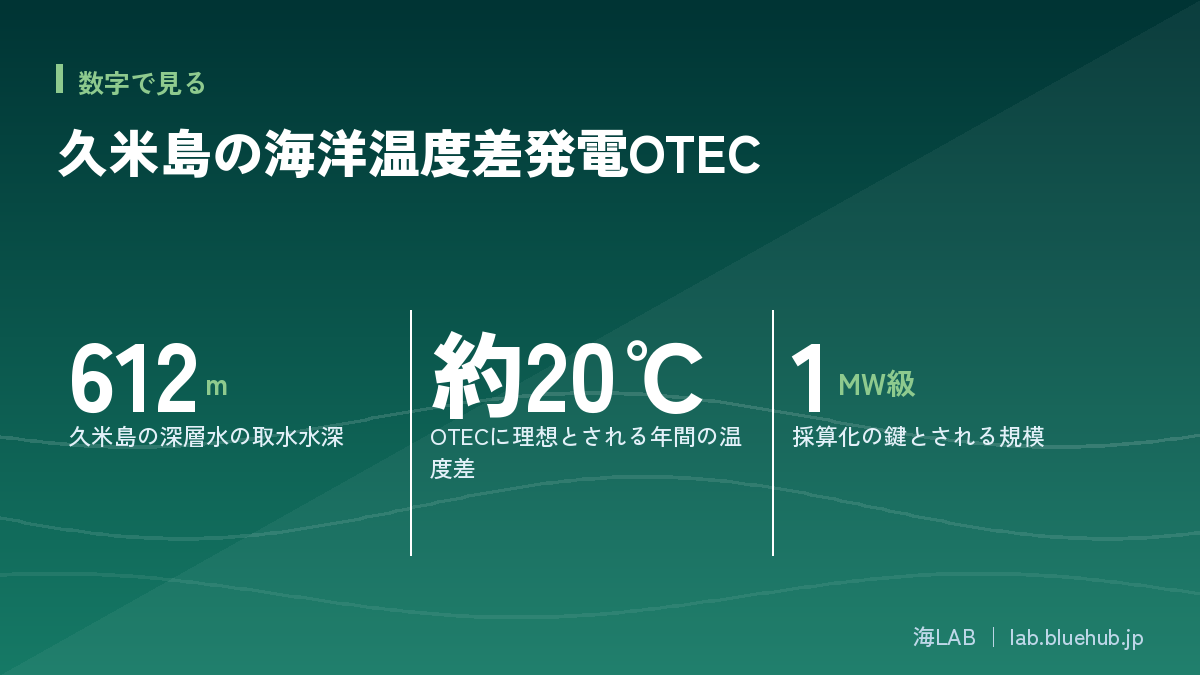
- On Kume Island, a demonstration using deep seawater drawn from 612 m has run since 2013.
- The "Kumejima Model" reuses the water after power generation for aquaculture, agriculture and cooling to improve overall profitability.
- A 1 MW class is seen as the key to viability; in October 2025 Mitsui O.S.K. Lines and Kumejima Town signed a partnership agreement.
The ocean holds a vast, still largely untapped energy source: the temperature difference between warm surface water and cold deep water. Ocean thermal energy conversion (OTEC), which turns this gap into electricity, needs no fuel and can run day and night regardless of weather, making it a notable renewable energy option.
In Japan, demonstration work continues on Kume Island in Okinawa Prefecture. Using the intake facilities of the deep sea water research institute, power generation in the real ocean has been carried out since 2013. The "Kumejima Model", which reuses seawater after power generation for fisheries and agriculture, is attracting attention in Japan and abroad.
This article organizes how OTEC works, Kume Island's demonstration, the challenges, and the push toward a 1 MW class, based on public sources.
What you will learn
- The basic principle of OTEC and its three types
- Why Kume Island became a suitable demonstration site
- The "Kumejima Model" of reusing water after generation
- Challenges and the cost structure of OTEC
- The push toward 1 MW and global trends
What is ocean thermal energy conversion (OTEC)?
Turning "warm on top, cold below" into electricity
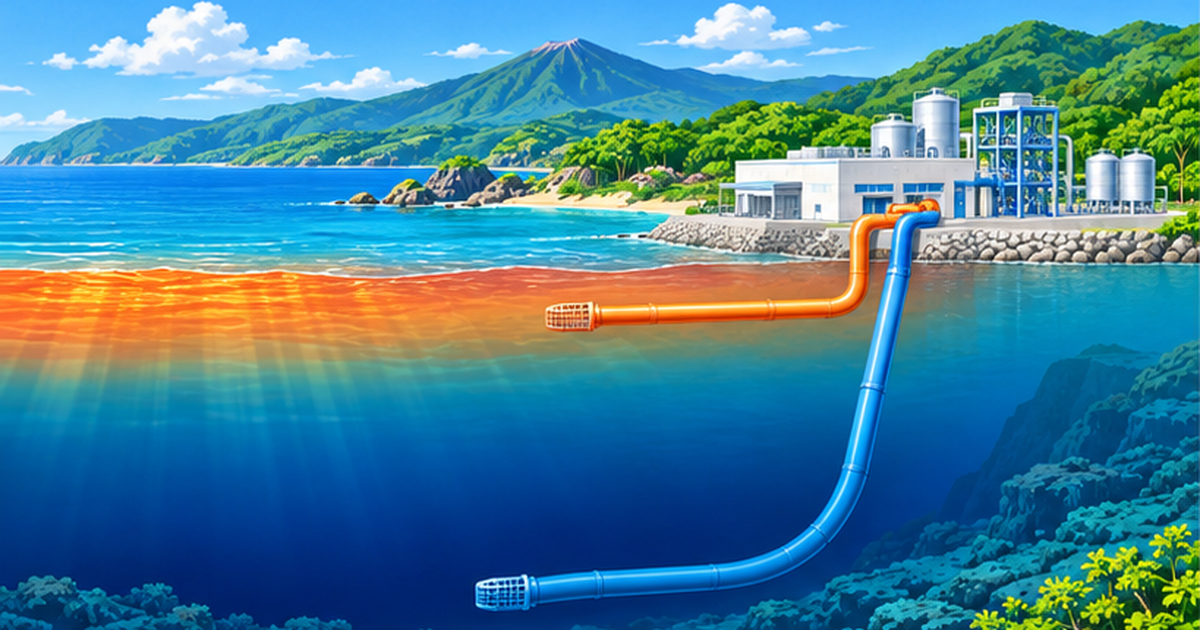
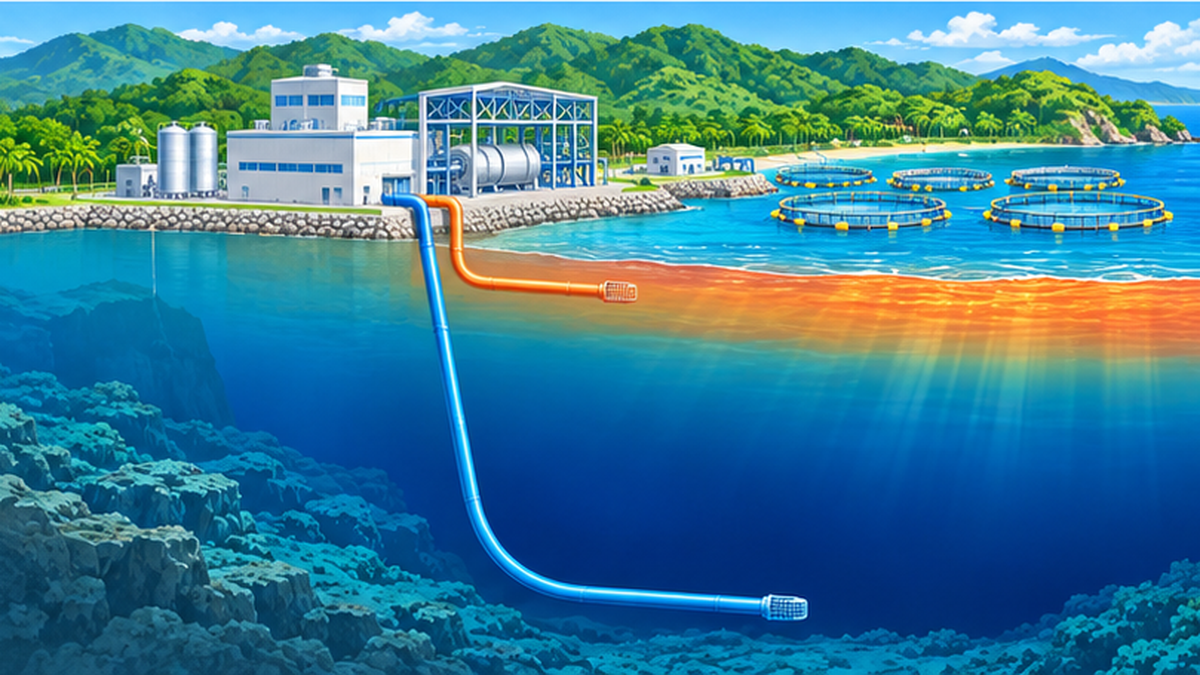
Ocean thermal energy conversion (OTEC) generates power from the temperature difference between surface seawater warmed by the sun and cold seawater in the deep ocean where light does not reach. A thermal power plant burns fuel to boil water and spins a turbine with steam; OTEC instead evaporates a low-boiling liquid with warm seawater and condenses it again with cold seawater to spin the turbine. No fuel is needed, and it can run day and night in any weather as long as there is sea.
Solar and wind depend on the weather, but ocean temperatures do not change suddenly. OTEC has therefore long been studied as a renewable source that could serve as stable baseload power. The ideal condition is a gap between surface and deep water of about 20°C or more throughout the year. This is met mainly in tropical and subtropical waters around the equator; in Japan, the Nansei Islands including Okinawa are candidates.
How it works: the Rankine cycle
OTEC is based on a heat engine called the Rankine cycle, and comes in three main types.
| Type | Working fluid | Features |
|---|---|---|
| Closed cycle | Low-boiling liquids such as ammonia or HFC alternatives to CFCs | Easy to make compact; the Kume Island demonstration uses this type |
| Open cycle | Seawater itself, evaporated under reduced pressure | Produces fresh water along with power, but equipment tends to be large |
| Hybrid | A combination of the two above | Aims for both power and desalination |
The Kume Island demonstration plant uses a closed cycle with the hydrofluorocarbon R134a (boiling point −26°C) as the working fluid. Surface seawater heats and evaporates the fluid, the vapor spins a turbine generator, and deep seawater cools it back to a liquid, repeating the loop.
Key points
- Generates power from the ocean temperature gap alone, without fuel
- Little affected by weather or time of day, so output tends to be stable
- Best suited to tropical and subtropical seas with a gap of about 20°C or more
Why deep seawater is essential
The cold source for OTEC is deep seawater pumped up from several hundred meters. Because sunlight does not reach it, deep water stays cold all year, is rich in nutrients, and is clean, with few bacteria and little organic matter. These properties lead not only to power generation but to wide industrial uses such as fisheries, agriculture, food and cosmetics. Combining OTEC with deep seawater use is the core of the "Kumejima Model" described below.
Why Kume Island: location and the deep sea water research institute
Island power supply and a suitable site for OTEC
Okinawa has one of the lowest energy self-sufficiency rates in Japan. According to the sources, it is 4.8% nationwide (2010) versus 0.5% in Okinawa (2012). Few large rivers limit hydropower, and each remote island needs its own power grid. For islands that depend on imported fuel, OTEC, which draws electricity from the sea at their doorstep, is an attractive option.
Deep seawater drawn from 612 m
Kume Island hosts the Okinawa Prefecture Deep Sea Water Research Institute (opened in 2000). It takes deep seawater from a depth of 612 m through two intake pipes and surface seawater from 15 m through one pipe. The maximum intake is about 13,000 tons per day each for deep and surface water, said to be the largest in Japan. Surface water is about 25–30°C and deep water about 5–10°C (some sources say 10–12°C), giving a large gap all year.
| Item | Details |
|---|---|
| Deep seawater intake | Depth 612 m (2 pipes) |
| Surface seawater intake | Depth 15 m (1 pipe) |
| Maximum intake | About 13,000 tons per day each for deep and surface water |
| Surface water temperature | About 25–30°C |
| Deep water temperature | About 5–10°C |
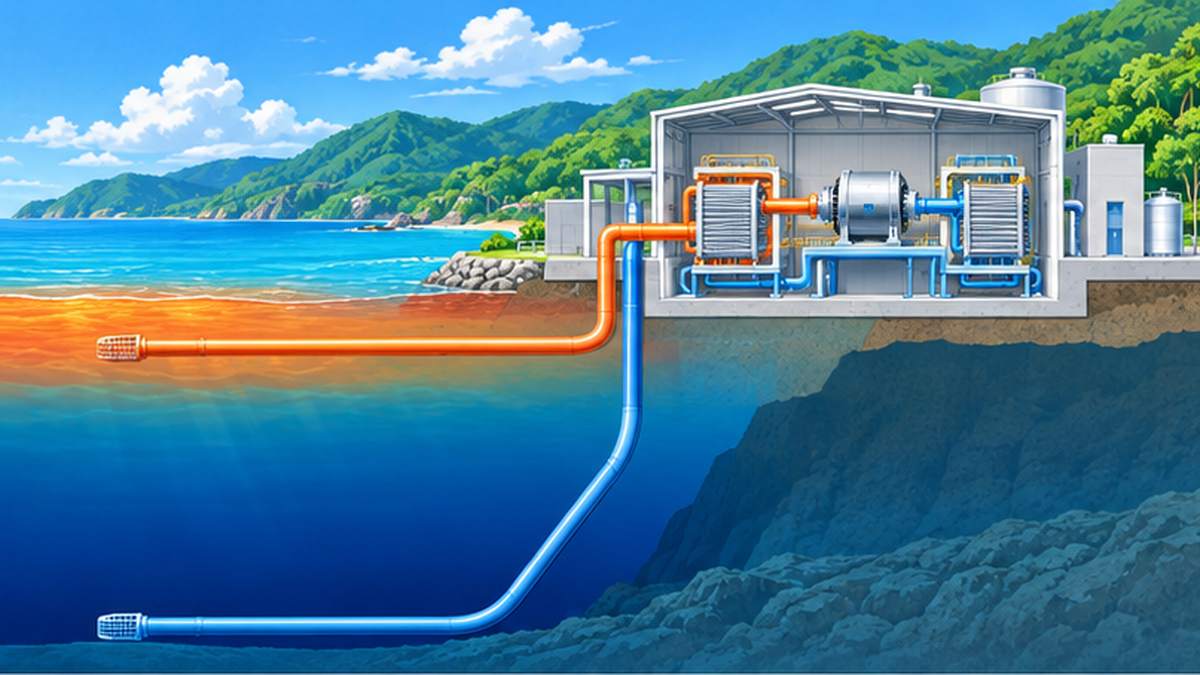
Why was the demonstration placed on Kume Island?
The main reason is that existing intake infrastructure could be shared. Most of the construction cost of OTEC is the long intake pipe that draws cold water from the deep. Because the research institute already had pipes, the project could keep initial costs down and focus on long-term continuous operation and technical reliability.
Kume Island's OTEC demonstration since 2013
Overview of the demonstration plant
In April 2013, demonstration operation of OTEC in the real ocean began on the grounds of the Okinawa Prefecture Deep Sea Water Research Institute. It consists of one generating unit with a maximum output of 50 kW and one test unit equivalent to 50 kW. (Reports say "50 kW class" while the operating company sometimes describes it as "100 kW class". This may reflect differences in configuration or notation; the exact rating should be checked in official prefecture or institute materials.)
JICA's explanation introduces it as a world first of generating power with real seawater, and notes that the deep seawater after generation can be reused by other industries. In 2012, the JST Science Portal also reported the start of the OTEC trial on Kume Island.
Saga University and Japan's research legacy
OTEC research in Japan surged after the oil shocks of the 1970s but later shrank. Saga University is said to be the only one in Japan to have continued it. The Kume Island demonstration was realized through this long accumulation of research together with Okinawa Prefecture and local companies.
Worldwide: Hawaii's 105 kW OTEC
Demonstrations are advancing abroad too. At NELHA (Natural Energy Laboratory of Hawaii Authority) on Hawaii Island, Makai Ocean Engineering's 105 kW-class OTEC plant was connected to the grid in August 2015. It uses ammonia as the working fluid and was reported as the largest operating OTEC plant in the world at the time. The cost was about 5 million US dollars, funded by the Office of Naval Research and others. Some sources say it is not a commercial plant and does not run continuously, so its status should be treated with care.
A note on numbers
OTEC output figures can differ between rated output, net output (after pumping power) and the names used in news reports. When comparing, always check which output is meant.
The Kumejima Model: cascading use of deep seawater
How deep seawater became an island industry
On Kume Island, industries built around deep seawater have grown for a quarter century since the institute opened in 2000. Contributions by the town's vice mayor and others describe how this came to be called the "Kumejima Model". The institute supplies deep and surface water to companies, spreading aquaculture technology and attracting businesses. Kuruma prawns and sea grapes (Caulerpa lentillifera) are known aquaculture products.
The idea of cascade use
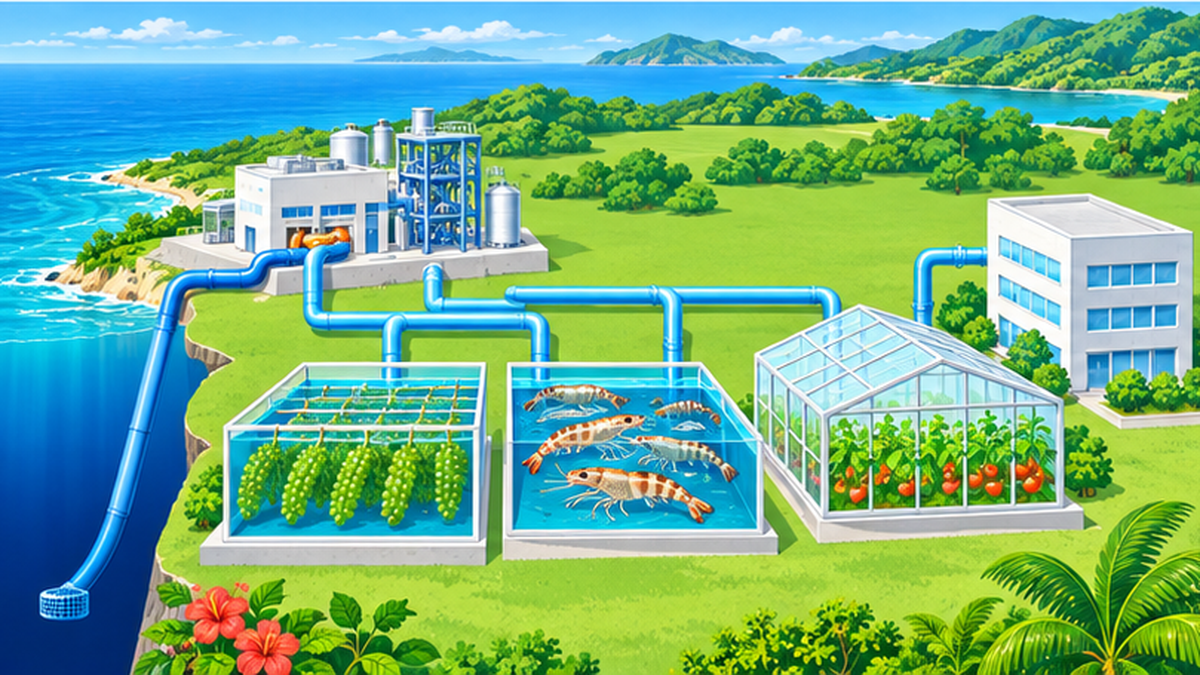
Deep seawater used in OTEC is still cold and rich in nutrients. Using it in sequence instead of discarding it is cascade (multi-stage) use, the heart of the Kumejima Model.
- First use it for OTEC to obtain electricity from the temperature gap
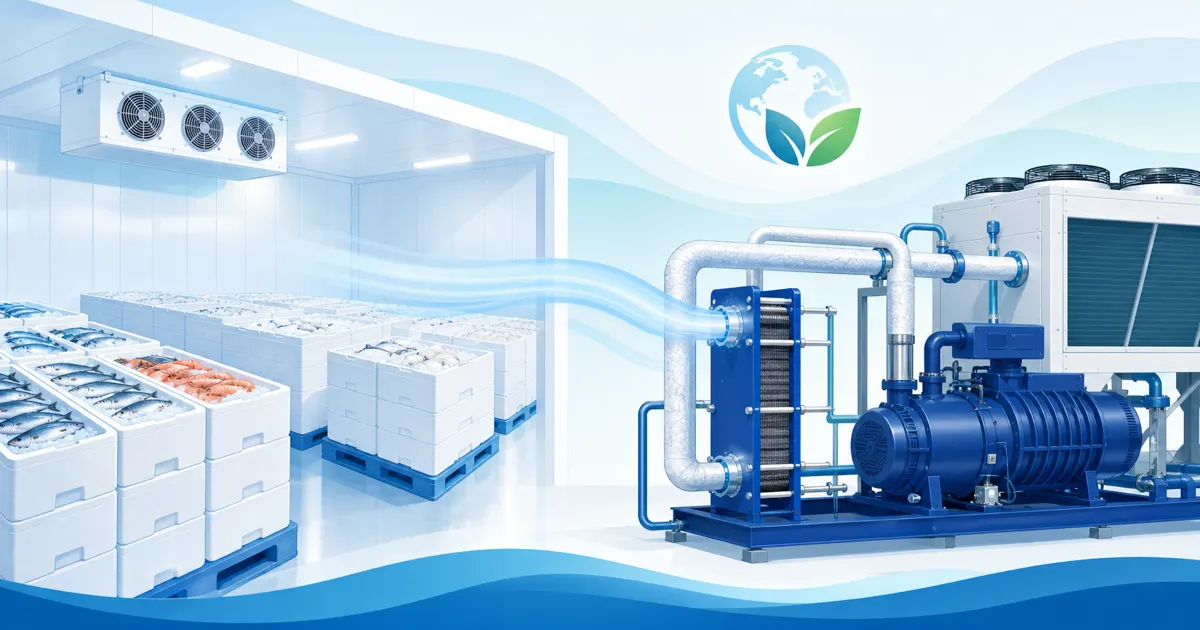
- Then use the remaining cold water for aquaculture temperature control and air conditioning
- Finally use it for agriculture (cultivation on cooled soil) and as raw water for food and cosmetics
Even if power alone is hard to make profitable, revenue from downstream industries can improve the economics of the whole project. In fact, a 2011 survey by Kumejima Town showed the possibility of combining a 1 MW-class OTEC with deep seawater use. The idea is to lower power costs by using the water after generation for fisheries, agriculture and air conditioning.
Jobs and the local economy
Okinawa Prefecture's materials say that using deep seawater supports agriculture, forestry and fisheries on small remote islands and attracts businesses. Some sources say deep-seawater industries have become the main industry of Kume Island in little more than a decade. However, sales and employment figures of individual operators could not be confirmed from primary sources in this research. Please check the latest publications of Kumejima Town and the institute before citing numbers.
Strengths of the Kumejima Model
- Existing intake facilities are shared between power and industry
- Water after generation is not wasted but reused across industries
- Local companies, research institutions and the municipality cooperate
Challenges: why OTEC has not spread yet
Economies of scale are hard to reach
Because the temperature gap is small (in the 20s of °C), thermal efficiency is low, only a few percent even in theory. Pumping large volumes of seawater also takes power, so smaller plants lose more of their net output. Professor Yasuyuki Ikegami of Saga University has said that 100 kW scale is not economically viable but that a 1 MW-class plant could solve OTEC's problems. Okinawa Prefecture materials likewise assume that profitability is almost impossible with small plants under 100 kW.
The intake pipe is the biggest cost
Laying a long pipe to draw deep water accounts for most of the construction cost. The pipe must withstand typhoons, ocean currents and biofouling. Kume Island could run its demonstration by sharing existing pipes, but building pipes from scratch at a new site would greatly raise the investment.
Winter cooling and operational stability
In winter, when surface water cools, the temperature gap narrows and output may fall. Even in subtropical Okinawa, water temperatures vary by season, so whether the expected output can be achieved must be confirmed with long-term operating data.
| Challenge | Details | Direction |
|---|---|---|
| Efficiency | Small temperature gap, low thermal efficiency | Larger scale, better heat exchangers |
| Cost | High cost of laying intake pipes | Sharing infrastructure, multi-use |
| Seasonal change | Surface water cools in winter | Accumulating long-term demonstration data |
| Environment | Large intake and discharge affect the sea | Designing intake depth and discharge location |
How to think about environmental impact
OTEC pumps up large volumes of deep water and returns it to the sea after use. Because deep water is rich in nutrients and differs in temperature, the place and depth of discharge could affect surrounding ecosystems. Before scaling up, the spread of the discharge and effects on phytoplankton need to be assessed in advance. This is an ongoing research topic in Japan and abroad, and continuous environmental monitoring is needed from the demonstration stage.
Toward 1 MW: Mitsui O.S.K. Lines and Kumejima Town
What private-sector participation means
The next stage drawing attention is a 1 MW class. In October 2025, Mitsui O.S.K. Lines signed a comprehensive partnership agreement with Kumejima Town and announced it would develop and design an intake system toward a 1 MW-class OTEC in the field of "OTEC and the use of deep seawater" (as reported by LNEWS). The company already takes part in operating the 100 kW-class OTEC demonstration plant on Kume Island.
A shipping company's involvement may reflect its marine expertise and its search for new energy businesses for decarbonization. A notable feature is the move from the research stage toward bringing in private funding and operating know-how.
What would change with 1 MW?
Converted to household use, 1 MW corresponds to a few hundred households (a rough guide, as it varies greatly with usage). What matters more than the output itself is whether the smallest economically viable scale can be reached. If profitability becomes clear here, expansion to other islands and tropical island nations becomes realistic.
Schedule needs checking
The specific start date and investment for the 1 MW class could not be confirmed from published materials in this research. Please check the latest official announcements from Kumejima Town and participating companies.
OTEC in the world and Japan: can it change island energy?
Tropical islands are the best sites
The best sites for OTEC are tropical and subtropical seas with a large temperature gap all year. Many island nations in the Pacific, Caribbean and Indian Ocean pay high prices for power from imported diesel, so the benefit would be large if OTEC becomes profitable. Experience from Hawaii and Kume Island could also lead to technical cooperation with such countries.
Its place among renewable energies
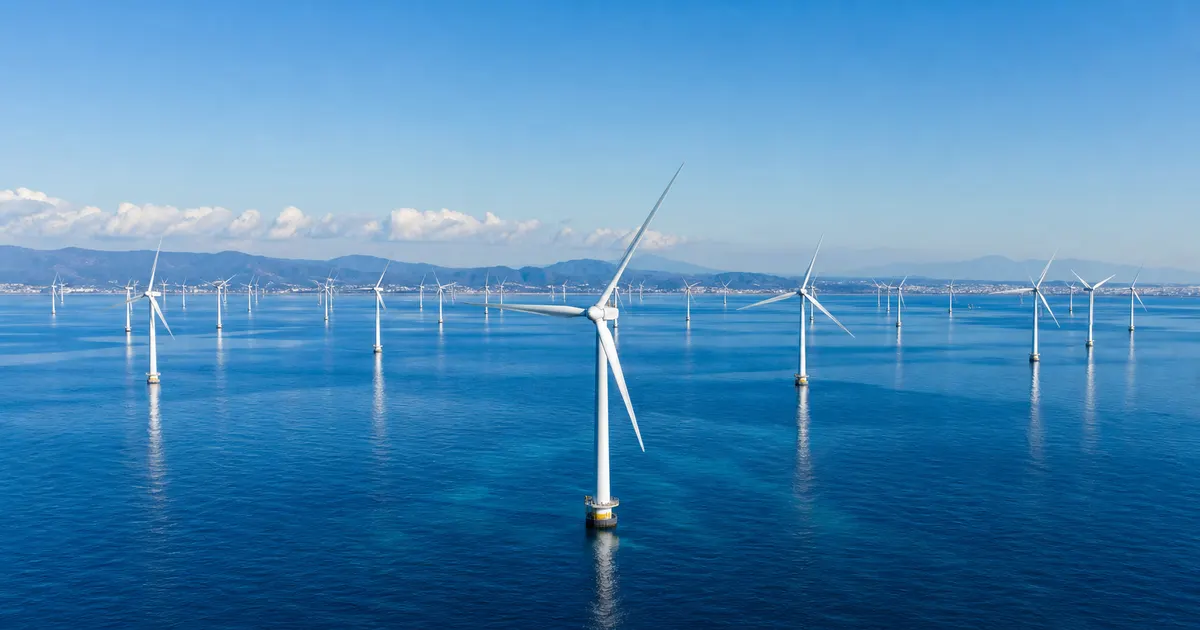
Japan is also developing marine renewables such as offshore wind, wave and tidal power. OTEC can complement them because its output tends to be stable. For example, offshore wind varies with the wind, whereas OTEC can run steadily as long as the temperature gap exists. Combining them could make island grids more stable.
Related efforts are also explained in these articles on this site.
- Generating power from tidal flow: Tidal current power generation and its potential in Japan
- Sailing ships with wind: Wind-assisted sails for decarbonizing ships
- Carbon absorption by seaweed: Seaweed beds and blue carbon
OTEC and diversifying marine industries
OTEC is more than a power technology. Linked with aquaculture, food, cosmetics and health industries using deep seawater, it can become a foundation for an island's whole economy. The Kumejima Model is watched in Japan and abroad as an example of growing renewable energy together with local industry.
What we can do: bringing ocean energy closer
First learn, then see it in person
OTEC is still little known to the public. The deep sea water research institute on Kume Island may offer tours or introductions to related facilities (please check availability on the official website beforehand). If you visit Kume Island, enjoying products such as sea grapes made with deep seawater is also a way to support local industry.
Connecting energy and the ocean
Being aware of where electricity comes from is the first step in climate action. Renewables include solar, wind, hydro, geothermal and ocean energy, each with strengths and weaknesses. Whether technologies like OTEC grow depends not only on researchers and companies but also on how much interest society takes.
Three things you can do today
- Look up the latest on OTEC on the websites of Kumejima Town and Okinawa Prefecture
- Talk about "how to make electricity from the sea" at school or at home
- Choose local products made with deep seawater
Summary
- OTEC generates power from the surface–deep temperature gap (ideally about 20°C or more)
- Kume Island has run a demonstration since 2013 using existing deep seawater intake facilities
- The Kumejima Model reuses water after generation for fisheries, agriculture and air conditioning
- A 1 MW class is the key to profitability; in 2025 Mitsui O.S.K. Lines and Kumejima Town signed a partnership agreement
References and sources
- Sasakawa Peace Foundation, Ocean Policy Research Institute, Ocean Newsletter No. 320 (OTEC demonstration on Kume Island) – Overview of the demonstration plant
- Sasakawa Peace Foundation, Ocean Policy Research Institute, Ocean Newsletter No. 608 – History of the Kumejima Model
- JST Science Portal: OTEC trial begins on Kume Island (July 10, 2012) – News of the trial
- JICA: Topic on ocean thermal energy conversion (November 17, 2023) – Explanation from an international cooperation view
- LNEWS: Mitsui O.S.K. Lines and Kumejima Town sign partnership (October 28, 2025) – Partnership toward 1 MW-class OTEC
- Ryukyu Shimpo: OTEC on Kume Island – Views on output and profitability
- OpenEI PRIMRE: Makai 105 kW OTEC – 105 kW-class OTEC plant in Hawaii
- JASE-W Technology Collection: Deep seawater – Technical material on deep seawater use
* Arranged in order of reliability: government and academic institutions > peer-reviewed papers > specialist organizations > reliable media