⚡ In short
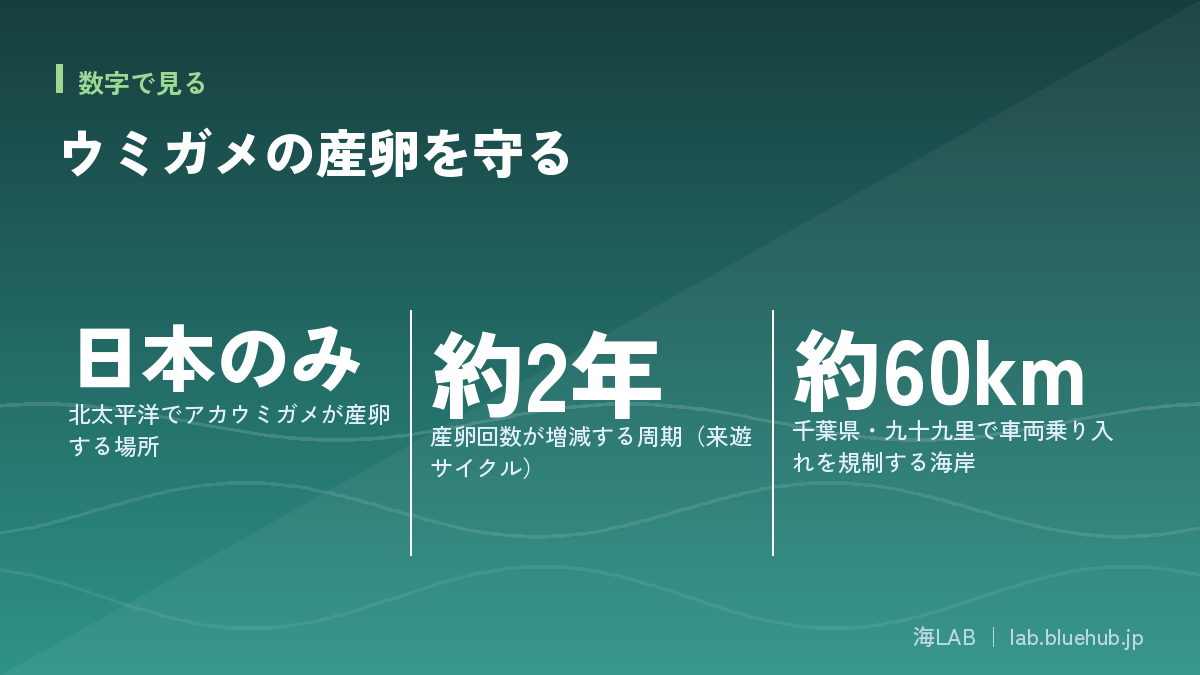
Japan is the only place in the North Pacific where loggerhead turtles nest. Learn how nesting counts fluctuate, what threatens the beaches (erosion, light pollution), and what is being done: vehicle bans, light-blocking forests, and the Nagata-hama rules on Yakushima.
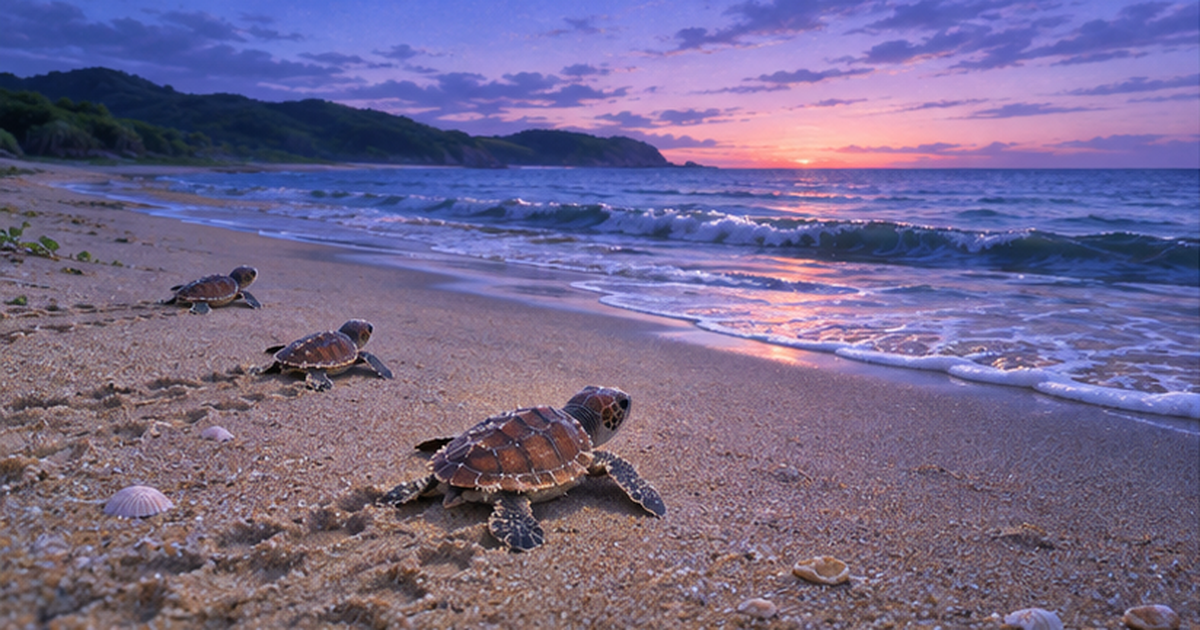
A huge sea turtle crawls ashore at night to lay eggs. This rare sight, found only on Japan's shores, is in fact supported by conservation work done by many people.
Japan is regarded as the only place in the North Pacific where loggerhead turtles nest. Yet beach loss, artificial light and vehicles driving onto sand all threaten the nesting grounds.
Based on Ministry of the Environment monitoring reports and the efforts of local governments and community groups, this article organizes the conservation measures actually used on Japan's beaches and what each of us can do starting today.
What you will learn in this article
- Why Japan's beaches are the only nesting grounds for North Pacific loggerheads
- The flow from nesting to hatching, and how hatchlings find the sea
- The main threats: beach loss, light pollution, vehicles, litter, bycatch and changing sand temperature
- Field measures such as vehicle bans, nest protection, light-blocking forests and Nagata-hama's rules
- Rules to follow on night beaches and everyday ways to help
Japan's beaches are the only nesting grounds for North Pacific loggerheads
Why Japan's beaches matter worldwide
On an early-summer night, a large shadow slowly comes ashore on a beach where only the sound of waves can be heard. Sea turtle nesting is one of the most mysterious natural events seen on Japan's coasts, yet it is far from guaranteed to continue. Naoki Kamezaki, president of the Japan Sea Turtle Association, explains that Japan is the only place in the North Pacific where loggerheads nest. If Japan's beaches are lost, North Pacific loggerheads lose their nesting grounds altogether.
Three species regularly come ashore to nest in Japan: loggerhead, green and hawksbill turtles. Loggerheads are mainly known on the Pacific coast from Honshu to Kyushu, and green and hawksbill turtles in the Nansei Islands. For the ecology of each species and the sex-ratio skew caused by warming, see our related article Sea Turtle Nesting and Homing in Japan. Here we change perspective and focus on what people are doing on the beaches themselves.
Nesting counts cannot be summed up as simply "up" or "down"
The Ministry of the Environment's Monitoring Sites 1000 project continuously records loggerhead landings and nests at survey sites nationwide. According to its reports, nests at the survey sites numbered 573 in 2021, the lowest since 2017, then rose 62% to 930 in 2022. The swings look large, but they occur because the population that travels from East China Sea feeding grounds to Japan's coasts arrives on a roughly two-year cycle, so it is hard to judge the population's health from year-to-year changes alone.
The Ministry also notes that nest counts had been rising since 2008, peaked in 2012, and then fell for three straight years from 2013. Seeing medium- to long-term trends requires data over several years. This steady monitoring is carried out by citizen groups, researchers and local government staff who walk the beaches every morning to check tracks.
| Year | Nests at survey sites | Notes |
|---|---|---|
| 2019 | 651 | Second consecutive decline |
| 2021 | 573 | Lowest since 2017 |
| 2022 | 930 | Up 62% from the previous year |
Conservation status
- The loggerhead turtle is listed as Endangered (IB) on the Ministry of the Environment's Red List. On the IUCN Red List the species as a whole is classified as Vulnerable (VU).

About two months from nesting to hatching: what happens on the beach
Mother turtle comes ashore and nests
The nesting season varies by region, but from Honshu to Kyushu it is generally early summer through summer. After crawling up from the waterline at night, the mother moves to a high spot on the beach beyond the reach of waves, digs a body pit with her hind flippers, then digs an egg chamber within it. A clutch holds around 100 eggs, and a female may come ashore several times in one season at intervals. After laying, she covers the eggs with sand, smooths the surface, and returns to the sea.
The key point is that the mother chooses a "safe place" herself: dark, quiet, beyond the reach of waves, with suitably soft sand. On beaches with a lot of artificial light or human presence, more females are said to turn back without laying (false crawls).
Egg development and sand temperature
The eggs develop in the sand for about two months before hatching. Sand temperature affects not only development speed but also hatchling sex (generally, warmer sand produces more females, cooler sand more males). The Ministry's monitoring reports also record sand temperature at each beach; for example, the FY2020 report noted that at Ichinomiya, Chiba, low temperatures late in the season may have made embryo development difficult. Understanding each beach's thermal environment is the first step in conservation.
How hatchlings find the sea, and the pitfalls
Hatchlings reach the sand surface at night and emerge all at once. They are thought to head for the sea by the bright horizon over the water, because on a natural beach the sea surface, reflecting starlight and moonlight, is brighter than the dark forest or dunes behind. Artificial lights behind the beach throw this cue off.
- A mother turtle comes ashore at night and chooses a nesting site
- Eggs develop in the sand for about two months (sand temperature affects sex and hatching success)
- Hatchlings emerge from the sand at night and head toward brightness
- They reach the waterline and swim out to sea
Five factors threatening nesting on the beach
So what is hindering sea turtle nesting on Japan's beaches? Reports from local governments and conservation groups point to the following main factors.
1. Loss of the beach itself (coastal erosion)
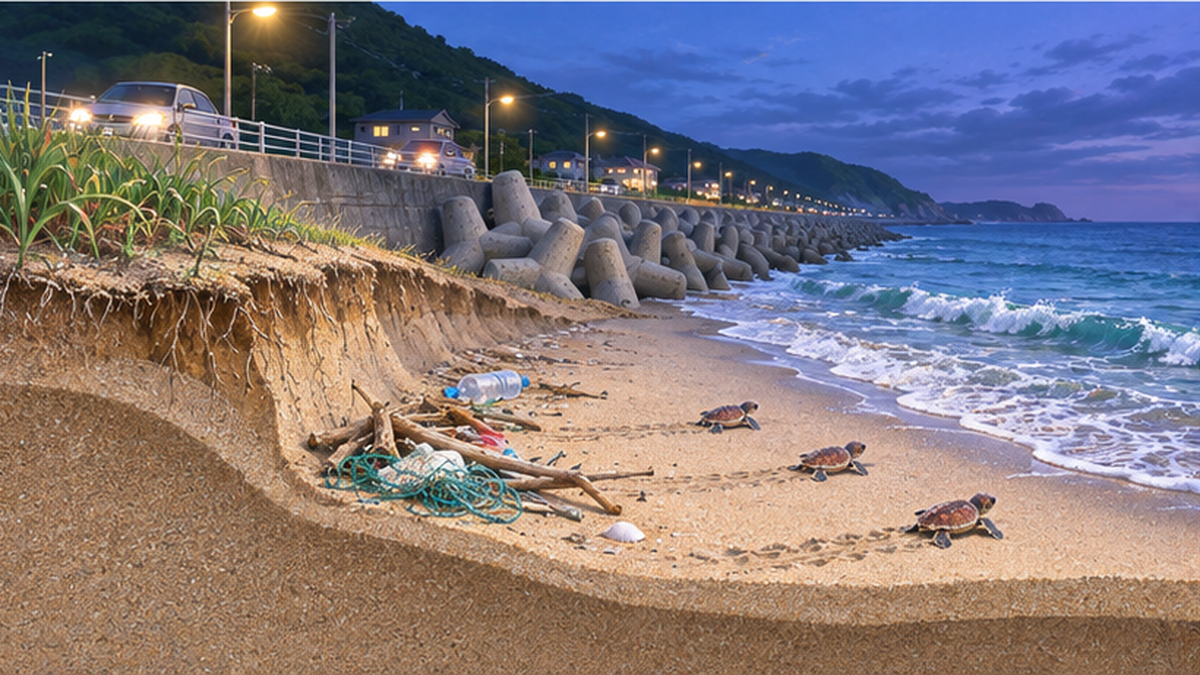
Nesting first requires a beach with enough width and sand. But coastal erosion is advancing in Japan, and a survey group on the Omote-hama coast in Shizuoka points out that natural beaches where nesting is possible have become few because of erosion and artificial shoreline armoring. There are cases where mother turtles were blocked by wave-dissipating concrete blocks. For how erosion works, see Why Is Japan's Coast Eroding? and Dams and Coastal Erosion.
At Kijoka beach in Ogimi Village, Okinawa, a local surveyor's view reported in the press is that the beach has dropped by more than a meter in the last 20 years (a local view; causality has not been established). When sand decreases, the waterline approaches the nesting area and eggs are more likely to be flooded. Future sea-level rise also takes away the beach's room (What Will Sea-Level Rise Do to Japan's Beaches?).
2. Artificial light (light pollution)
The Ministry of the Environment's Light Pollution Guidelines (revised March 2021) define light pollution as a situation in which a good light environment is impaired by improper or careless use of artificial light or light leakage, and note reports of harm to wildlife. For sea turtles, coastal road lighting, parking lots, buildings and car headlights keep mother turtles away and disorient hatchlings.
3. Vehicles and trampling
Vehicles driving onto beaches destroy nests, crush eggs, and leave ruts that trap hatchlings. In materials related to Kumamoto Prefecture's Red List, beaches on Amakusa-Shimoshima are described as affected by beach loss, plastic litter and fixed nets, and, at swimming beaches, trampling and light pollution.
4. Stranded litter and bycatch
Litter washing up from the sea becomes an obstacle for mother and hatchling turtles. See What Beach Litter Really Is for the nature of the litter and countermeasures. At sea, bycatch in set nets and other gear is considered a cause of declining mature females, and a decrease in mature individuals caught during the nesting season has also been pointed out (Ministry of the Environment monitoring report).
5. Climate change: changing sand temperature
As sand warms, hatchling sex ratios may skew toward females. This is covered in Sea Turtle Nesting and Homing in Japan; please read it together with this article.
Conservation efforts on the beaches
The threats are varied, and so are the responses. Here are the measures actually used on Japan's beaches, by type.
Vehicle restrictions and entry rules
Chiba Prefecture restricts vehicle entry on about 60 km of coast from Asahi to Ichinomiya in Kujukuri Prefectural Natural Park under the Chiba Prefectural Natural Park Ordinance. The aim is to protect marine coastal life such as loggerheads, and violations carry penalties. Kagoshima Prefecture's Sea Turtle Protection Ordinance prohibits capturing turtles and taking eggs. On the Omote-hama coast in Aichi, a plan was shown to designate sand within special zones of the natural park as vehicle-restricted areas.
Okinawa Prefecture, meanwhile, generally prohibits vehicles on beaches, but it has been reported that this is not written into ordinances or rules and carries no penalty, so posts and signs to block vehicles are used in various places. The strength of regulation differs by region.
Nest protection: fences, markers and egg relocation
Putting markers or fences around confirmed nests to guard against trampling and vehicles is the basic measure conservation groups have long followed. Eggs laid where waves reach or where many people walk are also relocated to a safer "hatchery." In a report published by the Shikoku Regional Development Bureau of the Ministry of Land, Infrastructure, Transport and Tourism on protection around the Niyodo River in Kochi (one fiscal year), vehicle-blocking ropes and egg relocation were carried out, with a hatching rate of 40% and 1,128 hatchlings returned to the sea.
Because relocation involves moving eggs, errors in timing or method can lower hatching success. It should be done only under the guidance of knowledgeable groups or local governments, and ordinary people must never dig up or move eggs on their own.
Do not touch eggs or hatchlings
- Some areas, like Kagoshima Prefecture under its sea turtle ordinance, prohibit capturing turtles or taking eggs. Even with good intentions, do not touch nesting mothers, eggs or hatchlings; if you find any, contact a local conservation group or the municipality.
Light-blocking forests and lighting measures
On Yakushima, light-blocking forests have been planted along the prefectural road so that mother turtles coming ashore at night are not affected by car lights, and a local council handles pruning and weeding. As general light-pollution measures, light-distribution control and shielding plates can reduce light leaking toward the sea.
Overseas, coastal municipalities in Florida have ordinances requiring beachfront lights to be turned off or dimmed during nesting season. Broward County's materials list long wavelengths above 560 nm (amber, orange, red LEDs and so on) as turtle-friendly light under state criteria. According to Sea Turtle Conservancy data, an estimated 64,000 hatchlings were disoriented by artificial light in Florida in 2007. In Japan, as white LEDs spread, choosing the wavelength and direction of lighting is becoming an issue.
Lessons from Nagata-hama, Yakushima: local rules and coexisting with development
The densest nesting site in the North Pacific
Nagata-hama on Yakushima, Kagoshima, was registered as a Ramsar wetland (site no. 1559) on 8 November 2005. The Ministry of the Environment describes it as the beach where loggerheads nest at the highest density in the North Pacific region. Many turtles come ashore from late April to early August, and the hatchlings return to the sea from early July to late September.
The "viewing rules" created in 2009
Popular viewing spots suffer from visitors using lights and getting too close. So in 2009 the community drew up the "Nagata-hama Sea Turtle Viewing Rules" as voluntary rules. They have no legal force but are still in effect according to Ministry guidance. The main points are:
- Stay off the beach at night: refrain from entering from 20:00 to 5:00 between May 1 and September 30
- Join a viewing tour: during the nesting season (May 10 to July 10), use the reservation-only tours (capacity 50, run by the Nagata Sea Turtle Liaison Council)
- Stay out of fenced areas: so you do not trample eggs or hatchlings underground
- Do not use lights: night light affects mothers coming ashore and hatchlings returning to the sea
- Pitching tents and taking sand are prohibited under the Natural Parks Act
What is distinctive is that the rules do not only "prohibit" but also provide a way to see turtles through guided tours. A system that does not shut out the wish to see turtles but makes it compatible with conservation is the key to local acceptance. Even so, the Ministry says nest numbers are on a declining trend and that strict adherence to the rules is needed to reduce degradation of the nesting and hatching environment.
Key points of the Nagata-hama model
- (1) Voluntary rules led by the community, (2) a place where turtles can be seen, (3) hard measures such as light-blocking forests, (4) tour proceeds and donations used to run the program. A combination of soft and hard measures underlies the success.
Coexisting with development: construction, facilities and events
In recent years, public works, facility development and events near nesting beaches have raised debate in various places. On the Enshunada coast in Shizuoka, Hamamatsu City has designated the loggerhead and its nesting ground as a city natural monument, while a residents' group has collected signatures asking for a review of new facility construction near the coast out of concern about its effect on the light environment (this is the residents' group's claim, not an official government view).
Three things to check at the planning stage
- Timing: can construction and night events avoid the nesting and hatching season (roughly early summer to autumn)?
- Light: can the position, direction, color (wavelength) and hours of lighting be designed so that no light spills toward the sea?
- Sand: will heavy machinery or material yards compact nesting sand, or excavation remove it?
Rather than pitting development against conservation, consulting local conservation groups and researchers early reduces trouble in the end. For the perspective of protecting the coast's sand budget, see also Sand Mining Accelerates Coastal Erosion.
Comparing efforts: regional approaches and common ground
Let's compare the efforts seen so far by region. Even under the same goal of protecting sea turtles, the emphasis differs by beach conditions and who carries the work.
| Region | Main efforts | Features |
|---|---|---|
| Chiba (Kujukuri) | Vehicle restrictions under the prefectural natural park ordinance (about 60 km) | Protects a wide stretch of beach by ordinance, with penalties |
| Kagoshima (Yakushima, Nagata-hama) | Voluntary viewing rules, reservation tours, light-blocking forests | Led by residents, balancing viewing and conservation |
| Kochi (around the Niyodo River) | Vehicle-blocking ropes, egg relocation, hatcheries | Government and conservation groups cooperate nest by nest |
| Okinawa | Posts and signs to block vehicles | Generally prohibited, but weak written rules and penalties; focus on awareness |
| Aichi (Omote-hama) | Plan to designate sand in special zones as vehicle-restricted areas | Strengthening regulation using the natural park system |
| Shizuoka (Enshunada) | City natural monument designation, citizen surveys and proposals | Positioned as local cultural heritage |
Common keys to success
Regions differ, but places that work well share several traits. First, researchers, protectors and users know each other. Second, besides regulation there are entry points where people can learn while enjoying themselves, such as viewing tours and awareness events. Third, data is collected every year to check whether measures work. Conversely, on beaches with rules that are not publicized, rules tend to become dead letters.
Three ways to make rules that get followed
- (1) Signs and explanations that tell people why ("why can't I use a light?"), (2) alternative chances to enjoy turtles (guided tours), (3) ways for those who comply to feel proud (introducing local activities and expressing thanks).
Citizens, schools and companies in beach conservation
Morning track surveys and monitoring
In many places such surveys are supported not only by experts but also by local volunteers, school club activities and university seminars. The experience of children finding tracks and watching over eggs and hatchlings has great value as environmental education. From the viewpoint of ocean education, we hope interest will spread from living creatures as an entry point to the sea's broader issues (beach erosion, litter, climate change).
Sea turtle nesting surveys involve walking the beach in the early morning to count and check the "tracks" left by landings. Under the Ministry of the Environment's Monitoring Sites 1000, the Japan Sea Turtle Association is listed as the creator of and contact for the survey manual, so surveyors in each region collect data using the same method. Keeping the same method over a long period reveals trends beyond the year-to-year swings seen at the start.
Beach cleanups are also "nesting preparation"
Cleaning beaches before the nesting season secures a path for mother and hatchling turtles and is important conservation work. However, cleanups at night or in the early morning during the nesting season require care not to step on nests. For basics, see What Is a Beach Cleanup? How to Join, What to Bring, and How to Keep Going.
Cooperation from tourism and lodging
In some areas, hotels and guesthouses along the coast cooperate by closing curtains or turning off outdoor lights facing the sea during nesting season. The light-distribution control and shielding plates shown in the Ministry's Light Pollution Guidelines are relatively easy measures for businesses. Balancing tourism and conservation also benefits the local economy in the long run.
Viewing guides and surveyors become the local "storytellers," changing visitors' behavior. Rather than imposing rules, sharing the reasons is the shortcut to rules that are respected.

What we can do: sea turtle consideration in travel, walks and daily life
Rules for visiting the beach
Our actions when visiting a beach have more effect on mothers and hatchlings than we imagine. Even a smartphone light switched on casually on a night shore can be a strong stimulus to a mother used to the dark and can make her give up coming ashore. Conversely, one more person who knows the rules means more nests protected at that beach. Here are considerate habits that are easy to keep up, for travelers, locals and businesses.
- Do not use lights (including smartphone lights or flash) on night beaches
- Do not approach or touch nesting mothers or hatchlings, and do not use flash
- Stay out of fenced areas. If you find tracks or holes, do not step on them
- Do not drive cars, motorbikes or bicycles onto the beach
- Fill in holes you dig and do not leave sandcastles or deep holes (they obstruct mothers and hatchlings)
- Take all litter home. Plastic bottles and bags can also be swallowed by turtles
For viewing, join a tour
- In places like Nagata-hama on Yakushima, reservation-only guided viewing tours are held. Fees and capacity change by year, so check the latest information from the local council or municipality.
Things you can do close to home
- If you live or run a shop near the sea, keep outdoor lights at night from spilling toward the sea
- Reduce single-use plastics such as bags and straws (The Life and Conservation of Sea Turtles also introduces the threat of ingestion)
- Donate to local conservation groups, volunteer, or join viewing tours
- Contact your municipality if you notice beach changes such as erosion or more stranded litter
- Do not post too much location information on social media (it may attract poaching or excessive crowds)
Summary of this section
- On night beaches, just following four rules (no light, keep your distance, do not touch, leave no litter) greatly reduces the impact on sea turtles.
Challenges ahead: conserving beaches across generations
What happens to hatchlings after they reach the sea
Hatchlings that reach the sea ride currents such as the Kuroshio out to open water and make long journeys as they grow. Research is known showing that loggerheads born in Japan cross the Pacific to coastal waters off North America such as Mexico, and later return to Japanese waters. Protecting Japan's beaches is therefore not just a domestic matter but an international one across the Pacific.
Reaching reproductive age generally takes decades. Mothers are thought to have a "homing" habit of returning to or near the beach where they were born to nest, so once a beach is lost, it is not easy for the population that would have returned there to recover. For homing, see Sea Turtle Nesting and Homing in Japan.
Why cooperation across borders is needed
Since hatchlings cross borders as they grow, protecting Japanese beaches will not restore numbers if turtles suffer from bycatch or litter in the seas they migrate through. Along with protecting nesting beaches, we need to protect the whole ocean, for example by reducing fishery bycatch and marine litter (Why Ocean Plastic Does Not Break Down).
- Nesting beaches: erosion and light-pollution measures, vehicle restrictions, nest protection
- Migration areas (open sea): reducing bycatch and marine litter
- International cooperation: sharing data and joint conservation with the countries of the migration route
Sea turtle conservation is not work that shows results in a few years. Turtles are said to take a long time to mature, so conservation of today's beaches will bear fruit decades from now. That is why continuous monitoring and involvement of local people across generations are essential.
Four challenges ahead
- Continuing data: keep long-term monitoring, including the two-year cycle, from running short of people
- Sand budget: review sediment management across entire watersheds, including dams, armoring and sand mining, to stop erosion
- Standardizing light environments: set guidelines for wavelength, direction and hours of lighting along coasts, using overseas examples
- Spreading local rules: extend voluntary rules and viewing programs like Nagata-hama's to other nesting beaches
Japan's beaches are irreplaceable nesting grounds for North Pacific loggerheads. People who survey tracks, people who tend light-blocking forests, and all of us who visit beaches: the accumulation of each person's small consideration protects the first steps of the next generation of hatchlings.
Summary of this article
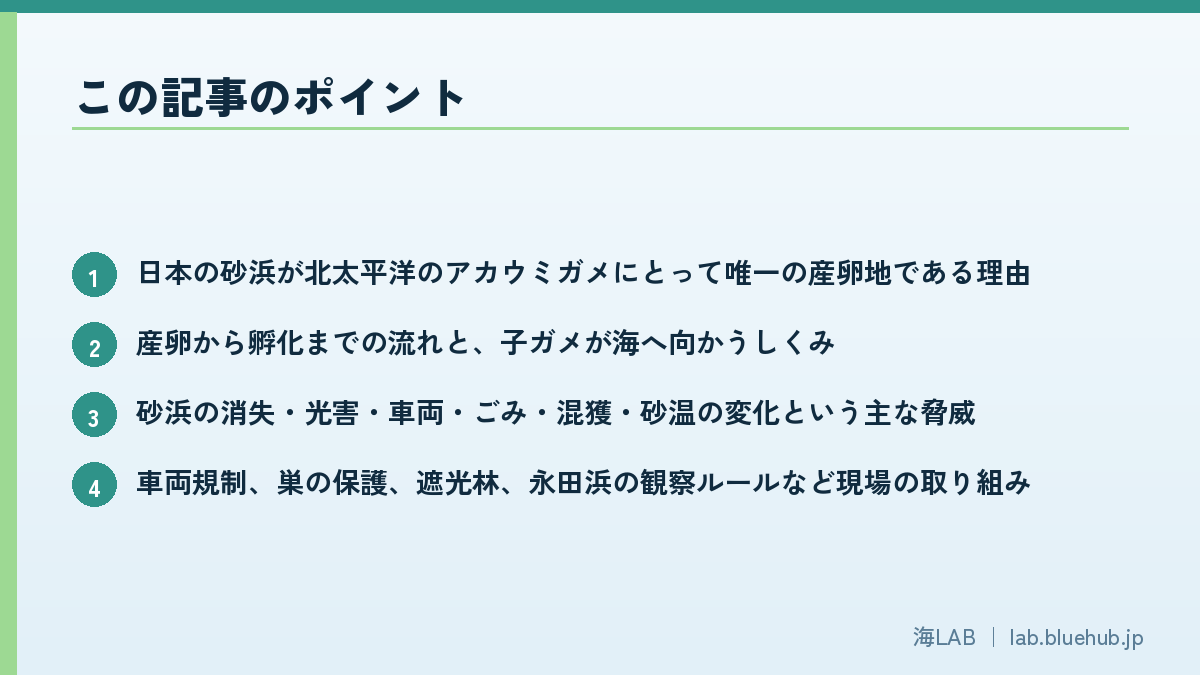
- (1) Japan is the only place in the North Pacific where loggerheads nest. (2) Nest counts vary on a roughly two-year cycle, so long-term observation is needed. (3) Threats include beach loss, light pollution, vehicles, litter, bycatch and changing sand temperature. (4) Field measures include vehicle restrictions, nest protection, light-blocking forests and viewing rules. (5) We can start by not using lights, keeping our distance and leaving no litter on night beaches.
参考文献・出典
- Ministry of the Environment, Biodiversity Center: Monitoring Sites 1000 Sea Turtle Survey, FY2023 Report – Report on loggerhead landings and nest counts
- Ministry of the Environment: Monitoring Sites 1000 Sea Turtle Survey, FY2022 Report – Nest counts and periodicity in 2022
- Ministry of the Environment, Yakushima World Heritage Conservation Center: Nagata-hama Turtle Viewing Rules – Night entry restraint and viewing tours guide
- Ministry of the Environment: Ramsar Site Yakushima Nagata-hama – Leaflet on the registered wetland
- Chiba Prefecture: Kujukuri Natural Park – Guide to vehicle-restricted zones
- MLIT Shikoku Regional Development Bureau: Sea Turtle Protection Efforts (2024) – Egg relocation and vehicle blocking in Kochi
- Ocean Policy Research Institute, Sasakawa Peace Foundation: Ocean Newsletter – Article on loggerhead nesting and beach change
- Broward County: Artificial Lighting and Nesting Females – Wavelength criteria for turtle-friendly lighting
- Japan Sea Turtle Association (NPO) – Japan's sea turtle research and conservation group
* Ordered by reliability: government and academic institutions > peer-reviewed papers > specialist bodies > reliable media