⚡ The answer in 30 seconds
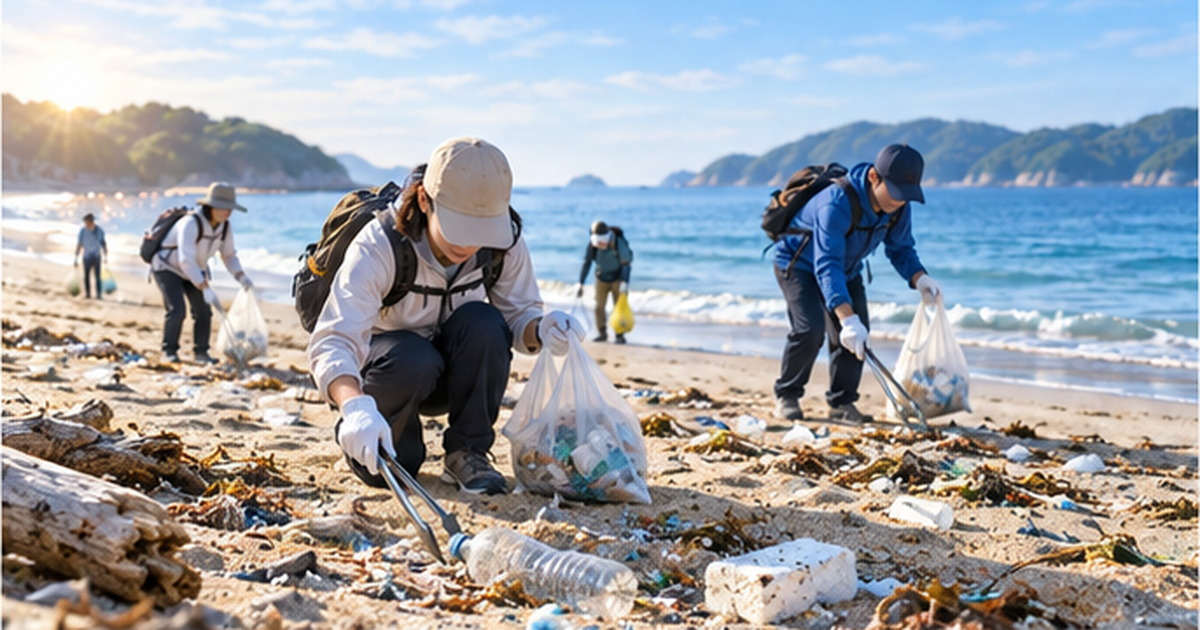
- A beach cleanup means removing washed-up and dropped litter from the shore by hand; with the right gear you are useful from your very first day.
- Four items are enough: thick gloves, litter tongs, sturdy shoes and water. Never handle hazardous items with bare hands.
- Record the amount and the item types, and the activity shifts from cleaning to surveying, giving clues to where the litter comes from.
- Most coastal litter originates on land. Picking it up only works alongside using fewer disposables in the first place.
Have you ever walked along a beach and noticed a plastic bottle rolling in the surf, or a chunk of polystyrene half-buried in the sand? A beach cleanup turns that flicker of concern into action, and it is the most direct relationship with the sea available to almost anyone. No qualifications and no specialist knowledge are required.
At the same time, plenty of people hold back, wondering whether picking up litter alone achieves anything, whether it is even safe, and where the collected waste actually goes. These are fair questions. Broken glass and rusted metal really do hide in the sand, and disposal follows rules that differ by municipality. Turning up unprepared can turn goodwill into injury or confusion.
Drawing on primary sources — Japan's Ministry of the Environment manual for coastal cleanup projects and its surveys of beach litter composition, the nationwide campaign run jointly by the Ministry and The Nippon Foundation, and the global tallies of the International Coastal Cleanup — this article walks through preparing for a first cleanup, keeping the habit alive, turning your records into usable data, and reaching upstream so that cleaning is not all you do. By the end, your next free weekend may look a little different.
What you will learn
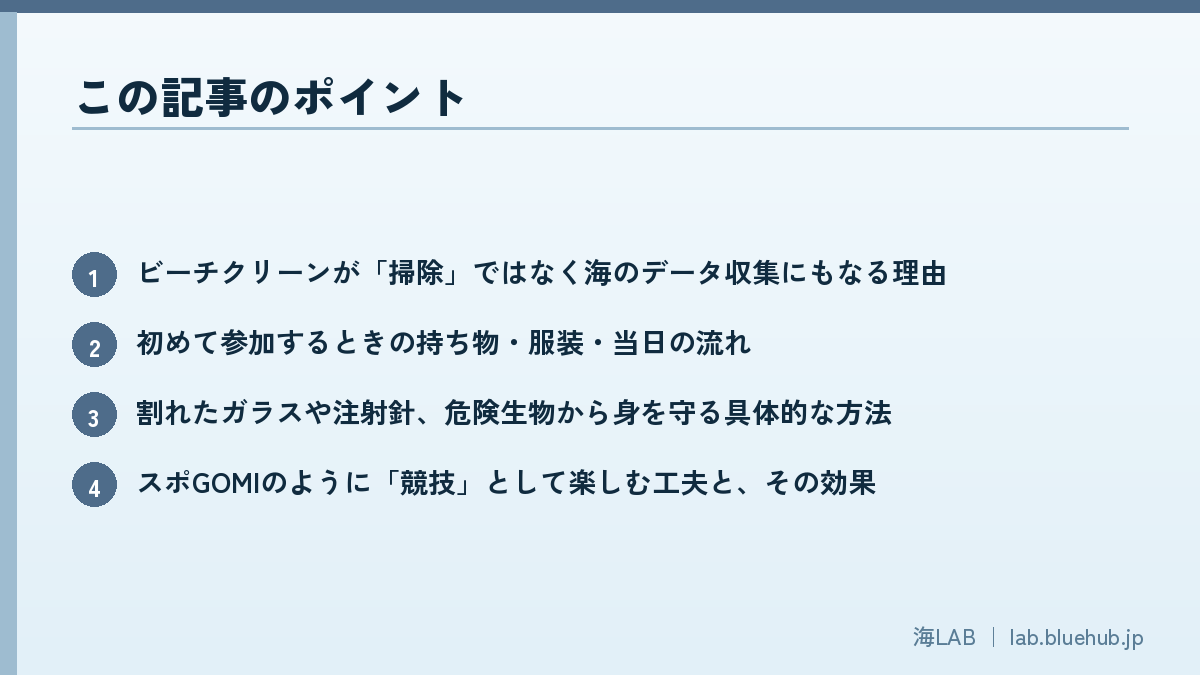
- Why a beach cleanup is not just tidying up, but also ocean data collection
- What to bring, what to wear, and how a first cleanup day actually runs
- How to protect yourself from broken glass, needles and venomous marine life
- How turning cleanups into a game, as SpoGOMI does, changes participation
- How to record what you pick up and link it to the sources of litter
- The laws, subsidies and support available to companies, schools and local governments
What a beach cleanup is: cleaning, and also surveying
A beach cleanup is the removal, by hand, of washed-up litter that the sea deposits on the shore and of dropped litter left behind by swimmers, anglers and walkers. The people who do it range from community groups, surfers and fishery cooperatives to companies, schools and local governments, and the scale runs from a few friends on an early-morning walk to campaigns involving hundreds.
The point worth grasping early is that a cleanup has two faces. One is the direct effect: a cleaner shoreline, safer for people and better as habitat. The other is that by recording where, what kind and how much, the activity produces the baseline data on which marine litter policy rests. That second face is easy to overlook, yet it is the one with the power to move regulations and product design.
What actually washes up on Japan's beaches
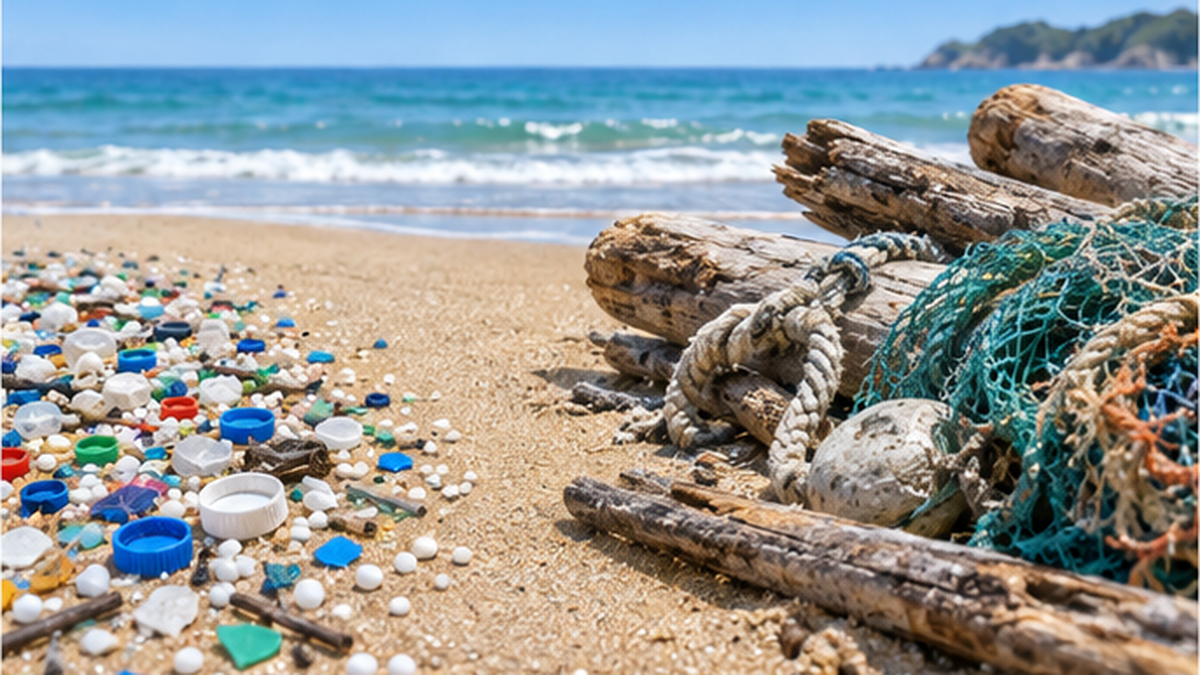
Japan's Ministry of the Environment runs continuous composition surveys of beach litter at representative sites nationwide. In the compilation for fiscal 2022, the top ten items by count were all plastics, including expanded polystyrene. By weight the picture flips: wood such as driftwood was the single largest category at about 21.6% of the total, and among artificial items by weight, plastic rope and cord came first at roughly 23%.
That split between count and weight matches what people feel on the sand. Walk a beach and small fragments and bottle caps stretch on endlessly; they dominate by number. Lift the bag, though, and the weight is waterlogged driftwood and sand-packed rope. Reducing the number of items and handling the tonnage are, in other words, two different problems needing two different responses.
The litter does not come from the sea; most of it comes from land
Many people picture coastal litter as something that drifted in from abroad. Seasonal winds and currents do concentrate foreign debris on some shores, but nationally the dominant pathway is domestic: litter dropped in towns, or waste that is poorly contained, washes into drains with the rain and reaches the sea through rivers. That is exactly why picking up on the beach and avoiding waste in daily life belong to the same story.
For more on the river pathway, see our article on plastic flowing from rivers to the sea. If you want to go deeper into the composition of beach litter and how it drifts ashore, our piece on what beach litter really consists of covers that ground.
Litter accumulates according to rules
Wandering the sand at random is not efficient. Every beach carries a drift line — the band of seaweed, driftwood and fragments left by the highest reach of the tide. Buoyant artificial items travel exactly as seaweed does, so they concentrate along that line. Following it is the basic move on site.
Beyond that, litter piles up in wind shadows: at the base of headlands on the lee side, beside river mouths, inside breakwaters and behind clumps of coastal vegetation. Conversely, the middle of a popular swimming beach can be surprisingly clean because the municipality sweeps it. Choosing where litter collects rather than where it is conspicuous changes how much an hour yields.
There is a seasonal rhythm too. On the Sea of Japan coast, winter monsoon winds raise the volume that comes ashore, and after typhoons or heavy rain the river-borne influx spikes. A sudden increase in household items right after a storm is evidence that it came from town. Knowing this helps in scheduling and stops people from misreading a seasonal swing as a trend.
Three things to grasp first
- Coastal litter splits into plastics by count and wood and fishing gear by weight
- Most of it began as dropped or poorly managed waste on land and travelled via rivers
- Your records are, directly, the baseline data for marine litter policy
By the numbers: the scale of cleanups in Japan and worldwide
Feeling that one person picking up litter cannot matter is natural. Looking at what happens when many people act on that same thought, however, tends to change how the activity reads.
The International Coastal Cleanup, the world's largest
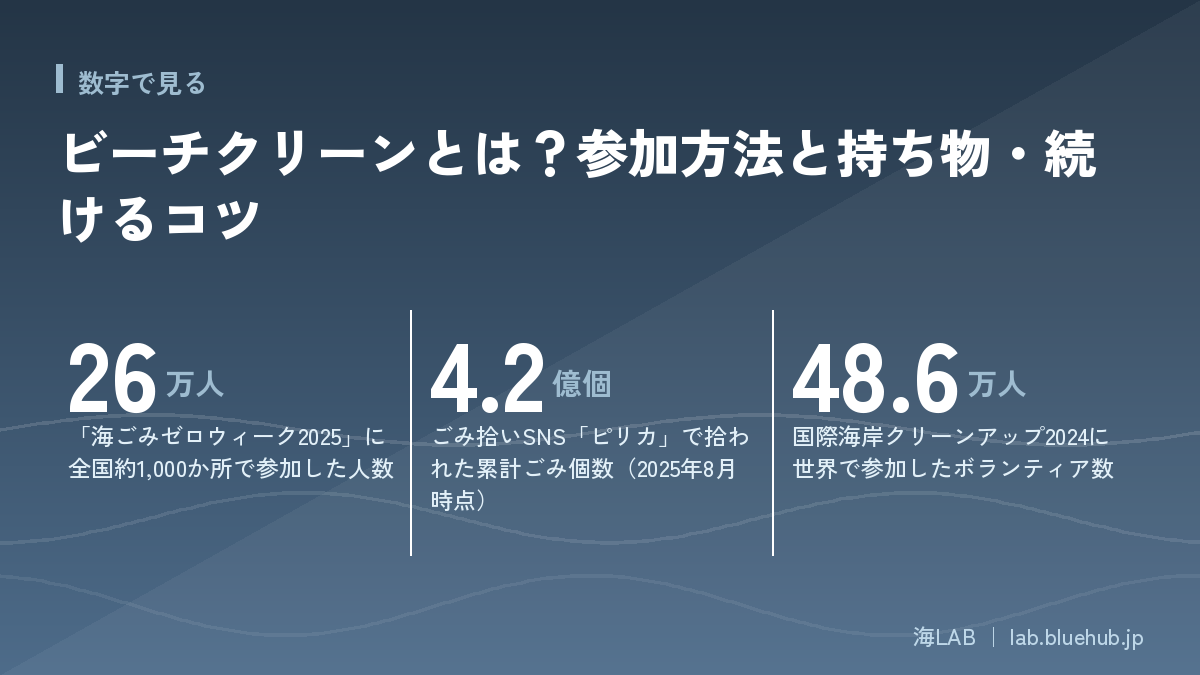
The International Coastal Cleanup (ICC), run by the US environmental NGO Ocean Conservancy since 1986, is among the largest coastal cleanup campaigns on the planet. In the 2024 tally, more than 486,000 volunteers collected over 7.4 million pounds (roughly 3,400 tonnes) of trash. Cumulatively, more than 19 million volunteers have gathered over 400 million pounds.
What makes the ICC distinctive is that participants do not merely collect: they count items by category. The 2024 haul included about 1.4 million food wrappers, more than 1.2 million beverage bottles and more than 1.2 million cigarette butts. That record of what was lying there, and how much, has been used as evidence in debates over the design and regulation of single-use packaging.
Japan's Umi-Gomi Zero Week
In Japan, the Ministry of the Environment and The Nippon Foundation jointly run a nationwide simultaneous cleanup campaign called Umi-Gomi Zero Week ("zero marine litter week"). The spring focus period runs from 30 May, Japan's "zero waste day", to World Oceans Day on 8 June, with groups across the country cleaning in the same window. According to official announcements, fiscal 2024 saw more than 600,000 participants at about 1,300 sites (tallied as of February 2025), and fiscal 2025 saw more than 260,000 participants at about 1,000 sites.
There is a reason for the "same week, whole country" design. Individual cleanups are small, but synchronising them attracts coverage, multiplies the reasons someone might join, and makes nationwide comparison of the data possible. Think of it as a device for bundling scattered goodwill into something society can see.
| Initiative | Organiser | Scale (latest published figures) | Distinctive feature |
|---|---|---|---|
| International Coastal Cleanup (ICC) | Ocean Conservancy | 2024: over 486,000 people, about 3,400 tonnes | Item-by-item counts on a shared global form |
| Umi-Gomi Zero Week | Ministry of the Environment and The Nippon Foundation | 2025: about 1,000 sites, over 260,000 people | Nationwide focus period each spring |
| SpoGOMI World Cup | Nippon Foundation SpoGOMI Federation and partners | 2025: 34 countries in the final | Litter picking turned into a scored competition |
| Pirika cleanup app | Pirika, Inc. / Pirika Association | 420 million items cumulative (August 2025) | Logs everyday individual pickups |
How to read these numbers
- Participant and volume figures shift with the tally date and the method (self-reported versus measured)
- Tonnages include water and sand, so they differ from dry weight
- Count and weight are separate indicators; do not judge severity from either alone
Getting ready for your first day: gear and how it runs
From here on, the practical side. Organisers often lend equipment, so checking the "what to bring" line in the event listing comes first, but the following will not steer you wrong.
The four essentials
- Thick gloves. Rubber-coated or grip-backed beats plain cotton: you can hold wet litter and your hands are shielded from fragments.
- Litter tongs. Far fewer squats, much kinder to your back, and you never touch hazardous items directly.
- Sturdy shoes. Sandals and bare feet are out. Buried glass and nails go straight through. Trainers or boots.
- Water. Reflected heat off the sand makes you sweat more than you expect; add salts in summer.
Add a hat, long sleeves, sunscreen, clothes you do not mind ruining, and two or three bags for sorting. If you can separate "burnable", "bottles, cans and glass" and "hazardous", the disposal step afterwards becomes far simpler.
How a typical day runs
- Check-in and briefing (10–15 min): area assignments, sorting rules, what to do about hazardous finds, meeting time
- Cleaning (45–90 min): not only the waterline. Work the drift line and the base of coastal plants, where litter gathers
- Weighing and recording (10 min): note bag counts, weight and notable items. Photos help when sharing later
- Sorting and stacking (10 min): follow the municipality's rules and use the designated point. Never take litter home on your own initiative
- Debrief (optional): a few minutes on what was most common and where people think it came from does more than it sounds
What not to do
- Do not dump collected litter in beach bins or a nearby convenience store's bin; it falls outside the disposal route and will not be collected
- Do not force large items such as refrigerators, tyres or heavy fishing gear. Record the location and report it to the municipality
- Do not enter stands of coastal vegetation or what may be a turtle nesting site. Wrecking habitat defeats the purpose
When to go
Aim for the hours around low tide. With the water out you can safely reach the waterline and pick up items normally submerged. Tide times are published by the Japan Meteorological Agency and in tide apps. In summer, go early or late in the day; in winter, the warmer middle hours. If strong wind, high waves or thunderstorms are forecast, cancelling is the right call no matter how much litter is waiting.
Note also that two or three days after heavy rain or a typhoon the volume ashore jumps. It is rewarding, but driftwood and large debris increase too, and so does the risk. For a first outing, joining a small group on a calm day is better for both safety and learning.
Going with children
Children are closer to the ground and have sharp eyes for small things. Collecting fragments of a few millimetres to a few centimetres — the stage before microplastics — is often work they do better than adults. The safety rule is to define the target in advance: "only coloured fragments", "only bottle caps", and a promise to call an adult for anything metal, glass or unfamiliar.
Afterwards, laying the caps and fragments out by colour turns the outing into a lesson on its own. "There are this many of the same shape", "you can read the letters, so it is from Japan" — realisations of that kind stick far better than any explanation.
Picking up alone counts too
If group events never fit your schedule, carrying a bag on a walk is a complete activity in itself. English-speaking countries coined plogging for jogging while collecting litter. What matters is not scale but continuity and recording. As the next chapters show, even one person's log becomes data once it accumulates.
Staying safe: hazardous objects and dangerous wildlife
The greatest risk in a beach cleanup is not the volume of litter but injury. Shorelines receive hazards that urban litter picking never presents. Japan's Ministry of Land, Infrastructure, Transport and Tourism, together with the agriculture and fisheries agencies, publishes a handbook and guidelines on hazardous items washed ashore, and the field criteria are set out there.
Things you must not touch
- Needles and syringes. Infection risk. Never bare-handed. Place in a rigid container and always report to the organiser or municipality
- Broken glass and sharp metal. Lift with tongs into a hard container such as a bottle or can, kept separate
- Drums, jerrycans and containers holding liquid. The contents may be unknown chemicals. Do not move them; record the position and report
- Cylindrical or shell-shaped metal objects. Possibly unexploded ordnance or flares. Stay back and call the police or fire service
- Lighters and aerosol cans. Residual gas can ignite once stacked. Keep them apart
When in doubt, leave it and report it. Not taking everything on yourself is also how people keep doing this for years.
Watch for marine life
Living things shelter under debris and in tide pools. Blue-ringed octopus, sea snakes and Portuguese man o' war all occur along Japan's coasts and are dangerous to touch. Always lever boards and rope towards you with tongs and never push a bare hand into a gap; that alone removes most of the risk. If someone is stung or bitten, do not rub the area — tell the organiser and get to a medical facility quickly.
Heat and pacing
Sand reflects heat and drags at every step, so a beach tires people faster than ordinary walking. In summer, early morning or evening is the default, with a break after about 45 minutes. When children or older participants take part, shade and water should be non-negotiable items on the organiser's checklist.
An on-site safety check
- Confirm before setting off that everyone has gloves, shoes and tongs
- Set up one rigid container for hazardous items and tell everyone where it is
- Adopt "when in doubt, leave it and report it" and agree how to reach the organiser
- Have the organiser call the breaks rather than leaving it to each person
Making it enjoyable: the invention called SpoGOMI
The main reason cleanups fizzle out may not be that they are hard, but that they have no visible end. You clear a beach and next week fresh debris has arrived. Designing around that sense of futility is the central problem, and Japan produced a striking answer: SpoGOMI.
"Litter picking is a sport"
SpoGOMI was created in Japan in 2008 by Kenichi Mamizuka, representative director of the Social Sports Initiative (formerly the Japan Sport Litter-Picking Federation). The rules are simple: teams of three to five compete within a set time and area for points assigned to each category of litter. Because correct sorting affects the score, collecting the most does not automatically win.
The elegance of the design is that it turns litter picking into a game with strategy. Which area to work, how to split collectors and sorters, what to prioritise in the closing minutes. Conversation arises naturally within the team, and at the end there is a ranking — an ending. The formlessness that produced the futility is resolved by the frame of competition.
It reached a world championship
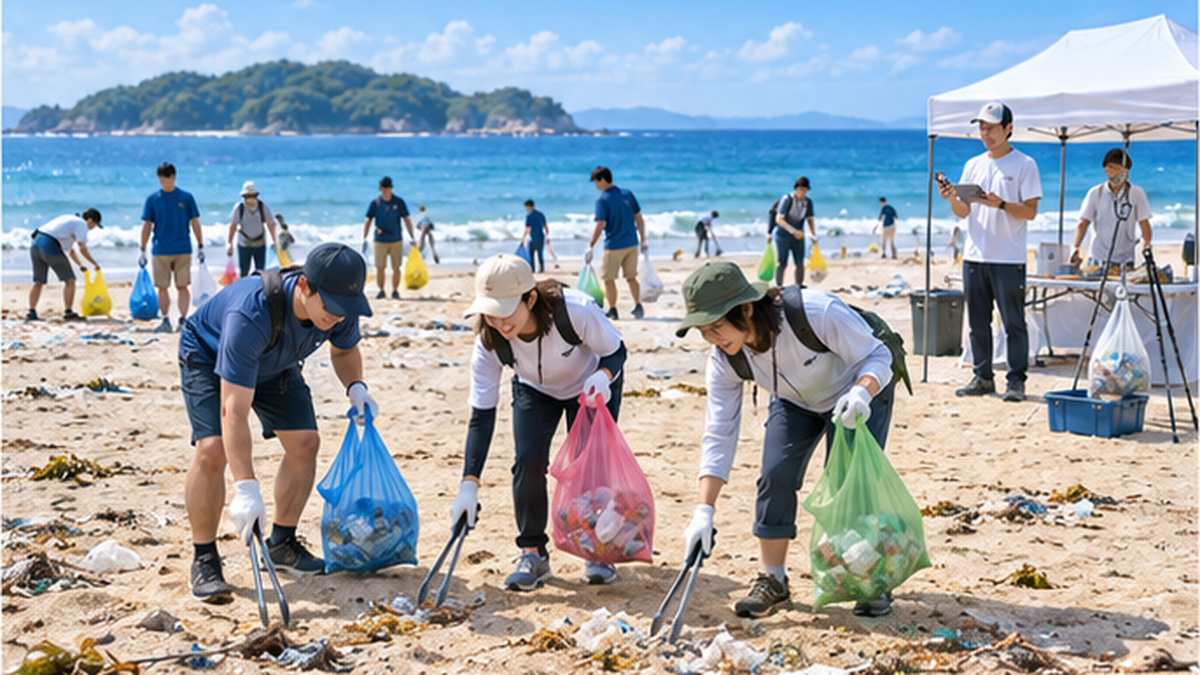
With support from The Nippon Foundation, SpoGOMI went international. According to the official site, the final of the Nippon Foundation SpoGOMI World Cup 2025 brought together 34 countries. Japan's national stage, held in Tokyo on 21 September 2025, fielded 47 teams representing all 47 prefectures and produced 712.57 kg of litter. Cumulatively from 2008 to the end of 2025, the organisers report 209,489 participants and 264,517 kg collected.
The effect of competition shows less in tonnage than in who turns up. People with no prior interest in environmental work join as a sport, or as a corporate team-building exercise, and end up seeing for themselves how much litter a beach holds. It functions as a device for lowering the threshold at the entrance.
Adding your own game element
- Set a time limit. Simply declaring 45 minutes gives the activity an ending
- Set a theme. "Caps only today", "find the oldest thing here" — narrowing the focus multiplies discoveries
- Weigh and log it. Knowing whether it is more or less than last time makes change tangible
- Always debrief. Five minutes of sharing at the end moves the return rate more than anything else
Preventing burnout
Cleanup groups tend to share two problems: ageing membership and a fixed core. The same handful carry everything until their bodies stop cooperating. The way out is to design separate kinds of sessions — an easy one and a deep one. The first finishes in an hour; the second goes as far as recording and analysis. A wide entrance with depth behind it lets people with very different levels of commitment share the same space.
How results are presented matters as well. "We collected 100 kg today" closes the loop; "30% less than last month, perhaps because there was no typhoon" opens it, and participants want to know the next figure. Attaching a story to the result is the cheapest device there is for bringing people back.
Design principles for continuity
- Create endings (time, area, theme)
- Make results visible (weight, count, photographs)
- Create company (a team, family, colleagues)
Turning collected litter into data
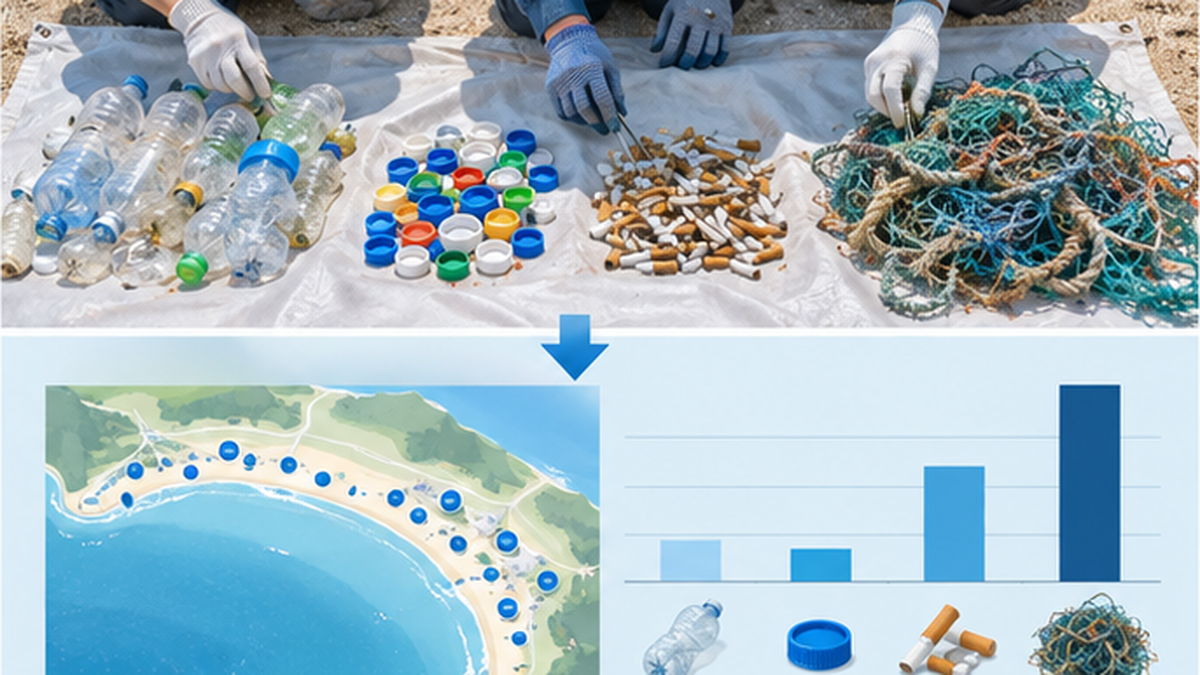
Recording is what lifts a cleanup to another level. By keeping the amount and the item types, the day becomes both a cleanup and environmental monitoring. This is not the preserve of specialists; it is a textbook case of citizen science.
Four fields are enough
- Place. The beach name, and ideally latitude and longitude, which any phone map app will give you
- Date, headcount and duration. So that volume per person-hour can be compared
- Amount. Not just bag counts; weigh it in kilograms if you can
- Items. Counts for the top few categories: bottles, caps, cigarette butts, fishing gear, polystyrene
Item counts matter most. Weight alone ends at "mostly wood", whereas counting reveals "a lot of beverage containers" or "a lot of fishing gear" — clues to the source. That is why the ICC has kept using a common global record card.
Sharing records through an app
The Japanese cleanup social app Pirika (Pirika, Inc. / Pirika Association) accumulates records on a map from nothing more than a photo and a location. It is used in 136 countries and regions, and as of August 2025 some 420 million items had been logged, having passed 400 million in February 2025. A single item picked up on a walk is counted on the same footing as anything else.
The same company also provides Takanome, a survey system that uses image analysis to map the distribution of roadside litter, working with municipalities and companies to visualise where litter concentrates as a heat map. In August 2025 that distribution data was fed back into the Pirika app as a "cleanup spots" feature. Instead of walking on instinct, you can now choose where to pick up based on data.
Citizen data moves policy
The Ministry of the Environment monitors beach litter nationwide, but the number of survey sites is finite. Records built up by local groups fill that gap. Patterns such as "a particular beverage container keeps appearing on this beach" or "fishing gear spikes after typhoons" only emerge from sustained recording in the field. For more on how this works in general, see our article on citizen science.
The top ten items by count were all plastics, including expanded polystyrene.
― Ministry of the Environment, "Compilation of FY2022 beach litter composition survey data" (March 2024)
How companies, schools and local governments fit in
Beach cleanups do not run on individual goodwill alone. Japan has legislation underpinning coastal cleanup, and the frameworks for organisational participation by companies and schools have matured.
The law that provides the foundation
The Act on Promoting the Treatment of Marine Litter, enacted in 2009, was amended on 22 June 2018 (Act No. 64 of 2018) to place conservation of the marine environment explicitly within its scope, adding provisions on microplastics among others. Under it, prefectures draw up regional plans and support collection and treatment by municipalities and private groups.
Financially, the Ministry of the Environment's regional programme for countermeasures against washed-up litter subsidises prefectural and municipal projects. Collection, treatment and prevention work attract subsidy rates of 90% to 70%, rising to 95% in remote islands, depopulated areas and peninsular regions, while drawing up a regional plan is subsidised at 50%. In other words, the chain from volunteers picking litter to the municipality disposing of it is joined up as a matter of policy. Checking that an organiser is coordinating with the municipality saves trouble at the collection stage.
| Who | What they can do | Common stumbling block |
|---|---|---|
| Individuals and families | Pick up on a walk, join local cleanups, keep records | Where the litter goes; check municipal rules |
| Companies | Staff cleanups, supplying materials and transport, recycling what is collected | One-off events. Annual planning and accumulated records give it meaning |
| Schools | Integrated studies and club activities, recording as a survey | Safety management. Briefing on hazardous items is essential |
| Local governments | Regional plans, collection and treatment, subsidies, lending equipment | Building a way to consolidate scattered groups' records |
Support that is already available
Many municipalities offer groups free bags, loans of tongs and grabbers, and collection of what is gathered. The desk varies — environment section, cleaning office, coastal management department — but saying you want to clean a beach will get you routed. Contacting them beforehand smooths the collection and avoids the classic problem of non-designated bags being left behind.
For participant safety, enrolment in volunteer activity insurance, handled by social welfare councils among others, is standard. For a few hundred yen a year it covers injury and liability during the activity. Schools and companies should check whether their event insurance already applies.
Keeping corporate participation from being a one-off
The familiar corporate pattern is one event a year, of which only photographs remain. To make the manpower count, run it at the same beach, in the same area, by the same method, several times a year. Continuous data gathered under consistent conditions becomes a valuable time series for that stretch of coast, and gains value for the municipality and researchers too. Using part of what is collected as feedstock for the company's own products is a growing practice that links the activity to the core business.
If you are the one organising
- Notify and obtain permission from the coastal manager (municipality, port authority and so on)
- Agree in advance how collected litter will be taken away and where it will be stacked
- Arrange volunteer insurance and an emergency contact chain
- State clearly where to report hazardous finds
- Decide the cancellation criteria for rain and high waves beforehand
Beyond picking up: reaching the source
Having covered how to take part, the most important point comes last. Beach cleanups alone will not reduce marine litter. What can be collected on a shoreline is a small fraction of what has already escaped, and fresh debris arrives as fast as it is removed. Cleaning stops the bleeding; it is not the cure.
Turning the experience into a conversation about sources
That said, a cleanup is a powerful entrance to upstream action. What you picked up with your own hands stays with you. "It was all containers from the same maker", "there were more food wrappers than carrier bags" — that felt sense changes behaviour more persuasively than statistics. The ICC insists on item counts precisely because approaching companies and policymakers lies on the far side of them.
Upstream actions available today
- Carry less disposable. A reusable bottle, a bag, refill products. One fewer single-use container is one fewer future piece of beach litter
- Always take outdoor waste home. If the beach bin is full, bag it and deal with it at home
- Clear the drains before it rains. Litter on land travels with the rain, so street cleaning is marine action
- Leave no fishing gear behind. Line and tackle cause heavy entanglement harm; collection boxes at fishing spots are becoming common
- Look at materials when you buy. Choosing recycled content and recyclable design sends a demand signal
Not only protecting, but growing fond
Ask long-standing volunteers why they keep going and the answer is more often affection than alarm: they like that particular beach. Returning to the same sand regularly makes visible what cleaning alone would never reveal — seasonal shifts in what arrives, migrating birds, the movement of the sand itself. A beach cleanup is also an excuse to meet the sea on a schedule.
The few minutes of looking out over a shoreline you have just cleared carry a satisfaction that is hard to convey second-hand. Activities driven by obligation have a ceiling; activities driven by pleasure are durable. Start by taking a bag and a pair of gloves to the nearest beach on your next day off.
In summary
- Thick gloves, tongs, sturdy shoes and water are enough to take part from day one
- Needles and unidentified containers are "leave it and report it". Watch for dangerous wildlife too
- Japan's beach litter is led by plastics in count and by wood and fishing gear in weight
- Framing the activity with time and scores, as SpoGOMI does, makes it far easier to sustain
- Record place, date, amount and items, and the cleanup becomes monitoring data
- Cleaning only stops the bleeding; pair it with using fewer disposables
References and sources
- Ministry of the Environment, Japan – Manual for coastal cleanup projects (marine litter model programme)
- Ministry of the Environment, Japan – Compilation of FY2022 beach litter composition survey data (March 2024)
- Ministry of the Environment, Japan – Compilation of FY2023 beach litter composition survey data (March 2025)
- Ministry of the Environment, Japan – Marine litter surveys (washed-up, floating and seabed litter)
- Ministry of the Environment, Japan – Act on Promoting the Treatment of Marine Litter: law, regional plans and subsidies
- Ministry of Land, Infrastructure, Transport and Tourism et al. – Handbook on hazardous items washed ashore
- Umi to Nippon PROJECT – Umi-Gomi Zero Week, the nationwide cleanup campaign by the Ministry of the Environment and The Nippon Foundation
- Ocean Conservancy – International Coastal Cleanup
- Nippon Foundation SpoGOMI Federation – SpoGOMI events and rules
- Pirika, Inc. / Pirika Association – Pirika, the litter-picking social app
Listed in order of reliability: government and academic institutions > peer-reviewed papers > specialist organisations > credible media