⚡ The answer in 30 seconds
- MSC covers wild seafood and ASC covers farmed seafood; both are third-party certifications showing resources, environment and management were verified.
- Labeled products require CoC certification across processing and distribution, which can be checked via the license number.
- No label does not mean unsustainable. Canned and frozen items are a practical first step.
The small blue or green marks on the fish counter. The MSC and ASC eco-labels show that a third party has verified that the seafood was caught or farmed with care for resources and the environment.
Yet many questions remain: how do MSC and ASC differ, what do the numbers mean, and is unlabeled fish bad?
Based on public data and official information, this article neutrally explains how to read labels and choose.
What you will learn in this article
- Differences in target and audit between MSC and ASC
- What CoC certification and license numbers mean
- Where Japan's MEL and other labels fit
- Five steps to choose at the store
- How to spot greenwashing
Why Do We Need Eco-Labels? The Invisible Problem at the Fish Counter
A fish on the shelf tells you nothing about the fishing ground
Salmon fillets, packs of shrimp, canned tuna. Looking at seafood in a store, you cannot tell which sea it came from, how it was caught, or whether the stock was healthy. Appearance, price and place of origin say almost nothing about ocean sustainability. Seafood eco-labels, with standards set and audited by third parties, were created to fill this information gap.
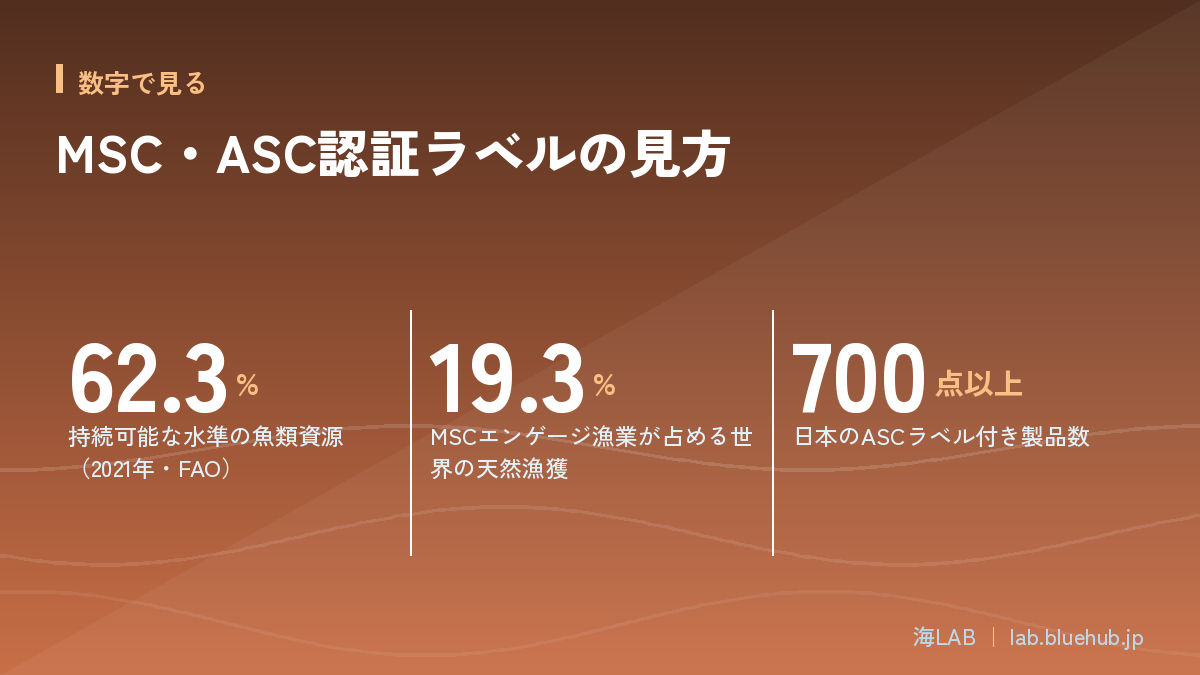
According to the FAO's State of World Fisheries and Aquaculture (SOFIA) 2024, 62.3% of the fish stocks assessed by FAO were fished within biologically sustainable levels in 2021. In 1974 the figure was about 90%, so it has fallen sharply over half a century. The remaining roughly 38% are considered overfished.
Japan is one of the world's major seafood-consuming countries and also relies considerably on imports. In such complex supply chains, eco-labels play an increasingly important role in conveying origin and fishing method at a glance.
Not every fish is in trouble
The state of stocks varies widely by species and sea area. SOFIA 2024 states that, for the ten most-landed species, about 79% of the catch came from sustainably fished stocks. Healthy and troubled stocks coexist, so consumer choices can make a real difference.
Key points of this section
- Seafood counters alone do not reveal resource or environmental care
- 62.3% of assessed stocks are at sustainable levels (2021, FAO)
- Stock status varies by species and area, which is why selection criteria help
An eco-label is a clue, not an answer
An eco-label does not guarantee safety or taste. What it certifies is that a third party has verified the resources, environment and management system against set standards. Keeping this in mind lets you use labels as a shopping aid without over- or under-trusting them.
Reading the MSC Label: The Blue Label for Wild-Caught Fish
What is the MSC?
The MSC (Marine Stewardship Council) is an international certification program for wild-caught seafood. It began in the late 1990s through cooperation between a conservation group and a company, and is now run as an independent non-profit. The blue fish mark on packages is the MSC label, known as the "blue fish" eco-label.
The three principles audited
MSC fishery certification is assessed against three principles. Failing any one prevents certification.
- Principle 1: Sustainable fish stocks: can fishing continue without depleting the stock?
- Principle 2: Minimizing environmental impact: are impacts such as bycatch and seabed damage kept low?
- Principle 3: Effective fisheries management: is there legal compliance and a system that adapts to changing conditions?
Fishery certification and CoC certification are different
The MSC has two certifications: fishery certification, which audits the fishery itself, and CoC (Chain of Custody) certification, which audits processing and distribution. To sell products with the label, each distributor, processor and retailer must hold CoC certification and ensure that uncertified seafood is not mixed in.
In other words, the blue label is attached only when the fishing ground and the path to the shelf are connected. The license number near the label (a code starting with MSC-C-) is a clue showing that the business is certified.
The MSC in numbers
According to the MSC's 2023-24 annual report, fisheries engaged with the MSC program, including certified, in-assessment and improvement-program fisheries, numbered 716, with a catch of about 15.48 million tonnes, equal to 19.3% of the global wild marine catch. Note that this figure is "engaged", not only "certified".
| Item | Value (2023-24) | Note |
|---|---|---|
| Number of engaged fisheries | 716 | 674 the previous year |
| Engaged catch volume | about 15.48 million t | 19.3% of global wild marine catch |
| Share of commercial whitefish catch | 75% | Engaged fisheries |
| Share of commercial salmon catch | 91% | Engaged fisheries |
Reading the ASC Label: The Green Label for Farmed Fish
What is the ASC?
The ASC (Aquaculture Stewardship Council) certifies farmed seafood. Aquaculture is increasingly important for global supply, and coverage of FAO's SOFIA 2024 reported that aquaculture surpassed capture fisheries in aquatic animal production for the first time. Challenges remain in feed, water quality, disease and labor conditions, and the ASC was created to promote farming that cares for both the environment and society.
What the ASC looks at
- Environmental impact such as water and sediment quality around the farm
- Sourcing of fishmeal and fish oil in feed, and management of drug use such as antibiotics
- Escapes and effects on wild populations
- Social criteria such as workers' rights and relations with local communities
Standards are set for each species group, and the covered species have expanded over time to include salmon and trout, shrimp, yellowtail and sea bass, bivalves and more, extending across aquaculture.
The ASC in Japan
According to the Ministry of the Environment (March 2026), there are 2,575 ASC-certified farms worldwide, 45 of them in Japan; 3,119 CoC-certified businesses worldwide, 218 in Japan; and more than 31,000 ASC-labeled products worldwide, over 700 in Japan. Certified farms in Japan are still limited, but distribution and retail efforts appear to be leading the way.
MSC vs. ASC at a glance
| Item | MSC | ASC |
|---|---|---|
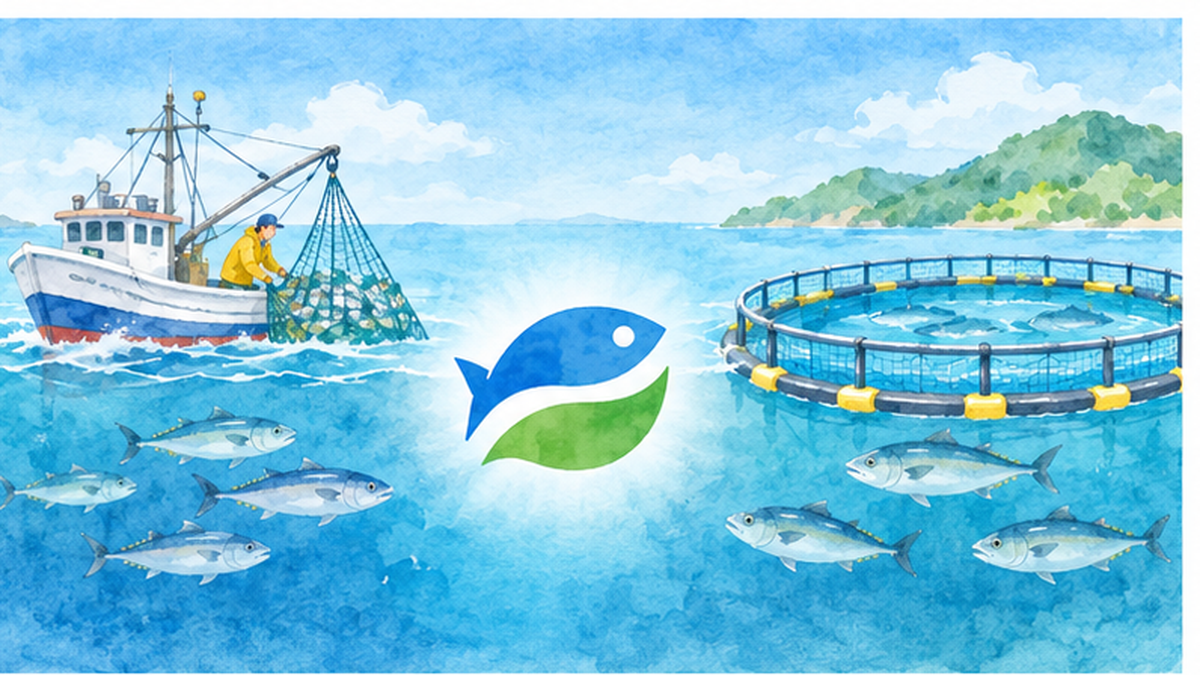
| Target | Wild seafood | Farmed seafood |
| Main audit focus | Stock status, ecosystem impact, management | Environmental load, drugs, feed, labor and community |
| Unit of certification | Fishery | Farm |
| Distribution certification | CoC required | CoC required |
| Label look | Blue fish mark | Green-toned mark |
How Labels Are Earned: The Certification Process and Auditors
Who issues certification?
The MSC and ASC create the standards, while the audits are carried out by independent third-party certification bodies. Fishers or farmers who apply bear the audit cost and undergo site visits and document reviews, with results made public. Experts and stakeholders can also submit comments during the process.
Certification is not a one-time achievement
Certificates have a validity period, and annual surveillance audits follow. If a stock deteriorates or conditions are no longer met, certification can be suspended or withdrawn. Some fisheries are certified with conditions and meet the standard step by step through improvement plans.
Perfection is not required to start
The MSC has an improvement program for fisheries that aim for certification. Even if a fishery does not yet meet the standard, showing and carrying out an improvement path is valued. That is why the engaged-fishery figures include pre-certification fisheries, showing the system works as an engine for improvement.
Terms worth knowing
- Fishery certification: proof that the fishery itself meets the standard
- CoC certification: proof that certified seafood is not mixed with others during processing and distribution
- Surveillance: periodic audits conducted every year after certification
- Improvement program: a mechanism for fisheries aiming for certification to fix their issues
Other Labels to Know, Including Japan's MEL
MEL (Marine Eco-Label Japan)
MEL (Marine Eco-Label Japan) was created mainly by Japan's seafood industry. It has standards tailored to the realities of Japanese fisheries and aquaculture, and is said to be designed so that small and mid-sized domestic operators can take part more easily. Alongside international certifications, it is one of the options supporting seafood sustainability in Japan.
Other certifications and guides
Ways of choosing seafood are not limited to labels. There are consumer guides that rate species as recommended or to avoid based on stock assessments, national and local resource management, and traceability efforts that state origin and catch method. Many sustainably caught products carry no label at all.
No label does not mean bad
Certification costs money and effort, so small-scale fishers and local cooperatives may meet the standards without being certified. The lack of a label does not necessarily mean the fish is unsustainable. It is important to see the label as just one piece of evidence.
See also our articles on MSC certification and choosing ASC-certified farmed fish.
Putting It into Practice: Five Steps to Choose with Labels
Steps 1 to 3: Check the mark and license number
- Look for the mark: check the package for the blue MSC, green-toned ASC or MEL mark
- Wild or farmed?: wild usually corresponds to MSC and farmed to ASC; products rarely carry both
- Find the license number: the CoC number near the label shows the handling business's certification
Steps 4 and 5: Choose by species and purpose
- Narrow by species: start with staples where certified products are easy to find, such as salmon, cod, scallops and canned tuna
- You don't have to change everything: making one item a week a certified product already sends a demand signal
Start with canned and frozen foods
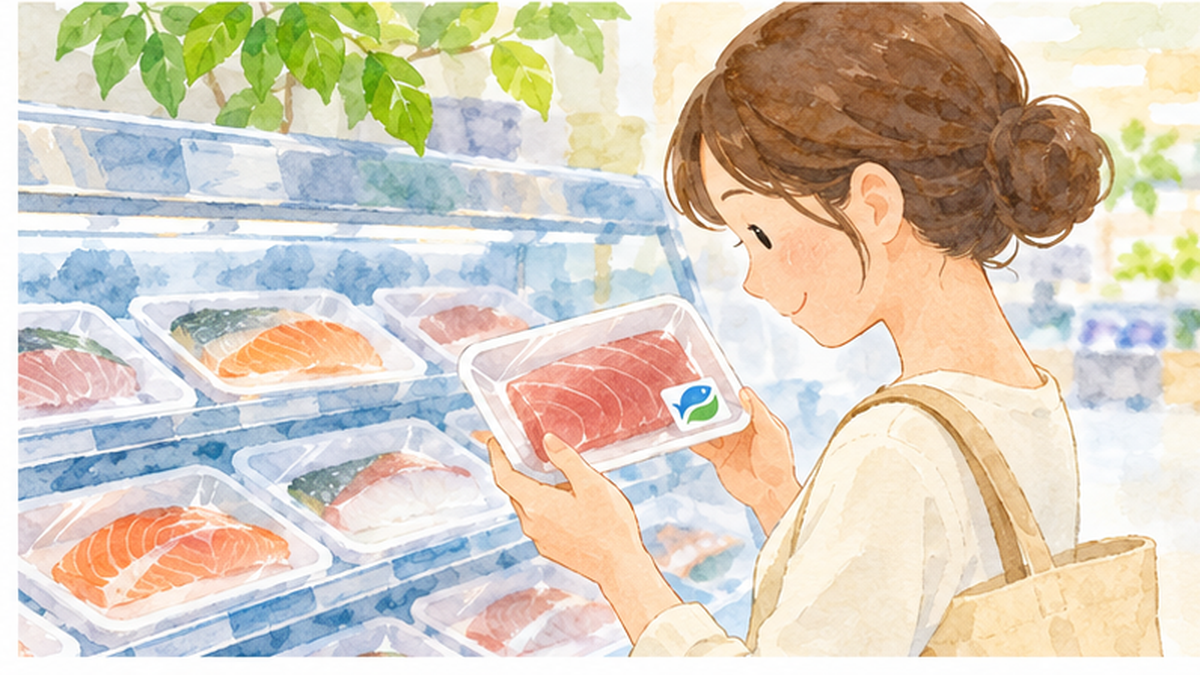
Canned, frozen and processed products tend to offer more certified varieties and are available all year compared with the fresh counter. Canned tuna and mackerel, and frozen whitefish fries, often have small price gaps and make a good first step. See our guide to certified canned fish for details.
Living with the price
Certified products can cost more, but not all are expensive. Retailers' private brands now include certified items in everyday price ranges. Choosing when you can, within your means, is enough.
Limits of Labels and How to Avoid Greenwashing
Certification has limits
Certification schemes are not perfect. Researchers and environmental groups debate topics such as the strictness of standards, how bycatch is handled, and how easily small-scale fisheries can take part. The schemes revise their standards regularly, so they are best seen as evolving mechanisms rather than finished ones.
How to spot greenwashing
- Only a proprietary mark with no third-party basis
- Words like "eco" or "sustainable" with no specific standards or figures
- Certification covering only part of the ingredients while the whole product looks certified
- No license number or certifying organization named
Things to keep in mind
- Certified does not mean healthier. Nutrition and safety are separate issues
- Even certified products lose meaning if much is wasted
- Don't rely only on labels; seasonal and local fish are also good options
Illegal fishing and traceability
The credibility of certification depends on transparency in distribution. Efforts against illegal, unreported and unregulated (IUU) fishing and against origin fraud complement eco-labels. See our IUU fishing article and our seafood traceability article.
How Eco-Labels Change the Sea: Consumers, Companies and Fishers
What demand changes
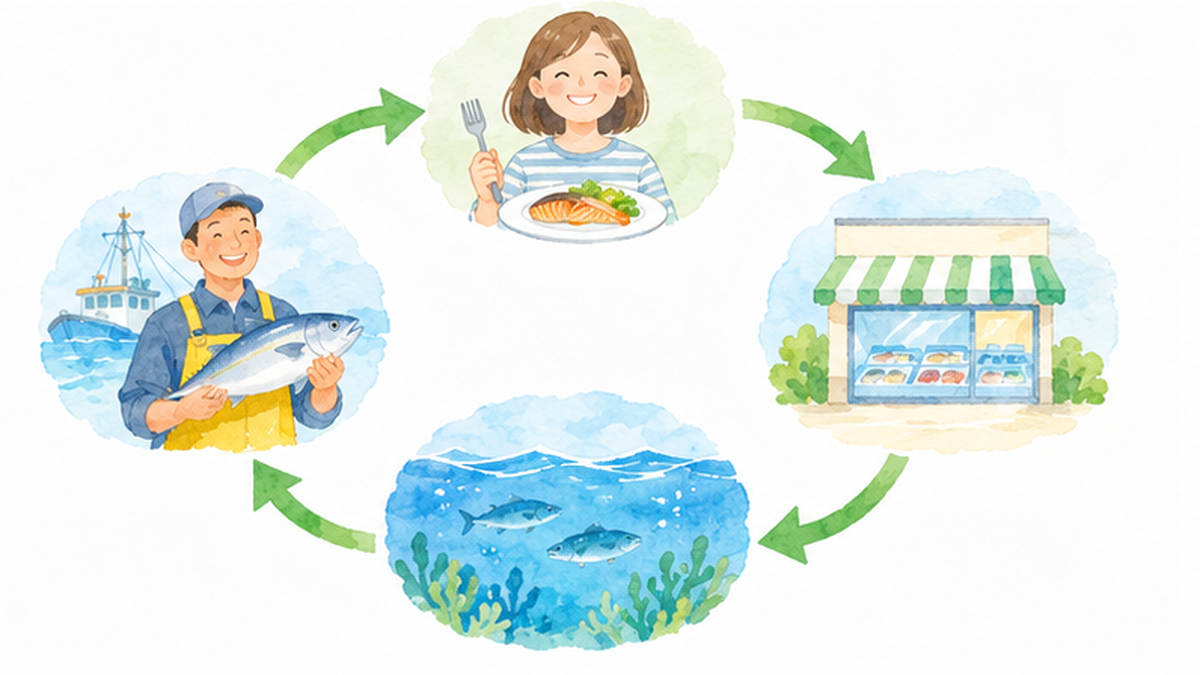
When consumers choose certified products, retailers and restaurants find it easier to build them into sourcing policies. Fishers and farmers then gain an economic motive to obtain certification. The growth in MSC-engaged fisheries partly reflects this flow from demand to supply.
Spreading corporate sourcing policies
In Japan, major retailers, food makers, restaurants and in-flight meal services are expanding certified seafood. For example, Aeon's TOPVALU and Co-op products place MSC and ASC items on shelves.
Improving resource management
In pursuing MSC certification, fisheries in various countries have reportedly introduced catch limits, bycatch-reducing gear and stronger data collection. The label is not just a sign but a mechanism that prompts improvement on the fishing ground.
What we can do
Choosing eco-labeled products is one of the easiest ways for individuals to support ocean conservation. It is not enough alone. Combining actions such as reducing leftovers, enjoying seasonal and local fish, and supporting cooperatives with resource management raises the effect.
Summary: How to Use Eco-Labels from Today
Five key points
Summary of this article
- MSC is for wild fish and ASC for farmed fish; their targets differ
- A label shows a third party verified resources, environment and management
- CoC certification covering processing and distribution makes labeling possible
- Fish without labels are not necessarily bad; the label is one piece of evidence
- Start with one canned or frozen item and choose within what you can sustain
Your next step
Next time you buy fish, look for the small mark in the corner of the package. That alone turns the shelf from a plain display into a gateway to the sea. Accumulated choices support the sustainability of the world's fishery resources.
Ocean resources can be kept for the future or lost, depending on how we use them. Now that you know the eco-label tool, a single purchase can nudge the sea in a better direction.
References and sources
- FAO State of World Fisheries and Aquaculture 2024 (SOFIA 2024) – State of world fish stocks
- MSC Annual Report 2024 summary – Number and catch of engaged fisheries
- Ministry of the Environment, Japan: Eco-labels – ASC counts in Japan and worldwide
- MSC Japan – Consumer information on MSC
- ASC Japan – Overview of ASC
- Marine Eco-Label Japan (MEL) – Japan's seafood eco-label
- Fisheries Agency, Japan – Information on fisheries resources and distribution
* Ordered by reliability: government and academic institutions > peer-reviewed papers > specialist bodies > reliable media