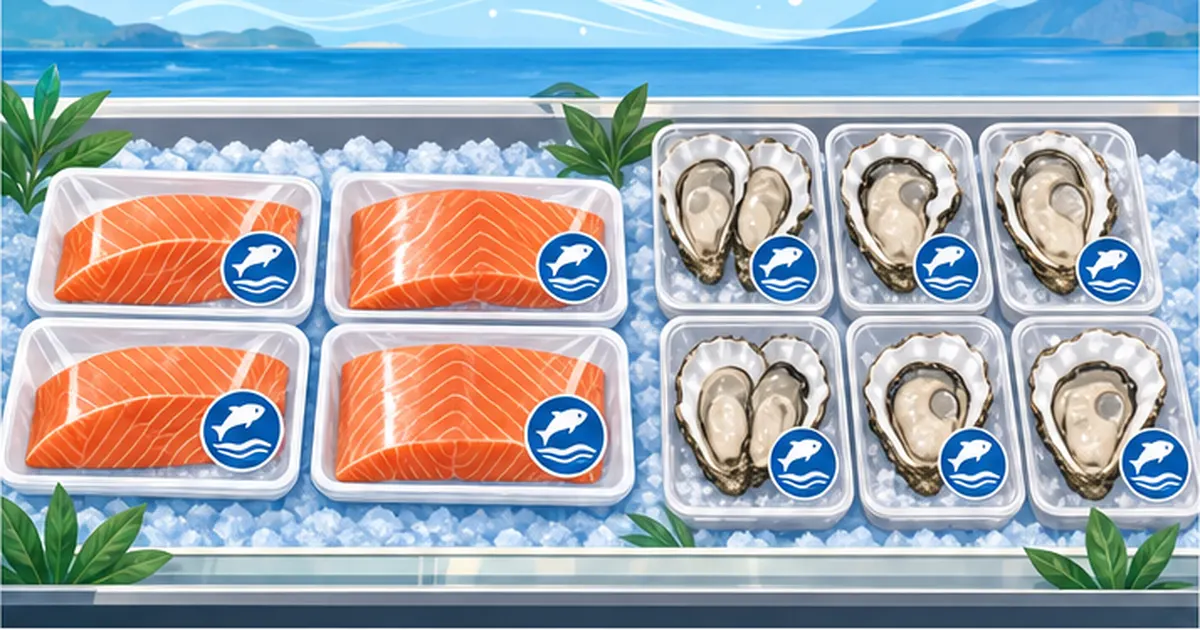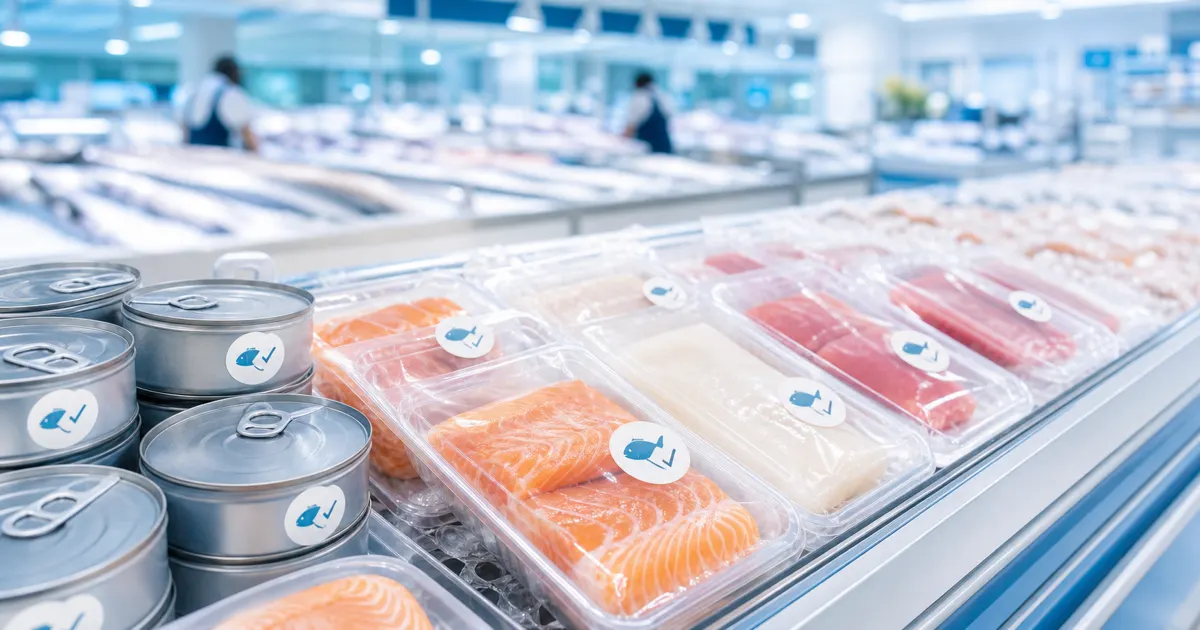
Have you ever noticed a small blue fish mark on the packaging of breaded white fish, canned tuna, or salted cod roe at the supermarket's fish counter or prepared-food section? That's the MSC Blue Fish Label. This mark is far more than decoration — it's an international seal of approval that says, "This fish was caught with care not to deplete ocean resources."
Around the world, fish stocks keep shrinking because of overfishing. According to the Food and Agriculture Organization of the United Nations (FAO), about 37.7% of the world's fish stocks are being harvested at levels that are not sustainable. Amid this, MSC certification has drawn attention as a practical mechanism for leaving fish for future generations.
This article lays out, in terms accessible to complete beginners and grounded in primary sources from Japan's Ministry of the Environment, the Fisheries Agency, and the FAO, everything from the basics of what the MSC Blue Fish Label is, to the three principles examined during certification, the traceability system that connects the sea to our tables, real-world examples of certified tuna, skipjack, and cod fisheries in Japan, and practical tips for spotting labeled products at the supermarket. By the time you finish reading, you should find yourself naturally looking for the blue mark on your next shopping trip. Building a sustainable ocean isn't someone else's distant job — it starts with the choices we make at our own dinner tables every day.
What you'll learn in this article
- What the blue Blue Fish Label promises: sustainable fishing
- The current state of the world's fish stocks and the background behind MSC's creation
- How the "two-tier" system of fishery certification and CoC certification guarantees trust
- Practical tips for finding MSC-labeled products at the supermarket fish counter
- The different roles of the three labels: MSC, ASC, and MEL
What Is the MSC Blue Fish Label? The Promise Behind the Blue Fish Mark
MSC stands for the Marine Stewardship Council, an international non-profit organization founded in 1997 to protect the world's dwindling fish stocks. It was originally launched jointly by the global environmental group WWF and Unilever, then a major seafood company, before becoming an independent, neutral organization apart from both founders in 1999. Its headquarters are in London, England, with offices operating around the world.
MSC runs the "Blue Fish Label," familiar for its blue fish mark. This label can only be attached to wild seafood caught by sustainable, well-managed fisheries that take fish stocks and the marine environment into account. If a package carries this mark, it means the fish has undergone third-party verification confirming it was "caught with care so that it can keep being caught in the future."
MSC's founding was shaped by a bitter lesson: the collapse of North Atlantic cod stocks in the early 1990s. Off the coast of Newfoundland in eastern Canada, a cod fishery that had continued for centuries suddenly became unviable in 1992 due to overfishing, and tens of thousands of people lost their jobs. Even a sea that looked abundant could see its fish vanish almost overnight if mismanaged — this shock is said to have led to the idea that "good fishing needs to be supported through the power of the market," forming the background to MSC's creation.
MSC itself does not assess fisheries; it is strictly an organization that sets the standard, or yardstick. The actual assessments are carried out by independent certification bodies accredited by MSC. By separating those who write the rules from those who judge pass or fail, the system is designed to be fair and resistant to favoritism — and this separation is what underpins the credibility of the whole scheme.
The Origin of the Nickname "Blue Fish Label"
The MSC mark is known in English as the "blue fish tick." In Japan, the nickname "Blue Fish Label" (umi no eco label) has been widely used since around 2017. Its simple design combines a fish and a checkmark inside an oval, and it appears not only on fresh fish but on any product made with certified ingredients — canned goods, frozen food, prepared meals, and even pet food.

What Does "Sustainable Fishing" Actually Mean?
In a nutshell, "sustainable fishing" means "fishing at a rate that stays within the amount the sea can naturally replenish." Fish spawn every year and increase in number. If you only catch as much as that increase, the stock won't shrink — but if you keep catching faster than it can grow back, the fish will eventually decline. It helps to think of MSC certification as a system for verifying that this principle of "catching only within the growth" is actually working in practice.
Think of fish stocks like a bank deposit. If you leave the principal (the amount of breeding fish) untouched and spend only the "interest" generated each year, the deposit will last forever. But if you keep drawing down the principal beyond the interest, the balance will eventually hit zero. Sustainable fishing is exactly this: "living off the interest without touching the principal." The MSC label is proof that a fishery is managing its household budget that way.
The key points to remember
- MSC = the Marine Stewardship Council, an international non-profit (founded 1997)
- The Blue Fish Label marks wild fish caught by sustainable fisheries
- It applies to wild seafood (farmed seafood is covered by ASC certification)
- It appears on a wide range of products, not just fresh fish, including canned, frozen, and prepared foods
If you'd like to broaden your understanding of ocean-related issues, we also recommend the article on ghost gear, lost fishing equipment that keeps polluting the sea, and on blue carbon ecosystems, which protect the habitats of marine life. Together they'll give you a fuller picture of why caring for the ocean as a whole, not just "how fish are caught," matters so much.
MSC's blue Blue Fish Label is applied to seafood caught by sustainable, well-managed fisheries that take fish stocks and the environment into account, so that we can go on eating fish for good.
— Marine Stewardship Council (MSC Japan)
In other words, this mark is a signpost that lets consumers make an "ocean-friendly choice" in the few seconds it takes to reach the checkout, no expert knowledge required. In the next chapter, let's look at why such a system became necessary in the first place, starting with the current state of the world's oceans.
Why Sustainable Seafood Matters Now: The State of the World's Oceans
To understand why MSC certification matters, the fastest route is to look at the numbers behind how much the world's fish stocks have declined. The Food and Agriculture Organization of the United Nations (FAO) publishes a report called "The State of World Fisheries and Aquaculture (SOFIA)" every two years — essentially a "health check-up" for the world's oceans. The latest 2024 edition contains some rather concerning figures.
Overfished Stocks Have Roughly Quadrupled in 50 Years
According to the FAO, the share of the world's major fish stocks being harvested at biologically unsustainable levels has risen from about 10% in 1974 to 37.7% in 2021. In other words, more than a third of the world's fish stocks are currently overfished. This proportion has crept steadily upward over the past several decades.
On the other hand, the remaining roughly 62% is being used within sustainable limits. Breaking that down, about 50.5% are "maximally sustainably fished" — used to their full sustainable capacity — while about 11.8% are "underfished," with room to spare. Not all ocean resources are in crisis; the reality is a clear split between "seas that are well managed" and "seas that are overfished." That's precisely why we need a system that makes good fishing visible and supports it.
| Stock status | Share (2021) | Meaning |
|---|---|---|
| Underfished | About 11.8% | Room remains to increase catch |
| Maximally sustainably fished | About 50.5% | Used up to the sustainable limit |
| Overfished | About 37.7% | Harvested at a rate that depletes the stock |

Why Fish Populations Decline: Rising Demand and a "First-Come, First-Served" Structure
Behind this lies a combination of global population growth and rising demand for seafood driven by health consciousness. The amount of seafood people eat has grown enormously over the decades. As demand rises, so does fishing pressure. What's more, because ocean fish are a "shared resource" belonging to everyone, in the absence of rules a "first-come, first-served" mentality easily takes hold — "if I don't catch it, someone else will" — a structural problem that readily leads to overfishing. This phenomenon, known as the "tragedy of the commons," is exactly why strict management rules are indispensable in fisheries.
There is good news, too. According to FAO's analysis, an average of about 78.9% of the top ten most-landed fish species were harvested within sustainable limits. This means much of the seafood traded in world markets comes from relatively well-managed stocks. Good management can protect fish stocks — and MSC certification serves as the bridge that makes that "good management" visible to consumers and translates it into market recognition.
In addition, "bycatch" — the incidental capture of species other than the target fish — fishing methods that damage the seafloor, and the effects of climate change (epitomized by ocean plastic and coral bleaching) are all placing further strain on marine ecosystems. We need to rethink not just "how much" fish we catch, but "how" we catch it.
This isn't someone else's problem for Japan, either
Japan is one of the world's leading consumers of fish and relies heavily on imports. Domestically, too, poor catches of familiar fish such as Pacific saury, Japanese flying squid, and eel have repeatedly made the news in recent years. The shift toward sustainable fishing isn't a story about some distant ocean — it's also a story about protecting our own dinner tables.
The starting point of MSC certification is to let consumers choose based on "which fish was caught by which fishery" as a response to these challenges. In the next chapter, we'll look in detail at what the assessment actually examines.
What's important here is that "not eating fish" is not the answer. Fish is an excellent food, rich in protein and unsaturated fatty acids, and it supports the diets and livelihoods of billions of people worldwide. The goal isn't to give up eating fish, but to shift toward a system that lets us keep eating it without depleting the resource. MSC certification, which selects and supports good fisheries, is a system built on this realistic idea of "protecting while still eating."
The Three Principles of MSC Fishery Certification: What Must a Fishery Pass?
"Sustainable fishing" can't be decided by feel alone. MSC has established the "Principles and Criteria for Sustainable Fishing," grounded in scientific evidence, and assessments are carried out in line with these three principles. Crucially, the evaluation is not done by the fishery itself but by an independent third-party certification body, based on field surveys and scientific data.
Principle 1: Sustainability of Fish Stocks
The first principle asks whether the fishery is depleting the very fish stock it targets. It requires that the stock not be diminished through overfishing, and if a stock has already declined, that fishing practices allow for its recovery. This is the most basic condition of sustainable fishing: "catch only within the amount that grows back."
Principle 2: The Fishery's Impact on the Ecosystem
The second principle looks at the fishery's impact on the entire marine ecosystem, not just the target species. This includes whether "bycatch" — the incidental capture of non-target fish, sea turtles, seabirds and the like — is being minimized, whether the seafloor environment is being excessively damaged, and whether operations preserve the structure, diversity, and productivity of the ecosystem. It calls for consideration of the whole web of ocean life and its connections, including highly intelligent creatures such as octopuses and squid.
Principle 3: The Fishery's Management System
The third principle asks whether there is a "system" in place to keep delivering on Principles 1 and 2 over time. This covers compliance with domestic and international laws and rules, whether there's a framework for continually surveying stock levels and revising catch rules, and whether operations are run appropriately while incorporating stakeholder input. What's evaluated is a management structure that can sustain good conditions indefinitely, not just for a single year — because even if this year's stock happens to be abundant, without monitoring and review mechanisms, that abundance would end up being nothing more than a lucky one-off.
What's interesting is that undergoing the assessment itself has the effect of improving a fishery. In the process of pursuing certification, fisheries objectively review their own data and shore up any gaps. Even fisheries that fall short of certification right away have a path laid out — through a step-by-step effort called a Fishery Improvement Project (FIP) — to move closer to the standard over the course of several years. MSC isn't merely a system that hands down pass or fail; it also plays the role of a "yardstick and coach" that guides fisheries toward improvement.
| Principle | What is checked | Like... |
|---|---|---|
| ① Sustainability of stocks | Not overfishing, and rebuilding depleted stocks | Living off the interest without touching your savings |
| ② Impact on the ecosystem | Limiting bycatch and seafloor damage, preserving the marine ecosystem | Caring for the surrounding nature, not just your own field |
| ③ Management system | Having rules, monitoring, and review mechanisms | Keeping a household ledger and reviewing it every month |

A Score of 80 or Above Is the Benchmark for Passing
Each of these three principles is broken down into more detailed evaluation criteria. In the assessment, each principle is scored, and passing generally requires an average score of about 80 or higher; if even one item falls significantly short of the standard, certification cannot be granted. Moreover, certification isn't a one-time achievement — there is normally an annual surveillance audit, and a full re-assessment must be undergone every five years. It's a strict system: the label cannot be maintained unless the standard continues to be met.
Beware of Marketing Slogans
Words like "sustainable" and "eco-friendly" are not strictly defined by law, and companies are free to use them however they like. The value of the MSC label lies not in such self-declaration, but in the fact that an independent third party assesses it against clear standards and tracks it through the entire supply chain. Rather than relying on the impression a word gives, checking for the presence of the mark itself is the reliable way to know.
This strictness can sometimes come with a side effect: certification can be slow to spread. Because assessment takes both time and money, there are cases where a fishery that manages its resources properly still fails to achieve certification simply because it can't keep up with the paperwork and data requirements. It's worth remembering that "no MSC label" does not simply mean "bad fish." Even so, there are few schemes as reliable as this one when it comes to giving consumers an objective marker they can trust. That very strictness is the source of the mark's value.
The System Connecting Sea to Table: CoC Certification and Traceability
In fact, MSC certification isn't complete with "the fishery alone." Even fish caught by a sustainable fishery could end up mixed with uncertified fish somewhere along the distribution chain, making it impossible to know whether the product a consumer picks up is really "that fish." That's why MSC guarantees trust through a two-tier system: "fishery certification" and "Chain of Custody (CoC) certification."
What Is CoC Certification? Keeping the "Chain of Custody" Unbroken
CoC stands for Chain of Custody, and it is a certification covering every stage a fish passes through — from a certified fishery, through processing, distribution, and sale, to the consumer. When processors, wholesalers, retailers, and other businesses that handle the fish each obtain CoC certification, it guarantees that certified products are properly separated and managed so they never get mixed with uncertified ones.
The assessment mainly checks whether a business is purchasing from certified suppliers, whether certified products can be identified as such, whether they are stored and processed separately from uncertified products, whether records can be traced (traceability), and whether the business has an appropriate management system in place. If this chain is broken at even a single point between the fishery and the store, the Blue Fish Label cannot be applied to the product further down the line.
Why is this so strict? Because the seafood supply chain is remarkably complex. From the moment a single fish is landed, it may be filleted at a processing plant, frozen, passed through a trading company, seasoned at another plant, packaged, and finally placed on a store shelf — passing through the hands of many different companies along the way. If even one of those companies mixes certified and uncertified product on the same line, no one can know whether the final product is genuine. CoC certification is the set of commitments that ensures this long relay's baton is passed all the way to the end without ever being "contaminated."

Japan Ranks Third in the World for CoC Certification
This behind-the-scenes system is steadily spreading in Japan, too. According to MSC Japan, the number of domestic businesses that have obtained CoC certification to handle MSC-certified seafood has passed 400, putting Japan in third place worldwide behind China and the United States. It's a part consumers rarely see, but it is precisely this expanding network of certified businesses that is increasing the number of MSC products on supermarket shelves.
DNA Testing Backs Up Traceability
MSC pulls labeled products from the market at random around the world and uses DNA testing to check whether they are truly the species stated on the label. These tests have confirmed high match rates, lending scientific backing to the trust that "the fish on the label really is that fish."
Awareness Is Rising, But Challenges Remain
Even with the system in place, the label won't be chosen if consumers don't know about it. A 2024 international survey conducted by MSC and a research company (covering 23 countries and more than 27,000 people worldwide) found that awareness of the "Blue Fish Label" in Japan stood at 22%, up 7 points from the previous survey. While that's steady growth, it remains low compared with the global average of 50%, making raising awareness a task for the future.
A consumer awareness survey by Japan's Ministry of Agriculture, Forestry and Fisheries similarly shows that while interest in sustainability-conscious food is rising, a certain share of consumers still doesn't translate that interest into actual purchasing behavior. It's a stage of "knowing about it, but not yet consciously choosing it in the store." That's exactly why the simple act of you, having read this article, looking for the mark in the store even once is a small practice that moves the statistics one step forward.
From the corporate side, this effort is also reflected in the procurement policies of major seafood companies. Moves to raise the share of certified ingredients are spreading across the industry as a whole, as seen for example in the sustainable sourcing efforts of major seafood companies. In the next chapter, let's look at exactly which fisheries in Japan have received certification under this system.
This spread of CoC certification also extends to restaurants and hotels. More establishments are adopting certified seafood on their menus, and by keeping proper records from procurement through to serving, they can confidently tell customers, "This fish is sustainable." This steady, behind-the-scenes system-building quietly supports an environment where we can choose fish with confidence.
Certified Tuna, Skipjack, and Cod Fisheries in Japan
MSC certification is often thought of as something that happens overseas, but Japanese fisheries have been earning certification one after another, too. As of 2024, more than 20 fisheries in Japan have received MSC fishery certification. Here we introduce some representative cases, focusing on tuna, skipjack, and cod — fish that are familiar staples at our own dinner tables.
Skipjack and Yellowfin Tuna: The First Certification for a Japanese-Flagged Purse Seine Fishery
In 2024, a skipjack and yellowfin tuna purse seine fishery operated by a group including Kyowa Suisan and Meiho Gyogyo obtained MSC fishery certification. This was the first MSC certification ever granted to a Japanese-flagged purse seine fishing vessel, and it became big news. Skipjack is a fish familiar to the Japanese as katsuobushi (dried bonito flakes) and seared tataki. The fact that this Pacific fishery cleared an international standard is being watched as a turning point for Japanese fisheries.
Beyond this, among tuna species fished in Japan's coastal waters and on the high seas, the longline fishery for albacore tuna (binchou-maguro) has also obtained MSC certification, and MSC-labeled albacore is increasingly seen at supermarket sashimi counters. Canned tuna made with MSC-certified ingredients has appeared as well. Skipjack and tuna are caught using purse seine, longline, and pole-and-line methods; among these, pole-and-line fishing — which catches only the targeted fish one at a time — produces little bycatch and is often praised as a resource-friendly method.
Cod and White Fish: Staples of Fried Fillets and Fish Burgers
Cod species (such as Alaska pollock), familiar as the raw material for breaded white-fish fillets, fish burgers, and fish paste products (surimi), are also closely tied to MSC certification. In particular, the North Pacific Alaska pollock fishery is one of the largest white-fish fisheries in the world, and MSC-certified raw material is used in fish burgers, breaded white-fish fillets, and imitation crab (surimi) around the globe. It's not uncommon for the fish in fast food you eat without a second thought to actually be certified ingredient.
| Example species | Main fishing method | Familiar products |
|---|---|---|
| Skipjack and yellowfin tuna | Purse seine | Seared tataki, canned tuna, processed skipjack products |
| Albacore tuna | Longline | Sashimi, sushi toppings, canned tuna |
| Cod species (Alaska pollock, etc.) | Trawl, etc. | Breaded white-fish fillets, fish burgers, surimi and imitation crab |
| Scallops | Hanging culture, dredge net | Boiled scallops, frozen scallop adductor muscle |
| Oysters | Hanging culture | Shucked meat, processed products |

Scallops, Oysters, and Local Fisheries
Among shellfish too, scallop hanging-culture and dredge-net fisheries, as well as oyster hanging-culture fisheries, have obtained MSC certification. Beyond that, projects are underway around the country in which regionally rooted fisheries — such as a Japanese sardine purse seine fishery in Hokkaido, or a giant Pacific octopus barrel-drift fishery in the town of Tomamae — are working toward certification. These efforts also serve as a way for local fisheries to promote themselves at home and abroad with the added value of being "sustainable."
Earning certification is never an easy road for fishers. It demands years of data collection, the burden of assessment costs, and reworking operational methods — a great deal of effort and resolve. Behind the decision to pursue it anyway lies the fact that being "sustainable fish" gives an advantage in trade and export, along with a desire to build a fishery that can be handed down with pride to the next generation of fishers. When we choose that fish at the store, we are directly responding to these fishers' efforts.
A Leading Overseas Example: Alaska Pollock
Looking overseas, the Alaska pollock fishery in the U.S. state of Alaska is known as one of the earliest fisheries in the world to receive MSC certification. It is run with thorough catch-quota management and scientific stock surveys, and its white fish is widely used in fish burgers and breaded white-fish fillets around the world, as well as in Japanese imitation crab (surimi). Our own dinner tables are connected to sustainable fisheries around the globe.
Key Points from These Certification Examples
- The skipjack and yellowfin tuna purse seine fishery became the first Japanese-flagged fishery to earn MSC certification (2024)
- Certification is expanding into sashimi and canned tuna as well, including the albacore tuna longline fishery
- Cod species such as Alaska pollock are the main ingredient in breaded white-fish fillets and imitation crab
- Certification is spreading to regional fisheries too, including scallops, oysters, and Japanese sardine
For more detail on how certified fisheries manage their stocks, explanations from specialized organizations covering skipjack and tuna fisheries are also a useful reference. Next comes the practical part: how we, as shoppers, can spot these certified fish at the supermarket.
Practical Tips for Spotting MSC Products at the Supermarket
From here, it's time for the practical part: shopping. There's no need to overthink it. There's just one point: look for the blue fish mark on the package. Once you get used to it, you'll be able to spot it in seconds. Let's go over some tips for each part of the store.
Three Steps to Spot the Label
- Look for the blue oval fish mark (the Blue Fish Label) on the package or label.
- Check not just the fresh fish section, but also canned goods, frozen food, prepared meals, and fish-paste products.
- If there's a certification number near the mark, one starting with "MSC-C-," that's a good sign it's a genuine certified product.
The MSC label extends well beyond fresh fillets and sashimi to canned tuna, canned mackerel, breaded white-fish fillets, salmon flakes, salted cod roe and mentaiko, imitation crab, and even the fillings inside sushi and rice balls. The trick to finding it is to not assume it's "only in the fish section" and to scan the processed-food shelves as well. In fact, in 2017, the world's first "rice ball with MSC-certified filling" was launched for Japanese convenience stores and supermarkets, and it became a talking point. The blue mark hides in unexpected places, from canned goods and frozen food to shelf-stable prepared meals.
Certification is also spreading in restaurants and takeout. Conveyor-belt sushi chains, company cafeterias, and school lunch programs are increasingly using certified seafood, and the blue mark sometimes appears on menus or banners. Some municipalities have adopted MSC-certified fish for school lunches, giving children an accessible way to learn about "sustainable oceans."
Stores Where It's Easy to Find: AEON, Co-op, Seven & i, and More
In Japan, major retailers are actively expanding their handling of MSC- and ASC-certified products, including in their own private-label lines. AEON in particular is promoting sustainable seafood through its "Topvalu" private brand, while Co-op and Seven & i Holdings are also expanding their offerings. For more detail, see our article on AEON Topvalu's MSC/ASC efforts as well.

Why Is It "A Little More Expensive"? Understanding the Price
Even for the same species of fish, MSC products can sometimes cost slightly more than uncertified ones. This is because the price reflects the catch management needed to protect the resource, the cost of assessment and maintaining certification, and the extra effort of keeping distribution separated. Put another way, that price difference is also an investment in "an ocean where we can keep eating fish in the future." There's no need to make every purchase a certified one — it's fine to engage casually, simply choosing one certified item whenever you can.
A Small Step You Can Take Starting Today
- When buying canned tuna or breaded white-fish fillets, try looking for the blue mark just once
- At the same price point, give preference to the labeled product
- Tell your family, "This blue mark means the fish is ocean-friendly"
- If you can't find one, let the store know you'd like to see it stocked, whether through staff or a customer inquiry
One person's choice may be small, but this accumulation of demand pushes stores and fishers forward. When consumers demonstrate that they choose sustainable fish, it becomes a force that helps good fisheries keep going.
That said, aiming for perfection and burning yourself out won't last. It's fine to have days when "there was no certified option today" or "it didn't fit the budget." Ethical consumption isn't a test you have to ace with a perfect score — it's a habit built from choosing one step whenever you can. Start by swapping just one item from the seafood you regularly buy — canned tuna, breaded white-fish fillets, salted cod roe, whatever it may be — for the "blue-marked" version. That's enough to begin with. This small, everyday act of shopping becomes a vote for the ocean's future.
MSC vs. ASC vs. MEL: Which Label Should You Choose?
Look closely at the fish counter and you may notice similar marks alongside the blue MSC label. The most representative are ASC and MEL. Each plays a different role, so sorting them out once will keep you from getting confused.
MSC Is for "Wild-Caught," ASC Is for "Farmed"
Why does having multiple marks tend to cause confusion in the first place? It's because each label is protecting a slightly different thing: one protects the wild ocean, another protects farming environments, and another is tailored to Japan's specific circumstances. Because the roles are divided up this way, consumers can easily wonder, "which one should I trust?" But flip that around, and every one of these marks is a trustworthy sign that has passed a third-party assessment — you don't need to memorize every subtle difference perfectly. Let's just get the broad division of roles straight first.
The biggest difference is whether the fish is wild-caught or farmed. MSC certification applies to wild seafood caught in the sea or rivers. ASC (Aquaculture Stewardship Council) certification, by contrast, applies to farmed seafood raised in net pens or aquaculture ponds. ASC assesses factors such as impact on the surrounding environment, water quality, and consideration for local communities and workers. It's a mark commonly seen on farmed shrimp, salmon, oysters, and yellowtail.
MSC and ASC aren't a matter of "which is better" — it makes more sense to think of them as two wheels of the same cart, each supporting the sustainability of wild and farmed fish respectively. That's because our tables are supported by both wild and farmed fish.
MEL: A Japan-Born Seafood Eco-Label
MEL (Marine Eco-Label Japan) is a Japan-born seafood eco-label operated by a Japanese organization. It has both a fishery certification and an aquaculture certification, and it assesses efforts around stock management and environmental conservation. It has also been recognized by the Global Sustainable Seafood Initiative (GSSI), the international benchmarking body for seafood eco-labels, and is spreading as a scheme tailored to the realities of Japanese fisheries and aquaculture. The MEL mark is being seen more and more often on domestically produced fish.
Why was a Japan-born label like MEL needed at all? Japan's coastal fisheries include many small-scale operators, with diverse species and fishing methods. MSC, as an international standard, involves considerable assessment effort and cost, which posed a high barrier for smaller fisheries to clear. MEL is designed around the realities of Japanese fisheries and existing resource-management systems, sharing the role of an option that makes it easier for domestic fishers to demonstrate sustainability. For consumers, whichever label you encounter, it remains equally true that it is "a gateway to choosing sustainable seafood."
| Mark | Operator | Covers | How to remember it |
|---|---|---|---|
| MSC | Marine Stewardship Council (international) | Wild seafood | Blue fish mark = wild |
| ASC | Aquaculture Stewardship Council (international) | Farmed seafood | Aquaculture |
| MEL | Marine Eco-Label Japan (Japan) | Both wild and farmed | The label born in Japan |

How to Remember the Three Marks
- MSC = wild fish (blue fish mark)
- ASC = farmed fish (Aquaculture)
- MEL = Japan-born, covers both wild and farmed
- All three are trustworthy markers for choosing "sustainable seafood"
In short, if you remember MSC for wild fish, ASC for farmed fish, and MEL for domestic products, then whichever mark catches your eye, you can choose with confidence, knowing "this is a sign of sustainable seafood."
It's also worth noting that wild and farmed aren't a matter of one being "good" and the other "bad." Wild fishing is the practice of receiving a share of nature's resources, while aquaculture plays the role of easing fishing pressure on limited wild stocks. In global seafood supply, aquaculture has now grown to exceed wild catch. What matters is paying attention to "how it's caught" or "how it's raised" — whether wild fish are being overfished, or whether farming is placing a burden on the environment. Eco-labels are a convenient signpost that shows us that judgment on the experts' behalf.
Conclusion: The Blue Fish Mark Connects the Future of the Sea and Our Tables
MSC's Blue Fish Label is an international certification, marked with a blue fish, that is applied to wild seafood caught by sustainable fisheries. With more than a third of the world's fish currently overfished, this system — which makes good fishing visible and supports it — is one practical means of leaving fish for the future.
The assessment confirms three principles — sustainability of stocks, impact on the ecosystem, and management systems — and a two-tier structure of fishery certification and CoC certification keeps trust connected all the way from sea to table. In Japan, too, certification has spread to familiar fish such as skipjack, tuna, cod, and scallops, and the number of products available in supermarkets has reached about 660 items.
What we can do is very simple: look for the blue mark on the package when you shop. The accumulation of that small choice becomes the force that keeps good fisheries going, and hands a rich ocean down to the next generation.

Summary of This Article
- MSC's Blue Fish Label is an international certification for wild fish caught by sustainable fisheries
- About 37.7% of the world's fish stocks are overfished (FAO, 2021)
- Assessment covers three principles — stocks, ecosystem, and management — with a score of 80 or above as the benchmark for passing
- A two-tier system of fishery certification plus CoC certification tracks the fish from sea to table
- In Japan, this has expanded to about 660 products, easy to find at AEON, Co-op, and similar stores
- Wild is MSC, farmed is ASC, Japan-born is MEL — looking for the blue mark is the first step
References and Sources
- Marine Stewardship Council (MSC Japan) - Summary of MSC Certification (fishery certification, CoC certification, three principles)
- Ministry of the Environment, Japan - Environmental Labels Database: MSC "Blue Fish Label"
- FAO (Food and Agriculture Organization of the United Nations) - The State of World Fisheries and Aquaculture 2024
- Fisheries Agency of Japan / Japan Fisheries Research and Education Agency - Status of International Fishery Resources: The Current State of World Fisheries and Stock Conditions
- Sasakawa Peace Foundation Ocean Policy Research Institute - Ocean Newsletter, "MSC Certification and Skipjack/Tuna Fisheries"
- WWF Japan - Marks That Protect the Ocean (1): On the MSC Certification System for Wild Seafood
- MSC Japan - Number of Domestic Businesses with MSC CoC Certification Surpasses 400, Third in the World (Press Release)
- Ministry of Agriculture, Forestry and Fisheries, Japan - Consumer Awareness Survey on Sustainability-Conscious Food (FY2024)
- Japan Sustainable Label Association - Explanation of the MSC "Blue Fish Label"
Note: Sources are listed in order of reliability: government/academic institutions > peer-reviewed papers > specialized organizations > reputable media.