⚡ The answer in 30 seconds
- ECOALF is a Spanish brand that has built a scheme where fishermen bring ocean waste caught in their nets back to port, and turns it into recycled yarn "Ocean Yarn" for clothing and goods.
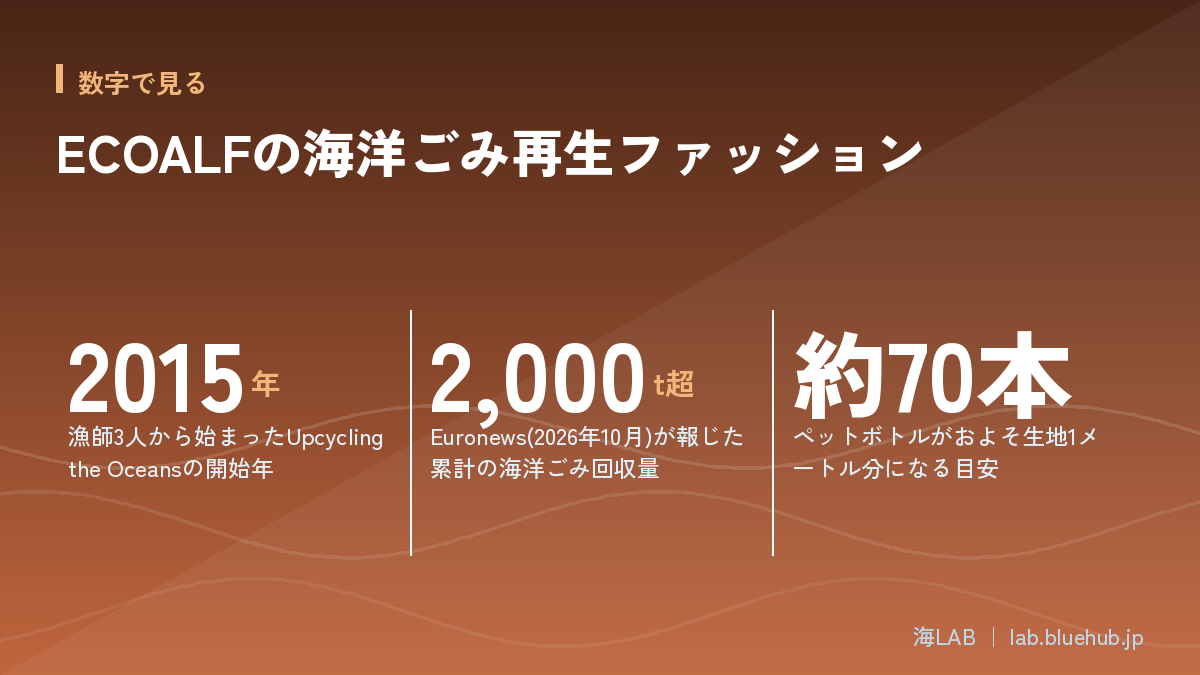
- Begun in 2015 with three fishermen, the project is reported to involve over 4,000 fishermen on the official page and about 5,000 fishermen and 2,000+ tonnes cumulatively by Euronews (October 2026).
- Recycled PET is said to cut water use by about 20%, energy by about 50% and greenhouse gases by over 60% versus conventional polyester, but these are company-provided figures.
- Plastic bottles are only about 5% of the recovered ocean waste; the rest includes nets and tyres. Recycling alone is not enough, and preventing waste at the source is essential.
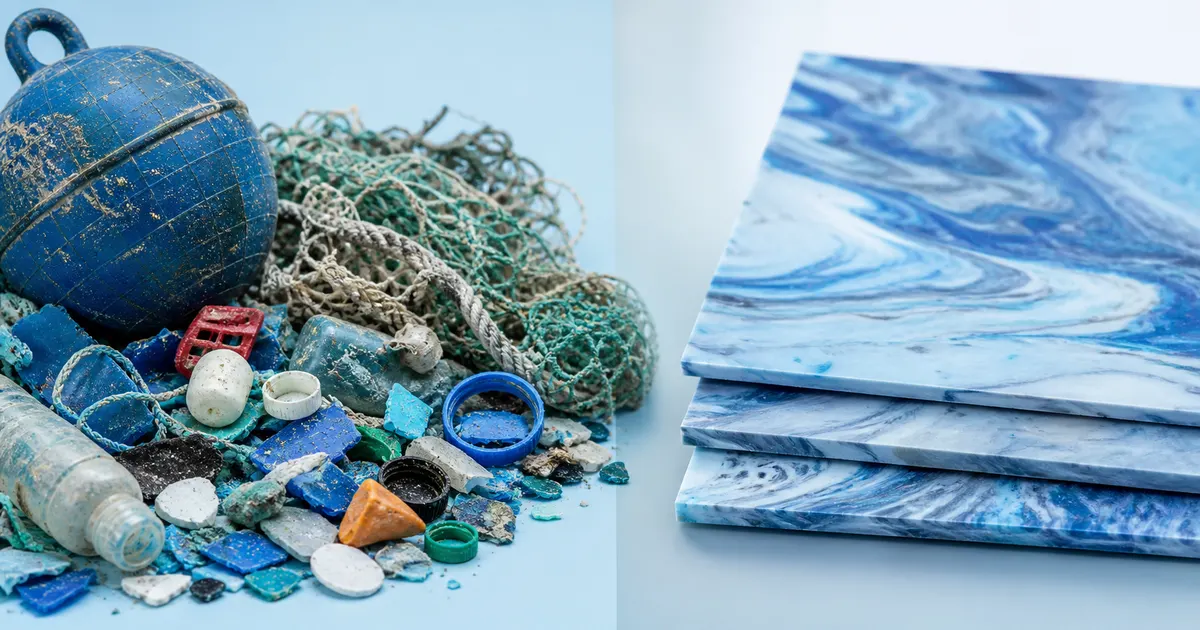
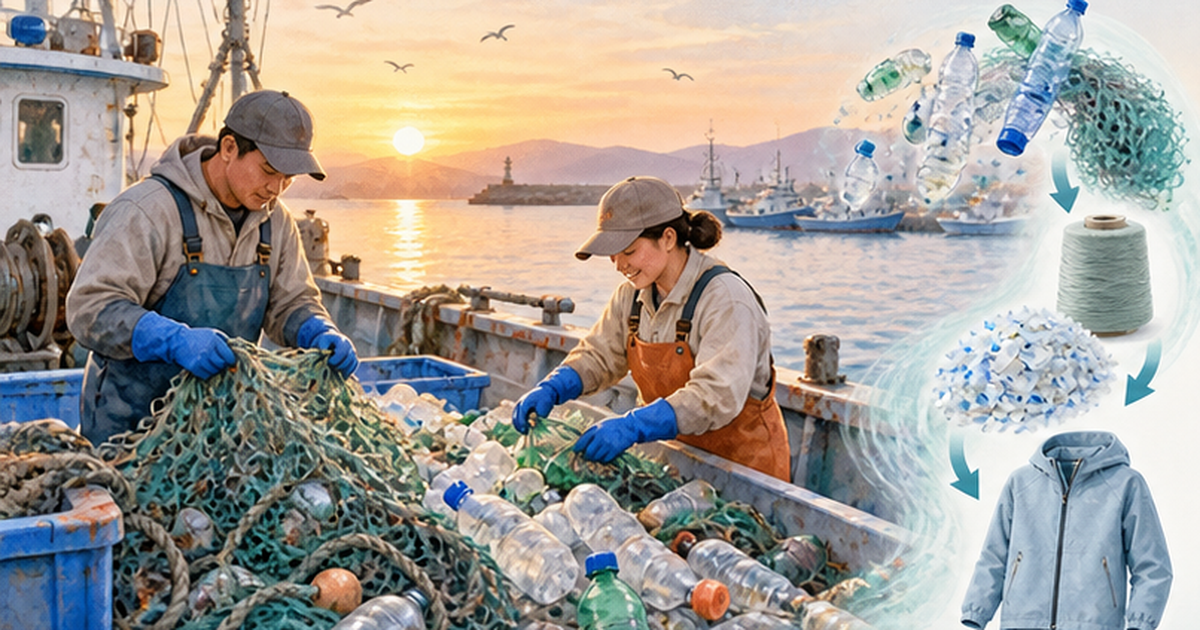
When fishing boats haul in their nets, they bring up not only fish but also bottles, plastic bottles, old fishing nets and rope. Much of this used to be thrown back into the sea. The Spanish fashion brand ECOALF asks fishermen to bring it back to port, then turns it into yarn and makes clothes, shoes and bags from it.
This scheme is called "Upcycling the Oceans." It began in 2015 with three fishermen in the Spanish Mediterranean port town of Villajoyosa, and it has since spread to several countries and dozens of ports. Its distinctive feature is that it links "reducing ocean waste" and "producing raw materials for clothing" in a single flow.
Drawing on public information such as official pages, news reports and materials from public bodies, this article covers how ECOALF's scheme works, the environmental load of its materials, its expansion in Japan, and the issues worth viewing with a cool head. Figures differ by source and date, so we state the source and time of each.
What you will learn in this article
- How ECOALF and Upcycling the Oceans came about and what they aim to do
- How seafloor waste is collected by fishermen and turned into yarn
- How the environmental load of recycled PET and recycled fishing nets compares with conventional materials
- Why recovery volumes and fisherman numbers differ between sources, and how to read them
- The expansion in Japan, and what buyers should keep in mind
- The problems upcycling alone cannot solve, and what we can do
What is ECOALF? A Spanish brand founded in 2009
ECOALF is a Spanish sustainable fashion brand founded in 2009. Its founder and president is said to be Javier Goyeneche, and its slogan is "There is no Planet B." Euronews (October 2026) describes annual revenue of around €65 million, about 300 employees and stores around the world.
Clothing built around recycled materials
The company is known for using recycled materials made from plastic bottles, discarded fishing nets, tyres, and offcuts of cotton and wool. A 2019 report on its entry into Japan described recycled materials made from waste such as nylon, coffee grounds, plastic bottles, cotton, wool and tyres.
The brand profile at Pitti Immagine states that the company has developed more than 600 recycled fabrics so far, which shows continuing research and development of new materials.
Division of roles between brand and foundation
The collection of ocean waste is run by a non-profit, the Ecoalf Foundation. The foundation also works to raise understanding of how plastic waste affects communities. Part of the brand's sales goes to the foundation: the Pitti Immagine profile explains that 10% of each item sold goes to the foundation, and that each €1 donated pays to remove 1 kg of ocean waste.
Basic facts
- Founded: 2009 (headquartered in Madrid, Spain)
- Project start: 2015 (together with the Ecoalf Foundation)
- Name of the recycled yarn made from recovered material: Ocean Yarn
- Most sources are company or foundation disclosures, not third-party verified figures
How Upcycling the Oceans works: fishermen bring back seafloor waste
The project started from the realisation that "fishermen work, every day, closest to the seabed." When trawling near the bottom, a large amount of waste comes up along with the fish. The Ecoalf Foundation's official page states that about 75% of marine debris lies on the seafloor, and explains the value of enlisting fishermen, who spend more than 12 hours a day at sea.
2015: starting with three fishermen in Villajoyosa
According to the official page, the activity began in 2015 with three fishermen at the port of Villajoyosa in eastern Spain. Rather than throwing the waste caught in their nets back into the sea, the fishermen collect it in dedicated containers at the port.
From sorting to recycled yarn
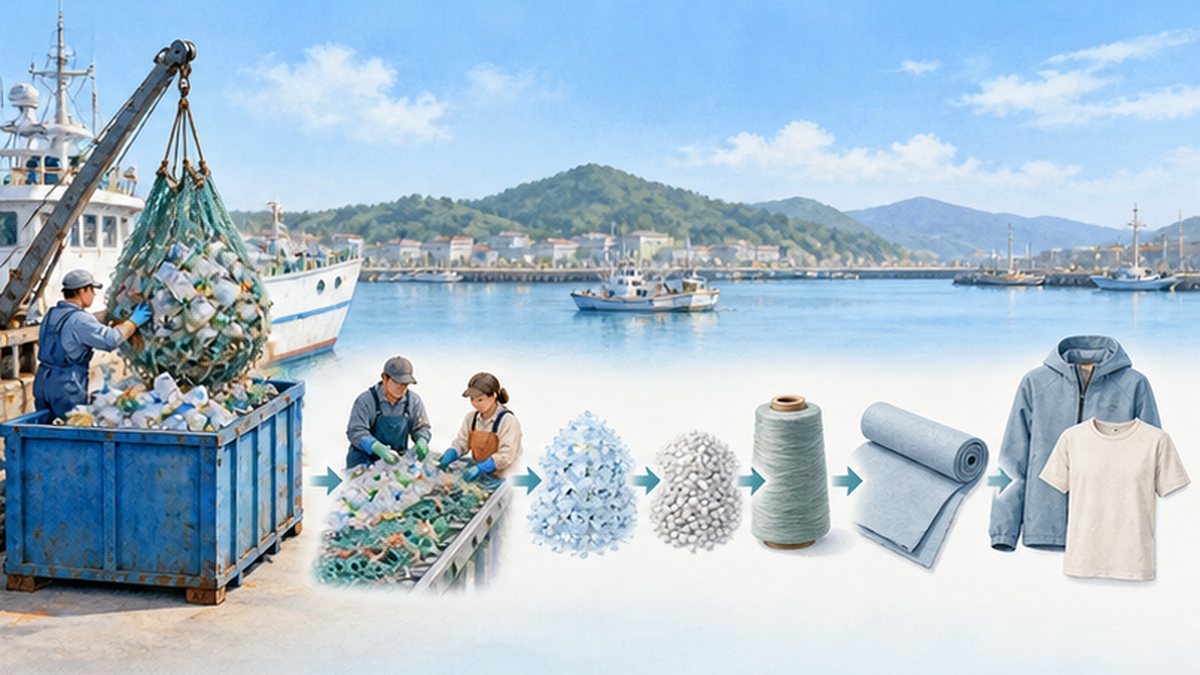
Combining the Circle Economy case study and the Euronews article, the flow is roughly as follows.
- While fishing, fishermen separate plastic bottles, nets and other waste caught in their nets from the fish and bring it back
- ECOALF collects the waste gathered at the port and sorts it by material
- Plastic bottles are shredded into flakes, then processed into pellets, and made into recycled polyester yarn
- Fishing nets are made into recycled nylon yarn
- The yarn and other recycled materials such as cotton and wool are made into fabric at the Madrid headquarters and then into clothes, shoes and bags
The recovered waste is not "just plastic bottles"
According to Euronews, plastic bottles make up about 5% of the recovered waste, and these become the raw material for Ocean Yarn. Other inputs include discarded fishing nets, tyres, and recycled natural fibres such as cotton and wool. Talking about the ocean problem as if it were only about plastic bottles would miss the bigger picture.
The scale in numbers: fisherman counts and volumes differ by source
Figures about ECOALF's activities vary with when and where they were published. This is because the activity keeps growing; it is less that the figures contradict each other, and more that you need to line them up by "as of when".
| Source | Fishermen | Volume / scale | Notes |
|---|---|---|---|
| Circle Economy case study | 3,000+ (54 ports) | 700+ tonnes | Likely an older figure |
| Impress Watch (2019) | About 3,000 | Not stated | Report from Japan launch briefing |
| Ecoembes page | About 2,600 | 1,196 tonnes | Older figure |
| Ecoalf Foundation official page | 4,000+ (later 4,500+) | 1,000+ tonnes (from the seabed) | Spain, Thailand, Greece, Italy, France |
| Pitti Immagine brand profile | Not stated | 1,700+ tonnes | Exhibitor profile |
| Euronews (Oct. 2026) | About 5,000 (about 80 ports) | 2,000+ tonnes (about 100 truckloads) | Expanded to France, Italy, Greece, Egypt, Thailand |
Targets that have been set
The official page states a goal of enlisting over 10,000 fishermen by 2025 and recovering 1,000 tonnes of waste from the Mediterranean each year. Euronews, as of October 2026, reports the goal of bringing together 10,000 fishermen across the Mediterranean, which suggests the original target year has not yet been met.
Cautions when reading the numbers
- Most recovery and fisherman figures are self-reported by the company or foundation and are not necessarily audited by a third party
- "Waste recovered from the sea" and "waste turned into material" are different things; recovered items include some unsuitable for recycling
- Because the figures are growing, always check the publication date
Environmental load of recycled materials: how do they differ from conventional ones?
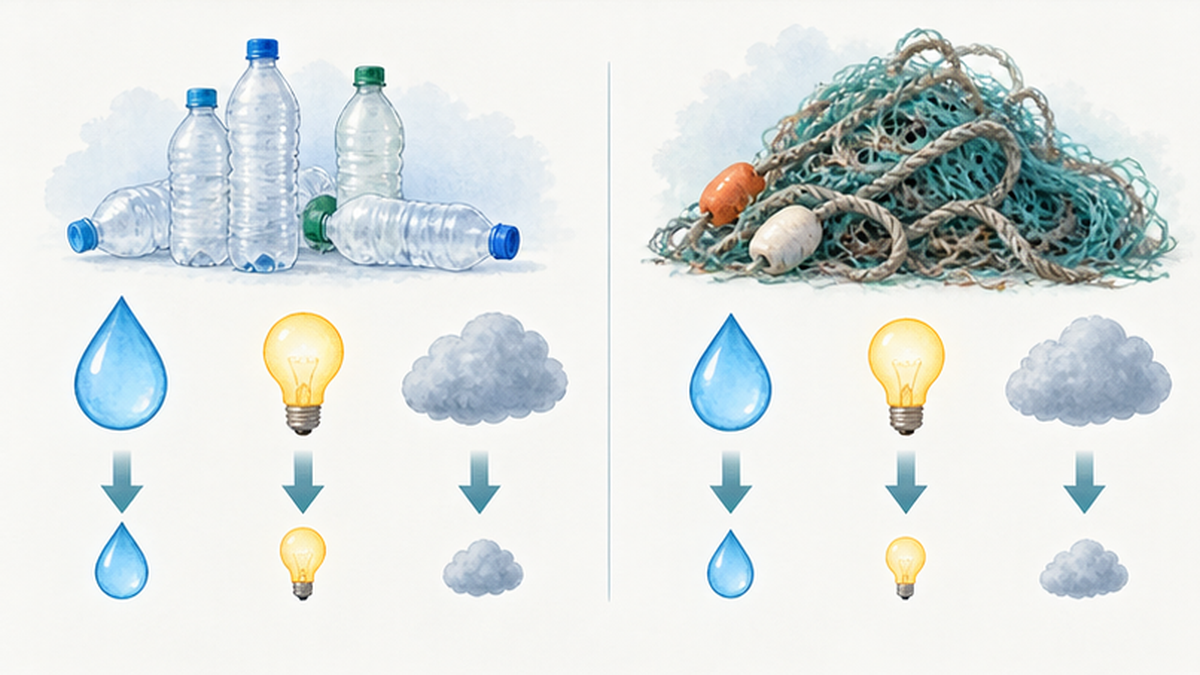
When waste is turned into yarn, the natural question is "is it actually better for the environment?" The Circle Economy case study contains comparison figures presented by ECOALF.
Recycled PET (from plastic bottles)
Compared with ordinary polyester, recycled PET is said to use about 20% less water, about 50% less energy and over 60% less in greenhouse gases.
Recycled fishing nets (nylon)
Compared with virgin material, it is said to save over 25% of natural resources and to emit about 28% less greenhouse gas.
| Material | Water | Energy | Greenhouse gases | Resources |
|---|---|---|---|---|
| Recycled PET (vs. ordinary polyester) | About 20% less | About 50% less | Over 60% less | — |
| Recycled net nylon (vs. virgin material) | — | — | About 28% less | Over 25% saved |
The same profile states that about 70 plastic bottles, or 135 grams of fishing net, make one metre of fabric. Expressed in everyday numbers, it is easy to picture.
How to read these comparisons
- The company's profile page alone does not give details of the comparison conditions (scope, year, method)
- The savings apply to the "material"; they may not include making the garment, transport, washing or disposal
- Even so, the direction, that the load is smaller than producing new virgin material, is consistent with what is generally expected from recycled materials
Significance for the sea: ghost gear and seafloor waste
The discarded fishing nets that ECOALF uses as raw material are linked to the problem known in the field as "ghost gear." Nets and ropes left in the sea cause entanglement of fish, seabirds and sea turtles, and keep harming marine life for a long time.
Beach cleanups are widely practised, but waste sunk on the seabed is out of reach of ordinary cleanups. A scheme in which fishermen who go to sea every day bring waste back as part of their normal fishing is one realistic approach to seafloor waste.
Related articles
- The ghost gear problem is explained in detail in Ghost gear and fisheries issues
- For fishing net recycling in general, see How fishing net recycling works
What it means for fishermen
The official page also publishes a short documentary and digital exhibition, "Ode to Our Ocean Heroes: The Fishermen," conveying what fishermen see at sea each day. Fishermen from Villajoyosa, France, Italy, Thailand and elsewhere speak in interviews about changes in the sea. It reflects a stance that treats fishermen not as "waste collectors" but as the people who know the sea's condition best.
On the other hand, bringing waste back is extra work for fishermen. For this to last, payment for the effort, acceptance arrangements at ports and a cost-sharing system are essential. Details are hard to see in public materials, and further disclosure is desirable.
What products come out of it: clothes, shoes, bags
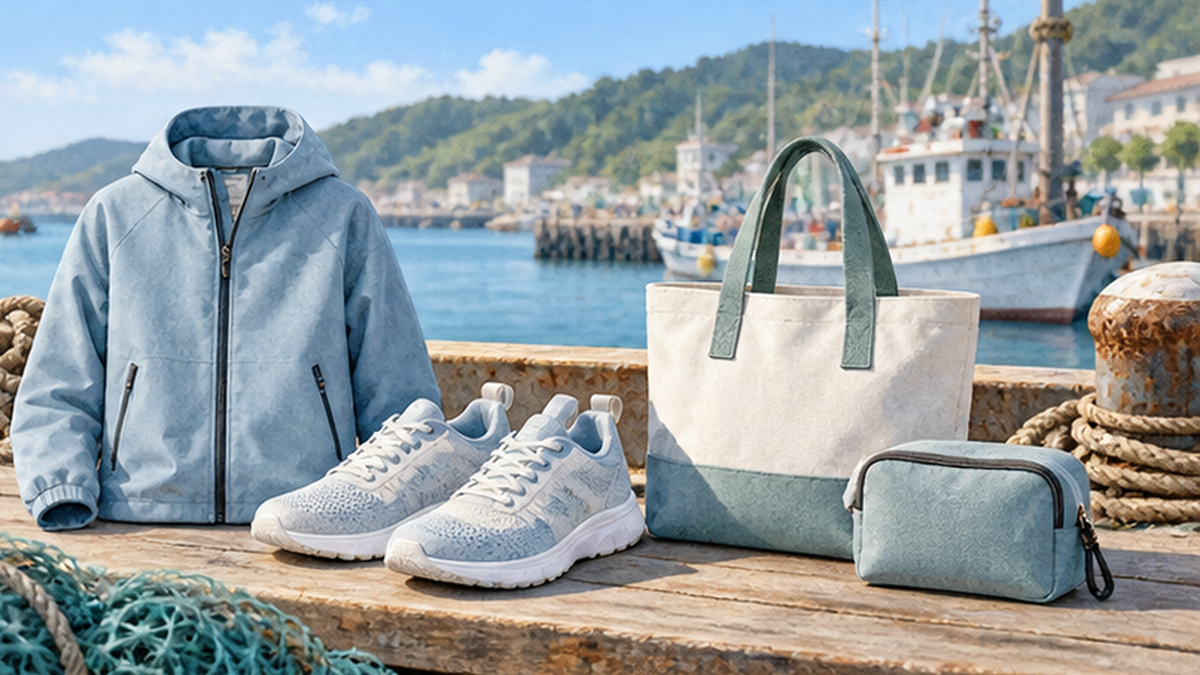
Recycled materials including Ocean Yarn are used in clothing such as outerwear, shirts and trousers, as well as shoes, bags and small goods. Reports on the Japan launch listed categories such as men's, women's, kids, shoes, accessories and yoga.
Expansion in Japan
According to Impress Watch, Sanyo Shokai and ECOALF established a new company, "Ecoalf Japan," in September 2019 and announced plans to operate in Japan from spring 2020. The plan was to open a flagship store in Jingumae, Shibuya in March 2020, to have 20 stores in the first year, and to aim for annual sales of 6 billion yen in fiscal 2025. This was the plan at the time, and the current number of stores and results should be checked on the official site.
A PR TIMES release also introduced the "UTO collection" of shoes and bags using plastic bottles from ocean waste.
Product examples
- Coats and outerwear: priced at 24,000–36,000 yen in reports at the time
- Shirts: around 15,000–19,000 yen
- Shoes: sneakers, sandals, beach sandals and more
- Accessories: pouches, wallets, bags and more
Prices are those reported at the time
The price ranges above come from reports at the 2019 briefing and may differ from current prices. Always check the latest official information when buying.
Euronews reports that the company designs garments so that they can be taken apart without extra processing. It is a feature meant to make it easier to put the materials back into circulation after use.
How it differs from other brands
ECOALF is not the only maker of clothing and goods from ocean plastic or fishing nets. This site also covers products using the net-derived material "NetPlus" from Patagonia and Bureo, and ocean plastic shoes from adidas and Parley.
- Patagonia's NetPlus products: outdoor goods using recovered fishing nets as recycled material
- Bureo's NetPlus products: supply and product development of net-derived material
- adidas and Parley: sports goods using ocean plastic
ECOALF's distinguishing features
ECOALF's distinguishing features are a brand design that builds most of its product lines from recycled materials, and an operation that puts a non-profit foundation in charge of collection itself, with fishermen at the centre. Rather than replacing only a part of the materials, it builds the whole brand on that premise, which gives it its character.
However, judging which brand's material is better requires several viewpoints, such as the performance of the product, traceability and the presence of certification. Public information alone cannot settle a ranking.
Issues to keep in view: upcycling is not a cure-all
The Euronews article does not simply praise the effort; it also presents the debates. The company's chief marketing officer says the biggest problem is mass overconsumption and overproduction, and that brands should adopt eco-design from the start rather than stopping at sustainable capsule collections or a focus on a single material.
A problem recycling alone cannot keep up with
The article also asks whether recycling can offset the new waste being generated. With roughly 8 million tonnes of plastic said to enter the oceans each year, a cumulative 2,000 tonnes recovered is only a small fraction. That does not mean recovery is pointless; rather, it takes effect only when combined with upstream measures that reduce the inflow.
| Issue | Details |
|---|---|
| Scale comparison | Against about 8 million tonnes of inflow a year, cumulative recovery is 2,000+ tonnes (figures quoted by the official page and Euronews) |
| Fast fashion | Euronews points out that sustainable clothing has a long way to go before it replaces mass-produced, mass-discarded clothing |
| Transparency | Recovery and fisherman figures are mostly self-reported; published third-party verification would raise trust |
| Fibre-derived waste | Clothes made from recycled polyester or nylon may also shed microfibres when washed |
Microfibres released in the wash
Even when recycled, synthetic clothing is known to shed tiny fibre fragments with each wash. Whether recycled or new, using a wash bag or a dedicated filter and washing less often are effective. For details, see Microfibres from laundry and ocean pollution.
What we can do: before buying, while using, when letting go
Choosing clothes made from ocean waste is one option. But the lowest environmental load comes from "wearing the clothes you already have for a long time." If you do consider a recycled-material product, keeping the following in mind helps you make the most of the effort.
What to check before buying
- Ask whether you really need it, or whether clothes you already own would do
- Check on the official site what percentage of the material is recycled and which processes are explained publicly
- Check whether the quality and design will last, and whether repair or take-back services exist
Tips while using
- Wash only as often as needed and use a wash bag
- Mend favourite clothes and wear them for a long time
- Also act to reduce plastic waste itself (reusable bottles, refills)
Options when you no longer wear it
Clothes you no longer wear can be reused, put into recycling collection or passed on. For the circulation of clothing, see also our article on products recycled from ocean plastic.
Three things you can do from today
- Mend one garment you own, or wear it more often
- Use a wash bag and review how often you wash
- Read the materials and collection information on the official site of a brand you are curious about
Summary: how to take this attempt to connect the sea and clothing
ECOALF's Upcycling the Oceans starts from fishermen's everyday work, recovers seafloor waste, and links it to yarn, fabric and products. The activity, which began in 2015 with three fishermen, has spread to ports in several countries, and an October 2026 report cites a cumulative recovery of over 2,000 tonnes.
At the same time, many of the figures are disclosures by the company and foundation, and given that roughly 8 million tonnes of plastic is said to flow into the sea each year, recovery and recycling alone do not solve the problem. It is important to hold three viewpoints together: curbing generation upstream, a culture of using clothes for a long time, and transparency about materials.
Summary of this article
- ECOALF was founded in 2009; it started Upcycling the Oceans in 2015, creating a scheme in which fishermen bring back seafloor waste
- Plastic bottles are about 5% of what is recovered; nets, tyres and more are included, and become recycled yarn such as Ocean Yarn
- Recycled PET and recycled nets are said to have a smaller environmental load than conventional materials, but the figures are company-provided
- Recovery and fisherman numbers differ by date and outlet, so check the time they refer to
- Even with recycled-material clothes, wearing them long, washing carefully and cutting waste remain the basics
References and sources
- Ecoalf Foundation | Upcycling the Oceans (official digital exhibition) – Start of activity (2015), fisherman numbers, volumes, targets
- Euronews | From ocean waste to fabric: inside Spain's sustainable fashion revolution – October 2026 report. 2,000+ tonnes cumulative, about 80 ports, production process and issues
- Circle Economy | ECOALF: Upcycling the Oceans project designs out waste with the help of fishermen – Sorting and recycling process, environmental comparison figures
- Pitti Immagine | ECOALF brand profile – 600+ recycled fabrics, 10% to the foundation, 1,700+ tonnes
- Ecoembes | Upcycling the Oceans – Project introduction (as of 1,196 tonnes and about 2,600 fishermen)
- Impress Watch | Sanyo Shokai to launch Spain's "ECOALF" in Japan – Ecoalf Japan establishment, Japan plans, product categories
- PR TIMES | ECOALF collection using plastic bottles from ocean waste – Ocean Yarn and products (Japan)
- BuzzFeed Japan | ECOALF turns sea waste into clothes – The project flow and fishermen's role (Japanese explainer)
※ Listed in order of reliability: government agencies > academic institutions > peer-reviewed papers > specialist bodies > reputable media