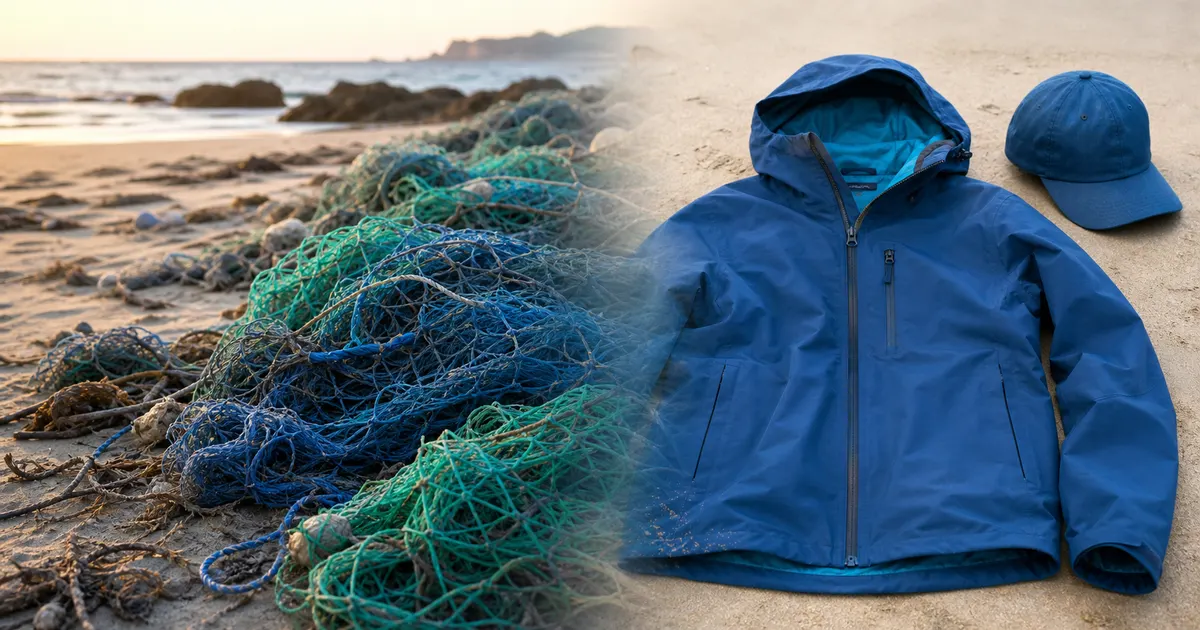
If you walk along a beach, you may come across a blue rope half-buried in the sand, or a tangled scrap of fishing net. This ownerless gear is, in fact, one of the most serious "killers" in the world's oceans today. Debris derived from fishing gear that has drifted into the sea—so-called ghost gear—is estimated at roughly 640,000 tons a year, indiscriminately entangling whales and sea turtles for decades on end.
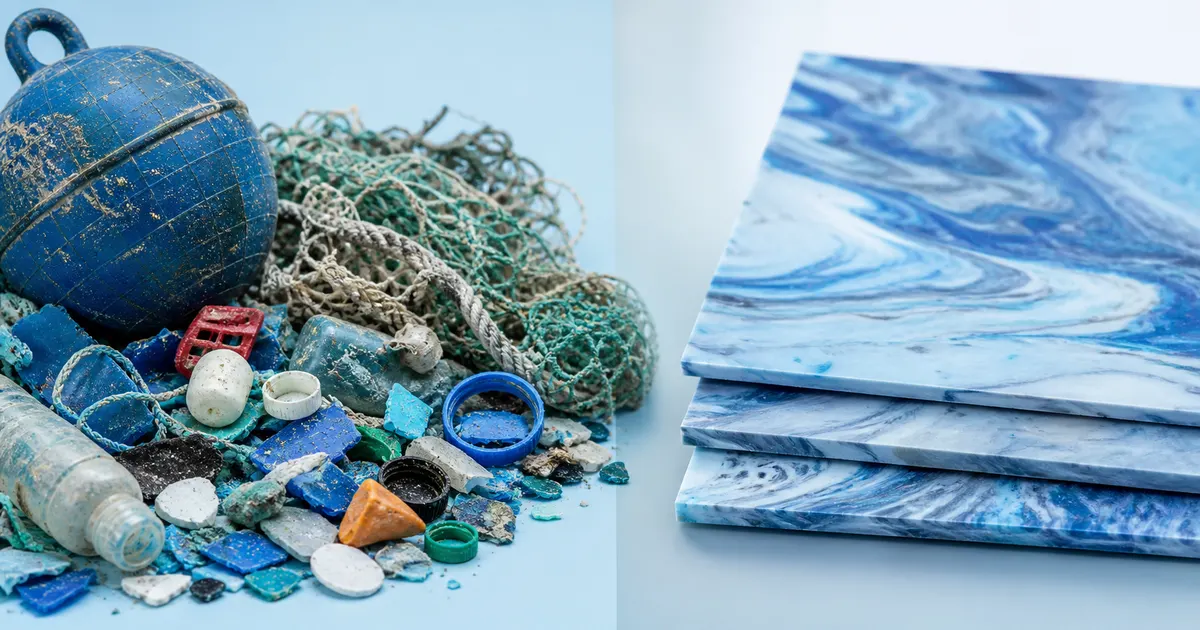
The outdoor brand Patagonia has tackled this problem through "material." Developed by the Chile-born company Bureo, and supported and adopted by Patagonia, is a material that collects 100% of discarded fishing nets and recycles them into thread and plastic—that material is NetPlus. The hard plastic becomes hat brims, and the supple fiber becomes the fabric of down jackets. Fishing nets that were once ocean debris are reborn as things we wear every day.
This article gently walks through, based on primary sources, the scale of the ghost gear problem, the journey NetPlus takes to turn fishing nets into products, the mechanism of traceability, and the honest question of effectiveness and limits—does recycled material really save the ocean? Let's look together at how the ordinary act of shopping connects to the sea.
What you will learn in this article
- Ghost gear accounts for about 10% of ocean plastic waste and continues to indiscriminately harm marine life
- NetPlus is a "traceable" recycled material made from 100% discarded fishing nets, whose origin can be tracked
- Even using the same fishing net, the recycling mechanism is completely different for a hat brim (hard HDPE) versus a jacket fabric (nylon fiber)
- The collection system creates supplemental income for fishing communities, generating a virtuous cycle that makes gear less likely to be discarded at sea
- Recycled materials also have limits, and using items for a long time and repairing rather than discarding them remains the choice that reduces environmental impact the most
What Is Ghost Gear?—An "Invisible Killer" Adrift at Sea
Ghost gear refers to fishing nets, ropes, traps, and fishing lines that have been abandoned, lost, or discarded and have drifted into the sea. A direct translation of the English term "ghost gear" is "the ghost of fishing gear." It is named this way because gear that has lost its owner drifts through the sea, operated by no one, continuing to entangle prey—a sight that truly resembles a ghost.
According to estimates by the UN Food and Agriculture Organization (FAO) and the UN Environment Programme (UNEP), roughly 640,000 tons of fishing gear flows into the sea every year. Some studies present a range of 500,000 to 1 million tons annually, but in any case, the volume is enormous. This debris derived from fishing gear is thought to account for roughly 10% of ocean plastic waste as a whole. The weight of 640,000 tons is said to be equivalent to more than 50,000 double-decker buses. That is the amount of "tools for catching fish" being added to the ocean every year, unmanaged by anyone.
Why does so much fishing gear flow into the sea? The causes can be broadly divided into three categories: "abandonment," where gear is unavoidably left behind due to storms or accidents; "loss," where gear is unintentionally lost due to rough weather or snagging on rocks on the seafloor; and "discarding," where old, damaged gear is thrown away without proper disposal. None of these are caused by malice alone—weather, accidents, and the structural circumstance that "there is nowhere to cheaply dispose of old fishing nets" are all intertwined. That is precisely why penalties alone are difficult to solve the problem, and the collection system itself needs to be rebuilt.
Why Is Ghost Gear So Dangerous?
Unlike a plastic bottle or a plastic bag, a fishing net was originally designed as a tool "for catching living creatures." Even after losing its owner, that function does not disappear. Rather, uncollected and drifting through the sea, it entangles fish, and large animals drawn to the carcasses become entangled in turn—a chain reaction (ghost fishing) that continues endlessly. Nets made of durable nylon or polyethylene are said to take hundreds of years to break down, meaning a single net can keep killing for decades. Moreover, nets gradually break apart in the sea into microplastics, returning invisibly to ecosystems, and eventually, to our own dinner tables.

According to the World Wide Fund for Nature (WWF), roughly two-thirds of marine mammals, half of seabirds, and all seven species of sea turtles have suffered harm from entanglement in or ingestion of ghost gear. Whales, seals, sea turtles, seabirds, sharks—the nets do not discriminate. Entangled creatures can no longer swim, cannot obtain food, or cannot surface for air, and slowly weaken. Some estimates suggest that plastic strangles, suffocates, and injures roughly 100,000 marine animals every year. How marine life lives and what threats it faces is explained in detail in the article on the impact of ghost gear on ecosystems.
Wildlife is not the only victim. Nets drifting on the surface tangle in ship propellers and leave vessels stranded, while nets sunk to the seafloor damage fishing grounds and rob fishery workers of their income. In other words, ghost gear is a kind of "compound disaster" that quietly chips away at marine ecosystems, fisheries, tourism, and safety all at once. Because it is hard to see and there is no clearly identifiable perpetrator, countermeasures also tend to be deprioritized—a further complication.
The True Nature of the Great Pacific Garbage Patch
Research examining the massive garbage accumulation zone floating in the North Pacific—the Great Pacific Garbage Patch—reported that, by weight, roughly 46% originated from fishing gear such as nets, ropes, and fishing lines. Since this had initially been estimated at around 20%, the figure came as a surprise even to researchers. Ocean debris is made up of "fishing gear" far more than we tend to assume.
Looking at the damage in numbers makes its severity clearer. The fact that 46% of the Great Pacific Garbage Patch's weight comes from fishing gear overturns the image many of us hold, that "ocean debris equals plastic bottles and plastic bags." Land-based plastic is, of course, also a major problem, but when it comes to large debris drifting on the open ocean, the leading role clearly belongs to fishing gear. This figure makes clear that when thinking about tackling ocean plastic, focusing only on "reducing single-use containers" is only half the picture—a perspective on stopping the flow of fishing gear is indispensable.
Not Someone Else's Problem for Japan Either
For Japan, a maritime nation with a thriving fisheries industry, this is an especially familiar problem. Some data shows that among the plastic debris that washes up on Japan's coastlines, fishery-related plastics such as fishing gear and buoys account for 50-60% by weight. WWF Japan has sounded the alarm over delayed countermeasures, requesting that the Ministry of the Environment grasp the nationwide reality of abandoned fishing gear at sea. Ocean debris is not a story about some faraway foreign country—it is an issue right next to the fishing grounds that support our own dinner table.
- Abandoned: Left behind unavoidably due to storms or accidents, or deliberately
- Lost: Unintentionally lost at sea due to rough weather or snagging
- Discarded: Old, damaged gear thrown away without proper disposal
Taking the initials of these, ghost gear is internationally referred to as "ALDFG" (Abandoned, Lost or otherwise Discarded Fishing Gear). It's a slightly technical term, but essentially it means that fishing gear accumulates in the ocean through a combination of "deliberately, accidentally, and out of sheer hassle." And once gear enters the ocean, it rides ocean currents across national borders, causing damage to the coastlines and ecosystems of far-off countries. That is precisely why ghost gear is positioned as an issue that no single country can solve alone—one that requires international cooperation.
What Is NetPlus?—A Recycled Material Born from 100% Discarded Fishing Nets
Patagonia took on this ghost gear problem with an approach of "turning discarded fishing nets into valuable material." That is NetPlus®, developed by Bureo and adopted by Patagonia. NetPlus is a post-consumer recycled material made from 100% used fishing nets collected from fishing communities around the world.
The key lies in two words: "100%" and "traceable." Whereas other recycled materials often mix in some new, petroleum-based plastic, NetPlus's raw material is fishing nets alone. Moreover, it has a system in place to track which country and which type of fishing net it came from. It's a material that reduces environmental impact in two ways—not only cutting down on waste, but also reducing the need to newly manufacture plastic from petroleum.
Behind this idea lies Patagonia's own stance as a company. The company has long advocated relying as little as possible on new, petroleum-derived materials, incorporating recycled polyester from plastic bottles and similar materials into its products. NetPlus is an extension of that stance, but what's new is that it set its raw material not as "land-based waste" but as "fishing gear about to leak into the ocean." By choosing a material that is itself a party to the ocean's problem, Patagonia is trying to create a cycle in which the more products sell, the more collection advances.

Hearing "made from ocean debris," some people might brace themselves, expecting inferior quality or appearance. But actually holding a NetPlus product in your hand, that worry mostly proves unfounded. The color and texture are indistinguishable from those of new material—so much so that, unless told, you likely wouldn't notice it was recycled. This, too, is by design. As long as an eco-friendly product is something you have to "put up with," the number of people choosing it won't grow. Being chosen first for its quality, and only afterward being surprised to learn "actually, this is made from ocean debris"—that order is precisely the shortcut to making environmental consideration not something special, but something ordinary.
Not "Upcycling" but "Regeneration into Material"
When you hear "product made from ocean debris," you might picture "upcycling," like a bag made by processing a net as-is. NetPlus draws a clear line from that approach. It is a "regeneration into material," where fishing nets are once returned all the way to the level of raw plastic (pellets), from which thread and parts are made anew. That's precisely why it can be applied to entirely different products, from the hard brim of a hat to the delicate fabric of a down jacket.
The stability of quality differs greatly between "processing as-is" and "returning to material." When a net is used as-is, color and strength tend to vary widely, and applications tend to be limited. Once returned to pellet form, thread thickness and fabric texture can be controlled while managing quality. It's a method that requires effort and energy, but in exchange, it secures the durability required for clothing worn against the skin every day, or outdoor gear used for years. Elevating ocean debris from a "compromised material" to a "chosen material"—that is NetPlus's aim.
NetPlus Expands Beyond Patagonia's Own Products
NetPlus is used not only in Patagonia products but also in other companies' products, such as Costa (sunglasses) and Futures (surf fins), and even in the board game Jenga. Bureo, the developer of the material, is the driving force behind this expansion. Efforts to reduce ocean plastic are also part of a broader movement to expand recycled materials into every corner of daily life. The perspective of rethinking our overall relationship with plastic is also connected to the article on ocean plastic and the problem of fishing gear.
This expansion of applications carries significant environmental meaning. Even if a material is collected and recycled, if there are few products that use it, the collected raw material loses its destination. Conversely, the more widely NetPlus is used—from caps to sunglasses to games—the more meaning there is in collecting more fishing nets, becoming the funding source that sustains the collection program itself. "Increasing the ways it's used" and "increasing collection" are two sides of the same coin, neither of which can turn without the other. The structure in which demand for a material sustains its collection is an essential perspective for making recycling truly function.
Three Reasons NetPlus "Works"
- By collecting fishing nets before they flow into the sea, it can prevent the very occurrence of ghost gear
- It reduces the use of virgin plastic, curbing petroleum consumption and CO2 emissions during manufacturing
- Fishery workers are paid for collection, creating an economic incentive to properly dispose of gear
| Perspective | Typical ocean-plastic products | NetPlus |
|---|---|---|
| Raw material | Partly recycled plastic + new plastic | 100% discarded fishing nets |
| Processing method | Often molded as-is (upcycling) | Returned to pellets and regenerated |
| Traceability | Often unclear | Collection site and type can be tracked |
| Range of applications | Limited | From hard parts to clothing fabric |
From Fishing Net to Product—Collaboration with Bureo
Supporting NetPlus is a company called Bureo. Based in Oxnard, California, and Talcahuano, Chile, Bureo launched its first fishing net collection program in Chile in 2013. Since then, it has worked directly with fishing communities around the world, building the collection system—it is "the parent of NetPlus."
Bureo's collection program now spans eight countries: Chile, Peru, Argentina, Ecuador, Mexico, the United States, the Seychelles, and Japan. Cumulative collection of used fishing nets amounts to roughly 14 million pounds (over roughly 6,300 tons). The Patagonia-Bureo collaboration alone has supported the collection and recycling of over 2,000 tons of discarded fishing nets.
What's interesting is that Bureo originally started from a small project: "making skateboards from fishing nets." Its founders, surfers themselves, became concerned about ghost gear polluting the ocean they loved, and first demonstrated with a familiar product that "a net can become value." That track record built trust, expanding into collaborations with major brands like Patagonia and, eventually, into apparel fabric. Building up small successes and growing the system from there—this is an important process for making an environmental business take root.
The Five Steps of a Fishing Net's Journey
- Collection: Retired fishing nets are gathered directly from fishery workers or at port collection sites
- Sorting: Sorted by material type, such as nylon or polyethylene
- Washing: Salt, sand, seaweed, and other buildup are washed off, leaving pure material
- Cutting and baling: Finely cut and bundled into easy-to-handle bales
- Regeneration: Bureo's recycling partners return the material to raw form through processes such as depolymerization, turning it into pellets
Among these five steps, "washing" and "sorting" are actually the most painstaking and important. Fishing nets used at sea are thickly coated with sand, seaweed, shellfish, oil, and salt. Unless these are removed, the quality of the recycled material won't be stable. Also, a single fishing net often contains multiple types of plastic mixed together, requiring careful sorting, done partly by hand. Behind the glamorous-seeming idea of "making things from ocean debris" lies this kind of painstaking, labor-intensive preparation work.

What makes the Patagonia-Bureo initiative special is that it has taken root not as a one-off donation or campaign, but as a "system" that has continued for over a decade. Rather than ending as a one-time feel-good story, it is precisely this continuity—accumulating annual collection volumes and gradually adding new countries—that has produced a figure of over 2,000 tons. Many environmental problems are determined less by a dramatic solution than by whether an unglamorous effort can be sustained over the long term. This system, unglamorous but steadily turning, also has value as a demonstration of a "model" other companies and regions can replicate.
The Hard Part Was Turning It into Thread
Making a part like the hard brim of a hat is relatively simple—just melt the plastic from the fishing net and mold it. But making "high-quality thread," like the fabric of a down jacket, from fishing nets was not so easy. Patagonia's material development team worked with supply chain partners to establish a method of chemically breaking down the fishing net plastic once, and returning it to a purity level suitable for making thread. Ocean debris becoming fiber for clothing worn against the skin—behind that lies painstaking technological development.
The chemical process used here is called "depolymerization." Synthetic fibers like nylon are made of small molecules (monomers) linked together in a long chain. Depolymerization is a technique that once unravels that chain down to individual monomer units, removes impurities, and then reconnects them cleanly. Doing this makes it possible to extract thread of quality comparable to new material, even from used fishing nets that varied in color and strength. Not simply "melting and hardening" but "rebuilding at the molecular level" was the key that made application to clothing possible.
By working directly with fishing communities, we are trying to offer a more responsible alternative to virgin plastic.
— Bureo (summarized from NetPlus's philosophy)
Collection Spans Eight Countries
Bureo's collection network spans eight countries: Chile, Peru, Argentina, Ecuador, Mexico, the United States, the Seychelles, and Japan. Since the type of fishing and the material of fishing nets differ from country to country, Bureo has built sorting and washing hubs while carefully building relationships with local communities. Rather than "exporting" a single system, Bureo's distinctive approach is to take root according to each region's circumstances.
Hat Brims and Jackets—Same Fishing Net, Different Mechanisms
What makes discussing NetPlus products interesting is that, even while using the same "discarded fishing nets" as raw material, the recycling mechanism differs completely from product to product. The key lies in the difference between the two types of plastic used in fishing nets.
Hat Brims = Hard HDPE
The brims of Patagonia's caps are made of 100% post-consumer recycled HDPE (high-density polyethylene). HDPE is a hard, durable plastic also used in plastic bottle caps and cutting boards. Within a fishing net, this corresponds to the parts used for ropes and floats. Because it is a hard part, melting it down and pouring it into a mold can produce a firm shape like a brim. Ocean debris becomes the skeleton that gives a hat its "shape."
The hat brim was actually one of the first applications of NetPlus to get off the ground. What a brim requires—"appropriate hardness" and "resistance to losing its shape"—is exactly the property HDPE excels at. Since it doesn't require the same delicate quality management as thread, it could be turned into a product relatively quickly. The brim of the cap you casually wear every day might once have been a rope catching fish in the seas of South America—thinking of it that way, you might get a small sense of how a familiar item connects to a distant ocean.

Jacket Fabric = Supple Nylon
Meanwhile, the outer fabric of jackets such as the Down Sweater uses NetPlus 100% post-consumer recycled nylon ripstop. This is a fabric made by recycling fishing nets collected from fishery workers on South American coastlines into fiber. According to Patagonia, roughly 118 tons of fishing nets have already been reborn as jackets, and products using NetPlus recycled nylon ripstop now exceed 100 items. The ability to extract both hard plastic and supple fiber from fishing nets underpins the broad range of NetPlus's applications.
"Ripstop" refers to a weave in which reinforcing threads are woven in a grid pattern, making the fabric resistant to further tearing even if it does rip. It's a standard structure in outdoor wear, which demands both lightness and durability. That thread made from ocean debris can weave this kind of high-performance fabric means NetPlus has already moved past the stage of "eco but with compromised performance." In fact, reviews note that wind resistance and lightness are comparable to models made with new material—environmental performance and practicality are starting to coexist.

| Example product | Material used | Corresponding part of original fishing net |
|---|---|---|
| Hat brim | Recycled HDPE (rigid) | Ropes, floats, and hard parts |
| Down jacket outer fabric | Recycled nylon fiber (supple) | Nylon netting |
| Sunglasses, fins | Recycled HDPE, etc. | Hard fishing gear parts |
In other words, NetPlus can be said to fully make use of a single fishing net as two resources—"hard plastic" and "supple fiber"—without waste. When a piece of ocean debris is collected, part of it goes to the skeleton of a hat, and another part to the fabric of a jacket, each role divided and put to use. This idea of "assessing a material's properties and using the right material for the right purpose" is exactly the kind of thinking behind a circular society that cherishes finite resources. NetPlus teaches us that reducing waste isn't just about not throwing things away—it's also about making full use of what already exists, to the very end.
Quick Fact: How Are HDPE and Nylon Different?
HDPE (high-density polyethylene) is a hard, water-repellent, easily molded plastic. Nylon is a synthetic fiber that is strong and elastic, and can be drawn out thinly into thread. A fishing net uses both of these for different roles, which is exactly why, even after recycling, it can be split into different products—a hard part and a soft fabric.
Tracing "Where It Came From"—The Value of Traceability
Another keyword that characterizes NetPlus is traceability. There are many products in the world that claim to be eco-friendly, but few can prove that their raw material "really is ocean debris" or "was really collected from where they say." NetPlus has a system that records and manages which country and region collected fishing nets came from, allowing the material's history to be traced.
Avoiding Greenwashing
Why does this matter? The reason is that vigilance is rising globally against "greenwashing"—environmental claims that do not match reality. Being able to trace a material's origin means being able to back up that claim with data. Consumers can receive the story of "we reduced ocean debris" as fact, not just vibe.
In reality, not a few products that claim to be "ocean plastic" or "derived from marine debris" actually use land-based waste that never reached the coast, or contain only a tiny fraction of recycled raw material. Even without malicious intent, if the flow of raw material is opaque, consumers have no way to verify the truth. Being able to clearly state, as NetPlus does, "100% fishing net" and "collection location on record" is, in itself, an indicator of a brand's integrity. It could even be said that Patagonia is deliberately raising the bar for what it takes to call something "eco."

A Mechanism That Gives Back to Fishing Communities
Traceability is also connected to giving back profits to fishing communities. Bureo's collection program is "incentive-based": either fishery workers are paid directly for the fishing nets collected, or donations are made to local environmental NPOs. In other words, it is a system in which bringing nets to a collection site is more profitable than throwing them into the sea.
This can be described as an attempt to economically reverse the structure at the root of the ghost gear problem—that "throwing it away is easier and cheaper." Reducing waste while also generating supplemental income for people living along the coast—this idea of making environmental protection and livelihoods compatible resonates with the concept behind blue carbon ecosystems, which protect tidal flats and seagrass meadows while also enriching local communities.
This kind of "protecting alongside the community" system is thought to be more sustainable than restricting people's behavior through regulation alone. With bans or penalties alone, gear will simply be discarded again in places beyond the reach of surveillance. But if "bringing it in becomes income," fishery workers themselves become motivated to collect gear voluntarily. Designing environmental conservation as a "benefit" rather than "something to endure"—this is an important idea common to various efforts to protect coastal nature. Regarding the connection between the ocean's bounty and our livelihoods, reading the article on rising sea temperatures and fisheries alongside this one will deepen your understanding.
In recent years, this kind of movement to "prove a material's history" has been becoming a global trend. In the EU and other countries, regulations requiring evidence for environmental claims are being put in place, making vague eco-advertising harder to get away with. Traceability is likely to become, not merely a matter of corporate goodwill, but a future standard of manufacturing. A pioneering example like NetPlus can be seen as getting ahead of that future standard. As buyers, we too can move the entire industry in a better direction by holding a mindset that asks not "does this vaguely seem good for the environment?" but "where did this material come from?"
Three Kinds of Trust Created by Traceability
- Trust from consumers: Eco claims are backed by fact, avoiding greenwashing
- Trust from fishery workers: Fair compensation is paid according to the amount collected
- Trust in the ocean: Collection results are published as numbers, allowing effectiveness to be verified
Can It Really Protect the Ocean?—The Effectiveness and Limits of NetPlus
Up to this point, we've introduced the positive aspects, but we also need to honestly examine the "limits." Recycled material does not clean up the ocean like magic. Let us calmly sort out what NetPlus can and cannot do.
What It Can Do—"Prevent" Occurrence
NetPlus's greatest significance lies less in collecting debris already drifting in the ocean than in collecting fishing nets before they flow into the sea, preventing the very occurrence of ghost gear. If a retired fishing net is reliably put onto a collection route, the possibility of it ever becoming ghost gear is cut off. The fact that the Patagonia-Bureo collaboration has spared over 2,000 tons of fishing nets from going out to sea is a solid achievement. Collecting debris that has already flowed into the sea is a task of searching for something whose location in the vast ocean is unknown—an enormously laborious task. Compared to that, collecting gear reliably at the port is far more efficient and certain.

The Limits—Only a Small Portion Can Be Collected
On the other hand, against an annual outflow of 640,000 tons, cumulative collection worldwide to date is still on the order of a few thousand tons. Collection programs still reach only limited coastal areas, and it is not easy to gather the vast quantities of ghost gear already drifting offshore. Recycling itself also consumes energy through processes such as washing, cutting, and chemical treatment. Recycled material is "a better choice than making something new," but it is not "harmless."
An even more fundamental challenge is that reducing the outflow of fishing gear requires changing the practice of fishing itself. The development of gear that is harder to tear, identification marking on gear (so it's clear whose net it is), a system for reporting lost gear, and the establishment of collection points where gear can be cheaply disposed of—only once these systems are established in each country will the outflow volume truly decline. A material business like NetPlus is an important piece within that bigger picture, but it is not a problem that a single company or a single product alone can solve. Only when international rule-making and the choices of us as consumers combine can real progress be made.
To Avoid Misunderstanding
Saying "if you buy a NetPlus product, the ocean will become clean" would be an overstatement. More accurately: "if you choose a NetPlus product instead of buying clothing made of new plastic, you put one fishing net that might have flowed into the sea onto a collection route, and reduce petroleum use a little." There is meaning in many people taking this small step.
And we must not forget that any recycled material still involves "newly making something." The choice that reduces environmental impact the most is actually to use what you already have for a long time, rather than buying something new. Ocean environmental problems are intertwined not only with fishing gear but also with the changes in fishing grounds due to rising water temperatures, and it's worth understanding this broader trend as well, as covered in the article on rising sea temperatures and their impact on fisheries.
That said, it would be premature to reject such efforts simply because of their limits. While we wait for a perfect solution to appear, fishing nets will keep flowing into the sea. What matters is neither overestimating that "this alone will save the ocean," nor underestimating it as "a drop in the bucket anyway," but adopting a posture of steadily accumulating what can be done. NetPlus is a good example showing that a company can engage with environmental problems through its core business (manufacturing), and perhaps its greatest value lies precisely in the fact that this system can spread to other companies as well.
What We Can Do—Ideas for Shopping and Everyday Life
So what can we, having read this article, actually do? Supporting efforts like NetPlus matters, but even more powerful is making a small shift in how we choose things day to day.
Three Perspectives When Buying
- Check the material label: Is it a recycled material, and is the origin of the raw material clearly stated (traceability)?
- Choose based on whether it will last: Is there a repair guarantee or after-sales service? Choose with the assumption that you won't replace it right away
- Ask yourself whether you really need it: The most eco-friendly choice is "not buying." First consider whether what you already have is enough

The perspective of "asking yourself whether you really need it" may sound a bit unremarkable. But no matter how excellent a recycled material is, making it still consumes resources and energy. So the garment with the smallest environmental footprint is "the one you didn't need to buy." That said, it's not realistic to keep denying yourself things you actually need. That's precisely why, when you truly need something, you should choose a recycled material whose origin is known, or a durable product built to last. This two-step approach of "reducing" and "choosing wisely" is a realistic form of eco-friendliness that can be sustained without strain.
Thinking All the Way Through to After Use
What the fishing net problem teaches us is that the impact on the environment can end up greater at the point of "discarding" than at the point of "making." The same is true of our clothes and tools. Don't send clothes you no longer wear straight to the trash—route them to used-clothing collection or recycling instead. Repair things when they break. Having a route in place for when you let go of something is an effort to avoid creating the next "ghost waste," so to speak, rather than ghost gear.
The fact that Patagonia has a program called "Worn Wear"—a system for buying back, repairing, and reselling used goods—is an expression of this same philosophy. Make things from good material, repair them when broken, and pass them on to the next person when no longer needed. The more this "cycle" turns, the less new material needs to be produced, and the total volume of debris flowing into the sea can also be curbed. Reducing waste at the "entrance" with NetPlus is not enough on its own—only when combined with keeping products alive for a long time at the "exit" does resource circulation truly happen in the full sense.
Everyday habits that reduce food loss and plastic waste are directly connected to the health of the ocean. Ocean debris is born from life on land, and eventually cycles back to marine life and, in time, to fish on the dinner table. This sense that our small daily choices are connected to the ocean should also help when thinking about a seemingly distant phenomenon like coral bleaching—see the article on the mechanism of coral bleaching.
Actions You Can Take Starting Today
- Decide to use the clothes and tools you already have "for one more year" (using things longer is the best form of eco-friendliness)
- Next time you buy something, take just a moment to check the material label and the origin of the raw material (traceability)
- When something breaks, consider repairing it first, and when you let it go, use used-clothing collection or recycling routes
- If you go to the beach and find a tangled rope or fishing net, collect it as debris (within a safe range)
Conclusion—Shopping Is Connected to the Ocean
Ghost gear flows into the sea on a staggering scale of roughly 640,000 tons a year, an "invisible killer" that indiscriminately harms living creatures. Patagonia's NetPlus is an effort to collect that fishing net before it reaches the sea and turn it, as a 100% recycled material, into hat brims and jackets. Hard HDPE and supple nylon, traceability, giving back to fishing communities—packed into it are painstaking efforts to turn waste into value.
At the same time, recycled material is not a cure-all. Only a small portion can be collected so far, and recycling itself requires energy. That is precisely why the most important thing is to "use things for a long time and not let go of them easily." On top of that, if you do buy, choose a material whose origin is known. The accumulation of these small choices reconnects the ocean and our lives.
Ocean debris is not something generated by a faraway country or some special someone else. It is an extension of each of our own acts of "making, using, and discarding" as people living on land, cycling back eventually to marine life and, in time, to the fish on our dinner table. The story of one material, NetPlus, has shown us that connection in a visible form. If, the next time you pick up a hat or a jacket, you can remember, just for a moment, the ocean that lies beyond that tag—then this article will have done its job.

Summary of this article
- Ghost gear flows into the sea at roughly 640,000 tons a year, accounting for about 10% of ocean plastic waste and 46% of the Great Pacific Garbage Patch's weight
- NetPlus is a 100% discarded-fishing-net, traceable recycled material, with different mechanisms for hat brims (HDPE) and jackets (nylon)
- Bureo handles collection across eight countries including Chile, and compensation to fishery workers creates a virtuous cycle that keeps gear from being thrown into the sea
- The Patagonia-Bureo collaboration has collected and recycled over 2,000 tons of fishing nets—but this is still only a fraction of the total outflow
- The most eco-friendly choice is to use things for a long time. If you do buy, the small choice of choosing a material whose origin is known shapes the ocean's future
References and Sources
- United Nations Food and Agriculture Organization (FAO) – The State of World Fisheries and Aquaculture 2022
- United Nations Environment Programme (UNEP) – Abandoned, lost or otherwise discarded fishing gear (2009 joint FAO/UNEP report, the original source of the roughly 640,000-ton annual estimate)
- World Wide Fund for Nature (WWF) – Ghost Fishing Gear: Ocean's Silent Killer
- WWF Japan – Let's Eliminate "Ghost Gear," a Cause of the Serious Ocean Plastic Problem
- Patagonia – NetPlus® Recycled Fishing Nets (official explanation of the NetPlus material)
- Bureo – How It Works / NetPlus® Supply Chain (the mechanism from collection to recycling)
- National Geographic – Great Pacific Garbage Patch Is Bigger and Mostly Made of Fishing Gear
- Greenpeace – Ghost Gear: The Abandoned Fishing Nets Haunting Our Oceans
* Listed in order of reliability: government and academic institutions > peer-reviewed papers > specialized organizations > reputable media