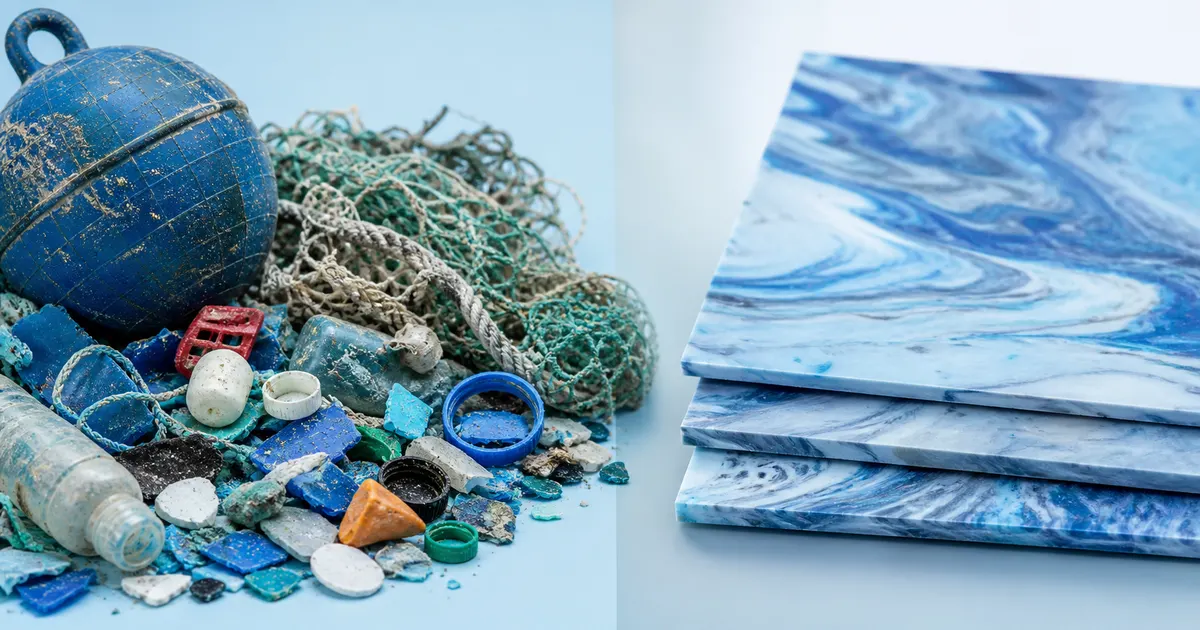
Debris picked up along the coastline is reborn as a vividly marbled tray or coaster. The one-of-a-kind everyday items behind this transformation come from "buøy," a brand created by Technolabo Co., Ltd., a plastics processing company based in Yokohama, Kanagawa Prefecture. The raw material is plastic waste that has washed up on beaches across Japan. Because no coloring agents are ever added, and the material is molded using the colors the waste already had, no two patterns are ever the same.
Ocean plastic waste is now a shared environmental challenge worldwide. According to Japan's Ministry of the Environment's White Paper on the Environment, an estimated 8 million tons of plastic waste flows into the ocean globally every year, and if effective countermeasures aren't taken, it's estimated that by 2050 the weight of plastic waste in the ocean will exceed the weight of fish. Until now, most of the washed-up debris that gets collected has had nowhere to go but landfill or incineration.
This article explains, in a way that's easy to follow even for first-time readers, how buøy turns this "ocean plastic waste with nowhere to go" into valuable everyday items—alongside the bigger picture of the ocean plastic problem. Let's take a look together at what you can buy, and what meaning lies behind that purchase.
What You'll Learn in This Article
- What kind of brand buøy is, and how it differs from ordinary recycled goods
- Why plastic waste washing up on coastlines has, until now, had no choice but to be thrown away
- How Technolabo's patented technology molds different types of plastic together without sorting them
- The idea behind traceability, where a product's color and pattern reveal "which sea it came from"
- Concrete ways to bring upcycled items like coasters and trays into daily life
- What upcycling can and can't do—and the real shortcut to reducing the ocean plastic problem
What Is buøy? The Idea of "Plastic with a Face"
buøy is an upcycling brand for ocean plastic waste, launched in July 2020 by Technolabo Co., Ltd., a plastics processing company based in Yokohama. The name comes from the "buoy" that floats on the sea. Like a buoy drifting on the water's surface, the idea is to "bring to the surface" plastic waste that had lost its place, turning it into everyday items that people come to love.
buøy's defining feature is that no coloring agents whatsoever are added to the ocean plastic raw material. The marbled patterns of blue, white, and red that appear on the trays and coasters are entirely made up of the original colors the collected waste already had. As plastics of various colors—PET bottle caps, detergent containers, fishing floats—melt together, a pattern unlike any other is born by chance. Technolabo describes this as "plastic with a face, whose finished look can never be predicted."
How Is Upcycling Different from Recycling?
A similar term is "recycling," but the two are somewhat different. Recycling refers to breaking down or melting a used product and, in many cases, turning it back into a material of lower value than before. Upcycling, on the other hand, is the idea of remaking waste into something of higher value while making the most of the material's individual character. buøy is a prime example of upcycling in that it turns the very color and texture of washed-up plastic—long treated as mere garbage—into an appeal.
buøy in a Nutshell
- Made from plastic waste collected from coastlines across Japan
- No coloring, no sorting—marbled patterns are made from the waste's original colors
- A brand of one-of-a-kind everyday items, no two patterns ever alike
- Created by Technolabo, a plastics processing company in Yokohama

The brand name "buøy" is a coined term inspired by the English word "buoy," and is pronounced the same way. In the logo, a diagonal line runs through the center of the "o," evoking both a buoy floating on the sea and the body of the buoy hidden beneath the surface. The ocean debris we normally see is, like an iceberg, only a small part floating on the surface—far more debris lies sunk beneath it and on the seafloor. Layered into the brand name is a wish for people to also turn their attention to this "unseen problem."
This Brand's Official Sitebuøy Official Site | Technolabo Co., Ltd.An interior goods brand that upcycles ocean plastic. See the concept and product-making process in detail.🔗 buoy.yokohamabuøy is not simply a brand selling "eco-friendly goods." It treasures the very moment when the person holding a product realizes, "This vivid color used to be trash floating in the sea." Drawing attention to the ocean plastic problem with beauty as the entry point—that is the idea at buøy's core. Among efforts that protect the coastal environment itself, activities such as tidal flat conservation protect the habitats of living creatures, and buøy can be seen as approaching the waste problem from the "exit" side.
This concept has been recognized both in Japan and abroad, and has repeatedly been featured in media and design publications. The candor of "not hiding the trash, but proudly showing that it was once trash" resonates with many people. A company that handles plastic deliberately confronting plastic's negative side head-on, and turning it into beauty—this twisted sincerity is exactly what sets buøy apart from a mere passing eco-trend.
Why Coastal Plastic Loses Its Way
To understand the significance of buøy, we first need to understand just how serious a problem ocean plastic waste is. Because plastic is light, durable, and cheap, it spread explosively from the latter half of the 20th century onward. But that same "durability" is the flip side of a weakness: plastic barely breaks down in the natural environment. Plastic that flows into the sea remains in the environment for decades, even centuries.
About 8 Million Tons a Year, Worldwide, into the Sea
According to Japan's Ministry of the Environment's White Paper on the Environment, an estimated 8 million tons of plastic waste flows into the ocean worldwide every year. That is an enormous amount, equivalent to tens of thousands of jumbo jets. Furthermore, if no effective countermeasures are taken, it is estimated that by 2050, the weight of plastic waste in the ocean will exceed the weight of the fish living there. East and Southeast Asia are said to be major sources of this plastic, but this is not a problem confined to any one country—it concerns all of us who use plastic in large quantities.

Much of Japan's Coastal Debris Is Also Plastic
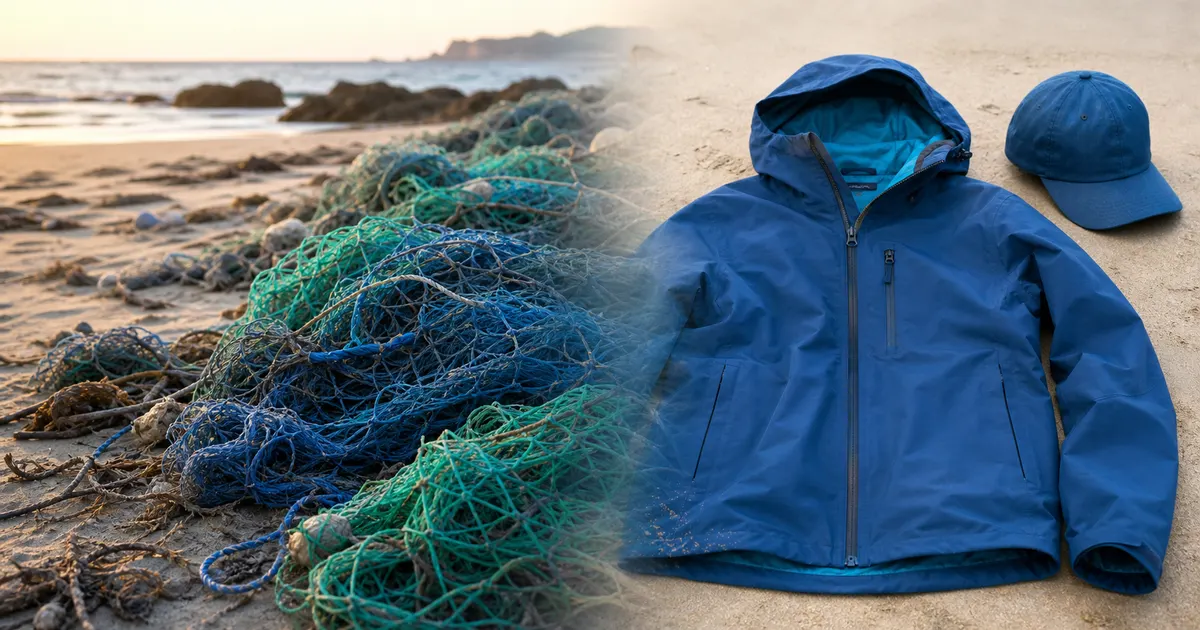
Japan is no exception. In monitoring surveys conducted by the Ministry of the Environment on coastlines nationwide, when washed-up debris is counted by item, plastics account for about 65.8%, the highest share of any category. This includes PET bottles and food containers, as well as a great deal of fishing-related debris such as nets, ropes, and floats. Countermeasures for plastic waste originating from fishing gear are being pursued in various regions—for example, the spread of recycling of fishing nets, which collects used nets as a resource. The Ministry of the Environment also estimates that, in fiscal 2023, 11,000 to 27,000 tons of plastic waste flowed from Japan's land area into the sea each year.
| Figure | Detail | Source |
|---|---|---|
| About 8 million tons | Estimated amount of plastic waste flowing into the ocean worldwide each year | Ministry of the Environment, White Paper on the Environment |
| 2050 | Year by which ocean plastic waste is estimated to exceed fish by weight | Ministry of the Environment, White Paper on the Environment |
| 65.8% | Share of plastics among debris washed up on Japan's coastlines (by item count) | Ministry of the Environment, Marine Litter Survey |
| 11,000–27,000 tons | Annual outflow from Japan's land area (fiscal 2023 estimate) | Ministry of the Environment |
There Was No "Exit" After Collection
Coastal debris is picked up daily through beach cleanup activities across the country. But there was a big wall here. Plastic that has washed up on a coastline becomes degraded, dirty, and mixed together with multiple types due to prolonged exposure to UV light, salt, and abrasion by sand. Since ordinary plastic recycling assumes that materials will be cleanly sorted by type, this kind of "mixed and degraded waste" has been difficult to recycle, and most of it has ended up in landfills or incinerators. Even after being carefully collected, it still ended up as "waste."
Where does ocean plastic waste actually come from in the first place? In fact, much of it is thought to be items used on land that flowed out to sea via rivers. Littered PET bottles and plastic bags, agricultural and fishing materials left outdoors, and debris blown away by the wind are carried by rain and rivers until they reach the sea. In other words, the ocean waste problem is not only an ocean problem—it is directly connected to our everyday lives. Even if you live in a city far from the coast, you are by no means unrelated to it.

Problems Caused by Ocean Plastic
- Sea turtles, seabirds, and fish mistake it for food and accidentally swallow it
- "Ghost fishing," in which marine creatures become entangled in nets and other gear
- "Microplastics" broken down to 5mm or smaller enter the food chain
- Degraded scenery, and economic damage to tourism and fisheries
Before It Breaks Down into "Microplastics"
Plastic left in the ocean breaks down into smaller and smaller pieces over time under the force of UV light and waves. Pieces that shrink to 5mm or smaller are called "microplastics." Once it gets this small, collection is nearly impossible, and it has been pointed out that plankton and fish take it in along with their food, potentially cycling back through the food chain to our own dinner tables. There are also concerns that additives contained in plastic, and harmful substances that attach to its surface in seawater, could accumulate in the bodies of living creatures. In other words, it is critically important to pick debris up on the beach while it is still large enough to collect, before it breaks down beyond our control.
This kind of ocean pollution also affects biodiversity. The waters around Japan are known worldwide as a rich sea, and in protecting Japan's marine biodiversity, how to reduce washed-up debris and how to make use of it after collection are themes that cannot be avoided. buøy is precisely a brand that has taken on this wall of "no exit after collection" with manufacturing technology. By preparing a destination—a product—for collected waste, it supports the motivation of the people who pick it up, and keeps waste in society before it breaks apart. In this dual sense, buøy's cycle plays a preventive role.
Technolabo, the Company, and the Birth of the "Plas+tech Project"
Technolabo Co., Ltd., the company behind buøy, originally had nothing to do with ocean waste. Based in Yokohama, Kanagawa Prefecture, it is a group of plastic-molding professionals handling everything from casing design for communications and medical equipment to small-batch production. Its president is Terukuni Hayashi. The engineers behind buøy are people who have spent years working closely with plastic as a material.
The Question of "How Should We Live with Plastic?"
buøy's starting point was an in-house research and development activity called the "Plas+tech project." Precisely because handling plastic is its business, Technolabo confronted head-on the question of "how should society live with plastic going forward?" as environmental problems grew larger. Plastic tends to be cast as the villain, but it is inherently an excellent material—light, resistant to rot, and easy to process. So could that character be put to use not for "single use," but in the direction of "crafts made to last"? That was the thinking.

A Shift in Thinking: From "Mass Production" to "One of a Kind"
When you think of plastic products, it's normal to imagine identical, uniform items made in large quantities from a mold. But Technolabo deliberately took the opposite approach. If mixed and degraded ocean waste is used as the raw material, it is only natural that the color and texture will differ from piece to piece. So why not affirm that "variance" as individuality rather than a flaw, and craft it as a one-of-a-kind piece? This shift in thinking is what made buøy possible as a distinctive brand. A company built on industrial products deliberately steered toward manufacturing where "no two are ever the same."
The color and pattern that emerge by chance are determined by the washed-up debris that was collected. That is exactly why no two are ever the same.
— From the buøy (Technolabo) brand concept
This direction goes beyond mere business. Through the product, the buyer comes to feel "the ocean waste of their own region" as something close to home, and it can become a trigger for taking environmental action. Technolabo positions buøy as an "upcycled craft that conveys the present state of the sea," and has grown it as a social enterprise that balances solving social issues with manufacturing.
It Started with Crowdfunding
The catalyst that brought buøy into the world was crowdfunding. Many people resonated with the idea of a craft made from ocean plastic waste and offered their support, allowing the project to reach product commercialization. It was the moment when a challenge that engineers at a small factory had steadily built up through prototype after prototype was accepted by society in the form of a support-purchase. This success became solid proof that "society needs this," and has served as the foundation for the brand's continued development ever since.
Yokohama, where Technolabo is based, is also known in recent years as a city actively promoting a "circular economy." From a one-way economy of make, use, and discard, to an economy that keeps resources circulating—buøy has grown as a local practical example that embodies exactly this philosophy, connecting with regional environmental activities and design communities along the way. A small manufacturing factory linked to its local sea, creating a circular loop—buøy's story also offers a hint for small and medium-sized businesses across Japan.
Basic Information on Technolabo and buøy
- Company name: Technolabo Co., Ltd. (Yokohama, Kanagawa Prefecture)
- President: Terukuni Hayashi
- Core business: Casing design and small-batch production for communications and medical equipment
- buøy launched: July 2020 (after a successful crowdfunding campaign)
- Origin: In-house R&D activity, the "Plas+tech project"
Mixing to Make the Most of It — buøy's Patented Technology and Manufacturing Process
Supporting buøy's manufacturing is a molding technology that Technolabo developed independently and has filed a patent for. As mentioned in the previous section, coastal plastic waste comes in a jumble of types, dirty and degraded. In ordinary recycling, "sorting by type first" is the basic premise. buøy, however, has turned that premise upside down.
The Unconventional Choice Not to Sort
The heart of buøy's technology lies in molding different types of plastic together while still mixed. Plastic comes in many types—polyethylene (PE), polypropylene (PP), polystyrene (PS), and more—each with a different melting temperature and set of properties. Normally mixing them is avoided because it destabilizes quality, but Technolabo established a method of molding them together into a single product by controlling the processing conditions. This has made it possible to use, as raw material, coastal waste that previously had to be thrown away simply because it "couldn't be sorted."

The Flow from Collection to Finished Product
buøy's products are roughly made through the following process. Washed-up debris collected by beach cleanup groups and others serves as the starting point for the raw material, which goes through washing, sorting, and shredding before being shaped into everyday items using Technolabo's proprietary molding technology.
- Beach cleanup groups and others collect washed-up plastic waste from coastlines nationwide
- Technolabo purchases that waste as "raw material"
- Attached sand and dirt are washed off, and foreign matter unsuitable for recycling is removed
- The plastic is shredded finely into flakes (types are not sorted)
- It is heated and molded while still mixed together, with no coloring agents added
- The color and pattern that emerge by chance are put to use to finish trays, coasters, and more
- Information about the collection site is recorded and stamped, and the product is sold as a one-of-a-kind item
What matters is that almost no new plastic or coloring agents are added to the raw material. That is exactly why a product's color directly reflects the makeup of that particular coastline's waste. A tray from one beach may be strongly blue, while one from another beach is whitish—such differences arise naturally. Taking advantage of plastic's "water resistance," many products are designed for use around water, such as planters and soap dishes.
The Craftsmanship of Working with the "Unpredictable"
Molding different types of plastic together is, in fact, technically very difficult. Because each type of plastic has a different melting temperature, hardening behavior, and shrinkage rate, mixing them can cause bubbles, brittleness, or unexpected warping. Drawing on years of know-how built up through small-batch production, Technolabo finely adjusts temperature, pressure, and mixing methods to draw out strength and texture that hold up to practical use even from mixed materials. Patiently working with material whose "outcome cannot be predicted"—that, precisely, is craftsmanship.
Also, because the composition of the raw waste changes every time it is collected, it's impossible to produce under exactly the same conditions each time. Even if a large order comes in for the same "blue tray," there's no guarantee that only blue waste will conveniently be collected. This very "unwillingness to go as planned" is, in essence, what makes buøy one of a kind. Seen from the world of industrial products, which has long pursued efficiency and uniformity, this is an unconventional idea—but it is exactly why a value found nowhere else is born from it.
Why buøy's Technology Is So Impressive
- It can mold materials while mixed, without sorting by type (patent-pending technology)
- It can use as raw material degraded waste that used to be almost 100% discarded
- Since no coloring agents are used, the waste's original color becomes the pattern as is
- It repurposes industrial small-batch production technology to solve a social issue
By "mixing to make the most of it" in this way, buøy keeps plastic that would otherwise have gone to landfill or incineration in society as a product. Fixing what would have been released into the atmosphere as CO2 if incinerated into a long-lasting everyday item instead—this idea also has something in common with concepts like blue carbon, which keep circulating resources and carbon locked in the sea or on land.
Where Does It Come from the Sea? — How Origin Traceability Works
What sets buøy apart from other upcycled goods is its traceability, which reveals "which sea this product's raw material came from." Just like place-of-origin labeling on food, buøy's products carry a record of their "birthplace."
Origin Stickers and QR Codes
buøy's products are sold with information about the collection site of the plastic waste that became their raw material. Depending on the product, a sticker indicating the origin may be attached, and items such as coasters have the collection site information stamped on the back. Furthermore, a mechanism has been introduced whereby scanning a QR code reveals which coastline, and which group, collected the waste. The person holding the product can engage with it not as a mere trinket, but as "something with the story of a specific beach."

Collaboration with Beach Cleanup Groups
buøy's raw material is gathered from groups doing beach cleanups on coastlines across Japan. Because Technolabo purchases that waste, for the people doing the cleanup, the debris they collected changes from "a troublesome burden that costs money to dispose of" into "a valuable resource." This carries great significance for improving the sustainability of volunteer activities. Those who collect, those who process, and those who buy—buøy's cycle only comes together when each of these is connected.
Waste collected during a beach cleanup doesn't become a product just as it is. Because sand, shells, driftwood, metal, cloth, and other foreign matter are mixed in, it takes effort to wash it, sort it, and extract just the plastic. It's precisely this patient preprocessing that makes the mix-and-mold technology work. When the cleanup groups' "power to collect" meshes with Technolabo's "technology to make use of it," new value is born from resources that used to be discarded. buøy is supported not by any one person's effort, but by this entire network of collaboration.
Waste that is collected becomes a resource that sells. That sense of reality becomes the motivation for the next cleanup activity.
— A way of thinking that connects coastal cleanup and upcycling
Why Having a "Visible Face" Matters
Knowing the origin has two effects. One is trustworthiness. More and more products claim to be "made from ocean plastic," but not a few are vague about exactly whose waste, and how much of it, was actually used. Clearly stating the collection site serves as proof that a product truly is made from ocean waste. The other is making it personal. If you know a product was made from waste collected on a beach in your own region, or one you visited on a trip, the ocean plastic problem suddenly becomes much closer to home. Origin traceability is a sign that buøy is trying to be more than a mere "eco-product"—it aims to be a medium connecting people and the sea.
This "visible face" mechanism also has power in educational settings. If students experience, through a school class or an ocean workshop, the process by which a coaster is made from the waste of a beach they themselves cleaned up, the ocean plastic problem stops being something confined to a textbook. Witnessing the flow of "collect → make use of → use" firsthand builds children's ability to think about the environment and act for themselves. buøy's traceability not only guarantees the trustworthiness of the product—it also serves as an entry point for relearning the relationship between people and the sea.
Three Key Points of the Traceability System
- Products come with collection site information (a sticker or a stamp on the back)
- A QR code lets you trace the background of the group and location that collected it
- Technolabo purchasing the waste economically supports cleanup activities
buøy's Product Lineup and How to Bring It into Daily Life
Having looked at the background so far, what kind of products does buøy actually offer? You don't need to overthink it—you can start simply by welcoming one favorite piece into your life.
Coasters and Trays Are the Signature Items
The item most loved as an entry point to buøy is the coaster. Prices start at around ¥1,100 (tax included) per piece. There are also lineups such as a two-piece gift box for ¥2,200 and a five-piece set for ¥5,500. Other items include round trays, leaf-shaped desktop trays (the leaf series), pen trays and clip trays, soap dishes, and planters—with a strong range of items for use around water, taking advantage of plastic's water-resistant properties. Larger items extend to interior products such as photo frames, vases, lamps, stools, and clocks.
The leaf-shaped "leaf" series is an ambitious work in which the designer gives ocean waste a "natural shape," expressing the contrast between waste and nature. Made of waste, yet as gentle as a single leaf resting in your palm—this paradox quietly asks the viewer to consider the relationship between plastic and nature. In this way, buøy's products are practical items that also double as small works carrying a message from the sea.
| Product Category | Example Uses | Approximate Price |
|---|---|---|
| Coasters | For guests, everyday cup rests, and gifts | From ¥1,100 each |
| Various trays (round, leaf, pen, clip) | Temporary storage for small items, stationery, keys | Roughly ¥1,000s and up |
| Soap dishes, planters | Around water or for greenery (water-resistant) | Varies by product |
| Vases, photo frames, clocks, lamps | An accent for your interior | Several thousand yen and up, depending on size |


Points to Consider When Choosing
Because buøy items are one of a kind, even products with the same name differ from piece to piece in color and pattern. That's exactly why "choosing by pattern" is the most enjoyable way to shop. Look closely at the photos and choose the one piece that suits your room, or the person you're giving it to—one that's strongly blue, one that's whitish, one with red or yellow as an accent color. It's also a good idea to check the origin information on the back and choose a piece from a coastline you have a personal connection to.
- Start with something affordable and easy to use, like a coaster or tray
- Since each piece is one of a kind, look closely at the photo to choose the color and pattern
- Choosing by origin (collection site) can deepen your attachment to it
- As a gift, you can share the story of the sea along with the item itself
Where Can You Buy It?
buøy can be obtained through its official online store, as well as at general goods stores, select shops, and corporate collaboration projects. Efforts are also underway to make buøy products as corporate novelties or commemorative gifts from waste collected on coastlines connected to a company, drawing attention as a way to demonstrate a company's environmental stance in tangible form. When considering a purchase, it's most reliable to check the latest stock, prices, and origin information on the official store.
View and Purchase Productsbuøy Official Online Store (STORES)Sells one-of-a-kind signature products such as coasters and trays. Check here for the latest stock, prices, and origin information.🔗 buoy.stores.jpCare for Long-Term Use
Because buøy products are plastic, they are basically water-resistant and easy to wipe clean with a damp cloth when dirty. However, since they are made from mixed materials, care should be taken with extreme heat. Avoid placing a hot pot directly on the surface, or leaving items near open flame or in a car under the summer sun for extended periods. Treated carefully, they can be used for many years, letting you put buøy's concept of "plastic that isn't thrown away" into practice in your daily life. Using something for a long time is, in fact, one of the most effective environmental actions of all.
Upcycled goods also make excellent gifts. Given for a birthday, an anniversary, or a housewarming, they carry a message of "caring about the sea" and "environmental consideration" along with the item itself. Since origin information is included, you can hand it over with a story attached: "This was born from waste collected on such-and-such beach." It becomes a gift that stays in the recipient's heart in a way that price or convenience alone cannot measure.
One Step You Can Take Today
- Bring home one buøy coaster to use when guests visit
- Next time you go to the beach, try a five-minute beach cleanup
- Check a product's origin and think, "I wonder what waste this came from"
- Share what you've learned about the ocean plastic problem and upcycling with family or on social media
What Upcycling Can and Can't Do
Efforts like buøy are highly meaningful for the ocean plastic problem. However, upcycling alone will not solve the entire ocean plastic waste problem. Let's calmly sort out what it can and cannot do.
What Upcycling Can Do
buøy's great achievement is that it created an "exit" after collection. It gave a product destination to degraded, washed-up waste that previously had no choice but to go to landfill or incineration. Furthermore, by purchasing the waste, it economically supports beach cleanup activities, and through beautiful products, it has the power to convey the ocean plastic problem to many people as something personal. Beyond the direct effect of reducing waste, its value as an "entry point" that changes people's awareness and behavior is significant.

The Limits of Upcycling
On the other hand, there are limits that should be honestly acknowledged. First is the issue of scale. Against the roughly 8 million tons of plastic flowing into the ocean worldwide each year, the amount that can be turned into crafts is only a tiny fraction. Upcycling alone cannot offset the volume of outflow. Second, microplastics that have already broken down to 5mm or smaller are extremely difficult to collect and cannot be used as raw material for products either. That is precisely why upstream measures to "not let waste flow into the sea in the first place" are essential for a fundamental solution.
| Aspect | What Upcycling Can Do | What's Difficult with Upcycling Alone |
|---|---|---|
| Volume of waste | Gives an "exit" to already-collected waste | Offsetting the millions of tons that flow in each year |
| Scope | Turns visible washed-up plastic into products | Collecting microplastics that have already broken apart |
| Nature of impact | Becomes an "entry point" that changes awareness | "Upstream measures" that stop the outflow at its source |
The Real Shortcut Is to "Reduce and Not Let It Flow Out"
The fundamental shortcut to the ocean plastic problem still lies in the 3Rs (Reduce, Reuse, Recycle), and especially the first R—"reducing the amount used in the first place (Reduce)." Using your own bag or bottle, avoiding single-use plastic, properly sorting waste so it doesn't end up in nature—the accumulation of these individual actions is, in fact, the most effective. Ocean environmental problems are interconnected: for example, the way red tides and eutrophication are caused by an influx of nutrients shares a structure with plastic waste, in that life on land affects the sea. If buøy has sparked your interest, please try connecting it to "reducing" actions as well.
Efforts to cut off plastic pollution at its root are also progressing in the international community. Discussions on building international rules covering the entire lifecycle of plastic, from production to disposal, continue at the United Nations, and reducing single-use plastic and building systems for reuse and regeneration are increasingly positioned as a shared global challenge. At the national level too, Japan has introduced charges for plastic bags and developed laws related to plastic, and companies are now being asked to devise ways to reduce waste from the design stage onward. Only when "exit"-side efforts like buøy and these "upstream" policies and international rules turn together as two wheels will the problem truly move forward.
Points to Avoid Misunderstanding
- Buying an upcycled product does not offset the waste that has already flowed out
- Some products labeled "made from ocean plastic" are vague about their origin—choose trustworthy products
- What has the greatest effect is, above all, to "reduce and not let plastic flow out" in the first place
- Upcycling is not a cure-all—think of it as a "trigger" that changes awareness
Conclusion: Using Beauty as an Entry Point to Connect with the Sea
buøy is an upcycling brand in which Technolabo, a plastics processing company in Yokohama, uses its own patented technology to turn coastal plastic waste into one-of-a-kind everyday items. The idea of using no coloring, no sorting, and making the most of the waste's original color has given new value and a new story to "waste that had no choice but to be thrown away." Through origin traceability, the person holding the product can trace "which sea it came from."
At the same time, upcycling is not a cure-all. Faced with the reality of roughly 8 million tons flowing into the ocean each year, only a tiny amount can be turned into products, and microplastics that have already broken apart cannot even be collected. That's exactly why it's important to receive efforts like buøy as "an entry point through beauty," and to connect them from there to the fundamental action of "reducing and not letting it flow out." A single coaster becoming the starting point for caring about the sea—that, I believe, is buøy's true value.

Summary of This Article
- buøy is an upcycling brand through which Technolabo regenerates coastal plastic waste washed up on shore (launched in 2020)
- Patented technology that molds waste while mixed, without coloring or sorting, turns waste that had no choice but to be discarded into one-of-a-kind everyday items
- Products come with collection site information and QR codes, letting you trace "which sea it came from"
- The lineup centers on items easy to bring into daily life, such as coasters (from ¥1,100) and trays
- Worldwide, about 8 million tons of plastic flow into the sea each year; upcycling is meaningful but limited in scale
- The fundamental shortcut is to "reduce and not let it flow out." buøy serves as an entry point to that interest
Efforts to protect the ocean environment go beyond the waste problem. There are activities from many different angles, such as restoring seagrass meadows, which protect and nurture places that serve as cradles for marine life. We hope this article has helped you find your own "step toward connecting with the sea."
References and Sources
※ Listed in order of reliability: government and academic institutions > peer-reviewed papers > specialized organizations > reliable media