⚡ In short
The medaka, beloved in the song "The Medaka School," was declared endangered in 1999. Beyond habitat loss and invasive species, well-meaning releases are disrupting nine distinct regional lineages through genetic disturbance.
As the old children's song goes, "the medaka school is in the river" — medaka were once an ordinary sight in rice paddies and streams across Japan. Yet in 1999 the Japanese Environment Agency (now the Ministry of the Environment) placed this everyday fish on the Red List as Vulnerable (VU). That a fish so familiar to everyone had become endangered came as a genuine shock at the time.
The decline isn't only about habitat loss from paddy-field consolidation, concrete-lined channels, and predation by invasive species. A newer, less visible threat has drawn growing attention: genetic disturbance caused by well-meaning "releases" and "let's increase the medaka" activities. Genetic analysis has revealed that medaka are not a single uniform fish nationwide, but a collection of "regional populations" that have developed distinct genetic traits over tens of thousands of years.
This article explains, based on primary sources, how medaka came to be endangered, the taxonomy behind the northern and southern medaka and their nine regional types, how paddy-field consolidation and invasive species have changed their habitat, and why releasing fish "with good intentions" turns out to be a problem.
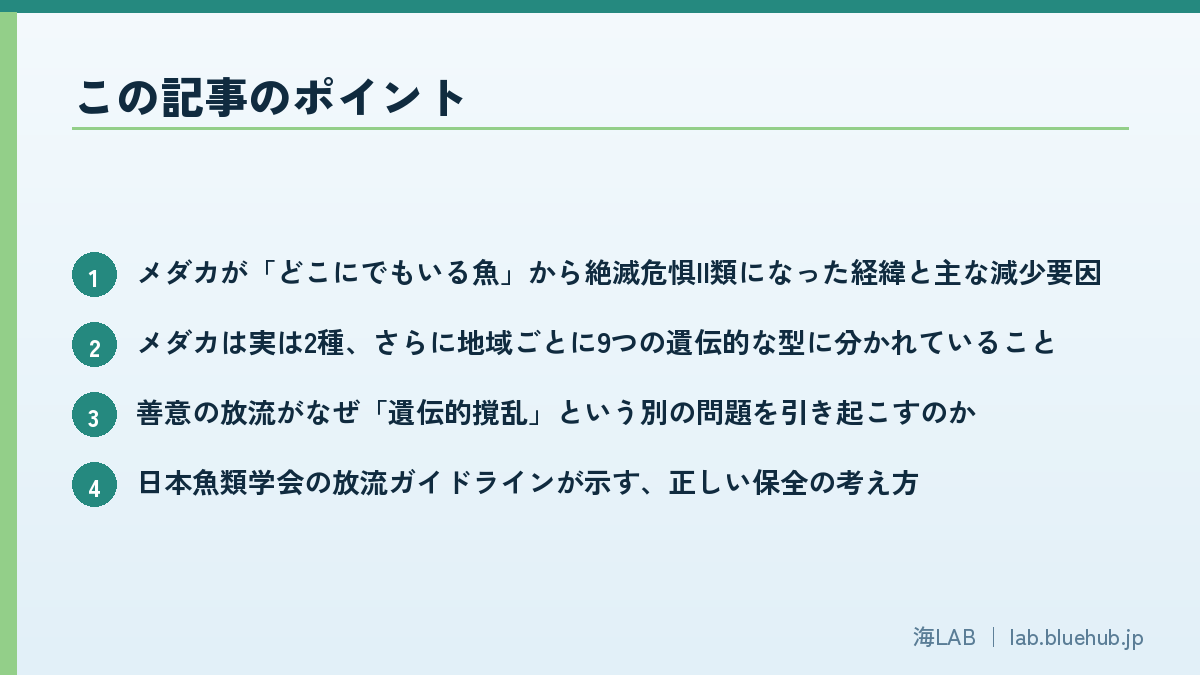
What you'll learn in this article
- How medaka went from "the fish found everywhere" to Vulnerable status, and the main causes of decline
- That medaka are actually two species, further divided into nine genetically distinct regional types
- Why well-intentioned releases cause a separate problem called "genetic disturbance"
- The correct approach to conservation, as laid out in the Ichthyological Society of Japan's release guidelines
- Regional conservation efforts underway across Japan, from school biotopes to university research projects
- Practical precautions anyone keeping medaka at home can start today
Why the fish of "the medaka school" became endangered
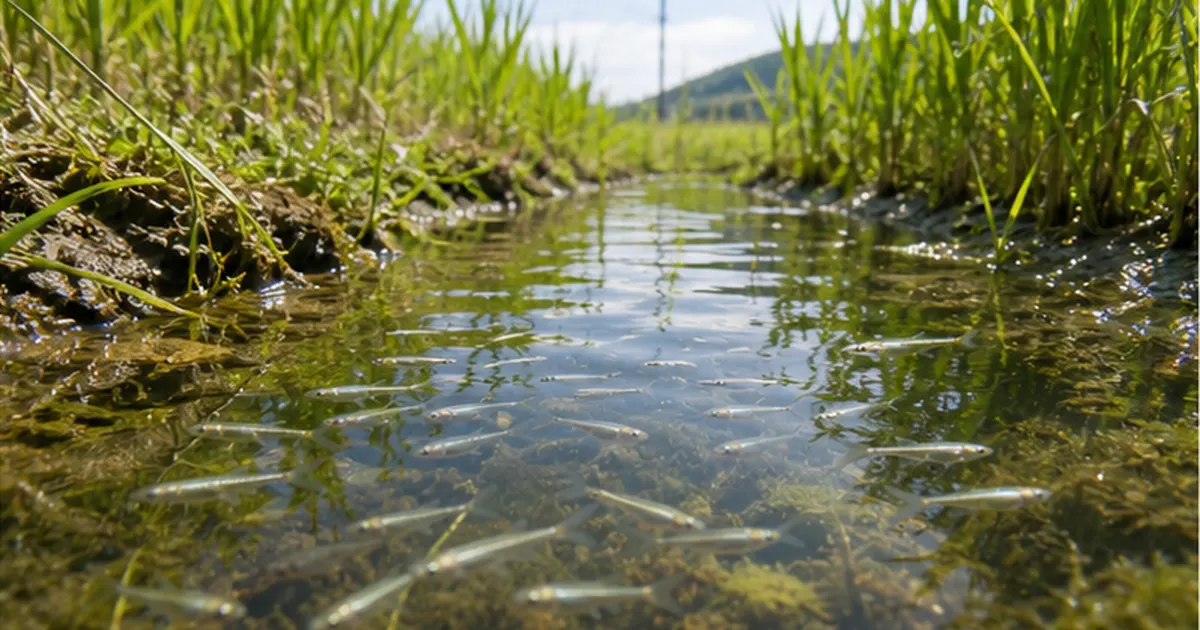
"Medaka no Gakko" ("The Medaka School"), with lyrics by Shigeru Chaki and music by Yoshinao Nakada, was written in 1950 and first broadcast in March 1951 on the NHK radio program "Children's Hour." The song is said to have been inspired by a school of medaka Chaki saw swimming in a paddy stream while evacuated during the war. More than seventy years after it first aired, the scene the song describes — medaka swimming happily together in a river — has disappeared from many parts of Japan.
In the 1950s, when the song was written, medaka were an ordinary fish found in rice paddies, irrigation channels, and ponds across nearly all of Japan. But in February 1999, the Environment Agency (as it then was) placed medaka on its Red List as Vulnerable (VU), a status maintained in the Ministry of the Environment's 2003 Red Data Book. Subsequent revisions kept the designation in place, and as of the Ministry of the Environment's Red List 2020, the "southern medaka" is still listed as Vulnerable.
It isn't only the national Red List. Many prefectural Red Data Books, compiled independently by local governments, also classify medaka (both southern and northern) as endangered or near-threatened. That a creature once synonymous with "the fish found everywhere" is now a conservation target at both the national and local level speaks to just how much familiar environments like paddies and channels have changed.
The vanishing of a once-familiar fish
Ministry of the Environment materials and reports from nature-observation groups across the country repeatedly record the same testimony: people can walk through paddy country and no longer encounter wild medaka. Because bred varieties sold in pet shops — such as "himedaka" and "yokihi medaka" — circulate nationwide, it's easy to mistakenly assume medaka overall aren't declining. But the Red List concerns wild populations living in the field, which is an entirely separate matter from how many bred varieties are in commercial circulation.
Timeline of the Red List designation (key points)
- 1999: First listed as Vulnerable (VU) on the Environment Agency's Red List
- 2003: Listed as an endangered species in the Ministry of the Environment's Red Data Book
- 2007: Red List revision splits the listing into "northern population" and "southern population"
- 2013: The 4th Red List again lists the two populations separately
- 2020: Red List 2020 continues to list the "southern medaka" as Vulnerable
"In-situ conservation" and "ex-situ conservation"
Conservation of endangered species generally follows two approaches: "in-situ conservation," which protects a population and its environment where the species naturally lives, and "ex-situ conservation," which maintains a species outside its natural range through captive breeding, cultivation, or preservation of genetic resources. For medaka, protecting paddy and channel habitat is the core of in-situ conservation, while, as discussed later, lineage preservation by universities and research institutions is also advancing as a form of ex-situ conservation.
That said, being listed as endangered doesn't mean it's "already too late." If anything, it plays the role of alerting society at large that action is needed. The fact that a creature everyone recognizes by name became endangered served as a symbolic event that made changes in familiar waterside environments visible, and it became an important starting point for subsequent conservation and environmental-education efforts.
Medaka are actually two species, split into nine regional types
Medaka is often assumed to be a single species, but taxonomically, in 2012, based on molecular genetic analysis (including work from Niigata University) and morphological verification by Toshinobu Asai, a graduate student at Kindai University, and colleagues, medaka were split into two independent species: the northern medaka (Oryzias sakaizumii) and the southern medaka (Oryzias latipes). The northern medaka is distributed mainly along the Sea of Japan coast from Aomori to Kyoto, while the southern medaka is distributed widely across the rest of the country.
Medaka have long attracted attention as a research subject because of traits well suited to biological study: a small body that's easy to keep, a short generation time, and transparent eggs that make observing development straightforward. Records show medaka were already kept as ornamental fish in the Edo period, making them a fish that has long been familiar to Japanese people both scientifically and culturally.
Nine regional types within the southern medaka alone
The story doesn't end there. Allozyme analysis (genetic analysis based on variation in enzyme proteins) has shown that the southern medaka is further divided into nine regional types: eastern Japan, eastern Seto Inland Sea, western Seto Inland Sea, San'in, northern Kyushu, Osumi, Ariake, Satsuma, and Ryukyu. Mitochondrial DNA analysis has also confirmed that these regional types represent genetically distinct lineages.
| Species / regional type | Main distribution |
|---|---|
| Northern medaka | Sea of Japan coast, Aomori to Kyoto |
| Southern medaka (eastern Japan type) | Pacific side of Kanto to Tohoku, etc. |
| Southern medaka (eastern / western Seto Inland Sea types) | Seto Inland Sea coast |
| Southern medaka (San'in type) | Sea of Japan coast of the Chugoku region |
| Southern medaka (northern Kyushu, Ariake, Satsuma, Osumi types) | Various parts of Kyushu |
| Southern medaka (Ryukyu type) | Okinawa and the Nansei Islands |
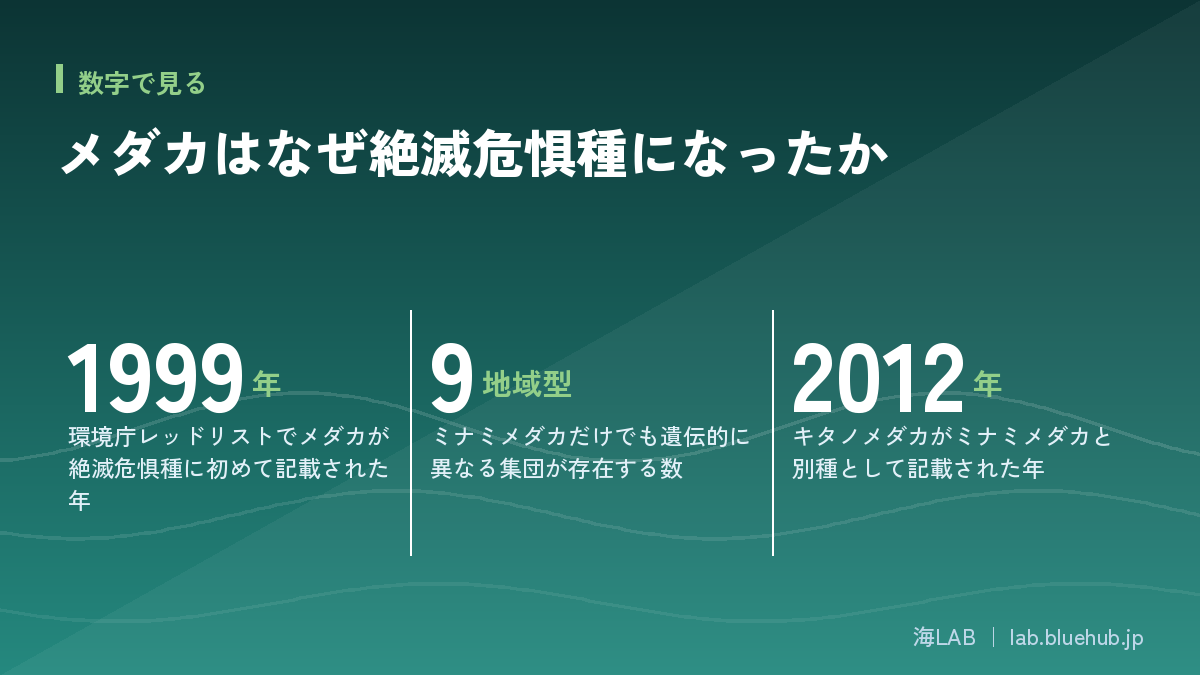
In other words, medaka from Kanto, Kyushu, and Okinawa may look nearly identical, but they are genetically distinct populations that have evolved separately over tens of thousands of years. This fact is essential background for understanding the "release" problem discussed later.
"Medaka as lab animals" and "wild medaka" are separate issues
The southern medaka (Oryzias latipes) is also used worldwide as a laboratory animal in genetics and developmental biology, and it is one of the classic model organisms whose genome has been sequenced. Laboratory strains of medaka (inbred lines) maintained in research settings do not themselves represent the genetic diversity found in the wild. It's worth noting that using medaka as laboratory animals and conserving wild regional populations are entirely different undertakings, both in purpose and method.
This classification into two species and nine regional types is more than an academic exercise. By showing that the conservation unit previously treated as a single category — "medaka" — needed to be reconsidered in finer detail, it significantly shaped subsequent conservation policy and release guidelines. The substance of "protecting the endangered medaka" turned out to be the more delicate task of "protecting nine distinct regional populations individually."
This kind of fine-grained regional structure isn't unique to medaka. Among freshwater organisms with limited mobility, such as loaches, bitterling, and salamanders, populations are often isolated for long periods by river watersheds and terrain, giving rise to distinct regional genetic lineages — a pattern reported repeatedly. Medaka has become a representative symbol of this "hidden diversity" among Japan's freshwater organisms.
Main cause of decline ① Paddy-field consolidation and concrete-lined channels
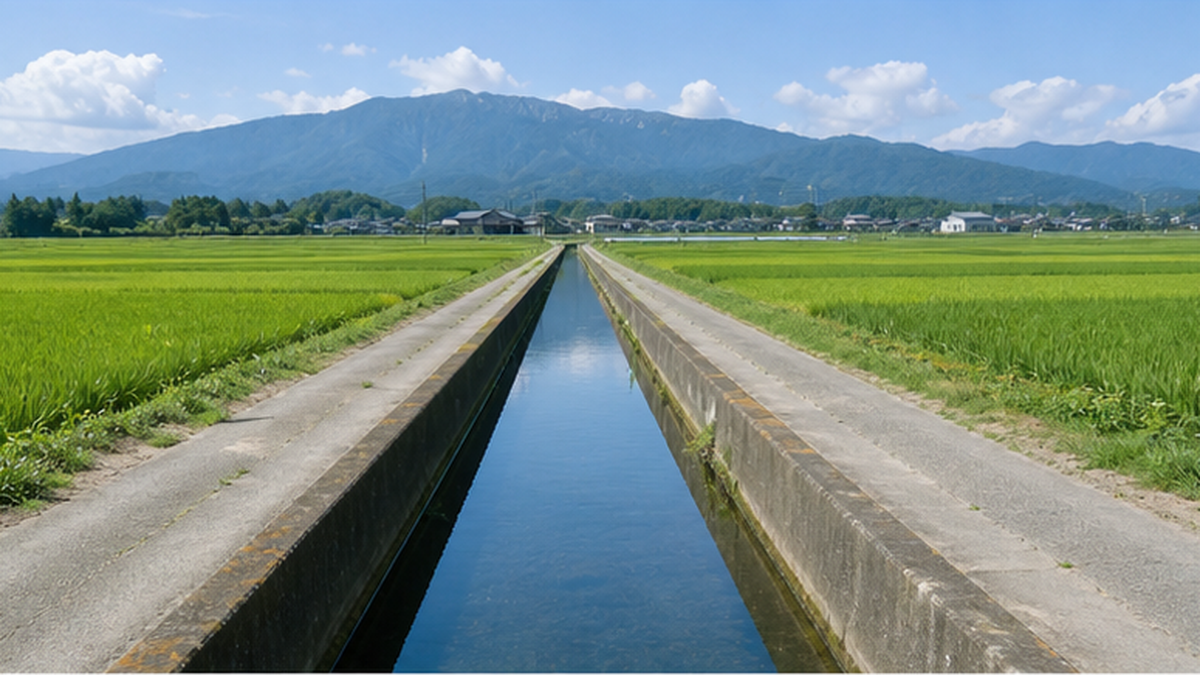
The primary cause of the medaka's decline is agricultural infrastructure development (paddy-field consolidation) that accelerated after the postwar period of rapid economic growth, along with the resulting concrete-lining and straightening of irrigation channels. Gently flowing earthen channels with aquatic plants provided both the vegetation medaka need to lay eggs on and the complex terrain fry could hide in from predators. But concrete-sided channels have faster currents and support little to no aquatic vegetation, so the very spawning grounds disappear.
According to Ministry of Agriculture, Forestry and Fisheries data, as of March 2014, paddies consolidated into plots of roughly 30 ares or larger totaled about 1.57 million hectares nationwide, or about 64% of all paddy fields. While this consolidation greatly improved farming efficiency, it also eliminated the once-intricate network of channels and the seamless connections between paddies and channels, dramatically simplifying the fine-scale terrain that organisms relied on for spawning and growth.
Dry-field conversion and drop structures compound the problem
"Dry-field conversion," in which fields are no longer flooded through winter, and the installation of "drop structures" that create a height difference between a paddy and its channel, have also cut off the routes medaka once used to move between paddies and channels to spawn and overwinter. While these changes have reasonable justifications tied to more efficient rice farming, they have also drastically simplified the fine-scale habitat features that organisms around the paddies depended on.
Urbanization and river modification are factors too
Beyond rural paddy-field consolidation, Ministry of the Environment materials also point to the loss of waterside habitat from suburban housing development and river modification as a factor in the broader decline of paddy- and channel-dwelling organisms, including medaka.
Not a single culprit, but "compound environmental change"
It's important to note that paddy-field consolidation itself isn't simply "bad." It's necessary infrastructure for supporting Japan's food production, but its impact on waterside life varies greatly depending on how it's carried out. In recent years, land improvement districts around the country have experimented with approaches that balance productivity with wildlife habitat, such as installing "paddy fish passages" (structures that ease the height difference between a paddy and a channel) and preserving small "refuge pools" called "e," part of the "fish cradle paddy" concept.
Innovations balancing productivity and wildlife habitat
- Paddy fish passages: structures that ease the drop between channel and paddy so medaka and loaches can move between them
- "E" (refuge pools): small, deep pools left in a corner of a paddy where fish can take refuge as water levels drop
- Near-natural channels: channels that use earth and natural stone rather than three-sided concrete, making it easier for aquatic plants to grow
- Winter flooding: keeping water in paddies even after harvest, preserving an environment where fish can overwinter
Main cause of decline ② Predation and competition from invasive species like mosquitofish
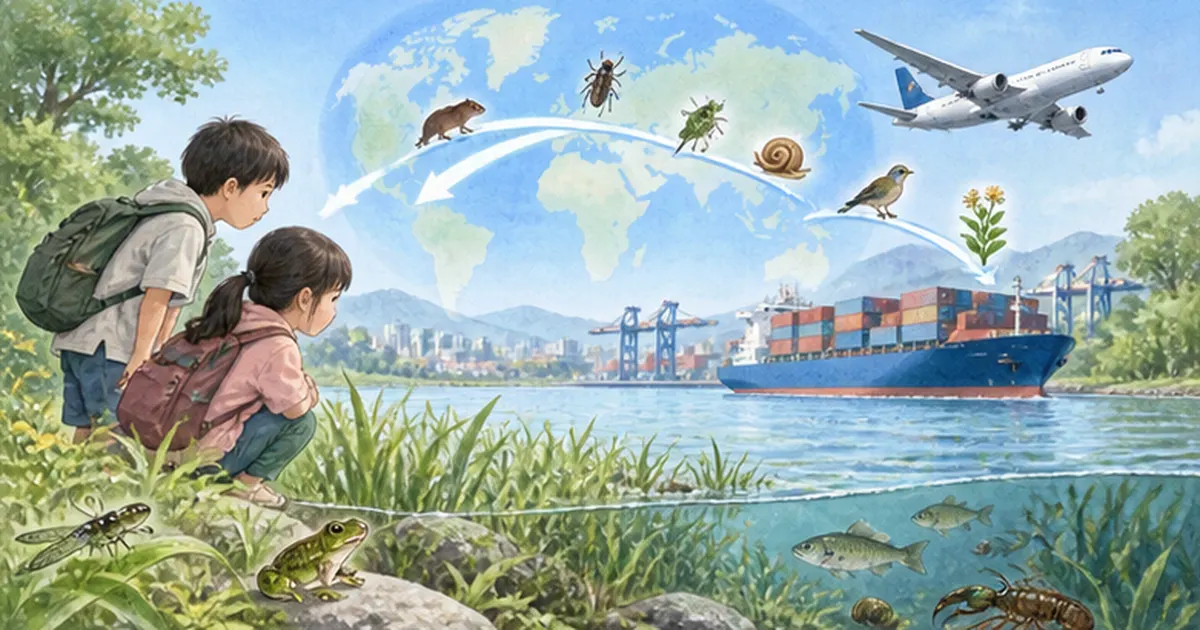
The second major cause is the impact of invasive species. Of particular concern is the western mosquitofish (Gambusia affinis). This small fish, native to North America, was introduced to various parts of Japan to control mosquito larvae, and it has been designated an Invasive Alien Species under the Invasive Alien Species Act, which took effect in 2005.
Mosquitofish were brought to Japan via Taiwan in 1916 to control mosquito larvae, first released in Shiga and Wakayama prefectures. They were subsequently transplanted by people from Tokyo to Tokushima and then from Tokushima nationwide, rapidly expanding their range from the 1970s onward. As their Japanese name — literally "mosquito-exterminator" — suggests, they were welcomed at the time as pest control and deliberately released in many areas. Ironically, this well-intentioned introduction of an alien species later became one cause of the decline of native medaka.
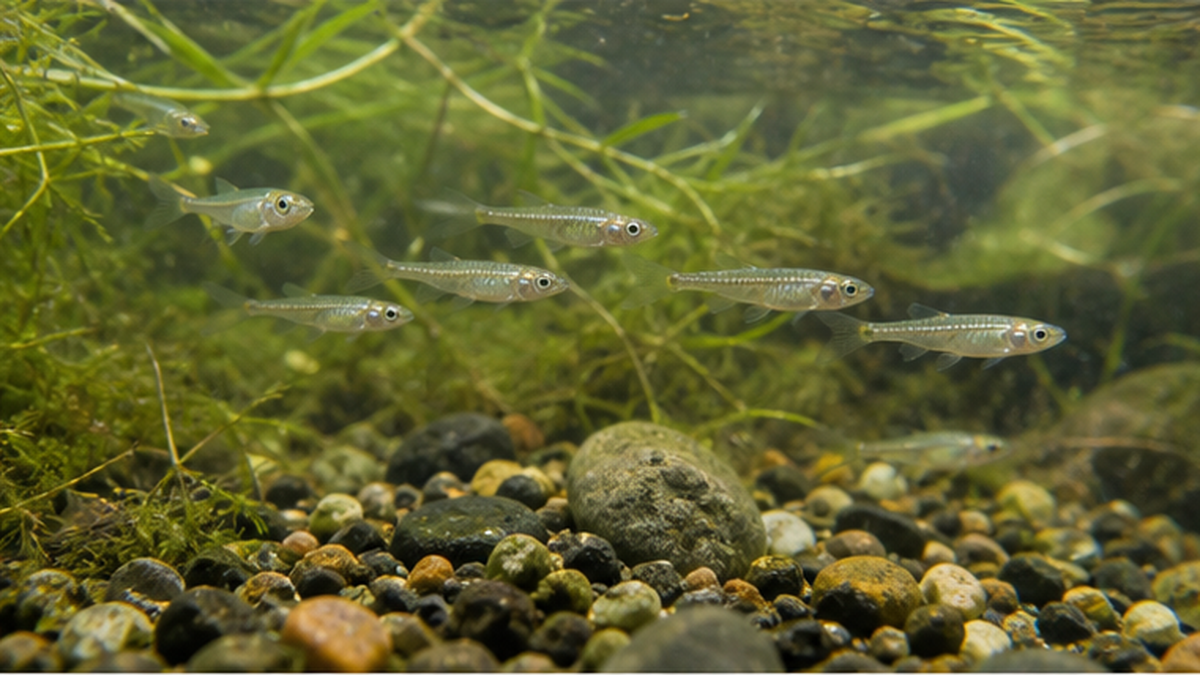
Studies have observed that when mosquitofish and medaka are kept in the same tank, mosquitofish relentlessly chase and attack medaka. Mosquitofish are livebearers that give birth to live fry rather than laying eggs, and their rapid breeding pace is also thought to contribute to their fast population growth. In artificial environments like consolidated concrete channels, where there are few hiding places, cases have been reported where medaka cannot escape mosquitofish attacks and are locally displaced.
Similar in appearance, opposite in temperament
Mosquitofish are commonly mistaken for medaka because they look quite similar, though they can be distinguished by the shape of the tail fin and the angle of the mouth. They are aggressive, prey on medaka fry and eggs, and are highly adaptable to environmental change — reports indicate mosquitofish tend to dominate in artificial channels affected by consolidation and concrete lining, with medaka numbers declining as a result. Predation by other invasive fish such as bluegill and largemouth bass has also been cited as a factor in medaka decline in ponds and lakes across the country.
When the Invasive Alien Species Act took effect in 2005, mosquitofish were designated an Invasive Alien Species in 2006, in principle banning their import, keeping, transport, and release into the wild. However, eradicating an already-established population is extremely difficult, and citizen-led control efforts continue in many areas.
In ponds and larger waters, bluegill and largemouth bass are threats too
Beyond channels and paddies, in standing waters such as irrigation ponds and lakes, North American bluegill and largemouth bass — also designated Invasive Alien Species — are considered a problem in many areas as predators of small fish, including medaka. These species were introduced by humans as game fish for angling, and, much like the mosquitofish, represent a case where human activity unintentionally threatened native species.
A common feature of these invasive-species problems is that, once established, eradication becomes extremely difficult. Regular control efforts involving local residents — not just government agencies and researchers — along with strict adherence to the basic rule of never releasing non-native species into the wild, are considered essential to long-term countermeasures.
The genetic disturbance caused by "good intentions"
In addition to habitat degradation and the threat of invasive species, experts have increasingly sounded the alarm in recent years about genetic disturbance. Ironically, its main cause lies in a well-intentioned action — the desire to "help increase the medaka population" or "help an endangered species" — namely, releasing medaka sourced from other regions.
Much of this releasing is done with a positive motivation: a love of local nature and a desire to help an endangered species recover, even a little. Activities such as "raising medaka caught in a nearby river and releasing them elsewhere" or "releasing medaka bought at a pet shop into a pond," carried out through school lessons or community events, have continued for many years in many places, often valued for their educational significance. But as genetic-analysis technology has advanced, it has gradually become clear that such well-meaning actions were unintentionally damaging locally distinct lineages.
"Genetic contamination" in Okinawa
According to a case reported by the Ryukyu Shimpo, research by scholars at the University of the Ryukyus found that releasing medaka sourced from outside Okinawa Prefecture into irrigation ponds within the prefecture caused hybridization with the genetically distinct "Ryukyu type" medaka, resulting in "genetic contamination" that erodes their genetic uniqueness. Okinawa's medaka habitat has reportedly already shrunk to around ten locations, and there are concerns that hybridization could further erode this rare lineage.
Lineage replacement was happening in the Kanto region too
Surveys of the Arakawa and Tone river systems in the Kanto region have reported that many of the medaka living there did not belong to the "eastern Japan type" that would naturally be expected in that region, but instead to lineages that should be distributed around the Seto Inland Sea or northern Kyushu. It has been suggested that an accumulation of well-intentioned releases, along with escapes and abandonment of captive individuals, may have replaced the original regional population with a different lineage.
Releasing himedaka and other bred varieties is even more serious
Bred varieties sold in ornamental fish shops, such as himedaka and yokihi medaka, have had certain genes (such as those for body color) skewed through selective breeding. Releasing these into the wild can further erode locally distinct genetic diversity through hybridization with wild populations, which is why organizations such as the Ichthyological Society of Japan issue especially strong warnings on this point.
The "disruption of adaptation" caused by hybridization
In genetics, the phenomenon in which crossing two populations that are each adapted to their own local environment actually lowers overall environmental fitness is called "outbreeding depression." The particular combination of genes carried by each regional population has been optimized over a long span of time to suit the local water temperature, water quality, and seasonal cycle, and mixing genes from a different lineage can disrupt that optimization. Genetic disturbance in medaka is understood within this same general ecological framework.
What genetic disturbance actually destroys
Genetic disturbance is not treated as a serious concern out of mere sentimentality about "purity" being disrupted. Each regional population represents a genetic asset shaped by tens of thousands of years of adaptation to its local water temperature, water quality, seasonal changes, and set of predators. Multiple studies indicate that when distinct lineages hybridize, locally adapted traits can be lost, potentially reducing resilience to environmental change.
For example, populations in colder northern regions tend to have stronger tolerance for low temperatures, while populations in southern or coastal areas differ in their tolerance for salinity and high water temperatures — subtle physiological differences are known to exist between regional populations. Because such traits are largely invisible from the outside, crossing individuals that "look like the same medaka" can quietly erode an unseen mechanism of adaptation.
As climate change alters water temperatures and precipitation patterns, the diverse adaptive traits held by each regional population also carry value as a kind of "insurance" against future environmental change. If a particular regional lineage carries genetic traits conferring tolerance to high water temperatures, that trait could become a lifeline for that region's medaka population as warming progresses. Losing this diversity to genetic disturbance means narrowing future adaptive capacity — a cost that goes beyond simply reducing today's population numbers.
Once lost, regional distinctiveness cannot be restored
One of the tricky aspects of genetic disturbance is that, superficially, the problem is hard to see — after all, "medaka are still swimming there." But if hybridization erodes a locally distinct gene pool, then even if population numbers appear to recover, the fish are no longer the original medaka. At the core of this issue is the fact that "diversity," in the context of biodiversity conservation, includes not just diversity between species but genetic diversity within a species.
Individuals used for release should originate from the population at the release site, or at minimum from a population within the same river system, and should include, to the greatest extent possible, the various genetic and ecological characteristics of the original population.
— Ichthyological Society of Japan, "Guidelines for the Release of Fish Aimed at Conserving Biodiversity" (2005)
A conservation unit finer than "species"
Conservation biology includes a concept known as the "Evolutionarily Significant Unit" (ESU), which treats regional populations with their own distinct evolutionary history — rather than the species as a whole — as the unit of conservation. For a species like medaka, which contains multiple geographically and genetically distinct lineages, a particular regional lineage can be lost to hybridization or habitat loss even while the species as a whole is not extinct. This is the underlying reasoning behind why medaka conservation emphasizes not just "the survival of the species" but "the survival of each regional lineage."
Learning proper conservation from the Ichthyological Society of Japan's release guidelines
In response to these issues, the Ichthyological Society of Japan published its "Guidelines for the Release of Fish Aimed at Conserving Biodiversity" in 2005. Targeting the release of fish in general, with a particular focus on rare species, the guidelines set out principles for protecting regional populations and biodiversity.
From the late 1990s through the 2000s, "nature-oriented river restoration" projects aimed at improving river and lake environments, along with citizen movements seeking to restore local nature, spread across the country. As part of this trend, "stock enhancement releases" — raising carp, crucian carp, medaka, and other fish from fry and then releasing them — also became common. The Ichthyological Society of Japan published its guidelines against a backdrop in which awareness of the genetic risks had not kept pace with the spread of these activities.
Rather than rejecting the act of releasing fish altogether, this guideline — which applies to rare freshwater fish in general, not only medaka — organizes "how to release" from a scientific perspective. Behind it lies the recognition that, while well-intentioned release activities spread across the country, there were not a few cases where the origin of the individuals used had not been adequately considered.
- First consider whether release is actually the most effective conservation approach available (ongoing activities such as population surveys and habitat management are often far more effective than casual release)
- Individuals used for release should come from a population native to the release site, or at least from as close to the same river system as possible
- Commercially available individuals (such as himedaka sold as ornamental fish) should not be used for release
- Individuals of unknown origin should not be released into the wild out of "good intentions"
In short, even with a genuine desire to protect an endangered species, "just increase the population and release them" is not recommended. Instead, protecting the habitat itself and conserving locally distinct lineages within their own region is considered the most important approach for maintaining genetic diversity.
The thinking behind this guideline applies not only to medaka but also to other familiar organisms with regional genetic differences, such as bitterling, loaches, and fireflies. As an example illustrating how the conservation mindset itself has advanced — from "it's endangered, so just increase and protect it" to "how do we protect the genetic assets unique to this place" — the medaka genetic-disturbance issue is often used as material for education and public awareness.
Regional population conservation efforts underway across Japan
Certificates of origin in the school biotope network
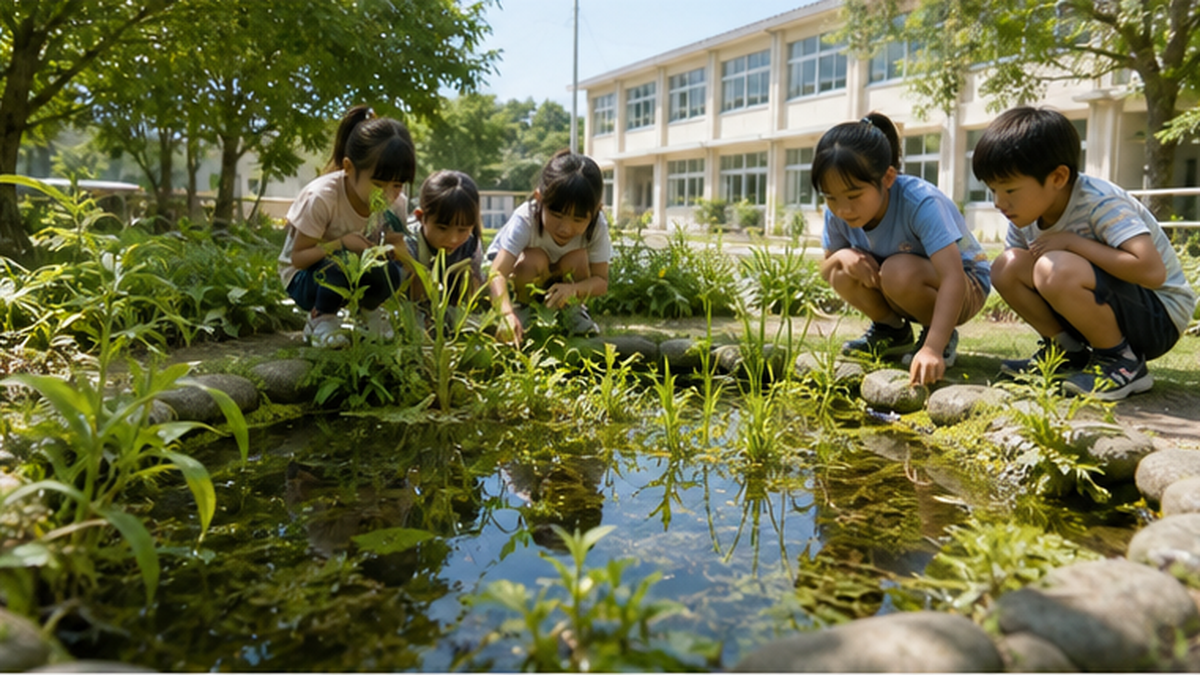
The certified NPO Asaza Fund (Ibaraki Prefecture), through its work networking school biotopes across the Lake Kasumigaura watershed, strictly enforces a policy of using only medaka and pond snails collected within a school's own district to protect regional genetic lineages, never introducing or releasing individuals at a site different from where they were collected. The organization has also set up a system that issues a "certificate of origin" recording each individual's provenance, allowing children to engage in educational activities with familiar local creatures while preventing genetic disturbance.
University genome analysis and conservation projects
The University of Tokyo, with cooperation from organizations such as the NPO Konotori Citizens' Research Institute, is pursuing a project to conduct genome analysis and conservation work on the "Toyooka medaka," which lives in the Toyooka Basin and Maruyama River watershed in Hyogo Prefecture. Accumulating genomic information on regional populations provides a scientific basis for deciding which lineages should be protected, and where.
Common threads across regional efforts
- Use only locally sourced individuals; never bring in individuals from other regions or lineages
- Match the collection site with the release/introduction site
- Establish a system to record and certify the origin of individuals
- Use scientific evidence, such as genome analysis, to understand regional lineages
What these efforts have in common is that, before "increasing" the population, they prioritize thoroughly understanding and never mixing the lineage unique to that particular place. Conservation efforts involving local residents and schools also play an important role in monitoring the condition of paddies and channels across a wide area that experts alone cannot fully cover.
Cryopreservation: "another kind of insurance"
Alongside habitat conservation, efforts to preserve genetic resources themselves are also advancing. A research team from Akita University, Tokyo University of Marine Science and Technology, and the National Institute for Basic Biology (NIBB) announced in 2017 that it had achieved, for the first time in the world, the successful production of normal offspring by long-term cryopreserving testicular tissue from the critically endangered "Tokyo medaka," extracting germline stem cells from it, and transplanting them into the testes of himedaka. This technology serves as a kind of "insurance," carrying regional lineages that are difficult to recover in the wild forward into the future in the form of preserved cells.
Two pillars: in-situ and ex-situ conservation
- In-situ conservation: protecting the habitat itself — paddies, channels, and irrigation ponds
- Ex-situ conservation: lineage maintenance at universities and research institutions, cryopreservation of cells and sperm, and more
- Common principle: both rest on the fundamental rule of never mixing regional lineages
What anyone keeping medaka at home can do starting today
Medaka are among the most widely kept freshwater fish in Japan. Enjoying them as pets is not itself a problem, but there are precautions anyone can take to help protect wild populations.
The tricky part is that it's difficult to accurately distinguish wild medaka from bred varieties, or from individuals sourced from other regions, based on appearance alone. Even fish sold as "black medaka," with coloring close to the wild type, are often of unclear regional origin after passing through generations of farming and breeding. That's exactly why the simple rule "don't release an individual of unknown origin into the wild" is the most reliable safeguard.
- Never "let go" or "release" medaka you keep — including himedaka, bred varieties, or wild-caught medaka of unknown origin — into a nearby river, channel, paddy, or pond
- If you collect and keep wild medaka, never move them outside the river system where they were collected
- If you want to take part in regional conservation, join efforts by organizations or local governments that have an origin-management system in place, like the Asaza Fund
- If you can no longer care for your fish, look for a new owner or consult a specialty shop rather than releasing them into the wild
To leave the medaka of "the medaka school" for future generations, what matters most isn't simply increasing their numbers — it's not destroying the genetic individuality each region has nurtured. Protecting familiar environments like paddies and channels, and protecting the invisible asset of genetic diversity, are two sides of the same coin in medaka conservation.
For more on the creatures found in rice paddies and channels, see A Field Guide to Rice-Paddy Wildlife, and for more on irrigation ponds as habitat, see What Is a Farm Pond Ecosystem?. The genetic-diversity challenges posed by hatchery-based stocking are also covered in The Mystery of Salmon Homing Migration, which is worth reading alongside this article.
| Action | Effect on wild populations |
|---|---|
| Keeping medaka for enjoyment in a home tank or biotope | No problem, as long as they aren't released into the wild |
| Releasing captive individuals into a nearby river, paddy, or pond | Risk of genetic disturbance and harm to the ecosystem (should be avoided) |
| Returning individuals to the same location within the river system where they were collected | Low risk to maintaining the regional lineage |
| Participating in regional conservation activities with proper origin management | Can contribute to conservation with a solid scientific basis |
Medaka-keeping has become a boom in recent years, and a wide variety of bred forms are now in circulation. Enjoying it as a hobby is, of course, up to the individual, but keeping in mind that "wild medaka" and "medaka bred for ornamental purposes" differ in both purpose and origin ultimately helps protect regional nature. Small precautions — such as designing tanks and biotopes so they don't overflow and let medaka escape during rain — also help prevent unintended spread.
References and Sources
- Ministry of the Environment, Japan – Medaka: Ex-situ Conservation of Endangered Wild Flora and Fauna
- Ministry of the Environment, Japan – Publication of the Red List 2020
- Ichthyological Society of Japan – Guidelines for the Release of Fish Aimed at Conserving Biodiversity (2005)
- Ministry of the Environment, Japan – Materials on the Invasive Alien Species Mosquitofish
- Certified NPO Asaza Fund – Biodiversity Conservation (School Biotope Network)
- University of Tokyo Foundation – Fund for the Conservation of Wild Medaka Populations
- Ryukyu Shimpo – Hybridization Progresses in Okinawa's Medaka: "Genetic Contamination" from Releases of Fish from Outside the Prefecture
- J-STAGE (Ichthyological Society of Japan) – Medaka: Genetic Disturbance Caused by Artificial Releases
- Ministry of Agriculture, Forestry and Fisheries, Japan – On the Status of Agricultural Production Infrastructure Development (Rural Development Bureau, March 2016)
- National Institute for Basic Biology (NIBB) – Successful Regeneration of an Endangered Medaka from Cryopreserved Testicular Tissue Cells
※ Listed in order of reliability: government and academic institutions > peer-reviewed papers > specialist organizations > reputable media