⚡ In short
About 1,000 km south of Tokyo, the Ogasawara (Bonin) Islands are true oceanic islands that were never connected to any continent. Some 94% of native land snails and roughly 36% of native vascular plants are endemic. This article explores the evolutionary laboratory built by adaptive radiation, and the decades-long fight against green anoles, feral goats, and other invaders.
Board a ferry at Tokyo's Takeshiba Pier and travel roughly 1,000 km south for a full day and night. The Ogasawara Islands you reach have never been connected to anywhere else on Earth — they are true oceanic islands. Here, a remarkable 94% of native land snails exist nowhere else in the world. That single figure is what secured the islands' inscription as a World Natural Heritage site in 2011.
Ogasawara is called the "Galapagos of the Orient" not simply because it is home to unusual creatures. It is because the process of adaptive radiation — a single ancestor branching out, changing its habits and even its body shape as it moved into the treetops, onto the ground, and beneath the leaf litter — can still be observed right in front of you. The islands were inscribed under a single World Heritage criterion, (ix), which recognises exactly this evidence of ongoing evolution.
Yet this evolutionary laboratory is now being dismantled by creatures that humans brought in. A lizard that devours insects, goats that strip mountainsides bare, alien trees that crowd out native forest, and a carnivorous flatworm that hunts snails. This article first unpacks how Ogasawara's endemic species came to be, then follows the front lines of a 30-year campaign to remove invasive species, drawing on primary sources from Japan's Ministry of the Environment, the Tokyo Metropolitan Government, and research institutions.
What You Will Learn in This Article
- What it means for Ogasawara to be an "oceanic island," and how that created its endemic species
- The breakdown behind 94% endemism in land snails and about 36% in vascular plants, and the evolutionary process of adaptive radiation
- The five major threats: green anoles, feral goats, bishopwood, feral cats, and an invasive land flatworm
- How the "state of emergency" on Anijima led to a containment campaign using exclusion fences and sticky traps
- What the recovery of the Red-headed Wood Pigeon and the loss of the Ogasawara Blue butterfly reveal about the conditions for successful conservation
- Realistic ways people far from the islands can still help protect Ogasawara's biodiversity
What Are the Ogasawara Islands? Oceanic Islands That Never Touched a Continent
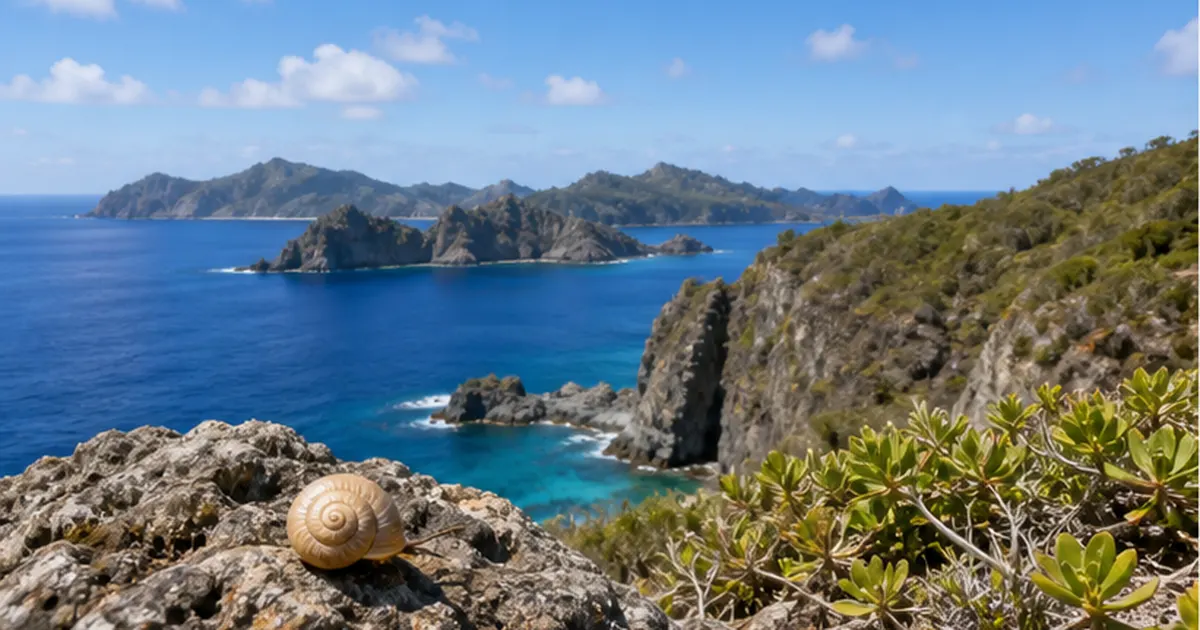
The Ogasawara Islands are an archipelago of just over thirty islands scattered across the Pacific Ocean about 1,000 km south of central Tokyo. Administratively they form Ogasawara Village, Tokyo. From north to south lie the Mukojima, Chichijima, and Hahajima island groups, with the Volcano Islands further south and Minamitorishima and Okinotorishima to the east and southwest. Only two islands, Chichijima and Hahajima, have permanent residents; most of the rest remain uninhabited.
The defining characteristic of this archipelago is that it has been surrounded by ocean ever since it formed. Unlike the Japanese archipelago, Yakushima, or Iriomote, it was never joined to a continent or to mainland Japan during glacial periods. Born from the seafloor through submarine volcanic activity and isolated ever since, such islands are called oceanic islands in geography. The Galapagos Islands and Hawaii share the same origin.
On an Oceanic Island, Every Living Thing Is Descended From an Arrival
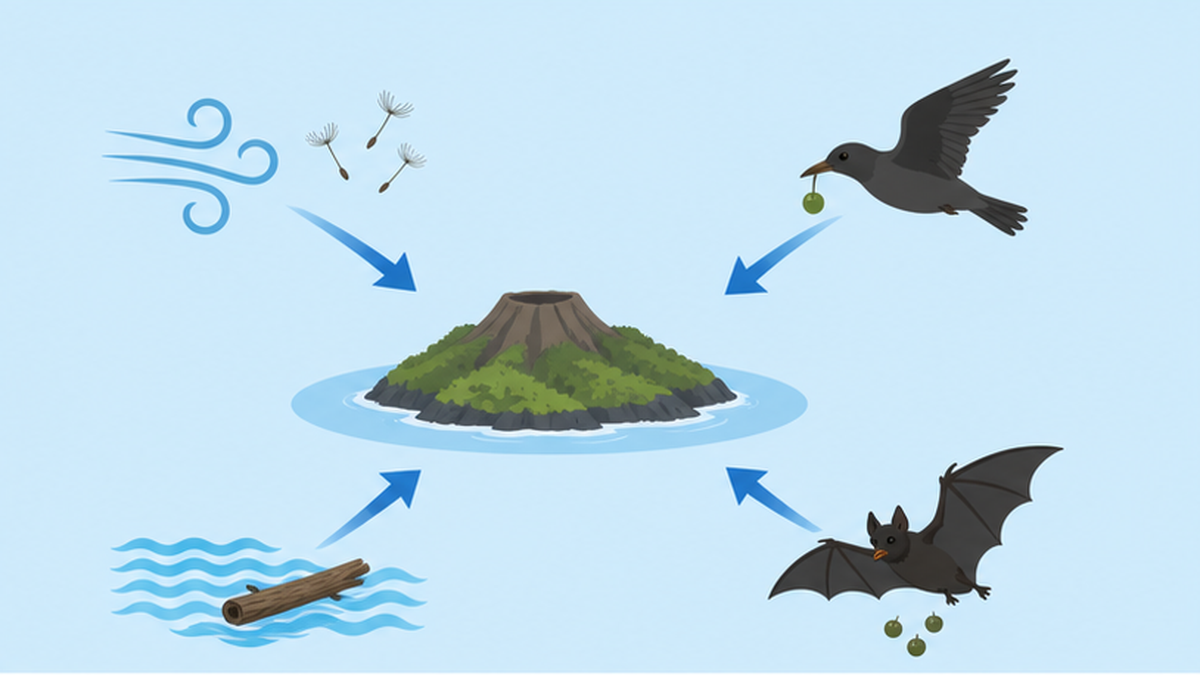
Never having been connected by land means that not a single creature ever walked here. Every native organism in Ogasawara is descended from an ancestor that crossed the ocean under its own power, by one of the following routes.
- Carried by wind — fern spores, fine seeds, small insects and spiders
- Drifting on ocean currents — salt-tolerant seeds and fruits, small animals clinging to driftwood
- Transported by birds — seeds and snail eggs stuck to feathers or feet, seeds passing undigested through droppings
- Flying in unaided — migratory birds and fruit bats
This filter — only those able to reach the islands could arrive — gave Ogasawara a distinctive biota. For instance, the islands have just one native land mammal, the Bonin flying fox. Native amphibians (frogs and salamanders) number zero. Animals that cannot swim or fly and are intolerant of salt water simply never made the crossing.
People Have Lived Here for Only About 200 Years
Permanent settlement of Ogasawara began in the 1830s. Settlers of Western and Pacific Island origin are believed to have been the first to establish themselves on Chichijima, with full-scale Japanese settlement following in the Meiji era. Fewer than 200 years of human habitation is a mere instant in geological terms, and no less brief on the timescale of biological evolution.
Yet in that short span, the cast of living things on the islands was dramatically rewritten. Goats and pigs were released as food supplies for whaling ships calling at the port, alien trees were planted to open up farmland, and rats came ashore with the vessels. The postwar period of United States administration, and the flow of goods after reversion to Japan in 1968, brought in still more organisms. Ogasawara's invasive species problem is the accumulated residue of these two centuries of human activity.
In 2011, Inscribed as World Heritage Under Criterion (ix) Alone
On 24 June 2011, at the 35th session of the World Heritage Committee held at UNESCO headquarters in Paris, the Ogasawara Islands were inscribed as a World Natural Heritage site — Japan's fourth, after Yakushima, Shirakami-Sanchi, and Shiretoko. The inscribed area covers 79.39 km², including land and marine zones: a narrow area roughly one-eighth the size of Tokyo's 23 wards.
What stands out is that the site was inscribed under a single criterion: (ix), "to be outstanding examples representing significant on-going ecological and biological processes in the evolution and development of terrestrial, fresh water, coastal and marine ecosystems and communities of plants and animals." Not scenic beauty (criterion vii), nor importance as habitat for threatened species (criterion x), but the fact that this is a place where evolution is still visibly under way.
Ogasawara Islands at a Glance
- Location: Ogasawara Village, Tokyo, about 1,000 km south of central Tokyo
- Origin: oceanic islands of submarine volcanic origin, never connected to a continent or to mainland Japan
- World Natural Heritage inscription: 24 June 2011 / inscribed area 79.39 km² / criterion (ix) only
- Only Chichijima and Hahajima are inhabited. Access is by scheduled ferry (about 24 hours each way); there is no airport
The Land Snails That Proved the "Galapagos of the Orient": 94% Endemic
When it comes to Ogasawara's World Heritage inscription, the leading role belongs to its land snails. They may seem like modest creatures, but the land snails of these islands have long been a textbook subject for evolutionary biologists worldwide.
The figures in the nomination dossier convey just how exceptional they are. Of the native land snails naturally distributed in Ogasawara, about 94% are found nowhere else. Around 36% of native vascular plants and about 25% of insects are likewise endemic — high figures in their own right — but 94% for land snails stands out even on a global scale.
Why Snails Are So Prone to Producing Endemic Species
The reason lies in their very limited mobility. Snails can barely travel on their own. Even within a single island, one valley or one ridge is enough to sever contact between populations almost entirely. Once genetic exchange stops, each population begins its own evolutionary path.
At the same time, snail eggs can very occasionally cross the sea attached to a bird's feet or feathers. "Almost never able to cross, but not quite never" — this exquisite balance set the stage for an explosive diversification from a handful of founding ancestors.
Adaptive Radiation in the Genus Mandarina
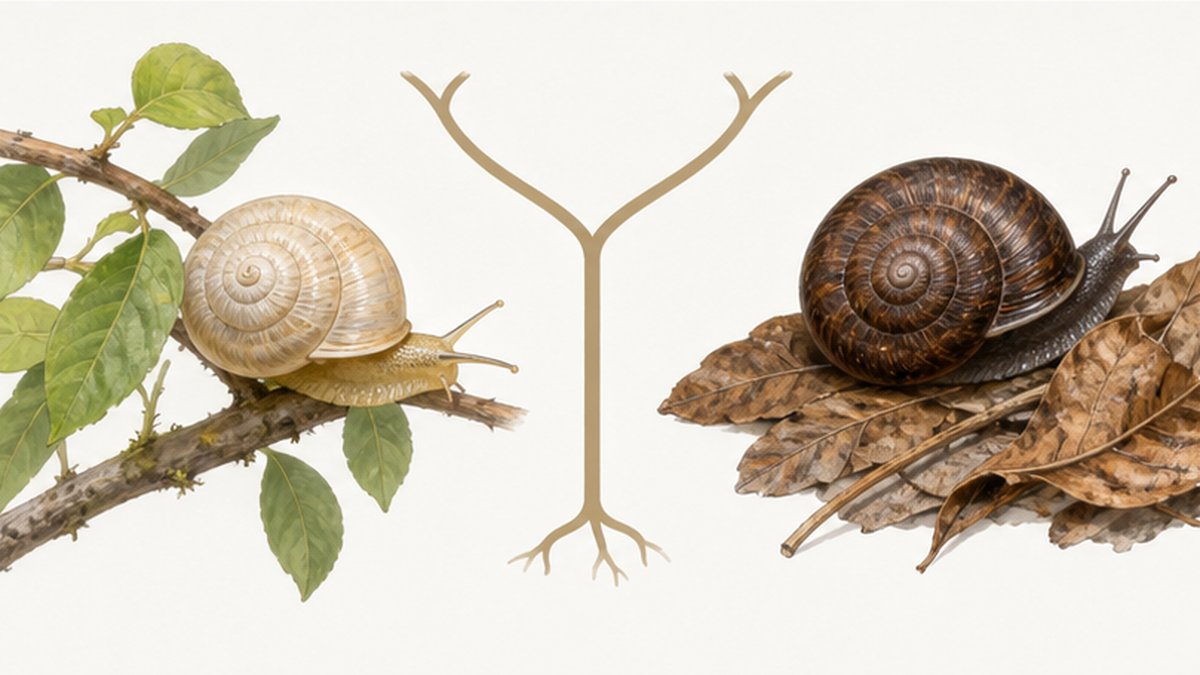
The best known of Ogasawara's land snails is the genus Mandarina. From a shared ancestor that reached the islands, this group diverged by changing form according to where it lived — a process biologists call adaptive radiation. It is the same phenomenon as the Galapagos finches whose beaks changed to suit their food.
| Where they live | Shell characteristics | Likely explanation |
|---|---|---|
| In the trees | Pale in colour, thin-walled and relatively light | Less conspicuous on leaves, and easier to carry aloft |
| On the ground (in leaf litter) | Dark and thick-walled, robustly built | Blends into the ground, and withstands trampling and desiccation |
| Underground or in rock crevices | Tends toward small, flattened forms | Easier to slip into narrow gaps |
In other words, within the same forest on the same island, the "treetop faction" and the "ground faction" split into separate species. Evolution that would take millions of years across vast regions for continental organisms is compressed into islands just tens of kilometres across. This is the substance of the "on-going process" that convinced the World Heritage Committee.
The Value of What Still Remains
Land snails on oceanic islands have suffered devastating losses worldwide. In Hawaii and across Polynesia, the introduction of alien snails and predatory carnivorous snails has already wiped out many endemic land snail species. Against that backdrop, Ogasawara has been assessed as having kept its extinction rate lower than other oceanic islands. The fact that so many endemic species still survive in the wild is what underpins its World Heritage value.
Put another way, Ogasawara is not an island where it is already too late; it is an island where action taken now can still make a difference. That is a source of hope and a heavy responsibility at once. Precisely because it is one of the few such examples left in the world, failure here would be irreversible. This is why so much labour and funding is poured into the invasive species measures described below.
About the Name "Galapagos of the Orient"
Ogasawara earns this label because, like the Galapagos, it consists of oceanic islands where species diversification through adaptive radiation can be observed. Its land area, however, is roughly one-hundredth that of the Galapagos — an order of magnitude smaller — which means each population contains far fewer individuals and is correspondingly vulnerable to invasive species and environmental change.
Adaptive Radiation in Plants: 441 Native Vascular Plants, 161 of Them Endemic
Less dramatic than the land snails, perhaps, but Ogasawara's plants have also undergone remarkable endemic differentiation. The islands are home to 441 native vascular plant species, of which 161 are endemic — an endemism rate of about 36%. Among woody plants alone, the figure is higher still.
A Low, Dry Forest: The Stage Called "Dry Scrub Forest"
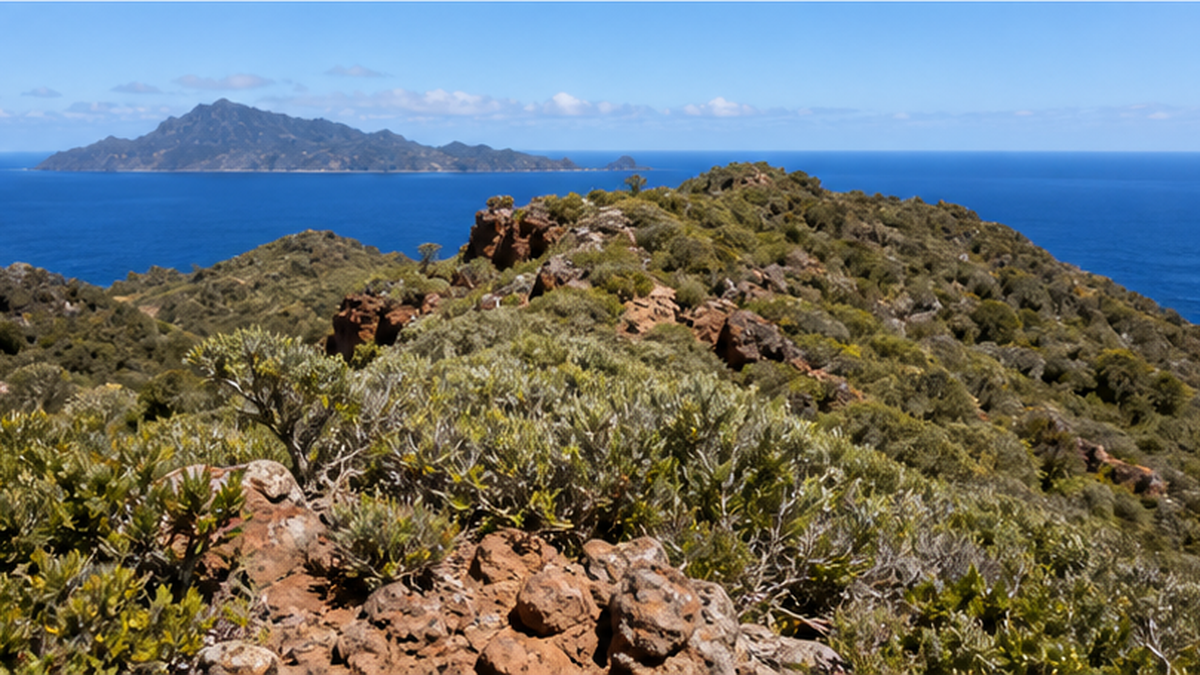
No account of Ogasawara's vegetation is complete without its dry scrub forest. Along the ridgelines of Chichijima and Anijima, low trees ranging from about human height to a few metres grow so densely that the ground is hidden from view. Shallow soils, scarce water, intense sunlight and salt-laden winds together produced this dense forest of stunted trees.
This dry, low forest is where Ogasawara's endemic plants and endemic insects are most heavily concentrated. The dry scrub forest of Anijima in particular has remained in outstandingly healthy condition even by the standards of the World Heritage area, because the island has always been uninhabited and escaped development. That single fact is why the invasive species problem on Anijima came to be described as an emergency.
Dioecy: Another Kind of Evolution That Happens on Islands
Among Ogasawara's plants, a striking number of species are separated into male and female individuals even though their mainland relatives are hermaphroditic (bearing both stamens and pistils on the same plant). On oceanic islands, the small number of founding individuals makes inbreeding likely, and evolution is thought to have pushed toward avoiding it. A different cast of pollinating insects compared with the mainland is also believed to have encouraged the shift.
In much the same way, island plants often undergo woodiness, in which herbaceous ancestors evolve into trees. Where large competing trees are scarce, a strategy of growing tall to capture light becomes advantageous. Ogasawara too has shrub-like endemic species derived from groups that are herbaceous on the mainland. All these changes are products of selection pressures that operated precisely because this is an island.
Three Evolutionary Changes Common in Island Plants
- Speciation: small populations separated by valleys and ridges diverge into distinct species
- Dioecy: populations founded by few individuals evolve toward avoiding inbreeding
- Woodiness: on islands with little competition from large trees, tree-like species arise from herbaceous ancestors
Endemic Birds and Insects: The Red-headed Wood Pigeon and the Ogasawara Blue
Ogasawara's endemic species are not limited to snails and plants. Birds and insects capable of flight have also evolved along their own paths here. But their very mobility — and their larger, more conspicuous bodies — leaves them extremely vulnerable to introduced predators.
The Red-headed Wood Pigeon: The Forest's Seed Sower
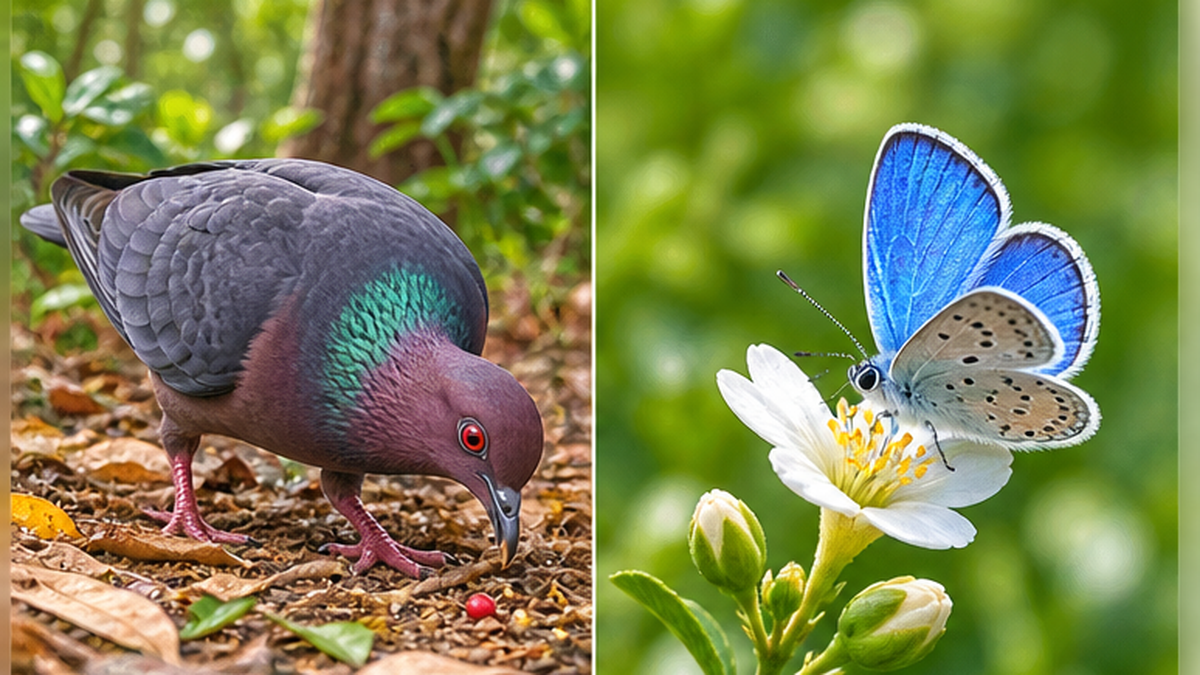
The Red-headed Wood Pigeon is an endemic subspecies of pigeon found only in the Ogasawara Islands. It is a Natural Monument and is also designated a National Endangered Species of Wild Fauna and Flora under Japan's Act on Conservation of Endangered Species. It is a beautiful bird with a reddish-purple head and an iridescent green sheen around the neck. It forages heavily on the ground and serves as a "seed sower" for the forest, eating fruit and dispersing seeds.
In the 2000s this bird was in a critical state. The estimated population across the entire Ogasawara Islands stood at just 30 to 40 individuals around 2005. The main cause was predation by feral cats descended from animals brought in by people. For a pigeon that spends much of its time on the ground, cats were an inescapable predator.
The Ogasawara Blue: A Small Blue Butterfly That Quietly Vanished
A stark contrast is offered by the Ogasawara Blue. This small endemic lycaenid butterfly once lived in the Chichijima island group as well, but disappeared from Chichijima by the 1990s and in recent years was confirmed only on Hahajima. Predation by the invasive green anole lizard is considered the main cause.
Anticipating the loss of the wild population, the Ministry of the Environment and the Tokyo Metropolitan Government pursued ex-situ conservation — captive breeding. Successive generations were reared at Tama Zoological Park and at the Ministry of the Environment's Shinjuku Gyoen. But from spring 2020 the proportion of fertilised eggs fell sharply. Breeding could no longer be sustained, and on 25 August 2020 the last of the captive individuals died, as announced by the Ministry of the Environment and the Tokyo Metropolitan Government.
The cause identified for this breeding collapse was inbreeding depression. In a captive population founded from few individuals, inbreeding becomes unavoidable across generations, genetic diversity is lost, and the effects of harmful genes surface. It was a biological wall that no amount of husbandry skill could overcome. The outlook for wild individuals is also considered severe.
Lessons Left by the Ogasawara Blue
- Ex-situ conservation as "a last resort after the wild population is gone" can come too late
- Whether sufficient numbers and genetic diversity can be secured at the outset determines success or failure
- Unless the root cause — here, predation by an invasive species — is removed, there is nowhere to release the animals back to
The Greatest Threat: Five Invaders Dismantling Ogasawara
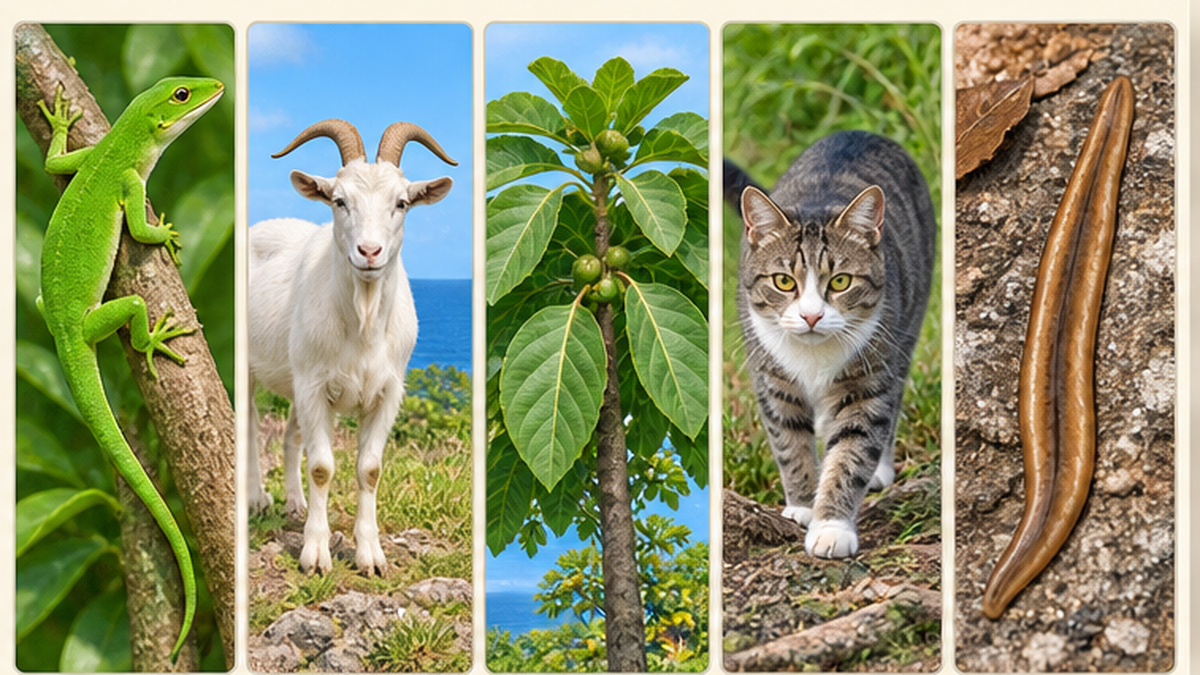
The greatest factor driving Ogasawara's endemic species toward the edge is neither development nor climate change, but organisms introduced by humans. Native species on oceanic islands have no history of exposure to continental-style predators and competitors. Having never evolved toxins, spines, or a swift escape, they are all but defenceless against newcomers. Here are the five principal invaders.
Why Are Oceanic Island Species So Vulnerable?
There is a clear reason why island natives are so weak against invasive species. Organisms that have long lived without predators had no need to pay the cost of self-defence. They lost flight power, dropped their wariness, abandoned toxins and spines, and reduced the number of eggs they laid while raising each one larger. These changes are collectively known as "island syndrome" and are observed on islands worldwide.
In a world of limited resources, these were rational choices. But the moment a creature that survived the evolutionary arms race with continental predators is introduced, that rationality flips into a fatal weakness. They do not flee, they do not hide, and they reproduce slowly. Island natives are essentially defenceless against a predator they are meeting for the first time. What has happened in Ogasawara is a textbook case.
1. The Green Anole: A Lizard That Erased Entire Insect Communities
The green anole is an arboreal lizard native to North America. After the Second World War it became established on Chichijima, apparently arriving amid cargo, and later spread to Hahajima. Diurnal and hunting by sight, it preys voraciously on insects. Even flying insects are attacked the moment they alight, leaving them nowhere to escape.
Its impact went far beyond a mere decline. On Chichijima and Hahajima, native insect communities collapsed across wide areas, and several endemic insects including the Ogasawara Blue have disappeared. The green anole was designated an Invasive Alien Species in June 2005, and its keeping, transport and release are regulated by law.
2. Feral Goats: Herbivores That Strip Mountains Bare
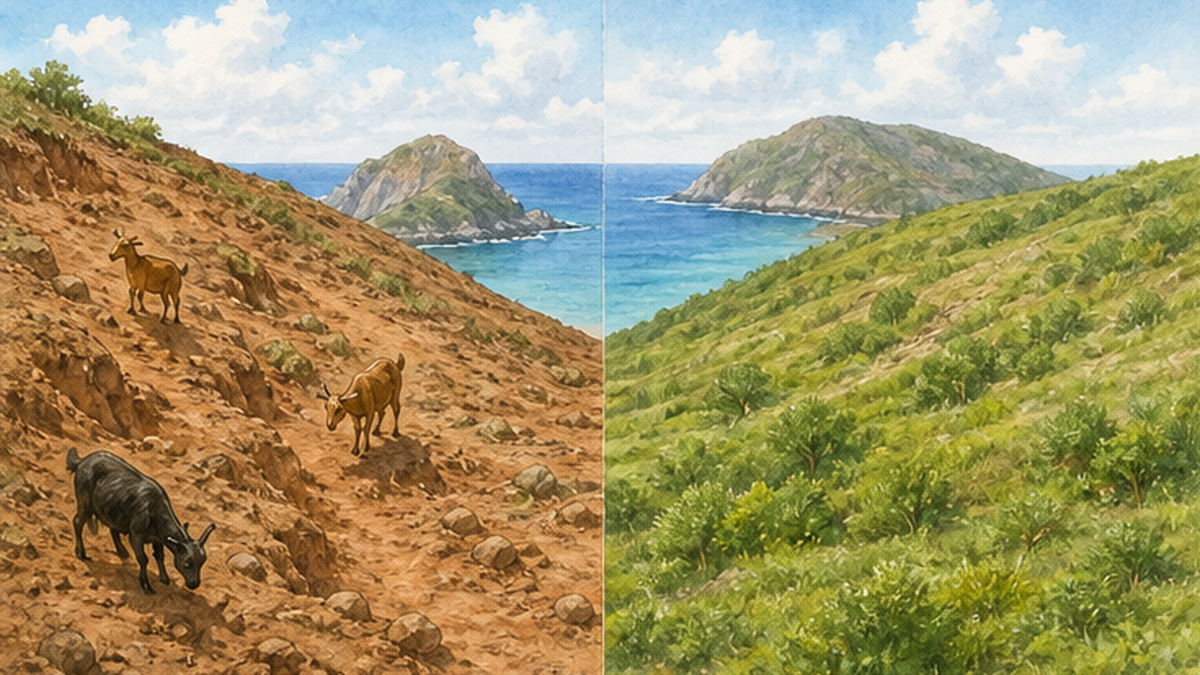
Goats released as a food source in the whaling era and later went feral, consuming the islands' vegetation down to the roots. When steep slopes lose their plant cover, topsoil washes away with every rainfall and flows into the sea as red soil runoff. The disappearance of plants means the disappearance of the insects and snails that depended on them.
3. Bishopwood and Other Alien Plants: Replacing the Native Forest
Bishopwood (akagi) is a tree introduced from the Meiji era onward for firewood and charcoal. It grows fast, tolerates shade, and pushes in among native trees, darkening the forest interior. Native saplings can no longer grow, and over time the entire composition of the forest is replaced. Other problem species include ironwood (mokumao) and lead tree (ginnemu).
4. Feral Cats and Black Rats: Direct Predators of Birds and Snails
Feral cats, descended from domestic cats gone wild, prey on the Red-headed Wood Pigeon, the Bonin flying fox, and seabirds. Black rats, which arrived aboard ships, eat seabird eggs and chicks, land snails and even plant seeds, quietly eroding the island ecosystem.
5. The New Guinea Flatworm: A Carnivorous Flatworm That Hunts Snails
The most serious threat to land snails is the New Guinea flatworm (Platydemus manokwari), a carnivorous terrestrial flatworm. It was originally introduced in various regions as a natural enemy of the giant African snail, an agricultural pest, but in practice it preys on a wide range of small animals including native snails. Research has confirmed a broad diet that extends to the carcasses of other land flatworms and earthworms as well as land snails.
Wherever this flat, inconspicuous creature invades, land snails decline catastrophically within a short time. For Ogasawara's land snails, with their 94% endemism rate, that means the loss of entire species. Because it travels in soil and potted plants, preventing its spread from island to island is the top priority.
The movement of organisms across oceans is hardly unique to Ogasawara. Transport via ships' ballast water and hull fouling occurs in seas around the world. For more, see the invasive species problem carried by ballast water and where do marine invasive species come from?
Front Line 1: Anijima's "State of Emergency" and Containing the Green Anole
Just two years after World Heritage inscription, green anoles were confirmed in the southern part of Anijima in March 2013. Anijima is uninhabited, and its healthy dry scrub forest and the endemic insect fauna it shelters lie at the very core of the site's World Heritage value. For those who knew how insect communities had collapsed on Chichijima and Hahajima, this was the worst possible news.
The Ogasawara Islands World Natural Heritage Scientific Council issued a "declaration of a state of emergency and urgent recommendations concerning green anoles that have invaded Anijima." In response, the four managing bodies — the Ministry of the Environment, the Forestry Agency, the Tokyo Metropolitan Government, and Ogasawara Village — set up a green anole countermeasures working group and drew up a control roadmap and implementation plan.
Stopping the Spread Before Killing: The Idea of the Exclusion Fence
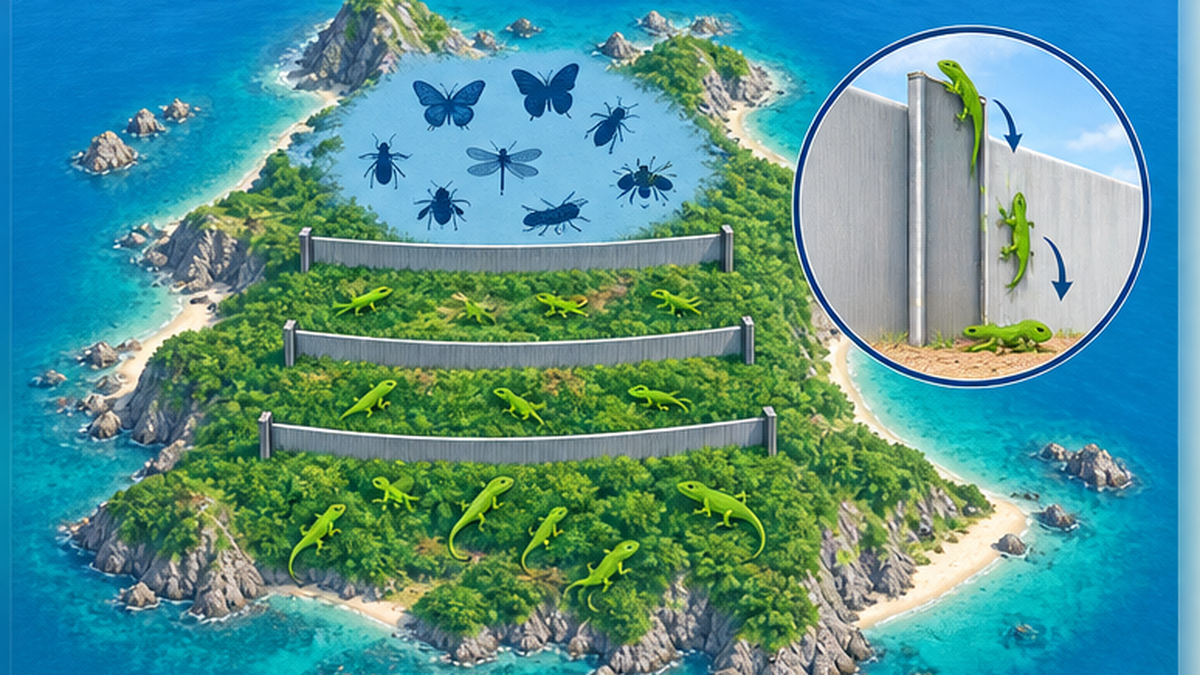
The core of the response was not to aim for island-wide eradication from the outset, but first to prevent any spread northward. Exclusion fences (anole lines) were installed across the island so that the lizards could be contained while they remained in the south. The fences use Teflon sheeting that lizards cannot climb, physically nullifying their ability to scale vertical surfaces.
Fences were built in stages as the A Line and B Line, and in fiscal years 2016–2017 the Tokyo Metropolitan Government installed a third barrier, the C Line, some 2.4 km long. According to reports from the managing bodies, no green anole incursion has been confirmed in the area north of the C Line. In other words, the northern half of the island has been successfully defended.
A War of Attrition: 60,000 Sticky Traps
With the island partitioned, the main tool for reducing numbers inside the fenced area has been the sticky trap. Adhesive sheets, similar to those used for rats, are deployed in large numbers throughout the forest to capture anoles as they move. By the end of May 2017, more than 60,000 traps had been set on Anijima alone, capturing roughly 27,000 individuals in total.
| Method | Purpose | Features and challenges |
|---|---|---|
| Exclusion fence (Teflon sheeting) | Physically blocking range expansion | Nullifies climbing ability. Requires constant inspection for typhoon and treefall damage |
| Sticky traps | Reducing numbers inside the fence | Setting and collection demand enormous labour. Care needed regarding non-target bycatch |
| Exclusion fence plus intensive control | Restoring the ecosystem in a defined area | Recovery of insect fauna has been confirmed at Shin-Yuhigaoka on Hahajima |
| Inspection of goods and baggage | Preventing introduction to new islands | Cargo checks on ferries, boot-sole washing mats when moving between islands, and similar measures |
Evidence of Resilience at Shin-Yuhigaoka on Hahajima
There is evidence that containment works. At Shin-Yuhigaoka on Hahajima, an anole exclusion fence was installed and intensive control carried out inside it, and recovery of the insect fauna has been confirmed. Remove the predation pressure, and surviving native insects can rebuild their numbers. That fact has been a major source of hope for those working on control.
Why Containment Rather Than Eradication First?
Completely eradicating an invasive species requires finding every last individual, which becomes unrealistic as the area grows. Where, as on Anijima, the whole island constitutes the core value, it is more sensible to confine the damage locally, reliably protect the healthy zone, and then reduce density inside the perimeter. The thinking is: establish what you can defend, and only then go on the offensive.
Front Line 2: Feral Cat Control and the Return of the Red-headed Wood Pigeon
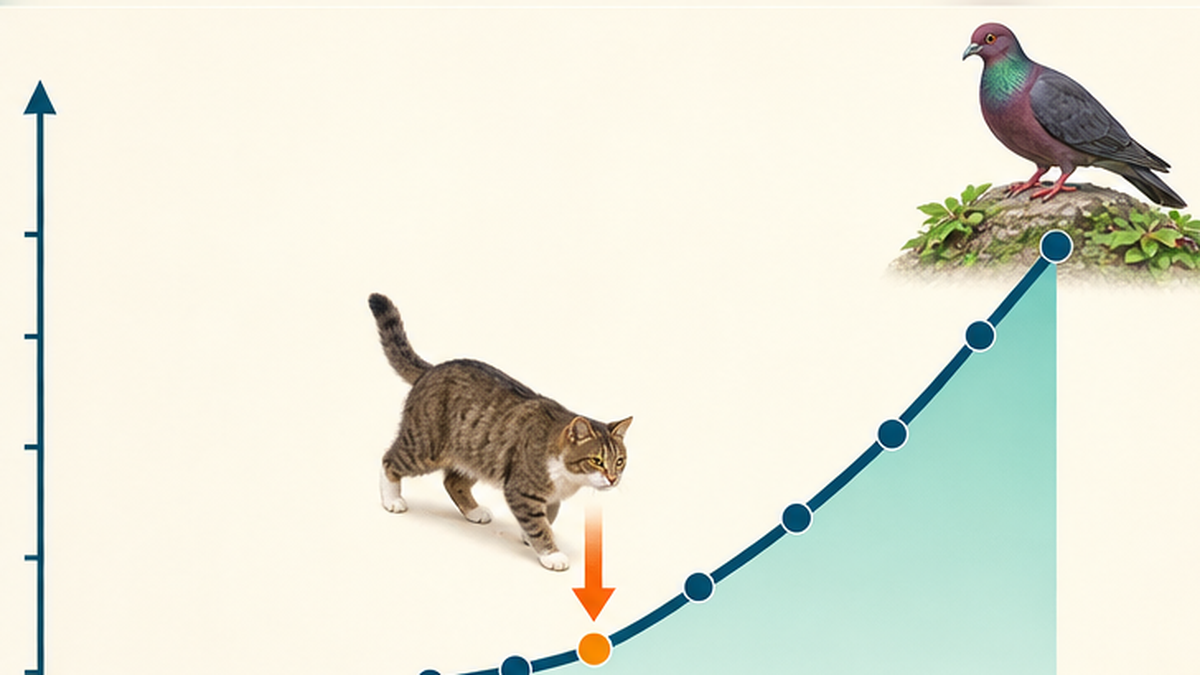
Of all Ogasawara's invasive species work, the effort that has produced the clearest measurable results is feral cat control. Let us trace how the Red-headed Wood Pigeon, down to 30–40 birds around 2005, made its recovery.
Building a System That Does Not Kill the Cats It Catches
From 2010, capture of feral cats was scaled up across the whole of Chichijima. Crucially, a destination was arranged for the cats that were caught. Working with veterinary associations and animal welfare organisations, a system was built to transport captured animals to mainland Japan, socialise them, and rehome them as pets — the initiative widely known as the Ogasawara Cat Project. More than 1,000 cats have been taken in so far.
Invasive species work often runs into psychological resistance to "culling," and that resistance is especially strong for companion animals such as cats. By providing captured animals with a second life, this system connected islanders, mainland supporters, government and veterinarians, and is highly regarded for creating the social foundation that allows the work to continue.
The Pigeon's Numbers and Range Clearly Rebounded
As capture progressed, the feral cat population on Chichijima is estimated to have fallen to less than a tenth of its original level by around 2013. And the effect fed directly through to the pigeons.
| Period | Status of the Red-headed Wood Pigeon |
|---|---|
| Around 2005 | Estimated at 30–40 birds across the entire Ogasawara Islands |
| 2010 | Island-wide feral cat capture begins in earnest on Chichijima |
| 2012–2013 | Numbers rise sharply. Feral cats estimated at less than a tenth of their original level |
| 2017 | Range on Chichijima expands to about 80% of settled areas and 60% of mountain areas |
| 2018 | Estimated population of about 600 birds (reported in the Japanese Journal of Ornithology) |
This recovery has been reported in the Japanese Journal of Ornithology as "Population increase of the Red-headed Wood Pigeon after alien cat control on Chichijima, Ogasawara Islands." Identify the threat, remove it physically, and native species can come back on their own — a textbook result in conservation biology, obtained in the field.
In 2025, "Genetic Purging" Revealed as the Force Behind the Recovery
In 2025 a new explanation was added to this comeback story. A research group at Kyoto University (Daichi Tsujimoto, Professor Yuji Isagi and colleagues, together with the Tokyo Zoological Park Society and the Institute of Boninology) analysed the genome of the Red-headed Wood Pigeon and showed that "genetic purging" — the removal of harmful mutations from the genome — had occurred over its long island existence. The findings were published online in the international journal Communications Biology on 15 July 2025.
A population that has fallen to a few dozen individuals usually cannot recover, because of inbreeding depression — exactly what happened to the Ogasawara Blue. The Red-headed Wood Pigeon, however, had maintained a small population on the islands for so long that harmful mutations had already been weeded out, which is thought to have allowed it to withstand recovery from very low numbers. Part of the reason two endemic species on the same islands met such different fates has now come into view.
Conditions for Success, as Shown by Ogasawara
- Narrow the threat down to one — if the cause stays vague, the response is scattered
- Remove it physically — fences, trapping and culling, unglamorous as they are, work best in the end
- Provide an exit that avoids backlash — rehoming captured animals proved key to sustaining the effort
- Measure the effect through monitoring — only records of numbers and range make results and remaining challenges visible
The Recovery Front: Ex-situ Conservation of Land Snails and Vegetation Restoration
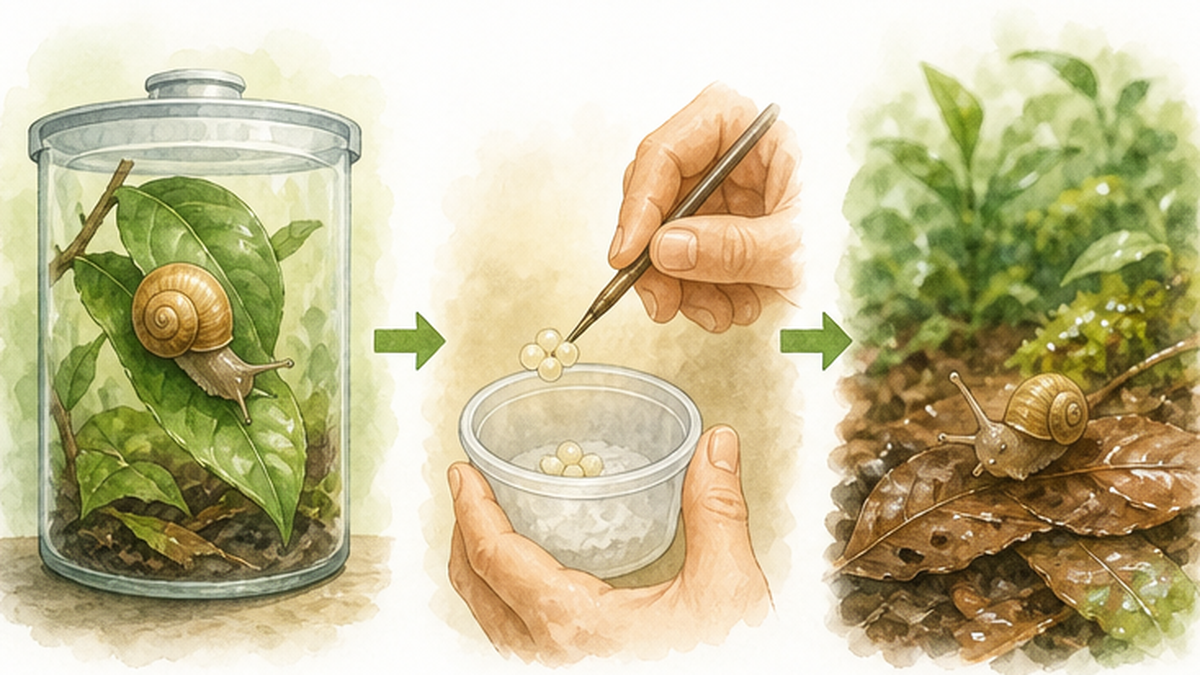
Rearing Snails and Returning Them to the Islands
For land snails exposed to the invasive flatworm, field control alone was judged insufficient, so ex-situ conservation — evacuation through captive rearing — proceeded in parallel.
The Ministry of the Environment began rearing land snails on Chichijima in 2011, in both indoor and outdoor facilities. The aim was to secure the species before invasive predators reached them, and to establish captive breeding techniques in advance. Rearing snails may sound simple, but each species prefers different humidity, food and shelter (arboreal or terrestrial), and establishing the methods required long trial and error.
November 2020: Japan's First Reintroduction of Mandarina Snails
After roughly a decade of preparation, at the end of November 2020 captive-reared Mandarina hirasei and Mandarina anijimana were returned to the wild. It was Japan's first reintroduction of Mandarina snails. The release site was Tatsumijima, an island untouched by the invasive flatworm. Because wild individuals already lived there, the operation was classed as reinforcement — adding captive-bred animals to strengthen an existing population.
Notably, the transfer was carried out at the egg stage rather than with adults. Hatching the eggs on site was a deliberate step to let the snails adapt to the wild environment without carrying over the habits of captivity. In the very year the Ogasawara Blue's captive lineage came to an end, a first step in the opposite direction — from captivity back to the wild — was taken here.
What Makes Ex-situ Conservation Work
- Begin while a substantial wild population remains, so genetic diversity can be secured
- Take the time to establish rearing techniques for each target species
- Ensure the release site is free of the threatening invasive species, or was never invaded in the first place
- Be clear whether the operation is reinforcement or reintroduction, and assess the impact on the wild population beforehand
Restoration on the plant side has proceeded in parallel. Dealing with feral goats and alien plants in particular means restoring the very skeleton of the islands.
Removing Feral Goats Brought the Green Back
The Tokyo Metropolitan Government pursued feral goat removal and vegetation restoration on uninhabited islands such as those of the Mukojima group, and goat removal on these islands was completed in fiscal 2010. On islands where the goats are gone, recovery of vegetation including rare endemic species has been confirmed. Grasses return to bare slopes, shrubs grow up, soil stabilises, and red soil runoff declines — it takes time, but the effect is certain.
Bishopwood Removal by Standing Kill
Removal of the alien tree bishopwood combines trunk injection of herbicide to kill trees where they stand with the pulling of saplings. Felling large trees would let light flood suddenly into the forest interior and could actually increase alien seedlings, so the trees are killed gradually while standing to encourage native trees to grow. Under the Tokyo Metropolitan Government's programme, about 11 hectares were cleared in fiscal 2009 at Sekimon, Kuwanokiyama and other sites on Hahajima.
The Difficulty of "Remove One Invader, Get Another Problem"
Invasive species work never ends with simple subtraction. Cases have been reported on islands worldwide where removing feral goats caused the alien plants they had been eating to proliferate all at once. Because ecosystems are interlinked, pulling out one element shifts another balance. Ogasawara's managing bodies maintain a standing scientific council and continually update their plans through monitoring precisely to respond to this unpredictability.
| Issue | Current status | Remaining questions |
|---|---|---|
| Green anole | Northward spread blocked by fences on Anijima; insect fauna recovering in part of Hahajima | Eradication across Chichijima and Hahajima not achieved. Fence maintenance required indefinitely |
| Feral cats | Numbers sharply reduced on Chichijima; rehoming system established | Not eradicated, especially in mountain areas; continued capture is a prerequisite |
| Feral goats | Removal completed in fiscal 2010 in the Mukojima group and elsewhere | Monitoring needed to ensure alien plants do not proliferate after removal |
| Alien plants | Ongoing removal of bishopwood and others | The area is vast; continuous suppression is more realistic than eradication |
| Invasive flatworm | Focus on ex-situ conservation and preventing spread between islands | No effective removal method established for islands where it is already established |
For a clearer picture of why Japan's seas and islands support such extraordinary diversity, and where Ogasawara fits within it, see also why Japan's seas rank among the world's most biodiverse.
What Can We Do? Ways to Engage, Whether You Visit or Not
Ogasawara is not an easy place to reach. There is no airport, and the scheduled ferry takes about 24 hours each way. Precisely because of that, visitors have specific protocols to follow, and those who cannot go still have ways to contribute.
What to Observe When You Visit
- Clean soil from your boots and baggage before boarding — alien seeds, eggs and flatworms travel in soil. Always use the washing mats provided at the port
- Follow the same procedure when moving between islands — crossing from Chichijima to Anijima or Hahajima is the riskiest moment of all
- Stay on the trails and boardwalks — trampling damages the shallow soils of the dry scrub forest. Keep to designated routes
- Do not bring in or take out plants and animals — bringing in seeds, seedlings or live insects is strictly prohibited. Refrain from removing stones and shells too
- Use an accredited guide — some restricted areas may only be entered when accompanied by a Tokyo-accredited nature guide
What You Can Do Without Going
- Care for pets for life — Ogasawara's feral cat problem began with cats that people brought in. Never abandoning or releasing an animal, and having pets neutered, is the foundation of protecting native species on any island
- Never release exotic animals into the wild — red-eared sliders and green anoles alike all started with "just one"
- Support conservation groups and research — learn about and support organisations such as the Institute of Boninology that carry out survey and conservation work on site
- Spread accurate information — more people able to explain why snails are worth protecting is what sustains long-term budgets and staffing
Summary of This Article
- Ogasawara consists of oceanic islands never connected to a continent. Adaptive radiation from a few founding ancestors made 94% of native land snails and about 36% of native vascular plants endemic
- The 2011 World Natural Heritage inscription rested solely on criterion (ix), recognising that evolution is still under way here
- The greatest threat is invasive species: green anoles, feral goats, bishopwood, feral cats and an invasive flatworm have driven endemic species toward the edge
- On Anijima, following the 2013 "state of emergency," exclusion fences and sticky traps have kept the northern half of the island secure
- Feral cat control brought the Red-headed Wood Pigeon back from 30–40 birds to about 600, while the Ogasawara Blue's captive lineage was lost
- The work stands at the stage of continuous suppression rather than eradication, and every visitor who cleans the soil off their boots is holding the front line
The figure of 94% is not only something to take pride in; it is also a warning. To exist nowhere else means that if it is lost here, it is gone from the Earth. The story of small snails on distant islands is, in truth, a very universal question about the distance we keep between ourselves and other living things.
References and Sources
- Ministry of the Environment, Japan – World Natural Heritage in Japan | Ogasawara Islands | Protection and Management
- Ministry of the Environment, Japan – World Natural Heritage in Japan | Ogasawara Islands | Introduction to the Heritage Area
- Ministry of the Environment, Japan (press release) – On the collapse of breeding in the ex-situ population of the Ogasawara Blue (27 August 2020)
- Ministry of the Environment, Kanto Regional Environment Office – On the confirmation of green anoles on Anijima in the Ogasawara Islands World Natural Heritage area (statement of the Scientific Council)
- Ministry of the Environment, Kanto Regional Environment Office – [Ogasawara] Reintroduction of Mandarina snails! Reinforcement (December 2020)
- Ministry of the Environment, Japan – Red-headed Wood Pigeon (species conservation and propagation programme)
- Tokyo Metropolitan Government, Ogasawara Branch Office – Ogasawara Islands World Natural Heritage | Tokyo's initiatives: invasive species control, green anole management
- Tokyo Metropolitan Government, Bureau of Environment – Nature Parks of Tokyo | Vegetation restoration projects in the Ogasawara Islands
- Japanese Journal of Ornithology (J-STAGE) – Population increase of the Red-headed Wood Pigeon after alien cat control on Chichijima, Ogasawara Islands
- Kyoto University – Research news: "Genetic purging behind the population increase of an endangered pigeon in the Ogasawara Islands" (19 August 2025)
Listed in order of reliability: government and academic institutions > peer-reviewed papers > specialist organisations > trustworthy media