⚡ The answer in 30 seconds
- Fishing facilities have largely been restored, but wakame output has not returned to pre-quake levels.
- Tokura's oyster farmers cut facilities to about one third, raised quality, and won Japan's first ASC certification in 2016.
- The next challenges are adapting to rising sea temperatures and a shortage of successors.
The 2011 Great East Japan Earthquake caused about 1.26 trillion yen in damage to the sea and fisheries of Sanriku. Years later, how far has the fishing industry come back, and what has changed?
Drawing on materials from the Fisheries Agency, Iwate and Miyagi Prefectures, and WWF Japan, this article reviews the recovery, the state of wakame farming, and the reform of oyster farming in Tokura.
Let's follow a recovery that was "chosen anew", something numbers alone cannot show.
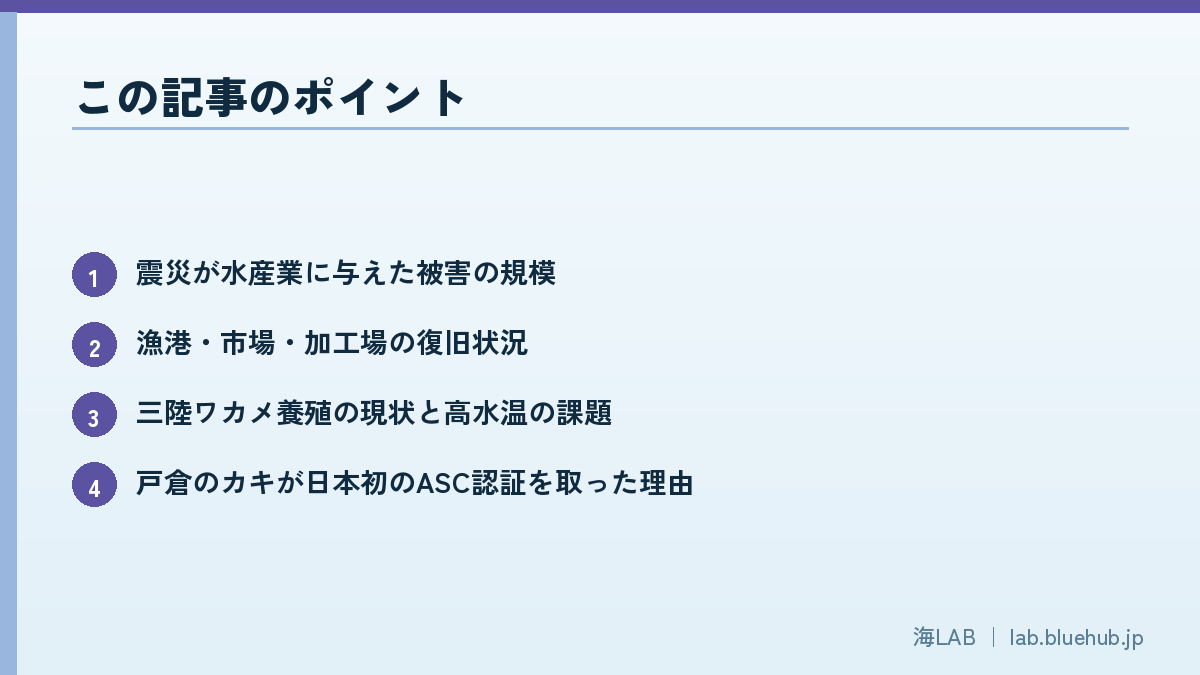
What you will learn in this article
- The scale of damage to fisheries
- Recovery of ports, markets and processing plants
- The state of Sanriku wakame farming and the heat challenge
- Why Tokura oysters won Japan's first ASC certification
- How we can take part through certification labels
How the Great East Japan Earthquake damaged Sanriku's fisheries
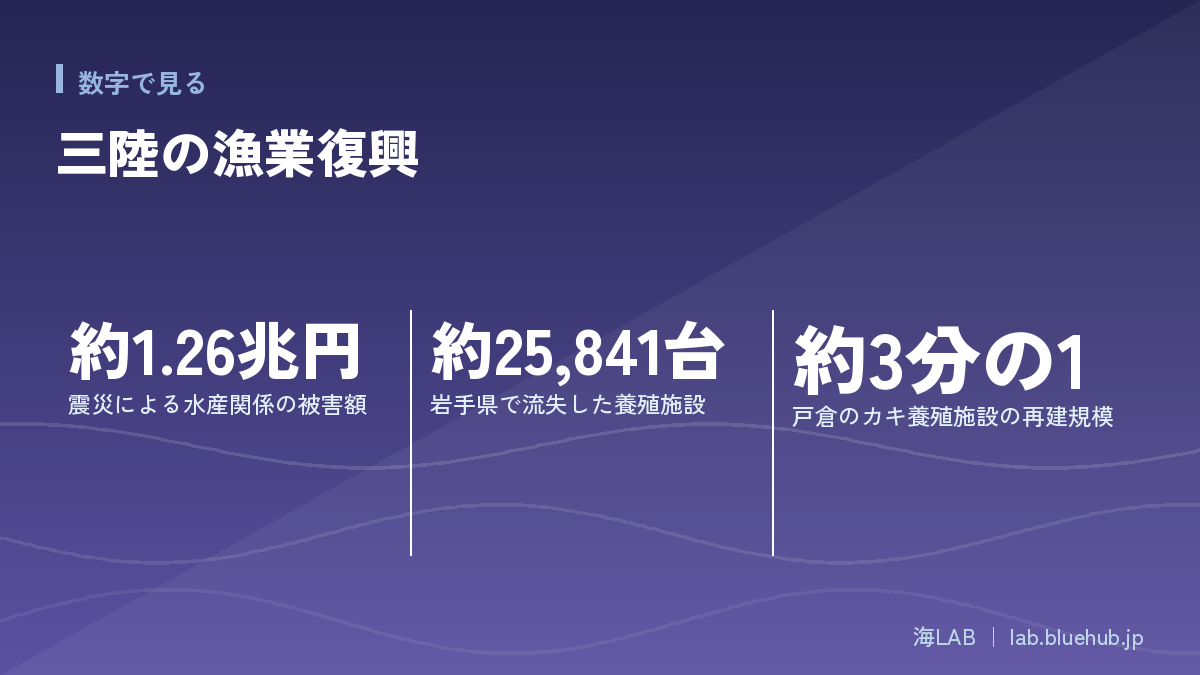
Scale of damage: about 1.26 trillion yen in fisheries alone
The Great East Japan Earthquake of March 11, 2011 transformed the sea and fisheries along the Sanriku coast. According to the Ministry of Agriculture, Forestry and Fisheries, fisheries-related damage came to about 1.2637 trillion yen. Boats, ports, aquaculture facilities, processing plants and cold storage, the foundations of an ocean-linked industry, were hit all at once, which made recovery difficult.
Sanriku is a rich fishing ground where the Oyashio and Kuroshio currents meet, and its indented ria coast has calm bays suited to farming wakame, kelp, scallops, oysters and sea squirts. The tsunami swept away the rafts, ropes and seedlings that are the tools of aquaculture, all at once.
Over 25,000 aquaculture units lost in Iwate alone
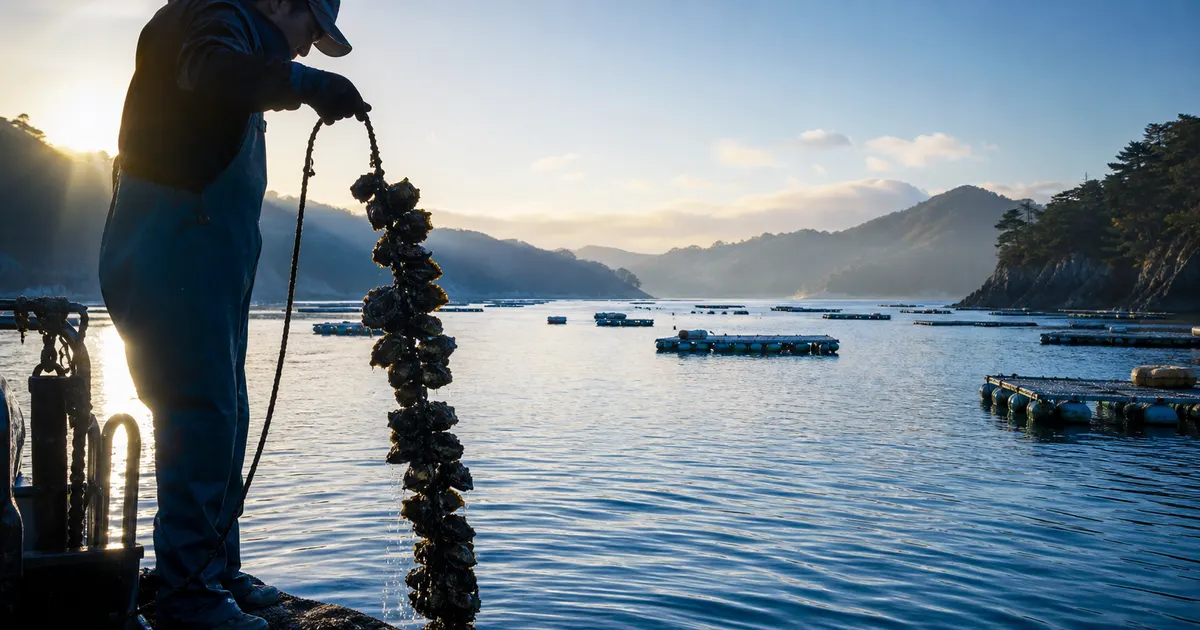
Iwate Prefecture materials state that about 25,841 units of aquaculture facilities for wakame, kelp, scallops, oysters and more were washed away. Farming takes about a year for wakame and several years for scallops and oysters before harvest, so rebuilding facilities does not bring income right away. Supporting this "income gap" was a major challenge of recovery.
- Boats and ports: ports themselves became unusable through subsidence and damage
- Aquaculture and seedlings: rafts, ropes and growing shellfish and seaweed were lost
- Processing and distribution: cold storage and markets were damaged, so catches could not be sold
- Workforce: in aging communities, some chose to quit fishing after the disaster
Key points of this section
- Damage spread beyond fishing to processing and distribution
- Because aquaculture takes time to generate income, the design of recovery support mattered
Changes under the sea: debris and ecosystems
Debris swept into the sea also affected the seabed and fishing grounds. Removal of seabed debris by fishers, local governments and divers was painstaking work to win back the grounds. Researchers have also tracked the sea's recovery over the long term to study how recovery relates to ecosystems, a hallmark of Sanriku.
Why does recovering aquaculture take so long?
Boats can be rebuilt or repaired relatively quickly, but in aquaculture, "time spent growing" is itself capital. Scallop spat take several years to reach market size, and oysters one to two years. Wakame has a one-year cycle, but seedlings had to be secured first. Even after facilities were rebuilt there was no income until the first harvest, and living costs and cash flow in the meantime influenced whether people quit or resumed.
Most fishers are also sole proprietors, facing damaged homes, evacuation and loan repayments at once. Sharing facilities or restarting as groups was chosen against this background.
Regional differences in damage
Even within Sanriku, damage and speed of recovery differed with bay shape, tsunami height, degree of subsidence and population behind the coast. Where ports were large, markets and plants were prioritized for reopening; in small fishing villages, fishers sometimes tried to restart on their own. Remembering that every village has its own story is important when reading the numbers.
The path to recovery: ports, boats, markets and processing plants
Physical recovery has advanced greatly
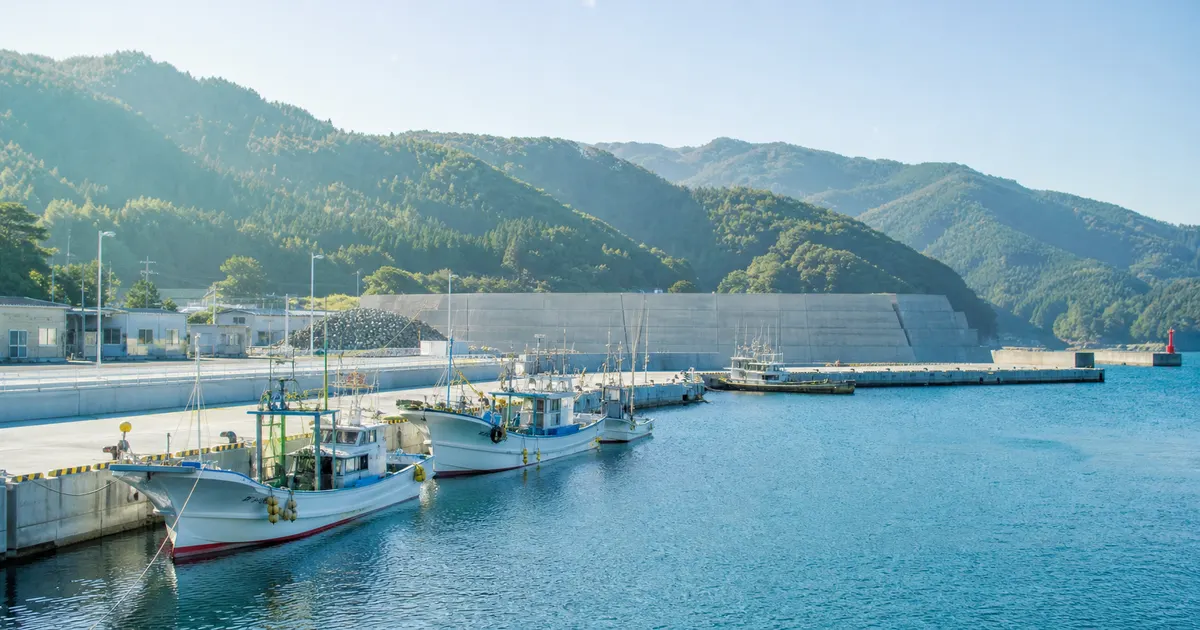
According to Fisheries Agency materials, all 319 damaged fishing ports were restored to landing capacity by June 2017. Boat restoration in Iwate and Miyagi was reported completed by the end of fiscal 2015, and all 22 production-area markets have reopened. Over 90% of processing facilities that wanted to resume have done so.
| Item | Recovery status | Source |
|---|---|---|
| Damaged fishing ports (319) | Landing capacity restored by June 2017 | Fisheries Agency materials (2021) |
| Fishing boats (Iwate, Miyagi) | Restoration completed by end of FY2015 | Fisheries Agency materials (2021) |
| Production-area markets (Iwate, Miyagi) | All 22 markets reopened | Fisheries Agency materials (March 2026) |
| Processing facilities | Over 90% of facilities that wanted to resume reopened | Fisheries Agency materials (March 2026) |
Even when equipment returned, customers did not
The hurdle was not only rebuilding equipment. Trade was interrupted by evacuation and closures, many processors lost their sales channels, and some could not return to pre-quake customers. The Fisheries Agency and local governments continue to support sales recovery and new product development. Restoring equipment is not the same as restoring an industry, an important lesson for recovery.
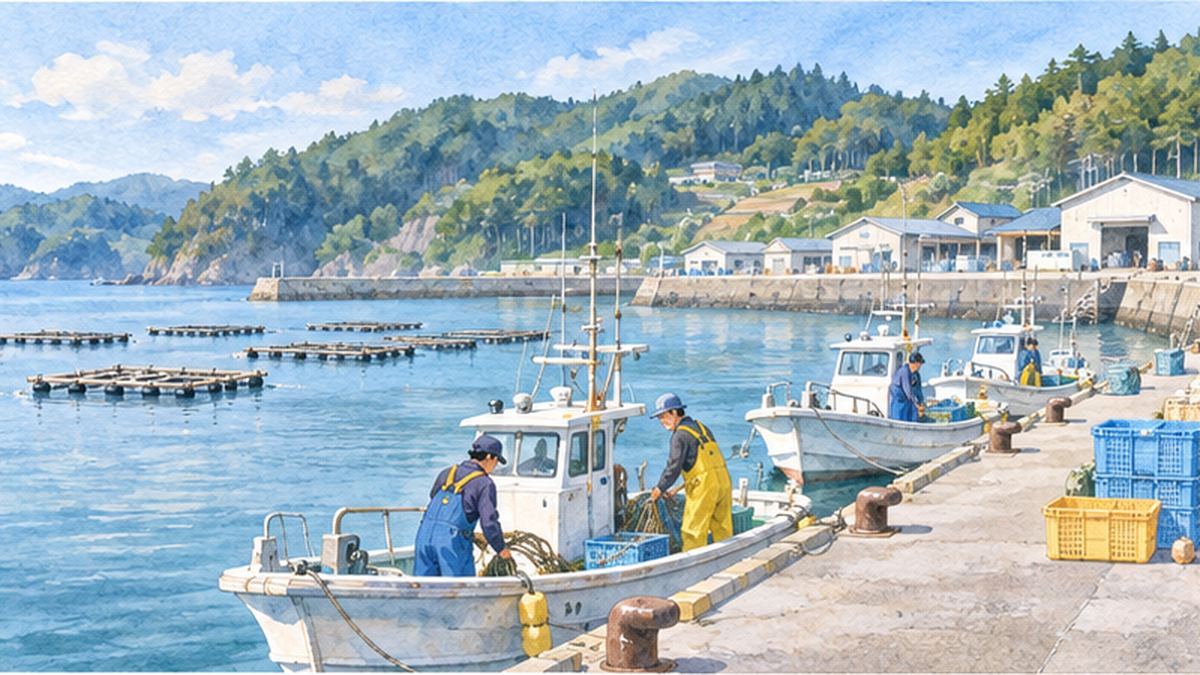
How national recovery support worked
Recovery measures included building shared-use facilities, subsidies for seedling purchases, and contract production of wakame and kelp seedlings. By sharing facilities across a community rather than individually, production could restart with a smaller initial burden. This idea later fed into rethinking the scale of aquaculture.
The power of people who supported recovery
Recovery was supported not only by budgets and systems but also by cooperation from fishing cooperatives, companies and volunteers nationwide. Debris removal, donated nets and ropes, seedlings, and online sales launches all piled up. These outside ties later helped build fans of the region and prompted certification.
Restructuring processing and distribution
While over 90% of plants reopened, some faced labor shortages and difficulty securing raw materials. Responses included switching raw materials as species changed (such as poor salmon and saury catches) and supplying year-round through freezing. The fisheries industry after recovery continues by changing form with the environment and market rather than simply returning to its former shape.
Tips for reading the data
- Recovery rates use "facilities that wanted to resume" as the denominator, which may exclude businesses that closed
- Treat equipment recovery and recovery of sales and employment as separate indicators
Revival of Sanriku wakame farming and today's challenges
About 70% of Japan's farmed wakame comes from Sanriku
The coasts of Iwate and Miyagi produce about 70% of the farmed wakame made in Japan. Wakame farming runs on a one-year cycle: seed collection in summer (June–August), nurturing seedlings (August–September), grow-out at sea in autumn (October–November), winter management, and harvest in February–April.
- Seed collection (June–August): take spores from parent wakame and attach them to thread
- Seedling nursery (August–September): raise seedlings under conditions such as water at or below 20°C
- Grow-out (October–November): put the ropes out to sea
- Management (December–January): thin and tend the crop
- Harvest (February–April): cut and process into blanched, salted wakame
After harvest, wakame is generally processed into "blanched, salted wakame" by dipping in water at 90°C or hotter for 30–60 seconds, cooling it quickly, and salting it; it is shipped to processors nationwide.
Output has not returned to pre-quake levels
According to Iwate Prefecture, wakame output was around 25,000 tons before the quake, fell below 20,000 tons afterward, and was about 13,400 tons in 2023 (Reiwa 5). Besides fewer facilities and workers, several factors are thought to overlap: low prices, competition from imports and changing sea temperatures.
Note: lower output does not mean recovery failed
The decline is affected not only by the earthquake but also by low prices and aging workers that predate it. Do not judge recovery by numbers alone; look at the background as well.
Rising sea temperature as a new wall
Wakame prefers cold seas. High water temperature in the nursery stage hinders seedlings, and low nutrients cause shedding of fronds. The Iwate Fisheries Technology Center is working on breeding heat-tolerant wakame and has reported strains that grew well. Adapting to ocean warming is the next stage of recovery.
Wakame quality depends on water and nutrients
Wakame grows by absorbing nutrients such as nitrogen and phosphorus from seawater. A sudden drop in nutrients causes frond loss, and water below 5°C at harvest can cause physiological disorders. It is a delicate crop that dislikes both extremes, so fishers watch temperature and nutrient data to adjust when they set out crops and the depth of the ropes.
The prefectural fisheries technology center is also researching ways to secure seedlings in hot years, such as storing the sporophyll (mekabu) on land. Cooperation between researchers and the field is important for preparing for change in the sea.
Wakame prices and imports
Domestic wakame competes in the market with imports from China, South Korea and elsewhere. Prices have been low since around 2000 and producer numbers have kept falling. Differentiating through quality, safety and traceability is seen as the path for domestic producers to survive.
Tokura's oysters: a reform of "reducing" born from the disaster
Cutting overcrowded rafts to one third
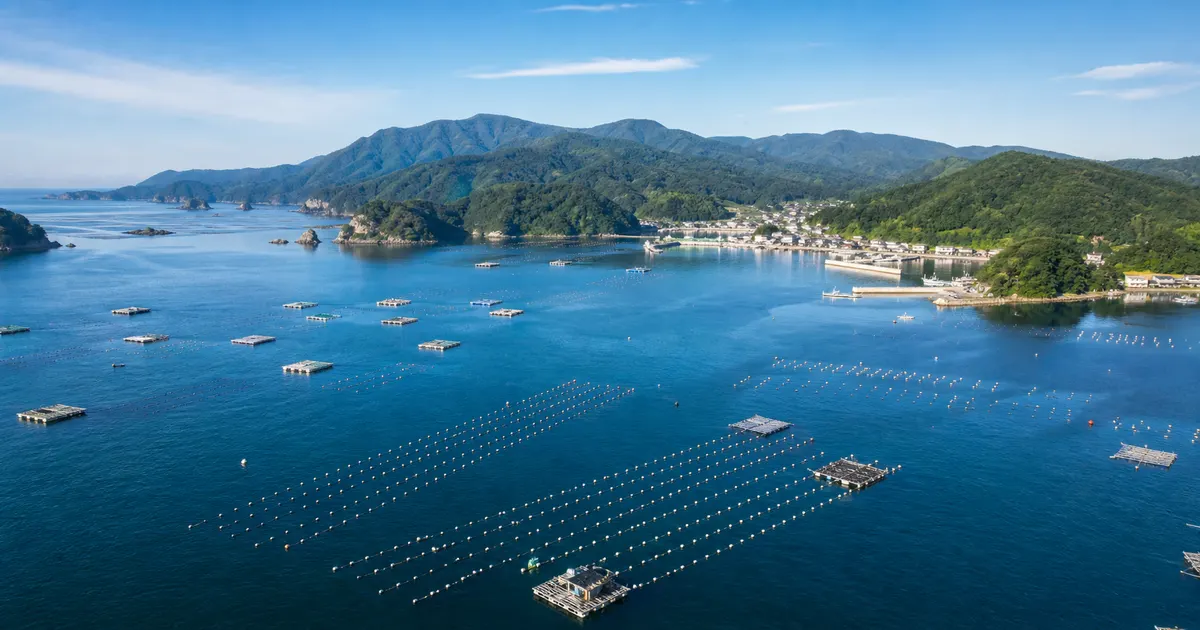
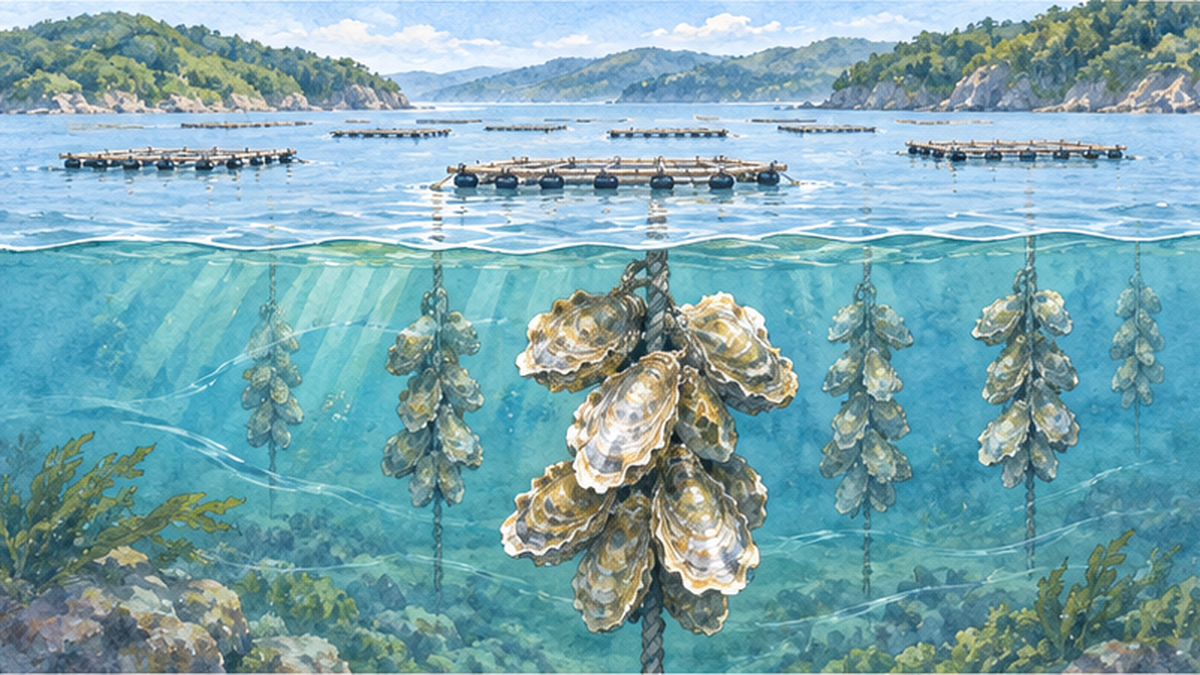
Tokura, on Shizugawa Bay in Minamisanriku, Miyagi, had densely packed oyster rafts before the quake. Having lost almost all facilities to the tsunami, the fishers chose to cut the number of aquaculture facilities to about one third of pre-quake levels when rebuilding. Wider spacing improves water flow, spreads the phytoplankton that oysters feed on, and speeds growth.
It has been reported that even with fewer facilities, time to shipment shortened and quality improved, raising profitability. It was a shift from "the more rafts the more profit" to "protect what the sea can support."
Toward Japan's first ASC certification
In recognition, the Tokura oyster group of the Shizugawa branch of the Miyagi Prefecture Fisheries Cooperative obtained Aquaculture Stewardship Council (ASC) certification in March 2016, the first in Japan. The audit took place in November 2015, and the certificate presentation was held in Minamisanriku on May 18, 2016. The certified oysters are sold as "Minamisanriku Tokura-kko Kaki."
What is ASC certification?
An international scheme certifying aquaculture that is considerate of the environment and society. Standards cover effects on water quality and ecosystems, relations with local communities and working conditions, and certified seafood carries the ASC label.
One trigger is said to have been a recommendation from a WWF Japan staff member active in the area after the quake. It is an example of outside help, such as volunteers, meshing with the decisions of local fishers.
Combining Ramsar wetland status and FSC
Shizugawa Bay was registered as a Ramsar wetland in 2018. Minamisanriku is noted as a municipality holding both forest FSC certification and marine ASC certification. Resource management that links mountains, rivers and sea has become the region's brand. For more on oyster recovery, see also Recovery of oyster farming.
Do oysters clean the water?
Oysters are bivalves that filter seawater and eat phytoplankton. In suitable numbers they are said to remove suspended matter from the water. Overcrowding, however, leads to competition for food, oxygen shortage and accumulation of organic matter on the seabed, causing slow growth, lower quality and disease risk. Tokura's "reduce" reform was an attempt to restore balance between aquaculture and the marine environment.
The effort of meeting the standards
ASC certification requires meeting many criteria, including water measurement, effects on surrounding organisms, community relations, working conditions and traceability. Records are kept, third-party audits are undergone, and annual audits confirm continuity. It is laborious for fishers, but the shared goal of "earning a living while protecting the sea" sustained the effort.
A brand as local pride
Certification is both a product label and a source of local pride. "Minamisanriku Tokura-kko Kaki" has been told alongside the story of recovery and introduced at restaurants and shops. The value of a brand, however, is maintained through continued quality and accumulated environmental management.
Scallops, sea squirts, silver salmon: diverse farming supports Sanriku
Sanriku as a "department store" of aquaculture
Along the Sanriku coast, many species besides wakame and oysters are raised, including scallops, sea squirts, kelp and silver salmon. Variety reduces the risk of total loss from one disease or market swing and stabilizes regional income. In Tokura as well, scallops, wakame, sea squirts and silver salmon have been farmed alongside the main oyster crop.
| Product | Main features | Challenges |
|---|---|---|
| Wakame | Harvested winter to spring; processed into blanched, salted wakame | High water temperature, low prices |
| Oysters | Shipped after about 1–2 years; filter feeding can help water quality | Overcrowding, shellfish toxins |
| Scallops | Raised over several years; securing seedlings is key | Risk of damage from high water temperature |
| Sea squirts | Miyagi is the main producing prefecture | Export restrictions, demand swings |
| Silver salmon | Sea-cage farming; shipped autumn to spring | Rising water temperature, feed costs |
"After" the recovery demand settled
In the early recovery period there was demand from subsidies and supportive purchases; now that it has settled, the question is making products chosen in ordinary markets. Certification, branding, processed products, direct sales and links with tourism are advancing. For Fukushima's case, see Fukushima's fisheries recovery.
Sea squirts and silver salmon, each with its own situation
Miyagi is a leading producer of sea squirts, but they are vulnerable to overseas export regulations and demand swings. Silver salmon are raised in sea cages and affected by water temperature and feed prices. Because risks differ by species, combining several species stabilizes the whole region.
The idea of integrated farming
Integrated aquaculture, which grows seaweed, shellfish and fish in the same waters, is studied worldwide as a way of reducing environmental load from feed and waste. In Sanriku too, combining different kinds of farming is used to make full use of the sea's resources.
Certification and branding: what consumers can do
Choosing by label as a way to take part
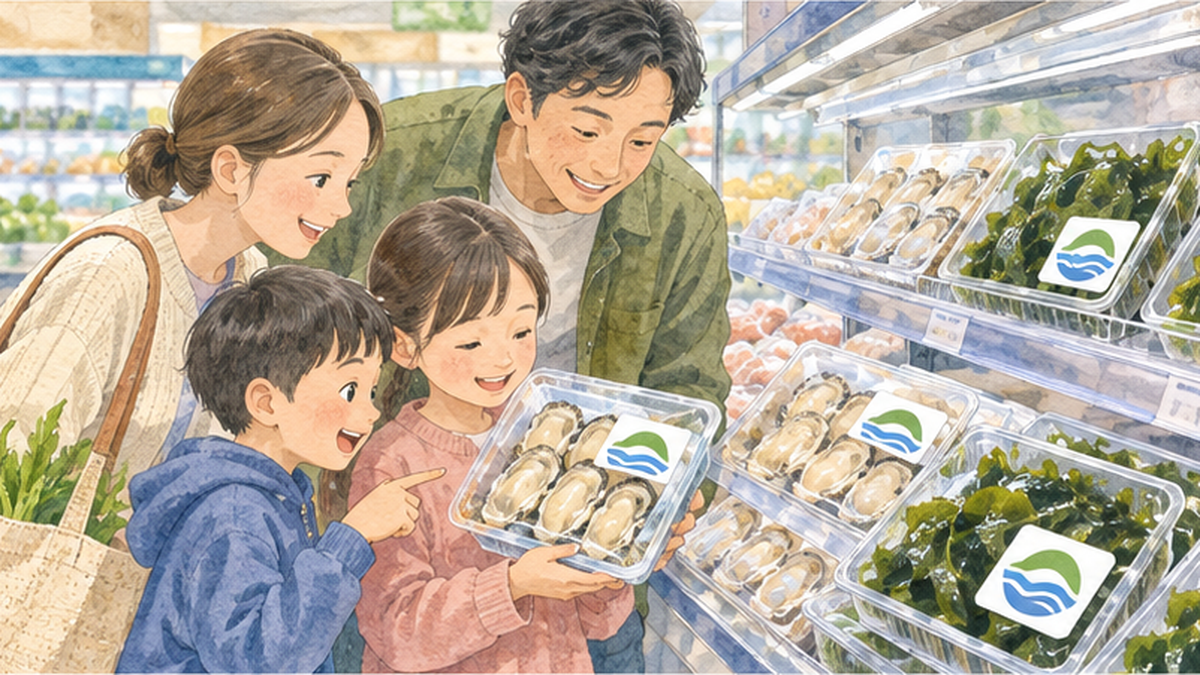
Recovery support often brings to mind donations and volunteering, but choosing seafood with certification labels in everyday shopping is another way to support sustainable local fisheries. Besides ASC there are schemes such as MSC for wild-caught seafood. A label does not mean something is absolutely safe or best; it is a guide showing that certain standards were met.
- Is information on origin (Iwate, Miyagi, etc.) and producers disclosed?
- Is there a third-party label such as ASC or MSC?
- Choose items in season (wakame in spring, oysters mainly in winter)
- Buy only what you can finish to reduce food waste
Effects and limits of certification
Certification makes environmental care visible. But audits and maintenance cost money, a burden for small fishers, and certification does not always show up in price right away. Spreading it needs ways to share costs locally and consumer understanding.
Certification and traceability
Certified seafood has systems to trace which farm or fishing ground it came from. Clear origin builds reassurance and also helps create relationships where the producer's face is visible. When buying, check QR codes or origin labels on the package.
Consumer behavior changes fisheries
When consumers choose environmentally considerate seafood, retailers and restaurants buy more and producers are motivated to pursue certification. Without buyers, care for the environment cannot continue. Daily choices are small votes for the sea's future.
Sanriku's future: warming, population decline and the next generation
Adapting to climate change
Sanriku waters are easily affected by changes in the Kuroshio and Oyashio and by rising sea temperatures. Poor salmon catches and the difficulty of growing cold-loving wakame show change in the fishing field. See Ocean warming and current changes for how ocean warming works. Research continues on adaptation, such as heat-tolerant varieties, adjusted farming timing and shifts to new species.
Nurturing successors
Aging of fishery workers is a problem that predates the quake. In Sanriku, cooperatives and local governments provide training and housing support for new entrants, and young people and migrants are being welcomed. ICT-based monitoring of water temperature and salinity and more efficient farm management are also ways to keep going with fewer people.
What we can learn
Sanriku's recovery is an example of practicing building back better rather than just restoring. Oysters whose quality rose after rafts were reduced, a region branded through certification, and research preparing for climate change all offer hints applicable to other regions and industries.
Balancing disaster prevention and industry
Sanriku remains at risk of earthquakes and tsunamis. Alongside relocation to high ground, seawalls and revised evacuation plans, the question is how to build a system in which fishing can continue. Spreading out aquaculture facilities, using insurance and mutual aid, and organizing work so people can evacuate early are being advanced.
Passing it to the next generation
As time passes, more people do not remember the disaster. School visits, fishing experiences, guided tours and archive facilities serve to leave the experience of recovery as a lesson. Knowing both the sea's gifts and its risks is the foundation for future fisheries.
What you can do starting today
- Check the origin and certification label when shopping
- Enjoy seasonal Sanriku seafood such as spring wakame and winter oysters
- Talk about ocean environmental issues with family and friends
Summary: a recovery "chosen anew" behind the numbers
The Great East Japan Earthquake caused about 1.26 trillion yen in fisheries damage, yet physical infrastructure such as ports, boats, markets and processing plants has largely been restored. Wakame output, however, has not returned to pre-quake levels, and new challenges include rising sea temperatures and a shortage of successors. Cases like Tokura's oysters, which cut scale, raised quality and gained international certification, are one answer to sustainable fisheries.
Summary of this article
- Fisheries damage was about 1.26 trillion yen, with large losses of aquaculture facilities
- Physical recovery advanced, but sales channels and successors remain challenges
- Sanriku makes about 70% of Japan's wakame, and output is lower than before the quake
- Tokura's oysters cut facilities to about one third and won Japan's first ASC certification in 2016
- We can take part by shopping with attention to labels and origin
References and sources
- Ministry of Agriculture, Forestry and Fisheries: recovery of agriculture, forestry and fisheries after the Great East Japan Earthquake – Damage figures, etc.
- Fisheries Agency: current status and issues in rebuilding fisheries after the earthquake – March 2026
- Fisheries Agency: materials on recovery from the earthquake (2021) – Recovery of ports and boats
- WWF Japan: Tokura district ASC certification case study – 2021
- Miyagi Prefecture: international certification for JF Miyagi Shizugawa branch – ASC certification
- Iwate Prefecture: fisheries materials (recovery support) – Loss of aquaculture facilities, etc.
- Iwate Fisheries Technology Center (Reiwa 7) – Wakame farming and heat-tolerant varieties
- Ministry of the Environment: Ecojin feature – Efforts in Shizugawa Bay
* Ordered by reliability: government and academic institutions > peer-reviewed papers > specialist bodies > reliable media