⚡ The answer in 30 seconds
- A whale fall community is an ecosystem that lasts for decades, starting from a whale carcass sunk in the deep sea.
- The carcass passes through the mobile-scavenger, enrichment-opportunist, and sulphophilic (decades) stages.
- Osedax worms have no mouth or gut; they root into bone with the help of symbiotic bacteria.
- Sulfide from bone lipids supports a chemosynthetic food web that does not rely on sunlight.
In the darkness of the deep sea, a whale weighing tens of tons slowly sinks. Its carcass becomes an "oasis" that feeds deep-sea life for decades.
This phenomenon is called a whale fall community. From scavenging fish and crabs to strange bone-eating worms and sulfur-powered bacteria, the leading players change over time while the chain of life continues.
Drawing on research papers and observations in Japan, this article explains how it works and how it connects to our oceans.
What you will learn
- What a whale fall community is
- The 3–4 stages a carcass goes through
- The remarkable biology of bone-eating worms (Osedax)
- How chemosynthetic food webs differ from other ecosystems
- Research in Japan and the latest discoveries
- Links to the carbon cycle and commercial whaling
What is a whale fall community? How a whale's death creates an "oasis" in the deep sea
The deep seafloor is a nutrient-poor world that depends almost entirely on the fragments of organic matter raining down from above (marine snow). Now and then, a huge "feast" weighing tens of tons sinks onto that quiet seafloor: the carcass of a whale that died of old age or other causes. The carcass and the community of organisms that gather around it are called a whale fall community.
An adult large whale weighs roughly 30 to 160 tons, and its carcass delivers a huge amount of organic matter to the deep seafloor all at once (Smith & Baco, 2003). It is a "gift of carbon" many orders of magnitude greater than the usual rain of organic matter, and a wide variety of organisms gather from several kilometers around to exploit it.
Why it is called a "whale fall"
In English it is called a whale fall, and in Japanese it is called "geikotsu" (whale bone) or "geikotsu seibutsu gunshu" (whale fall community). Researchers treat the whole process as a single ecosystem, from the carcass sinking to when only bones remain, and until even the bones decay. What matters here is that it is not a one-time event but a long drama lasting decades.
When was it first discovered?
The existence of organisms swarming on whale bones was scientifically confirmed in the late 1980s. During a survey with a crewed submersible on the deep seafloor off California, large whale bones were found, and it was reported that specialized organisms were densely packed there. Until then, deep-sea chemosynthetic ecosystems were known mainly from hydrothermal vents, so the discovery that a similar world can exist on whale bones surprised researchers.
Research then spread around the world. Long-term observations off California and experiments that deliberately sank whale carcasses and tracked them gradually revealed what happens on a carcass. In Japan, surveys and sinking experiments have been carried out in Sagami Bay, Kagoshima Bay, Tokyo Bay, and elsewhere.
- Official name: whale fall community
- Main player: the whale carcass (about 30–160 tons for an adult)
- Feature: a large amount of organic matter arrives at once and is used up over decades
- Related fields: deep-sea ecology, chemosynthetic ecosystems, biogeochemistry
In a nutshell
A whale fall community is "a deep-sea oasis that lasts for decades, in which scavengers, opportunists, and chemosynthetic organisms take turns, starting from a giant carcass."
How a whale carcass changes: 3–4 successional stages
The changes in a community on a whale fall are based on the three stages that ecologists Craig Smith and Amy Baco summarized in a 2003 review. Later research sometimes adds a fourth stage (the reef stage), in which bones act like a reef.

Stage 1: The mobile-scavenger stage
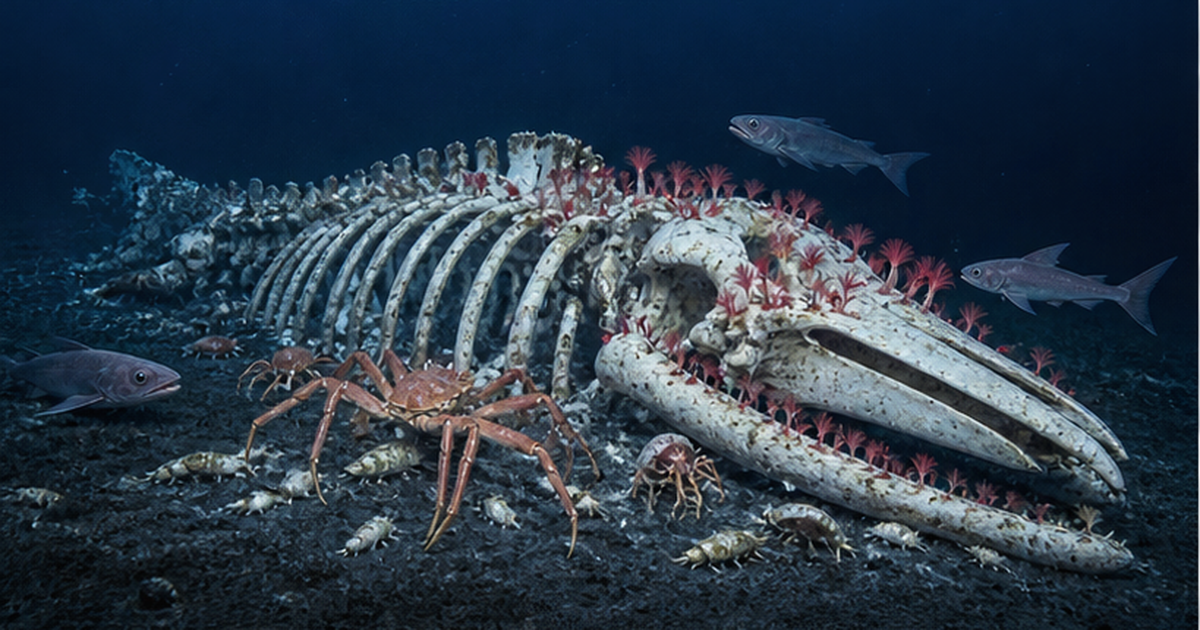
Once the carcass reaches the seafloor, large scavengers that arrive guided by smell begin eating the soft tissue. In observations off California, typical examples include sleeper sharks (deep-sea sharks), hagfish, and various crustaceans. This stage is said to last months, up to about 1.5 years, during which the whale's flesh and fat rapidly disappear.
Stage 2: The enrichment-opportunist stage
As the soft tissue decreases, polychaetes (relatives of marine worms) and small crustaceans swarm around the bones and the nutrient-rich sediment where bits of flesh have fallen. These are "opportunistic" species that multiply quickly. This stage is said to last months, up to about 4.5 years.
Stage 3: The sulphophilic stage
The longest is the third stage. The bones contain a large amount of lipids, and when these are broken down anaerobically (without oxygen), hydrogen sulfide is produced. Sulfur-oxidizing bacteria that use this sulfide as an energy source form mats on the bone surface, and bivalves living in symbiosis with these bacteria and snails that graze on the bacteria appear. This stage is estimated to last decades, and a community lasting more than 50 years has been reported on a large whale.
Stage 4: The reef stage
Even after the organic matter is used up, the remaining bones stay on the seafloor as a hard substrate. On the sandy-muddy deep seafloor, they themselves become a valuable "reef" to which sessile organisms attach. However, the length of this stage varies with local conditions such as bone size and rate of decay.
| Stage | Main players | Approximate duration | Energy source |
|---|---|---|---|
| Mobile-scavenger stage | Deep-sea sharks, hagfish, crustaceans | Months to about 1.5 years | Whale flesh and fat |
| Enrichment-opportunist stage | Polychaetes, small crustaceans | Months to about 4.5 years | Organic matter around the bones |
| Sulphophilic stage | Sulfur-oxidizing bacteria, symbiotic bivalves, snails | decades | Sulfide produced from bone lipids |
| Reef stage | Sessile organisms | Varies by location | The bone itself as a substrate |
Durations are only a guide
The length of each stage varies greatly with the whale's size, depth, water temperature, and the abundance of nearby organisms. In some observations of small carcasses, the first stage ended in a few dozen days.
Bone-eating marine life: Osedax worms
If you had to pick one "star" of the whale fall community, many researchers would name the bone-eating worm (genus Osedax). This genus was reported as new in the journal Science in 2004 by the US researchers Rouse, Goffredi, and Vrijenhoek. It is an annelid (a relative of marine worms) found on whale bones that had sunk at a depth of about 2,900 m off Monterey Bay.
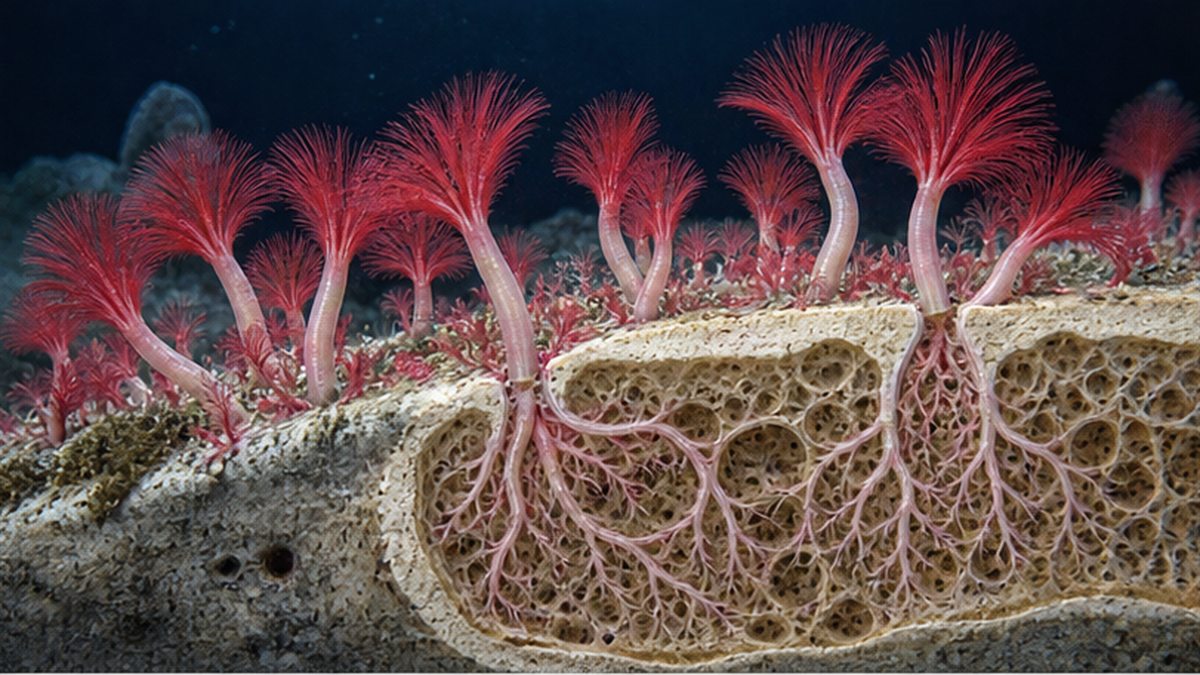
Worms with no mouth and no gut
The most distinctive feature of Osedax is that it has no mouth and no gut. Instead, it is thought to extend root-like tissue into the bone and obtain nutrition by breaking down lipids in the bone with the help of symbiotic bacteria. At the top of the body are red, feather-like gills, which take in oxygen from the seawater.
Large females, tiny males
Another fascinating aspect of this worm is its sexes. In Osedax, it is the female that roots into the bone, while the male is an extremely small individual called a dwarf male. Many males live inside the female's tube. The chance of meeting a mate in the vast deep sea is low, so living beside the partner one has found appears to be an efficient strategy.
Also found in the seas around Japan
Osedax has been found not only in the Pacific but also on whale bones around the world, and in some cases on the bones of other large animals. Surveys are also being carried out in the seas around Japan, and it attracts attention as a subject of research. It also affects how fast bones decay, and is considered one of the factors shaping succession in whale fall communities.
Key points about Osedax
- Reported as a new genus in 2004 (Rouse et al., Science)
- No mouth or gut; it roots into bone
- Symbiotic bacteria are involved in breaking down bone lipids
- Compared with females, males are tiny dwarf males
Note that how many years Osedax takes to break down what percentage of a bone varies with bone size, environment, and species, and cannot be given as a single figure.
Chemosynthesis and the chain of life: a food web that does not rely on sunlight
In the sunlit surface layer, photosynthesis by phytoplankton is the starting point of the food web (see also the explanation of marine food chains). In the third stage of a whale fall, by contrast, chemosynthesis is the starting point.
Bacteria that make organic matter from hydrogen sulfide
When bone lipids are broken down anaerobically, hydrogen sulfide is produced. Sulfur-oxidizing bacteria make organic matter from carbon dioxide using the energy obtained by oxidizing this hydrogen sulfide. Because they rely on the energy of chemical reactions rather than photosynthesis, this is called "chemosynthesis."
Similarities and differences with hydrothermal vents and cold seeps
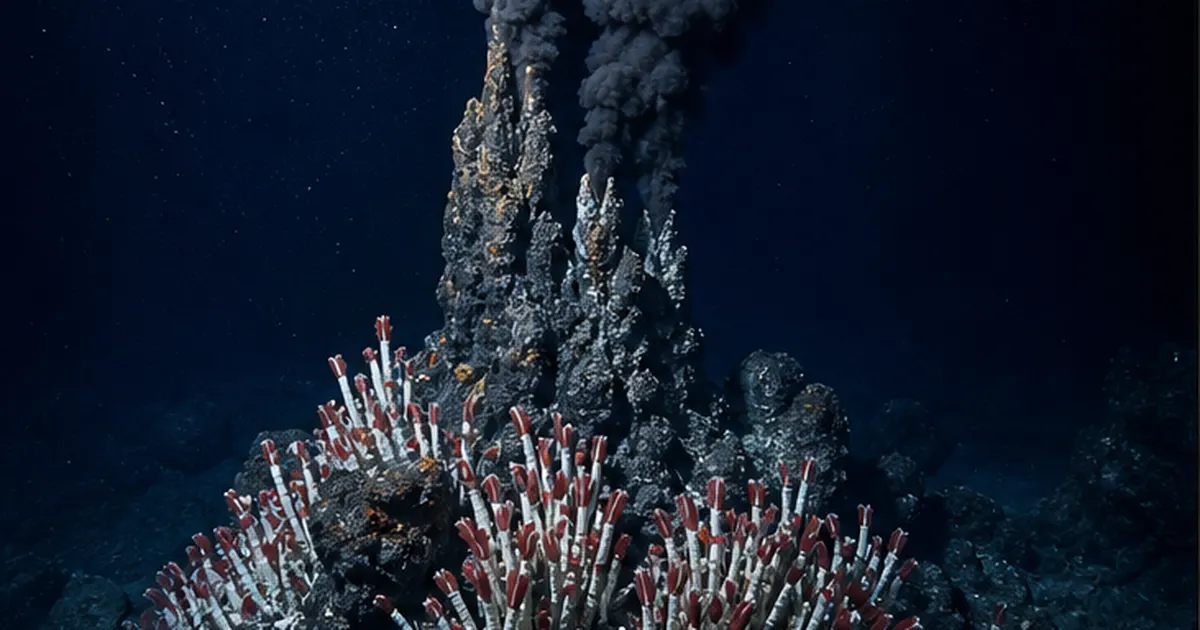
Ecosystems that are likewise supported by chemosynthesis include hydrothermal vents and cold seeps. However, while hydrothermal vents and cold seeps are supplied with sulfides and methane from inside the Earth over long periods, a whale fall is a chemosynthetic ecosystem with a time limit: it lasts only until the finite organic matter is used up.
| Item | Whale fall | hydrothermal vents | cold seeps |
|---|---|---|---|
| Energy supply | Sulfide produced by bone lipid breakdown | Sulfides in underground hot water, etc. | Methane and sulfide in seeping water |
| Duration | Finite (decades) | Geological time scales | Geological time scales |
| Distribution | Scattered where whales die | Mid-ocean ridges, submarine volcanoes, etc. | Continental margins, etc. |
What happened to the "stepping-stone hypothesis"?
At one time, a hypothesis was proposed that whale falls acted as "stepping stones" for organisms of hydrothermal vents and cold seeps, helping them move across the wide ocean. However, later surveys did not find many chemosynthetic organisms shared between whale falls and hydrothermal or cold-seep systems, and the hypothesis is not strongly supported. On the other hand, the role of whale falls as evolutionary stepping stones is being discussed anew.
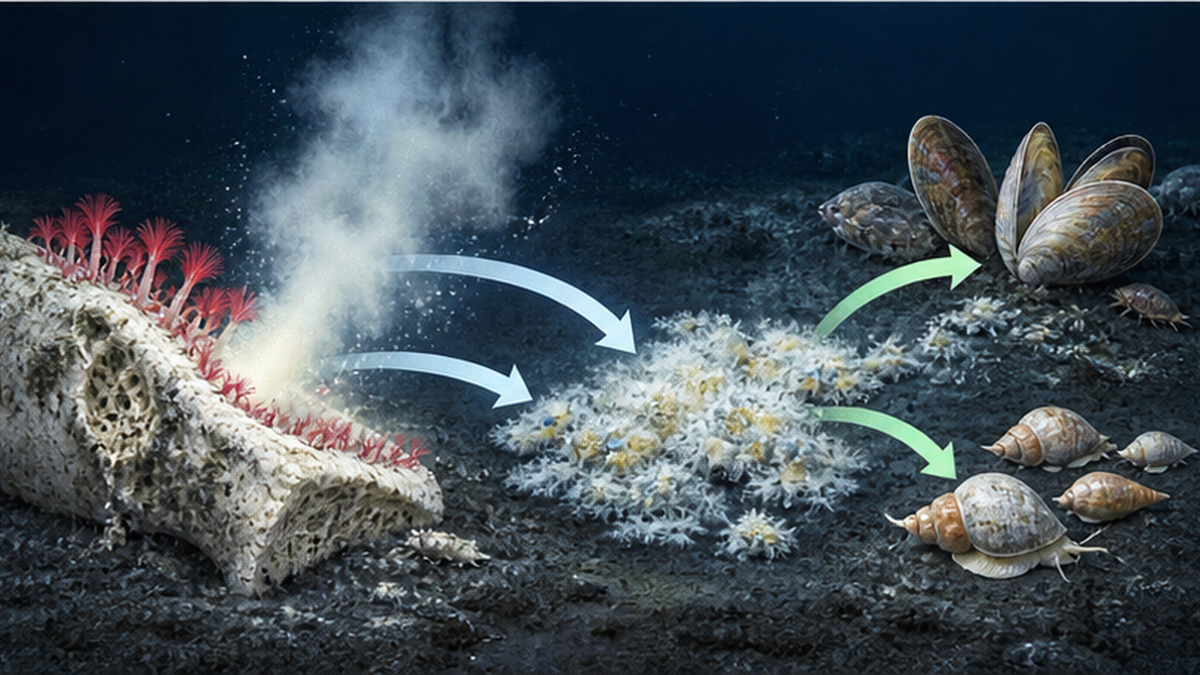
How diverse is it? Reports of hundreds of species on one skeleton
A whale fall is like a small island, and a single carcass feeds a surprising number of species. In a report (2000) in which a US research group examined the skeleton of one whale, more than 30,000 individuals and over 200 species of animals were reportedly confirmed on a single skeleton.
Observations in Sagami Bay, Japan
In Sagami Bay, Japan (depth about 500 m), a study sank the carcass of a young sperm whale, 464 cm long and about 1.2 tons, in 2012 and photographed it every two hours for 72 days (Aguzzi et al., 2018, Scientific Reports). From 850 photographs, 16 taxa and a total of 7,177 individuals were counted.
| Organism | Individuals | Share |
|---|---|---|
| Deep-sea eel (Simenchelys parasitica) | 4,052 | 56.5% |
| Japanese spider crab | 1,002 | 14.0% |
| Gissu (Pterothrissus gissu), a bonefish relative | 390 | 5.4% |
| Giant isopod (Bathynomus doederleinii) | 349 | 4.9% |
In this observation, scavengers were more numerous at night and predators more numerous in the daytime, with a 24-hour rhythm confirmed in three species. Because the carcass was small, the shift from the scavenger stage to the enrichment-opportunist stage took about 1.8 months (about 50 days), faster than for large carcasses.
Species unique to whale falls
In a study off California, among about 100 species of bottom-dwelling animals found in the sediment around whale falls, about 10 dominant species were unique to whale falls. In other words, a whale fall is a special habitat that supports organisms not found on the ordinary seafloor.
For deep-sea biodiversity as a whole, see The full picture of deep-sea biodiversity as well.
Coasts and the Atlantic too: research in Japan and the latest findings
Research on whale falls is not limited to the deep sea. Researchers in Japan have also built up important knowledge in shallow seas.
A shallow-water sinking experiment in Tokyo Bay
In an experiment that sank whale bones at a depth of about 5 m in Tokyo Bay, no animals dependent on chemosynthesis were seen after one year. On the other hand, ciliates living in symbiosis with sulfur bacteria were found on the bone surface, suggesting that whale bones can serve as a basis for chemosynthesis even in coastal waters.
The world's deepest whale fall community (Atlantic)
In 2016, research by JAMSTEC and others found the world's deepest whale fall community in the deep Atlantic. Its composition shared many species with Pacific whale fall communities, showing that organisms gathering at whale falls are widely distributed across ocean basins.
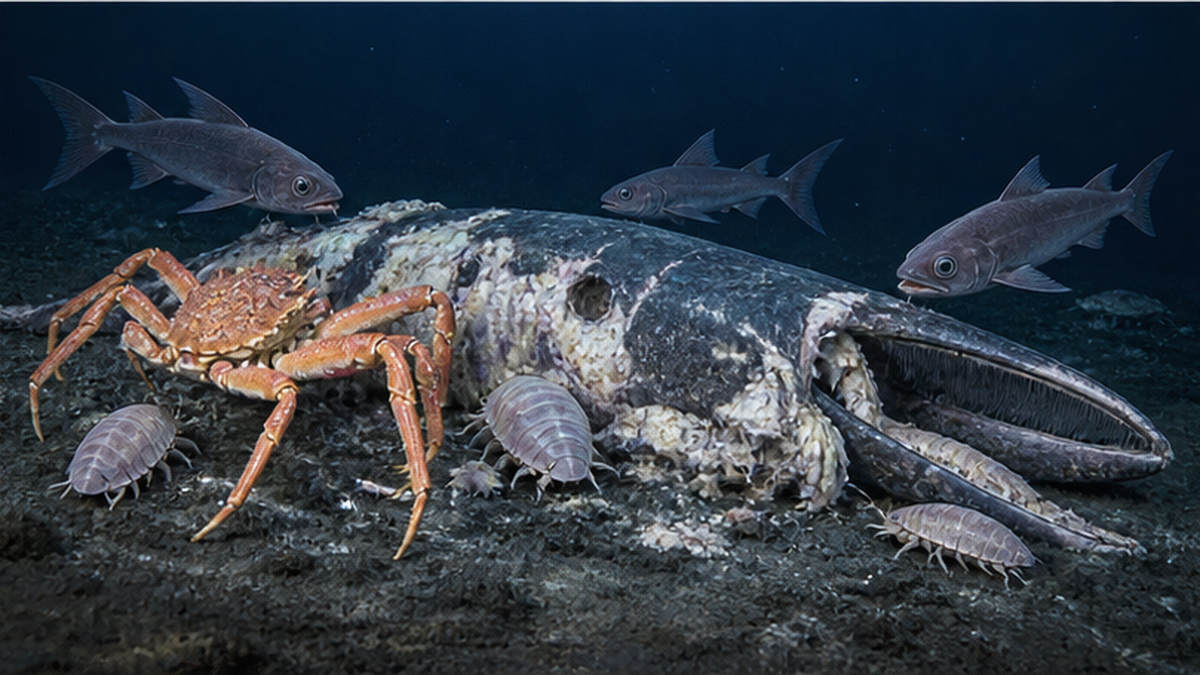
Why is the research so difficult?
- It is impossible to predict when and where a whale will sink
- Long-term deep-sea observation requires submersibles or remotely operated vehicles
- Stage transitions occur over years to decades, so tracking takes time
- Experiments that deliberately sink carcasses face ethical, permit, and cost challenges
What whale falls teach us: the carbon cycle, commercial whaling, and our lives
Whale falls are not just a story about "a rare deep-sea phenomenon." They have modern significance, linking how the ocean works with human activity.
The "whale pump" carrying carbon to the deep sea
Whales feed in the surface layer, and when they die they sink to the deep sea together with the carbon stored in their bodies. The carbon in a carcass is either used by the deep-sea ecosystem for decades or buried in sediment. Large whale carcasses play a part in carrying carbon over a long period to the deep sea, away from the atmosphere. The blue carbon perspective is also introduced in the blue carbon article.
Fewer whales also affect the deep sea
In the 20th century, commercial whaling reduced many large whales. When whale numbers fall, fewer whale carcasses reach the deep sea. For specialized species that depend on whale falls, the distance to the "next oasis" grows, and it has been pointed out that habitat connectivity may weaken. However, no conclusion has yet been established that quantitatively shows how large this effect is.
Whale migration and the continuity of life
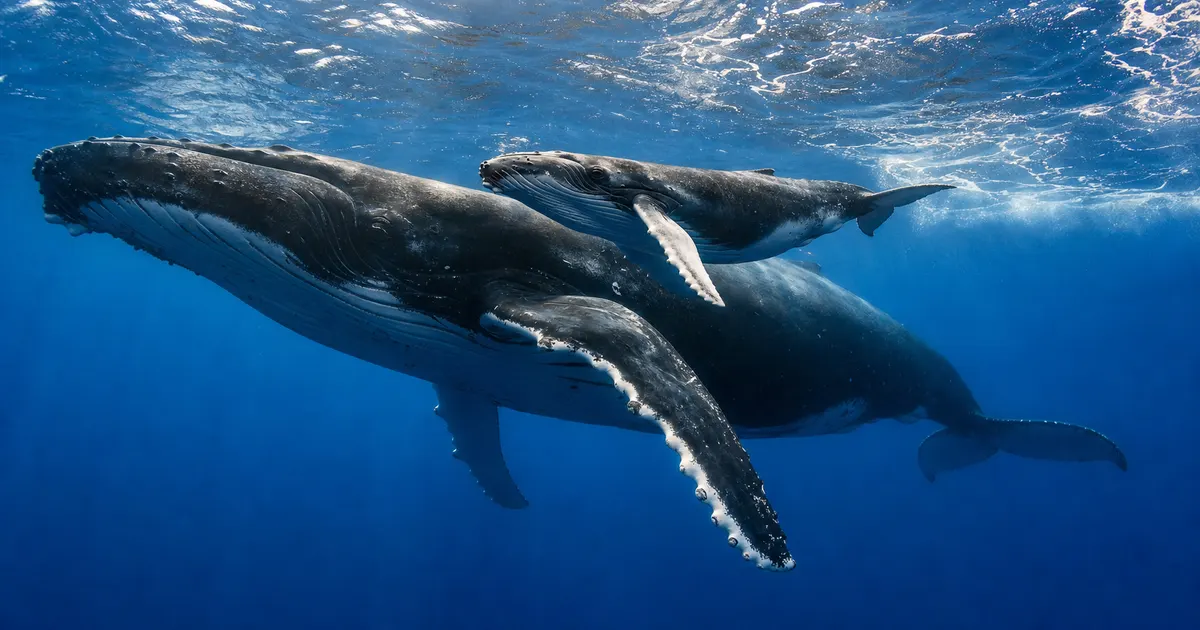
Whales migrate across the wide ocean throughout their lives (the mystery of whale migration). From feeding in the surface layer to the oasis of the deep sea at the end, a whale's life connects the flow of matter in the ocean with a single line.
What we can do
- Take an interest in research and conservation of whales and other marine life
- Visit whale-bone specimens and exhibits at aquariums and museums
- Choose actions that reduce threats to whales, such as marine debris and bycatch
- Check public information from marine research institutions such as JAMSTEC
Summary: the ocean seen through a chain of life lasting decades
A whale fall community is a deep-sea oasis that lasts for decades, in which the leading players change from scavengers to opportunists to chemosynthetic organisms after a whale's death. Strange creatures such as bone-eating worms, and a food web that does not depend on the sun, teach us that life connects from an "end" to the "next beginning."
Key points of this article
- An adult whale carcass weighs about 30–160 tons and delivers a large amount of organic matter to the deep seafloor
- The community passes through at least three stages (four according to some studies) and can last up to decades
- Osedax has no mouth or gut and roots into bone
- In a Sagami Bay experiment, 7,177 individuals gathered on a 1.2-ton carcass
- Unlike hydrothermal vents and cold seeps, chemosynthesis at a whale fall is supported by a finite resource
Summary
Whales support the ocean's ecosystems both while alive and after death. Learning about the chain of life quietly continuing in the darkness of the deep sea is an opportunity to think about why protecting the ocean matters.
References and sources
- Smithsonian Ocean: Life After Whale (On Whale Falls) – Explanation of whale fall communities
- Aguzzi et al. (2018) Scientific Reports 8:11163 – Whale fall sinking experiment in Sagami Bay
- Rouse, Goffredi & Vrijenhoek (2004) Science – Description of the new genus Osedax
- Smith & Baco (2003) Ecology of whale falls at the deep-sea floor – Review of the three successional stages
- JAMSTEC press release (2016) – The world's deepest whale fall community in the Atlantic
- Science Portal (JST) – News report on a whale fall community in the Atlantic
- ScienceDaily(2000)Whale skeleton community – Report of over 200 species on one skeleton
* Listed in order of reliability: government agencies > academic institutions > peer-reviewed papers > specialist organizations > reliable media