⚡ In short
Montbell offers the recycled-polyester fleece "CLIMAAIR," has switched about 70% of its products to PFAS-free fabrics, runs a sleeping bag collection and recycling project, and provides extensive repair services. Based on primary sources, this article explains the full picture of the brand's approach built around using gear for a long time.
More and more people choose outdoor wear based on whether it is kind to the environment. Montbell, Japan's leading outdoor brand, is working to reduce its environmental footprint from both sides — "responsible production" and a "culture of long use" — through fleece materials made with recycled polyester, a switch to fabrics free of per- and polyfluoroalkyl substances (PFAS), collection and recycling of used sleeping bags, and extensive repair services.
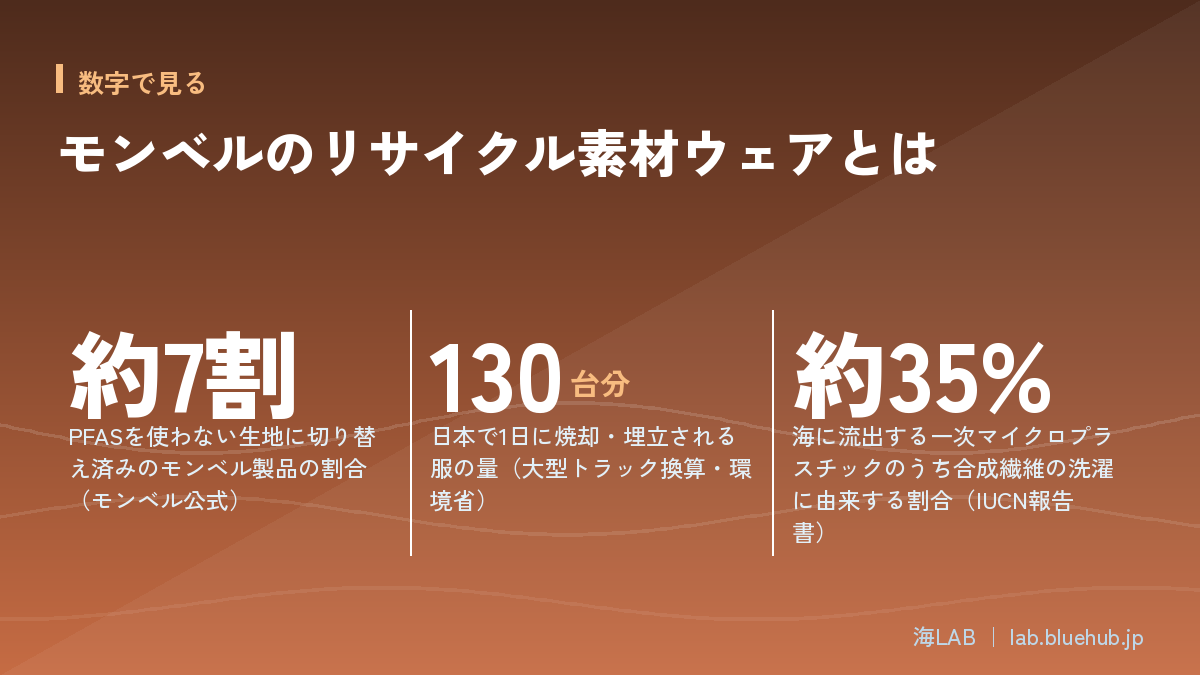
Clothing and the environment are in fact deeply connected to the ocean. According to Japan's Ministry of the Environment, clothes equivalent to about 130 large trucks are incinerated or landfilled every day in Japan. Moreover, synthetic fabrics such as fleece shed tiny fiber fragments (microfibers) with every wash that flow from wastewater into the sea; a report by the IUCN (International Union for Conservation of Nature) estimates that about 35% of primary microplastics entering the ocean originate from washing synthetic textiles.
Drawing on primary sources such as Montbell's official information and the Ministry of the Environment, this article examines the reality of recycled-material wear, the progress of PFAS-free conversion, the collection and recycling schemes, and the repair services — and considers what each of us can do when choosing and using outdoor wear.
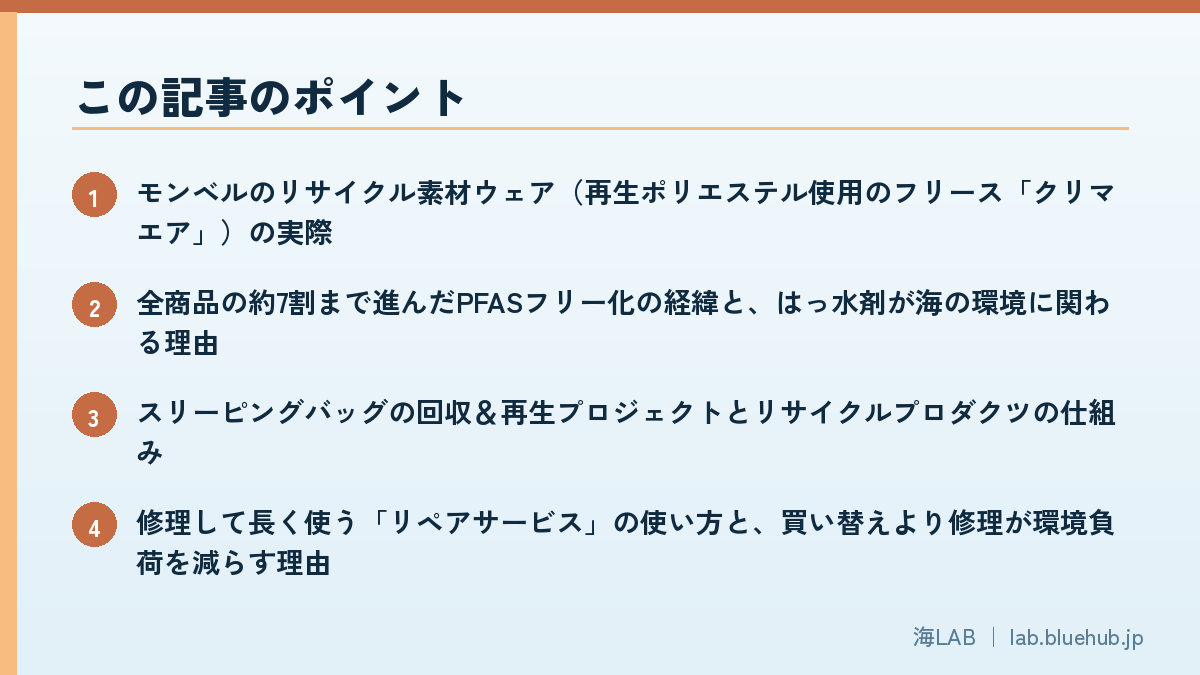
What you will learn in this article
- The reality of Montbell's recycled-material wear (the recycled-polyester fleece "CLIMAAIR")
- How PFAS-free conversion reached about 70% of all products, and why water repellents matter for the marine environment
- How the sleeping bag collection & recycling project and the Recycle Products line work
- How to use the repair service, and why repairing beats replacing for the environment
- The link between clothing and marine pollution (microfibers) and what households can do
- Checkpoints for choosing environmentally conscious outdoor wear
What Kind of Brand Is Montbell? Functional Beauty and Conservation
Montbell (mont-bell) is a comprehensive Japanese outdoor brand founded in Osaka in 1975 by mountaineer Isamu Tatsuno. Covering everything from mountaineering wear, sleeping bags, and tents to waterside gear such as kayaks and packrafts, it has grown into one of Japan's largest outdoor equipment makers. The brand name means "beautiful mountain" in French.
A maker built by a mountaineer, from the user's point of view
Founder Isamu Tatsuno is known as a climber who, at a young age, successfully ascended the north face of the Eiger, one of the three great north faces of the Alps. The starting point — "make the gear we truly want to use with our own hands" — still runs through Montbell's product development today. Gear used in extreme environments must be light, durable, and easy to repair, and the accumulation of those qualities naturally leads to products that last a long time.
Beyond making products, Montbell has continued activities that connect the field and society, such as the "Outdoor Volunteer Corps" that supports disaster-hit areas using outdoor equipment and staff skills, and programs that create opportunities for nature experiences. Because the business stands on nature's blessings, the company stands on the side of protecting nature — this attitude underpins its environmental efforts.
"Function is Beauty" and "Light & Fast"
At the root of Montbell's craftsmanship are the concepts of "Function is Beauty" and "Light & Fast." The philosophy of stripping away excess decoration and achieving necessary and sufficient function with minimal material also serves to hold down resource use. Making products that are light, durable, and repairable for long-term use is itself a design that reduces environmental impact.
A business that exists only because of natural fields
For an outdoor maker, natural fields — mountains, sea, and rivers — are the very foundation of the business. Montbell maintains a conservation section on its official site, publishing initiatives such as the switch in water-repellent components, Recycle Products, and the sleeping bag collection & recycling project. What stands out is that environmental action is positioned not as "publicity" but as a premise of manufacturing.
See Montbell's initiativesMontbell | Nature Conservation ActivitiesThe official page on Montbell's environmental efforts, including the switch in water-repellent components, Recycle Products, and the collection & recycling project.🔗 about.montbell.jpThe four pillars of "environmental consideration" in this article
- Materials: adoption of recycled materials such as recycled polyester
- Chemicals: switching to fabrics free of PFAS (per- and polyfluoroalkyl substances)
- Circulation: collecting and recycling used sleeping bags, reusing offcuts
- Longevity: repair services and maintenance to keep one garment in use longer
Why Outdoor Wear Now Demands Environmental Consideration
Why has environmental consideration become so important for clothing, and outdoor wear in particular? Behind it are three problems: mass disposal, marine pollution, and chemicals.
In Japan, about 130 large trucks' worth of clothes are discarded per day
According to the Ministry of the Environment's research on "sustainable fashion," most clothes discarded from households in Japan are not reused, and clothing equivalent to about 130 large trucks per day is incinerated or landfilled. While roughly 820,000 tons of new clothing is supplied domestically each year, only a fraction is recycled, and the one-way flow of "make, wear, discard" continues.
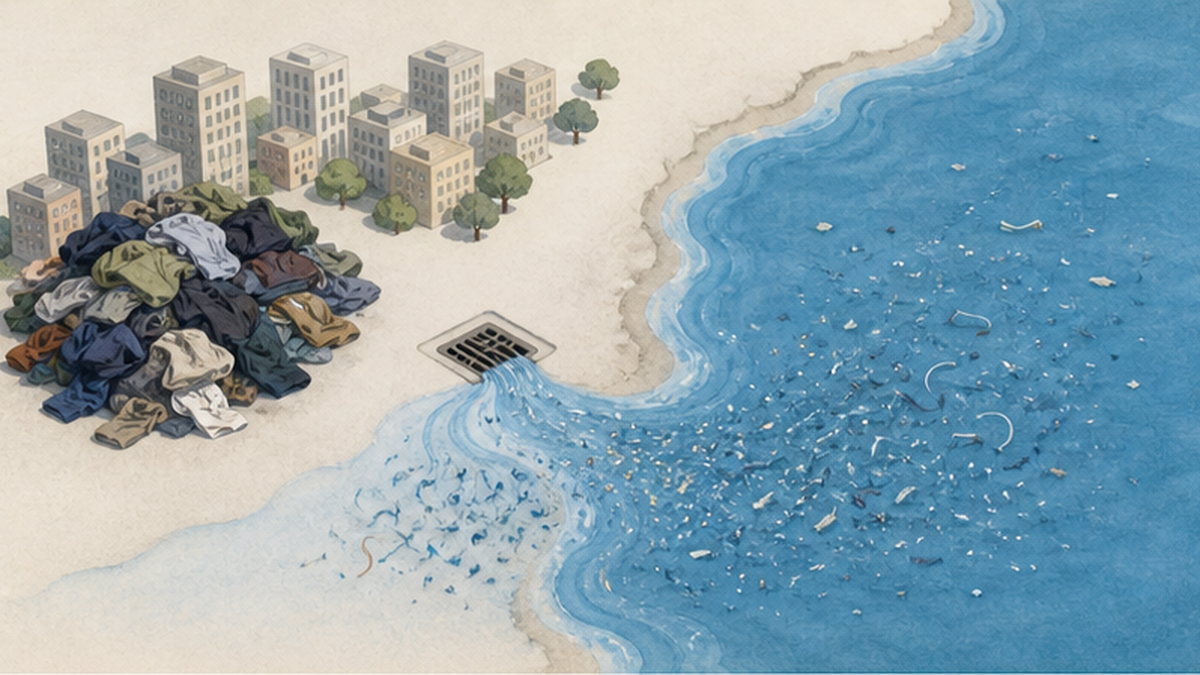
The same research shows that the share of discarded clothes going to reuse (as secondhand clothing) or recycling (as material resources) is still limited. Against an annual domestic supply of about 820,000 tons, only around 120,000 tons are said to be recycled, with the majority heading to incineration or landfill. Burning clothes emits CO2, and in landfill, synthetic fibers persist without degrading for a very long time.
Fashion is one of the world's most environmentally burdensome industries
Clothing's environmental burden is not just Japan's problem. International bodies such as the UN Environment Programme (UNEP) list the fashion industry among those with heavy environmental impacts in terms of massive water consumption, chemical use, and greenhouse gas emissions. Across a garment's life cycle, more than 90% of CO2 emissions are said to occur from raw material sourcing through manufacturing, so reducing production volume itself and wearing one garment longer are the most effective countermeasures.
Microfibers flow into the sea with every wash
Synthetic garments such as fleece release invisibly fine fiber fragments (microfibers) every time they are washed. A 2017 report by the IUCN (International Union for Conservation of Nature) estimates that about 35% of primary microplastics entering the ocean come from washing synthetic textiles, one of the largest single sources. The released fibers cannot be fully removed by sewage treatment; they travel via rivers to the sea and have been found in organisms ranging from plankton to fish and shellfish. At home, you can reduce the outflow by using laundry nets, washing less often, and using fiber-catching filter products. For details, see our related article "What Are Microfibers Released by Laundry?".
The chemical problem behind high-performance wear
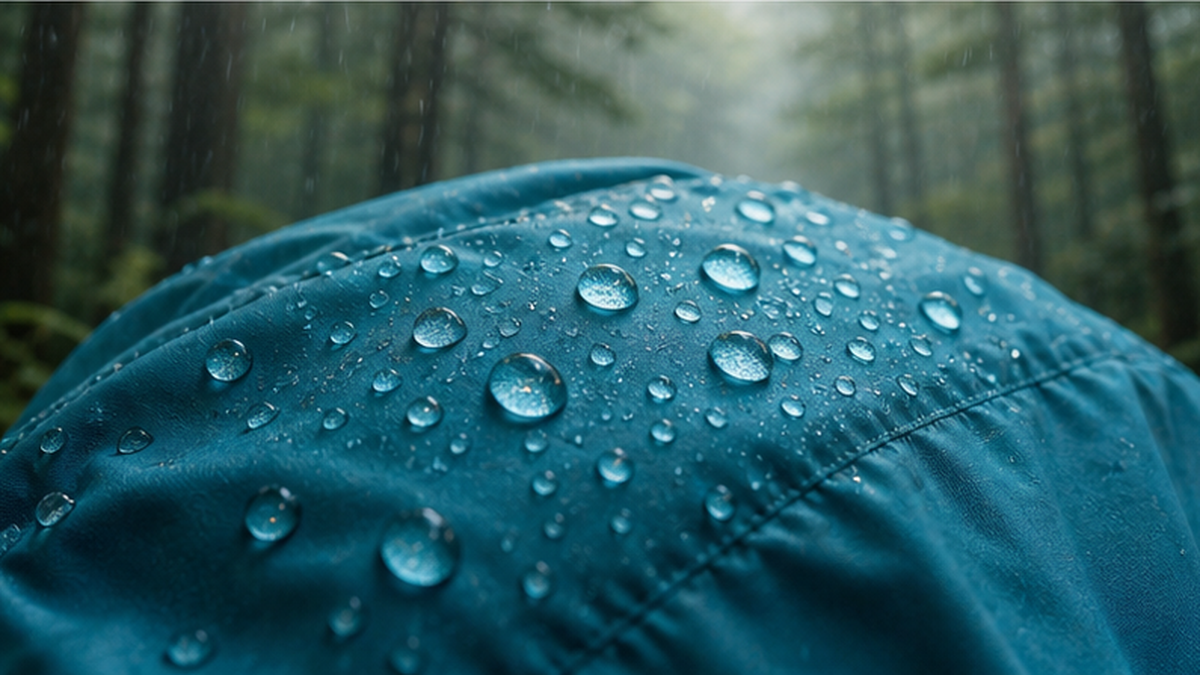
The high water repellency of rainwear has long been achieved with organofluorine compounds known as PFAS (per- and polyfluoroalkyl substances). Because PFAS barely degrade in nature, they are also called "forever chemicals," and their accumulation in rivers, oceans, and living organisms has become a global issue, with regulations advancing in many countries. How to balance high performance with lower environmental impact is a challenge for the entire outdoor industry.
Three problems at the intersection of clothing and the sea
- Mass disposal: about 130 large trucks' worth of clothes incinerated or landfilled per day in Japan (Ministry of the Environment)
- Microfibers: about 35% of primary microplastics entering the ocean come from laundry (IUCN, 2017)
- Chemicals: PFAS used in water-repellent finishes degrade poorly and persist in water environments
Montbell's Recycled-Material Wear: Recycled Polyester in Practice
To cut carbon dioxide emissions, Montbell is switching from petroleum-derived materials to lower-impact ones such as recycled polyester. Let us look at a representative example confirmed by official information.
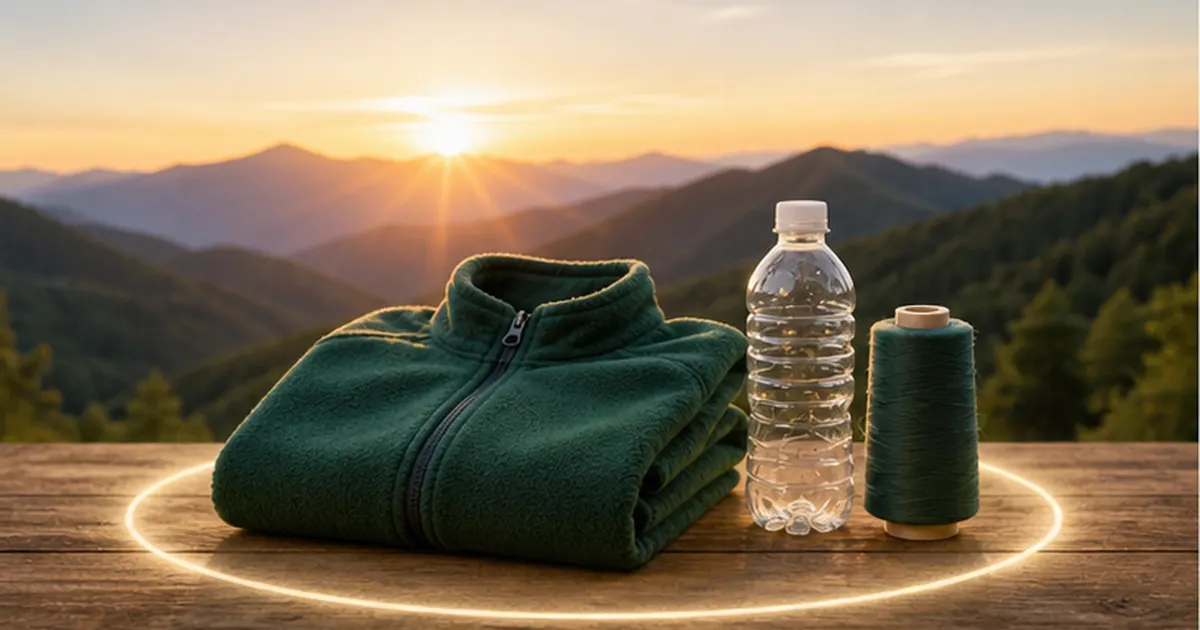
The fleece material "CLIMAAIR" partially uses recycled polyester
According to Montbell's official website, the fleece material "CLIMAAIR" partially uses recycled polyester. CLIMAAIR is one of Montbell's signature fleece materials: knitted with a coarser weave for lightness, its long pile traps plenty of air for high warmth. It is used across a wide range of products such as jackets and vests. The key point is that recycled raw material is built into a mainstay fabric — rather than sacrificing performance for the environment's sake.
Fleece originally spread as a lightweight polyester pile fabric replacing wool, the classic insulation layer. Light, quick-drying, and warm even when damp, it is used everywhere from mountaineering to town wear — but its raw material is petroleum. Building recycled content into it means cutting new resource extraction and CO2 emissions while keeping a familiar, proven material.
What the press reports about Montbell's material transition
An article in the outdoor magazine BE-PAL reports that Montbell, to reduce CO2 emissions, is switching from petroleum-derived materials to fabrics using plant-derived bio-based materials and recycled polyester. Material transition is painstaking work involving re-verification of dyeing and durability; rather than replacing everything at once, Montbell's way is to proceed product by product while confirming quality.
How recycled polyester is made
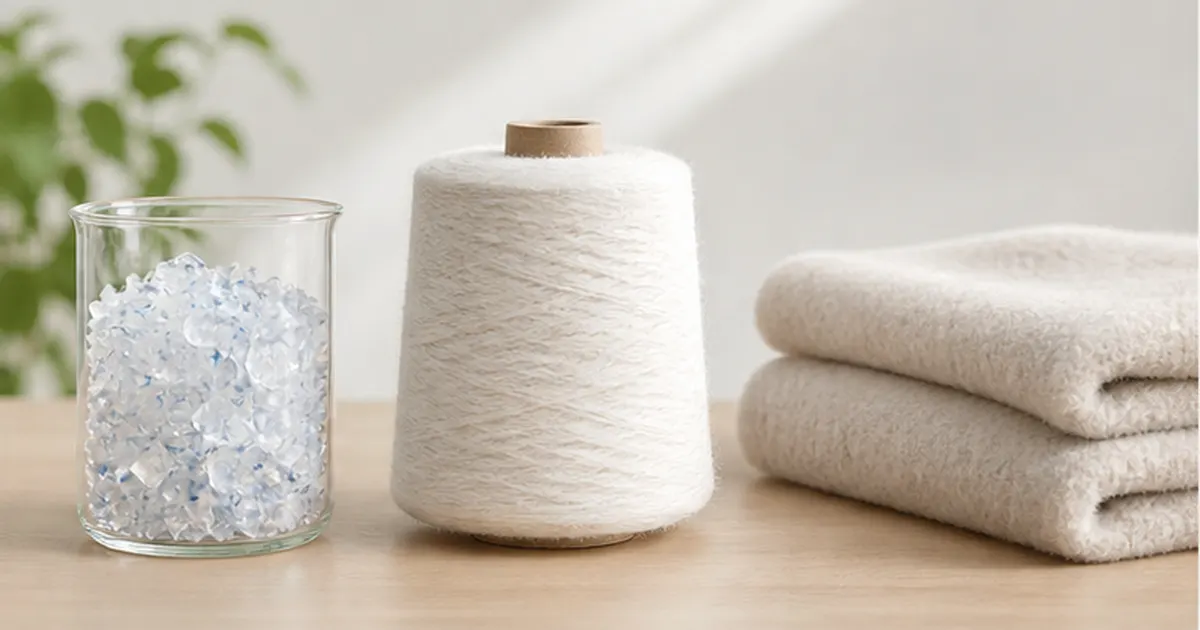
Most recycled polyester is made from collected used PET bottles and similar sources. The manufacturing flow is roughly as follows.
- Collect used PET bottles and wash them after removing labels and caps
- Crush them into flakes and remove impurities
- Melt them into pellets and spin them back into yarn
- Knit the spun yarn into fabrics such as fleece
The Ministry of Economy, Trade and Industry's casebook on environmentally conscious design of textile products also presents recycled polyester as a material that reduces new resource extraction and CO2 emissions compared with virgin, petroleum-derived polyester. For more on the PET bottle cycle, see our article "Suntory Tennensui's Recycled PET".
Knowing the benefits and limits of recycled materials
- Benefits: less new petroleum use / productive use of waste / quality can be made nearly equal to virgin material for the application
- Limit 1: even recycled polyester sheds microfibers when washed
- Limit 2: garment-to-garment "horizontal recycling" is still developing; most content comes from bottles
- Limit 3: in many cases, wearing one garment longer has a bigger environmental effect than the recycled content itself
In short, recycled materials are no panacea; they deliver results only when paired with the behaviors of using garments long, washing them properly, and returning them to the loop when finished. That Montbell's efforts extend beyond materials to collection and repair is rational on exactly this point.
How to identify recycled-material products
When looking for recycled-material products in stores or online, check whether the materials or features section states "uses recycled polyester" or similar. In the textile industry, international certifications such as GRS (Global Recycled Standard), under which third parties certify recycled content, are also spreading. Not assuming a product "must be recycled" when there is no label is a basic part of shopping on accurate information.
The Shift to PFAS-Free: A Timeline of Water-Repellent Changes
Among Montbell's environmental measures, the switch of water repellents is especially advanced. The history is clearly stated on the conservation page of the official site.
From C8 to C6 in 2015, and PFAS-free from 2020
In 2015, Montbell switched from water repellents using C8 (eight-carbon) fluorine compounds — whose environmental persistence was particularly problematic — to C6 types. Then from 2020 it began converting to fabrics that use no PFAS at all. According to the official site, including trekking pants, insulated wear, and sleeping bags, about 70% of all products now use PFAS-free fabrics.
| Year | Initiative |
|---|---|
| 2015 | Switched water-repellent components from C8 types to less persistent C6 types |
| 2020 | Began switching to fabrics that use no PFAS |
| 2024 | Development reported of rainwear using fabric that is PFC-free through the face fabric, waterproof-breathable membrane, and lining |
| Present | About 70% of all products use PFAS-free fabrics (Montbell official) |
Why PFAS are regulated worldwide
Among PFAS, the representative substance PFOS (perfluorooctane sulfonic acid) was added in 2009, and PFOA (perfluorooctanoic acid) in 2019, to the Stockholm Convention, the international treaty regulating persistent organic pollutants, and their manufacture and use were banned in principle. These substances degrade poorly in water and soil, and their accumulation through the food chain in fish, seabirds, and even humans has been confirmed. A water-repellent garment itself is not immediately dangerous, but PFAS released to the environment during manufacturing or after disposal circulate back and persist in river and marine ecosystems — that is the concern.
Why "de-fluorinating" waterproof-breathable wear is hard
Fluorine compounds have the peculiar property of repelling both water and oil, maintaining high water repellency for a long time with a small amount, so substitution is not simple. Non-fluorine water repellents have been considered weak against oily soiling and less durable in repellency. Even so, the industry-wide switch is advancing because of concerns over PFAS persistence and bioaccumulation and tightening regulations in many countries. The fashion journal WWDJAPAN reported in 2024 that Montbell developed rainwear using fabric that achieves PFC (organofluorine compound)-free construction through the face fabric, the waterproof-breathable membrane, and the lining.
What users should know is that non-fluorine water-repellent finishes are more easily affected by oils and dirt. Since repellency drops faster when sebum or mud stays on the garment, the more PFAS-free your wear is, the more "washing it regularly and keeping it clean" becomes the key to maintaining performance. The move to environmentally friendly materials is completed together with the user's maintenance habits.
Key points
- The PFAS problem in water repellents was a trade-off between wearer comfort and protecting water environments
- Montbell switched in stages — 2015, then 2020 — bringing about 70% of all products to PFAS-free
- Users too can reduce replacement purchases through repellency-restoring maintenance (see below)
Collection & Recycling Project: Used Sleeping Bags Become Resources
Alongside material switching, the other pillar is "circulation" after a product's use ends. Montbell collects and recycles products it manufactured and sold.
How the sleeping bag collection & recycling project works
Montbell runs a project to collect and recycle sleeping bags with synthetic-fiber insulation that it manufactured and sold. All synthetic-fill models are eligible; down products are excluded. As long as the bag has been washed, it is accepted even with tears or other damage. You can take part by bringing it to Montbell stores nationwide or to participating shops displaying the sticker, or by shipping it to Hokuriku Montbell Co., Ltd. in Hakui City, Ishikawa Prefecture (shipping at the user's expense).
The official page also explains how to wash the bag before handing it in: press-wash with neutral detergent in a large bathtub (a large washing machine on a gentle cycle also works); a spin dryer may be used, but a tumble dryer must not. It takes a little effort, but the process itself becomes an experience of caring for gear to the very end.
Where do collected sleeping bags go?
Research and development is under way to reuse the collected synthetic insulation as thermal insulation and cooling materials, cushion filling, mats, and more. Sleeping bags are bulky, and in some municipalities people are unsure how to dispose of them. A maker providing its own take-back channel reduces waste and embodies the attitude of taking responsibility for its products to the end.
Such initiatives are an example of a maker voluntarily practicing the idea of "extended producer responsibility," in which the producer stays involved through the disposal stage. The mindset of treating the take-back channel as part of product design — not ending at the sale — is essential for the transition to a circular society.
"Recycle Products": fleece offcuts reborn as stuffed bears
Montbell uses offcuts generated in manufacturing fleece products to make teddy bears, cushions, and other items sold as "Recycle Products." The initiative reuses offcuts that had been disposed of as industrial waste, and production is carried out in cooperation with vocational facilities of the social welfare corporation Aohani-kai, achieving environmental care and welfare support at the same time.
This scheme, in which waste reduction creates work for people with disabilities, is a fine example of an initiative spanning the environment (SDG 12, "Responsible Consumption and Production") and society (SDG 8, "Decent Work and Economic Growth"). The idea of giving new value to "waste" like offcuts can also inspire how we use unwanted items at home.
See Recycle ProductsMontbell | Recycle ProductsOfficial online store listing of stuffed bears, cushions, and other items made from fleece manufacturing offcuts.🔗 webshop.montbell.jpHow to use the collection & recycling project (key points)
- Eligible: Montbell sleeping bags with synthetic-fiber insulation (down excluded)
- Condition: must be washed (tears and other damage are acceptable)
- Where: Montbell stores / participating shops nationwide, or ship to Hokuriku Montbell Co., Ltd.
- Destination: thermal insulation and cooling materials, cushion filling, mats, etc. (in R&D)
Long Use Is the Greatest Eco-Action: Montbell's Repair Service
Ministry of the Environment research shows that, compared with the amount of clothing a person discards in a year, the amount repaired and kept in use is tiny. As a system supporting the culture of "repair and use long," Montbell's repair service plays an important role.
What the repair service can do
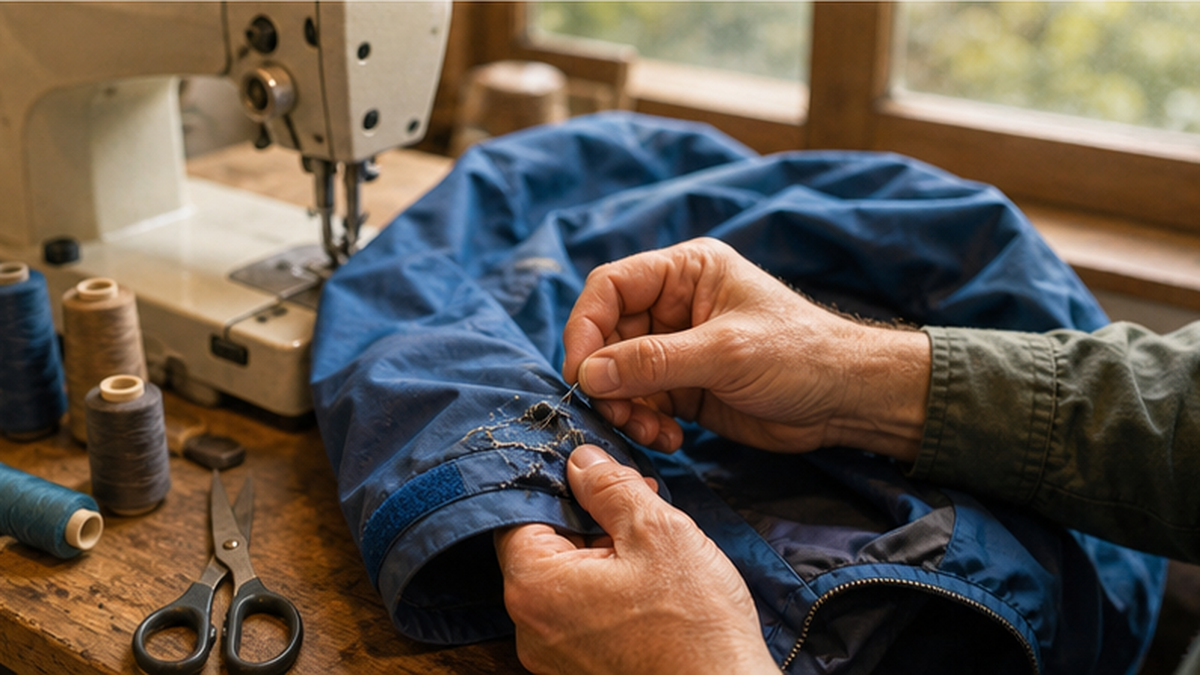
Montbell's customer service accepts a wide range of repairs, including mending torn fabric on wear and bags, zipper replacement, and resoling hiking boots. According to the official FAQ, repairs take roughly four to six weeks from acceptance to delivery (varying with the number of repair points and the season). Requests concentrate on tents, rainwear, and hiking boots in the summer mountain season, and on down wear in winter.
Why repairing reduces environmental impact more than replacing
Most of the CO2 emitted across a garment's life cycle occurs at the raw material sourcing and manufacturing stages. In other words, wearing one garment you already own for longer defers and reduces the entire emissions of manufacturing a new one. The Ministry of the Environment also lists "wearing the clothes you have longer" as the first step in sustainable fashion. Montbell's stance — building durable products and providing a repair channel — aligns with this thinking.
The same research shows that while the clothes a person repairs and keeps wearing in a year are few, many garments are discarded while still wearable. Having a place to repair, and the experience of having repaired, become motivation to choose long-lasting products at the next purchase too. The repair service is not mere after-sales service; it is a mechanism that changes how we consume.
Restoring water repellency and maintenance extend garment life
Most cases of rainwear "starting to soak through" are caused not by degradation of the waterproof layer but by decline in surface water repellency. Washing off the dirt and applying heat treatment (ironing with a pressing cloth, etc.) or a water-repellent agent can restore repellency, and in many cases the garment can continue in use without replacement. Montbell publishes maintenance methods for keeping water repellency on its official site.
Specifically, the guidance includes frequent washing with a technical or neutral detergent, rinsing thoroughly, applying heat after washing with a low-temperature tumble dryer or an iron with a pressing cloth to reactivate the repellent finish, and re-treating with a commercial water-repellent agent if repellency does not recover. Down garments and sleeping bags, too, keep their warmth for a long time if washed and stored correctly (not stored compressed long-term, etc.) so that their loft is maintained.
See the repair serviceMontbell | Repair Service GuideFabric repair for wear and bags, hiking boot resoling, and more — the official repair service for long product life.🔗 support.montbell.jp"Long use" actions you can start today
- Before discarding torn garments or broken zippers, consult the repair service
- Wash rainwear regularly and restore its water repellency
- Use a laundry net when washing synthetics to reduce microfiber outflow
- Send unused Montbell synthetic sleeping bags to the collection & recycling project
Montbell's Position Compared with Other Brands
In the outdoor industry, brands compete on environmental action. Comparing representative brands' initiatives brings Montbell's characteristics into focus.
| Brand | Representative initiatives | Characteristics |
|---|---|---|
| Montbell (Japan) | Adoption of recycled polyester, PFAS-free conversion (about 70% of all products), sleeping bag collection & recycling, repair service | Strong in long-life design and repair/collection systems under the "functional beauty" philosophy |
| Patagonia (US) | "NetPlus" material recycled from discarded fishing nets, broad adoption of recycled materials, "Worn Wear" repair service | Powerful environmental advocacy and a high ratio of recycled materials |
| adidas (Germany) | "adidas × Parley" series recycled from ocean plastic | Pioneer in applying ocean plastic to sporting goods |
Overseas brands lead in materials; Montbell excels at systems for long use
We cover Patagonia's fishing-net-derived material in "Patagonia NetPlus Explained" and the potential and challenges of ocean-plastic products in "What Are Recycled Products from Ocean Plastic?". While overseas brands lead in recycled-material ratios and storytelling, Montbell's distinctiveness lies in having laid out nationwide "infrastructure for long use" — repair services and take-back channels — across Japan.
Checkpoints for choosing environmentally conscious wear
- Read the material label: is the use of recycled materials such as recycled polyester clearly stated?
- Check the water-repellent finish: is it labeled PFAS-free (fluorine-free)?
- Look into the repair system: does the maker offer repair services and supply parts?
- Check for take-back schemes: is there a collection program for used products?
- Ask whether you really need it: the purchase with the smallest footprint is the one you do not make
What matters is not crowning any single brand the "right answer," but building the habit of comparing products from multiple perspectives — materials, chemicals, circulation, and longevity. Environmental information is updated on each company's official site year by year, so checking the latest information before purchase is another key point.
A realistic answer to "it's too expensive"
Environmentally conscious products tend to cost more, but for outdoor wear it is rational to think in terms of "price divided by years of wear." One garment used for ten years with repairs can have a lower annual cost and footprint than cheap clothes replaced every two or three years. Choosing a brand with a solid repair system like Montbell is a rational long-term choice for the household budget as well. Using secondhand markets and outdoor gear reuse shops is also a legitimate environmental action in that it reduces new manufacturing.
Conclusion: Wearing One Garment Longer Helps Protect the Sea
We have looked at Montbell's recycled-material wear and environmental initiatives. Its style of steadily building unglamorous systems — material switches, repair, collection — rather than flashy campaigns is the very embodiment of "Function is Beauty."
Three things we can do
First, check the material and water-repellent labels when buying. Second, care for and repair the wear you own and use it longer. Third, return finished products to collection schemes. In Japan, about 130 large trucks' worth of clothes are disposed of every day, and laundry-derived microfibers are a major source of marine microplastic pollution. The familiar act of using one garment long and with care directly reduces waste and protects the sea.
When we hear "marine environmental problems," plastic bags and straws come to mind — but the fleece and rainwear in your closet can also increase or decrease the burden on the sea depending on how you choose and use them. The initiatives of Montbell, a maker of mountain gear for half a century, teach us that the simple principle of "buy good things, repair them, use them long" is the most reliable environmental action. The next time you buy — or let go of — a piece of outdoor wear, remember the systems introduced in this article.
Summary of this article
- Montbell partially uses recycled polyester in its fleece material "CLIMAAIR"
- Water repellents moved from C8 to C6 in 2015 and toward PFAS-free from 2020; about 70% of all products are now PFAS-free
- The company runs a project collecting synthetic-fill sleeping bags for recycling into insulation materials, plus Recycle Products made from offcuts
- Repair services (about 4–6 weeks from acceptance) and maintenance information support a culture of long use
- Mass clothing disposal and microfibers are directly linked to marine environmental problems; long use is the greatest environmental consideration
References
- Montbell – Nature conservation activities (switch of water-repellent components, Recycle Products, etc.)
- Montbell – Collection & Recycling Project (sleeping bags)
- Montbell – Light, warm, soft fleece wear (CLIMAAIR material guide)
- Montbell – Repair service guide
- Montbell Online Store – Recycle Products
- Ministry of the Environment, Japan – Sustainable fashion (research on clothing disposal and circulation)
- IUCN – Primary Microplastics in the Oceans (2017, source estimates of marine primary microplastics)
- Ministry of Economy, Trade and Industry, Japan – Casebook of environmentally conscious design of textile products (April 2023)
- WWDJAPAN – Montbell develops rainwear using PFC-free fabric
※ Ordered by reliability: government and academic institutions > peer-reviewed papers > specialized institutions > trusted media