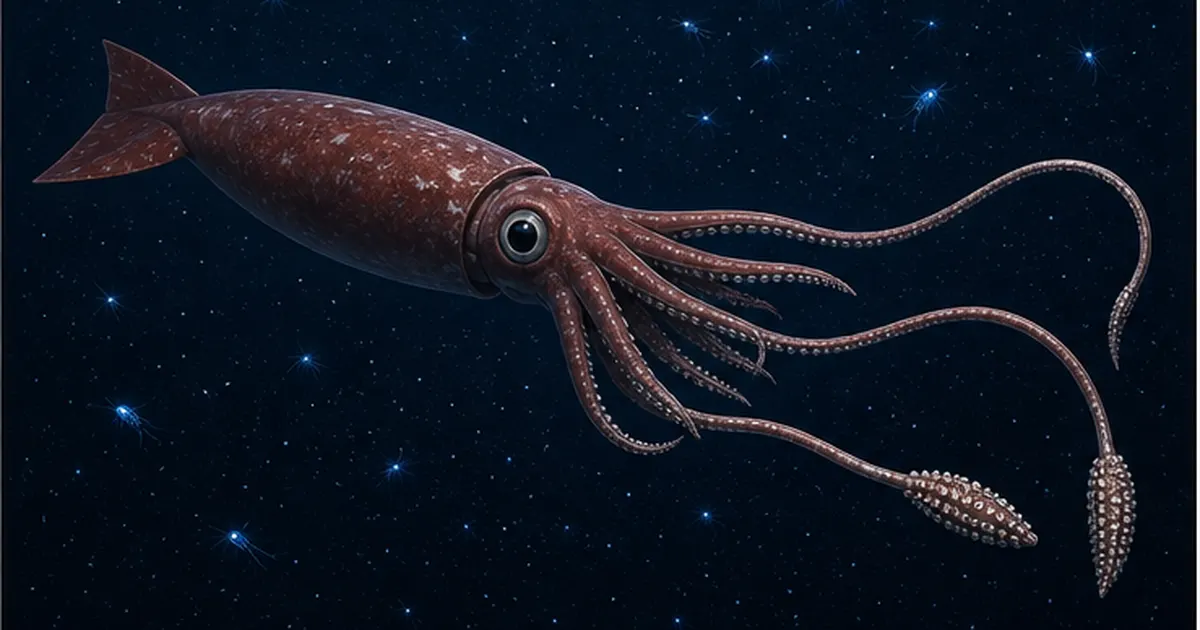
Somewhere in the ocean live creatures that arrived at "intelligence" by an entirely different route than we did: cephalopods, including octopuses, squid, and their close relatives the cuttlefish. Despite being mollusks with no backbone or rigid skeleton, they open jar lids, carry tools around, and blend into their surroundings by changing their body color in an instant. They are often described as "aliens living on Earth."
Why would an invertebrate related to clams and snails evolve such sophisticated intelligence? The key lies in a unique nervous system in which the brain isn't concentrated in one place. An octopus has roughly 500 million nerve cells, and about two-thirds of them are scattered not in the central brain but across its eight arms. The arms are, in effect, "thinking hands," acting on their own judgment without waiting for orders from the center.
This article traces the evolutionary history of cephalopods, the mechanics of their distributed nervous system, real examples of tool use and problem-solving, the mystery of their color vision and color-changing skin, and finally the reasons behind the short life that follows reproduction — all based on peer-reviewed papers and primary sources from research institutions. By the end, you should be able to see another "shape of intelligence" living in the ocean.
What you'll learn in this article
- That an octopus's nervous system has about 500 million neurons, roughly two-thirds of which are distributed across its eight arms in a "nine brains" structure
- Exceptional examples of tool use and problem-solving for an invertebrate, such as carrying coconut shells and opening jar lids
- That octopuses and squid, which should have "no color vision" since they possess only a single type of photoreceptor, may be estimating color using the chromatic aberration of their lenses
- The three-layer structure of chromatophores, iridophores, and leucophores that lets them change body color in an instant for camouflage
- Why many octopuses reproduce only once in their lifetime and then die, and the "death program" governed by the optic gland
- An evolutionary strategy unlike ours, in which they extensively rewrite RNA rather than DNA
What are octopuses and squid — how mollusk relatives came to acquire intelligence
In biological classification, octopuses and squid belong to the "phylum Mollusca, class Cephalopoda." The same phylum also includes clams and turban shells, as well as slugs and snails. In other words, if you trace their distant relatives, cephalopods are kin to shellfish. And yet, they evolved a nervous system and set of behaviors far more advanced than any other mollusk. This gap is the very first thing to grasp when discussing cephalopod intelligence.
A veteran group with a 500-million-year history
The history of cephalopods is astonishingly old, with fossil records dating back roughly 500 million years to the Cambrian period. The earliest cephalopods were a "shelled" group with a hard external shell, like the nautilus. From there, evolution repeatedly internalized or reduced the shell, and by the Jurassic and Cretaceous periods, ammonites flourished spectacularly in the ocean. Over 7,500 cephalopod species are said to be confirmed in the fossil record, and only a tiny fraction of them are alive today. The long-running trend of shedding the heavy armor of a shell laid the groundwork for the highly developed mobility and nervous system that would follow.
| Category | Representative examples | Characteristics |
|---|---|---|
| Nautiloids | Nautilus | The most primitive cephalopods, with an external shell; sometimes called a "living fossil" |
| Extinct groups | Ammonites, belemnites | Flourished spectacularly in Mesozoic seas; most went extinct around the same time as the dinosaurs |
| Coleoids (superorder Decapodiformes and relatives) | Octopus, squid, cuttlefish | Living groups that reduced or internalized their shells and developed advanced nervous systems and color-changing skin |
Why did cephalopods bother to give up the hard shell that protected them? One influential idea points to the emergence of fast predators and competitors, such as fish. A heavy shell may help with defense, but it slows movement down. Cephalopods that shed their shells and became nimble adopted a different survival strategy: swimming quickly, squeezing into narrow gaps, burrowing into sand, and disguising themselves to hide within their surroundings. But a soft, exposed body is also defenseless. In exchange for losing their hard armor, they went down the path of protecting themselves through "cleverness" — quick judgment, skillful camouflage, and complex behavior. The high intelligence of cephalopods was both the price of abandoning the shell and its reward.

An "intelligence from a separate lineage" that diverged from humans 500 million years ago
Around 800 species of cephalopods are thought to live in the world's oceans today, and even in the waters around Japan alone, species familiar from the dinner table — such as common octopus, giant Pacific octopus, Japanese flying squid, and cuttlefish — are abundant. They are a familiar "seafood" to us, and at the same time creatures still surprising scientists at the frontier of intelligence research.
What makes cephalopod intelligence so remarkable is that it evolved completely independently of us vertebrates. The last common ancestor of humans and octopuses is thought to have lived more than 500 million years ago. That ancestor was a small, simple worm-like creature that didn't even have proper eyes, and had nothing to do with advanced intelligence. In other words, the octopus brain and the human brain didn't "inherit a shared blueprint" — each independently built a sophisticated information-processing system from completely different materials and paths. Biologists call this phenomenon "convergent evolution." Octopuses and humans independently evolving camera-like eyes is another classic example of convergent evolution.
What is convergent evolution?
When organisms from different lineages, adapting to similar environments or challenges, end up independently evolving strikingly similar organs or abilities. The eyes of an octopus and a human, or the wings of a bat and a bird, are typical examples. Octopus intelligence can be described as "another shape of intelligence," reached by a route entirely separate from vertebrates.
This fact of being a "separate lineage" is extremely important for how we think about animal intelligence. Cephalopods overturn the assumption that intelligence can't arise without a backbone or a single, massive brain. How creatures have remodeled their bodies to survive the harsh deep-sea environment is explored in detail in our article on the astonishing adaptations of deep-sea creatures, and cephalopod intelligence, too, is an extension of this kind of bold bodily remodeling in response to the environment.
A body with "nine brains" — the mechanics of a distributed nervous system
The greatest feature underpinning cephalopod intelligence is a "distributed nervous system," where the brain isn't concentrated in one place. An octopus has roughly 500 million nerve cells (neurons) throughout its body — a number close to that of a dog's brain, and staggering for an invertebrate. But what's truly surprising isn't the number itself; it's how those neurons are arranged.
The centers outside the arms make up only a third of the whole
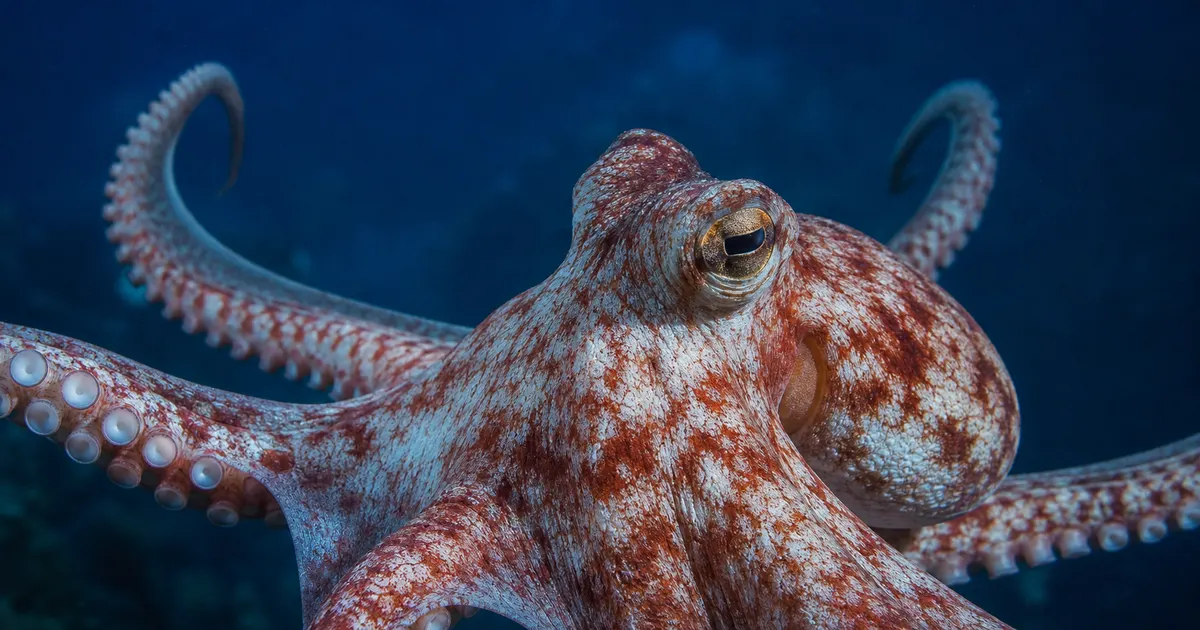
The nerve cells contained in an octopus's central nervous system — the central brain between the two eyes, plus the optic lobes on either side that process vision — total roughly 180 million, only about a third of the whole. Of that, the central brain itself accounts for only about 40 to 45 million, an even smaller share. The remaining two-thirds — over 300 million neurons — are distributed across the eight arms. Simple arithmetic puts that at about 40 million per arm. Each arm has its own cluster of nerves (a ganglion) and can process information about whatever it touches and organize its own movements without a direct command from the central brain. This structure is often described as "nine brains" — one central brain plus eight in the arms.

The arms as "thinking hands" — they keep moving even when severed
Research from the Okinawa Institute of Science and Technology (OIST) and elsewhere has reported experiments demonstrating the arms' autonomy. Even an arm severed from the central brain showed essentially the same basic movement patterns as an arm on a living octopus when stimulated electrically. Moreover, when the environment the arm was placed in or its starting posture was changed, even the severed arm adjusted its movements in the same way as an arm still attached to the body. This suggests the arm itself has circuitry that decides "how to move." When hunting for prey, an octopus lets its eight arms crawl off in different directions, simultaneously exploring narrow crevices in the rocks. If the central brain had to micromanage everything, this kind of parallel exploration wouldn't be possible.
- Central nervous system (central brain and optic lobes): the command center handling overall judgment such as vision, learning, and memory (about a third of the total, excluding the arms)
- Arm ganglia: "small brains" that locally process touch, taste, and movement (the remaining two-thirds)
- Suckers: hundreds per arm, with a "tactile taste" sense that detects the chemical makeup of whatever they touch
Suckers as sensors of "tactile taste"
The hundreds of suckers lined up along each arm are not simply devices for gripping. Their surfaces are densely packed with sensors that detect chemical substances, allowing an octopus to directly sense the "taste" of whatever it touches. It's as if an octopus performs, with a single sucker, the combined act of touching something with our hands and tasting it with our tongue. By reaching an arm into a crevice in the rocks and identifying prey it can't see by chemical cues alone the instant it makes contact, an octopus can search complex terrain without relying on eyesight. Much of the neuron concentration in the arms is thought to be used for processing this enormous stream of sensory information on the spot.
Advantages of a distributed nervous system
- Using all eight arms in parallel to handle multiple tasks or searches at once
- Distributing the processing load away from the central brain, enabling fast reactions
- Because the arms can make local decisions, they excel at foraging in narrow, complex terrain
- A body that is soft all over, with no fixed joints, allows for near-infinite range of movement
Lacking a backbone and having no rigid pivot point anywhere in its body, an octopus can, in theory, take on almost limitless postures. To move this excessively flexible body without falling apart, it makes more sense to hand over judgment to the arms on the front line, rather than managing everything centrally. A distributed nervous system can be seen as the inevitable answer produced by the choice cephalopods made in favor of a soft body.
This idea connects to our own technology as well. In recent robotics, rather than having a central computer control everything, the concept of "embodiment" — distributing sensors and simple decision-making functions across different parts of the body — has attracted attention. In research on "soft robots" built from flexible materials, the octopus arm has become something of a role model. The cephalopod body, capable of complex movement without a rigid skeleton, represents a superb design arrived at through 500 million years of evolution, and a treasure trove of wisdom that human engineering is only now beginning to learn from.
Using tools, solving problems — solid evidence of intelligence
What backs up the impression of "intelligence" is, above all, behavior. Cephalopods repeatedly display advanced behaviors — tool use, problem-solving, observational learning, and play — that had previously only been confirmed in some mammals and birds. Here, we introduce representative examples confirmed through research.
Carrying coconut shells — tool use in an invertebrate
In 2009, a study published in the journal Current Biology delivered a major shock. Researchers observed the veined octopus (Amphioctopus marginatus), living in waters off Indonesia, carrying halves of broken coconut shells and assembling them into a "shelter" when needed. Between 1999 and 2008, researchers conducted more than 500 total hours of diving surveys and observed more than 20 individuals. The octopuses carried the shells with the concave side up, held in their arms, and walked along the seafloor using their arms like rigid legs in a behavior called "stilt-walking," carrying the shells as far as 20 meters.
This behavior is judged to be "tool use" because carrying the shells serves no purpose in the moment — they only become useful later, once assembled — meaning it is "preparation for the future." Carrying an object not for the present moment but in anticipation of the future was, until then, almost unknown among invertebrates.

Opening jar lids — learning by observation
In aquariums and research facilities, octopuses have repeatedly been observed opening the lids of clear jars to retrieve prey (such as crabs) inside. Being able to smell the prey through the jar but only able to eat it after twisting the lid off — this amounts to an intelligence test for an octopus. What's even more interesting is that an octopus can "learn by watching" another individual open the jar. In experiments, octopuses that had observed another individual solve the task solved the same task faster than octopuses with no observational experience. Observational learning — taking in another's behavior and incorporating it into your own — has long been considered a hallmark of highly social animals.
Play, and mischief
Cephalopods also display behavior resembling "play," which shouldn't be necessary for survival. At one aquarium, an octopus was observed repeatedly pushing an empty bottle into a water jet, then going to retrieve the bottle after the current carried it away, over and over. Repetitive behavior with no clear purpose is a hallmark of "play," suggesting the presence of a mind that feels boredom and seeks stimulation. At a German aquarium, an anecdote was also recorded of an octopus named Otto, who apparently disliked the lighting above his tank and squirted water at it to short it out.
These behaviors, taken together, are not one-off coincidences — they show that cephalopods have the ability to "understand a given situation and construct means toward a goal." Using tools, solving problems, learning from others, playing, and sometimes even causing mischief — these were once thought to be the exclusive privilege of large-brained mammals and birds. Cephalopods prove that a completely different body structure can arrive at similarly intelligent behavior, forcing us to reconsider the very question of "what is intelligence?" It's also a valuable clue as to just how diverse the ways life on Earth can be for understanding the world.
Advanced behaviors confirmed in cephalopods
- Tool use: carrying coconut shells and using them as a shelter (veined octopus)
- Problem-solving: twisting open a jar lid to retrieve prey
- Observational learning: watching another individual's method and incorporating it into their own behavior
- Spatial memory: learning a maze route and improving performance with practice
- Play behavior: repeating purposeless actions
A memory that learns mazes and recognizes individuals
Cephalopod intelligence isn't just about on-the-spot dexterity. Experiments have confirmed that octopuses can learn maze routes and improve their performance with repeated practice. This means they have the ability to memorize spatial information and use past experience to guide future behavior. Some studies have even reported that octopuses can recognize specific people and change their attitude depending on likes and dislikes. Learning about the environment from scratch and accumulating experience within a short lifespan — the high learning ability of cephalopods is supported by this accumulation of memory and flexible behavior.

An octopus's arm is, in itself, a semi-independent "thinking hand," which together with the central brain forms the intelligence of a single individual.
— Summarized from findings on distributed nervous system research
Manipulating color without color vision — the mystery of cephalopod eyesight
Cephalopods freely change their body color to match their surroundings. Surely, then, they must have superb color vision — yet the answer research gives is surprising. Most cephalopods have only a single type of light-sensing photoreceptor for detecting color. We humans distinguish color using three types of receptors — for red, green, and blue — but an animal with only one type of receptor should, in principle, see a "colorblind" (monochrome) world. Here lies a great mystery.
A world seen through a single type of receptor
Distinguishing color means telling apart light of different wavelengths. With only one type of receptor, you can tell brightness apart, but you can't, in principle, distinguish differences in wavelength — that is, color. In fact, behavioral experiments have never produced clear evidence of color vision in cephalopods, and for a long time, it has been a great mystery: "if octopuses and squid can't see color, how do they match the colors of their surroundings so precisely?"
Ironically, another marine invertebrate — the mantis shrimp — has more than 12 types of photoreceptors, said to give it one of the most complex color vision systems in the animal kingdom. Cephalopods, by contrast, have only a single type. And yet, cephalopods are far better at matching their body color to the background. The mantis shrimp, which "sees color through many receptors," and cephalopods, which "manipulate color while barely seeing it at all" — this contrast vividly shows that living things can arrive at entirely different answers to the same challenge (living in a world of color). How cephalopods overcome this contradiction remains one of the great mysteries of the ocean that continues to fascinate researchers.

The hypothesis that lens "chromatic aberration" is used for color discrimination
A study published in 2016 in the Proceedings of the National Academy of Sciences (PNAS) offered a bold hypothesis for this mystery. The key lies in the "chromatic aberration" of the lens in a cephalopod's eye. Chromatic aberration is a phenomenon in which the point of best focus shifts by color, because the degree of light bending (refractive index) differs by wavelength. Ordinary animal eyes are corrected to cancel out chromatic aberration, but cephalopod lenses are known to leave this chromatic aberration uncorrected.
The research team proposed that by combining the cephalopods' unique pupil shape (a laterally spread shape, such as a W or U) with this uncorrected chromatic aberration, they could indirectly estimate color using the difference in the in-focus distance for each color as a clue. In other words, rather than "distinguishing color itself," the idea is that they extract color information by measuring "which color appears sharpest (best in focus)." This would mean compensating for the limitation of having only a single type of receptor through an optical trick.
Note: this remains a "hypothesis"
Color discrimination using chromatic aberration is a compelling idea, but it is still at the hypothesis stage. It has not been directly proven that cephalopods actually use this mechanism to distinguish color. In science, many findings remain at the stage of "this might explain it," and it's important to read with a clear distinction between confirmed fact and hypothesis.
Sensing light through the skin — sensors beyond the eyes
Even more surprisingly, cephalopods are known to have light-sensing molecules called "opsins" in their skin as well. This suggests the possibility that they can sense light — and in some cases, perhaps even color — directly through the skin itself, without using their eyes. If a light sensor sits right next to the cells that change body color, it might be possible to check, on the spot and without going through the brain, how well the skin's surface matches its surroundings. Just as with the distributed nervous system, cephalopods appear to be designed, even in terms of vision, to "sense and judge across the whole body."
Another point not to overlook is just how sophisticated the cephalopod eye itself is. An octopus's eye has the same lens-based structure known as a "camera eye" as the human eye, but it actually has an advantage over ours. The human eye has a "blind spot" where the optic nerve passes through the retina, but the octopus eye has no such blind spot. Two separate lineages that diverged more than 500 million years ago each independently evolved a nearly identical camera eye, with the octopus's version structurally more efficient — a superb example of convergent evolution, and a testament to how heavily cephalopods have invested in vision.
Body color that changes in an instant — the precision mechanics of camouflage
If there's one ability that symbolizes cephalopods, it's their color-changing skill. Cuttlefish and octopuses change the color and pattern of their body in a fraction of a second to match backgrounds like sand, rock, or seaweed. Their range of expression is astonishingly rich, from camouflage that blends in perfectly to flamboyant signals for courtship or intimidation. This magical ability is produced by a precise "three-layer structure" built into their skin.
Three types of cells that create color
Cephalopod skin is layered with cells that each play a different role, from the surface down to deeper layers. At the very top are pigment-bearing "chromatophores"; below them, "iridophores" that reflect light; and deeper still, "leucophores" that scatter light. Together, this combination of three layers produces every appearance from muted protective coloring to vivid warning colors.
| Cell type | Location | Function |
|---|---|---|
| Chromatophore | Outermost layer | A sac of pigment in yellow, red, brown, to black; stretched by muscles to display color |
| Iridophore | Middle layer | Selectively reflects light, producing structural colors such as pink, blue, green, and silver |
| Leucophore | Deep layer | Scatters light of all wavelengths to appear white; forms the base that reflects the background color |

An instantaneous change driven by muscle and nerve
A chromatophore is an elastic sac containing hundreds of thousands of pigment granules. Hundreds of muscles extend radially around this sac. When a motor neuron issues a command, the muscles contract, stretching the sac open in an instant and revealing the color inside. When the nerve command stops, the muscles relax, the sac springs back due to its own elasticity, the color is hidden, and the reflective layer beneath becomes visible. Because these muscles connect directly to the nerves of the brain, cephalopods can switch their body color almost reflexively, faster than conscious thought. Having nerves directly control skin camouflage is a feature unique to cephalopods, not seen in other animals.
Changing texture, not just color
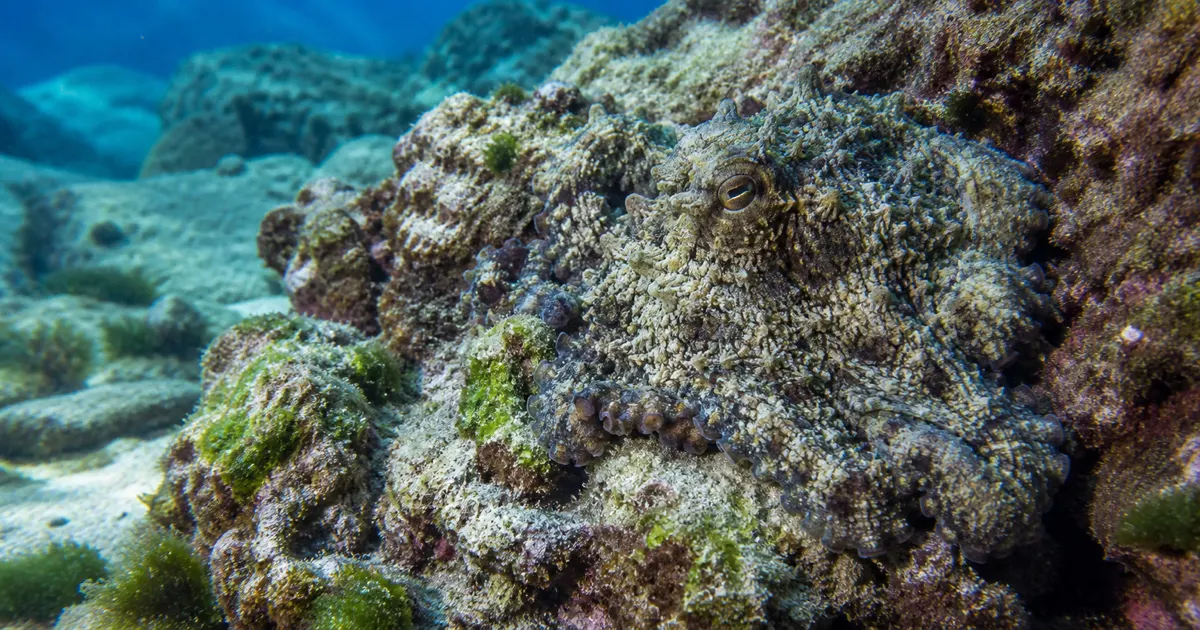
Cephalopod camouflage isn't limited to color. Cuttlefish and octopuses can raise or flatten spiky or lumpy protrusions called "papillae" on the surface of their skin, changing even the texture of their body. On rugged rock, they raise their papillae to mimic the surface of the rock exactly; on smooth sand, they flatten the protrusions to appear level — blending into the background through the combined effect of color, pattern, and texture. And even though their color vision should be poor, they still match the colors around them precisely. This may well be living proof that the "color discrimination via chromatic aberration" and "light sensors in the skin" discussed in the previous section actually play a real role.

Camouflage as both a shield and a weapon for stalking prey
For cephalopods, this instantaneous ability to transform is a life-or-death weapon. A soft body with no backbone or hard shell can make an easy target for many predators. That's exactly why camouflage — blending into the surroundings to hide — becomes their greatest defense. At the same time, camouflage is also used for attack. They disguise themselves as part of the background to sneak up on prey like crabs and small fish without being noticed, then strike the moment they're within range. Male cuttlefish even pull off the remarkable feat of displaying different patterns on each side of their body — courting a female on one side while deceiving a rival male on the other. The power to manipulate color is a shield for defense, a spear for hunting, and a language for the games of courtship, all at once.
Three reasons cephalopod camouflage is remarkable
- Speed: switching body color at a reflexive speed measured in fractions of a second
- Versatility: changing not just color and pattern but even skin texture (three-dimensional relief)
- Self-control: nerves move the skin directly, reacting without waiting for a decision from the brain
Why such short lives — reproduction and the death program
Despite being this intelligent and possessing such an elaborate body, most cephalopods have remarkably short lives. Many well-known octopus species live only about one to two years. Despite evolving such advanced intelligence, they have precious little time to accumulate experience. And the way they die involves a mechanism of "programmed death," rather than simple aging.
"Semelparity" — reproducing only once in a lifetime
Many well-studied octopuses live a life pattern called "semelparity." They reproduce only once in their lifetime. They pour everything into that single occasion, and once reproduction is complete, they decline rapidly and die. After laying eggs, a female devotes herself entirely to caring for them, eating little or nothing at all during that time. A male, too, reaches the end of his life not long after mating. Reproduction and death are tightly linked.

The "optic gland" pulls the trigger
The switch for this death is controlled by an endocrine organ called the "optic gland," located between the two eyes. In a female that has finished laying eggs, activity in this optic gland intensifies, triggering major changes in the body's biochemistry. A 2018 study, using advanced genetic analysis, showed that after egg-laying, the optic gland releases several distinct molecular signals that control a mother octopus's caregiving behavior and subsequent decline and death in stages. In particular, changes in cholesterol metabolism, and the steroid hormones produced from it, are thought to be involved in the rapid decline that follows.
What matters is that this isn't simple "wear-and-tear aging" — it's an active program built into the body. In fact, experiments that surgically removed the optic gland have confirmed that this decline can be delayed or prevented. In other words, an octopus's death is, in a sense, a predetermined event, triggered by a switch prepared in advance.
So why would such an intelligent creature evolve toward a short lifespan? A clear answer hasn't yet been found, but there are several perspectives. One is that cephalopods pursue a "speed over quantity" strategy. Many octopuses and squid grow rapidly over a short period, lay a large number of eggs at once, and bet everything on the next generation. It may have been more advantageous to turn over generations quickly, adapting rapidly to environmental change, than for the parents to live long. Another is the risk of cannibalism. Cephalopods do sometimes attack their own kind, and if parents lived long and reproduced too much, they could end up competing with their own offspring for limited food. A parent's exit after egg-laying may in fact have the effect of preserving resources for the next generation.
The evolutionary dilemma created by short lifespans
Despite their high learning ability, cephalopods' short lifespans make it hard to pass experience on to the next generation or accumulate wisdom over the years. Parents have almost no opportunity to teach knowledge to their offspring through child-rearing. And yet, one could also say this shows just how high their learning ability truly is — high enough for each individual to relearn everything from scratch within its brief life.
Exceptions exist — a deep-sea longevity record
That said, not all cephalopods are short-lived. Among octopuses living in the deep sea, there are examples that live for an extraordinarily long time. The Monterey Bay Aquarium Research Institute (MBARI) recorded the deep-sea octopus Graneledone boreopacifica guarding its eggs for a remarkable 53 months — roughly four and a half years. This is the longest known egg-brooding period in the animal kingdom. Researchers visited this deep-sea nest 18 times over four and a half years to observe it, and in all that time, the mother octopus was never once seen eating. In the cold deep sea, metabolism slows down and the passage of time itself effectively slows, which is thought to make such extreme longevity and prolonged parental care possible. Just how much the deep-sea environment reshapes living creatures also connects deeply to the themes of rising sea temperatures and shifting ocean currents and deep-sea creature adaptation.
Evolution by rewriting RNA — the molecular secret behind their intelligence
Among the many findings surrounding cephalopod intelligence, what has been received with particular astonishment is how they handle genetic information. Under the basic rules that govern us as living things, genetic information is written in DNA, transcribed into RNA, and used to build proteins. Extensively rewriting information partway through this process is normally an extreme rarity. Cephalopods, however, boldly break this rule.
"Editing" over 60% of their RNA
According to a study published in the journal Cell in 2017, more than 60% of RNA transcripts in a squid's brain are rewritten through "RNA editing." Compare this to humans and fruit flies, where less than 1% of RNA undergoes such rewriting — an overwhelming difference in scale. Moreover, in every species of octopus, squid, and cuttlefish the researchers examined, tens of thousands of editing sites were found in each. The RNA that was edited most intensively was that encoding key proteins involved in nerve function. Researchers believe this vigorous RNA editing may be connected to the extraordinary intelligence of cephalopods.

A trade-off sacrificing "DNA evolution"
This large-scale RNA editing came at a cost. Carrying out extensive RNA editing places a constraint on how freely the surrounding DNA sequence can change. In other words, cephalopods appear to have chosen the ability to flexibly rewrite RNA on the spot, in exchange for the freedom to let their DNA itself evolve slowly. Researchers describe this as a "trade-off between RNA editing and genome evolution." Where we, as vertebrates, chose "DNA evolution," cephalopods chose a different path: "flexible RNA editing." Here again, cephalopods present another answer to what we take for granted about life.
Rebuilding proteins to match the environment
One advantage of RNA editing is that it allows for rapid adaptation to environmental change. For instance, when water temperature drops, cephalopods have been found to change how they perform RNA editing, rebuilding proteins so they still function well in the colder environment. Changing DNA takes many generations, but RNA editing lets a single individual adjust its body during its own lifetime — as though "switching a setting." A distributed nervous system, light sensors in the skin, and RNA editing — cephalopods appear to share one consistent design philosophy across every level: "not central control, but flexible response on the ground."
This ability to "switch the body's settings to match water temperature" is also worth keeping in mind when thinking about the changes now happening in the ocean. Rising sea temperatures are thought to affect the distribution, growth, and reproductive timing of cephalopods, which are sensitive to water temperature. As long as environmental change is gradual, a flexible mechanism like RNA editing may help. But if the change is too rapid, that flexibility risks being unable to keep up. How changes in the ocean's overall temperature ripple out to affect living creatures is deeply connected to the theme of rising sea temperatures and shifting ocean currents. The molecular-level adaptability of cephalopods invites us to consider both the resilience of life in the face of ocean change, and its limits.
The shared design of "distribution and flexibility" across cephalopods
- Nervous system: not concentrated in the brain, but distributed across the eight arms, making decisions on the ground
- Vision: sensing light not just through the eyes but through sensors in the skin
- Genetic information: rather than letting DNA evolve rigidly, rewriting RNA on the spot
- Body color: nerves move the skin's muscles directly, without waiting for a central decision
Conclusion — another intelligence, nurtured by the sea
Octopuses and squid are called "aliens of the ocean" not because of their strange appearance. It's because they built their own intelligence via a route completely separate from us vertebrates. Branching off from a shared ancestor roughly 500 million years ago, they built a sophisticated information-processing system using strategies utterly different from our own: abandoning their shells, distributing their nervous system throughout the body, manipulating their body color, and rewriting RNA.
A distributed nervous system, tool use, color discrimination without color vision, instantaneous camouflage, and a programmed death that follows reproduction — these aren't a random collection of oddities. They are connected by one consistent design philosophy: "don't rely on a center; respond flexibly on the ground." Cephalopods teach us that intelligence isn't the exclusive property of a backbone or a large brain. Understanding how the ocean environment has shaped the bodies and minds of living creatures should also give us an important perspective of respect for life as we consider the challenges the ocean now faces, such as ocean acidification and coral reefs and the problem of deep-sea trash.
Summary of this article
- Cephalopods are invertebrates related to shellfish, but they diverged from humans more than 500 million years ago and independently evolved advanced intelligence (convergent evolution)
- About two-thirds of an octopus's roughly 500 million neurons are distributed across its eight arms, giving it a "nine brains" structure in which the arms make semi-independent decisions
- Advanced behaviors have been demonstrated, including tool use such as carrying coconut shells, opening jar lids, observational learning, and play
- Despite having only a single type of photoreceptor, they may be distinguishing color using the chromatic aberration of their lens and light sensors in their skin
- A three-layer structure of chromatophores, iridophores, and leucophores, combined with muscles moved directly by nerves, enables instantaneous camouflage
- Most octopuses reproduce only once in their lifetime, ending their short one-to-two-year life through a "death program" governed by the optic gland (though deep-sea species include a long-lived exception that broods eggs for about four and a half years)
- Cephalopods adapt to their environment through the flexible strategy of extensively rewriting RNA, at the cost of DNA evolution
The next time you encounter an octopus or squid at an aquarium, take a close look at each of its arms and the instantaneous shifts in color across its skin. Living quietly within it is another intelligence, sensing and thinking about the world in a form entirely different from our own.
References and sources
- Current Biology (Cell Press) – Finn, Tregenza & Norman (2009), "Defensive tool use in a coconut-carrying octopus," tool use in the veined octopus
- Cell (Cell Press) – Liscovitch-Brauer et al. (2017), "Trade-off between Transcriptome Plasticity and Genome Evolution in Cephalopods," RNA editing
- PLOS ONE – Robison, Seibel & Drazen (2014), the 53-month egg-brooding record in a deep-sea octopus (longest in the animal kingdom)
- PNAS (Proceedings of the National Academy of Sciences) – Stubbs & Stubbs (2016), the hypothesis of color discrimination in "colorblind" animals via chromatic aberration and pupil shape
- Okinawa Institute of Science and Technology (OIST) – Introduction to research on autonomous decision-making in octopus arms (2020)
- Smithsonian Ocean – The mechanism of color change in octopuses and squid (chromatophores, iridophores, leucophores)
- Nature Scitable (Nature Education) – Cephalopod camouflage: an explanation of the cells and organs of the skin
- ScienceDaily – Introduction to research on a mother octopus's final days and the optic gland's death program (2018)
- Natural History Museum, UK – Eight examples of octopuses' astonishing behavior
- University of California Museum of Paleontology (UCMP) – An overview of cephalopod (Cephalopoda) evolution and the fossil record
※ Listed in order of reliability: government and academic institutions > peer-reviewed papers > specialist organizations > trusted media