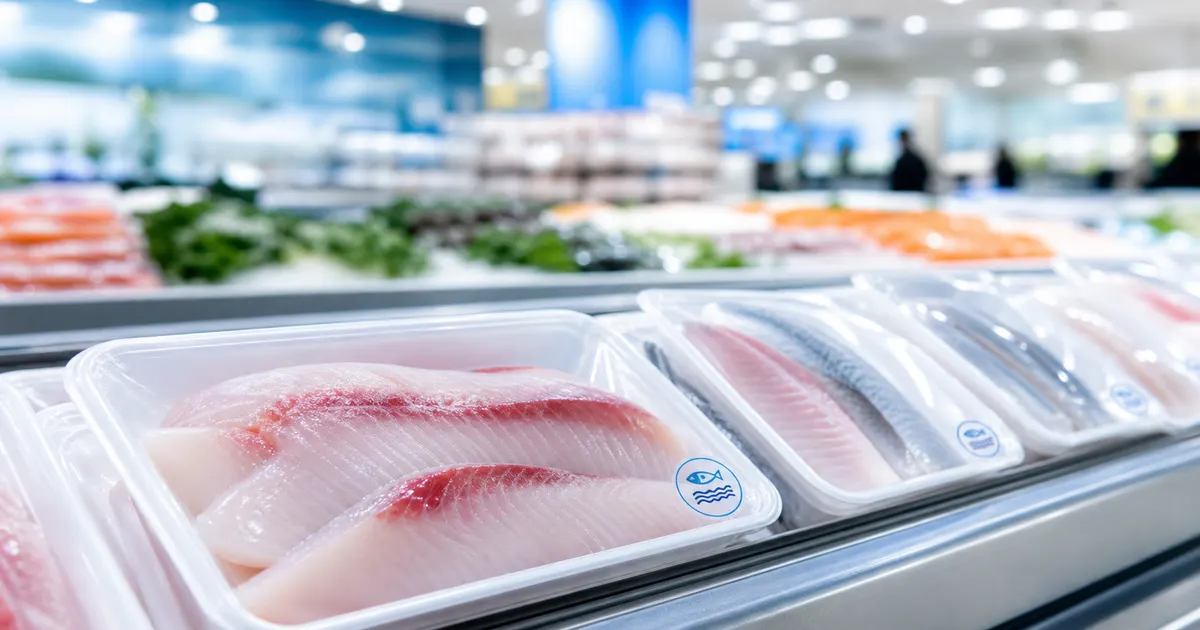
Have you ever noticed a small blue fish mark or a turquoise logo on a fish package at the supermarket or in a home-delivery catalog? That is the MSC or ASC "ocean eco-label," proof that the seafood was caught or farmed without overfishing or environmental destruction.
The Japanese Consumers' Co-operative Union (JCCU, hereafter "Co-op") began handling certified seafood in 2007, expanding sustainable sourcing through the "CO・OP" products that reach members nationwide. Rather than being just one product line among many, this effort is positioned as a core part of Co-op's "2030 goals for Co-op products."
This article organizes, based on primary sources, how Co-op has worked with MSC and ASC certification, the case of its flagship CO・OP Fish Sausage, the current state of seafood eco-labels in Japan, and the condition of fish stocks both worldwide and in Japan. Beyond just the certification mechanism, it also looks at real-world issues such as price and supply, before turning to how households can choose certified seafood.
What you'll learn in this article
- What MSC certification and ASC certification each guarantee
- Co-op's history of certified seafood sourcing since 2007 and its 2030 target
- The types of seafood eco-labels covered by the "Co-op Sustainable" series
- The traceability behind CO・OP Fish Sausage's Alaska pollock
- The reality of overfishing worldwide, based on FAO statistics
- How to identify certified seafood when shopping at home
What are MSC and ASC certification?
There are mainly two kinds of "ocean eco-label" for seafood. MSC certification (Marine Stewardship Council) is an international certification for wild fisheries that assesses catch-limit management to avoid depleting stocks and consideration for the marine ecosystem. ASC certification (Aquaculture Stewardship Council) is a certification for aquaculture that assesses low-impact farming methods, labor conditions, and consideration for local communities.
MSC for wild fisheries, ASC for aquaculture
MSC certification is mainly used for wild-caught fish such as mackerel and Alaska pollock, while ASC certification is mainly used for farmed seafood such as salmon and shrimp. Both require rigorous review by independent third-party bodies, and a certification label can only appear on store packaging once the certified fishery or farm has also obtained "Chain of Custody (CoC) certification," which tracks the product consistently through processing, distribution, and sale.
Even for the same species, whether or not it is certified can differ depending on the sea area or fishing method used. For example, with mackerel, some Norwegian fisheries hold MSC certification while mackerel from other areas or methods do not. So it is not accurate to simply say "all mackerel is sustainable" or "all mackerel is risky" — you need to check for the certification mark on each individual package.
The origins of international seafood eco-labels
MSC was founded in 1997 through a collaboration between the World Wide Fund for Nature (WWF) and the major food company Unilever at the time. Set against the backdrop of the collapse of North Atlantic cod fisheries amid worsening overfishing, it was created as a market-based mechanism to protect "seas that can keep producing fish." ASC was established in 2010 as its aquaculture counterpart, by WWF and IDH, a Dutch organization promoting sustainable trade, completing a framework that safeguards seafood sustainability on both the wild and farmed sides.
Why a consumer co-op focuses on certified seafood
Japan is one of the world's leading seafood-consuming nations, yet consumers rarely have the chance to think about where and how a given fish was caught. As an organization supporting its members' dinner tables, Co-op works to build a system that protects fish stocks through consumer choices, by making resource sustainability part of the criteria for product selection.
Co-ops originally built their strength on "direct sourcing" — connecting directly with producers at the source — so tracing the origin of raw materials and disclosing it to consumers is not a new idea for them. The push into certified seafood can be seen as connecting this direct-sourcing philosophy to an internationally recognized certification system.
Unlike a joint-stock company, a co-op is also structured so that the members who invest in it are the same people who use it. Because long-term support from members matters more to its operations than quarterly share prices or short-term profit, a co-op tends to take the risk of future resource depletion — and the resulting inability to keep supplying a product — more seriously than other retailers might. Continued investment in certified seafood is consistent with this long-term orientation.
From assessment to certification
To obtain MSC certification, a fishery or fishing cooperative first applies for assessment by an independent certification body, which then evaluates the fishery on three fronts: the state of the stock, the fishery's impact on the ecosystem, and its management system. The full assessment, including a worldwide public comment period, takes an average of about 12 months (typically 8 to 18 months), and gives environmental groups and competing fishing interests a formal channel to raise objections. Certification is valid for five years, during which the fishery undergoes annual surveillance audits, and it must pass a reassessment within that five-year window or the certification lapses. ASC certification follows a similarly structured process, built around on-site inspection by an independent assessment body and ongoing monitoring.
The difference between MSC and ASC certification
- MSC certification: covers wild fisheries. Assesses catch-limit management and ecosystem impact
- ASC certification: covers aquaculture. Assesses environmental impact, labor conditions, and consideration for local communities
- What they share: third-party review plus CoC certification, which together allow a label to appear on packaging
Co-op's journey with certified seafood since 2007
JCCU began selling MSC-certified products in 2007. The first was a product made with Norwegian mackerel. At the time, few retailers or co-ops in Japan carried MSC-certified seafood, making Co-op's move a pioneering one.
View this pageCo-op Products Site: MSC CertificationCo-op's page introducing its MSC-certified seafood🔗 goods.jccu.coopExpanding the product lineup
Starting with mackerel, Co-op's handling of certified seafood has since expanded in both species and number of products, covering fresh, processed, and frozen foods. The CO・OP products site now features dedicated pages introducing products certified under MSC and ASC respectively. While imported Norwegian raw material was the initial focus, the range has since broadened to include Alaska-sourced ingredients used in processed products.
This expansion has been supported by a growing number of domestic processing and distribution companies obtaining CoC certification. Even if the raw material comes from a certified fishery, the final product cannot carry an MSC or ASC label unless it passes through CoC-certified operators at every stage of processing, packaging, and distribution. Behind Co-op's ability to keep increasing its supply of certified raw materials lies this less visible, supply-chain-side shift, as its partner processing plants and logistics hubs have pursued CoC certification.
Toward a 50%+ share under the "2030 goals for Co-op products"
As part of its "2030 goals for Co-op products," JCCU has set a target of raising the share of certified (MSC/ASC) products in Co-op's seafood supply value to 50% or more. As of 2021, over 10% of its seafood products were MSC-certified, and the switch to certified products is proceeding step by step.
What this target really means is not simply expanding the certified product lineup, but the more ambitious commitment that more than half of Co-op's overall seafood "supply value" — that is, on a sales basis — should be certified. Achieving it requires balancing member demand and price while making the switch gradually, and it also depends on expanding certification uptake among the fisheries and aquaculture operations that supply Co-op.

The role of the "Co-op Sustainable" series
In February 2021, JCCU launched "Co-op Sustainable," a full-scale rollout of a series that places a common logo on products made with environmentally and socially responsible raw materials. Under its seafood-focused theme, "Protecting Ocean Resources," every product's main seafood ingredient must come from a fishery or farm certified as sustainable.
Certifications covered
- MSC certification (wild seafood)
- ASC certification (farmed seafood)
- Marine Eco-Label Japan (MEL, Japan's own seafood eco-label)
- BAP (Best Aquaculture Practices, an international aquaculture certification)
A series design that extends beyond seafood
"Co-op Sustainable" is not a seafood-only framework; it is designed as a series spanning multiple raw-material themes, including forest-certified paper (FSC certification), coffee and cacao (Rainforest Alliance certification, among others), and palm oil (RSPO certification). It also covers paper products, such as the FSC-certified "CO・OP Unbleached Recycled Toilet Paper," and the seafood-focused "Protecting Ocean Resources" theme is just one part of this broader picture.
Making it easy for members to choose
By putting a common logo on these products, Co-op lets members instantly identify "which products are sustainable" in the catalog or in store, without needing to understand the individual certifications in detail — the logo itself becomes a simple cue for changing behavior. Similar efforts are underway at other retailers too, and the spread of certified products is not limited to co-op stores alone.
Bundling multiple certifications into a single series also benefits the company itself. Rather than explaining each certification logo individually, communicating under the single "Co-op Sustainable" brand lowers the comprehension cost for members while also helping the product development team keep its sourcing policy consistent. As the logo itself becomes more widely recognized, even members who don't know the details of each certification can rely on it as a simple signal of trust.
Traceability seen in CO・OP Fish Sausage
A flagship example of Co-op's certified seafood is "CO・OP Fish Sausage." A long-running product that can be stored at room temperature and is often used for school outings or snacks, it uses Alaska pollock surimi as its main ingredient, and Co-op has disclosed that this material is subject to distribution management based on MSC certification.
View product pageCO・OP Fish SausageProduct page for an item made with MSC-certified Alaska pollock🔗 goods.jccu.coop
Mid-water trawling and the observer program
Alaska pollock fisheries use mid-water trawling, a method that limits impact on the seafloor ecosystem. When catches arrive at the processing plant, an observer is present to check for bycatch — species other than the target catch mixed in — and the process from catch to processing is recorded.
Whereas bottom trawling and similar methods can easily damage seafloor reefs and bottom-dwelling organisms, mid-water trawling targets the middle depth of the water column, reducing physical impact on the seafloor ecosystem. Combined with strict, science-based management of the catch itself, this is what makes Alaska pollock fisheries distinctive: sustainability is secured not through a single clever fishing technique alone, but through the resource-management system as a whole.
The guarantee of tracing back to the original fishery
The core value of the MSC eco-label is that it lets you trace back from the package on the store shelf to confirm exactly which fishery a fish came from. Alaska pollock fisheries are recognized as among the largest and most sustainable in the world, and CO・OP Fish Sausage is a product that brings this system into consumers' everyday lives.
This "traceability" function matters just as much as the resource management itself. Even a fishery with excellent resource management is of little use if its catch gets mixed with uncertified material somewhere in processing or distribution — the final product's true origin becomes impossible to verify. It is only through strict, segregated handling at every stage under CoC certification that a consistent guarantee can be maintained all the way to the product in consumers' hands.
Expansion to other CO・OP products
Products using MSC- or ASC-certified raw materials are not limited to fish sausage. Frozen foods, fish-paste products like chikuwa, canned goods, and salmon are among the multiple categories of products featured on the CO・OP products site's MSC/ASC pages. What they share is a design that displays the MSC or ASC logo on the packaging so consumers can check the origin of the ingredients.
Products like CO・OP Fish Sausage, which disclose specifics down to the resource-management system behind the raw material, are among the easier certified-seafood cases for consumers to understand. Most processed seafood products rarely disclose exactly which sea, which fish, and which fishing method were involved, so this kind of disclosure is itself evidence of the transparency in Co-op's sourcing policy.
Certification highlights of CO・OP Fish Sausage
- Made with MSC-certified Alaska pollock surimi
- Uses mid-water trawling to limit impact on the seafloor ecosystem
- Bycatch checked and recorded with an observer present
- A CoC system that allows traceability from the package back to the fishery
The state of Japan's seafood eco-labels and resource management
Japan's Fisheries Agency has set a target of reaching 225 internationally recognized seafood eco-label certifications (MSC, ASC, and MEL) at the production stage by fiscal year 2025. As of the end of fiscal year 2021, 90 new certifications had been granted (15 MSC, 14 ASC, and 61 MEL), showing that the base of certification uptake is gradually widening.
How MEL, MSC, and ASC are positioned
| Certification | Covers | Characteristics |
|---|---|---|
| MSC | Wild fisheries | The most widely adopted seafood eco-label internationally. Held by 572 fisheries in about 60 countries as of end-March 2024, including 12 in Japan |
| ASC | Aquaculture | Assesses environmental impact, labor conditions, and consideration for local communities |
| MEL | Both wild and farmed | Japan's own seafood eco-label; the only one in Asia recognized by the GSSI (Global Sustainable Seafood Initiative) |
The catch from MSC-certified fisheries is said to account for 16.5% of the world's total wild seafood catch. As of fiscal 2023, MSC-labeled products were sold in over 2,000 items across about 70 countries, with a combined weight of 1.27 million tons and wholesale sales value of roughly ¥1.5 trillion. In Japan, the number of businesses holding MSC CoC certification has passed 400, putting the country at the world's third-highest level after China and the United States. The fact that retailers and co-ops like Co-op have obtained CoC certification and built systems to handle certified raw materials is one factor behind this growing number of certified businesses.
Reinforcing resource management: the revised Fisheries Act and TAC
On the institutional side, one development worth noting is the revised Fisheries Act, described as the first fundamental reform in 70 years, which took effect in December 2020. Under the revision, management is now based on the TAC (Total Allowable Catch) system, which sets catch limits using scientific evidence, with the range of species covered being expanded in stages. The Fisheries Agency aims to have TAC management cover 80% of Japan's marine fishery production (excluding distant-water fisheries, internationally managed species, salmon and trout, shellfish, seaweed, sea urchins, and marine mammals), reinforcing the resource-management foundation that certification itself depends on.
The state of fish stocks around Japan
In its fiscal 2022 stock assessment, the Fisheries Agency evaluated 50 stocks across 36 species using a three-tier "high / medium / low" scale. The results: 11 stocks (22%) were rated high, 11 (22%) medium, and 28 (56%) low. In other words, more than half of the stocks assessed have not yet recovered to a sufficient level. This is one likely reason why much of the MSC-certified raw material Co-op sources — Norwegian mackerel, Alaska pollock, and the like — is imported: it reflects, in part, how slowly certification has taken hold among Japan's own fisheries.
An earlier fiscal 2019 assessment of 77 stocks found 18 rated high, 25 medium, and 34 low. While the specific numbers shift somewhat from year to year and stock to stock, the share of stocks rated low has consistently hovered between roughly 40% and just over 50%. For a domestic fishery to obtain MSC or MEL certification, its stock assessment itself generally needs to improve to a high or medium rating first — a precondition that tends to make certification a higher bar for domestic fisheries than for imported seafood.
The role played by retailers and co-ops
Even if fishers obtain certification, it won't reach consumers unless retailers or co-ops actually carry it. Co-op's approach — sourcing certified products on an ongoing basis and presenting them clearly under a unified series — helps support the businesses of certified fisheries from the demand side. For more on how to read the certification marks themselves, see What Is MSC Certification? How to Spot Sustainable Seafood at the Supermarket.
The challenges facing the world's fish stocks
The emphasis on certified seafood is set against a backdrop of worsening fish stocks worldwide. According to the FAO's (Food and Agriculture Organization of the United Nations) "The State of World Fisheries and Aquaculture" (SOFIA) report, the share of fish stocks at biologically sustainable levels fell from 64.5% in 2021 to 62.4% by 2023. Put another way, more than a third of assessed stocks are now overfished.
What this statistic shows is not individual fisheries collapsing one after another, but a slow, ongoing erosion of resource capacity worldwide. Even once a stock becomes overfished, catches don't drop to zero immediately — fishing tends to continue for a while, so both consumers and producers tend to feel the effects of resource decline only after the fact. Certification systems, through their continuous monitoring of catch data, are also a mechanism for heading off this "too-late-when-you-notice" risk before it fully materializes.

A long-term worsening trend since 1974
FAO statistics show that the share of stocks fished at unsustainable levels has risen steadily from about 10% in 1974, reaching 37.7% by 2021. Half a century of accumulated overfishing has shaped today's state of fish stocks. That said, when weighted by catch volume, biologically sustainable stocks are estimated to have accounted for 76.9% of 2021 landings, suggesting that large, well-managed fisheries help prop up the overall figures.
Japan's fish-eating culture and its relationship to stocks
Japan is one of the world's highest per-capita consumers of seafood, with a culture of eating fish daily in a wide range of preparations — sashimi, sushi, simmered fish, and more. At the same time, the country depends heavily on imports for much of its seafood, making it hard for consumers to know from which sea, and by what method, the fish they eat was actually caught. Certification systems are one of the few tools available for making this "invisibility" visible.
What consumer choices actually mean
The choices of individual consumers alone won't instantly turn around the state of fish stocks. But as demand for certified seafood grows, it becomes easier for certified fisheries to remain economically viable, helping push more fisheries toward sustainable practices. This is where the significance lies in a large-scale buying organization like Co-op setting a target share for certified products. For everyday items such as canned goods, see How to Choose MSC- and ASC-Certified Canned Seafood: A Starting Point for Sustainable Shopping with Tuna and Mackerel Cans.
Outreach activities with members
Co-op's efforts don't stop at stocking the shelves. Through catalog and in-store displays, and through information-sharing with direct-sourced and partner producers, Co-op creates opportunities for members to learn about the state of fish stocks.
Communicating through catalogs and in stores
The common "Co-op Sustainable" logo appears in catalog pages and in-store signage, designed so members can choose sustainable products without needing specialized knowledge. The CO・OP products site also features dedicated pages for each certification, summarizing the background and the products involved.
Learning opportunities for members
Japan's co-ops have a long history of connecting production sites with consumers through regional member organizations, via farm and fishery visits and study sessions. There is room to build understanding of seafood certification through these same existing channels of member participation.
A "face-to-face relationship" rooted in the direct-sourcing movement
Since the postwar era, Japan's co-ops have developed a "direct sourcing" movement that connects members directly with producers — farmers and fishers — at the source. Exchange visits to meet producers, and catalog pages that convey conditions at the production site, are extensions of this activity. Placing a new framework like international certification within this context of "relationships where you can see the producer's face" makes it easier for members to feel a personal connection to it.
Passing the baton to the next generation
As the core membership of co-ops shifts across generations, the sustainability of fish stocks is also a theme that needs to be passed on to parenting and younger generations. Beyond catalogs and in-store signage, outreach connected to school meals and food education is an important touchpoint for making certified seafood a normal choice for the next generation. The food-education activities that co-op member organizations have long carried out are, by nature, well suited to pairing with efforts to spread certified seafood.
Challenges facing certified seafood
The spread of certified seafood still faces challenges to overcome. Rather than emphasizing only the positives, it's worth acknowledging the real constraints as well.
Certification costs and their effect on price
Obtaining and maintaining MSC or ASC certification involves assessment costs for fishers and aquaculture operators, as well as CoC certification costs at the processing and distribution stages. These costs are often passed through into product prices, which is one reason certified products tend to be more expensive than conventional ones. That Co-op has set a 2030 target of 50%+ share is itself, in a sense, a reflection of how difficult it is to spread certified products while absorbing this price gap.
For small-scale coastal fishers in particular, the burden of assessment fees and paperwork can be a significant barrier to entry. The reason Japan's own MEL certification was developed alongside the international MSC scheme is thought to include a desire to offer a more accessible certification option suited to Japan's domestic fishery structure. How to widen the circle of resource management to include both large- and small-scale fisheries remains an ongoing challenge for Japan's fishing industry as a whole.
Limits on species covered and supply volume
Certified fisheries and farms still represent only a fraction of the world's total catch. Certification tends to concentrate in certain species — mackerel, Alaska pollock, salmon, and the like — so consumers are still far from a world where "whatever fish I happen to like turns out to be certified." Until supply catches up, certified-labeled products will remain confined to particular sales floors or product lines.
The separate problem of eco-label "proliferation"
Beyond MSC, ASC, and MEL, more than 140 seafood eco-labels and certification schemes are said to exist worldwide, and critics point out that this creates confusion for producers, distributors, and consumers alike. In response, the GSSI (Global Sustainable Seafood Initiative) was established in 2013 to review and approve the credibility of these proliferating labels; as of July 2023, it had approved nine certification schemes worldwide, including MEL, the only one from Asia. Not every unfamiliar label is untrustworthy, but whether or not a scheme has GSSI recognition is one useful point of reference.
Responding to "greenwashing" criticism
Seafood eco-label systems also face international criticism — for example, that assessment standards can be too lenient, or that certifications are sometimes maintained after renewal without clear evidence that stock conditions have actually improved. Rather than trusting third-party certification unconditionally, it is also worth examining the certifying body's assessment process and how much of a company's product range the certification actually covers.
Against this backdrop, cases like Co-op's published quantitative target — a "50%+ share" — or CO・OP Fish Sausage's specific disclosure of fishing methods and its observer program, deserve credit for being easy for outsiders to verify as progress is made. Conversely, when a company's "use of an eco-label" comes without disclosed targets or mechanisms, consumers should approach it with a degree of caution.
How to choose sustainable seafood at home
Finally, here is a summary of what you can keep in mind while shopping day to day. No special knowledge is required — the habit of checking package labels is enough to put this into practice.
What matters is not an all-or-nothing rule like "only buy certified products," but consistently choosing certified products as an option whenever you have the choice. Since certified seafood is often more expensive than uncertified alternatives, a realistic way to start — without straining your household budget — is to begin with everyday items like canned and frozen foods.
If you're a Co-op member, the search function in the home-delivery catalog and in-store displays already make it easy to find certified products. If you're not a member, you can look for the same logos on the CO・OP products site's MSC/ASC pages or in the seafood section of any supermarket. A good place to start is simply checking the packaging of the seafood products already in your freezer or pantry at home.
How to recognize eco-labels
- MSC label: a blue fish-shaped mark (wild seafood)
- ASC label: a mark based on green (farmed seafood)
- MEL mark: Japan's own seafood eco-label
- "Co-op Sustainable" logo: Co-op's own common series mark
What you can start doing today
- Check the certification mark on the back or side of the package while shopping
- Choose the certified option among products of the same fish type when available
- Check for "Co-op Sustainable" labeling in the home-delivery catalog
- Take the chance to talk with your kids about the state of fish stocks
An option that extends to restaurants and school meals too
Certified seafood isn't just a matter of household shopping. Cases of airlines' in-flight meals, restaurant chains, staff cafeterias, and school lunch programs switching to MSC- or ASC-certified ingredients have also been reported. The habit of choosing certified products at home also functions as an "invisible vote" that encourages these companies and organizations to make the same sourcing decisions. For more on efforts in the restaurant and airline industries, see How In-Flight Meals Are Changing the Ocean: MSC/ASC-Certified Seafood and Sourcing Reform at Airlines and Restaurants.
Summary
- MSC covers wild fisheries and ASC covers aquaculture — both are international certifications
- Co-op has handled certified seafood since 2007 and targets a 50%+ share by 2030
- CO・OP Fish Sausage is made with MSC-certified Alaska pollock
- Only 62.4% of the world's fish stocks are at sustainable levels (2023, FAO)
- Checking the certification mark on packaging is a simple first step you can take at home
References and sources
- JCCU Co-op Products Site: MSC Certification – Co-op's MSC certification efforts and covered products
- JCCU Co-op Products Site: ASC Certification – Co-op's ASC certification efforts and covered products
- JCCU: SDGs Initiatives – JCCU's overall SDGs policy
- Co-op Net Business Union: Six Pillars of Product Policy – Product policy for a sustainable society
- Fisheries Agency of Japan: On the State of Seafood Eco-Labels – Report on domestic seafood eco-label certification numbers and targets (PDF)
- FAO: The State of World Fisheries and Aquaculture (SOFIA 2024) – Statistics on the state of global fish stocks
- MSC Japan: Alaska Pollock Fishery Re-Certified – Press release on the MSC re-certification of the Alaska pollock fishery
- CO・OP Fish Sausage: Co-op Products Site – Product page for an item made with MSC-certified raw material
- Japan's MSC CoC-Certified Businesses Pass 400 – Report on the number of MSC-certified businesses in Japan, announced by MSC Japan
- Fisheries Agency of Japan: Japan's Resource Management (Revised Fisheries Act and TAC System) – Report on the revised Fisheries Act and the expansion of TAC management
※ Listed in order of reliability: government and academic institutions > peer-reviewed research > specialized organizations > reputable media