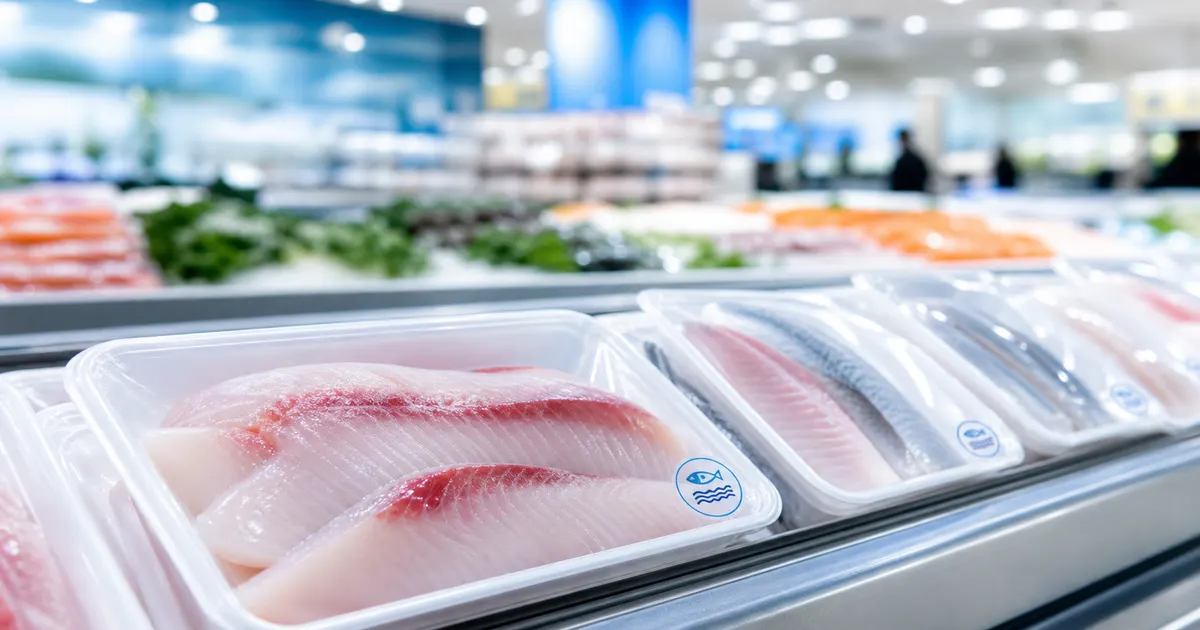
Frozen Alaska pollock fillets, canned salmon, farmed yellowtail lined up in the supermarket freezer case. We rarely stop to think whether each fish came from a fishery or farm that properly manages ocean resources. Yet according to the UN Food and Agriculture Organization (FAO), the share of the world's marine fish stocks considered biologically sustainable has been declining over the long term, and the larger a company's seafood volume, the greater its sourcing impact on the ocean's future.
Maruha Nichiro, one of Japan's leading seafood and food companies, has continued a practice that remains rare in Japan: evaluating the "resource status" of the wild seafood it handles using an external scientific method, and publishing the results as numbers. How much of its resources are well managed, and how much still needs improvement — disclosing both the good and the challenging is instructive for anyone thinking about sustainable seafood.
This article neutrally organizes Maruha Nichiro's resource-status disclosure, the expansion of MSC/ASC-certified seafood, and its participation in the international initiative SeaBOS, without exaggeration or criticism. The goal is not to praise a specific company, but to use "how a major seafood company thinks about resource management and how much it discloses" as a lens for us as consumers to make sustainable choices.
What you'll learn in this article
- What it means for a seafood major to publicly disclose, in numbers, how much of the fish it handles is sustainably managed
- How to read the four-tier resource assessment based on SFP's ODP method (FishSource's five scores)
- The differences and roles of seafood eco-labels such as MSC, ASC, BAP, and MEL (certifications recognized by GSSI)
- International moves such as SeaBOS and strengthened resource access, where companies engage further upstream in fisheries
- The value of transparency when a company itself discloses improvement areas such as "Needs improvement" and "Not scored"
- Concrete clues for consumers choosing sustainable seafood at the store
Why sustainable seafood at seafood majors matters now
"Sustainable seafood" refers to seafood caught or farmed with consideration for the state of fish stocks, the marine environment, and the people who work in the industry. It doesn't simply mean "eco-friendly fish" — the core question is whether the fish is managed so that continued fishing won't deplete the stock. Globally, demand for seafood keeps growing on the back of population growth and health consciousness, while stocks under heavy fishing pressure have become a problem of overfishing.
The UN Food and Agriculture Organization (FAO), in its "State of World Fisheries and Aquaculture" (SOFIA) report, has repeatedly warned that the share of marine fish stocks at biologically sustainable levels has been declining over the long term. Once a stock collapses from overfishing, it can take many years to recover, shaking the livelihoods of fishers and food culture itself. Understanding the mechanism of overfishing-driven stock collapse gives a fuller picture of this structure.
SDG 14 "Life Below Water" and the role of companies
The UN Sustainable Development Goal 14, "Life Below Water," calls for ending overfishing and IUU (illegal, unreported, and unregulated) fishing and reducing marine pollution. Achieving this goal is difficult for governments alone; the actions of companies that source, process, and sell seafood on a global scale hold the key. When a company handling large volumes of fish shifts toward sustainable sourcing, that impact reaches fishing grounds through the supply chain.
Japan is one of the world's largest consumers of seafood, and our tables are supported by diverse fishing grounds at home and abroad. That is precisely why the resource-management philosophy of Japan's seafood majors, and how much they disclose, affects not only domestic food culture but also the future of stocks in distant waters. Fulfilling the responsibility of being a "fish-eating nation" requires consumers, not just companies, to take an interest in resource management. Delving into a specific company's example in this article is meant to open a door to that interest.
The premise underlying this article
- Sustainable seafood = seafood caught/farmed with consideration for resources, the environment, and human rights
- The sourcing policies of seafood majors greatly affect management standards at fishing sites
- What matters is not just "good initiatives" but how much a company discloses about its challenges
Ocean warming: a new variable
What makes resource management harder is change in the ocean environment itself. Rising sea temperatures shift fish distribution and spawning timing, upending long-held assumptions about fishing grounds and seasons. Around Japan too, shifts in which species are caught have been reported region by region. See how ocean warming affects fisheries for details — but as this uncertainty grows, the importance of resource assessments based on scientific data only increases.

In other words, for seafood majors, sustainable seafood is not mere social contribution — it is directly tied to business continuity itself: the ability to keep sourcing fish into the future. If stocks are depleted, raw materials become unavailable, so protecting resources becomes a condition for the company's own survival. This perspective is the starting point for understanding the recent initiatives of seafood companies.
Sourcing can no longer be about "as cheap as possible"
Seafood sourcing used to center on competing to buy as cheaply and in as much volume as possible. But when overfishing thins out stocks, supply becomes unstable, prices swing wildly, and eventually sourcing itself becomes unworkable. In addition, investors have begun evaluating companies through an ESG (environmental, social, governance) lens, and retail and food-service business partners have come to demand sustainable sourcing. Companies indifferent to resource management are less likely to be chosen by markets and financiers alike — this kind of external pressure has become a real force driving seafood majors.
Internationally, importing countries including the EU are tightening restrictions on seafood originating from IUU (illegal, unreported, unregulated) fishing, and an inability to prove the legitimacy of a catch becomes a barrier to trade. Sustainability is both an ethical matter and increasingly a qualification for continuing to participate in the market. Behind the investment by Japan's seafood majors in resource assessment and certification lies this structural shift.
Whose job is "resource management"?
In principle, setting catch quotas and other resource-management measures is the role of national and regional fisheries management bodies. But there are many sea areas worldwide where management is not functioning well enough, and this is where large companies sourcing fish from around the world, and international initiatives, can play a role. National regulation and corporate voluntary efforts are complementary.
What kind of company is Maruha Nichiro
Maruha Nichiro Corporation is one of Japan's leading seafood and food companies, engaged broadly in fishing and aquaculture, processing, logistics, and sales. Known also for household products such as frozen foods, canned goods, and fish-paste products, it sits at the point connecting our tables to the ocean. Because it sources seafood from around the world, the reach of its sourcing policy is extremely wide.
"Ocean and Life" in the long-term vision
The company has set out a long-term vision under the direction "For the ocean, for life," positioning the sustainability of seafood resources at the core of its management. The idea is that precisely because it is a company that handles fish, the health of the ocean forms the foundation of its business. This vision is translated into concrete actions such as the disclosure of resource assessments and the expansion of certified seafood, discussed below.
| Category | Main business activities | Sustainability issues |
|---|---|---|
| Wild seafood (fisheries) | Catching and sourcing Alaska pollock, salmon, skipjack/tuna species, etc. | Managing resource status and avoiding overfishing |
| Aquaculture | Farming yellowtail, amberjack, bluefin tuna, etc. | Feed, environmental impact, obtaining certification |
| Processing / household food products | Frozen foods, canned goods, fish-paste products, etc. | Raw-material traceability, use of certified ingredients |

Renewing the corporate brand
The group has recently rolled out the corporate brand "Umios," built around ocean sustainability, and stepped up its sustainability-related communications. Whatever the brand or name, the essence — how the resource status of the seafood handled is managed, and how much is disclosed — does not change. This article mainly uses the more familiar corporate name "Maruha Nichiro."
Seen in comparison with peers
The efforts of a seafood major are hard to evaluate looking at just one company. Reading it alongside Nissui's sustainable sourcing, which covers a competitor's sourcing policy, helps reveal the direction the whole industry is moving.
The strength and responsibility of covering "upstream to downstream"
What characterizes Maruha Nichiro is that it holds, broadly within its own group, everything from raw-material production — fishing and aquaculture — through processing, logistics, and the sale of household food products. This means the company can be involved at every stage of the supply chain, a strength that makes it easier to embed resource-management policy down to the operational level. On the other hand, because the variety and volume of seafood it handles is enormous, making all of it sustainable is not easy, and comes with significant responsibility.
For example, wild Alaska pollock and salmon, farmed yellowtail and amberjack, and offshore-caught skipjack and tuna species all differ completely in resource status and the entity responsible for managing them, even within the same company. One species may be thoroughly managed under scientific catch quotas while another simply lacks data. That is precisely why the idea of measuring and disclosing status separately by species and by sourcing origin carries meaning. The resource-assessment effort discussed in the next section is a mechanism for confronting this complexity.
Having household food products closest to the table also matters. When certified ingredients are used in products such as frozen foods and canned goods, consumers can encounter sustainable choices without needing special knowledge. Translating a company's sourcing policy into "ease of choosing" at the store — this bridge can be built only by an integrated company that also handles processing and sales.
Publishing "resource assessments" of wild seafood handled
One of the most distinctive features of Maruha Nichiro's efforts is that it evaluates the resource status of the wild seafood it handles using a third-party method and publishes the results as numbers. While many companies emphasize "we are increasing our certified products," this company tries to show the whole picture: "of all the fish we handle, how much comes from properly managed resources?"
SFP's ODP method as a yardstick
The assessment uses the method of the "Ocean Disclosure Project" (ODP), run by the international NGO Sustainable Fisheries Partnership (SFP). ODP is an international framework, launched by SFP in 2015, for seafood companies to voluntarily disclose the sourcing origins of their wild seafood and its environmental performance. Maruha Nichiro classifies the wild seafood it handles into four tiers using the five scores from SFP's fishery database, "FishSource."
What are ODP and FishSource?
- ODP (Ocean Disclosure Project) = an international framework for the voluntary disclosure of seafood sourcing origins (run by SFP, launched 2015)
- FishSource = a public database scoring the status of fisheries and stocks worldwide
- Five scores together give an overall assessment of whether a stock is healthy and whether management is functioning
Results of the four-tier assessment (2nd survey)
The results of the company's published 2nd survey (covering FY2021 sourcing volumes, conducted in FY2022) are as follows. Of the wild seafood handled, about 44%, or roughly 600,000 tons, was rated "Well managed", with the majority originating from fisheries certified by bodies such as MSC, centered on Alaska pollock. This was followed by "Managed" at about 27%, or roughly 370,000 tons.
| Assessment category | Meaning | Share | Approx. volume |
|---|---|---|---|
| Well managed | Excellently managed | About 44% | About 600,000 tons |
| Managed | Managed at a certain level | About 27% | About 370,000 tons |
| Needs improvement | Requires improvement | About 15% | About 200,000 tons |
| Not scored | Cannot be assessed due to insufficient data | About 14% | About 190,000 tons |

The meaning of disclosing challenges without hiding them
What stands out is that the company discloses not just favorable ratings but also the inconvenient numbers: about 15% (roughly 200,000 tons) rated "Needs improvement" and about 14% (roughly 190,000 tons) rated "Not scored" due to insufficient data. A company voluntarily disclosing such challenges can become fodder for outside criticism, but it is also an act that demonstrates a high degree of transparency. Unless what needs improving is made visible, improvement cannot even begin.
Not making overfishing and management gaps "invisible," but showing them as data, is a first step toward keeping sustainability from ending as mere rhetoric.
— On the significance of disclosing resource assessments
Behind the spread of this kind of voluntary disclosure is the fact that consumers, investors, and business partners have grown stricter about "greenwashing" — environmental appeals without substance. Beautiful slogans alone no longer earn trust; what matters now is whether a company can speak in verifiable numbers. Maruha Nichiro's disclosure, expressed in percentages and tonnage, is one answer to this demand. That said, how we read the disclosed figures and judge the pace of improvement is a question posed to us, the recipients, as well.
The company conducted its 1st survey in FY2020 (covering FY2019 results) and its 2nd in FY2022, and states that during FY2023–2024 it fed the assessment results back individually to relevant business divisions and group companies, and is now conducting its 3rd survey in FY2025. Not ending with a one-off survey, but repeatedly re-measuring and feeding results into improvement — this continuity determines how effective the effort actually is.
The homework posed by "Not scored"
Of the four categories, the one that gives particular pause is "Not scored" (insufficient data), at about 14%. This does not mean "management is poor" — it means there simply is not enough scientific data to judge the status of that resource. There are many sea areas and species worldwide where no stock survey has ever been conducted, leaving no material to assess even if one wanted to. A company honestly disclosing this category is itself a display of the integrity of "admitting what is unknown as unknown."
Reducing data-poor resources requires cooperation not only from companies but also from research institutions and governments that conduct surveys. Part of the motivation behind Maruha Nichiro's involvement in the international initiatives and fishery-improvement efforts discussed later is a desire to fill this "assessment gap." Expanding the range that can be assessed is, in itself, progress for sustainability.

Three values of publishing a resource assessment
- It identifies which resources need improvement (you can't fix what you can't see)
- It gives consumers and investors material to gauge how serious a company really is
- It helps spread a norm across the industry that "disclosure is the default"
The aim of expanding MSC/ASC-certified seafood
Another pillar alongside resource assessment is expanding seafood that carries eco-label certification. Certification is a stamp of approval granted by a third-party body after reviewing whether a fishery or farm is sustainable, and it serves as an easy-to-understand marker for consumers making sustainable choices at the store.
The difference between MSC and ASC
The two representative labels are MSC (Marine Stewardship Council) certification, for wild fisheries, and ASC (Aquaculture Stewardship Council) certification, for aquaculture. MSC's "blue fish label" assesses whether stocks remain healthy, whether impacts on ecosystems are kept in check, and whether the fishery is properly managed. ASC assesses issues associated with farming, such as water pollution, feed sustainability, and labor conditions.
- MSC certification: covers wild fisheries. Assessed against three principles — stock status, ecosystem, and management system
- ASC certification: covers aquaculture. Assesses environmental impact, feed, local communities, and labor
- CoC certification: a system that manages processing and distribution so certified and non-certified products are not mixed at any stage
- MEL / BAP: certifications recognized by GSSI also include Japan's MEL and the US-based BAP
What is GSSI (Global Sustainable Seafood Initiative)?
To align the credibility of what can be a proliferating set of seafood certifications internationally, GSSI "recognizes" certifications that meet a certain standard. Maruha Nichiro has stated a policy of advancing sourcing under GSSI-recognized certifications such as MSC, ASC, BAP, and MEL, using multiple certifications across the board. This also links up with retail-side demand, as seen in AEON's Topvalu MSC/ASC products.
Volume handled and the 2030 target
Maruha Nichiro began considering the handling of MSC-certified products in 2006, and has since handled scallops, sockeye salmon, Alaska pollock, and more. In FY2024, the volume of household food products carrying the MSC "blue fish label" reached 1,802 tons. The company is further advancing sourcing of seafood under GSSI-recognized certifications such as MSC, ASC, BAP, and MEL, and has set a target to raise the share of sales accounted for by seafood products and seafood-containing products bearing such certification to 15% or more by FY2030.

The world's first ASC-certified species
In aquaculture, the group obtained ASC certification for yellowtail in April 2018 and for amberjack in July 2019, with the amberjack certification said to be the world's first. In recent years it has advanced gap analyses against ASC standards, the development of voluntary management standards, and audits at multiple domestic farm sites for yellowtail and amberjack farming, moving toward a shift to aquaculture with a lighter environmental footprint. Aquaculture draws attention as a way to ease fishing pressure on wild stocks, but it carries its own separate challenges around feed and environmental impact, which is why backing by certification matters.
Certification alone is not a guarantee of everything
Certification is a powerful mechanism for underpinning sustainability, but its review criteria and scope also have limits. While the share of certified products remains only a fraction of the whole, it is important not to oversimplify to "it's certified, so it's fine," but to view it alongside the company's overall resource assessment and progress on improvement.
"Obtaining" certification versus "using" it
Expanding certified seafood requires not only effort by fisheries and farms to obtain certification, but also a mechanism to "maintain" it through each stage of processing, distribution, and retail. The key to this is CoC (Chain of Custody) certification, which tracks and manages product history so that certified and non-certified fish are not mixed along the way. Even fish caught sustainably cannot carry the eco-label at the store if management is broken somewhere along the chain. Certification only carries meaning when it is not just "obtained" but "used all the way through the chain."
Obtaining certification also involves audit fees and the cost of on-site improvements. A major company handling certified products in bulk helps spread this cost burden and makes certified fishing economically viable. As demand grows, more fishers aim for certification — this kind of market cycle is what sustains the certification system itself. Retail moves such as the expansion of certification in private-label products mesh with the supply from seafood majors, and certified products at the store have steadily increased as a result.
Expanding aquaculture is expected to ease fishing pressure on wild stocks. The share of global seafood supply from aquaculture has already grown to a level rivaling that of capture fisheries, and it is seen as a pillar of future food supply. However, aquaculture also has its own issues, such as the resource pressure on small forage fish used as feed, environmental load around net pens, and disease control. That is precisely why backing from certifications like ASC, which reviews environmental and labor considerations, matters for underpinning the sustainability of aquaculture.
Engaging upstream in fisheries through international cooperation
Resource management cannot be completed by one company's effort alone. Because collaboration with fishers, governments, and scientists sharing the same ocean is essential, Maruha Nichiro also participates in international initiatives. The most representative of these is "SeaBOS."
The SeaBOS framework
SeaBOS (Seafood Business for Ocean Stewardship) is an international initiative launched in 2016 by major seafood companies worldwide working together with scientists researching the ocean, fisheries, and sustainability. With a strategy grounded in scientific knowledge, it aims for sustainable seafood production and a healthy marine environment, and states its contribution to SDG 14, "Life Below Water." Maruha Nichiro has participated since the initiative's founding, and its then-president served as SeaBOS's first chair from September 2018 to October 2020.
Main themes of SeaBOS
- Eliminating IUU (illegal, unreported, unregulated) fishing and improving traceability
- Addressing ocean challenges such as marine plastic and climate change
- "Science-business collaboration" in which scientists and companies work together as equal partners
- Cross-company action toward achieving SDG 14
IUU fishing and ghost gear as shared challenges
One area SeaBOS focuses on is reducing the risk of IUU fishing. In West Africa, for example, efforts have progressed to improve supply-chain traceability and transparency in cooperation with local scientists and organizations. Illegal fishing not only depletes resources but also threatens the livelihoods of legitimate fishers. At the same time, the problem of abandoned fishing gear drifting through the ocean cannot be overlooked. The damage caused by nets and ropes left in the sea is covered in detail in the problem of ghost fishing gear.

Such international cooperation involves steady, on-the-ground work whose results are not always immediately visible as numbers. Even so, a company's willingness to get involved further upstream in fisheries — the catching sites and how they are managed — represents a step beyond the passive posture of merely choosing where to source from. Ocean resources are a shared property, and if free-riding becomes widespread, everyone loses — understanding this structure underpins cross-industry cooperation.
The significance of competitors sitting at the same table
What makes SeaBOS interesting is that seafood majors, which normally compete against one another in the market, sit at the same table on the single point of ocean sustainability. Resource depletion and illegal fishing cannot be solved by one company acting alone. Even if one company thoroughly pursues sustainable sourcing, if another keeps buying from poorly managed stocks, the overall pressure on the ocean does not ease. Because this is a challenge where "going it alone gets you nowhere," collaboration becomes the rational choice — this is the reason cross-industry initiatives exist.
Another notable feature is the proactive involvement of scientists. By deciding priority issues based on scientific knowledge — stock estimates, risk assessments — rather than corporate goodwill or hunches, the persuasiveness and effectiveness of the effort increases. New risks around ocean environmental change, such as marine heatwaves, keep coming to light one after another, and collaboration with scientists is growing in importance as a channel for incorporating such findings into corporate activity.
What companies can do to reduce IUU fishing
- Secure traceability from catch through processing and distribution
- Confirm that sourcing fisheries are legal and properly managed
- Disclose information on origin and fishing methods to consumers
- Strengthen monitoring in cooperation with international initiatives and local organizations

Strengthening resource access and traceability
In raising sustainability, how a company secures its entry point to raw materials and traces their history is also an important theme. Maruha Nichiro has strengthened its access to resources and its ownership of management by acquiring fishing rights and processing facilities directly.
Access to Alaska pollock resources
In February 2022, the company took over Alaska pollock processing facilities and nine fishing vessels from the US company Icicle Seafoods, and states that it thereby acquired about 27% of the overall general quota share of the Bering Sea Alaska pollock catch. The Bering Sea Alaska pollock fishery is known as a leading example of a sustainable fishery holding MSC certification, and securing access to fishing grounds where resources are scientifically managed links stable raw-material sourcing with sustainability. Alaska pollock is also a fish deeply rooted in the Japanese table, used in chikuwa, kamaboko, and white-fish fillets, among other products.
The reason the Bering Sea Alaska pollock fishery is cited as a leading example of "excellent management" is that strict catch quotas, fishing methods that reduce bycatch, and stock monitoring through independent scientific surveys are all functioning. Even for the same fish species, catching it from a well-managed fishing ground versus a loosely regulated area has an entirely different impact on the ocean. Not just "which fish" but "from which fishing ground" it is sourced greatly affects the outcome of resource assessments. Owning processing facilities and fishing rights directly is also a means of strengthening control over the sourcing origin.
| Initiative | Content | Sustainability significance |
|---|---|---|
| Acquisition of processing base and vessels (2022) | Took over US Icicle Seafoods' processing facilities and nine fishing vessels | Secures stable access to an MSC-certified fishing ground |
| Regular resource assessments | 1st in FY2020, 2nd in FY2022, 3rd in FY2025 | Visualizes what needs improvement and tracks progress |
| Expansion of certified seafood | Target of 15%+ share of sales by FY2030 | Presents sustainability to consumers in an easy-to-understand way |
Linking nutrition and sustainability
The company reportedly set, in 2024, a 2030 sales target based on nutrient profiling (a method for scientifically assessing the nutritional value of food), said to be the first such move by a seafood major in Japan. The perspective of how to deliver sustainably caught fish as healthy food is an attempt to connect resource management and diet in a single line. Protecting the ocean's bounty and supporting human health are, at their core, inseparable.
Fish is being reappraised globally as a source of high-quality protein and health-supporting nutrients such as DHA and EPA. As the population keeps growing, how to sustainably supply healthy food from limited ocean resources is a major theme from a food-security standpoint as well. Reconciling the protection of resources with delivering nutritious food — how companies face this challenge will shape the future of our tables. Not cheap and abundant, but sustainable and healthy: that shift is what is being asked of seafood majors.
Traceability underpins trust
Certification and resource assessments only carry meaning when there is a system (traceability) to track where a fish was caught and how it was distributed. CoC certification, which manages processing stages so certified and non-certified products are not mixed, serves as the last line of defense. Making effective use of resources, including reducing food loss, is also closely tied to the problem of seafood food loss.

"Using it all up" is also sustainability
Sustainability is not only about how fish is caught. Making sure that fish caught sustainably is not wasted, and using it fully, is also a legitimate way to reduce the burden on resources. Making effective use of fish by-products from processing, and fish with irregular shapes that are hard to bring to market, can produce more food and value from the same catch volume. This idea connects with the use of underutilized fish, offering a practical answer of "don't waste it" when a resource "can't be increased."
Also, if fish that reaches households ends up thrown away uneaten, all the resources and energy spent on catching, transport, and processing up to that point go to waste. Only when consumers eat what companies have sustainably sourced does the sustainability of the entire supply chain come full circle. "How it is caught" and "how it is used to the end" are one continuous issue, with roles for both companies and consumers.
Managing how much is caught, using the catch without waste, and eating it all at the table — only when all three come together does it deserve the name "sustainable."
— On the overall optimization of the seafood supply chain
What consumers can do: choosing at the store
We have looked at corporate efforts so far, but sustainable seafood only spreads when consumers make the choice. If there is no demand, a company's incentive to increase certified seafood weakens too. There is no need to overthink it — there are things you can do in your everyday shopping.
Using labels as one clue
The simplest thing is to choose products bearing the MSC "blue fish label" or the ASC certification mark. The blue MSC label marks wild fish, and the ASC mark marks farmed fish, that meet sustainability standards. Certified products are increasing even in familiar items like canned goods, frozen foods, and sushi toppings. There is no need to aim for perfection — the accumulation of choosing when you can is what moves the market.
- Pick up products bearing MSC/ASC and similar certification labels when you can choose them
- Be mindful of in-season fish and species with resources to spare
- Buy only what you can finish, reducing household food waste
- Also pay attention to a company's sustainability information, such as published resource assessments
Small choices you can make starting today
- Look for the blue MSC label or the ASC mark at the supermarket
- Choose certified menu items at chain restaurants (expanding even at conveyor-belt sushi chains)
- Rather than "buying a lot because it's cheap," be mindful of "choosing what you can finish"
- Take a look at the sustainability page of a company you're curious about
Having an eye that "evaluates" disclosure
Efforts like Maruha Nichiro's resource-assessment disclosure, where a company presents numbers including its challenges, give consumers material to gauge how serious the company really is. Conversely, when there is little in the way of concrete figures or third-party assessment behind pleasant-sounding words, the reality needs to be examined carefully. This perspective for spotting environmental appeals without substance is important across all SDGs-related products. The concept of marine protected areas (MPAs) is also a useful reference for frameworks that protect ocean resources as a whole.

The efforts of a seafood major and the choices of individual consumers are directly connected. Companies advance sustainable sourcing, consumers choose it, and that demand further pushes companies forward — once this cycle starts turning, the chance of passing on ocean resources to the next generation rises steadily. As with Kura Sushi's wild-fish project, momentum to promote sustainability closer to consumers is spreading in the food-service industry as well.
Thinking about what "a little more expensive" means
Because of the costs of auditing and management, certified seafood can be slightly more expensive than non-certified products of the same species. Whether you see this price difference as "overpriced" or as "a contribution supporting sustainable fishing" changes what you choose. Of course, there's no need to strain your household budget to choose it. But knowing that part of that price difference goes toward mechanisms that protect resources and support fishers' livelihoods can slightly change how you see your everyday shopping.
The ocean's bounty rests on connections among a far more diverse range of living things than we tend to imagine. Rich fishing grounds are sustained only when ecosystems such as seaweed beds, coral reefs, and tidal flats are healthy, not just the fish themselves. Seagrass meadows, for instance, which are part of the blue carbon ecosystem, are also a spawning and nursery ground for many fish. Choosing a single fish connects to the entire ocean ecosystem behind it — that kind of imagination makes sustainable seafood more personal.
Checkpoints for "viewing things neutrally"
- Are concrete figures or third-party assessments shown (not just words)?
- Is the company disclosing challenges and shortfalls, not only good results?
- Are efforts continued and improved rather than one-off?
- Can you grasp what share of the whole the certified portion actually represents?
Conclusion: what the "visualization" of resource management asks of us
Maruha Nichiro's sustainable-seafood efforts are notable not only for the easily understood achievement of expanding certified seafood, but for their transparency in assessing the resource status of all the wild seafood handled and publishing both the good and the bad numbers. It is worth noting that the company itself shows the reality that while healthy resources account for about 70%, roughly 30% still needs improvement or cannot be assessed due to insufficient data.
Its activities reach broadly from upstream fisheries to the table, through international cooperation such as SeaBOS, resource access to MSC-certified fishing grounds, and the world's first ASC-certified aquaculture species. Of course, none of this is meant as material to glorify a particular company. What matters is holding onto a yardstick for how a seafood company thinks about resource management and how much it discloses, and putting it to use in our own choices at the store.

Summary of this article
- Maruha Nichiro assesses the resource status of wild seafood using SFP's ODP method and publishes the results in numbers
- In the 2nd survey, about 44% (roughly 600,000 tons) was rated "excellently managed," while about 30% still needs improvement or cannot be assessed
- MSC-certified label products reached 1,802 tons in FY2024, with a target of 15%+ certified share of sales by FY2030
- Engagement further upstream is also advancing, through ASC certification for yellowtail and amberjack (amberjack being the world's first) and participation in SeaBOS
- Consumers should use certification labels as a clue when choosing, while also keeping a critical eye on how much companies disclose
Ocean resources are a finite bounty we must keep confronting as long as we keep eating them. Receiving corporate disclosure as an effort toward "visualization," and going one step further to make our own choices — that is the surest way to carry a bountiful ocean into the future.
References and sources
- UN Food and Agriculture Organization (FAO) – The State of World Fisheries and Aquaculture (SOFIA)
- Maruha Nichiro Corporation (Umios) – Sustainability | Conservation of Biodiversity and Ecosystems (publication of resource assessment results)
- Maruha Nichiro Corporation (Umios) – Sustainability | SeaBOS Engagement
- Sustainable Fisheries Partnership (SFP) – About the Ocean Disclosure Project (ODP)
- Marine Stewardship Council (MSC) – What is "sustainable seafood" / features of MSC certification
- Ministry of the Environment, Japan – Environmental Label Database | MSC "Blue Fish Label"
- SeaBOS (Seafood Business for Ocean Stewardship) – Official site
- Sustainable Japan – Maruha Nichiro sets 2030 sales target based on nutrient profiling (2024)
* Ordered by reliability: government/academic institutions > peer-reviewed papers > specialist bodies > reliable media