⚡ In short
Airline catering kitchens, hotels and restaurant chains are beginning to change fisheries and aquaculture through the procurement of MSC- and ASC-certified seafood. From the 16.5% of the world's wild catch covered by MSC-certified fisheries, to the 400-plus CoC-certified companies in Japan, to oysters in Minamisanriku and sea bream in Uwajima, we lay out the facts from primary sources.
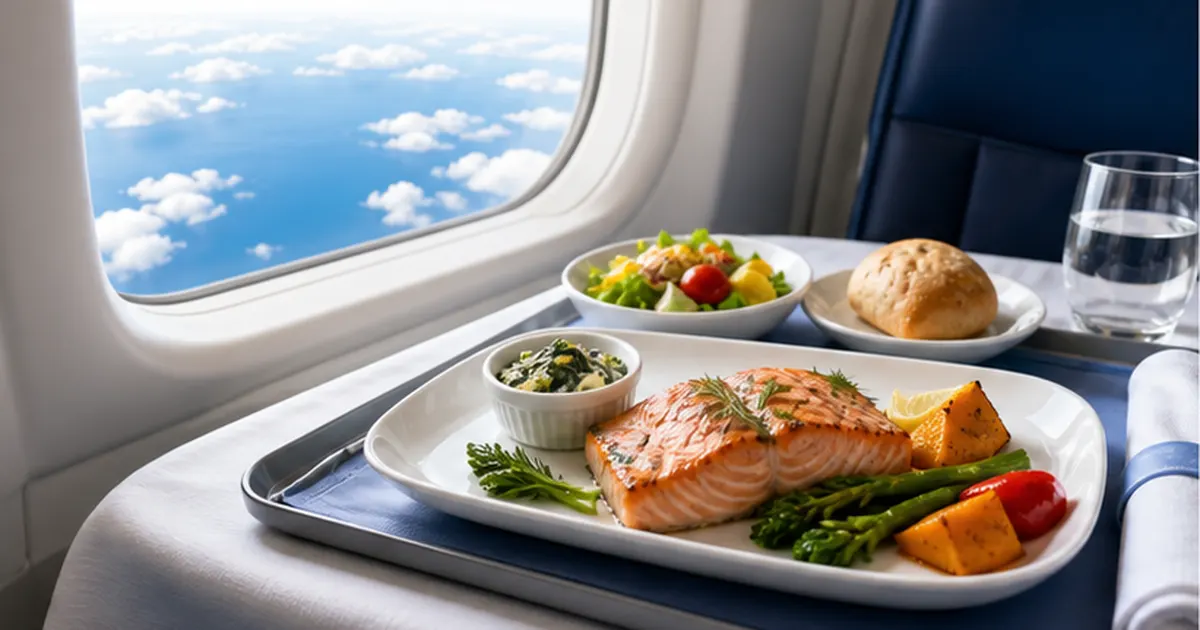
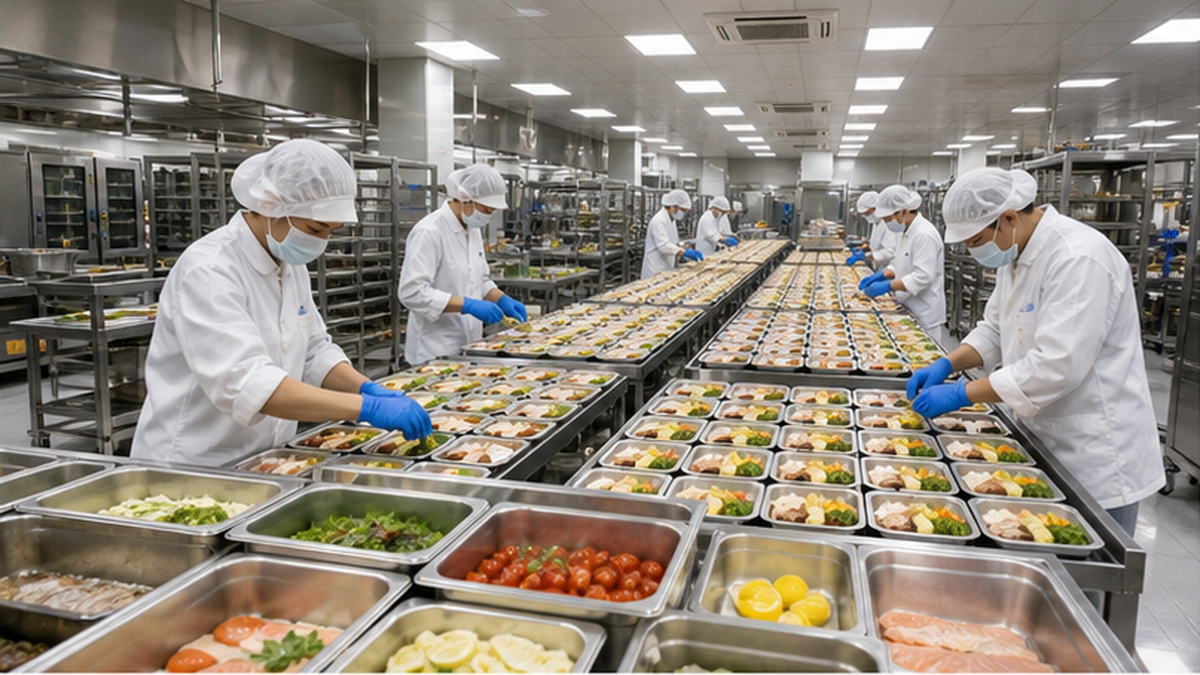
A small tray handed out in an aircraft seat. When a grilled fish or a marinated salmon sits on it, few passengers stop to wonder which sea it came from, or how it was caught. Yet in-flight catering is an invisible bulk procurement operation running into tens of millions of meals a year. Change a single line in an airline's sourcing standard, and the fisheries and fish farms downstream will feel it.
The standards used worldwide for this are MSC certification (Marine Stewardship Council) for wild fisheries and ASC certification (Aquaculture Stewardship Council) for farmed seafood. The blue 'ecolabel' and the turquoise ASC label you see in supermarkets are not mere marks. Behind them lie hundreds of audit criteria covering stock assessment, environmental impact, working conditions and community relations — plus a chain-of-custody system that runs through every stage of processing and distribution.
In this article we draw on primary sources — FAO (the Food and Agriculture Organization of the United Nations), Japan's Fisheries Agency, the MSC and ASC organisations themselves, and airlines' own published material — to explain how bulk procurement for in-flight meals connects to the sustainability of the ocean, using only what we could verify. Where we could not verify something, we say so plainly. In this field, that is the most important discipline of all.
この記事で学べること
- What MSC certification (wild fisheries) and ASC certification (aquaculture) each assess, and how they differ
- Why CoC certification is indispensable for calling something 'certified seafood', and how fast it is spreading in Japan
- How large-volume buyers such as airline catering and hotel kitchens actually move fisheries and fish farms
- Concrete Japanese examples: oysters in Minamisanriku, sea bream in Uwajima, scallops in Hokkaido
- Three real-world walls the certification system faces: supply volume, cost, and greenwashing
- What you can do today, as a shopper and as a passenger
In-flight catering: an invisible bulk purchase that reaches the sea
When we think about sustainable seafood, the supermarket fish counter usually comes to mind first. Whether or not you pick up the salmon or the canned tuna carrying the blue MSC label — that really is a vote. But in terms of sheer volume, there is an obvious fact: the quantity bought in bulk by companies dwarfs what individuals choose at the counter. Restaurant chains, hotels, institutional caterers, and airline in-flight catering. These are known as foodservice procurement, and they move enormous volumes of fish every day, out of consumers' sight.
What one tray becomes when you stack them up
A single international flight typically carries roughly 200 to 300 meals, and close to 400 on a large aircraft. Multiply that by daily departures and days in the year and one airline's annual loading easily reaches millions to tens of millions of meals. What is more, menus are fixed for months at a time and the same ingredients are ordered again and again. In-flight catering is therefore demand that is large, predictable and continuous — an ideal combination from a supplier's point of view.
That matters greatly for sustainability. The biggest worry for a fisher or fish farmer considering certification is: will anyone actually buy it? Audit fees, the burden of record-keeping, the temporary drop in income from changing gear or methods — all of these become investable if a stable outlet is visible at the other end. Without that outlet, no amount of sympathy with the idea will get anyone to move.
In-flight catering is a miniature of the whole supply chain
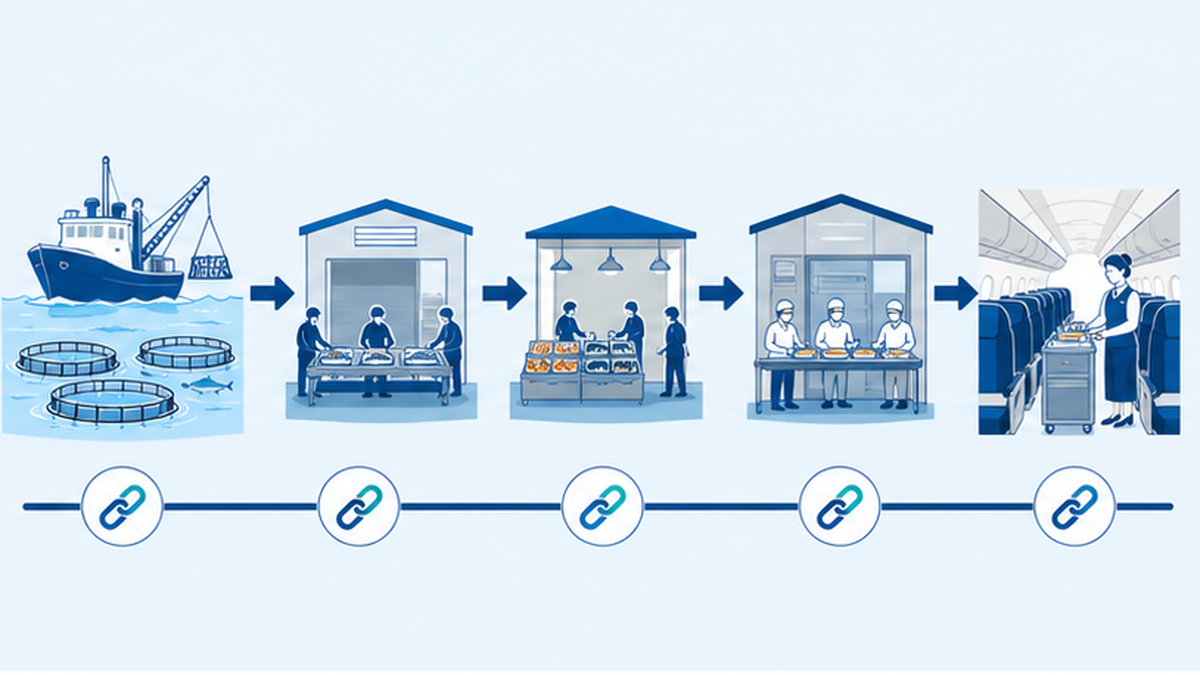
In-flight meals are normally produced not by the airline itself but by a catering company. In Japan these include JAL Royal Catering in the JAL group and ANA Catering Service Co., Ltd. (ANAC) in the ANA group. The raw fish arrives via trading houses and seafood wholesalers, is processed, chilled, driven to the aircraft side in dedicated trucks, reheated on board and served. If certified and non-certified product mix at any single point along that long chain, that fish can no longer be served as certified seafood. The CoC certification described below exists precisely to prevent such mixing.
Where this article stands
- Company names, figures and dates are only stated where we could confirm them in public documents from public bodies or the companies themselves
- Where an activity could not be confirmed, we do not fill the gap with guesswork — we state that it could not be confirmed
- Critical points about the certification system itself are addressed head-on in the second half
MSC and ASC: two international certifications for wild and farmed
The two most widely used global standards for sustainable seafood are MSC and ASC. The labels look similar and are often confused, but they cover completely different things. Put simply, MSC is for 'catching', ASC is for 'farming'.
MSC certification — the three principles a fishery must meet
The MSC (Marine Stewardship Council) is an international non-profit founded in 1997, headquartered in London and now with offices in 25 countries. MSC Japan, its Japanese arm, was established in 2007. The MSC Fisheries Standard is described as the only fisheries certification programme in the world that meets the requirements of both the FAO (Food and Agriculture Organization of the United Nations) and ISEAL (the International Social and Environmental Accreditation and Labelling Alliance).
To gain MSC certification, a fishery must demonstrate the following three points through assessment by an independent, third-party conformity assessment body.
- Sustainable fish stocks: the target stock is at a sustainable level, such that fishing can continue without depleting it
- Minimising environmental impact: impacts of the fishing activity on the marine environment and ecosystem are kept to a minimum (including bycatch and damage to the seabed)
- Effective management: a management system that secures long-term sustainability is genuinely functioning
Crucially, this is not a one-and-done award. Certificates expire, and there are periodic surveillance audits and re-assessments. If stock conditions deteriorate, certification is suspended. Understanding that certification is not proof of a result but proof of a state of ongoing management also makes the later discussion of its limits much clearer.
ASC certification — the environmental and social responsibility a farm carries
The ASC (Aquaculture Stewardship Council) was founded as an international non-profit in 2010 with the support of WWF (World Wide Fund for Nature) and IDH, the Dutch Sustainable Trade Initiative. Certification covers twelve species groups — salmon, seriola and cobia, freshwater trout, seabass/seabream/meagre, flatfish, tropical marine finfish, tilapia, pangasius, bivalves (oysters, scallops, clams, mussels), abalone, shrimp and seaweed — with farms audited against standards drawn up for each group.
Audit criteria include seabed pollution indicators, the ratio of wild fish used in feed, appropriate use of veterinary medicines, the ecological impact of escaped fish, working conditions, and relations with the surrounding community, in fine detail. What distinguishes this is that it is not a vague claim of being 'eco-friendly': it must be proven with concrete figures and records such as water-quality data and traceability of feed ingredients.
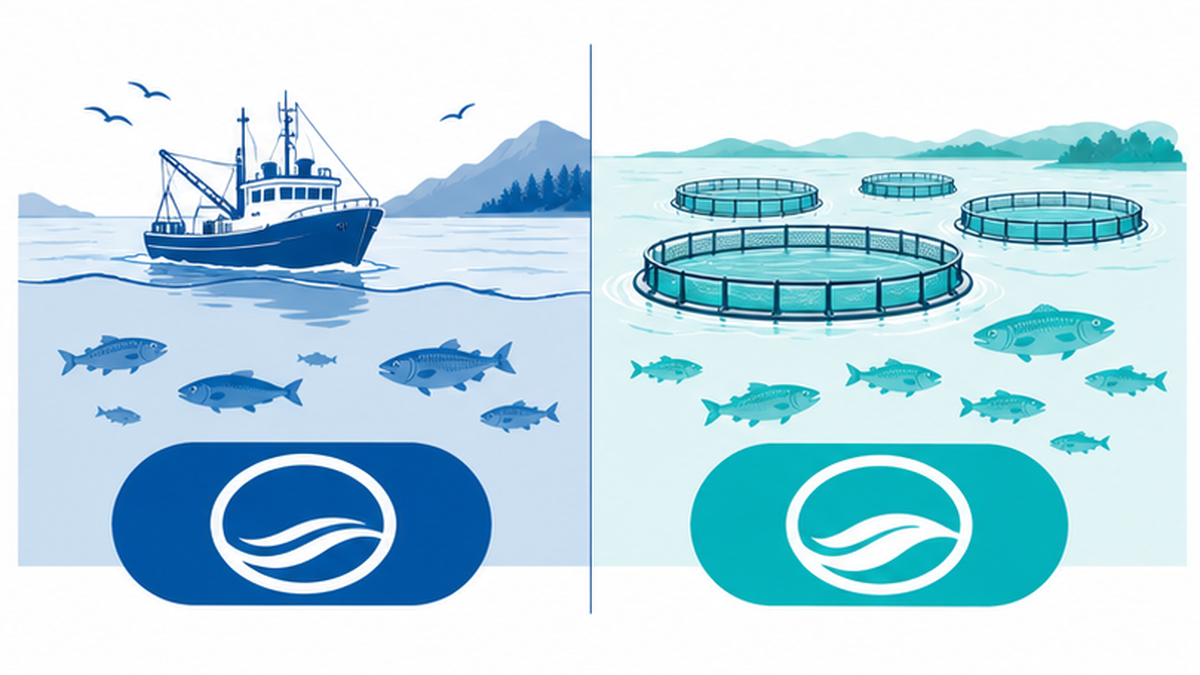
| Aspect | MSC certification | ASC certification |
|---|---|---|
| Subject | Wild fisheries (catching) | Fish farms (rearing) |
| Founded | 1997 (MSC Japan in 2007) | 2010 (supported by WWF and IDH) |
| Main audit axes | Three principles: stock status, environmental impact, management system | Water quality, feed, medicines, escapees, labour, community |
| First in Japan | — (multiple fisheries certified in sequence) | 2016: oyster farming at the Togura area, Shizugawa branch, Miyagi Prefecture Fisheries Cooperative |
| How species are handled | Assessed per fishery (species + gear + area) | Standards per twelve species groups, audited per farm |
A label is a device that creates the ability to choose
The essential role of certification is to give consumers and procurement managers the ability to choose. It is simply not realistic for a buyer to investigate, fillet by fillet, which sea a fish came from and how it was caught. Third-party assessment compresses that information into a single label and dramatically lowers the cost of the decision. That is the economic meaning of certification — and precisely why it is such a workable tool for companies buying in bulk.
Check this certification at the sourceMSC (Marine Stewardship Council) Japan — official siteOfficial site explaining the meaning of the MSC blue ecolabel, the three principles of the fisheries standard, and the list of certified fisheries in Japan.🔗 msc.orgCoC certification — the invisible chain behind the words 'certified seafood'
This is the part most often overlooked in discussions of sustainable seafood. A fishery or farm gaining certification is not by itself enough to put a label on the product in a shop or in the cabin. Every business handling that fish on its way to the consumer must also hold CoC (Chain of Custody) certification.
Proving, continuously, that nothing gets mixed
What CoC certification demands is simple to state but demanding in practice: certified and non-certified seafood must be kept physically and documentarily separate at every stage of storage, processing, transport and cooking. Quantities must reconcile from purchase invoice to shipping record. Staff must understand the system. Auditors check all of this.
In operations that juggle many product lines across many sites, such as hotels and restaurants, the difficulty rises sharply. At Hilton Tokyo Bay, for instance, it was reported that the team runs regular training for every member involved in food service, mindful that if certified and non-certified products become mixed anywhere between purchasing, storage, cooking and service, CoC certification could be withdrawn. Certification is not paperwork; it is a change in the habits of the shop floor.
Japan's CoC certification has climbed to third in the world
According to MSC Japan, the first MSC CoC certificate in Japan was issued in April 2006. The number of certified companies has grown steadily since, and passed 400 as of the end of September 2025. In recent years Japan has overtaken Germany and France, and now stands third in the world after China and the United States.
Growth was steepest between 2016 and 2019, when annual increases of roughly 35–40% or more were recorded. MSC Japan attributes this to rising awareness of the crisis in fish stocks and to the influence of the SDGs adopted in 2015. Growth slowed temporarily in the early stages of the COVID-19 pandemic, but has since resumed its upward trend.
The mix of certified businesses is worth noting. Alongside trading houses, processors, wholesalers and intermediate wholesalers, and retailers, the list includes foodservice operators, hotels and institutional catering companies. MSC Japan reports increasing certifications and enquiries from restaurants and hotels, and from the food wholesalers that supply them. Interest in sustainable seafood, previously concentrated in retail and seafood companies, is spreading into businesses that cook and serve on the spot. In-flight catering sits squarely in that category.

What happens without CoC certification
- Even fish bought from a certified fishery cannot be labelled or promoted as 'MSC certified'
- If a single business in the chain lacks certification, the chain breaks at that point
- Because certification can be withdrawn, companies must keep up staff training and record-keeping
Where Japan's airlines actually stand today
So what is actually happening in Japanese airlines' in-flight meals? This is an area where speculation creeps in easily, so we restrict ourselves to what each company publishes itself.
JAL: the catering company uses certified ingredients
Japan Airlines (JAL) states on the 'Use of certified products' page of its sustainability site that JAL Royal Catering Co., Ltd., which produces in-flight meals for the JAL group, actively uses ingredients certified under MSC, ASC and ASIAGAP with consideration for biodiversity. The company explains that MSC certification is the mark of wild seafood caught by fisheries that are sustainable and considerate of the environment and society, and ASC certification is the mark of seafood raised on farms that minimise environmental and social impact.
In other words, the adoption of certified seafood in Japanese airline catering is already a matter of practice, not a plan. This is where the CoC certification of the previous chapter comes into play: unless the catering company producing the meals is part of that chain, certified ingredients cannot be used 'as certified ingredients'.
See this initiative at the sourceJapan Airlines (JAL) — Use of certified productsJAL's own page on JAL Royal Catering's adoption of MSC, ASC and ASIAGAP certified ingredients.🔗 jal.com'Meal skip' — a different answer to reducing waste
Beyond sourcing, there is also the angle of simply not over-producing. JAL launched the 'JAL Ethical Choice Meal Skip Option', which lets passengers who do not need a meal cancel it in advance, on the Bangkok route in November 2020. After rolling it out mainly on Southeast and East Asian routes, the airline extended it to all international routes and all classes from December 2022. Passengers on overnight flights in particular have welcomed being able to rest undisturbed.
The service is also registered as a target menu of the 'TABLE FOR TWO Program' run by the NPO TABLE FOR TWO International, in which JAL participates. For every meal cancelled, JAL donates a set amount, which funds school meal programmes for children in developing countries. One mechanism links cutting food waste with tackling hunger and supporting education.
From 1 November 2022 to 28 February 2023, JAL also offered, as an à la carte item in First and Business Class on the London–Tokyo route, a wrap made with 'TU-NAH', a tuna alternative created from Norwegian seaweed and broad beans by the Berlin-based start-up BettaF!sh. Reducing the pressure on fish stocks through substitution is now being implemented as an option too.
ANA: 100% recycling of catering waste, and marine conservation
For the ANA group, the following in-flight catering initiatives can be confirmed as published. At ANA Catering Service Co., Ltd. (ANAC), which produces meals for domestic flights and international flights departing Japan, kitchen waste generated during cooking is recycled 100% into compost or animal feed, and 'soft kale' grown using that compost is served in salads in international Economy Class (excluding some routes). In 2022 the same soft kale was made into a paste and kneaded into bread dough to create a 'kale focaccia'.
On marine biodiversity, ANA has continued 'Team Chura Sango' since 2004. Supported by the Ministry of the Environment, Okinawa Prefecture and Onna Village, and run with the cooperation of the Onna Village Fisheries Cooperative, it holds coral planting programmes and awareness events. It marked its 20th anniversary in 2024 with 16 member companies, and by 2024 4,652 participants had planted 19,532 corals. Since 2012 ANA has also run the 'ANA Forest of the Heart Project' in Minamisanriku, a town hit by the Great East Japan Earthquake, and it became a corporate member of WWF Japan in 2022.
See this initiative at the sourceANA Group — Biodiversity conservationActivity records and figures for Team Chura Sango (since 2004), the ANA Forest of the Heart Project, and WWF Japan corporate membership.🔗 ana.co.jpWhat we could not confirm (and are recording deliberately)
In researching this article, we could not find any published information — on ANA group official websites or in press coverage — indicating that ANA uses MSC- or ASC-certified seafood in its in-flight meals. ANA's long record in marine conservation is one thing; whether it applies certification schemes to seafood sourcing for catering is another. Blurring that line and writing 'airlines are adopting certified seafood' would be unfair both to the company and to the reader, so we have written only what could be confirmed. If an official announcement is made, we will update this article.
Reading corporate cases carefully
- 'Sustainable in-flight meals' can mean certified seafood, food-waste reduction, or plastic-free packaging — several different things
- Checking which routes, classes and periods an initiative applies to reveals its real scale
- Limited-time campaigns and permanent changes to sourcing policy deserve to be judged separately
Procurement changed the ground: Minamisanriku, Uwajima, Hokkaido
Certification may look like paperwork, but in practice it changes how fisheries and farms work. The most emblematic case in Japan is oyster farming in Minamisanriku, Miyagi Prefecture.
Japan's first ASC certification: 'Minamisanriku Togurakko Oysters'
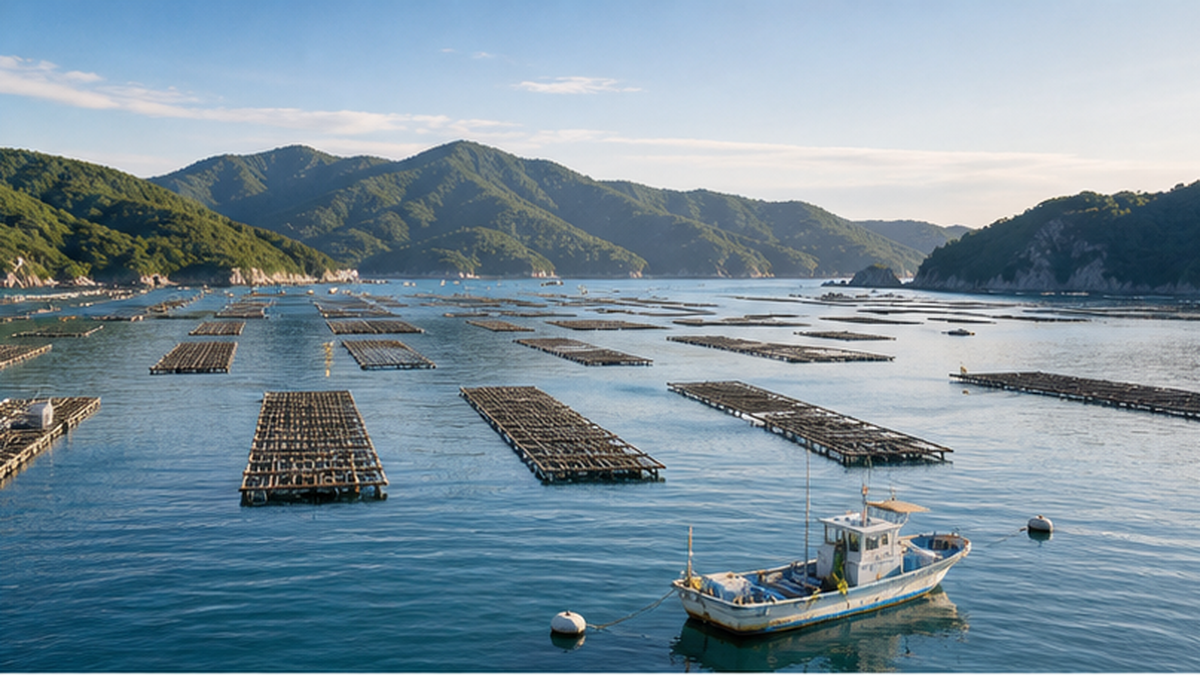
In 2016, oyster farming in the Togura sea area of the Shizugawa branch of the Miyagi Prefecture Fisheries Cooperative became the first in Japan to obtain ASC farm certification. This was a sea area where the tsunami of the Great East Japan Earthquake had swept away every raft and facility. Rebuilding from zero, the growers chose not to pack the rafts in as densely as before, but to cut the number of farming rafts to roughly one third of pre-disaster levels.
The results were dramatic. Ending overcrowded farming meant more feed — phytoplankton — reaching each oyster, so quality improved and the time to harvest shortened. Growth to market size, which had taken two to three years, became far quicker. Beyond that, the reduced workload shortened working hours, made days off possible, and drew in more young successors: productivity and working conditions improved at the same time. The paradox that 'farming less' ended up raising both income and the number of people willing to stay in the industry actually held true.
Minamisanriku later obtained FSC certification for its forests as well, becoming the first municipality in the world to hold both FSC and ASC certification. It is a case in which the idea of managing forest, river and sea as one continuous watershed was made visible in the form of certification. We explore this further in Oyster farming's recovery: how Sanriku chose to 'farm less, grow better'.
See this producing region'Minamisanriku Togurakko Oysters' and ASC certification — Umisa GozainThe producing region's own page on the Togura oyster farming in Minamisanriku, Miyagi, the first in Japan to gain ASC farm certification.🔗 umisagozain.comThe world's first ASC yellowtail, the world's first ASC sea bream
Japanese aquaculture has produced firsts in the ASC world too. In 2017, before the pandemic, yellowtail from Miyazaki Prefecture became the world's first to obtain ASC certification, and in 2020 red sea bream produced in Uwajima, Ehime Prefecture, became the world's first ASC-certified sea bream. Both are species for which Japan is a major producer, meaning Japanese farms were involved from the stage of drafting the standards.
Japanese fisheries with MSC certification
On the wild side, several Japanese fisheries already hold MSC fisheries certification. The list published by MSC Japan includes the following.
| Certificate holder | Fishery |
|---|---|
| Hokkaido Federation of Fisheries Cooperative Associations | Scallop hanging and dredge fishery |
| Meiho Fishery Co., Ltd. | Skipjack and albacore pole-and-line fishery |
| Maruto Suisan Co., Ltd. | Oyster hanging culture fishery |
| Usufuku Honten Co., Ltd. | Atlantic bluefin tuna longline fishery |
| Owase Bussan Co., Ltd. | Albacore longline fishery |
| ITOCHU Corporation | Skipjack and yellowfin tuna purse seine fishery (two cases) |
| Katsuo Ippon-Zuri Gyogyo Co., Ltd. | Skipjack and albacore pole-and-line fishery |
| Kyowa Suisan Co., Ltd. / Meiho Fishery Co., Ltd. | Skipjack and yellowfin tuna purse seine fishery |
| Taiyo A&F Co., Ltd. | Skipjack and yellowfin tuna purse seine fishery |
| Fukuichi Gyogyo Co., Ltd. | Yellowfin/bigeye/albacore longline and skipjack/yellowfin/bigeye purse seine fisheries |
What stands out in the list is the high proportion of skipjack and tuna. MSC Japan likewise notes that certification among businesses handling tuna and skipjack has risen recently in Japan, linked to the growing number of MSC-certified tuna and skipjack fisheries at home and abroad and the expanding trade in certified product. These are species that appear frequently in in-flight meals as canned tuna or tuna sandwiches — a field where demand and certification mesh readily.
How the ground actually changes
- To meet the criteria, concrete operations change: stocking density, gear, and how records are kept
- Because records remain, judgements once based on experience and instinct can be tested with data
- When outlets and prices stabilise, the work starts to look like something a successor can sustain
The certified seafood market in numbers
Let us pin down the scale of certified seafood with figures.
16.5% of the world's catch comes from MSC-certified fisheries
According to the MSC, as of the end of March 2024, 572 fisheries in around 60 countries held MSC fisheries certification, and their catch accounted for 16.5% of the world's total wild capture of fish and shellfish. On the product side, around 22,000 items carrying the MSC ecolabel were sold in more than 70 countries in FY2024, with 660 items in Japan. In Japan they can be found at AEON group stores, co-operatives, Ito-Yokado/York and McDonald's, among others. AEON's efforts are covered in detail in AEON 'TOPVALU' MSC/ASC certified seafood: sourcing reform that protects the ocean from the shop floor.
ASC's market grew sharply in three years
ASC is growing too. According to its first annual report, the number of certified farms worldwide rose 20% year on year in 2021, and production of seafood meeting the ASC standard's social responsibility and environmental sustainability requirements exceeded 2.5 million tonnes.
In Japan, as of May 2023, 48 farms belonging to 15 companies and cooperatives were certified, the number of CoC-certified companies was up 10% year on year at 187, and domestically produced ASC-certified products likewise rose 10% to 576 items. ASC Japan's published 'ASC market in numbers' shows further expansion: as of March 2026, 45 ASC farm certifications, 218 CoC-certified businesses, and more than 700 ASC-labelled products in Japan.
| Species | 2020 | 2021 | 2022 |
|---|---|---|---|
| Atlantic salmon | approx. 8,500 t | approx. 11,000 t | approx. 14,000 t |
| Coho salmon | approx. 1,000 t | approx. 2,500 t | approx. 6,000 t |
In three years Atlantic salmon grew about 1.6-fold and coho salmon roughly six-fold. The scale is still a fraction of Europe's, but the rate of change is unmistakable. One factor cited is that logistics and transport problems during the pandemic heightened interest in raising domestic self-sufficiency in certified seafood.
How serious are restaurants and hotels?
There are concrete numbers on how serious foodservice buyers are. The Hilton group had set a target of making 30% of the seafood handled across all its hotels in Japan, Korea and Micronesia sustainable; it has already reached 35%. Hilton Tokyo Bay alone reached 79.9% in April 2023. The hotel also matches products to uses — fresh domestic salmon from Chiba and Aomori for the restaurants, the belly cut of frozen imported salmon mixed with onion for a breakfast salad.
From Nissui, a major food manufacturer, comes the more sober reality that while the share of certified product on the procurement side is rising, the share in sales remains small. Even so, there was a sense of momentum: 'It was around 2021 that co-operatives across Kyushu, Chugoku and Shikoku began setting policies to strengthen certified products, and after the pandemic the current has clearly changed.' A change in sourcing policy seeps through to the shelf and the dinner table over several years — that lag needs to be part of the picture.

Supply that cannot keep up, cost, and greenwashing — three walls
We have set out encouraging figures so far, but sourcing certified seafood runs into real walls. Knowing them matters when judging corporate cases.
Wall 1: there simply is not enough supply
The biggest constraint is volume. MSC-certified fisheries account for 16.5% of the world's wild catch. Turn that around and more than 80% is uncertified. For foodservice buyers who need particular species in large, stable quantities, building a menu solely from certified product is not currently easy. Narrow the focus to domestic supply and it becomes harder still: Japan has a little over ten MSC-certified fisheries and a few dozen ASC-certified farms.
Underneath it all lies the state of the stocks themselves. According to FAO's The State of World Fisheries and Aquaculture (SOFIA) 2024, the share of stocks fished beyond biologically sustainable levels worsened from 35.4% to 37.7% over the preceding two years. Meanwhile world fisheries and aquaculture production in 2022 hit a record 223.2 million tonnes, and aquaculture production of aquatic animals surpassed capture fisheries for the first time. With wild capture plateauing, the sustainability of farming is becoming an ever weightier question. How overfishing leads to stock collapse is explained in Why overfishing collapses fish stocks: lessons from cod and herring, and recovery through catch limits.
Wall 2: cost and operations
Certified product generally costs more to buy. Audit fees, labour for record-keeping, space for separate storage — someone in the chain has to absorb these. When raw material prices are rising, that premium is not trivial. At Hilton Tokyo Bay, as noted, the team keeps up the effort of 'maintaining connections with suppliers and having them constantly look for new, relatively affordable ingredients'.
For in-flight catering, add strict food-hygiene standards, weight limits, and tolerance of chilling and reheating. The set of ingredients that are certified and can also survive in-flight operations is narrower than one might imagine.
Wall 3: certification alone is not reassurance
There are criticisms of the certification system itself. Aquaculture carries a range of issues: water and marine pollution, appropriate use of medicines, the impact of feed ingredients on wild stocks, the ecological effect of escapees, working conditions, and relations with local communities. Above all, more than 70% of aquaculture production excluding algae depends on feed, and as long as that feed contains fishmeal and fish oil from wild fish, one cannot simply say that 'farming places no burden on wild stocks'. FAO's data for 2020 show aquaculture had grown to 49% of world aquatic production.
The standard-setters are aware of this. On 30 May 2023, ASC brought into force and made mandatory a new module adding food safety requirements, including the need to hold a GFSI (Global Food Safety Initiative) recognised scheme, within the CoC certification process, in order to raise the value and assurance of the label (with a one-year grace period). Standards are not fixed; they are updated in response to criticism.
Retailers see the tightening positively. A representative of Seven & i Holdings commented that 'the thing companies fear most is being seen by consumers as greenwashing. Stricter rules are a good thing, in the sense that they dispel that concern and back companies up.' Certification is also a form of defence for companies — that is the perspective.

Checkpoints when you evaluate a claim
- Distinguish 'certain routes and menus only' from a company-wide sourcing policy
- Check whether a target share of certified product is published, alongside actual results
- Check whether CoC certification covers the whole supply chain, not just the final display
- Check whether it continues and is updated, rather than ending as a limited-time campaign
The foundation of stock management, and what we can do
Certification is no panacea. Because it works through the market, it cannot function without national fisheries management as its foundation. In Japan that foundation is being built.
The revised Fisheries Act and MSY-based management
Under the revised Fisheries Act, the Fisheries Agency conducts stock assessments based on stock surveys and is introducing evaluation and management methods that stand comparison internationally — managing stocks against a target level of biomass to be maintained or rebuilt in order to achieve MSY (maximum sustainable yield). The basic management tool is the TAC (total allowable catch).
In March 2024 the 'New Roadmap for Promoting Resource Management' was formulated and published. Its main contents are as follows.
- Expand MSY-based stock assessments from the current 38 stocks to around 45
- Begin TAC management for 80% of stocks on a catch-volume basis by FY2025
- Bring biomass to MSY level or above for at least 60% of stocks with MSY-based assessments
- Resolve operational issues with IQ (individual quota), such as simplifying transfer procedures
- Target recovery of catch volume to 4.44 million tonnes by FY2030
Since the third MSC principle is that an effective management system must be functioning, the scope for Japanese fisheries to gain certification will not widen unless national stock management advances. Corporate sourcing reform and national institutional reform are two wheels of the same cart.
What you can do as a passenger and as a shopper
What individuals can do is unglamorous but genuinely effective. Look for the blue MSC label and the turquoise ASC label when shopping. Choose certified seafood dishes when they appear on a restaurant or hotel menu. And on an overnight flight where you do not want to eat, make active use of meal-skip schemes. Each of these sends companies a signal that there is demand for this option.
Procurement managers cannot keep making products that do not sell. Conversely, once there is a track record of certified product being chosen, sourcing targets get raised. As the Nissui case showed — co-operatives set a policy and 'sales grew and the relationship deepened' — a demand-side signal underwrites a supply-side investment decision. That cycle is genuinely under way.
Worth watching the restaurant chains too
Beyond aviation, the restaurant industry is spreading its own ingenuity in resource-conscious sourcing. A conveyor-belt sushi chain, for instance, has built a model that uses fish which never reaches the market while supporting fishers' incomes — a useful reference for an approach to sustainability distinct from certification. See Kura Sushi's whole-boat buying and use of underutilised fish: how a restaurant chain supports sustainable fisheries for details.
Three things you can do today
- When you shop, first look for products carrying the blue MSC label or the turquoise ASC label
- Before an overnight flight, check whether a meal-skip or portion-size option is available
- Read the sustainability page of a hotel or restaurant chain you use, just once — and look for numerical targets

Summary of this article
- MSC covers wild fisheries and ASC covers aquaculture; both rest on third-party assessment and periodic audits
- To serve product as certified seafood, CoC certification across the whole supply chain is indispensable
- Japan passed 400 MSC CoC-certified companies at the end of September 2025, third in the world, with notable spread into foodservice, hotels and institutional catering
- JAL uses MSC/ASC/ASIAGAP certified ingredients via JAL Royal Catering; ANA contributes through 100% recycling of catering waste and coral conservation (no published MSC/ASC adoption could be confirmed)
- In Minamisanriku, oyster farming's ASC-driven reduction in density improved quality, growth and working conditions simultaneously
- Three walls remain — supply volume, cost and greenwashing — and national stock management is the indispensable foundation
参考文献・出典
- FAO (Food and Agriculture Organization of the United Nations) – The State of World Fisheries and Aquaculture 2024. Statistics on the state of world fish stocks and production
- Fisheries Agency of Japan – Fisheries White Paper. Resource management in Japan, MSY-based management under the revised Fisheries Act and the new roadmap
- MSC (Marine Stewardship Council) Japan – Overview of MSC certification, list of MSC-certified fisheries in Japan, explanation of CoC certification
- MSC Japan press release – 'MSC CoC certificate holders in Japan pass 400, third in the world after China and the US' (30 October 2025)
- ASC (Aquaculture Stewardship Council) Japan – ASC farm standards, species covered, and certification numbers in Japan ('ASC market in numbers')
- Japan Airlines (JAL) Sustainability – 'Use of certified products'. On JAL Royal Catering's adoption of MSC, ASC and ASIAGAP certified ingredients
- Japan Airlines (JAL) press release – 'Further expansion of SDGs-conscious initiatives in in-flight meals' (16 November 2022). Meal Skip Option and TABLE FOR TWO
- ANA Group corporate information – Biodiversity conservation. Team Chura Sango, ANA Forest of the Heart Project, WWF Japan corporate membership
- ANA Future Promise – 'ANA's sustainable food initiatives' (16 September 2022). ANA Catering Service's 100% recycling of kitchen waste
- Sustainable Brands Japan – 'ASC-certified aquaculture products spread worldwide; Japan's market expands in three years' (1 June 2023). Includes remarks from Hilton, Nissui and Seven & i
※ 信頼性の高い順に配列:政府機関・学術機関 > 査読済み論文 > 専門機関 > 信頼できるメディア