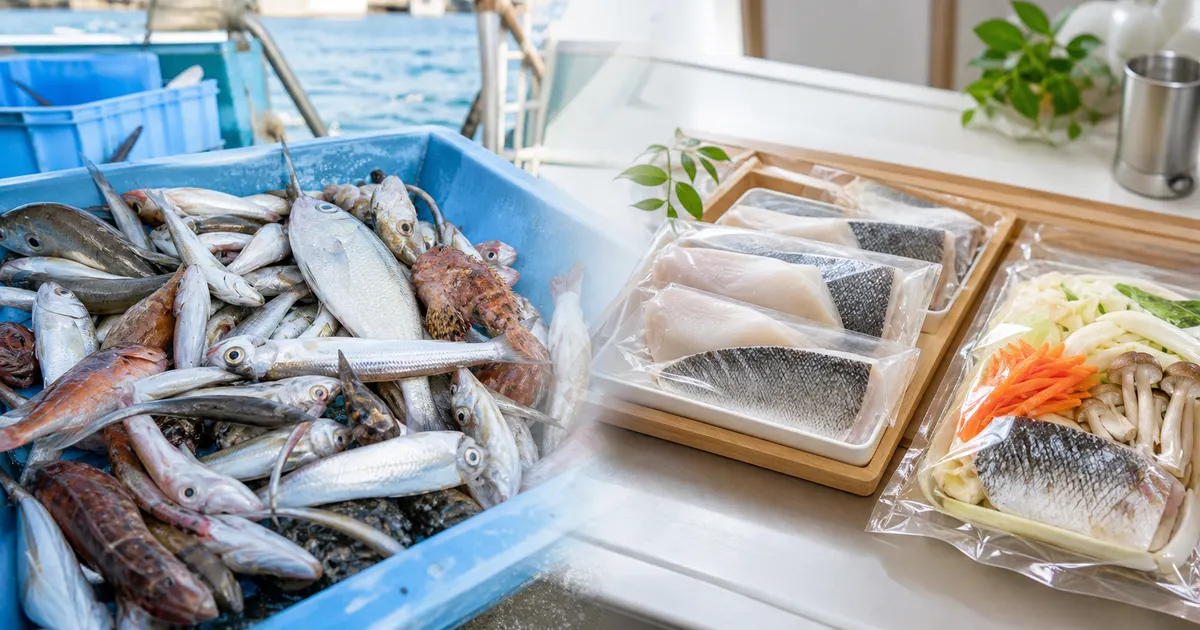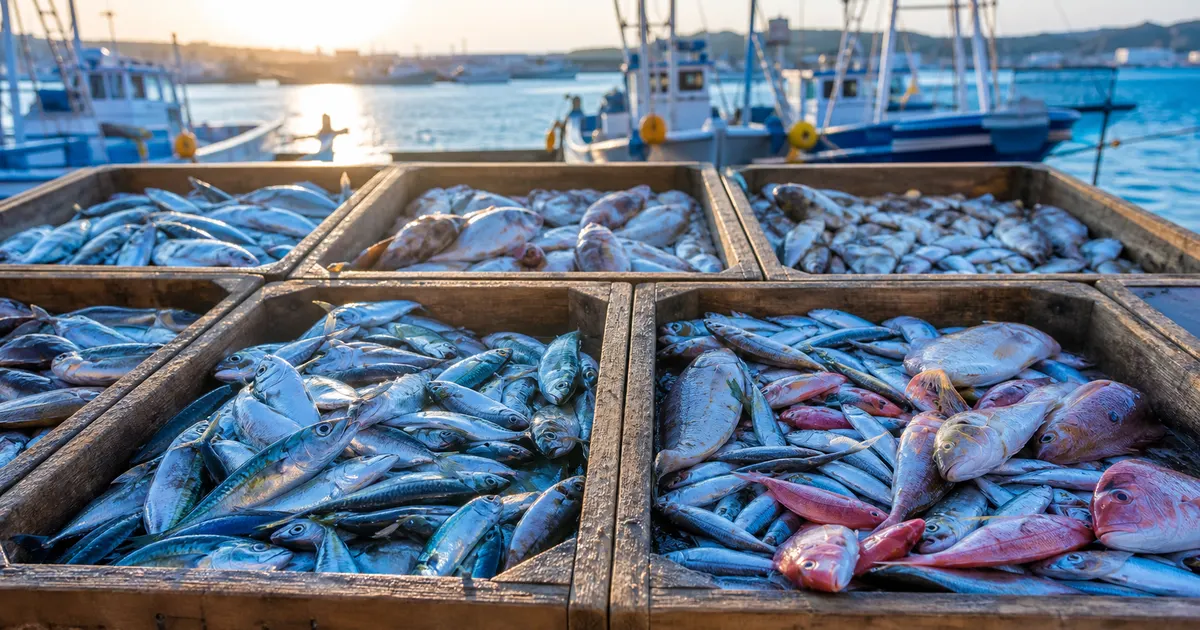
Fillets and sashimi displayed at the supermarket seafood counter are only a small fraction of the fish that come in from the sea. The UN Food and Agriculture Organization (FAO) estimates that about 35% of the seafood produced by the world's fisheries and aquaculture is lost or discarded somewhere after capture. In other words, more than one in every three fish never reaches anyone's plate.
Seafood food loss is different in nature from the loss of vegetables or grains. Fish is an extremely perishable food that begins to deteriorate rapidly from the moment it dies. On top of that, multiple factors overlap at every stage of distribution to create loss: "underutilized fish" that don't meet size or appearance standards, unsold stock caused by inaccurate demand forecasts, and leftovers at home.
This article first looks at the scale of seafood food loss using global and Japanese figures, then explains the science of freshness decay to understand why so much fish is lost. From there, it organizes concrete measures for reducing loss — freezing and processing technologies, distribution innovations, and choices consumers can make.
What you'll learn in this article
- How large the scale of "seafood food loss" is, worldwide and in Japan
- The biological reasons fish spoil faster than meat or vegetables (ATP breakdown, K-value, autolysis)
- At which stages, from catch to table, different kinds of loss occur
- The true nature of the "hidden loss" behind off-grade and underutilized fish and unsold stock
- How reduction technologies such as quick freezing, proton freezing, and surimi processing work
- Concrete reduction actions that both consumers and businesses can start today
What Is Seafood Food Loss? Grasping the Big Picture with Global and Japanese Figures
"Food loss" refers to food that could originally be eaten but ends up being discarded. Looking at seafood specifically on a global scale, the scale is beyond imagination. The FAO (Food and Agriculture Organization of the United Nations) estimates that about 30-35% of the seafood produced by fisheries and aquaculture is lost or discarded without ever being used for food after capture. That means the fuel, feed, and labor spent on production are entirely wasted as well.
Let's first sort out the terminology. In international statistics, the reduction that occurs between harvest/landing and just before retail is distinguished as "food loss," while what is discarded closer to consumption — at retail, food service, and in the home — is called "food waste." According to the FAO's SOFA report, about 14% of the world's food is lost between harvest and retail, and the UNEP (United Nations Environment Programme) Food Waste Index shows that about 17% (roughly 931 million tonnes in 2019) is discarded at the retail and consumption stages. Seafood is a category particularly prone to loss on both sides of this divide.
Why Seafood Is Not a "Model Student" but a "Category to Watch" for Loss
While grains and legumes can be stored for long periods at room temperature, seafood begins to lose quality the moment it dies. If it isn't cooled properly, it can lose its value as sashimi-grade product within hours, and it's not uncommon for it to become unfit even for cooking within a day. In other words, seafood loss is not just a matter of "throwing away what's left over" — it has a strong element of a race against time: "thrown away because it didn't make it in time." We'll look at this in more detail later alongside the seafood cold chain and the science of freshness decay.

Japan's Food Loss and Seafood's Place Within It
Japan's total food loss, as estimated by the Ministry of Agriculture, Forestry and Fisheries (MAFF) and the Ministry of the Environment, was about 4.72 million tonnes in FY2022 (approximately 2.36 million tonnes from households and 2.36 million tonnes from businesses). This figure covers all food combined, but seafood is among the most perishable of fresh foods, and it tends to be a breeding ground for loss at every stage — markdowns, price cuts, and disposal at fresh fish counters, and leftovers at restaurants.
| Category | Main content of loss | Stage where it typically occurs |
|---|---|---|
| Food loss (production to pre-retail) | Discarding at sea, freshness decay after landing, processing yield loss, damage during transport | Fishing vessels, ports, processing plants, distribution |
| Food waste (retail to consumption) | Unsold stock, markdown disposal, restaurant leftovers, unused food at home | Supermarkets, restaurants, households |
| Loss from grading/non-use | Off-size fish, low-recognition species, discarding of bycatch | Catch to market |
Key points of this article
- About 35% of the world's fisheries and aquaculture production is lost after capture (FAO)
- Fish is a food where "the race against time" begins the moment it dies
- Japan's food loss totals about 4.72 million tonnes a year, and seafood is especially prone to it
- The "hidden loss" from off-grade/underutilized fish and unsold stock is also substantial
- There is room to reduce loss through freezing, processing, distribution innovation, and consumer choices
Why Seafood Loss Is Drawing Attention Now
Several factors are converging behind the growing focus on seafood food loss. One is the growth of the world's population and rising demand for fish as food. Amid a health-conscious trend, global seafood consumption keeps rising, raising the question of how to use the ocean's limited resources without waste. Another is resource depletion: catching more than can be sold, letting it go to waste, and discarding it is nothing but a double loss — overfishing plus disposal. Furthermore, food loss emits greenhouse gases at every stage of production, transport, refrigeration, and disposal, making it an issue that cannot be overlooked from a climate-change perspective either.
The UN Sustainable Development Goals (SDGs), under Goal 12 ("Responsible Consumption and Production"), Target 12.3, call for halving per-capita global food waste at the retail and consumer levels by 2030 and reducing food losses along production and supply chains. In line with this, Japan is advancing public- and private-sector efforts under the Food Loss and Waste Reduction Promotion Act (enacted in 2019), with seafood as one of its priority areas.
Food loss is not a loss that occurs only at the moment of disposal. The fuel used by the boat that caught the fish, the feed and electricity used in aquaculture, the energy spent on processing and refrigeration, and the emissions from transport and waste disposal — all the resources invested at every step from production to disposal are wasted entirely. Discarded food is itself a "lump of unused water, energy, and labor." That is precisely why reducing loss by even one unit has effects that go far beyond simply cutting the amount discarded.
In the sections that follow, we will first uncover, through the science of freshness decay, why so much fish is lost, and then move step by step through each stage from catch to table, off-grade and underutilized fish, unsold stock, and finally reduction measures through freezing and processing.
Why Fish Spoils So Easily: The Mechanism of Freshness Decay
At the root of seafood loss lies the "perishability" of fish as a food. While beef and pork can keep for several days to about a week under refrigeration, fish loses quality far faster even under the same refrigeration. This difference isn't a matter of impression — it can be explained by the fish's physiology and the chemical reactions that occur after death.
Rigor Mortis and Autolysis: Breakdown Begins Inside the Body
When a fish dies, its muscles first enter rigor mortis, a state of stiffening. Freshness is still maintained during this stage, but once rigor eases, the fish's own enzymes begin breaking down its own muscle. This is called autolysis. Compared to land animals, fish break down more readily in terms of body temperature and enzyme activity, which is why the flesh becomes soft and falls apart easily. In addition, the skin, gills, and internal organs carry large amounts of microorganisms, which multiply explosively at higher temperatures and speed up spoilage.
The K-Value: Measuring "Freshness" with a Number
A representative scientific indicator of fish freshness is the K-value. Living fish muscle is rich in the energy compound ATP (adenosine triphosphate), but once the fish dies, replenishment stops, and a one-way breakdown proceeds: ATP → ADP → AMP → IMP → HxR (inosine) → Hx (hypoxanthine). The K-value is the proportion of HxR and Hx — the products closest to the final stage — among all breakdown products; the lower the number, the fresher the fish. According to materials from institutions such as Tokyo University of Marine Science and Technology, a K-value of 20% or below is generally considered suitable for raw consumption such as sashimi, while up to around 60% is considered the guideline for fish to be cooked.
Interestingly, IMP (inosinic acid), produced partway through this breakdown, is a powerful umami compound also found in katsuobushi (dried bonito flakes). That's why fish isn't necessarily "tastier the fresher it is" — resting it briefly at the right temperature can actually enhance its umami. But if temperature control is mismanaged, spoilage wins out before that umami develops. Preserving freshness, in other words, is the technique of controlling the speed of this breakdown using low temperature.
In recent years, "aged fish" — deliberately rested for several days to over ten days at low temperature to mature — has also gained popularity. This is an attempt to control autolysis within a safe range and draw out umami compounds; conversely, it shows that the very same breakdown reaction is a razor's-edge phenomenon — spoilage if mismanaged, umami if managed well. This also makes clear that the essence of loss reduction lies in "managing temperature and time."

A 10°C Difference in Temperature Changes Shelf Life Dramatically
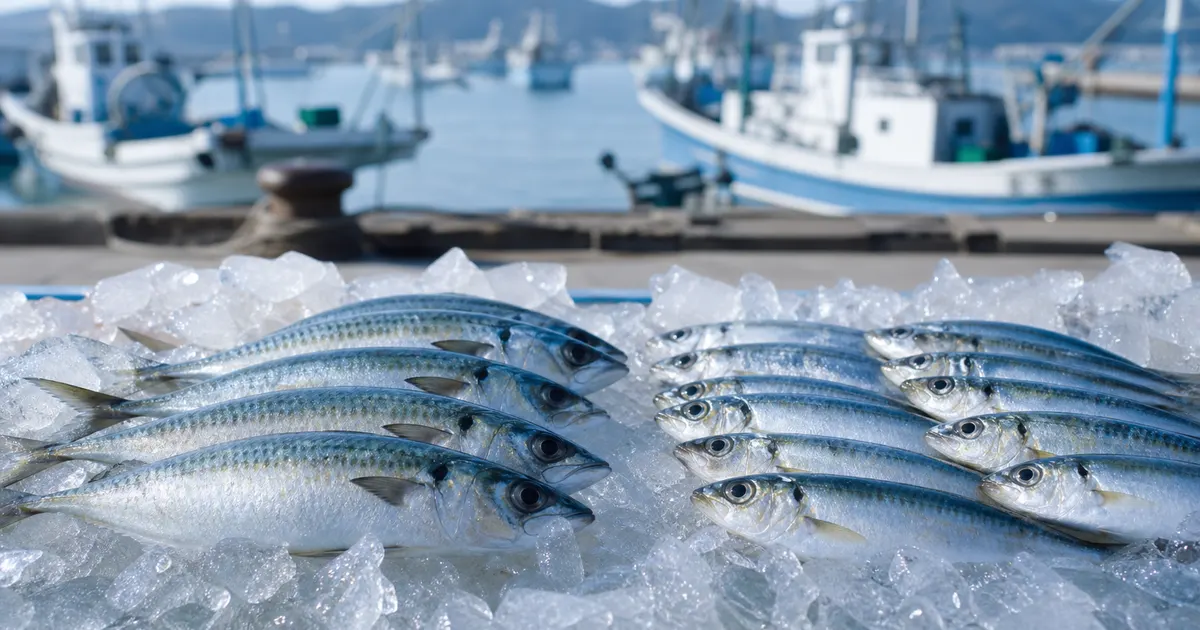
The single biggest factor affecting freshness decay is temperature. Both the enzymes responsible for autolysis and the microorganisms that cause spoilage become more active as temperature rises. That is exactly why it is critical to cool fish quickly with ice or chilled seawater immediately after capture and to transport it without ever breaking the "cold chain" (low-temperature distribution). Conversely, if the temperature rises even at just one point — on the boat, at the port, in the truck, or at the store — freshness is drawn down accordingly, raising the risk that the fish will ultimately be discarded.
The Wisdom of Ikejime and Shinkeijime
At fishing ports, it has long been common practice to stun and instantly kill fish immediately after capture, then bleed them and destroy the spinal nerve, suppressing the energy consumption and body-temperature rise caused by thrashing and slowing the rate at which freshness declines. Fish handled with this careful ikejime process can, combined with subsequent low-temperature management, have their edible period extended considerably.
Histamine: A Food Safety Issue
Freshness decay is not only a matter of "deliciousness." In red-fleshed migratory fish such as mackerel, tuna, bonito, and sardine, lax temperature control allows microorganisms to generate a substance called histamine, which can cause allergy-like food poisoning such as facial flushing and hives when eaten. Once histamine has formed, it is not broken down even by heating. This is precisely why consistent low-temperature management from the moment of capture is essential not only for reducing loss but also for food safety. Preventing situations where spoiled fish must be discarded for safety reasons also, in a broad sense, contributes to reducing loss.
In short, the first step in reducing seafood loss comes down to how quickly and reliably the catch is cooled right after capture, and how unbroken that low temperature is kept afterward. The next section follows this battle for freshness through each stage from catch to table, tracking where loss actually occurs.
From Catch to Table: Fish Lost at Every Stage of Distribution
Seafood loss doesn't happen in one massive burst at a single point. From the sea to the table, it accumulates little by little — but steadily — across multiple stages. Let's look at the major stages one by one.
1. At Sea: The Major Loss of Discarding
The first loss occurs even before the boat reaches port — out on the water. This is "discarding": bycatch, species other than the target catch, or fish judged unsellable due to size or species, thrown back into the sea on the spot (or dumped dead). According to FAO estimates, about 10.8% (an annual average of roughly 9.1 million tonnes over 2010-2014) of fish caught in the world's marine fisheries is discarded at sea. Industrial fisheries tend to have higher discard rates, and the economic loss from discarded fish is said to run into billions of dollars annually. Efforts to make use of such bycatch for food are drawing attention recently as food use of bycatch.
2. Landing and the Port: A Race Against Time
Even after landing at port, if cooling with ice or chilled seawater is delayed or insufficient, freshness drops rapidly. This loss at this stage cannot be ignored, especially during hot seasons or in fishing regions far from the market. As seen in the previous section, how well temperature is managed directly determines how long the fish stays edible. Some fishing ports have installed equipment that instantly chills fish using sterilized cold seawater, or set up systems that keep large quantities of crushed ice ready, thoroughly managing temperature from landing to shipment — achieving both higher added value through freshness and reduced loss at the same time.

3. Processing: Yield and Residue
When fish is processed into fillets, the head, bones, internal organs, and skin come out as "residue." The proportion of edible meat (yield) varies greatly by species, and it's not uncommon for only about half of the original weight to become salable product once filleted. However, not all of this residue goes to waste — it can be used as a raw material for dashi stock, surimi, fish meal, and oil. The movement to turn processing by-products into valuable products is spreading as seafood by-product upcycling.
4. Distribution and Retail: Both "Too Late" and "Too Much"
At the distribution stage, both spoilage from temperature rise during transport (loss from "not making it in time") and unsold stock at stores (loss from "excess") occur. Because fresh fish has a short shelf life, it is marked down if not sold by closing time, and discarded if it still remains unsold. Reduction efforts at supermarkets are covered in detail in supermarket food waste reduction, and convenience-store efforts in convenience store food loss.
5. The Home: The Final, and Closest, Loss
The restaurant and prepared-food (deli/bento) stage should not be overlooked either. Restaurants generate leftovers when portions are too large, and unused ingredients when prep exceeds demand. Sashimi garnish ("tsuma"), trimming scraps from sliced fish, and offcuts that couldn't be used for frying — seafood is lost in these less visible forms as well. Preparing food to order or reservation, adjusting portions to what can be finished, and encouraging takeout are among the ways to curb loss at this stage.
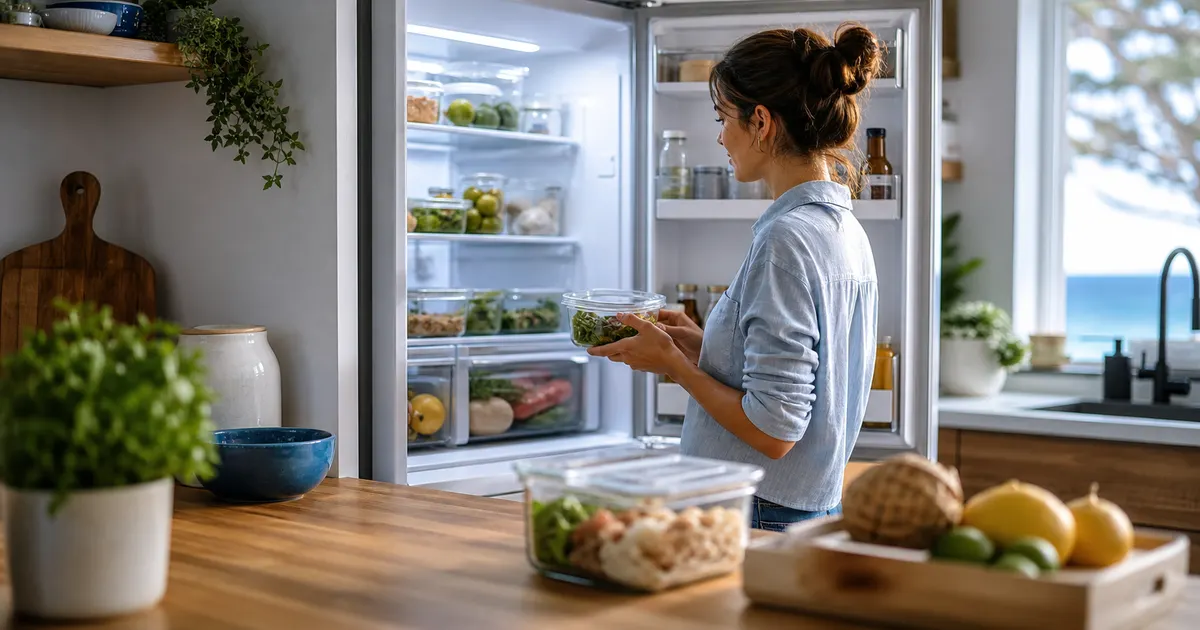
And the final stage is the home. Buying more than can be used, letting fish spoil at the back of the refrigerator, avoiding it because prepping it is a hassle — loss at home like this accounts for about half of Japan's food loss. This is explained in detail in Japan's household food loss, but seafood is a category especially prone to being discarded at home for the double reason that it is "perishable" and "high-hurdle to cook." As fewer people fillet fish themselves and buying packaged fillets or sashimi has become the norm, behavioral shifts — failing to finish fish within its use-by date, or avoiding whole fish as "seemingly hard to handle" — are also driving loss.
What matters is that these stages are not independent — they are linked like a chain. Even fish carefully bled and chilled at the source can be ruined if the temperature rises anywhere along the distribution chain. Conversely, if temperature and information stay connected without a break from upstream (fisheries, production areas) to downstream (retail, households), the same fish can stay "edible" for much longer. Reducing seafood loss means strengthening this entire chain.
| Stage | Main cause of loss | Key to reduction |
|---|---|---|
| At sea | Bycatch/discarding, off-size fish | Utilizing bycatch, selective fishing gear |
| Landing/port | Delayed or insufficient cooling | Rapid icing, chilled seawater |
| Processing | Yield loss, unused residue | By-product upcycling |
| Distribution/retail | Spoilage in transit, unsold stock | Cold chain, demand forecasting |
| Home | Overbuying, avoidance of cooking | Buying appropriate amounts, using frozen fish |
The Easily Overlooked "Hidden Loss"
The disposal figures that appear in statistics are, in fact, just the tip of the iceberg. Bycatch discarded at sea, and off-grade fish processed at the source because they fetch no price, often never enter distribution in the first place and so are frequently not counted as "food loss." Behind the numbers lies a large amount of uncounted loss.
Off-Grade and Underutilized Fish: The "Invisible Loss"
Among the various forms of seafood loss, the problem of "underutilized fish" is one that rarely shows up in statistics yet is large in scale. Japan's Fisheries Agency defines underutilized fish as fish that are diverted to non-food use or traded only at low prices for reasons such as irregular body size or catches too small to form a consistent lot.
Fish That Could Be Eaten but Go Unused
Underutilized fish are by no means "bad-tasting" or "inedible" fish. In fact, they often taste excellent but fall out of distribution for reasons such as the following.
- Size doesn't meet standards (too small, too large, or irregular)
- Catch volume is too small to bring to market as a consistent lot
- Unfamiliar to general consumers, with neither its name nor how to cook it widely known
- Plain in appearance, or requiring extra effort to prepare
- Has features that make it hard to handle, such as spines, sliminess, or bones
Such fish are said to account for 30-40% of total landings in some regions. Even when caught in the same waters, only the small subset of fish we know by name become "products," while much of the rest is processed away without fetching a price. Details of efforts to bring underutilized fish to the table are introduced in utilization of underutilized fish.
To give familiar examples, deep-sea species related to eelpout or anglerfish, distinctively shaped fish like gurnard or filefish, and various small, irregularly sized fish that don't easily fit the market — many such fish are eaten as a matter of course in regional areas, yet are rarely seen on the shelves of major cities. Many have refined white flesh or make excellent dashi, and with the right recipe can become a top-class ingredient. It is the information barrier of "not chosen because it isn't known" — unrelated to taste — that generates this loss.

Why Underutilized Fish End Up Discarded: The Barriers of Demand and Distribution
Behind the emergence of underutilized fish lie economic and logistical circumstances that have nothing to do with taste or quality. Fish landed only in small, irregular quantities don't fit the needs of retail or food service, which require stable supply. If a fish's name isn't known, it's avoided at the sales floor and doesn't command a price either. Furthermore, without a properly built cold chain to transport it at low temperature from the source to consumption areas, it can't be delivered far in the first place. "It's delicious, but there's no system to deliver it" — this is the essence of the underutilized fish problem.
An Ocean Whose Cast of Species Is Changing with the Climate
In recent years, rising sea temperatures have led to a "changing of the cast" — fish that were previously never caught now being landed in northern waters, while fish that used to be staples are no longer caught. New arrivals often lack established distribution routes or cooking methods, making them prone to becoming new underutilized fish. The relationship between ocean change and loss is explored further in rising sea temperatures and fisheries and the northward shift of fish species.
The problem of underutilized fish is also connected to bycatch and discarding at sea. When something other than the target species is caught, if there's no system to bring it back and sell it, there's no choice but to throw it back into the sea on the spot. Conversely, if routes are established to accept, process, and sell a diverse range of fish, fish that used to be discarded can be turned into "products." In other words, utilizing underutilized fish reduces discarding at sea and helps make the most of limited catches — an effort inseparable from resource conservation.

The "Fast Fish" Concept
Japan's Fisheries Agency has promoted an initiative to popularize easy-to-eat seafood as "Fast Fish." Lowering the barrier to cooking and bringing a diverse range of fish, including underutilized species, to the table contributes both to raising the food self-sufficiency rate and to reducing loss. New distribution channels that deliver small quantities of many different fish directly to consumers — such as direct-from-producer sales and subscription-style fresh fish delivery — are also spreading as an outlet for underutilized fish.
Unsold Stock and Oversupply: What Ehou-maki Reveals
If the freshness decay and underutilized fish covered so far represent loss from "not making it in time" or "not being used," then closer to the point of consumption, the problem shifts to loss from excess — "making too much" or "stocking too much." The symbol of this is the ehou-maki sushi roll eaten during the Setsubun festival.
Mass Disposal Created by Seasonal Products
Ehou-maki spread nationwide through convenience-store campaigns around the year 2000, but because it uses fresh seafood (tuna, salmon, shrimp, salmon roe, and so on), it has a short shelf life, and unsold rolls must be discarded. One survey suggested that in 2023, around 2.56 million rolls may have gone unsold at convenience stores and supermarkets nationwide, and it has been reported that in 2025, losses from disposal at convenience stores alone exceeded an estimated 300 million yen. Because this is a product that uses seafood lavishly, when it's discarded, it feeds directly back into seafood loss.

Demand Forecasting and Reservation Sales as a Remedy
What makes ehou-maki symbolic is that it clearly illustrates a "structure in which more is made than demanded." When sellers' logic accumulates — stocking extra out of fear of lost sales from running out, or filling out the product lineup to compete with other stores — supply easily exceeds demand. And what remains unsold is discarded along with the valuable seafood it contains. This is not limited to seasonal products; it repeats on a smaller scale every day at ordinary fresh fish and prepared-food counters.
In response to this issue, since the 2019 enactment of the Food Loss and Waste Reduction Promotion Act, MAFF has called on retailers to reconsider their sales approach. In 2024, 99 companies participated in countermeasures, and the following efforts are spreading.
- Making reservation sales the standard, to curb overproduction
- Refining demand forecasts based on historical data
- Narrowing sizes and menu lineups to balance lost-sales risk against disposal
- Adjusting same-day additional production and display quantities based on how sales are going
This kind of thinking is not limited to ehou-maki. Everyday fresh fish counters also need to improve the accuracy of demand forecasting and find ways to sell through markdowns or conversion into processed products. Related developments are also covered in convenience store food loss and supermarket food waste reduction.
The Consumer-Side Problem of "Not Taking from the Back of the Shelf"
Consumer behavior is also a factor that encourages oversupply. If everyone reaches for the newest item at the back of the shelf, the items at the front become more likely to go unsold. Correctly understanding what "best-before" and "use-by" dates mean, and taking from the front of the shelf if you'll eat it soon — these individual choices are actually connected to seafood loss as well. The thinking behind date labeling is explained in the reform of best-before date labeling.
Three Perspectives for Reducing "Loss from Excess"
- Producers: use demand forecasting and reservation sales to avoid overproducing
- Sellers: sell through with markdowns and conversion to processed products
- Buyers: buy only what's needed, and take from the front of the shelf
How Freezing and Processing Reduce Loss: Turning "Time" into an Ally with Technology
If "time" (freshness decay) is the biggest enemy of seafood loss, then technology that stops time is the most effective remedy — and its star player is freezing. Frozen fish used to be seen as inevitably "worse than fresh," but advances in quick-freezing technology have significantly changed that conventional wisdom.
Why Slow Freezing Degrades Flavor
The main culprit behind quality loss in freezing is ice crystals. In "slow freezing," where food is frozen gradually, the water inside cells grows into large ice crystals, which pierce through the cell membrane from the inside. As a result, when the fish is thawed, the umami-rich liquid (drip) leaks out, and the texture becomes dry as well. This cell destruction is the reason frozen fish came to be perceived as unappetizing.
Quick Freezing: Keeping Ice Crystals Small
Quick freezing emerged to address this. By rapidly lowering the food's temperature and passing through the temperature zone where ice crystals grow large (the maximum ice-crystal formation zone) in a short time, crystals are kept extremely fine. When crystals are small, cells are far less likely to be destroyed, so little drip escapes even after thawing. This effectively "stops time" while the fish remains close to just-caught freshness.
The significance of this technology is substantial. Fish caught in excess of what can be sold can be stored as frozen inventory instead of being discarded, and diverted to a time of higher demand or to a different market. If fish caught on the high seas is quick-frozen aboard ship, it can be delivered with quality preserved even when the port is far away. Quick freezing is a means of overcoming, in one stroke, both "time" and "distance" — the two major factors behind seafood loss. In fact, offshore tuna and bonito frozen aboard ship are often rated as no less fresh than fresh, unfrozen product.

Proton Freezing and CAS Freezing: Next-Generation Freezing Technology
In recent years, technologies that use magnetic fields and electromagnetic waves to make ice crystals even finer have also been put into practical use. Proton freezing combines magnets, electromagnetic waves, and cold air to control ice-crystal size and suppress deterioration. CAS freezing (Cells Alive System) uses a magnetic field to supercool the water in food, then freezes it uniformly all at once, making it less likely to damage cell membranes. With these technologies, it has become possible to freeze even delicate ingredients once considered unsuitable for freezing, such as sea urchin or fish milt, while preserving quality.
| Method | Characteristics | Aim |
|---|---|---|
| Slow freezing | Freezes gradually | (Conventional; large ice crystals tend to form) |
| Quick freezing (air-blast, etc.) | Cools rapidly in a short time | Keeps ice crystals fine, suppresses drip |
| Proton freezing | Hybrid of magnets, electromagnetic waves, and cold air | Further controls crystal size |
| CAS freezing | Supercools via magnetic field, then freezes all at once | Protects the cells of delicate ingredients |
Ice Temperature, Chilling, and Super-Chilling: "Not Freezing" Storage Is Evolving Too
Freezing isn't the only answer for reducing loss. When you want to preserve a fresh texture, storage in a temperature zone just above freezing is useful — including chilling, which keeps food around 0°C; ice temperature storage, which targets the temperature zone right before food starts to freeze; and super-chilling (partial freezing), which lightly freezes only part of the flesh to make the low temperature last longer. These methods significantly slow the rate of freshness decline and extend shelf life, reducing disposal. Choosing between "freezing" and "not freezing" according to use is a practical key point for reducing seafood loss.

Processing: Another Way to Extend Shelf Life
Alongside freezing, processing is another key measure for reducing loss. Fish that can't be sold fresh can gain extended shelf life by being processed into surimi, dried fish, canned goods, fish sausage, or fish sauce, absorbing the time lag between supply and demand. Surimi (the raw material for kamaboko and chikuwa) in particular can make use of a wide variety of species without waste, making it well suited to utilizing underutilized fish. If the heads and bones generated during processing are also used for dashi, fish meal, or oil, this approaches "full use" — using an entire fish without waste. This concept is covered in detail in use of processing residue and by-product upcycling.
Turning fish into forms that can be stored long-term at room temperature, like canned or retort-pouch products, makes transport and inventory management far easier and also serves as disaster stockpile. In other words, processing is also a means of easing, at the same time, both the constraint of time (freshness) and the constraint of distance (being far from the source). Wisely sorting which fish should be enjoyed fresh in top condition and which should be processed for wide, long-lasting distribution is the key to minimizing loss across seafood as a whole.
In addition, processing broadens the "range of use" in ways that make products easier for consumers to choose. Boneless fillets, pre-seasoned semi-prepared items, and ready meals that just need microwaving — products that lower the barrier to cooking are easier to pick up even for households that tend to avoid fish. Bringing back people who have drifted away from eating fish expands demand and, in turn, helps reduce loss from unsold stock.
Freezing as a "Pause Button for Freshness"
Quick-frozen fish can be distributed while keeping the state it was in at the moment of capture. It can be delivered to places far from the source, or held until demand rises. Freezing and processing are, in a sense, ways to overcome both the "time" and "distance" barriers that create seafood loss, at the same time.
What We Can Do: Reduction Actions for Consumers and Businesses
Seafood food loss is not a problem for fishers and companies alone. Everyone involved at every stage of distribution has some room to reduce it. Here, we organize concrete actions for both consumers and businesses. Each action may be small on its own, but when they accumulate from upstream to downstream, they add up to a substantial reduction — including the hidden loss that doesn't show up in statistics.
What Consumers Can Do
- Make good use of frozen fish — quick-frozen fish retains its freshness, and thawing only what you need reduces loss at home
- Choose underutilized or local fish — even unfamiliar fish can taste first-rate; try direct-from-producer sets or shipments
- Buy the right amount, and take from the front — don't reach for the back of the shelf for something you'll eat right away
- Correctly understand date labeling — know the difference between "best-before" and "use-by," and don't be overly cautious
- Use the whole fish — turn scraps into miso soup or dashi, and repurpose leftover sashimi into marinated or cooked dishes

What Businesses Can Do
- Prevent overproduction through demand forecasting and reservation sales (applying the lesson of ehou-maki to everyday operations)
- Build rapid cooling at the source and an unbroken cold chain
- Convert underutilized fish into processed products and prepared foods, and market them as new products
- Upcycle processing residue into fish meal, dashi, and oil, aiming for full use
- Build systems to donate unsold stock to food banks and children's cafeterias
Efforts to channel unsold stock and surplus into welfare are also introduced in food banks in Japan. In addition, mechanisms for sustainable procurement — such as seafood traceability, which lets you trace where and how a fish was caught, and certifications like MSC and ASC certification — form the foundation for advancing both loss reduction and resource conservation at the same time.
In recent years, there has also been progress in digitally managing inventory and expiration-date data and using AI-based demand forecasting to optimize purchasing and production. Services have also emerged that mark down products likely to go unsold early to sell them through, or that match surplus inventory with businesses or facilities that need it. Such digital technologies are shifting ordering and markdown decisions — long reliant on intuition and experience — toward "data-driven, waste-free" approaches, and they are especially effective for fast-moving products like seafood.
Protecting Resources Means Reducing Loss
Catching more than can be sold, letting it go to waste, and discarding it is, to begin with, a double loss for ocean resources as well. Using the amount needed, keeping it fresh, and using it without waste — accumulating this basic principle helps prevent resource depletion from overfishing and pass a bountiful ocean on to the next generation. Reducing food loss is both a matter of valuing food and an act of protecting the ocean.
Using seafood without waste cannot be separated from protecting the marine environment that raised that fish. Choosing fish caught by sustainable methods, and properly eating what has been caught, all the way through — only when these two come together does a cycle form that can pass on the ocean's bounty to future generations. Efforts such as sustainable aquaculture, which is mindful of the environmental burden of fish farming, and the digitalization of resource management and distribution, can also be considered fellow travelers toward the same goal.
Three Things You Can Start Today
- Actively use frozen fish as a "preserved food that keeps freshness"
- Try an unfamiliar local or underutilized fish at least once
- Buy only what you need, and use it all — down to the scraps
Conclusion: Change "Time" and "Awareness," and Fish Can Be Saved
Seafood food loss is not simply a matter of "what a waste." Bycatch discarded at sea, fish discarded after losing freshness, underutilized fish that fetch no price, seasonal products left unsold, and fillets left to spoil at home — all of it represents a loss of the ocean's bounty and of the resources spent to catch it.
Yet much of it can be avoided. It's true that fish is perishable, but rapid cooling and a cold chain, along with quick freezing and processing technology, turn "time" into an ally. And choosing underutilized fish, using it whole, and not overproducing — these shifts in each person's "awareness" reduce seafood loss, including the hidden loss that doesn't appear in statistics.
Technology keeps advancing year by year, and reduction targets set by government and businesses have become clearer. What remains is what choices we — the ones who use these systems — make in our everyday shopping and meals. Accepting frozen fish not as "inferior" but as a "convenient ingredient that preserves freshness," reaching for unfamiliar local fish, and using the fish you buy all the way to the end — when this accumulation meshes with efforts on the supply side, seafood food loss will visibly decrease.
Summary of This Article
- About 35% of the world's fisheries and aquaculture production is lost after capture, and Japan's food loss totals about 4.72 million tonnes a year
- Fish is a food whose freshness begins declining the moment it dies, and the "race against time" reflected in K-value and ATP breakdown lies at the root of the loss
- Loss accumulates at the stages of at-sea discarding, landing, processing, distribution, and the home
- Off-grade and underutilized fish, said to account for 30-40% of total landings, represent an "invisible loss"
- Processing such as quick freezing, proton/CAS freezing, and surimi are effective measures for overcoming the barriers of time and distance
- Consumers can reduce loss by using frozen fish, choosing local fish, and using it fully; businesses can reduce it through demand forecasting, cold chains, and upcycling
Eating fish without waste directly ties into protecting ocean resources and keeping the table bountiful for the future. Next time you stand at the fresh fish counter, or open the freezer, we hope you'll remember, even just a little, the perspectives of "time" and "awareness" covered in this article.
References and Sources
- Food and Agriculture Organization of the United Nations (FAO) – Food Loss and Waste in Fish Value Chains
- FAO – The State of Food and Agriculture 2019 (14% post-harvest loss)
- UNEP (United Nations Environment Programme) – Food Waste Index Report 2021 (17% waste at the consumption stage)
- Ministry of Agriculture, Forestry and Fisheries, Japan (MAFF) – Food Loss and Food Recycling (estimates of Japan's food loss volume)
- Ministry of the Environment, Japan – Announcement of Estimated Food Loss Volume in Japan (FY2022)
- Fisheries Agency of Japan – Fisheries White Paper, description regarding the use of underutilized fish
- MAFF – Call for businesses participating in ehou-maki loss reduction efforts for 2025
- Tokyo University of Marine Science and Technology, Laboratory of Food Distribution Safety Control – Materials on the freshness indicator (K-value)
- MAFF – What Is Cell-Damage-Reducing Freezing? (explanation of quick freezing and magnetic-field freezing)
- Hokkaido Government Fisheries and Forestry Department – Freshness Preservation Manual for Fresh Seafood (Summary Edition)
* Listed in order of reliability: government/academic institutions > peer-reviewed papers > specialized organizations > reliable media