⚡ In short
While Japan loses 4.64 million tonnes of food a year, some households struggle to eat. We explain how food banks and food drives work, hygiene and liability issues, the 2024 Food Donation Guideline and certification, and seafood donations.
Edible food is thrown away while some people struggle to get enough to eatThis contradiction is what food banks bridge. They receive donations from companies and farms of food that cannot be sold despite being fine in taste and safety—damaged packaging, misprints, excess stock, approaching best-before dates—and deliver it free of charge to people who need it.
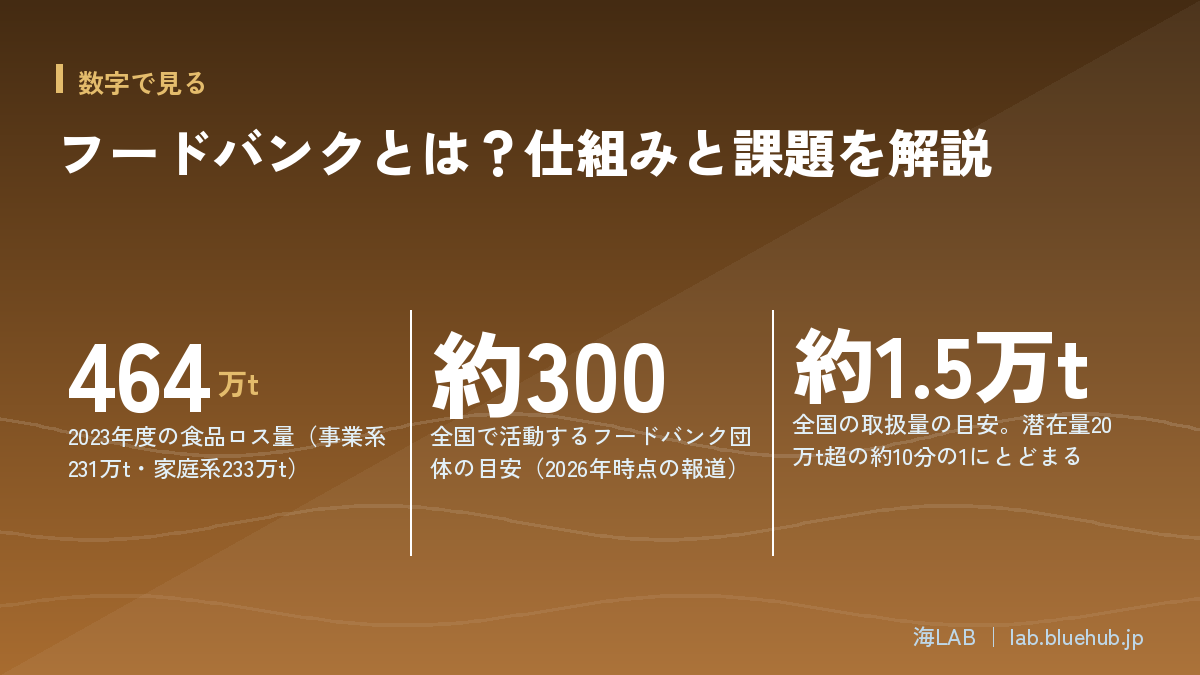
According to the Consumer Affairs Agency, food loss in FY2023 was 4.64 million tonnes (2.31 Mt business, 2.33 Mt household), the lowest since estimates began. Even so, that is about 37 kg per person per year—roughly one rice ball thrown away every day.
This article uses public sources to explain the difference between food banks and food drives, the flow from donation to distribution, hygiene and liability issues in the field, the 2024 guideline and the 2026 certification system, and the connection to seafood.
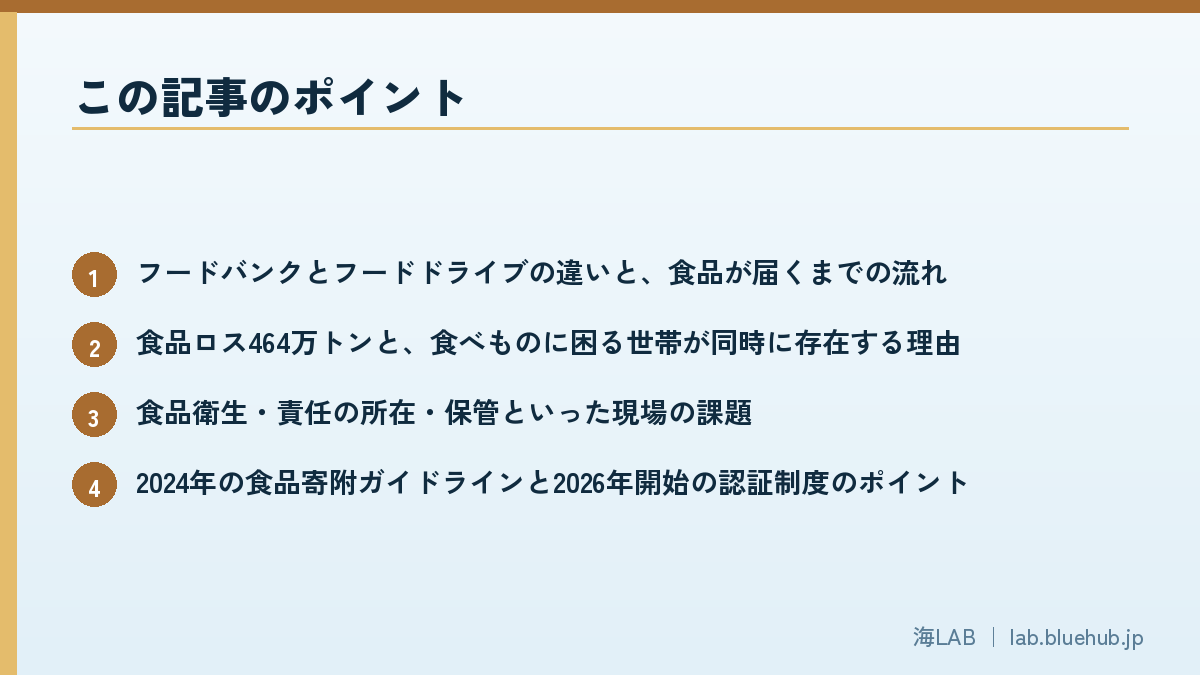
What you will learn
- The difference between food banks and food drives, and how food reaches people
- Why 4.64 million tonnes of food loss and households lacking food coexist
- Field challenges: food hygiene, liability and storage
- Key points of the 2024 Food Donation Guideline and the certification system starting in 2026
- How seafood (frozen fish, canned goods, processed products) is donated and its link to the ocean
- Ways individuals and companies can get involved starting today
What Is a Food Bank? Linking Food Loss and Support
Definition and Role
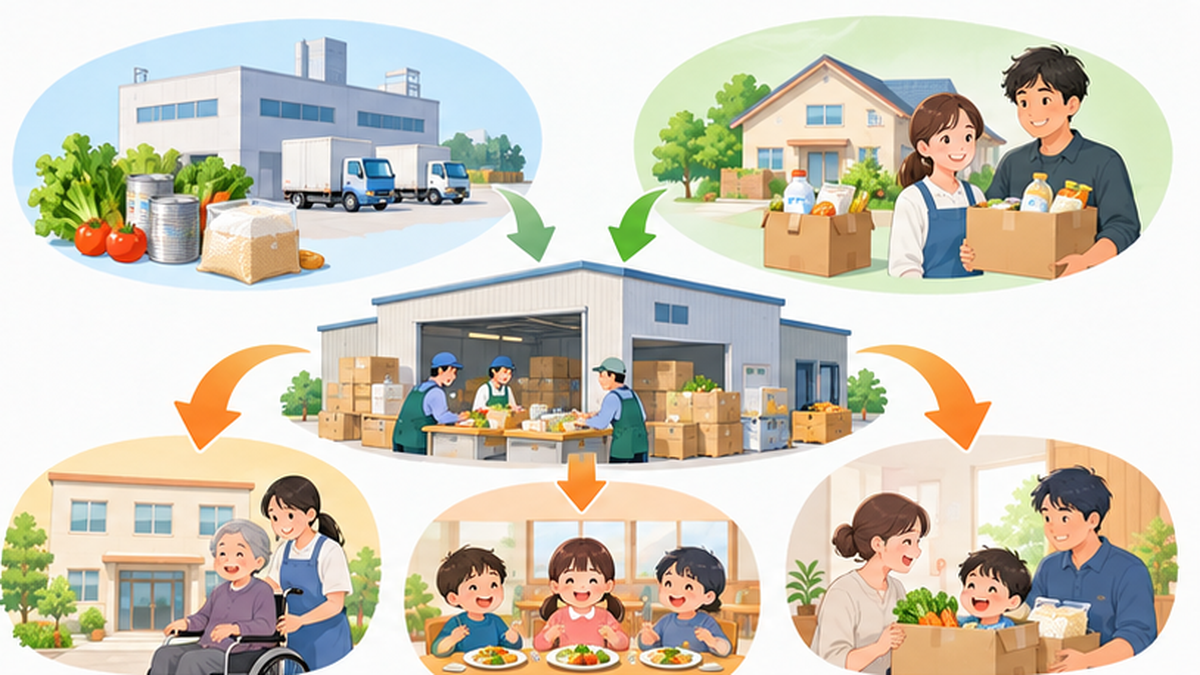
A food bank is an activity—or an organization carrying it out—that receives donations from food businesses and farms of food that cannot be sold for reasons such as non-standard size, packaging defects, excess stock or approaching best-before dates, even though the quality is fine, and provides it free to welfare facilities, children's cafeterias and households in need. The Ministry of Agriculture, Forestry and Fisheries (MAFF) regards this as an effective way to reduce food loss and continues to support it.
Many groups are run by NPOs, general incorporated associations or social welfare councils, and a few staff and volunteers handle warehouse management, sorting and delivery. Because they handle food, knowledge of hygiene and inventory control is essential.
Difference from Food Drives
A food drive, which has a similar name, is an “activity or event”in which people bring unopened surplus food from home or work and donate it to local food banks or children's cafeterias. A food bank, by contrast, is an “organization or system”that stores, sorts and delivers the collected food. In short, a food drive is one way to collect food, and a food bank is where it goes.
| Item | Food bank | Food drive |
|---|---|---|
| Nature | An organization/system that accepts, stores and distributes food | An activity/event to bring in and collect food |
| Main donors | Food makers, wholesalers, retailers, farmers, individuals | Households, schools, workplaces, local residents |
| Main recipients | Welfare facilities, children's cafeterias, households in need | Local food banks, children's cafeterias, etc. |
| Required setup | Warehouse, hygiene control, delivery, records | Collection boxes, reception, coordination with recipients |
Why It Matters Now
Amid rising prices and more households in hardship, the need for food assistance is growing. In a survey by the National Food Bank Promotion Council in September 2023 (35 groups responded), 77% said requests for help from households in need had increased, and 31% said donated food had decreased. Many groups see demand rising while supply fails to keep up.
Food Loss in Japan: Where Do 4.64 Million Tonnes Come From?
Business and Household: Roughly Half and Half
The Consumer Affairs Agency reported that food loss in FY2023 was 4.64 million tonnes, down from 4.72 million the previous year: 2.31 Mt from business and 2.33 Mt from households. Ministry of the Environment materials break the business share down into about 1.08 Mt from food manufacturing, 0.66 Mt from food service, 0.48 Mt from food retail and 0.09 Mt from food wholesale.
- Total: 4.64 Mt (previous year 4.72 Mt)
- Business: 2.31 Mt (manufacturing, food service, retail, wholesale)
- Household: 2.33 Mt (leftovers, direct disposal, excess removal)
- The FY2024 estimate has been published as 4.61 Mt (business 2.37 Mt, household 2.24 Mt)
Reduction targets
- By FY2030 the government aims for a 60% cut in business food loss and a 50% cut in household food loss compared with FY2000.
- As of FY2023, reductions were about 57.8% for business and 46.1% for households.
Food Banks Can Only Accept Food That Is Still Edible
Much food loss, such as kitchen scraps and leftovers, cannot be donated. Food banks mainly target unopened, quality-maintained food arising in the distribution stage. As a result, it has been pointed out that the national volume handled is about 15,000 tonnes—roughly one-tenth of the potential (said to exceed 200,000 tonnes). Put differently, a lot of donatable food is still sitting idle.
For the reality of household food loss, see The Reality of 2.36 Million Tonnes of Household Food Loss a Year; for how to think about best-before dates, see Best-Before Dates and the One-Third Rulefor details.
From Donation to Distribution: How Food Banks Work
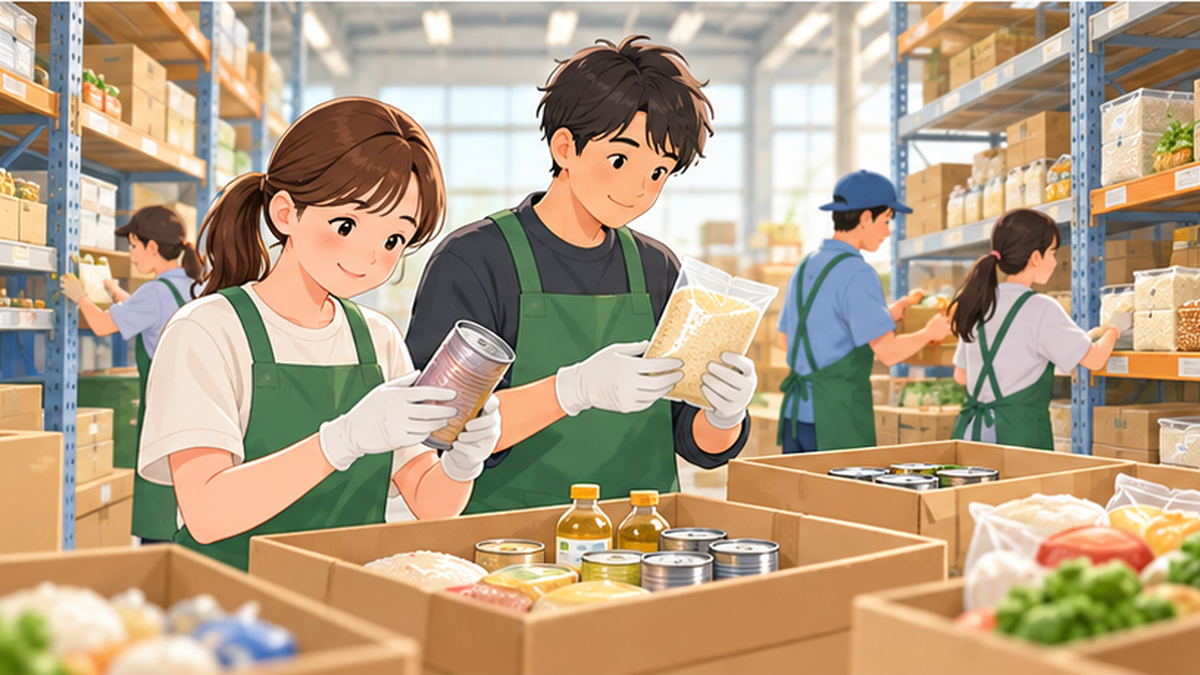
Step 1: Accepting Donations
Food makers, retailers and farmers contact a group about food they cannot sell. The group checks items, quantity, best-before date, storage temperature and allergen labeling, and decides whether to accept. Typically the business and the group agree in writing and set rules such as a ban on resale and handling procedures.
Step 2: Inspection, Sorting and Storage
Received food is checked for packaging damage, labeling, dates and temperature control, then sorted into ambient, chilled and frozen goods and stored in suitable conditions. These records become the basis for traceability if a problem arises later.
- Donation offer and decision on acceptance
- Inspection (labeling, dates, packaging, temperature)
- Sorting and storage (ambient, chilled, frozen)
- Matching to demand
- Delivery or hand-over and keeping distribution records
Step 3: Matching with Recipients
Recipients include welfare facilities such as children's homes and elder-care facilities, children's cafeterias, households in need and disaster shelters. Matching what is wanted with what is surplus is among the most labor-intensive parts of operations, and each group coordinates by LINE, dedicated apps or phone.
Key point
Food banks receive food that is safe to eat but cannot be sold. Checking quality and keeping records build trust on both the donating and receiving sides.
Challenges in the Field: Hygiene, Liability and Operations
Hygiene Control and Fear of Accidents
Even when food is handled free of charge, the risk of food poisoning or allergy accidents is never zero. There are many hard calls: food near its best-before date, temperature control of chilled and frozen goods, items whose labels have peeled off. For donating companies, “who is responsible if an accident happens?” is a major worry and has been one reason for hesitating to donate.
Liability and Insurance
To make food donation smoother, a public-private council on food donation was set up in April 2024, and along with the guideline, an insurance scheme that parties to food donation can join easily was also listed for study. Clarifying where responsibility lies and preparing compensation for emergencies is the key to increasing donations.
What hesitating companies say
- Unclear who is responsible if an accident occurs
- Tracking and record-keeping are burdensome
- Hard to judge the hygiene level of the receiving group
Shortages of Warehouses, Staff and Funds
Many groups are small and lack sufficient refrigeration and freezing equipment, delivery means and dedicated staff. Even if donated food is free, storage and transport cost electricity, vehicles and labor. The weak operating base is part of why volumes stay at about one-tenth of the potential.
| Challenge | Example | Direction of response |
|---|---|---|
| Hygiene and quality | Temperature control, date judgment, labeling defects | Standardized inspection criteria, records and training |
| Liability and compensation | Worry about who is responsible in an accident | Guidelines and insurance |
| Operating base | Shortage of warehouses, vehicles, staff and funds | Certification, public support, corporate partnerships |
| Matching | Mismatch of demand and supply | Information sharing, wide-area cooperation |
Building the Framework: Guideline, Certification and Tax
Food Donation Guideline (Published December 2024)
To raise the social credibility of food donation and encourage it, the public-private council drew up the “Food Donation Guideline,” published on December 25, 2024 (Reiwa 6). MAFF says the content of the earlier manual is basically included in the guideline and withdrew the old manual on February 5, 2025. The Ministry of the Environment's guide to running food drives was also revised following the guideline.
Food Bank Certification (Started April 2026)
A system to certify food banks that meet hygiene and other standards began operating on April 1, 2026. It makes it easier for donating companies to judge “we can entrust food to this group with confidence,” and gives groups a way to show their operating standard. Certification is not a precondition for activity, and compliance with the guideline is not a requirement for being listed in MAFF's information.
Tax Treatment
When a company provides food, if certain requirements are met—such as it being part of disposal under internal rules and an agreement with the food bank setting handling rules like a ban on resale—it is said not to count as a donation for tax purposes and can be treated as a disposal loss. Check MAFF and National Tax Agency materials for details.

Timeline
- April 2024: Public-private council on food donation established
- December 25, 2024: Food Donation Guideline published
- February 5, 2025: Old manual withdrawn
- April 1, 2026: Food bank certification begins operating
Balancing Loss Reduction and Support for People in Need
The Two Goals Are Not the Same
Food banks have two faces: reducing food loss and providing livelihood support. However, food donated by companies tends to be uneven, and rice, canned goods and infant food that households in need truly require are not always collected in sufficient quantity. If the only aim is to cut loss, it can drift away from recipients' nutritional needs.
Support for Children and Families
The National Food Bank Promotion Council's “6th Food Bank Children Support National Project” (December 2023–January 2024) involved 39 groups and reportedly supported 38,317 households. In one example of a group delivering food to children's cafeterias, the volume rose about 2.3 times, from 180 tonnes in 2022 to 411 tonnes in 2023.
Points to note
- Consideration is needed for the psychological resistance (stigma) of receiving help.
- Donated food alone leads to unbalanced nutrition, so cooperation with public welfare programs and consultation desks is essential.
- Delivery should protect recipients' dignity rather than treating food as leftovers.
Cooperation with Government and Social Welfare
Efforts are spreading in which groups, when handing over food, also point people to livelihood consultation and employment support desks. Food is the entry point to support, and it is important to design it to lead to fundamental stability in daily life.
Seafood and Food Banks: Using Marine Food Loss
Examples of Donated Seafood
Because seafood loses freshness quickly, food banks mainly handle highly storable processed goods such as frozen fish, canned goods, retort pouches, dried fish and fish paste products. Fillets that lose shape during processing, non-standard sizes and stock left over from packaging changes—items with no quality problem—go to donation.
Synergy with Underused and Non-standard Fish
Underused and low-use fish that rarely reach the market are also put to use through freezing and processing, in forms such as donations and school meals. For details, see How Using Underused Fish Changes the Table and Fisheries and Reducing Seafood Food Lossfor more.
Why Reducing Environmental Burden on the Ocean Matters
Food loss emits greenhouse gases at every stage of production, transport and disposal, and an explanatory article estimates that Japan's food-loss-related emissions are about 10.5 million tonnes of CO2 equivalent a year. Eating seafood instead of discarding it also avoids wasting the resources and energy spent on catching or farming it, and is a step toward protecting ocean resources.
| Form of seafood | Ease of donation | Points to watch |
|---|---|---|
| Canned and retort | High | Check best-before date and can damage |
| Frozen fish and frozen processed goods | Medium | Manage freezers and thaw history |
| Dried fish and fish paste products | Medium | Refrigeration, salt content, allergen labeling |
| Fresh fish | Low | Freshness declines quickly; basically difficult |
What We Can Do: Roles for Individuals, Companies and Communities
Individuals: Join a Food Drive
You can bring unopened surplus food from home to food drives run by municipalities, schools, supermarkets and companies. Typical conditions are that at least two months remain before the best-before date, the food can be stored at room temperature, and it is unopened and undamaged. Conditions differ by organizer, so check in advance.
- Choose unopened food with plenty of time left before the best-before date
- Shelf-stable items such as rice, canned goods, dried noodles, seasonings and retort foods are preferred
- Check acceptance dates, items and date conditions with the organizer
- Wanted items and unaccepted items differ by group
Companies: Set Up a Donation Process
Food businesses can start donating more easily by taking stock of food slated for disposal and preparing hand-over procedures and agreements in line with the guideline. Choosing a certified group also offers reassurance.
Communities: Support the Groups
Beyond food, offering warehouse space, lending vehicles, volunteering and cash donations all strengthen these groups. For loss countermeasures at convenience stores and supermarkets, see The Front Line of Convenience Store Food Lossas well.
Three actions you can take today
- Check your fridge and pantry for unopened food you cannot use up
- Look up nearby food drive locations on your municipality's website
- Check your stock before shopping to avoid overbuying
Summary
Food banks link food loss and livelihood support. While food loss is 4.64 million tonnes, the volume handled is only about one-tenth of the potential. As the guideline and certification system raise credibility, involvement by individuals and companies in sustainable ways helps protect food and ocean resources.
References and Sources
- Consumer Affairs Agency: Estimated food loss in Japan (FY2023) – Food loss of 4.64 Mt, business/household breakdown
- MAFF: Food donation (food banks) – Food Donation Guideline, withdrawal of old manual, tax, regional efforts
- MAFF: Food loss and food recycling – Overview page of food loss reduction measures
- Consumer Affairs Agency: Food loss reduction efforts – Public-private council on food donation, Act on Promotion of Food Loss Reduction
- Ministry of the Environment: Food loss portal – Food loss by industry, guide to running food drives
- Osaka Prefecture: About food bank activities – Guideline publication date, background to withdrawal of old manual
- nippon.com: Food loss in FY2023 at 4.64 Mt, a new low – About 37 kg per person; estimates of economic loss and greenhouse gases
* Arranged in order of reliability: government and academic institutions > peer-reviewed papers > specialist bodies > reliable media