Yogurt that quietly passed its best-before date at the back of the fridge, dinner leftovers you couldn't finish, vegetable peels cut a little too thick—each feels like "just a little," but added up across Japan, households alone throw away about 2.36 million tonnes of food every year. That is exactly half of the nation's roughly 4.72 million tonnes of total food loss, meaning that each of our own kitchens is, in fact, on the front line of a major environmental challenge.
When people think of food loss, they tend to picture restaurants or unsold supermarket stock, but in Japan the amount coming from households is roughly the same scale as the amount coming from business activities. What's more, household food loss is an area where a little ingenuity and knowledge can reliably cut the numbers down. This article carefully unpacks the breakdown and three main causes of household food loss using official data from Japan's Ministry of the Environment and other agencies.
And true to the spirit of Umi Lab, an ocean media outlet, we'll connect the dots between throwing away food and ocean issues such as sea level rise, rising sea temperatures, and coastal red tides and low-oxygen waters. At the end, we've put together concrete steps you can start applying from today's shopping trip. Cutting down on waste turns out to be an act of protecting the ocean too—let's explore that surprising connection together.
What you'll learn in this article
- Japanese households generate about 2.36 million tonnes of food loss a year, nearly half of the country's total food loss
- The three main causes are "plate waste," "direct disposal," and "excessive trimming," with direct disposal and plate waste each accounting for about 43%
- Incinerating and landfilling discarded food generates greenhouse gases that affect the ocean through rising sea levels and sea temperatures
- Excess food production also burdens coastal waters through nitrogen and phosphorus runoff, contributing to red tides and low-oxygen conditions
- Checking your fridge inventory, using up what you have, and correctly understanding date labels can substantially cut household food loss
- The government has set a target to halve household food loss to about 2.16 million tonnes by FY2030, compared with FY2000 levels
What exactly is "household food loss"?
Food loss refers to food that is still edible but ends up being thrown away. It does not include food that has spoiled and become inedible, or parts that are never eaten in the first place, such as fish bones or vegetable cores (the "inedible portion"). It strictly covers food that "could have been eaten, but wasn't."
Japan's food loss is broadly divided into two categories based on where it occurs. One is business-sector food loss, which comes from restaurants, supermarkets, food factories, and the like; the other is household food loss, which comes from ordinary homes. According to estimates for fiscal year 2022 (Reiwa 4), of Japan's roughly 4.72 million tonnes of total food loss, about 2.36 million tonnes came from businesses and about 2.36 million tonnes from households—almost an even split.
How does it differ from "business-sector" food loss?
Business-sector food loss arises from within the flow of commerce—off-spec products, unsold goods, offcuts from manufacturing processes, and leftovers at restaurants. Companies are subject to regulations such as the Food Recycling Act, and reduction systems have become relatively well established. Household food loss, on the other hand, arises little by little from countless individual kitchens, making it difficult to manage uniformly through legislation; ultimately, it depends on the awareness and behavior of us as individual consumers.
That is precisely why household food loss is often thought to be "hard to reduce." But flip that around, and it's also an area that can be reliably reduced without cutting back on eating out or installing special equipment—simply through small daily habits in shopping and cooking. Household food loss is the kind of loss where individual effort translates directly into the numbers.
Another point worth noting is that household food loss only counts the edible portion of food. Parts that people never eat in the first place—fish bones, eggshells, vegetable cores and seeds—are technically "food waste" but are not counted as food loss. In other words, the figure of 2.36 million tonnes is a tally of only the food that "could have been eaten if we'd wanted to, but wasn't"—in a sense, the total sum of "what a waste" moments in our daily lives. Keeping this premise in mind makes the meaning of the breakdown that follows much clearer.

Why household food loss is getting so much attention
Based on the Food Loss Reduction Promotion Act (enacted in 2019), the government has set concrete reduction targets not only for the business sector but also for households. Using the roughly 4.33 million tonnes recorded in FY2000 as a baseline, the target is to halve household food loss to about 2.16 million tonnes by FY2030. The reason this is being promoted as a national movement, calling on households directly, is simply that without reducing household food loss, achieving the nationwide target would be difficult.
Key points of this article
- Japan's food loss is roughly split evenly between households and businesses, with households accounting for about 2.36 million tonnes a year
- The three main causes of household food loss are "plate waste," "direct disposal," and "excessive trimming"
- Food loss is also connected to ocean conditions through warming and eutrophication
- The government's target is to halve household food loss by FY2030 compared with FY2000 (to about 2.16 million tonnes)
Food loss is not unrelated to learning about the ocean environment, either. As we'll cover later, producing, transporting, and disposing of food all consume large amounts of energy and emit greenhouse gases. Rising sea temperatures and their impact on fisheries are covered in detail in our article on rising sea temperatures and their impact on fisheries. First, let's take a numerical look at what's "inside" household food loss.
Japan's household food loss, by the numbers
Many people have a sense that waste is "such a shame," but surprisingly few know just how large that adds up to be nationwide. Here, we'll look at Japan's household food loss in numbers, based on estimates published annually by the Ministry of the Environment and the Ministry of Agriculture, Forestry and Fisheries.
About 4.72 million tonnes nationwide, half from households
Japan's food loss for fiscal year 2022 (Reiwa 4) was estimated at about 4.72 million tonnes nationwide. Of this, roughly 2.36 million tonnes came from businesses and roughly 2.36 million tonnes from households—an exact 50-50 split. The following year, FY2023 (Reiwa 5), the total fell further to about 4.64 million tonnes, the lowest since statistics began, but an enormous amount of food is still being discarded.
A figure of 4.72 million tonnes is too large to grasp intuitively. Converted per person, it comes to about 103 grams a day, roughly the size of one convenience-store rice ball. In other words, on average, every person in Japan effectively throws away one rice ball's worth of food every single day without eating it. Over a year, that's about 38 kilograms per person, or nearly 150 kilograms of food turned into waste for a family of four.

Looking at the trend, it is indeed decreasing
There is also good news. Compared with estimates from around fiscal year 2012 (Heisei 24), when statistics became more rigorous, Japan's food loss has been steadily trending downward. Business-sector food loss, where corporate reduction efforts have progressed, has already achieved the national target ahead of schedule, and household figures have gradually come down as well. That said, the household figure is declining more slowly than the business-sector figure, and there is still some distance to go before reaching the target of a 50% reduction.
| Category | FY2022 volume | Share of national total | FY2030 target |
|---|---|---|---|
| Total national food loss | About 4.72 million tonnes | 100% | ― |
| Business-sector food loss | About 2.36 million tonnes | About 50% | 50% reduction from FY2000 |
| Household food loss | About 2.36 million tonnes | About 50% | About 2.16 million tonnes (50% reduction from FY2000) |
| Per person (per day) | About 103g | ― | ― |
The reason household food loss reduction is lagging is that its sources are scattered across households nationwide, making it impossible to address with a single blanket measure the way businesses can. That is exactly why the accumulation of small actions in each individual home is the key to moving the overall numbers. The next section looks at exactly what kinds of "ways of discarding" are behind this household food loss.
It's not just "food" that's being thrown away
When considering the true cost of food loss, we must not forget the perspective that "throwing away food also means throwing away all the resources spent on it." Before a single ingredient reaches the dinner table, it goes through a long journey: seeds are sown, crops grown and harvested, processed, packaged, and transported by truck or ship before being placed on store shelves. All the water, fuel, and human labor invested throughout that entire process go to waste the moment the food is finally discarded.
The Consumer Affairs Agency, the Ministry of Agriculture, Forestry and Fisheries, and the Ministry of the Environment have also estimated the economic losses and greenhouse gas emissions associated with food loss. Not only is the monetary value of discarded food lost, but local government tax revenue is also spent on processing it (collection, transport, incineration), meaning food loss is a loss not just for individual households but for society as a whole. Recognizing that it's not "just leftovers" but resources, money, and the environment all being thrown away together is the first step toward reduction.
Where do these numbers come from?
Food loss volumes are estimated and published each year by the Ministry of the Environment and the Ministry of Agriculture, Forestry and Fisheries, based on waste composition surveys and statistics from local governments nationwide. They cannot be measured to the exact tonne and remain "estimates," but they are the most reliable official data available for understanding year-to-year trends and breakdowns.
Breaking down the three main causes of household food loss
Food loss from households is broadly classified into three types based on how it occurs: plate waste, direct disposal, and excessive trimming—these are what's known as the "three main causes." Looking at the breakdown of the roughly 2.36 million tonnes of household food loss in FY2022, the weight of each becomes clear.
| Cause | Description | FY2022 volume | Share |
|---|---|---|---|
| Direct disposal | Food discarded untouched | About 1.02 million tonnes | About 43% |
| Plate waste | Food served at the table but not finished and thrown away | About 1.00 million tonnes | About 43% |
| Excessive trimming | Edible parts removed along with peels, etc. | About 330,000 tonnes | About 14% |
① Plate waste — caused by over-cooking and over-serving
Plate waste is food loss that occurs when dishes served at the table cannot be finished and are thrown away; in FY2022 it amounted to about 1.00 million tonnes, or about 43% of household food loss. Most of the cause comes down to "cooking too much" and "serving too much." Cooking a large batch to use up ingredients bought in bulk during a sale, or making more portions than needed without accounting for family members' appetite or schedule, inevitably leaves leftovers.
In a demonstration project the Consumer Affairs Agency conducted in Tokushima Prefecture, "plate waste" was the most common reason given for discarding still-edible food, at 57%, followed by "it had spoiled" at 23% and "it was past its date" at 11%. To reduce plate waste, it helps to cook only what can be eaten, and to build a habit of "remaking" leftovers into a new dish the next day so nothing goes to waste.
② Direct disposal — food you forgot you even bought
Direct disposal refers to food thrown away completely untouched, still unopened. In FY2022 it was about 1.02 million tonnes, the largest of the three main causes, accounting for about 43% of household food loss. A seasoning forgotten at the back of the fridge, ingredients bought in bulk and never used, canned goods or retort pouches thrown away unopened after their best-before date passed—all of these fall under direct disposal.
Direct disposal is common because, at its root, it's a management problem: "forgetting that you even bought it in the first place." Conversely, this means there is significant room to reduce it simply by making your inventory visible and staying mindful of best-before dates. Among the three main causes, direct disposal is the one where a bit of ingenuity can be expected to have the biggest reduction effect.

③ Excessive trimming — throwing away even the edible parts
Excessive trimming is food loss that occurs when edible parts are thrown away together with inedible parts during cooking. In FY2022 it was about 330,000 tonnes, or about 14% of household food loss. Peeling daikon radish or carrots too thickly, discarding cabbage's outer leaves or broccoli stems, or removing more apple peel than necessary—these are all examples of this kind of "wasteful cutting" adding up.
Although excessive trimming is the smallest of the three main causes in volume, it's actually significant nutritionally as well. The area just beneath vegetable skins is known to be rich in dietary fiber and vitamins, so cooking vegetables with the skin on helps both reduce food loss and improve nutrient intake. Using a peeler to peel thinly, or using peels in dishes like kinpira or dashi stock, are simple tweaks that reliably reduce this cause.
An easy way to remember the three main causes
- Plate waste = served at the table but couldn't finish it
- Direct disposal = thrown away untouched, still unopened
- Excessive trimming = cut away even the parts that could be eaten
Each of these three occurs at a different "timing." Direct disposal happens at the shopping and storage stage, excessive trimming at the cooking stage, and plate waste at the mealtime stage. In other words, opportunities to reduce food loss are hiding in every stage of eating life—buying, storing, cooking, and eating.
Where to focus, based on the breakdown
The proportions of the three main causes serve as a map for thinking through reduction measures. The largest, direct disposal (about 43%), is caused by "buying too much" and "poor management," so reviewing your shopping habits and refrigerator is effective. Equally large, plate waste (about 43%), is caused by "cooking too much," so adjusting how much you cook and using up leftovers is effective. Excessive trimming (about 14%), while smaller in volume, is an improvement that's "within easy reach"—it can be reliably reduced just by changing how you use a knife.
What matters is the fact that the two biggest causes—direct disposal and plate waste—can both be prevented by decisions made "before eating." Most of this food isn't being thrown away because it spoiled beyond saving; rather, much of it can be prevented simply by slightly adjusting "how much you buy," "how much you cook," and "how you store things." In other words, household food loss is not a matter of self-restraint, but a matter of planning.
Why food loss happens in households in the first place
Now that we understand the three main causes—"what kind of discarding"—the next thing to consider is the background of "why it happens this way." Food loss is by no means caused only by indifference or wastefulness. In fact, the busyness of modern life and a genuine concern for food safety are, without anyone intending it, contributing to food loss.
The pitfall of bulk buying and large-size packs
As dual-income households have increased, more families buy in bulk to reduce the number of shopping trips. Sale items and large-size packs look like a bargain, but if you can't use them all, you end up throwing them away anyway, losing out both in money and in waste. Buying more than you need "because it's cheap" is a breeding ground for direct disposal.
Confusing best-before dates with use-by dates
One major cause of food loss is confusing best-before dates with use-by dates. The use-by date ("shohi kigen") indicates "the date up to which it can be safely eaten," and is shown on perishable foods such as boxed lunches and prepared dishes. The best-before date ("shomi kigen"), on the other hand, indicates "a guideline for when it tastes best," and is shown on foods that keep longer, such as canned goods and snacks. Foods can often still be eaten a little past their best-before date, as long as there is no problem with appearance or smell, but many people mistake this for "the date after which it can no longer be eaten" and throw it away unopened.
The best-before date is "a guideline for tastiness," while the use-by date is "a limit for safety." Understanding this difference alone reveals food that doesn't need to be thrown away.
— Summarized from the Consumer Affairs Agency's "Aim for Zero Food Loss" campaign
Being sensitive about food safety is one of Japan's strengths, but repeatedly throwing food away "just in case" without correctly understanding date labels causes household food loss to balloon. Understanding what the labels actually mean is the easiest step toward reducing food loss without forcing unnecessary self-restraint.

An overstuffed fridge and "invisible inventory"
When you cram a refrigerator full of food, items at the back become invisible, and you tend to forget they exist until they pass their date. A packed fridge also has poorer air circulation, which can cause food to spoil faster. Experts recommend keeping the fridge at about 70% capacity so you can see at a glance what you have and where it is.
In other words, household food loss arises from everyday mental habits—"I didn't notice," "just in case," "because it's a bargain." Since there's no malice involved, much of it can be prevented simply by tweaking your systems and habits a little. In the next section, we'll step away from the kitchen for a moment and consider how this "what a waste" connects to the planet and the ocean.
Seasonal events also breed hidden food loss
Beyond everyday shopping, seasonal events are another scene prone to generating food loss. Ehō-maki sushi rolls, Christmas cakes, New Year's osechi—when the feeling of "let's make a little extra for this special day" builds up, households often end up with more than they can finish. Precisely at these events, calmly estimating how much your family will actually eat is the key to preventing waste.
Food prepared in excess for guests, or plate waste caused by children's picky eating, are also causes of loss unique to households. Food loss born from such "good intentions" or "consideration for others" is hard to blame, but if you stay mindful of quantity and build a habit of following up—freezing or remaking leftovers to make sure they get eaten—you can reduce it without straining yourself.
How food loss affects the ocean and the planet
"Throwing away food" and "the ocean environment" may seem unrelated at first glance. But the two are firmly connected through two pathways: climate change and water quality. As an ocean media outlet, this section carefully traces that connection.
Discarded food generates greenhouse gases
Producing food requires vast amounts of farmland, energy, and water. When food that took so much to produce is thrown away, all the resources and energy spent on producing it go entirely to waste, and on top of that, carbon dioxide is emitted at the stage of incinerating and processing the waste. According to the UN Food and Agriculture Organization (FAO), the greenhouse gases attributable to food discarded worldwide are enormous—if food loss were treated as a single country, it would rank as the world's third-largest emitter, behind only China and the United States.
Furthermore, as buried food waste decomposes in landfills, it generates methane, a gas with a far more powerful greenhouse effect than carbon dioxide. In this way, food loss drives global warming, and that warming, in turn, has serious effects on the ocean. Rising sea temperatures, rising sea levels, and ocean acidification, which progresses as the sea absorbs carbon dioxide—none of these are unrelated to the food loss coming from our own dinner tables.

Rising sea temperatures hit fisheries directly
As sea temperatures rise, fish distribution shifts, and effects appear such as declining catches in waters that used to be productive. The seas around Japan are among the areas where sea temperature is rising particularly fast, and familiar fish such as saury and Japanese flying squid have continued to see poor catches. Greenhouse gas emissions from food loss can, in a roundabout way, end up reducing the very fish that appear on our dinner tables. For more detail, see our article on rising sea temperatures and their impact on fisheries.
Overproduction of food and coastal eutrophication
The other pathway is "water quality." Producing food in excess means spreading that much more fertilizer on farmland, and the nitrogen and phosphorus that go unused flow into rivers and eventually the sea. In coastal waters with excess nutrients, phytoplankton multiply abnormally, causing red tides and eutrophication. When large amounts of plankton die and decompose, oxygen in the water is depleted, sometimes creating expanding low-oxygen zones (dead zones) where marine life cannot survive.
In other words, producing more food than necessary and then throwing it away places a double burden on the ocean—warming it through climate change while simultaneously polluting coastal waters through nutrient runoff. Conversely, reducing household food loss may seem like a roundabout approach, but it reliably connects to protecting the ocean. For a perspective on protecting rich marine ecosystems, also see our article on Japan's marine biodiversity.
Two pathways through which food loss affects the ocean
- Warming pathway: incineration/landfill → greenhouse gases → rising sea temperatures, rising sea levels, ocean acidification
- Water-quality pathway: nitrogen/phosphorus runoff from overproduction → eutrophication, red tides, deoxygenation
The ocean's absorption of carbon is also covered in our article on blue carbon ecosystems. The ocean absorbs an enormous amount of carbon dioxide for us, but that function has its limits, too. That's exactly why reducing emissions at the source—reducing food loss—is a fundamental measure that lightens the burden on the ocean.
Concrete steps to reduce food loss at home, starting today
From here, let's move into practical measures. We've organized effective countermeasures for each of the three main causes along the flow of eating life—"buying," "storing," "cooking," and "eating." None of them require special tools or money, and you can start every one of them with today's shopping trip.
Shopping tips — preventing direct disposal
- Check the contents of your fridge and pantry before shopping, so you know what you already have before you leave home
- Take a photo of the inside of your fridge on your phone before heading to the store, to prevent buying duplicates
- Don't go shopping on an empty stomach (this helps prevent impulse buying)
- Decide what you plan to use and how much before buying, and choose large-size packs only when you know you can use them all
- For items you'll eat right away, get in the habit of "temae-dori"—choosing items with the nearest date from the front of the shelf
"Temae-dori" means choosing items with the nearer date first, for food you plan to eat right away; it also helps reduce disposal at stores (business-sector food loss). It's a two-birds-one-stone habit: it prevents direct disposal at home while also contributing to reducing food loss across society as a whole.
Storage tips — making your inventory visible
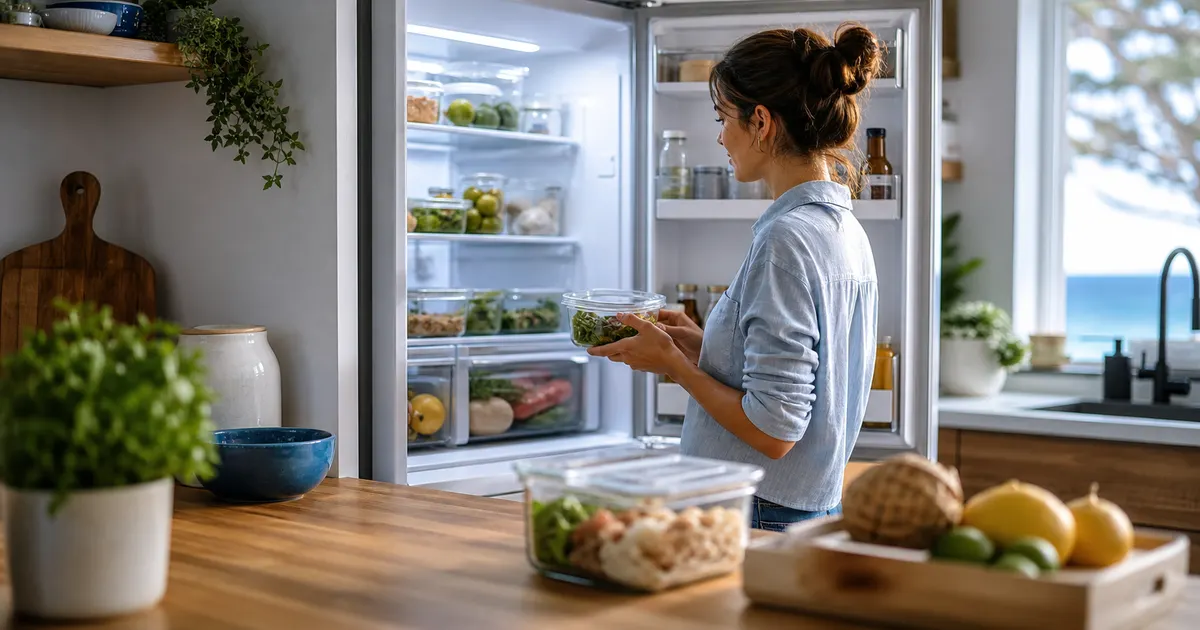
- Keep your fridge at about 70% capacity, so you can see all the way to the back
- Decide a fixed spot for each food category and store items there to "make them visible"
- Group opened items or items nearing their date into a prominent "priority zone"
- Portion out and freeze ingredients you can't use up right away, before they spoil
- Understand the difference between best-before and use-by dates, and don't casually throw things away based on the label alone

Cooking tips — reducing excessive trimming and plate waste
- Peel vegetables thinly with a peeler, and use the peels and cores in dishes like kinpira or dashi stock
- Cook mindful of how much you can actually eat, and only cook in large batches when you intend to prep meals ahead
- Use up leftovers with "remake recipes" that turn them into a different dish the next day
- Freeze vegetable scraps together and use them as ingredients for soups or fried rice
Recording tips — know your own "throwing-away habits"
The Consumer Affairs Agency provides an awareness tool called "Let's Measure It! Household Food Loss," which lets you record when, what, how much, and why you threw something away. When you actually write it down, patterns emerge, such as "I always end up with too much of the same vegetable" or "I throw away more on days I bought in bulk." Reducing food loss starts with knowing your own throwing-away habits.
Three steps you can start today
- Take a photo of your fridge on your phone before shopping (prevents direct disposal)
- Create one "priority zone" in your fridge (prevents forgetting to eat something)
- Make the final call on best-before dates using smell and appearance, not the label alone
These measures both help the environment and save money on groceries. Throwing away about 38 kilograms of food per person a year—nearly 150 kilograms for a family—means throwing away that much grocery money along with it. Cutting down on waste is a choice that's kind to your wallet, too.
Japan in a global context, and future targets
Finally, let's place Japan's food loss in a global context. Food loss is not just a problem for Japan—it's an international issue being tackled on a planetary scale.
Roughly a third of the world's production is lost
According to estimates by the UN Food and Agriculture Organization (FAO), of the food produced for human consumption worldwide, roughly a third—about 1.3 billion tonnes a year—goes uneaten and is lost or wasted. Meanwhile, there are still large numbers of people around the world who cannot get enough food. The fact that countries with surplus food throwing it away and regions suffering from hunger exist simultaneously is a contradiction that has become a major theme for the international community to address.
The SDGs and Japan's reduction targets
The United Nations' Sustainable Development Goals (SDGs) set out, in Target 12.3, to "halve per capita global food waste" by 2030. In line with this, Japan too has set a target under the Food Loss Reduction Promotion Act to halve food loss by FY2030 compared with FY2000 levels. For households specifically, the target is to reduce the roughly 4.33 million tonnes recorded in FY2000 down to about 2.16 million tonnes.
| Item | Details |
|---|---|
| Global food loss | About 1.3 billion tonnes a year (roughly a third of production) |
| International target | SDG Target 12.3 (halve by 2030) |
| Japan's household target | 2.16 million tonnes by FY2030 (50% reduction from FY2000) |
| Current status (FY2022) | About 2.36 million tonnes (households) |
The business sector has already achieved its target ahead of schedule, but the household sector is still holding steady just shy of the 2.16-million-tonne target. Closing that gap is a job not for companies or government, but for each of our own kitchens. Reducing household food loss is also an act of fulfilling an international commitment.

Did you know about "Food Loss Reduction Month"?
In Japan, October is designated by law as "Food Loss Reduction Month," and October 30 as "Food Loss Reduction Day." During this period, local governments and companies across the country run campaigns, which can be a good opportunity to start taking action at home as well.
Conclusion: Cutting down on waste protects the ocean
Japanese households generate about 2.36 million tonnes of food loss a year, accounting for nearly half of the nationwide total. Its breakdown is: "direct disposal," food thrown away untouched, and "plate waste" at the table, each about 43%, and "excessive trimming," cutting away even edible parts, about 14%. None of these come from malice—they arise from the everyday "I didn't notice" and "just in case."
And this food loss, through greenhouse gases from incineration and landfilling, drives rising sea temperatures and rising sea levels, and through nitrogen and phosphorus runoff from overproduction, brings about red tides and low-oxygen waters. The "what a waste" moments in our kitchens really are connected to the ocean. That's exactly why reviewing your fridge, correctly understanding date labels, and using up what you have are each, in their own way, acts of protecting the ocean.
Summary of this article
- Japan's household food loss totals about 2.36 million tonnes a year, nearly half of the national total
- The three main causes are direct disposal (about 43%), plate waste (about 43%), and excessive trimming (about 14%)
- Each person effectively throws away about one rice ball's worth of food (about 103g) per day
- Food loss affects the ocean environment through two pathways: warming and eutrophication
- Checking inventory before shopping, keeping the fridge at 70% capacity, and correctly understanding date labels are effective reduction measures
- The government has set a target to halve household food loss by FY2030 compared with FY2000 (to about 2.16 million tonnes)
If you'd like to learn more about the ocean environment, be sure to check out our articles on rising sea temperatures and their impact on fisheries, red tides and eutrophication, and blue carbon ecosystems. Finishing tonight's dinner is where the effort to hand down a thriving ocean to the future begins.
References and sources
- Ministry of the Environment, Japan – Announcement of estimated food loss volumes in Japan (FY2022)
- Ministry of the Environment, Japan – Announcement of estimated food loss volumes in Japan (FY2023)
- Ministry of Agriculture, Forestry and Fisheries – What is food loss?
- Consumer Affairs Agency – Aim for Zero Food Loss (Let's reduce food loss at home)
- Ministry of the Environment, Japan – Food Loss Portal Site, information for consumers
- Government Public Relations Online – Let's reduce food loss! Steps you can take at home starting today
- Consumer Affairs Agency – Reference materials on food loss reduction
- FAO (Food and Agriculture Organization of the United Nations) – Food Loss and Food Waste
- UNEP (United Nations Environment Programme) – Food Waste Index Report 2024
※ Sorted by reliability: government/academic institutions > peer-reviewed papers > specialized organizations > reputable media