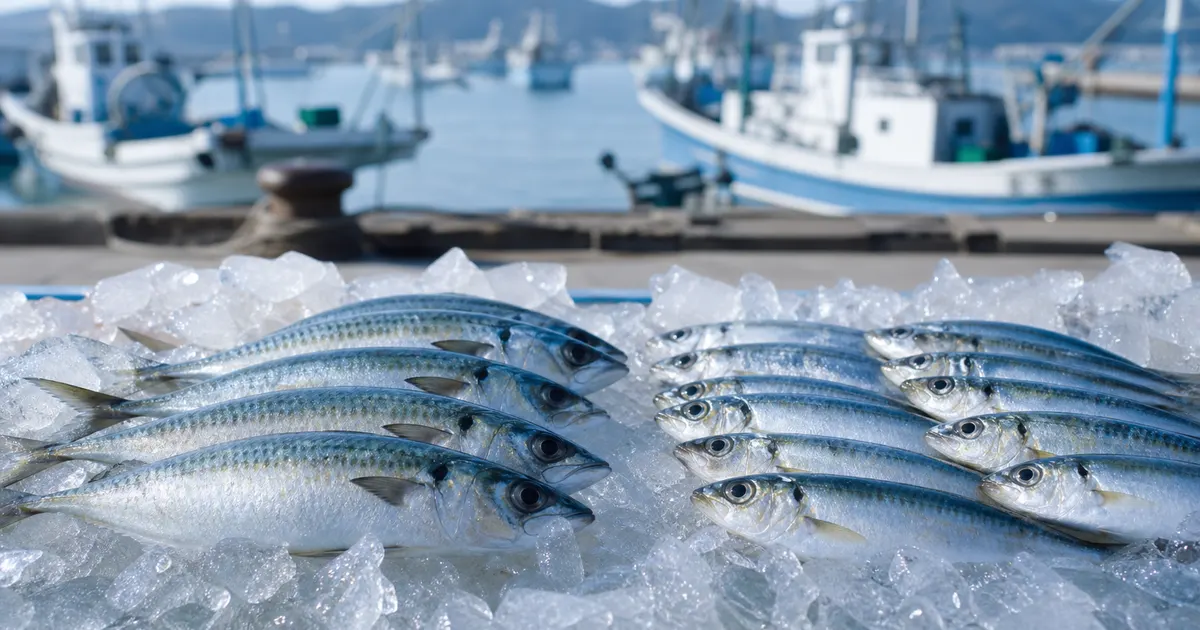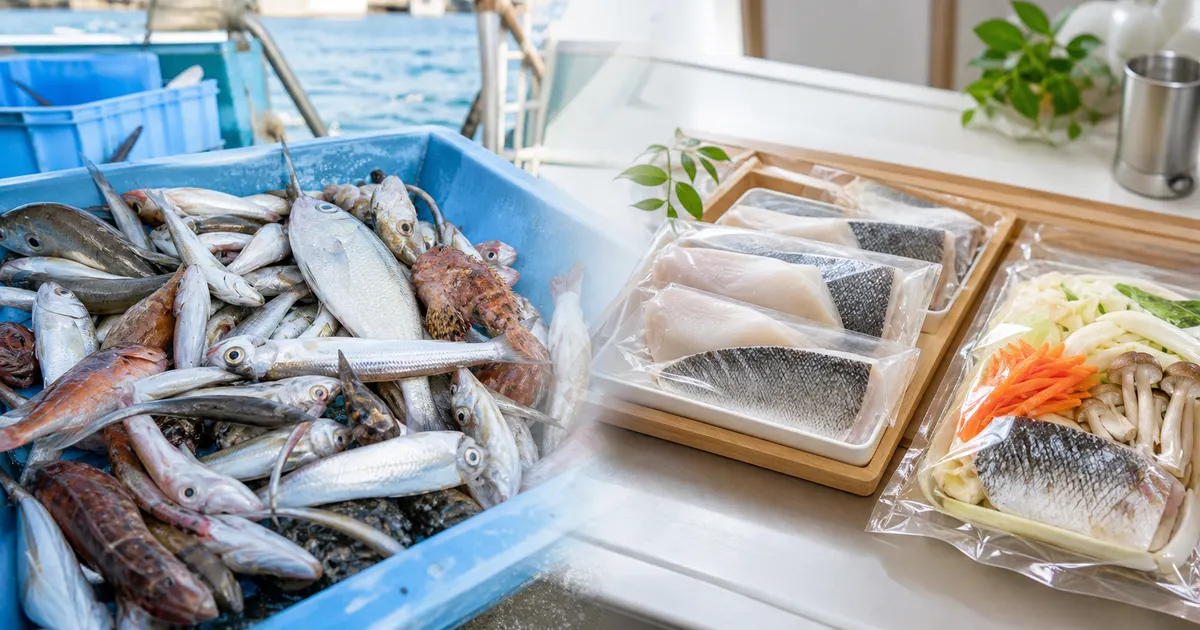
Not every part of a fish becomes a finished product when it's turned into fish paste, canned goods, or sashimi fillets. Skin, bones, organs, heads, and gills — the "fish waste" — are always left over. In Japan alone this amounts to 2.32 million tons a year (MAFF's "FY2022 Food Balance Sheet"), a figure that approaches the 2.59 million tons of seafood we actually eat. Of the 6.54 million tons of seafood supplied for domestic consumption, about 80% goes to food use — meaning nearly all of the remaining inedible portion is discharged as fish waste.
Once seen merely as a source of disposal costs, odor, and hygiene problems, this fish waste is now being reconsidered as a raw material for fishmeal and fish oil, fish silage, biogas, and high-value materials such as collagen and chitin. It's a win-win: lower disposal costs for the seafood processing industry, and resource circulation for the planet. There's also an interesting divergence in priorities between the UN Food and Agriculture Organization (FAO) and the EU's Common Fisheries Policy (CFP).
This article draws on domestic and international examples and academic research to explain where fish waste comes from, how much is generated, and how it is being turned into a resource. We hope it gives readers something to think about the next time they pick up a seafood product at the supermarket.
What you'll learn in this article
- What fish processing waste is, and where it comes from
- The different resource-recovery methods — fishmeal/fish oil, fish silage, biogas — and how they differ
- Examples of converting waste into high-value materials such as collagen and chitin
- How Japanese processing clusters and companies are putting this into practice
- The differing priorities of the FAO and the EU
- What challenges remain on the path to zero waste
What Is Fish Waste? Sources and Scale
"Fish waste" refers collectively to the inedible parts left over when fish and shellfish are processed for food — heads, bones, skin, organs, gills, and the like. Academically it is called "fish processing residue," a term also used in statistics and reports by Japan's Fisheries Agency and research institutions. According to research by Haruko Yamashita of Daito Bunka University (Regional Fisheries Research, Vol. 64, No. 2, 2024), about 80% of Japan's 6.54 million tons of seafood supplied for domestic consumption (2022) goes to food use, but because the inedible portion becomes fish waste, 2.32 million tons — 35% of the domestic supply and 44% of edible fish and shellfish — is discharged as fish waste.
The scale becomes clearer when compared with "net food supply" — the amount ultimately consumed as food by people — which stood at 2.59 million tons in the same year. The volume of fish waste generated is nearly equal to the volume of seafood we actually eat. In other words, for roughly every fish we "eat," a comparable amount of inedible material is generated at the processing stage.
Two sources: "factory waste" and "urban waste"
The nature of fish waste depends on where it is generated. "Factory waste" from seafood processing clusters that concentrate on a single species — such as bonito and tuna processing in Yaizu and Shimizu in Shizuoka Prefecture, or Makurazaki in Kagoshima Prefecture — has a consistent volume and composition and high freshness, making it easy to turn into good-quality feed or raw material. "Urban waste," generated at wholesale markets, retailers, and restaurants in cities, is collected and used by recovery businesses, but tends to be less consistent in freshness and composition than factory waste.
Shells count as fish waste too, in the broad sense
"Fish waste" tends to bring to mind parts of fish, but shells such as scallop and oyster shells are handled within the same framework. In Japan these two are the main types, and most are generated at processing sites near the production area. Scallop shells are used as seeding material for oyster farming, and oyster shells are used as artificial reefs under the product name "Shell Nurse," with both also serving as raw material for calcium supplements and soil conditioners. In Japan, fish waste is generally reused in some form and disposal is kept to a minimum — the exception is fish waste from households, which becomes waste unless composted by the household itself.

How "food loss" differs from "fish waste"
"Food loss" (edible food that is discarded), a topic we've covered many times on this site, is often confused with "fish waste," the subject of this article, but the two are distinct concepts. Fish waste refers to inedible parts — heads, bones, organs — that people generally don't eat in the first place. Food loss, by contrast, refers to edible parts that are discarded. According to Yamashita (2024), food loss in Japan is estimated at 4% of edible fish and shellfish, while the FAO estimates global seafood food loss at under 50% — a considerable gap.
In terms of sheer volume, fish waste (a processing by-product) is thought to exceed food loss. In other words, tackling seafood waste requires looking not only at reducing food loss — "edible food that gets thrown away" — but also at how to make effective use of fish waste, the portion that was never meant to be eaten in the first place. That second challenge is exactly what this article addresses.
Fishmeal and Fish Oil: The Most Established Route
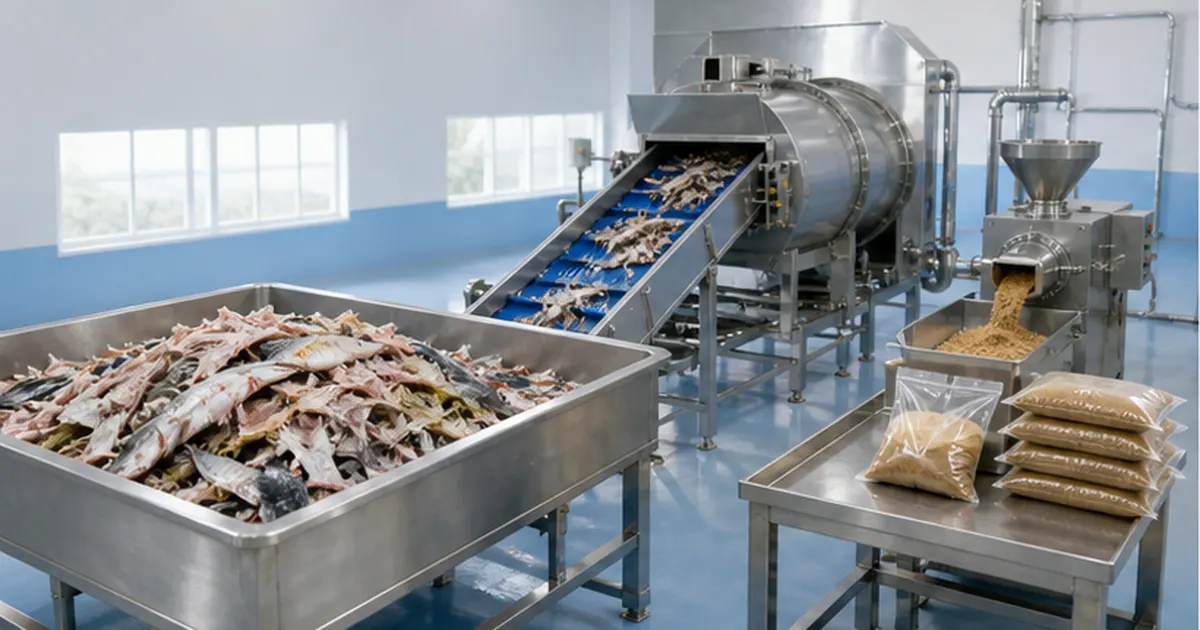
The longest-established and most versatile way of putting fish waste to use is processing it into fishmeal and fish oil. Fishmeal, made by drying and grinding fish waste, is used across a wide range of applications depending on quality — from premium feed for farmed fish to livestock feed and agricultural fertilizer. Feed and fertilizer quality varies by grade and composition, with the highest grade going to feed for farmed fish. Producing high-quality feed or fertilizer from fish waste requires high freshness and consistent composition — conditions that "factory waste," mentioned above, is well suited to meet.
The Fisheries Agency's national directory of fishmeal producers lists 67 companies nationwide (as of 2010). As an example of a company that manufactures fishmeal from seafood processing residue such as fish-paste factory waste, Sanki Feed Industry (Miyazaki Prefecture) handles everything from collecting and transporting fish waste from processing plants through to manufacturing and finished products. From the standpoint of reducing pressure on wild fish stocks, this kind of fishmeal production "made from fish waste" carries a different significance than fishmeal production made directly from whole fish.
Learn moreSanki Feed Industry Co., Ltd.A feed manufacturer handling everything from collecting seafood processing residue to producing fishmeal and fish oil🔗 sankishiryou.co.jpFeed and fertilizer have quality grades
Feed and fertilizer made from fish waste is graded by quality and composition. The highest grade becomes feed for farmed fish, the next grade becomes livestock feed, and the grade requiring the least quality goes to agricultural fertilizer. This hierarchy is determined by how well freshness and consistent composition can be maintained. "Factory waste," with its high freshness and stable composition, tends toward the higher grades, while "urban waste," with less stable freshness and composition, tends toward the lower grades.
- Top grade: feed for farmed fish (requires high freshness and stable composition)
- Mid grade: livestock feed (pigs, poultry, etc.)
- Lower grade: agricultural fertilizer (including use as a soil conditioner)
Fishmeal production has energy costs too
Fishmeal production, however, is an equipment-intensive industry requiring power for its drying and grinding processes, and continuous combustion generates greenhouse gases. Compared with feeding fish waste directly into aquaculture ponds, or with fish silage as discussed below, fishmeal is not necessarily superior in terms of environmental impact. Feeding fish waste directly to farmed fish also has its own drawbacks — leftover feed accumulates as sludge on the pond floor and nutritional content is hard to manage — so it's not possible to say definitively which method should be prioritized.
Fishmeal isn't the only processing option
Besides fishmeal, options for processing fish waste include "fish silage," "conversion to food," and "use without processing." Each requires different equipment and effort and yields different added value, so the optimal choice depends on the scale and location of the processing plant and the target market. The following sections look at each of these methods in turn.
Fish Silage: Fermentation Without Equipment
A method the FAO is promoting in developing countries is "fish silage." Fresh fish waste is finely chopped, placed in a container (silo) with a small amount of organic acid, and stirred occasionally; within a few weeks in tropical regions or a few months in cold regions, it becomes a viscous liquid that can be added to livestock feed as a protein-enriched supplement or applied to soil as fertilizer. Fish waste can be added to the silo as it is generated, and the silo needs only to be kept out of direct sunlight.
- Can be introduced even at seafood plants with little power or equipment infrastructure
- Requires effort to finely chop the waste beforehand and to stir it occasionally
- No temperature- or humidity-control equipment needed, and almost no upfront capital investment
- Becomes a usable liquid within weeks in tropical regions, or months in cold regions
To spread this technology, the FAO (2021) conducted case studies in Bangladesh, the Philippines, and Thailand, surveying actual and intended use of fish silage. The results showed positive interest — "fish silage is simple and effective, and we'd like to adopt it if we get the chance" — but also revealed that fish waste was already being used through other methods in these countries.
Different approaches from country to country
In Bangladesh, for example, shrimp heads are sold and eaten directly as food; in Thailand, shrimp waste is used not only to produce chitin for medical and cosmetic materials but is also increasingly processed into shrimp crackers for direct food use. In the Philippines, examples have been reported of fish bones being used in snack foods and organs in sauces. Fish silage is just one option among several, and which method actually gets adopted depends on local food culture and existing distribution networks.
Fishmeal or silage — which to choose
Fish silage and fishmeal are both ways of turning fish waste into feed or fertilizer, but they have different characters. Fishmeal, being a dried solid, is easy to transport and store, and its strength lies in its versatility — it can serve everything from aquaculture feed to agricultural fertilizer depending on quality and composition. Fish silage, by contrast, requires almost no major capital investment or power for drying or grinding, and its strength is that it can be introduced even in regions lacking power infrastructure. Rather than one being categorically superior, the suitable method depends on the scale of the processing plant and the infrastructure of the region where it operates.
Biogas and Composting: Converting Waste to Energy
Because fish waste is organic matter, it can also serve as feedstock for biogas production through methane fermentation. Mixing it with food waste or livestock waste for methane fermentation, then using the gas for power generation or heat, is an approach being pursued by municipalities and companies both in Japan and abroad. Japan's Ministry of the Environment's "Fishery Waste Treatment Guidelines" also lay out policy for the proper treatment and resource recovery of fishery waste, including fish waste. Biogas production offers value beyond simply reducing waste — it can also contribute to regional energy self-sufficiency.
Benefits and constraints of biogas production
- Can be processed together with other organic waste, such as food scraps and livestock manure, making it a good fit for regional resource-circulation hubs
- The gas produced can be used for power generation, hot water supply, or as a substitute for city gas
- On the other hand, the high salt and lipid content typical of fish waste can inhibit microbial activity in the fermentation tank, sometimes requiring pretreatment or dilution
- Upfront capital investment is substantial, making adoption difficult for a single small or mid-sized processing plant
In practice, then, a realistic approach is for multiple seafood processing plants to jointly operate a treatment facility, or to bring fish waste to a regional food-waste treatment facility. In areas where processing plants are clustered, as in seafood processing districts, economies of scale make joint treatment easier and biogas adoption more feasible. Conversely, in areas where processing plants are dispersed, collection and transport costs tend to be a barrier to adoption.
Composting as another option
Alongside biogas production, composting is another option under consideration. This involves fermenting fish waste together with other organic matter for use as agricultural compost, and often requires less capital investment than biogas production. However, because fish waste's high salt content can harm soil if composted as-is, measures such as dilution or desalination are needed.
A Japanese example: the Makinohara biogas plant
The Makinohara Biogas Power Plant in Makinohara City, Shizuoka Prefecture, processes about 80 tons of food waste a day, sorting it by type into three streams fed into methane fermentation tanks: solid waste such as vegetable scraps and fish and meat residue, liquid waste from dairy processing plants and similar sources, and sludge-like waste (Renewable Energy Institute, 2018). Dedicated facilities for seafood processing waste alone are still rare in Japan, but resource recovery through mixing fish waste into facilities that accept food waste more broadly is spreading in various regions.
Another benefit of biogas production is that the digestate left after fermentation can be returned to farmland as liquid fertilizer. Compared with incineration, it extracts energy while reducing the volume of waste, making it easier to build a system that circulates both energy and fertilizer within a region. That said, operational adjustments are also needed, such as securing farmland to use the digestate and managing seasonal fluctuations in the volume of waste generated.
Collagen, Chitin, and Other High-Value Materials
Fish skin and bones, and shrimp and crab shells, contain components in high demand in the medical and cosmetics fields — collagen, chondroitin, chitin, and chitosan. "Advanced use" — extracting and refining these components — has drawn growing attention in recent years because it can generate more added value than fishmeal.
The EU's Common Fisheries Policy (CFP) has set a circular bioeconomy and zero emissions as its ultimate goals for handling fish waste. According to Coppola et al. (2021, Marine Drugs), the near-term targets are a dramatic reduction in the volume discarded and, ultimately, a ban on discarding. Directly feeding fish waste to animals as feed or fertilizer, and the conventional production of meal, fertilizer, and fish oil, are not actively encouraged under this policy, on the grounds that the added value is too low. Instead, the policy calls for using fish waste as raw material for producing high-value components such as unsaturated fatty acids, collagen, peptides, and chitin.
Advanced use of shrimp shells in Thailand
According to an FAO (2021) survey, Thailand's shrimp processing industry discards almost no solid waste. In order of prevalence, shrimp-shell uses include medical and cosmetic raw materials such as natural carotenoprotein and chitosan, feed applications, and more recently food uses such as snack foods made from shrimp shells. This shows that shrimp waste holds high potential for both food and medical/cosmetic applications.
| Processing method | Equipment required | Main uses |
|---|---|---|
| Fish silage | Container only (no power needed) | Livestock feed additive, fertilizer |
| Fishmeal/fish oil | Drying and grinding equipment (power required) | Aquaculture feed, livestock feed, agricultural fertilizer |
| Biogas production | Methane fermentation tank (large-scale equipment) | Power generation, heat use, city gas substitute |
| Collagen/chitin extraction | Purification/separation equipment (specialized) | Medical/cosmetic materials, health foods |

Even advanced use doesn't mean "zero waste"
One point worth noting: components suited to advanced uses like collagen and chitin make up only a small fraction of fish waste as a whole. Secondary processing residue is generated again after these components are extracted. If that residue isn't put to further use — as fishmeal or otherwise — rather than being discarded, the food system remains incomplete from the standpoint of environmental conservation aimed at zero emissions. Advanced use and conventional fishmeal processing are not a matter of one replacing the other, but rather something to be used in combination.
Fish-derived collagen from Japanese food and health companies
In Japan too, there is a growing trend of extracting collagen from fish skin and scales generated during seafood processing and commercializing it as an ingredient for health foods and supplements. Meiji markets a "fish collagen (amino collagen)" product refined by removing calcium from fish scales and skin, positioning it as an alternative alongside collagen derived from pigs or cattle. Fish-derived collagen is said to have relatively small molecules and good absorbability, and there is also demand for it among consumers who avoid pork- or beef-derived collagen for religious or dietary reasons.
Such advanced-use products command a far higher price per unit than fishmeal. As noted above, however, only a small fraction of total fish waste can be extracted as collagen or chitin, and the residue left after extraction still needs to be processed as fishmeal or through some other route. Advanced use is best understood not as a "replacement" for fish-waste processing but as a way to boost the overall added value of the resource, used in combination with conventional methods such as fishmeal and fish silage.
Ingenuity at Japan's Seafood Processing Sites
Kanetora Co., Ltd., a long-established bonito-flake maker in Yaizu City, Shizuoka Prefecture, noticed fresh bonito waste that other companies had brought to a shared waste-treatment facility within the seafood processing district, and put it through its own bonito-flake roasting equipment to produce "neribushi," a seasoning additive, or turned the pre-roasted paste product into pet food. What's notable is that the company wasn't driven by a need to process its own processing residue, but rather found a hint for effective use by observing other companies' residue (based on a 2024 interview with Yamashita).
Yaizu City is also home to a framework called the "Yaizu Seafood Brand," under which local seafood processors are organized, providing fertile ground for the region as a whole to work on raising the added value of seafood processing. The way one company's ingenuity, like Kanetora's, is shared within the region and spreads to other processors' efforts is a strength unique to a seafood processing cluster.
Learn moreKanetora Co., Ltd. (bonito-flake maker in Yaizu)A long-established bonito-flake maker producing "neribushi" seasoning and pet food from bonito processing waste🔗 kanetora.jpThis kind of "mottainai" (waste-not) mindset runs deep in Japan's seafood processing industry. Analysis shows that in eastern Japan, where processing plants are concentrated, private fish-waste treatment companies have emerged, while in western Japan, fisheries cooperatives more often run their own meal factories (Miki et al., 2002). The differing structure of who handles processing by region reflects local characteristics such as the degree of clustering among processing plants and the organizational strength of fisheries cooperatives.

A Philippine tuna-canning giant's approach
A similar approach can be found overseas. Century, a major Philippine tuna-canning company, manufactures export-bound canned tuna on an OEM basis while also producing its own-brand canned tuna for the domestic market across several lines of differing quality and price. Its lowest-priced brand uses meat rejected from export-canning production and dark meat not normally used in canned goods, seasoned with local flavors to mask off-flavors and discoloration. By manufacturing and selling products of varying quality and price range in parallel within a single company, it builds parts that would otherwise have become fish waste into food-use applications from the outset.
Regional collaboration in processing clusters
Turning seafood processing residue into a resource isn't something a single factory can achieve alone — it's a field where regional collaboration matters. In seafood processing districts concentrated on a single species, such as Yaizu and Shimizu in Shizuoka Prefecture or Makurazaki in Kagoshima Prefecture, the "factory waste" generated daily has a consistent volume and composition, creating an environment well suited to producing fresh, stable feed and fertilizer.
Shared processing facilities as an option
In such processing districts, it's common for multiple factories to share a joint waste-treatment facility. As in the Kanetora example above, new uses are sometimes discovered from other companies' processing residue brought to a shared facility, and the region provides fertile ground for sharing information and know-how about processing residue. Biogas production and advanced component extraction — both of which are hard for a single small or mid-sized processing plant to adopt due to capital costs — become easier to introduce when there are economies of scale at the district level.
By contrast, "urban waste" generated at wholesale markets, retailers, and restaurants in cities is dispersed at its source, making it harder to benefit from this kind of regional collaboration. Collection businesses gather it individually and process it into feed or fertilizer, but it lags behind factory waste in freshness and compositional consistency. Raising the level of fish-waste resource recovery nationwide requires improving not only clustered processing regions but also the efficiency of collection and treatment systems in urban areas.
The Global Picture: Food First, or Advanced Use First?
Looking globally, of the 177.8 million tons of fisheries and aquaculture production worldwide (2020, FAO), 89% goes to food use, with only 11% non-food. Of the non-food share, roughly 9% goes to fishmeal and fish oil and 2% to other uses (FAO's 2022 report). Even compared with Japan's food-use ratio (about 80% of domestic supply), the world as a whole channels an even higher share toward food use.
International organizations differ in their approach to processing priorities. The FAO places weight on channeling as much fish waste as possible toward human food. FAO fisheries ethics, as summarized by Watanabe (2004), rests on pillars including: fishing should be sustainable; catches should not go unused and be discarded after being caught; and as much as possible should be used for human food, with parts that cannot be so used still put to effective use wherever possible. Given that hunger still afflicts large numbers of people worldwide, this food-first stance has a certain legitimacy.
| Japan (2022) | World (2020) | |
|---|---|---|
| Share going to food use | About 80% (domestic supply basis) | 89% (fisheries/aquaculture production basis) |
| Share non-food (fish waste, etc.) | About 20% | 11% |
| Share going to fishmeal/fish oil | No breakdown available | 9% |
The EU-CFP, by contrast, prioritizes maximizing added value, favoring the production of high-value materials such as collagen and chitin over low-value uses such as fishmeal or fertilizer. These two standards don't always align. If, for example, a chitin producer moves into an area where local residents had been buying shrimp heads cheaply as food, and begins buying up shrimp heads at a higher price, the added value captured by the companies increases while local residents may lose access to that food. Yamashita (2024) likens this structure to a situation in which large companies moving in deprive local residents of food access, and argues that whether the added value generated by advanced use can be appropriately redistributed to the local community is what determines whether prioritizing it is justified.
Examples of regions where processing is less advanced
- In India's shrimp processing industry, only about 5% of waste is turned into feed, with the rest discarded (Kandra et al., 2012)
- Discarded shrimp shells are a source of odor and hygiene problems around factories
- As one solution, recipes for converting shrimp shells into food, such as soup, have been proposed
In Bangladesh, the trading price of shrimp heads (US$0.31–1.75 per kg) is reported to be higher than that of shrimp shells (US$0.25–1.00 per kg), and even when not separated by part, the overall value of shrimp waste (US$0.31–0.8 per kg) exceeds that of general fish waste (US$0.25–0.75 per kg) (FAO, 2021). It's a clear example of fish waste being transformed from "waste" into a "valuable resource."
Where does the added value go? An economic view of redistribution
As advanced use of fish waste expands, overall economic welfare rises — but a separate question arises over who benefits. Yamashita (2024) uses shrimp waste in Bangladesh to explain this structure through a supply-and-demand model.
Consider a situation where a shrimp processor sells shrimp heads generated during processing to local residents as food. Now suppose a company that manufactures chitin from shrimp heads newly enters the market. Demand from the chitin company adds to existing demand, pushing up the trading price of shrimp heads. Local residents can no longer buy shrimp heads at the previous price and lose that food-access opportunity, while the added value captured by the shrimp processor and the chitin manufacturer increases.
Who should receive the added value?
This process satisfies the EU-CFP's standard of "maximizing added value" but departs from the FAO's standard of "channeling as much as possible to human food." Yamashita (2024) proposes, as a way to resolve this tension, redistributing some of the additional added value generated by advanced use back to local residents in some form. Possible approaches include the expanding companies hiring local residents and returning value in the form of wages, or having landowners who provide factory sites receive rental income.
Such redistribution, however, does not happen automatically. Even if overall economic welfare rises, that doesn't guarantee the benefits are shared fairly — a point worth keeping in mind. Evaluating fish-waste resource recovery requires looking not just at how much added value is created, but also at who ends up receiving it and how.

Challenges Remaining on the Path to Zero Waste
Even as fish-waste resource recovery advances, it doesn't mean zero waste can be achieved immediately. As noted above, advanced use applies to only a small fraction of fish waste as a whole, and the question of what to do with secondary processing residue after extraction remains. The ultimate goal should be optimization in the sense of making full, effective use of seafood resources and maximizing the total added value generated from them.
Research on achieving zero emissions in seafood processing waste (Haruko Yamashita, JSPS Grant-in-Aid for Scientific Research (C) 19K06213, "Zero Emissions in Fish Processing Waste: Verifying the Economic Rationality and Advancement of Japan's Food System") points out that how strongly people are motivated to use fish waste as food is shaped by national character and cultural background. In Japan, the "mottainai" (waste-not) food ethic runs deep even at processing sites, and the mindset of "can't we use this instead of throwing it away?" or "isn't there still edible meat here?" has driven food use and advanced use of processing residue.
Spreading the cultural mindset
This "mottainai" spirit is also known for having been embraced and championed internationally by Kenyan Nobel Peace Prize laureate Wangari Maathai after she encountered the term during a visit to Japan. How to spark this kind of potential in countries whose cultural background carries less stigma around discarding remains a global challenge. Zero-emission efforts for fish waste tend to be framed as an environmental obligation or requirement, but reframing them as opportunities for new product development and new business also has the potential to let each region advance the effort autonomously.
Technology and business models must advance together
Advancing fish-waste resource recovery requires not just technical progress in component extraction and methane fermentation, but also building business models that can run these processes profitably on an ongoing basis. While technologies like fish silage can be introduced at low cost, biogas production and advanced component extraction require substantial capital investment. Determining which technologies to combine, and how, based on the region and scale of the processing plant, will be key to further adoption going forward.
What consumers can do may seem limited, but choosing to support companies and brands committed to resource circulation when buying seafood products is itself a form of consumer behavior that indirectly supports these efforts. Making effective use of fish waste isn't flashy, but it's one of the quiet, foundational technologies underpinning the sustainability of the seafood industry.
Conclusion
Japan's seafood processing waste amounts to 2.32 million tons a year — a scale larger than most people would imagine. Beyond the well-established use of fishmeal and fish oil, processing methods are diversifying to include fish silage, biogas production, and conversion into high-value materials such as collagen and chitin.
Each processing method has its own strengths and weaknesses, and the optimal combination depends on the scale of the processing plant, the local infrastructure, and the target market. There is no single "correct answer" — combining multiple processing methods as the situation demands is the realistic approach to sustaining fish-waste resource recovery over time.
Key points from this article
- Japan's seafood processing waste totals 2.32 million tons a year, equivalent to 44% of edible fish and shellfish
- Fishmeal and fish oil production is the most established resource-recovery route, though it carries energy costs
- Fish silage is a fermentation method that can be introduced with no capital investment
- Biogas production can contribute to regional energy self-sufficiency, but requires measures to address salt and lipid content
- Conversion into high-value materials like collagen and chitin is drawing international attention
- Japanese processing sites show examples of ingenuity, including making use of other companies' residue
Making effective use of fish waste — which cuts disposal costs while closing the resource loop — is a field that, while not flashy, is steadily expanding. The next time you choose a seafood product at the supermarket, it's worth thinking about the resource-circulation efforts happening behind the scenes. For related reading, see also our articles on seafood food loss and making use of underutilized fish.
References and Sources
- Ministry of Agriculture, Forestry and Fisheries, "FY2022 Food Balance Sheet" – Statistics on domestic supply and net food supply
- Haruko Yamashita, "Policy and Usage of Fish Wastes," Regional Fisheries Research Vol. 64, No. 2 (2024) – Report paper on the volume and international comparison of seafood processing waste
- Ministry of the Environment, "Fishery Waste Treatment Guidelines" – Policy on proper treatment and resource recovery of fishery waste
- FAO, "Fish Waste Management" (2021) – Survey of fish silage use in Bangladesh, the Philippines, and Thailand
- FAO, "The State of World Fisheries and Aquaculture" (2022) – Statistics on world fisheries/aquaculture production and use breakdown
- Fisheries Agency, "National Directory of Fishmeal Producers" – List of domestic fishmeal producers
- Coppola et al., "Fish Waste: From Problem to Valuable Resources," Marine Drugs 19, 116 (2021) – Review paper on producing high-value materials from fish waste
※ Listed in order of reliability: government/academic institutions > peer-reviewed papers > specialized institutions > reputable media