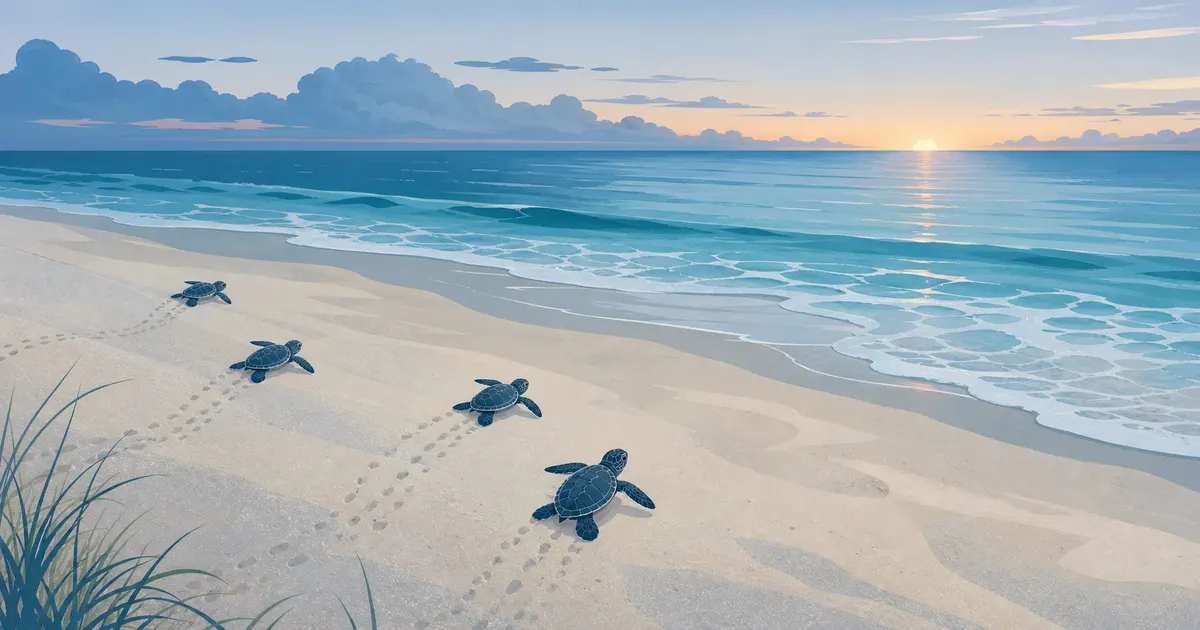
Under the light of the moon, a sea turtle comes ashore on a night beach. Using her hind flippers, she digs a hole 50-70 cm deep, and over about 30 minutes lays roughly 100 eggs before quietly returning to the sea. This scene has repeated itself along Earth's shores for tens of millions of years. But today, the life cycle of the sea turtle faces unprecedented threats.
This article, centered on the green and loggerhead turtles that live in Japan's waters, traces nesting and hatching, the mysterious mechanism by which sand temperature determines sex, the crises caused by human activity such as bycatch and plastic ingestion, and the conservation efforts continuing at Yakushima and the Ogasawara Islands, based on primary sources from Japan's Ministry of the Environment, the Fisheries Agency, the IUCN, and others.
"Out of 1,000 to 5,000 eggs, only one reaches adulthood." Once you understand the meaning behind this harsh statistic, you begin to see just how irreplaceable each small trail of flipper tracks left on the sand really is.
What You'll Learn in This Article
- The differences and how to identify the three sea turtle species that nest on Japan's beaches (loggerhead, green, and hawksbill)
- The life cycle from nesting to natal homing, and why the survival rate is only 0.02%
- "Temperature-dependent sex determination (TSD)," in which sand temperature determines sex, and the risks from warming
- The reality of four threats: bycatch, plastic ingestion, light pollution, and beach loss
- Ongoing conservation efforts at Japan's major nesting sites, including Nagata Beach on Yakushima and the Ogasawara Islands
- The hope offered by the recovery of the green turtle population, and what we can do starting today
What Is a Sea Turtle? An Ancient Reptile That Returned to the Sea
Sea turtles are marine reptiles that have changed little in appearance since the age of the dinosaurs. Some ancestors of tortoises that once lived on land moved into the sea more than 100 million years ago, evolving their front limbs into oar-like flippers. Because they breathe with lungs, they must surface regularly to breathe air, but their bodies are otherwise fully adapted to life in the sea. One clever adaptation is the "salt gland" near their eyes, which excretes salt like tears, allowing them to maintain their internal salt balance even after drinking seawater.
Even though they left the land, sea turtles do not spend their entire lives in the sea alone. Females must always come ashore to lay eggs, and the hatchlings also begin their lives buried in the sand. In other words, sea turtles live by moving back and forth between sea and land. This "straddling of sea and land" is the essential key to understanding their life cycle, and it is also a vulnerability, since they are susceptible to environmental changes on both fronts.
There are said to be seven species of sea turtle in the world, and for a long time six of them were classified as endangered. But in 2025, the green turtle, whose population had recovered, was downgraded to "Least Concern (LC)," and now five species remain classified as threatened (Vulnerable or higher) on the IUCN Red List. Their size and ecology vary widely, from the smallest, the olive ridley, to the leatherback turtle, whose shell can reach 2 meters in length. Some species dive into deep water, while others live on coral reefs or in seagrass meadows. Our article on deep-sea creature adaptation can also deepen your understanding of how marine life has adapted to its environment.
The Three Species That Nest on Japan's Beaches
Japan is an important breeding ground for sea turtles in the North Pacific. According to materials from Japan's Ministry of Land, Infrastructure, Transport and Tourism and the Ministry of the Environment, three species nest on Japan's beaches: the loggerhead, green, and hawksbill turtles. Olive ridley and leatherback turtles have also been recorded passing through waters near Japan during ocean migrations, but these three species are the ones that nest continuously in Japan.
For the loggerhead turtle in particular, Japan's beaches are the only significant nesting ground in the North Pacific, making them a globally irreplaceable place. Considering that individuals born here disperse across the entire Pacific, protecting Japan's coastline is directly linked to protecting the Pacific's entire sea turtle population. The beaches of a small island nation support a cycle of life on a planetary scale — sea turtles show us this truth through their very existence.
| Species | Main Food | Main Nesting Sites in Japan | Endangered Status (Ministry of the Environment / IUCN) |
|---|---|---|---|
| Loggerhead turtle | Shellfish, crabs, shrimp, etc. (mostly carnivorous) | Honshu to Kyushu, Yakushima | Endangered (Ministry of the Environment) / Vulnerable (IUCN) |
| Green turtle | Seagrass, seaweed, etc. (mostly herbivorous) | Ogasawara Islands, Nansei Islands | Vulnerable (Ministry of the Environment) / Improved to Least Concern (IUCN) |
| Hawksbill turtle | Sponges, etc. (coral reef-dwelling) | Nansei Islands (small numbers) | Critically Endangered (CR) |
Key Points
- Sea turtles are lung-breathing marine reptiles, with seven species worldwide. Five are endangered (the green turtle's status improved in 2025).
- The three species that mainly nest in Japan are the loggerhead, green, and hawksbill turtles.
- Loggerheads lean carnivorous, greens lean herbivorous — the two differ greatly in diet.

Even among "sea turtles," the loggerhead has a large head and sturdy jaws for crushing hard prey like shellfish and crabs. The green turtle, on the other hand, shifts to a mostly herbivorous diet of seagrass and seaweed as it grows, and its name is said to come from the greenish tint of its body fat. The hawksbill turtle has a specialized diet of sponges on coral reefs, and its beautiful shell (tortoiseshell) has long made it a target of overhunting.
The Role a "Living Fossil" Plays in the Ocean
Sea turtles are often called "living fossils," but that doesn't just mean they retain an ancient form. Within marine ecosystems, they play several important roles. When green turtles graze on seagrass, it keeps the meadows healthy and renewed; when hawksbill turtles eat sponges, it preserves space for coral to grow. Loggerhead turtles cracking open hard-shelled shellfish also affects the balance of bottom-dwelling organisms. A decline in sea turtles means that part of these ocean workings is quietly being lost.
Sea turtles are also "carriers" that connect the beach and the sea. Eggs that fail to hatch, along with eggshells, bring nutrients to the beach and support the growth of coastal plants. This cycle, in which nutrients gained at sea are carried to land through nesting, exists only because sea turtles live straddling both sea and land. Protecting them is also connected to protecting the beach ecosystem itself.
Green and Loggerhead Turtles: The Two Main Species Found in Japan
No discussion of sea turtle conservation in Japan is complete without loggerhead and green turtles. These two species differ in habitat and life history, and each faces its own unique challenges. Let's take a closer look at the true nature of these two leading species.
Loggerhead Turtles: Great Migrators Across the North Pacific
Loggerhead turtles are characterized by their reddish-brown shell and large head. Japan's beaches are the largest loggerhead nesting ground in the North Pacific, and tagging studies and genetic analysis have shown that some hatchlings born in Japan ride the Kuroshio Current across the Pacific, migrating as far as waters off Mexico and the American West Coast, before returning to waters near Japan as mature adults. This epic journey forms a single network of life spanning the entire Pacific.
Nesting sites span from around Miyagi Prefecture on the North Pacific side, and south of the Noto Peninsula on the Sea of Japan side, with Enshu-nada, southern Wakayama Prefecture, the Nichinan Coast, and Yakushima being representative locations. Nagata Beach on Yakushima in particular is Japan's largest nesting site, accounting for 30-40% of all landings nationwide. The Ministry of the Environment's Red List places it in the serious category of Endangered (EN).
Green Turtles: Herbivores That Cultivate Seagrass Meadows
Green turtles have a smooth shell and a relatively small head, and shift to a herbivorous diet of seagrass and seaweed as they mature. As "grazers of the sea" that help renew seagrass meadows by feeding on them, they play an important role in the ecosystem. In Japan, their main nesting sites are the Ogasawara Islands and the Nansei Islands south of Yakushima and Tanegashima.
Green turtles in Ogasawara are thought to take as long as 30 to 40 years to mature. A creature that takes this long to mature will need many years to recover once its population has drastically declined. That is precisely why the recent recovery trend, thanks to the conservation efforts described below, is drawing attention as a major source of hope.

"Green" But the Shell Isn't Green?
The green turtle's name is said to come from the blue-green (green) tint of its body fat, not the shell itself, which is not actually green. In English, too, it is called the "Green Sea Turtle." This distinctive fat color is thought to have inspired the name during the history of the species being used as food.
The two species often use the same beaches, but they differ subtly in their peak nesting season and preferred locations. On Yakushima, green turtle landings are also observed a little way beyond Nagata Beach, where loggerheads are the main species. It has also been pointed out that rising sea temperatures could shift migration routes and nesting timing, and rising sea temperatures and changing ocean currents are quietly affecting sea turtle distribution as well.
Tips for Telling Them Apart
If you encounter a sea turtle in the water or on the beach, there are a few clues for telling the species apart. The most obvious is head size: loggerheads have large heads with developed jaws, while green turtles have relatively small, sleek heads. Shell color also tends to differ, with loggerheads showing a reddish-brown tint and green turtles a yellowish-brown to olive tint. Hawksbill turtles are characterized by a sharp, beak-like snout and a jagged shell edge. However, since there are also differences by individual and growth stage, the basic rule in the wild is to observe gently without forcing yourself too close.
How to Tell Males from Females
Adult sea turtles can be distinguished as male or female, to some degree, by tail length. Males develop long tails for reproduction, long enough to extend beyond the shell, while females' tails are shorter. However, this is difficult to determine in young, immature individuals, and in TSD research, developing techniques to estimate sex without harming the animal's body remains a challenge.
The Life Cycle of a Sea Turtle: The Long Journey from Nesting to Natal Homing
The life of a single sea turtle begins as an egg buried in the sand. Let's trace the decades-long life cycle here — nesting, hatching, dispersal, maturation, and finally, returning to the natal beach. It is a journey that is unimaginably harsh, and at the same time remarkably intricate.
Nesting: About 100 Eggs a Night, Several Times a Season
During the nesting season, females come ashore onto beaches at night. Moving from the waterline to the dry sand, they use their hind flippers to dig a vertical hole about 50-70 cm deep, and over about 30 minutes lay about 100 white eggs the size of ping-pong balls. Once finished, they cover the nest with sand to hide it and return to the sea in an exhausted state. Because a single female repeats this process several times in one season, she may leave behind several hundred eggs in a single summer.
Hatching: A Mass Nighttime Escape About Two Months Later
The eggs develop using heat from sand warmed by the sun, hatching in roughly 55 to 75 days (about two months). Inside the nest, the hatchlings work together to dig their way up through the sand, then all burst out onto the surface together during the cooler nighttime hours. Instinctively, they head toward the brighter, more open direction of the sea, scrambling down the beach. This "mass nighttime escape" is a clever strategy for reducing the chances of being attacked by predators.

A 0.02% Survival Rate: Only One in 5,000 Reaches Adulthood
But the several dozen meters to the sea are full of danger. Crabs, foxes, and seabirds wait on the beach, and once in the water, hatchlings are picked off one after another by large fish such as groupers and red sea bream. Estimates vary by study, but only about 0.02-0.3% survive from egg to adult, roughly one in several thousand. That works out to only a single individual reaching adulthood out of 1,000 to 5,000 eggs. Laying so many eggs at once is the sea turtle's strategy for surviving this overwhelming rate of attrition.
If human activity pushes this number in the wrong direction, the impact is enormous. If streetlights lead hatchlings in the wrong direction away from the sea, for example, the already-low survival rate drops even further. Conversely, even raising the hatch rate by just a few percentage points through protection efforts can significantly change the number of adults that survive. Precisely because the survival rate is already such a tightrope walk, our small acts of consideration and effort carry the weight of determining the species' future.
| Stage | Approximate Duration | Main Events / Threats |
|---|---|---|
| Egg (in sand) | About 55-75 days | Sex is determined by temperature / hatch rate declines from high heat or flooding |
| Hatchling (escape to sea) | Minutes to hours | Crabs, seabirds, becoming lost due to light pollution |
| Juvenile (open-ocean dispersal) | Several years | Predation by large fish / debris and plastic waste |
| Subadult to adult | Decades | Bycatch, ingestion, habitat degradation |
| Breeding adult | After maturity (30-40 years for green turtles) | Returns to natal beach and repeats nesting |
Natal Homing: The Mystery of Returning to the Beach of Birth
Hatchlings that reach the sea swim straight out to open water, sheltering in drifting debris and mats of seaweed as they grow. Where and how hatchlings live during this period has long been shrouded in mystery, and researchers have called it the "lost years." In recent years, tracking with small transmitters has advanced, revealing that hatchlings don't merely drift with ocean currents but actively swim toward waters suited to their growth. Even so, much about the ecology of young sea turtles remains unresolved.
Loggerhead turtles are said to live into their 60s, making sea turtles remarkably long-lived creatures. But within that long life, it can take anywhere from 10 to 50 years, depending on the species, before they can participate in reproduction. Living a long life and maturing slowly is advantageous in a stable environment, but it becomes a weakness against rapid environmental change or overhunting, because it takes decades to recover lost numbers.
Sea turtles that survive decades in the open ocean head back to land to nest once they mature. Remarkably, genetic analysis and other evidence have shown that many individuals practice "natal homing," returning to nest on the beach in the region where they were born. They are thought to use Earth's magnetic field as a cue to find their birthplace across the vast ocean. It is precisely because of this trait that losing a single nesting site can mean losing that entire genetic lineage.

Life Cycle Summary
- About 100 eggs per nesting, several times a season. Hatches in about two months.
- Only 0.02-0.3% survive from egg to adult, about one in several thousand.
- Many individuals practice "natal homing," returning to the beach where they were born.
Sex Is Determined by Sand Temperature: Temperature-Dependent Sex Determination (TSD)
Among the many aspects of sea turtle biology, one of the most curious, and currently the most worrying, is how their sex is determined. Humans have our sex determined by sex chromosomes, but a sea turtle's sex is determined by its pre-birth environment — specifically, the temperature of the sand in which the egg develops. This mechanism is called temperature-dependent sex determination (TSD).
29°C Is the Dividing Line Between Male and Female
Research shows that around 29°C is the dividing line in sand temperature: lower produces males, higher produces females. Right around 29°C, males and females are produced in roughly equal numbers, a point called the "pivotal temperature." Specifically, it is known that the higher the temperature experienced during the middle stage of development (the critical period when the turtle's body is formed inside the egg), the more likely the hatchling is to be female, and the lower the temperature, the more likely it is to be male. Even within the same nest, eggs closer to the sun near the top and those deeper down can end up as different sexes.

The Crisis of Becoming "All Female" Due to Warming
This delicate mechanism poses a serious risk in the era of climate change. The higher beach temperatures rise, the more hatchlings will skew female. On Australia's northern Great Barrier Reef, a shocking research finding has reported that about 99% of young (immature) green turtles are female. If females keep increasing while males become extremely scarce, reproduction itself could eventually become unviable, potentially leading to population decline.
Why did sea turtles evolve a mechanism that seems, on the face of it, disadvantageous? One explanation is that determining sex by temperature offered the advantage of flexibly adjusting the population's overall sex ratio in response to environmental change. Under a stable climate, this was a clever adaptation. But the rapid warming caused by human activity far exceeds the pace of change this mechanism was built to handle. A strategy honed over millions of years is about to backfire in the face of a temperature rise occurring over just a few decades — herein lies the essence of the problem facing sea turtles today.
What's more, temperatures rising too high is itself a threat. Loggerhead turtle eggs are said to hatch normally at temperatures of roughly 24-32°C, and eggs die if this range is greatly exceeded. At Ohama Beach in Tokushima Prefecture, years with low egg hatch rates have reportedly become more noticeable in recent years. For more on the effects of ocean warming, please also see our article on rising sea temperatures and changing ocean currents.
A Risk That Cannot Be Overlooked
A skewed sex ratio is a "silent crisis" that's hard to notice by appearance alone, since the eggs themselves don't die. Even if every hatchling born today were female, the effects wouldn't show up as reproductive failure until decades later. That is precisely why long-term monitoring of sex ratios, and measures to lower beach temperatures, are being pursued around the world.
Conservation Efforts to Cool the Beach
In response to this problem, efforts to "cool the beach" are underway in various locations. Adaptation case studies from Japan's National Institute for Environmental Studies describe methods such as installing shades over nests to block sunlight, sprinkling water on nests to lower the temperature, and relocating eggs to relatively cooler areas. Securing, by human hand, an environment more conducive to producing males is seen as a realistic adaptation measure for maintaining a balanced sex ratio.
That said, such measures also require caution. Moving eggs at the wrong time can harm their development, and installing shades also requires consideration for the ecosystem. Above all, the sex ratio is said to naturally lean somewhat female even in nature, so accumulating long-term data is essential for determining what degree of skew is truly "dangerous." That is precisely why steady, ongoing temperature and sex-ratio monitoring at each nesting site holds the key to future conservation.
- Blocking direct sunlight from nests with shades
- Sprinkling water around nests to lower the sand temperature
- Relocating and protecting eggs to relatively cooler beaches or times
- Continuously recording and monitoring beach temperature and post-hatch sex ratios
Four Looming Threats: Bycatch, Plastic Waste, Light Pollution, and Beach Loss
Even after surviving nature's process of natural selection, sea turtles face new threats from human activity. Here we outline four threats considered especially serious on the front lines of conservation.
1. Bycatch: Drowning After Getting Caught in Fishing Nets
For lung-breathing sea turtles, fishing nets can be deadly. When they are accidentally caught in shrimp trawl nets or longlines in particular, they cannot surface and drown. This is called bycatch. Around 200 loggerhead turtle carcasses wash up on Japan's shores every year, and many are believed to have drowned due to fishing activity. Bycatch is one of the most significant factors threatening the survival of sea turtles.
What makes bycatch so troublesome is that it happens unintentionally. For fishers, sea turtles are not the intended catch — being caught in nets is an "accidental incident." That is precisely why technology that lets turtles escape without stopping fishing operations matters so much. Bycatch is a challenge common to fisheries worldwide, and countries including Japan are working to reduce it within international frameworks.
Countermeasures are also advancing. The TED (Turtle Excluder Device), widespread in the United States, is a device that fits a grid partway through a trawl net, letting large sea turtles escape through an exit outside the net. Japan and the United States, in particular, have also conducted operational trials using circle hooks, which are harder to swallow and easier to remove, in longline fishing, and their effectiveness in reducing bycatch mortality has been confirmed.
2. Plastic Ingestion: Plastic Bags That Look Like Jellyfish
Clear plastic bags drifting in the sea look, to a sea turtle, like a favorite food such as jellyfish. Studies compiling surveys from around the world report high rates of plastic found inside the body across species: about 60% in green turtles, about 50% in loggerheads, and about 35% in hawksbills (rates vary by survey location and period). Swallowed plastic can block the intestines and cause death, or accumulate in the stomach and create a false sense of fullness, leading the turtle to stop eating and starve. Some studies have even found plastic in every single dead sea turtle examined in the Pacific, Atlantic, and Mediterranean.

Plastic isn't a problem only in the form of visible bags. Microplastics, broken down into tiny fragments by ultraviolet light and waves, are taken into a sea turtle's body along with its food and seawater. How ocean plastic breaks down and circulates through ecosystems is explained in detail in our article on the breakdown of ocean plastic. Research is also advancing on how these even smaller broken-down particles affect living creatures and humans, from the perspective of microplastics and health.
Surveys of waters near Okinawa report that trash such as plastic sheeting and fishing line was found inside about 20% of stranded or rescued sea turtles. In some cases, as much as 2 liters of plastic was found packed inside a single turtle. Global estimates suggest more than half of all sea turtles have already ingested plastic at some point, and ocean plastic pollution is no longer a problem confined to a few sea areas. In addition, "ghost fishing" damage, turtles becoming entangled and drowning in abandoned fishing nets (ghost gear), remains an ongoing problem.
3. Light Pollution: Hatchlings Led Astray by Streetlights
Hatchlings have an instinct to head toward the brighter, more open direction, which is normally the sea. But when artificial light from streetlights, buildings, or fireworks is present near the coast, hatchlings mistake it for the sea and walk inland instead. Due to this phenomenon, called light pollution, many hatchlings are hit by cars on roads, attacked by predators, or die of dehydration before ever reaching the sea. Dimming coastal lighting during the nesting season is a simple and effective measure that saves lives.
Light pollution also affects females coming ashore to nest. They sometimes abandon their attempt to land, disliking a beach that is too bright. Even if a turtle has made the effort to return to her natal beach, if artificial light prevents her from nesting and she turns back to sea, that night's eggs are lost. In recent years, efforts to install "turtle-friendly lighting," dimming seaward lighting only during the nesting season, or adjusting fixtures so light doesn't reach the water's surface, have been spreading in various regions. Lives can be saved with just a little ingenuity that lets human life and turtle life coexist.
4. Beach Loss: Disappearing Places to Nest
Due to coastal engineering, beach erosion, and sand mining, the natural beaches where sea turtles can nest are themselves shrinking. If suitable nesting beaches disappear, no matter how strong the instinct for natal homing, turtles cannot leave behind eggs. Because of this trait of natal homing, the loss of a single nesting site becomes an irreversible loss. The problem of trash accumulating on the seafloor and in the deep sea is also covered in our article on the deep-sea trash problem.
Beach loss is a "hard-to-see threat" that progresses gradually. When concrete seawalls cut off the supply of sand, beaches gradually thin out. And as sea level rise progresses further, the dry sand available for nesting shrinks even more. Cases are increasing where nesting females turn back after hitting obstacles, or where eggs die after being submerged by waves. Preserving beaches where sea turtles can nest safely is inseparable from keeping the coastal environment itself healthy.
The Four Threats Are Interconnected
- Bycatch: drowning in trawl nets or longlines. TEDs and circle hooks are countermeasures.
- Plastic ingestion: high rates of plastic waste found inside many species.
- Light pollution: streetlights and fireworks lead hatchlings astray, away from the sea.
- Beach loss: seawalls and erosion reduce nesting sites themselves.
Japan's Nesting Sites and Conservation Efforts: Yakushima, Ogasawara, and the Nansei Islands
In response to these threats, local residents, NPOs, and government bodies are working together on conservation at beaches across Japan. Here we introduce Japan's leading nesting sites and the activities carried out there.
Nagata Beach, Yakushima: The Largest Loggerhead Nesting Site in the North Pacific
Located in the northwest of Yakushima Island in Kagoshima Prefecture, Nagata Beach (Inaka Beach and Maehama) is the largest nesting site in the North Pacific, accounting for fully 30-40% of all loggerhead landings in Japan. From late April to early August each year, at the peak of the season, more than 20 large females over 1 meter long can come ashore in a single night. Because of its importance, Nagata Beach was registered as a Ramsar Convention wetland in 2005.
The NPO "Yakushima Umigame-kan (Sea Turtle Museum)" has watched over this beach for many years, continuing steady work such as patrolling nests, surveying landing and nesting numbers, cleaning the beach, and training volunteers. Nighttime observation tours run by the Nagata Sea Turtle Liaison Council offer a valuable opportunity to watch nesting while following the rules, and are also an effort aimed at achieving both conservation and tourism together.

The Ogasawara Islands: The Birthplace of Green Turtle Conservation
The Ogasawara Islands, part of Tokyo, are the center of green turtle conservation in Japan. Despite a history of being hunted for food, conservation efforts such as hatching-and-release programs and population surveys have been accumulating there since early on. The number of nests has gradually increased, and the population size is recovering. For a species that takes 30-40 years to mature, decades of sustained effort are finally beginning to bear fruit.
What Ogasawara's efforts show is that "use" and "conservation" don't necessarily have to conflict. Building on the history of once using turtles as a resource, continued management backed by scientific research has explored a path that protects population numbers while also preserving cultural and community connections. Ogasawara's experience, of building reliable data over a long period and revising policy according to circumstances, serves as a valuable model for conservation efforts across Japan.
A Nationwide Network of Conservation
Nesting sites aren't limited to Yakushima and Ogasawara. Local organizations, schools, and volunteers across Honshu and Kyushu, at Enshu-nada in Shizuoka Prefecture, southern Wakayama Prefecture, the Nichinan Coast in Miyazaki Prefecture, Ohama Beach in Tokushima Prefecture, and other locations, are engaged in landing surveys, egg protection, and cleanup activities. Organizations including the certified NPO Everlasting Nature support the effort to clarify the true state of sea turtles in Japan through tagging studies and scientific monitoring.
Underlying these activities is the steady work of "tagging studies." By attaching a small tag to the front flipper of a nesting female and releasing her, researchers can learn where she next lands and how many years later she returns. Records accumulated over decades in this way have revealed the reality of natal homing and changes in population numbers, providing material for conservation decisions. It isn't glamorous, but each step taken by volunteers walking beaches all night long supports Japan's sea turtle research.
In recent years, the perspective of "ecotourism," which achieves both conservation and regional development together, has also been spreading. Rule-following observation tours are both an educational venue that directly conveys the importance of sea turtles to participants, and a way to generate the funding and personnel that support conservation work. In the town of Yakushima, too, the Ecotourism Promotion Council works on the protective use of sea turtles, aiming for a relationship in which tourism and conservation support each other rather than conflict.
Protecting sea turtles is also protecting, in its entirety, the beach, the sea, and the lives of the people who live there.
— From the perspective of those working on coastal conservation in the field
Etiquette for Joining an Observation Tour
- Do not use flash photography or strong lights (light pollution confuses the turtles).
- Do not get too close to or touch a turtle while she is nesting.
- Follow staff instructions when walking, to avoid stepping on nests or eggs.
- Always take your trash home, and don't leave holes or obstacles on the beach.
Signs of Recovery, and What We Can Do
We've looked at numerous threats so far, but the story surrounding sea turtles is by no means only about despair. There are also solid signs of hope, where human effort is beginning to bear fruit.
The Green Turtle Is Removed from the "Endangered" Category
In a recent IUCN Red List assessment, a positive finding was reported: the population of green turtles nesting in the Ogasawara Islands and Nansei Islands is trending toward recovery thanks to protection efforts, moving it out of the endangered classification. Years of accumulated hatch protection, monitoring, and bycatch countermeasures have finally shown up in the numbers as the recovery of a species that takes decades to mature. This is a powerful example demonstrating that persistent conservation work truly has an effect.
However, this doesn't mean "we can relax now." Loggerhead turtles remain Endangered, and hawksbill turtles remain Critically Endangered. New threats such as sex-ratio skewing from climate change, rising beach temperatures, and plastic pollution may, if anything, become more severe going forward. We must not forget that behind the recovery of one species, other species remain in crisis.
Even so, the recovery of the green turtle teaches us a great deal. Even a creature that takes 30-40 years to mature will, if humans apply the right effort, genuinely respond on a timescale of decades. This fact offers concrete hope, even for other species and marine ecosystems currently in crisis, that "if we keep at it without giving up, we can change things." Conservation doesn't produce results overnight, but there is meaning in continuing.
Recovery takes decades. But if we never begin, recovery will never come.
— A lesson shown by long-term monitoring in sea turtle conservation

What We Can Do Starting Today
Sea turtle conservation isn't only the work of researchers and local organizations. Our daily choices, even living far from the sea, ultimately connect to the turtles on the beach. It doesn't have to be anything special. Let's start with small actions like the ones below.
- Reduce single-use plastics (plastic bags, PET bottles, straws)
- When visiting the sea or a river, always take your own trash home
- Try joining a beach cleanup or cleaning event
- Avoid bright lights and fireworks at night along the coast, and be mindful of lighting during nesting season
- Follow the rules at sea turtle observation tours and don't interfere with nesting
- Support local activities through donations or volunteering with conservation organizations
Take This First Step
- Bring your own bag when shopping, and aim for zero plastic bags this week.
- Next time you go to the beach, put one small trash bag in your pocket.
- Look up the activities of one sea turtle conservation organization, whether local or somewhere you're traveling.
Ocean environmental problems aren't only about sea turtles. Marine ecosystems face a chain of various crises, including coral bleaching and ocean acidification. Reading our articles on ocean acidification and coral and the current state of coral bleaching alongside this one will help you see the fuller picture of the ocean sea turtles call home.
Conclusion: What Footprints on the Sand Teach Us
Sea turtles are creatures that have traveled the sea since the age of the dinosaurs, like a living memory of the Earth itself. Laying about 100 eggs at a time, yet only one in several thousand reaches adulthood. We are now making that already-harsh life even harsher, with new human-caused threats: bycatch, plastic, light pollution, beach loss, and warming.
Yet the delicacy of sex being determined by sand temperature, the steadfastness of natal homing to the beach of birth, and the hope offered by the green turtle's recovery, all of it begins with "knowing." A small choice made in the course of city life, far from the sea, ultimately guides one more trail of footprints on the night beach safely to the water.
Fishing gear innovations that reduce bycatch, adaptation measures that cool beaches, a lifestyle that reduces plastic, and mindfulness about dimming nighttime lights. The means of protecting sea turtles genuinely exist, even if each one is small. Every one of them connects not only to experts, but to the choices each of us makes. Learning about the life cycle of the sea turtle is also realizing that we, too, are living within the great cycle that is the ocean.
Summary of This Article
- Three species nest in Japan: loggerhead, green, and hawksbill. Loggerheads are Endangered, hawksbills are Critically Endangered.
- About 100 eggs are laid at once, but only 0.02-0.3% survive to adulthood, an extremely small share.
- Sex is determined by sand temperature (29°C is the dividing line), and there is a risk of skewing female due to warming.
- Bycatch, plastic ingestion, light pollution, and beach loss are the main threats. TEDs and circle hooks are countermeasures.
- Conservation is advancing at Nagata Beach on Yakushima and in Ogasawara, and green turtles are trending toward recovery.
- There is much we can do, including reducing plastic bags, taking our trash home, and being mindful of lighting.
Next time you walk along the beach and notice small footprints left in the sand, take a quiet moment to imagine the decades-long journey that turtle is about to begin. Each and every one of them is an irreplaceable life, having made it to the sea from among thousands of siblings.
References and Sources
- Ministry of the Environment, Japan - Yakushima World Heritage Center, "About Sea Turtles" / "About Nagata Beach, the Home of Sea Turtles"
- Biodiversity Center of Japan, Ministry of the Environment - Red List / Red Data Book (loggerhead turtle / green turtle)
- Fisheries Agency of Japan, Japan Fisheries Research and Education Agency - "FY2023 Status of International Fisheries Resources, No. 45: Sea Turtles (Overview)"
- National Institute for Environmental Studies, Climate Change Adaptation Information Platform (A-PLAT) - Adaptation case study, "Protecting Sea Turtle Hatching Through Heat Countermeasures"
- Ministry of Land, Infrastructure, Transport and Tourism - "Sea Turtle Migration," materials on the marine environment
- WWF Japan - "On Sea Turtles Facing the Threat of Extinction" / "Bycatch: An Environmental Challenge for Fisheries to Solve"
- Certified NPO Everlasting Nature - "What Is a Sea Turtle?" / "How to Save Sea Turtles from Extinction"
- NPO Yakushima Umigame-kan (Sea Turtle Museum) - Sea turtle research and protection activities at Nagata Beach
- The Nikkei - "Green Sea Turtle No Longer Classified as an Endangered Species, Population Recovers Through Protection Efforts"
- National Geographic Japan - "The Crisis Facing Sea Turtles: Bycatch Prevention Devices" / "Is Warming Disrupting Sea Turtle Sex Ratios?"
* Listed in order of reliability: government/academic institutions > peer-reviewed papers > specialized organizations > reliable media