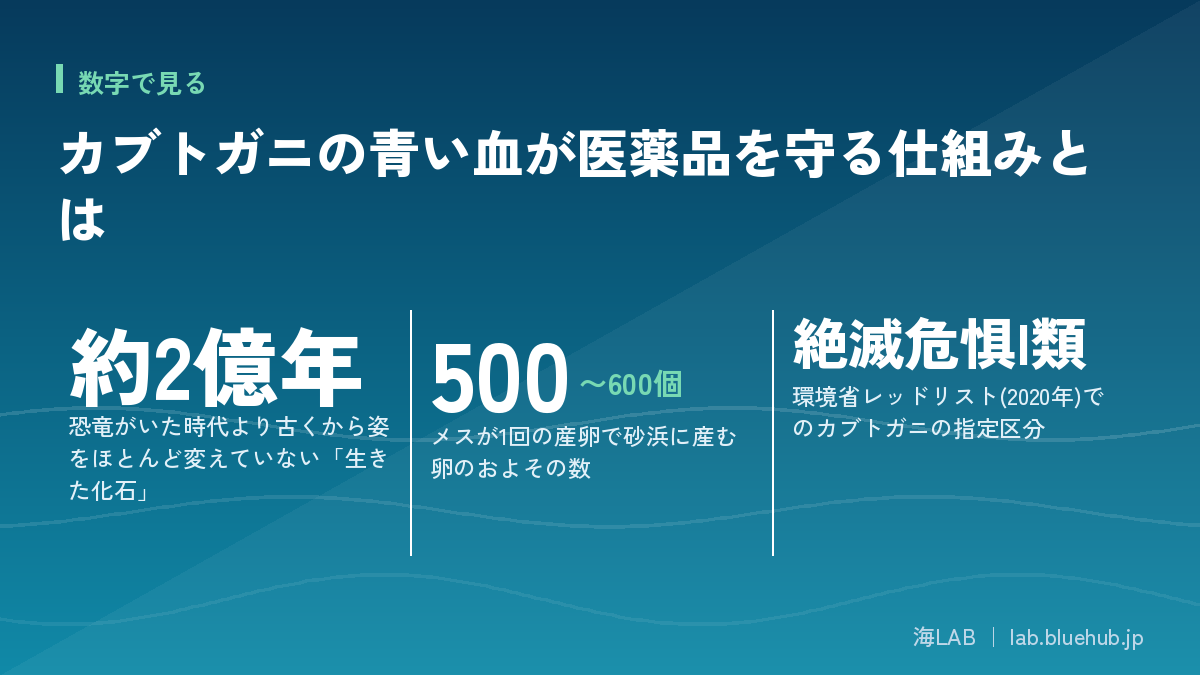
⚡ In short
Horseshoe crab blood is blue because it carries copper-based hemocyanin instead of iron-based hemoglobin. This same blood clots on contact with bacterial toxins, and that reaction has been used for over half a century to test the safety of drugs, vaccines, and medical devices. This article traces the evolution of this "living fossil," the spawning grounds surviving on Japan's tidal flats, and its endangered status today.
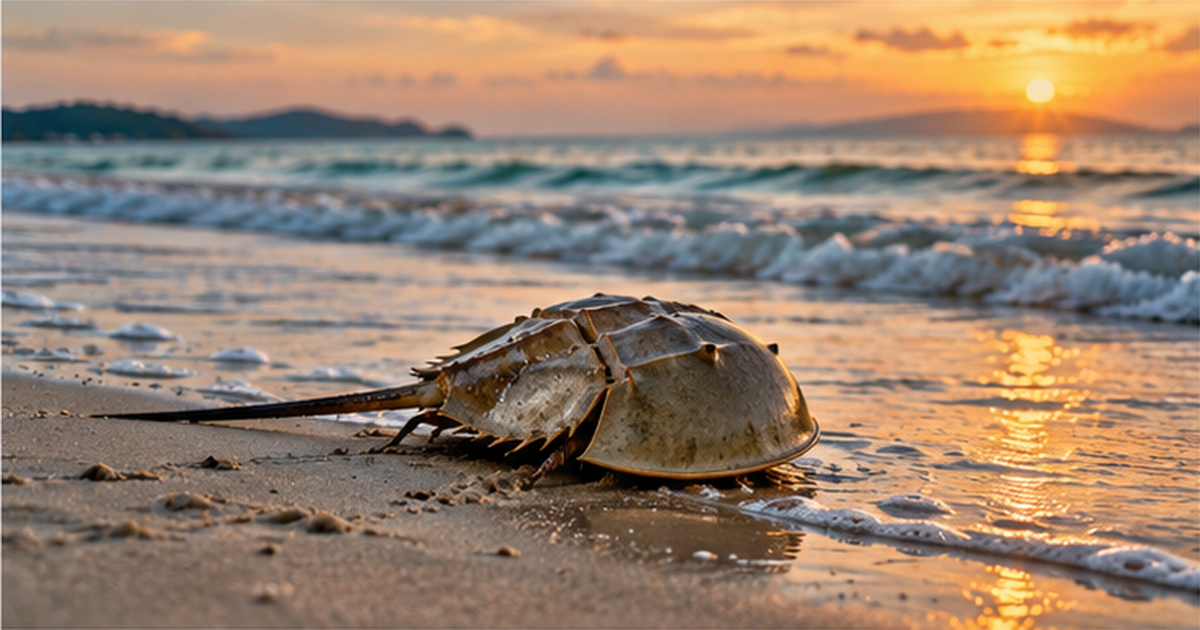
Dragging a hard, helmet-shaped shell along the water's edge of a tidal flat: the horseshoe crab looks rugged, but the blood flowing through its body is a brilliant blue. And this blood has an ability no other creature has — the moment it leaks from a wound, it detects bacterial toxins and instantly sets into a jelly-like clot.
By a twist of fate, this property has been used for more than half a century in tests that check whether injectable drugs, vaccines, and medical devices such as artificial joints and pacemakers are free of bacterial contamination. From the smallpox vaccine to COVID-19 vaccines, horseshoe crab blood is quietly involved in letting us receive medical care with confidence.
At the same time, the horseshoe crab is a "living fossil" that has barely changed in form since a time before dinosaurs existed, and in Japan it is also an endangered species whose spawning grounds now survive only in parts of the Seto Inland Sea and northern Kyushu. This article follows one continuous thread: the chemistry of blue blood, how it underpins drug testing, the cost of bleeding and the technologies replacing it, and the state of conservation efforts in Japan.
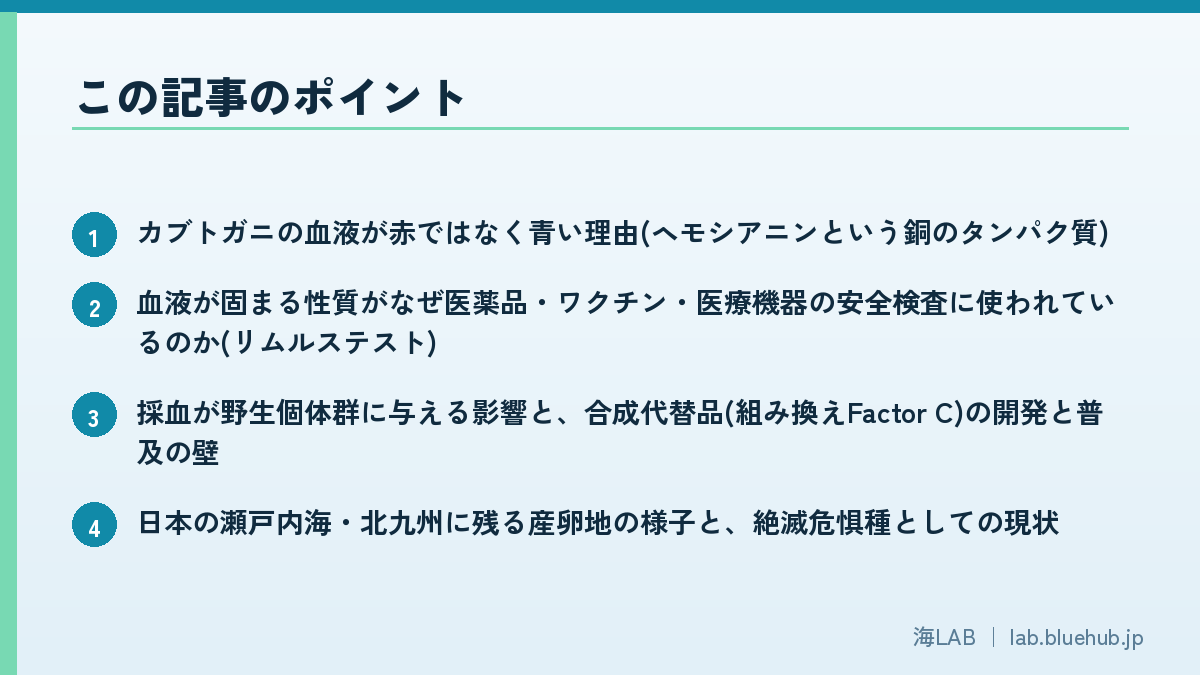
What you'll learn in this article
- Why horseshoe crab blood is blue rather than red (hemocyanin, a copper-based protein)
- Why the clotting property of this blood is used to safety-test drugs, vaccines, and medical devices (the Limulus test)
- How bleeding affects wild populations, and the development and adoption barriers of a synthetic alternative (recombinant Factor C)
- The state of the remaining spawning grounds in Japan's Seto Inland Sea and northern Kyushu, and the species' status as endangered
- Regional conservation efforts such as protection ordinances, museums, and larval release programs in places like Kasaoka City, Okayama
What Is a Horseshoe Crab? A "Living Fossil" Unchanged for 400 Million Years
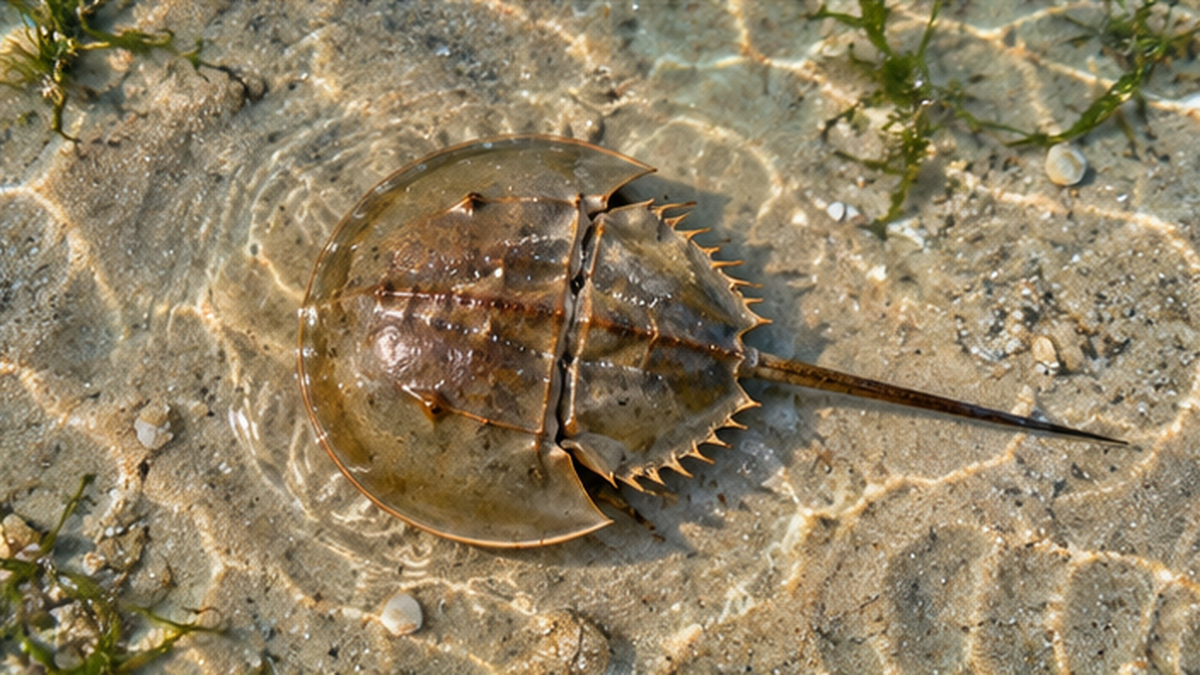
The name "horseshoe crab" and its rounded shell make people assume it's related to shrimp or crabs, but taxonomically it belongs to a completely different group. Rather than a crustacean, it is a chelicerate — a group that makes it closer to spiders and scorpions. Its scientific name is Tachypleus tridentatus. Its body has a simple three-part structure: a rounded prosoma (front shell), a smaller opisthosoma (rear shell), and a long telson (tail spine) that makes up nearly half its body length. That long, pointed tail spine is not a venomous weapon — it's a movable organ with muscles and nerves running through it. If the crab is flipped over by waves, it uses the tail spine to right itself, and it also uses it for burrowing into sand and steering while swimming backward — an indispensable tool for survival.
Surviving with almost no change to its ancestors' form
Fossils of horseshoe crab relatives date back to the Paleozoic era, and fossils with almost the same appearance as living horseshoe crabs have also been found in Mesozoic strata. Estimates of the exact timeline vary among researchers, but they agree that the horseshoe crab has carried on its lineage with little change in form since before dinosaurs appeared on Earth, making it one of the classic examples of a "living fossil." Through the long ages in which amphibians, dinosaurs, and countless marine species appeared and went extinct, the horseshoe crab has passed through almost unchanged.
A unique vision system combining compound and simple eyes
On either side of a horseshoe crab's shell sit a pair of compound eyes, similar to a dragonfly's, and near the center of its body it also carries several small simple eyes. Altogether it has several light-sensing organs, thought to let it recognize companions and obstacles even in dark tidal flats or murky water. These compound eyes have also been important material for vision research: the 1967 Nobel Prize in Physiology or Medicine was awarded "for discoveries concerning the primary physiological and chemical visual processes," and one of the laureates, Haldan Keffer Hartline, built his achievement on experiments using the compound eyes of horseshoe crabs.
A horseshoe crab is not a "crab"
Despite the name, taxonomically it belongs to the chelicerates, the same group as spiders and scorpions. Its evolutionary lineage is clearly separate from crustaceans such as shrimp, crabs, and barnacles.
Only four species exist in the world
Animals called "horseshoe crabs" are in fact represented by just four species worldwide. There is the Atlantic horseshoe crab (Limulus polyphemus), distributed along the eastern coast of North America and the Yucatan Peninsula; the Chinese/Japanese horseshoe crab (Tachypleus tridentatus), found widely from Japan's Seto Inland Sea and northern Kyushu through Taiwan, coastal mainland China, and Southeast Asia; the mangrove horseshoe crab (Tachypleus gigas), living in the Bay of Bengal and Southeast Asia; and the round-tailed horseshoe crab (Tachypleus rotundicauda), also found in Southeast Asia. Among these four species, the one found in Japan has historically been especially valued as a source material for LAL reagent used in drug testing.
Breathing through gills like the pages of a book
If you lift the shell on a horseshoe crab's underside, you'll find five pairs of organs arranged like stacked pages of a book. These are appendages called book gills, and inside them are thin, layered gill membranes — literally shaped like the pages of a book — called "book gills" (書鰓). This structure provides a large surface area, allowing the crab to efficiently draw oxygen from the water on tidal flats. Newly hatched larvae actively move these gill appendages to swim upside-down near the water's surface, steering by swinging the tail spine side to side, but once grown into adults carrying a heavy shell, they are rarely seen swimming at all.
No jaws — an unusual way of eating with its legs
Horseshoe crabs have neither teeth nor jaws. They burrow into the mud and sand of tidal flats, feeding mainly on bivalves and polychaete worms, but before these prey items reach the mouth, spine-like projections at the base of the walking legs mesh together like jaws to crush the prey. The mashed food is then carried to a small mouth at the center of the body. From around age three, they come to favor polychaete worms, but they also eat shellfish, sea urchins, and seaweeds such as sea lettuce, making them broadly omnivorous with a leaning toward meat. Protected by a hard shell and a long tail spine, quietly walking through the mud of the tidal flat in search of food — that is the everyday life of a horseshoe crab.
Why the Blood Is Blue: Hemocyanin, a Copper-Based Protein
The reason the blood of vertebrates, including humans, is red is that the oxygen-carrying protein hemoglobin contains iron. When iron binds with oxygen, it takes on a red color. Horseshoe crab blood, on the other hand, contains hemocyanin instead of hemoglobin — a pigment protein that carries not iron but copper. When copper binds with oxygen it takes on a blue tint, which is why horseshoe crab blood is a nearly transparent blue.
Red blood versus blue blood: different ways of carrying oxygen
Hemoglobin works while enclosed inside dedicated cells called red blood cells, whereas hemocyanin carries oxygen while dissolved directly in the blood (hemolymph). In terms of pure efficiency, hemoglobin has the edge, but animals with hemocyanin are found widely elsewhere too — octopuses, squid, and many crustaceans among them — and it's believed to be a mechanism that evolved independently multiple times over the course of evolution. It is this blue blood circulating through the horseshoe crab's body that leads to the medical discovery covered in the next chapter.
Horseshoe crabs aren't the only animals with hemocyanin
Copper-based blue blood is not actually unique to horseshoe crabs. Cephalopods such as octopuses and squid, as well as many shrimp, crabs, and snails, also have species whose blood (hemolymph) takes on a blue tint thanks to hemocyanin. Next time you see an octopus or squid up close at an aquarium, remember that blue blood is flowing inside it too. That said, so far only the horseshoe crab lineage has evolved a clotting reaction sensitive enough to be actually useful for drug testing.
Another feature: an open circulatory system
A horseshoe crab's circulatory system has another notable feature. Rather than a "closed circulatory system" like ours, with blood vessels running throughout the entire body, it has an "open circulatory system," in which blood spills once into the body cavity, directly bathes the tissues, and then returns to the heart. This structure, common to many invertebrates, means that blood comes into broad, direct contact with body tissue — which also makes it more exposed to bacteria that invade from outside. This is thought to be exactly why horseshoe crabs needed such a powerful defense reaction, in which the blood itself instantly clots to seal a wound.
| Hemoglobin (humans and others) | Hemocyanin (horseshoe crabs and others) | |
|---|---|---|
| Metal contained | Iron | Copper |
| Blood color (when bound to oxygen) | Red | Blue |
| Where it's found | Inside red blood cells | Dissolved directly in the blood (hemolymph) |
| Other animals that have it | Most vertebrates | Octopuses, squid, many crustaceans |
The Clotting Reaction That Saves Lives: How the Limulus Test Was Born
Horseshoe crab blood has another remarkable property beyond carrying oxygen. When it comes into contact with even a trace amount of a bacterial substance called endotoxin, the blood instantly sets into a jelly-like clot. This phenomenon was discovered by the American pathologist Frederik Bang. Bang was a researcher at Johns Hopkins University who spent his summers at the Marine Biological Laboratory (MBL) in Woods Hole, Massachusetts, studying the circulatory system of horseshoe crabs. In 1956, one of the horseshoe crabs he kept died of an unexplained infection, and he noticed that nearly its entire blood volume had clotted into a jelly-like mass — the discovery that started it all. Subsequent research established, by 1964, that it was endotoxin itself that triggered this reaction.
Amebocytes trigger a chain reaction that seals wounds
Floating in horseshoe crab blood are blood cells called amebocytes. Because of the open circulatory system mentioned in the previous chapter, bacteria that enter through a wound from seawater can spread easily throughout the blood. But when amebocytes detect endotoxin, they instantly trigger an enzymatic chain reaction (a cascade), gelling the blood itself to seal the wound and prevent bacteria from invading and spreading further. This is a self-defense mechanism the horseshoe crab has carried since ancient times, in the absence of a sophisticated acquired immune system like ours.
1977: becoming the global standard for drug testing
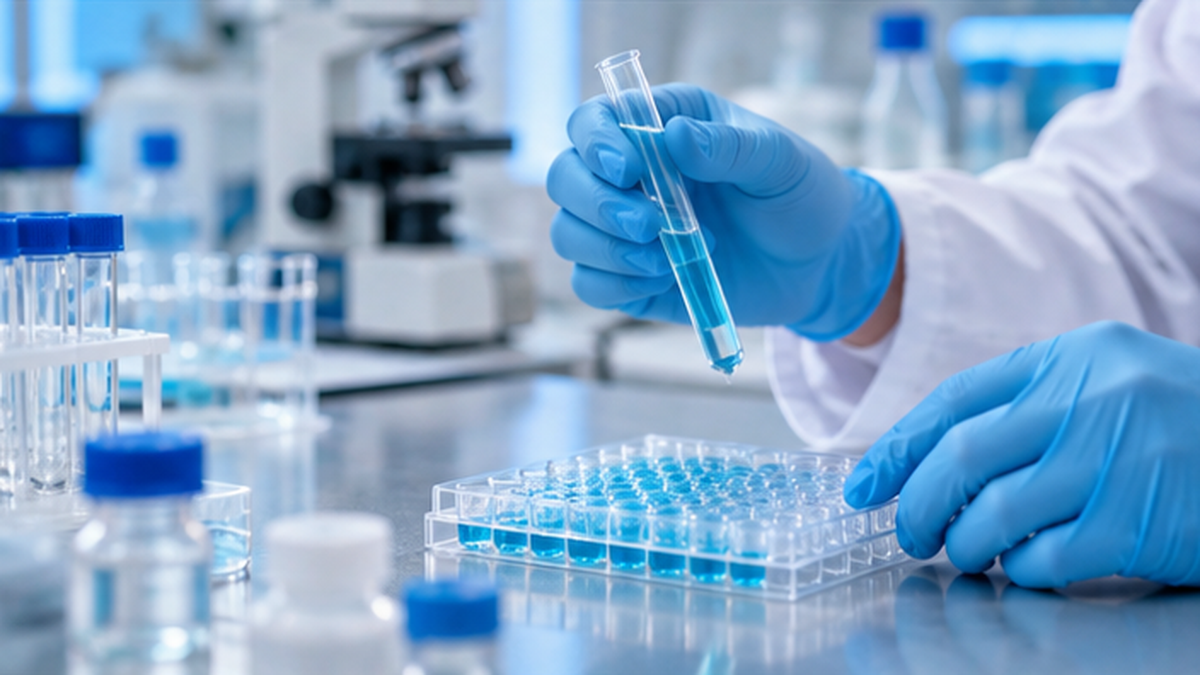
This reaction is put to artificial use in what's called the Limulus test (LAL test), named after the horseshoe crab's genus Limulus. It uses a lysate made from dissolved amebocytes as a reagent to detect whether injectable drugs or vaccines are contaminated with endotoxin. Building on Bang's discovery, the hematologist Jack Levin established the LAL test method in the 1960s; the U.S. Food and Drug Administration (FDA) recognized its validity in 1973 and formally approved its use for pharmaceutical quality testing in 1977. Compared to the previously dominant method — actually injecting rabbits and checking for fever — it spread around the world as a method far superior in speed, sensitivity, and animal welfare.
From a simple gel/no-gel check to precise numerical readings
The most basic test method is the "gel-clot method," in which a test tube containing reagent mixed with a sample is tilted, and the contents are visually checked to see whether they have set into a gel. Today, quantitative methods are also widely used alongside this — "turbidimetric" and "chromogenic" methods that measure, with instruments, the degree of cloudiness or color development produced by the reaction, reading out endotoxin concentration as a precise numerical value. These methods are chosen according to the purpose of the test and the precision required.
How This System Keeps Drugs, Vaccines, and Medical Devices Safe
Endotoxin is not bacteria itself, but a component contained in the bacterial cell wall. Even if heat sterilization kills the bacteria themselves, endotoxin can remain without breaking down, and if it enters the body it can cause dangerous fever or shock symptoms. That's exactly why it's essential, at the final product stage, to check not just that bacteria have been killed but that endotoxin itself is not present. The Limulus test is used broadly — not only for injectable drugs, IV fluids, and vaccines, but also for medical devices inserted into the body, such as artificial joints, pacemakers, and catheters.
Covering nearly every injectable drug and medical device on Earth
Today, nearly every injectable drug and vaccine distributed worldwide, and nearly every medical device inserted or implanted in the body — pacemakers, artificial blood vessels, stents — is required to pass an endotoxin test before shipping. A single major industry supplier is said to handle testing for more than half of the world's injectable and implanted products on its own, meaning that horseshoe crab-derived technology is woven far more widely than most people imagine into the medicines we casually receive at hospitals and pharmacies.
What happens if this testing is skipped
Before the Limulus test existed, the safety of injectable drugs was confirmed by the "pyrogen test" — actually injecting rabbits and observing changes in body temperature. This method takes time per animal tested, and its sensitivity to trace amounts of endotoxin is lower than that of the Limulus test. If an injectable drug contaminated with endotoxin were shipped without proper testing, patients receiving it could suffer fever, a drop in blood pressure, or in severe cases symptoms resembling septic shock. Having a reliable way to detect this invisible toxin — one that heat cannot destroy — before shipment is a fundamental premise underpinning modern injectable medicine. In addition, whereas the rabbit pyrogen test took days to produce results, the Limulus test can deliver results in tens of minutes to a few hours even with the gel-clot method, which also matters greatly on the production floor, since mass-produced medicines can be tested without halting the line.
The LAL reagent business in Japan: the work of Seikagaku Corporation
In Japan, development of a highly sensitive, quantitative Limulus test method by pharmaceutical manufacturers progressed from the late 1970s onward. The species harvested domestically in Japan is the closely related Tachypleus tridentatus, and one of the companies that has researched and manufactured LAL reagent made from its blood cells is Seikagaku Corporation. In recent years, in response to the challenge of declining horseshoe crab populations, the company has also been advancing research to reproduce the clotting-related proteins through genetic recombination.
See LAL reagent technical informationLAL Reagent | Seikagaku CorporationA technical information site from a specialist manufacturer explaining LAL, an endotoxin detection reagent made from horseshoe crab blood components, including its principles and types of test methods.🔗 lalbiz.comWhat endotoxin testing protects
- Prevents bacterial toxin contamination of injectable drugs, IV fluids, and vaccines
- Confirms the safety of medical devices such as artificial joints, pacemakers, and catheters
- Quality control of products that directly contact the body, such as blood products and dialysis water
The Cost of Bleeding: Harvesting and Its Impact on Populations in the U.S.
Making Limulus test reagent requires drawing blood from live horseshoe crabs. In the United States, the target is mainly the Atlantic horseshoe crab (Limulus polyphemus), found along the Atlantic coast, and the Atlantic States Marine Fisheries Commission (ASMFC), which oversees resource management, sets the annual biomedical harvest quota at roughly 200,000 crabs. Captured crabs have a portion of their blood drawn and are then released back into the sea. Bleeding itself is not meant to be a fatal procedure, but the burden of having roughly 30% of one's body fluid withdrawn is not small.
What independent research shows about mortality, and the impact on migratory birds
Industry sources describe the post-bleeding survival rate as roughly 85% (a mortality rate of about 15%), but independent studies tracking crabs after release have reported mortality rates as high as roughly 15–30%, clearly higher than the mortality rate of unbled crabs (a few percent). Behind this disagreement lies the difficulty of capturing delayed deaths from bleeding-related stress, or effects on spawning behavior, within the timeframe of a given study.
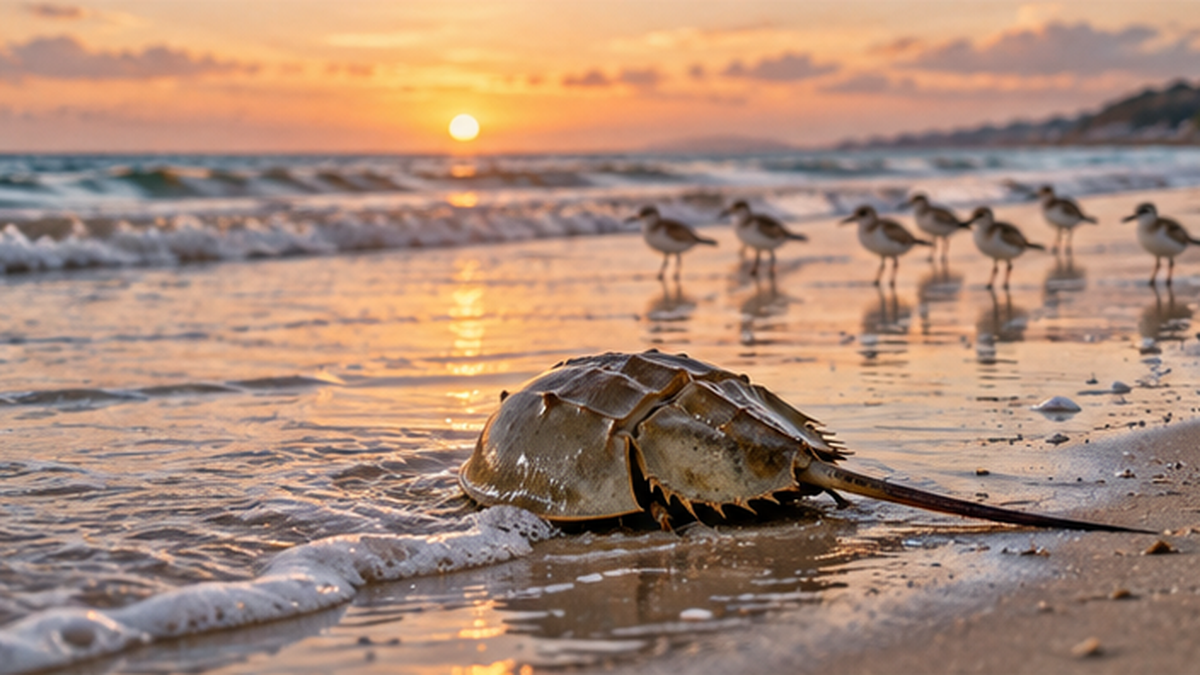
Horseshoe crab eggs are also an essential food source for migratory birds. On Delaware Bay on the U.S. East Coast, the Red Knot, migrating from South America to the Arctic, arrives for a brief period each spring and gorges on horseshoe crab eggs laid on the beach, nearly doubling its body weight to prepare for the long journey ahead. The North American subspecies of Red Knot (rufa) is said to have declined by roughly 75% in population from the 1980s to the 2000s, with excessive horseshoe crab harvesting and changes to spawning habitat cited as contributing factors. Because of this, regulations that balance resource management with ecosystem conservation are now in place, such as banning the harvest of females and allowing only males to be taken. In Japan, the practice of harvesting large numbers of wild horseshoe crabs as raw material for LAL reagent is not nearly as large-scale as in the United States — the biggest threat facing Japan's horseshoe crabs is, rather than bleeding, the loss of habitat itself, discussed in the next chapter.
Horseshoe crabs are also used, beyond drug testing, as bait for eel and conch fisheries, meaning two different kinds of demand — biomedical and fishery — draw on the same resource. Resource management authorities continue a cautious approach, setting a combined harvest cap covering both uses and adjusting the quota each year based on an assessment of the population's condition.
Efforts to make the bleeding process itself safer
To reduce mortality even slightly, resource management authorities have established guidelines for biomedical operators on how to handle horseshoe crabs. These include keeping the time from capture through bleeding to release back into the sea as short as possible, avoiding direct sunlight and high temperatures to prevent the crabs' body fluids from drying out, and keeping the volume of blood drawn within a set range relative to body weight. Operators, in turn, continue refining their working procedures in line with these guidelines — a steady, technical effort to keep the animal they're borrowing blood from alive as long as possible before returning it.
Horseshoe crab blood is a resource we borrow from the wild to protect our medicines, and it is not inexhaustible.
— Summarized from remarks by U.S. conservation researchers
The Rise of the Synthetic Alternative rFC, and Why Adoption Is Slow
A synthetic reagent called recombinant Factor C (rFC) has drawn attention in recent years as a technology to reduce the burden on wild populations. It works by identifying the gene for "Factor C," the enzyme precursor at the heart of the horseshoe crab's blood-clotting reaction, and producing it artificially without using animal-derived blood — and multiple studies have confirmed it performs on par with natural LAL reagent in detecting endotoxin.
A new chapter officially recognized by the U.S. Pharmacopeia (USP)
The expert committee of the United States Pharmacopeia (USP) decided to include an endotoxin test method using rFC as an official chapter, positioning the synthetic reagent as an option on equal footing with natural LAL reagent. Some major pharmaceutical companies have already introduced rFC into their manufacturing processes, and industry-wide it is thought there is potential to significantly reduce the use of natural-derived reagent.
A pioneering example from a major U.S. pharmaceutical company
As a real-world example of the switch, pharmaceutical giant Eli Lilly began introducing rFC testing in 2016, and in 2018 its migraine prevention drug Emgality, approved by the U.S. Food and Drug Administration (FDA), became the first FDA-approved drug shipped after undergoing rFC testing rather than natural LAL testing. As concrete track records like this accumulate, rFC is gradually shifting in status from a "usable alternative" to an "actually used standard." The Japanese Pharmacopoeia also has an endotoxin test provision, and methods using natural LAL reagent have long been the norm there as well, but as international harmonization among pharmacopoeias progresses, the switch to rFC is expected to become more of an option for Japan's pharmaceutical industry too.
An advantage: independence from live population numbers
rFC has practical advantages beyond simply not relying on wild horseshoe crabs. Natural LAL reagent tends to vary in quality depending on when the crabs were caught and individual differences among them, whereas rFC, being produced from cultured cells through genetic engineering, can in principle secure whatever quantity is needed at a consistent quality at any time. The possibility of decoupling a matter of life-or-death importance to the pharmaceutical industry — the stable supply of test reagent — from fluctuations in a biological resource, even as wild populations shift due to climate change or overharvesting, is an advantage that industry itself cannot afford to overlook.
Why widespread adoption is still slow
On the other hand, the long-standing status of the LAL test as an industry standard, differing approval frameworks among regulators, and the cost of revalidation involved in switching methods all act as barriers, meaning the shift to rFC is progressing only slowly across the industry as a whole. Natural LAL reagent enjoys deep trust from regulators built up over many years of track record, and there remains strong caution about making major changes to existing production lines and quality control procedures. Even once a technology to protect a single species like the horseshoe crab has been made practical, a separate barrier of institutions and business custom still stands in the way of putting it into wider social use.
Horseshoe Crabs in Japan: Spawning Grounds Remaining in the Seto Inland Sea and Northern Kyushu
Within Japan, the horseshoe crab's range is limited to the coast of the Seto Inland Sea (Hyogo, Okayama, Hiroshima, Yamaguchi, Tokushima, Kagawa, Ehime, and other prefectures) and parts of northern Kyushu. It was once seen on coastlines all over the country, but in recent years its habitat has shrunk considerably.
Why habitat has been lost
For horseshoe crabs to survive, they need two environments at once: a shallow, gently sloping beach for spawning, and a tidal flat where larvae can grow. But since the period of rapid economic growth, land reclamation along the coast and the construction of harbors and seawalls have destroyed such shallow coastlines in many places. Water pollution and the decline of seaweed beds that once sheltered larvae have compounded the problem, shrinking the areas with conditions suitable for spawning down to a limited number of places, such as parts of the Seto Inland Sea and the area around the Sone tidal flat in northern Kyushu.
Spawning happens on summer nights during spring tides
Horseshoe crabs spawn in July and August, at high tide during spring tides. Females dig holes in the sand and lay roughly 500–600 eggs per site, repeating this several to about ten times. Eggs are about 3 millimeters in diameter right after being laid, but by the time they hatch roughly 50 days later, they have grown to about 6 millimeters. Hatched larvae use the tidal flat as their main nursery ground, growing into adults through repeated molting.
Over a decade to adulthood, with more than ten molts
Estimates of the number of molts and years required to reach adulthood vary among surveys. What all the studies agree on is that horseshoe crabs are an extremely slow-growing animal, taking more than ten years and more than ten molts before finally reaching a size capable of spawning. Only when both the sandy beach used for spawning and the tidal flat used to raise larvae are preserved over the long term does this lead to the next generation. The horseshoe crab's lifespan is said to be roughly 20 years, and after reaching adulthood it continues to spawn nearly every year, carrying life forward over a long span of time.
| Study/source | Number of molts | Years to adulthood |
|---|---|---|
| Current general estimate | Males: 15, Females: 16 | Males: 13 years, Females: 14 years |
| Earlier survey (Asano, 1942) | 17–18 | 15–16 years |
| Earlier survey (Kawahara, 1989) | Males: 13, Females: 14 | Males: 8 years, Females: 9 years |
Some places let you observe spawning on summer nights
Some municipalities near horseshoe crab spawning grounds hold observation events timed to the summer spring tides, letting residents and visitors watch the spawning up close. A horseshoe crab that normally lives quietly in the mud of the tidal flat suddenly gathers en masse in the shallows, as if guided by the pull of the moon, and spawns on the beach — a sight that offers a valuable window into this animal's life history. Taking part in an event hosted by a local museum or environmental education facility is one way to experience the tidal-flat ecosystem up close.
In terms of how creatures living on tidal flats are connected to one another, A Field Guide to Tide Pool Life and Mangroves: The Ocean's Nursery both describe ecosystems supported, like the horseshoe crab, by shallow coastal environments. Reading them together reveals just how much diverse life Japan's coastal environments nurture.
Endangered Status Today, and Conservation Work in Kasaoka City, Okayama
Because of shrinking habitat and a sharp decline in numbers, the horseshoe crab has been listed on Japan's Ministry of the Environment Red List (2020) as Critically Endangered (CR+EN), one of the categories with the highest risk of extinction. An animal once commonly seen on coastlines throughout the country can now spawn only on a limited number of remaining tidal flats.
A nationally designated natural monument: the "Horseshoe Crab Breeding Ground"
Against this backdrop, the tidal flat facing the Kabeshima Channel in Kasaoka City, Okayama Prefecture, has been designated a national natural monument known as the "Horseshoe Crab Breeding Ground." In 2003, the city enacted a "Horseshoe Crab Protection Ordinance," restricting activities that disturb the habitat within the breeding ground, such as digging for mud shrimp or clam-digging. Alongside this, the Kasaoka City Horseshoe Crab Museum — the only museum in the world dedicated to horseshoe crabs — handles ecological exhibits, research, and the spread of conservation awareness.
See museum informationHorseshoe Crab Museum | Kasaoka City, OkayamaThe world's only museum dedicated to horseshoe crabs, facing the nationally designated natural monument "Horseshoe Crab Breeding Ground." It publishes ecological exhibits and information on conservation activities.🔗 city.kasaoka.okayama.jpRearing and releasing larvae to help populations recover
At the Kasaoka City Horseshoe Crab Museum, larvae hatched from eggs are raised in large numbers on-site, supported by hand through the vulnerable early stage of life when they are most susceptible to predators and have low survival rates, before being released into the natural monument's breeding ground. For an animal that takes so many years to reach adulthood, this kind of steady conservation work plays an essential role in boosting population numbers.
Monitoring and environmental education support conservation
Field surveys counting the number of spawning pairs, and environmental education programs aimed at local schools, are also an important part of conservation work. Horseshoe crabs also serve as an indicator of the health of tidal flat ecosystems, and keeping long-term records of their numbers provides a clue to changes in the tidal flat environment as a whole. At other spawning grounds too, such as the Sone tidal flat in Kitakyushu City, similar observation and conservation efforts continue, carried out by residents and NPOs.
From the perspective of endangered species conservation, this shares much in common with the spawning-ground protection efforts described in The Life and Conservation of Sea Turtles, and the challenge of balancing coastal development with the protection of rare species is a theme widely shared among marine creatures.
Conclusion: A Thin Thread Connecting a Living Fossil to Modern Medicine
Summary of this article
- Horseshoe crab blood is blue because it contains copper-based hemocyanin rather than iron-based hemoglobin
- The blood's clotting reaction to bacterial endotoxin is used as the Limulus test to safety-test drugs, vaccines, and medical devices
- Hundreds of thousands of crabs are bled annually in the United States, and independent studies report mortality rates of roughly 15–30%
- The synthetic alternative rFC has been recognized by the U.S. Pharmacopeia, but the industry-wide switch is progressing only slowly
- In Japan, spawning grounds survive only in parts of the Seto Inland Sea and northern Kyushu, and the species is listed as Critically Endangered by the Ministry of the Environment
- In places like Kasaoka City, Okayama, protection ordinances and larval rearing and release programs continue to support population numbers
The horseshoe crab, which has survived with almost no change in form since before dinosaurs walked the Earth, now supports humanity in the unexpected form of modern medicine. Rather than remaining wholly dependent on its blue blood, advancing both the shift to synthetic alternatives and the conservation of its habitat at the same time should be the path that connects the future of this "living fossil" with our own future as the ones who continue to benefit from it.
When we receive an injection at a hospital, part of that safety rests on a single animal living on a distant tidal flat or coastline: the horseshoe crab. The benefits of medical technology and the conservation of the wild species that technology depends on are one continuous problem that cannot be considered separately. The story of the horseshoe crab's blue blood is a reminder that human life is built on the unexpected workings of the natural world.
References & Sources
- Ministry of the Environment, Japan, Setouchi Net: "Horseshoe Crab" – Distribution, classification, and spawning ecology
- Ministry of the Environment, Japan, Biodiversity Information System: "Horseshoe Crab" – Red List category
- Kasaoka City: "Horseshoe Crab Development and Growth" – Data on egg numbers, egg size, and number of molts
- Kasaoka City: "Horseshoe Crab Protection Ordinance" – Contents of the breeding-ground protection ordinance
- Society for Biotechnology, Japan: "History of Endotoxin Measurement Using Limulus Reagent" – History of the discovery and its practical use in Japan
- United States Pharmacopeia (USP): "Statement on rFC" – The positioning of recombinant Factor C
- Scientific American: "Medical Labs May Be Killing Horseshoe Crabs" – Investigative reporting on the bleeding industry and mortality rates
- Seikagaku Corporation: "Types of Endotoxin Test Methods" – Technical explanation from an LAL reagent manufacturer
- Kasaoka City: "The Horseshoe Crab's Body" / "Horseshoe Crab Study Course 1" – Explanation of the tail spine's structure, and of book-gill respiration and larval swimming behavior
- Contract Pharma: "FDA Approves Lilly's Emgality Using Lonza's Factor C Assay" – News coverage of a real-world FDA-approved drug using rFC testing
*Listed in order of reliability: government and academic institutions > peer-reviewed papers > specialist organizations > trusted media