⚡ The answer in 30 seconds
- Combining offshore aquaculture and wind is studied as an example of multi-use of sea areas.
- A German EEZ study rated integrated aquaculture of seaweed, shellfish and fish highly.
- In Japan, coexistence with fisheries is the central debate, and no domestic aquaculture co-location demonstration was confirmed in public documents.
- Safety, rights coordination and accumulation of environmental data are future challenges.
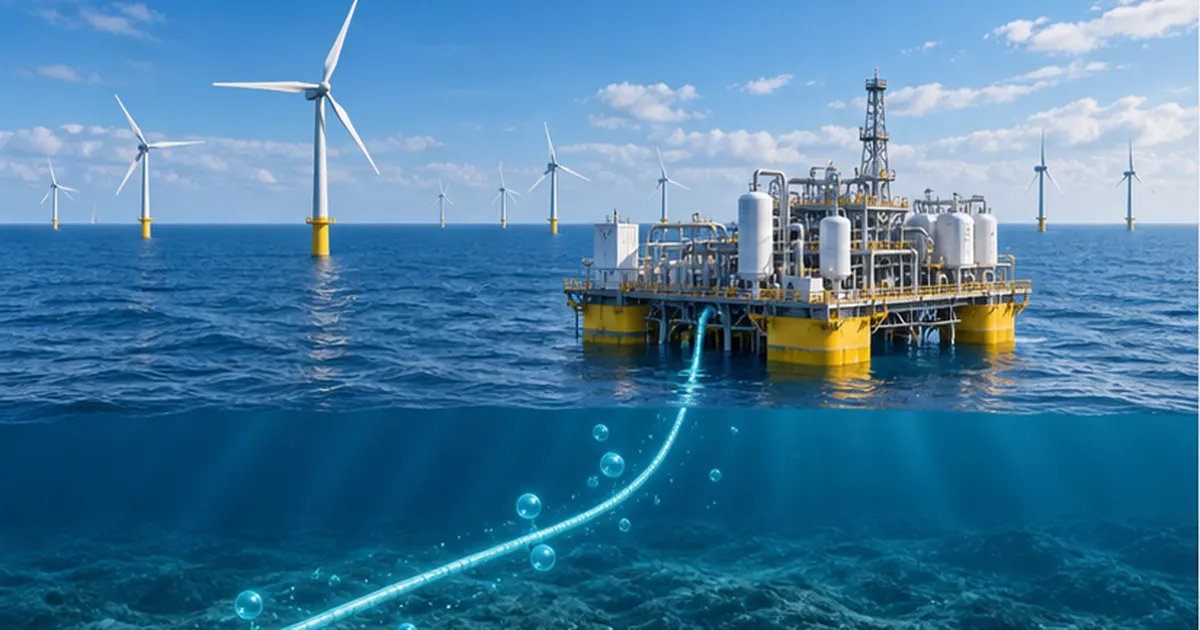
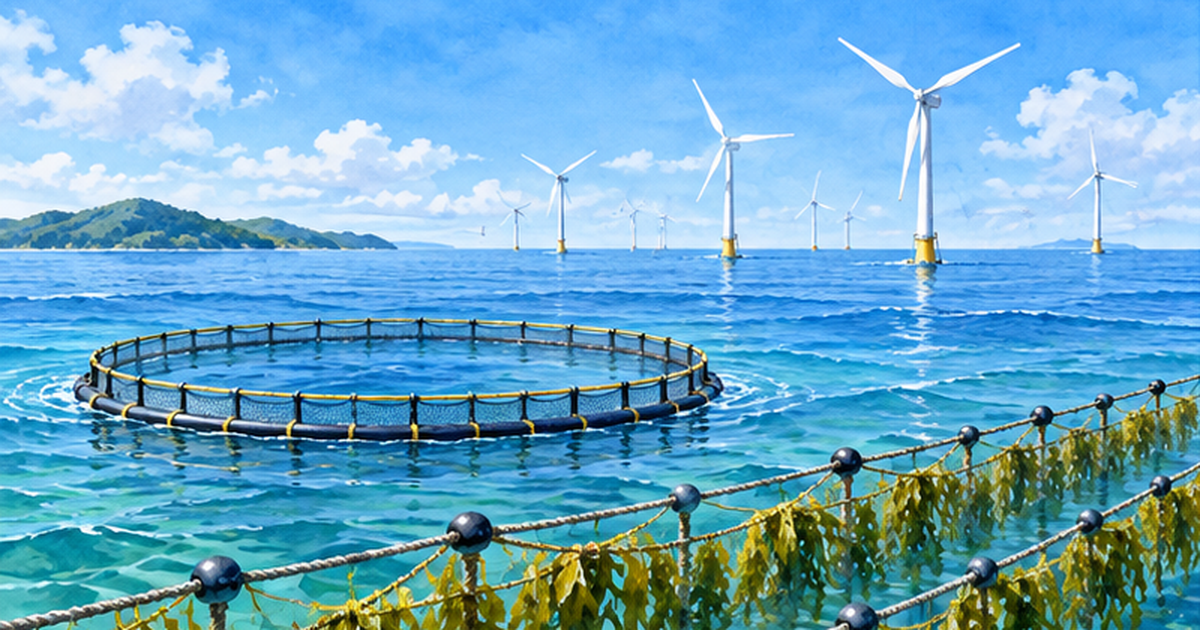
Wind turbines spin far offshore while shellfish and seaweed grow at their feet. Research aiming at this scene is now under way around the world.
This article summarizes, in plain language and based on public institutions and papers, the expected benefits and challenges of combining offshore aquaculture with offshore wind power.
Because the field is still at the demonstration stage, we separate what has been confirmed from what has not.
What you will learn
- Features of offshore aquaculture
- Types of offshore wind and Japan's framework
- Benefits and challenges of combining the two
- European case studies
- The debate on coexistence with fisheries in Japan
- What we can do
Why offshore aquaculture and renewable energy are in the spotlight
Japan is surrounded by sea on all sides and has one of the largest exclusive economic zones (EEZ) in the world. How to use that vast sea is a major theme for both food and decarbonization. In recent years, researchers in Japan and abroad have explored combining offshore aquaculture, which raises fish, shellfish and seaweed in open waters, with offshore wind power, which generates electricity from wind, in the same sea area.
However, this combination is not an "established technology"; most of it is at the survey and demonstration stage. Based on public documents and papers we could confirm, this article separates expected benefits from challenges.
Layering uses of the sea
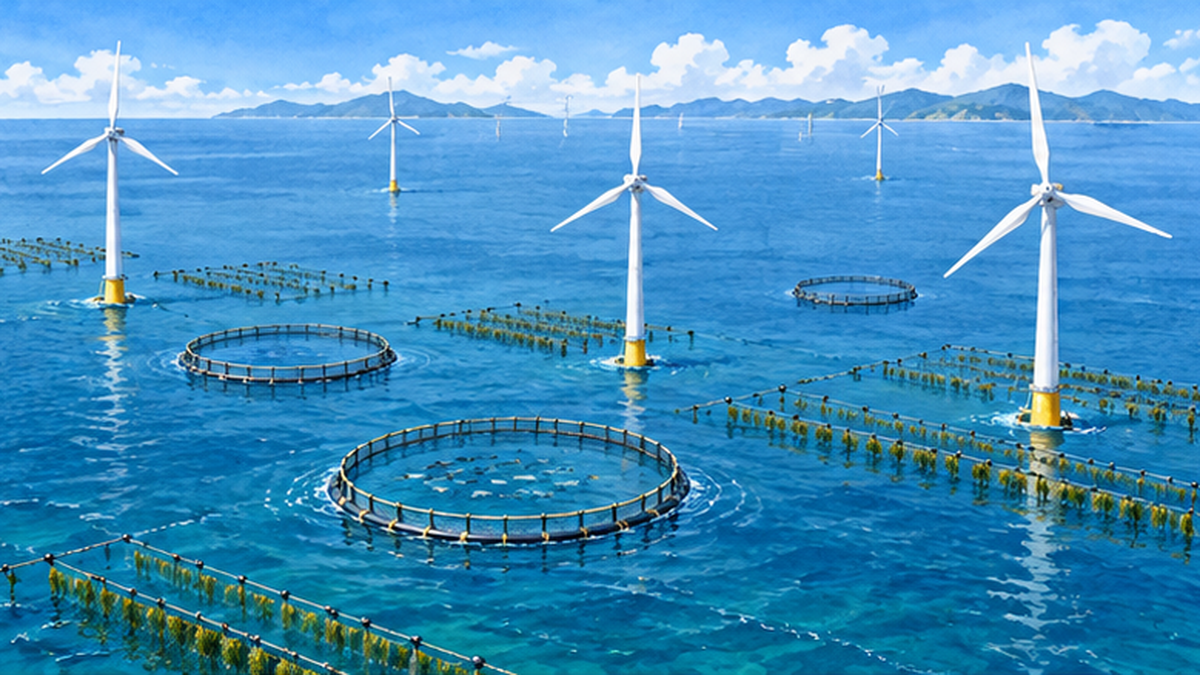
Uses of a sea area tend to compete: fishing, shipping lanes, power generation and conservation. Multi-use (shared use), which achieves several goals in the same place, is therefore being studied. In Europe, co-locating North Sea wind farms and aquaculture has been examined academically.
- Food: Aquaculture is a major pillar of the global seafood supply
- Energy: Offshore wind is being expanded as a decarbonized power source under policy
- Space: Sea areas are finite, so coordinating interests is essential
Key points of this section
- Combining offshore aquaculture and wind is one example of "multi-use of sea areas"
- Most of it is at the survey and demonstration stage
- Consider it from three viewpoints: food, energy and space
What is offshore aquaculture?
Aquaculture has mainly been done inside bays or near the shore. Offshore aquaculture, by contrast, is carried out in waters closer to the open ocean with strong waves and currents. Good water exchange is said to reduce the risk of disease and water-quality deterioration, but equipment and operations must withstand rough weather.
Differences from coastal aquaculture
| Item | Coastal (inner bay) aquaculture | Offshore aquaculture |
|---|---|---|
| Location | Calm waters such as bays and inlets | Near open ocean with strong waves and currents |
| Water exchange | May be limited | Tends to be good |
| Load on equipment | Relatively small | Large; wave resistance required |
| Work and maintenance | Close to land and easy | Requires travel by boat, raising costs |
Examples of species that can be farmed
- Fish: fed aquaculture of yellowtail, salmon and others
- Shellfish: oysters, scallops and others (unfed type)
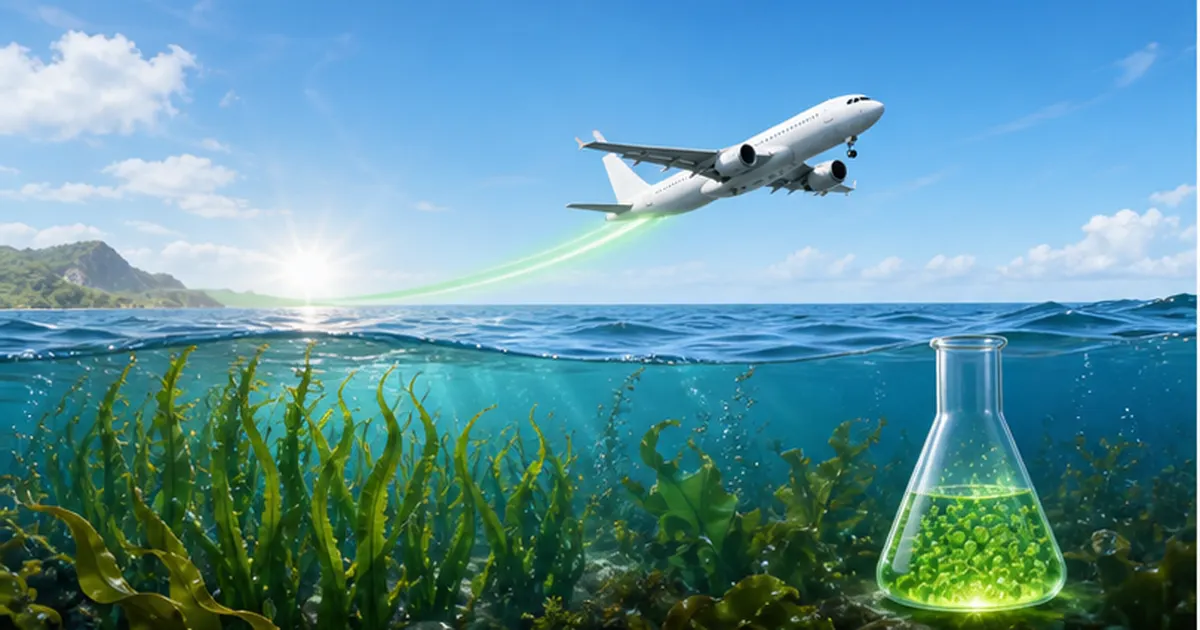
- Seaweed: kelp, wakame and others (no feed needed; take up CO₂ as they grow)
Farming of unfed shellfish and seaweed is being studied as aquaculture with a relatively small environmental load.
Key points of this section
- Offshore aquaculture is done in waters close to the open ocean
- Water-quality advantages exist, but equipment and maintenance costs are a challenge
- Unfed types such as shellfish and seaweed are considered low in environmental load
Basics of offshore wind power
Offshore wind comes in two types: bottom-fixed, with foundations fixed to the seabed, and floating, with a structure moored on the sea. Japan has many seabeds that deepen sharply from the coast, so expectations for floating wind are said to be high.
Japan's framework and demonstrations
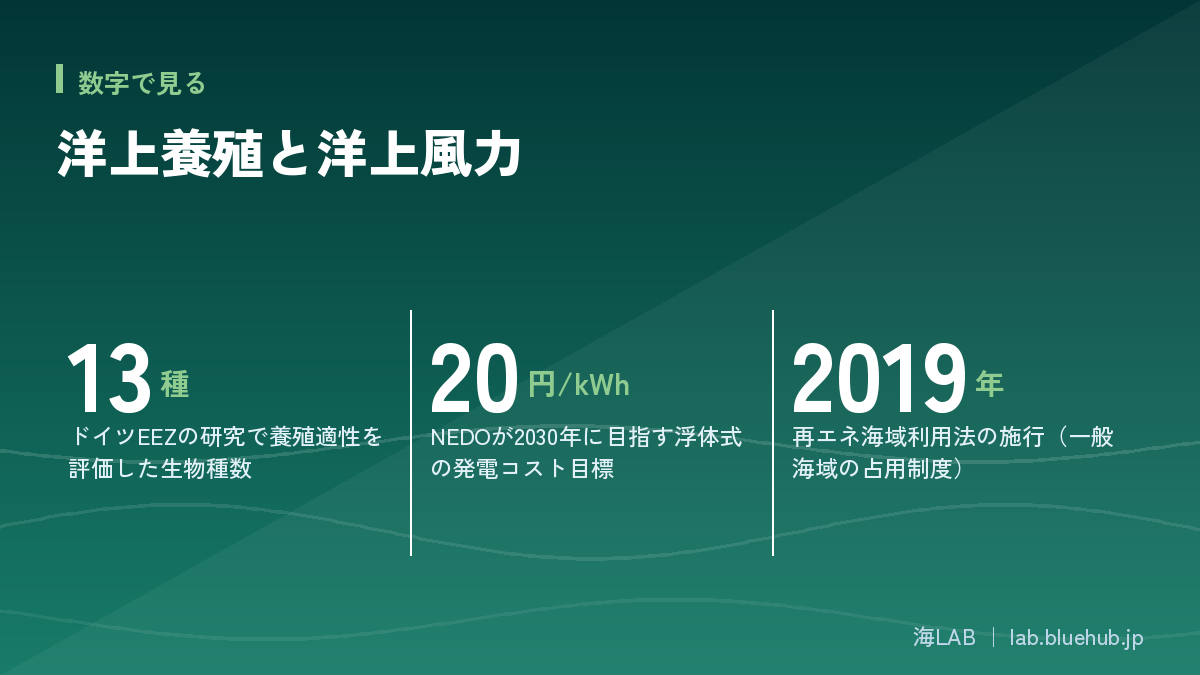
The Offshore Renewable Energy Act, in force since 2019, allows occupancy of general sea areas for up to 30 years and established a system for selecting operators through open bidding. The sea off Goto City, Nagasaki Prefecture, was designated a promotion zone in December 2019, and its public-tender occupancy plan was certified in April 2022. In October 2023, the sea off Tahara and Toyohashi cities in Aichi Prefecture was chosen as one of the candidate sites for the national (NEDO) Green Innovation Fund floating offshore wind demonstration project. NEDO is advancing technology development aiming for a generation cost of ¥20/kWh or less by 2030.
| Type | Features | Suitable waters |
|---|---|---|
| Bottom-fixed | Foundation fixed to the seabed; mature technology | Relatively shallow waters |
| Floating | Moored floating structure; fewer depth limits | Deep waters |
Key points of this section
- Offshore wind is divided into bottom-fixed and floating types
- The Offshore Renewable Energy Act set up a system for selecting operators
- Floating wind demonstrations are advancing toward lower costs
Why combine them?
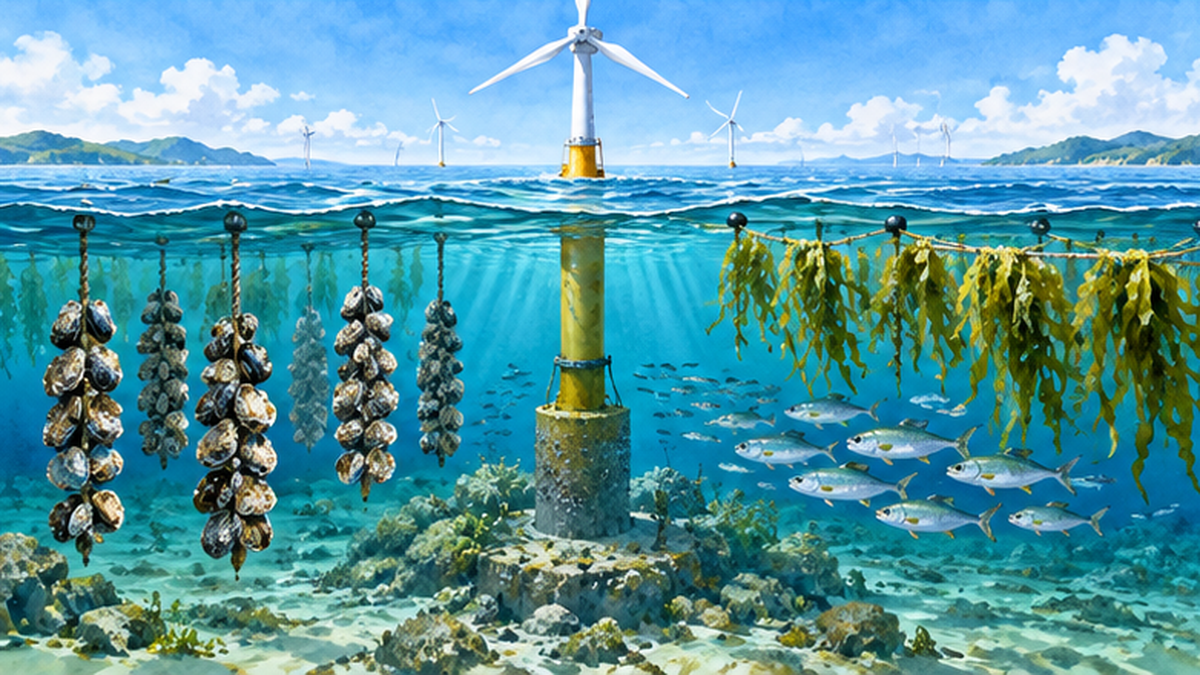
Around offshore wind farms, ship navigation and fishing operations may be restricted. If aquaculture could be carried out inside such an area, the sea could be used without waste, and fishers might gain a new source of income.
Expected benefits
- Effective use of space: The possibility of achieving power generation and food production in the same sea area
- Shared infrastructure: Sharing work-boat bases, transmission facilities and monitoring equipment is under consideration
- Coexistence with fisheries: Expected as a way to create new jobs locally
- Use of renewable power: The idea of supplying power for feeders and monitoring devices nearby
Anticipated challenges
- Safety in rough weather and equipment durability
- Interference and collision risk between turbine foundations or moorings and aquaculture facilities
- Securing work space for maintenance and inspection
- Legal rights (coordinating occupancy permits with fishing rights and zoned fishing rights)
- Little long-term data on environmental impacts so far
Key points of this section
- The aim is to reduce competition over sea use
- Economic benefits such as shared infrastructure are expected
- Safety, rights coordination and lack of environmental data are challenges
Research and cases overseas
In Europe, research on co-locating North Sea offshore wind farms and aquaculture began early. Buck and colleagues at Germany's Alfred Wegener Institute (AWI) have examined the feasibility of combining North Sea wind farms with open-ocean aquaculture since around 2002.
Assessment study in the German EEZ
A 2015 paper by Gimpel et al. (published in Marine Policy) used GIS and multi-criteria analysis to evaluate suitable sites for co-locating offshore wind farms and aquaculture in Germany's EEZ. Based on conditions such as temperature, salinity and oxygen, it examined the aquaculture suitability of 13 species including seaweed, shellfish, fish and crustaceans. According to the report, several wind farms were rated as suitable for aquaculture, and integrated multi-trophic aquaculture (IMTA) combining fish, shellfish and seaweed received high ratings. By species, a kelp (Laminaria digitata) was rated highest at depths of 10–20 m. The authors proposed pilot projects as the next step.
In Belgian waters as well, there is a document that reviewed more than 90 scientific papers and project reports and compiled recommendations for multiple uses of offshore wind areas.
Key points of this section
- In Europe, the possibility of co-location has been studied for over 20 years
- The German EEZ study found integrated aquaculture of seaweed, shellfish and fish promising
- Pilot projects are needed before full-scale operation
Efforts in Japan and coexistence with fisheries
In Japan, coexistence with fisheries is a major theme in introducing offshore wind. In fiscal 2022–2023, NEDO carried out a basic survey to understand the impact of offshore wind facilities on target fishery species. It was conducted by the Marine Ecology Research Institute and takes overseas survey cases into account.
What local councils ask for
The summary of opinions from the council for the sea off Goto City asks operators to establish a fund based on the principle of mutual prosperity with the region and fisheries and to ensure transparent operation, to decide the methods and timing of fishery impact surveys after hearing from the fishers concerned and experts, and to consult carefully with the fishers concerned while fully considering the effect on their operations.
Meanwhile, a contribution by a former Director-General of the Fisheries Agency points out that for floating offshore wind, conventional fishery promotion measures such as reef effects and maintenance jobs are unlikely to appeal to offshore fishers, and that the effects of multiple projects overlap. Combining with aquaculture could be one answer to these challenges, but we could not confirm demonstrations of such co-location in Japan in public documents in this survey. Future developments need to be watched.
Building consensus among stakeholders carefully will be just as important as the technology.
Key points of this section
- NEDO is investigating the effects of offshore wind on aquatic organisms
- Local councils ask operators for funds, surveys and consultation
- Domestic demonstrations of aquaculture co-location are not confirmed in public documents
Environmental benefits and risks
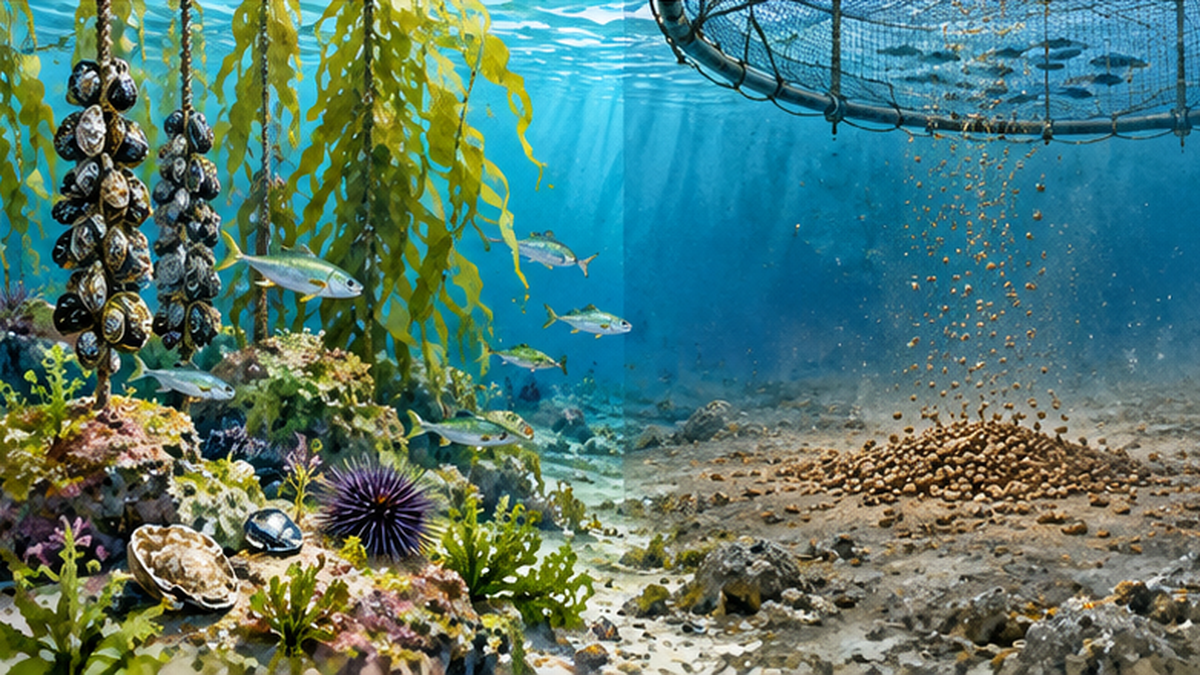
Seaweed and shellfish farming takes up nutrients and carbon from seawater, so links to water purification and blue carbon are being studied. However, methods for evaluating long-term carbon storage by aquaculture are still being established, and figures vary with studies and conditions.
Possible positive effects
- Uptake of nutrients and improved water quality by seaweed and shellfish
- Structures may serve as hiding places for fish (reef effect)
- Use of electricity that does not rely on fossil fuels
Points requiring caution
- Burden on the seabed environment from leftover feed and waste in fed aquaculture
- Effects of construction noise and vibration on marine life
- Risk of attachment and spread of invasive species
- Effects on birds and marine mammals
Key points of this section
- Seaweed and shellfish farming are expected to help water quality
- Caution is needed about the effects of fed aquaculture and construction
- Long-term data are scarce, so careful evaluation is required
What we can do and the outlook
Combining offshore aquaculture and renewable energy is still developing both technically and institutionally. That is why it matters to learn about it and take an interest in local discussions.
- Check plans for offshore wind and aquaculture in your area in municipal publications
- Choose seafood with a small environmental load, such as seaweed and shellfish
- Look for certified seafood (MSC, ASC, etc.)
- Use opportunities such as briefings and public comments to express your opinion
Points to watch
- Whether domestic pilot projects exist, and their results
- Development of rules to coordinate fishing rights and sea-area occupancy
- Results of long-term environmental monitoring
- Progress in cost reduction
Every initiative has benefits and challenges. We need an approach that decides how to use and protect the sea through scientific data and dialogue with local communities.
Summary
- Offshore aquaculture and offshore wind are studied as an idea of using the same sea area twice
- Site assessment has advanced in Europe, while coexistence with fisheries is the center of debate in Japan
- Benefits are expected, but demonstrations and long-term data are the key
References and sources
- NEDO Offshore Wind Power Cost Reduction Project – Floating offshore wind demonstration
- NEDO press release – Impact surveys of offshore wind on aquatic organisms, etc.
- Gimpel et al. (2015) Marine Policy – Assessment of co-locating offshore wind and aquaculture in the German EEZ
- Gimpel et al. (2015) paper PDF – AWI repository
- AWI Buck (2002) – Feasibility of North Sea wind farms and open-ocean aquaculture
- Ministry of Land, Infrastructure, Transport and Tourism press release – Promotion zones under the Offshore Renewable Energy Act
- Sasakawa Peace Foundation Ocean Newsletter – Offshore wind and fisheries
- Aichi Prefecture document – Floating offshore wind off Tahara and Toyohashi
* Ordered by reliability: government agencies & academic institutions > peer-reviewed papers > specialist organizations > reliable media