Forests of seaweed and muddy tidal flats actually absorb carbon dioxide (CO2) from the atmosphere and lock it away underground for decades. J Blue Credit turns this "ocean absorption power" into a value that companies can purchase. Starting from just a single 22.8-ton project in fiscal 2020, the system has since expanded to dozens of projects nationwide and has even been incorporated into Japan's national emissions trading scheme.
This article walks through, step by step, the science of how seagrass meadows and tidal flats absorb CO2, the process by which credits are created and delivered to companies, how prices are determined, and real examples of local fishing cooperatives earning revenue while continuing their conservation work. Difficult technical terms are explained in plain language along the way, so even first-time readers can grasp the full picture.
Decarbonization tends to bring to mind factories and electricity, but the ocean is actually a massive "carbon piggy bank." How do we create a flow of money to protect and grow that piggy bank? J Blue Credit is one Japan-born answer to that question.
What You'll Learn in This Article
- How J Blue Credit turns "CO2 absorbed by the ocean" into tradable value
- The scientific mechanism by which seagrass meadows and tidal flats absorb CO2 and lock it away on the seabed for the long term
- The process from credit certification and issuance to delivery to companies, and how prices are set
- Why and how companies use J Blue Credit for carbon offsetting
- The virtuous cycle in which local fishing cooperatives and municipalities earn revenue from credit sales and reinvest it in ocean conservation
- The system's expansion, including its incorporation into GX-ETS, and the challenges that remain to be overcome
What Is J Blue Credit? A System That Turns Ocean Absorption Power into Tradable Value
J Blue Credit is a uniquely Japanese system in which the amount of CO2 absorbed by ocean ecosystems such as seagrass meadows and tidal flats is verified by a third party, turned into a "certificate," and made available for companies and others to buy and sell. It is operated by an organization called the Japan Blue Economy Association (JBE), with certification and trading beginning in fiscal 2020 (Reiwa 2). It is easiest to think of it as a system that translates the ocean's natural "CO2-absorbing power" into visible economic value.
The key term here is blue carbon. Blue carbon refers to the carbon that coastal ecosystems — seaweed, seagrass, tidal flats, and the like — take in through photosynthesis and store in the seabed or in mud. Just as the carbon stored by forests on land is called "green carbon," the carbon stored by the ocean is called blue carbon. This concept is explored in more depth in our article on blue carbon ecosystems, which is worth reading alongside this one.
What exactly is being bought and sold as a "credit"?
In a nutshell, a carbon credit is a "certificate proving that 1 ton of CO2 has been reduced (or absorbed)." For example, if a fishing cooperative cultivates a seagrass meadow and that meadow is certified as having absorbed 10 tons of CO2 in a year, the cooperative receives 10 tons' worth of credits. A company that cannot fully cut its own CO2 emissions can then buy that credit and treat it as having "offset" its emissions — this is the basic idea behind credit trading.
What J Blue Credit handles, specifically, is the portion absorbed by ocean ecosystems. Unlike efforts to cut emissions at a factory, this system's distinguishing feature is that nature itself — the seagrass meadow or tidal flat — does the work of absorbing carbon. It is designed so that money flows directly into the conservation site itself. In other words, J Blue Credit is the first system to put a price on "ocean nature that, until now, earned not a single yen even when protected." Once a price is attached, protecting the ocean gains an economic rationale — and that is the shift in thinking this system is aiming for.

Which ocean ecosystems are covered
J Blue Credit covers so-called "blue carbon ecosystems" — those believed to absorb CO2 and store it for long periods. Specifically, these include the following types of sites, all familiar coastal landscapes that have long existed along Japan's shores.
- Seaweed meadows: Underwater forests thick with kelp, wakame, and species such as Eisenia and Ecklonia. Farmed wakame and kelp may also be eligible.
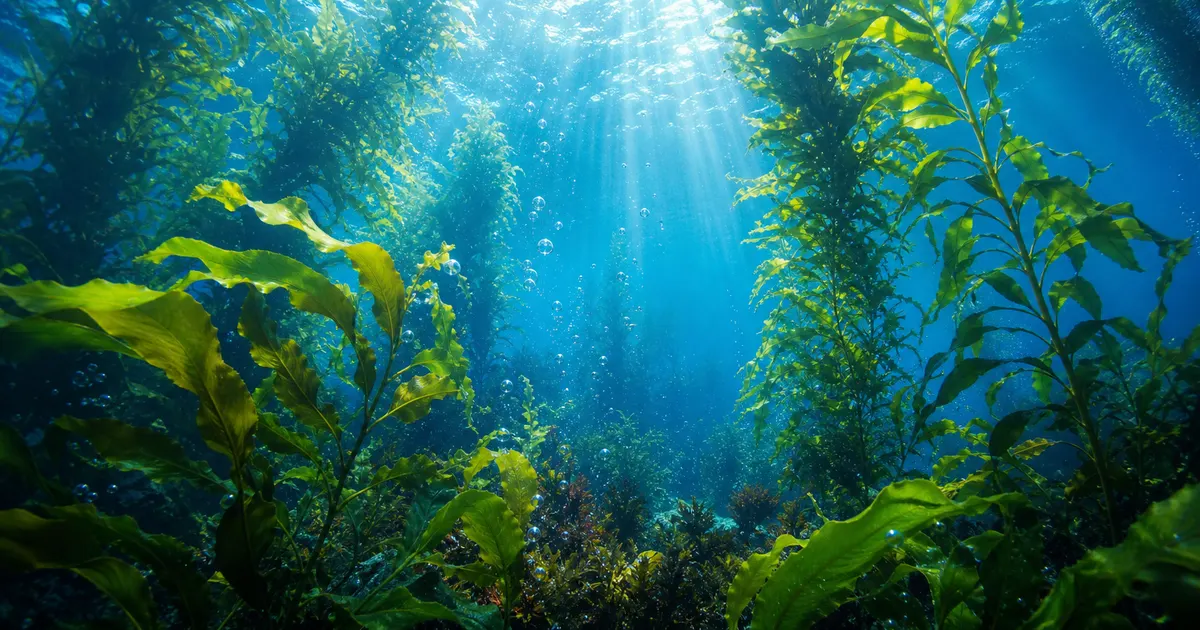
- Seagrass meadows: Ocean "grasslands" such as eelgrass (Zostera) that take root in sandy seabeds.
- Tidal flats and salt marshes: Muddy flatlands exposed by the ebb and flow of tides, including reed beds.
- Mangrove forests: Forests of tangled roots growing at subtropical and tropical river mouths.
The significance of tidal flat conservation itself is discussed in detail in our article on tidal flat conservation. These ecosystems are "multifunctional natural infrastructure" that serve not only as CO2 sinks but also as nurseries for fish and as natural water purifiers. That is precisely why their value should not be measured by CO2 absorption alone — protecting them also means protecting biodiversity, disaster resilience, and local livelihoods.
Why did this system originate in Japan?
The concept of blue carbon itself is international, first proposed in a 2009 United Nations Environment Programme (UNEP) report. But J Blue Credit stands as a globally advanced example in having implemented that concept as an actual credit system in society. For Japan — a nation surrounded by ocean on all sides, with a long coastline and abundant seagrass meadows and tidal flats — building a system to harness the ocean's absorptive power was a natural idea. Japan also faces the serious problem of seagrass meadows shrinking due to "isoyake" (a barren-ground phenomenon in which seaweed disappears), making the need to channel money toward conservation all the more urgent.
The national government is also backing this trend. In January 2023, the Ministry of the Environment, the Ministry of Agriculture, Forestry and Fisheries (Fisheries Agency), and the Ministry of Land, Infrastructure, Transport and Tourism jointly established the "Interministerial Liaison Conference on Blue Carbon," creating a framework that advances ocean carbon absorption across ministerial boundaries. This trinity of research, on-the-ground activity, and institutional support is what underpins the rapid expansion of J Blue Credit.
Key Points First
- J Blue Credit is a uniquely Japanese system that certifies and trades CO2 absorbed by the ocean (launched in fiscal 2020)
- It is operated by the Japan Blue Economy Association (JBE) and certified through review by a third-party committee
- Companies can use it for carbon offsetting, and the proceeds are returned to local conservation efforts such as fishing cooperatives
Why Do Seagrass Meadows and Tidal Flats Absorb CO2? The Science of Blue Carbon
So why can ocean plants reduce CO2 in the first place? The starting point is photosynthesis, something we all learned about in science class. Just like plants on land, seaweed and seagrass take in CO2 dissolved in seawater and use sunlight to build their own bodies (organic matter). Because atmospheric CO2 is continually replenished by dissolving into seawater, the more ocean plants flourish, the more CO2 is drawn from the atmosphere into the sea.
But simply taking in CO2 through photosynthesis is no different from what forests on land do. What makes blue carbon special is that the carbon it absorbs tends to stay locked away on the seabed for a long time. This is the ocean's unique strength.
The ocean excels at "locking in" carbon
When seaweed and seagrass die, some of it sinks to the seabed and becomes buried in mud. Because the mud is low in oxygen, decomposition by microorganisms proceeds very slowly, so the carbon stays stored, undecomposed, for decades — in some places for centuries. Compared with fallen leaves on land, which decompose within a few years and return to CO2, the mud on the ocean floor acts as a "vault the carbon can't easily escape from."
Carbon is also stored over the long term when broken-off fragments of seaweed are carried offshore and sink to the deep seafloor. The ocean is vast both horizontally and vertically, carrying carbon away to places beyond human sight and sequestering it there — and this sheer scale of space is exactly why the ocean is called a "carbon piggy bank." Seaweed, with its shallow roots, differs slightly from seagrass and tidal flats in that its stored carbon is transported offshore before sinking, and how to count this transport-and-deposition pathway is part of what makes calculating absorption amounts so difficult.
Each ecosystem has its own specialty
Even within the single category of "blue carbon ecosystems," each type stores carbon in its own way. Seagrass meadows, such as eelgrass beds, take root in sand and steadily build up carbon in the sediment around their roots. Seaweed meadows of kelp and wakame grow quickly and absorb large amounts of CO2, but their storage mainly occurs when broken fragments sink offshore. Tidal flats and salt marshes accumulate organic matter carried in by the tides, holding carbon for the long term in a low-oxygen environment. Understanding these differences is the starting point for accurately estimating how much CO2 any given activity actually reduces.

How much does Japan's ocean actually absorb?
According to estimates by the Ministry of the Environment and others, the CO2 absorbed annually by Japan's seagrass meadows and tidal flats amounts to roughly 1.32 million tons — by no means a small figure. Furthermore, in 2023 Japan began including the absorption by seagrass and seaweed in its official national greenhouse gas inventory (the formal tally of emissions and absorption). This was the first attempt in the world to count seaweed absorption as an official national figure, with roughly 350,000 tons per year of combined seagrass and seaweed absorption recorded for fiscal 2022.
What's more, this figure still has room to grow. If the Fisheries Agency's targets for restoring seagrass meadows and tidal flats are achieved, absorption is expected to increase further. Since this all depends on the health of the ocean environment itself, it is closely tied to issues such as rising seawater temperatures and their impact on fisheries. If the ocean weakens, this absorptive power wavers along with it.
The Difference from Green Carbon
Carbon stored by forests on land (green carbon) has a weakness: it can easily revert to CO2 through wildfires, logging, or the decomposition of fallen leaves. Blue carbon, by contrast, is locked away in low-oxygen seabed mud, making it more likely to be stored stably over the long term. Some research reports even indicate that, per unit of area, ocean ecosystems store carbon faster than forests on land.
One thing to keep in mind, however, is that the ocean's absorptive power is itself affected by climate change. If seawater temperatures rise and isoyake (the phenomenon in which seaweed disappears) progresses, the seagrass meadows themselves could be lost. Phenomena such as marine heatwaves (climate change and the waters around Japan) pose a direct threat to the foundation of blue carbon. That is exactly why a system to protect and nurture this absorptive power is needed.
How Are Credits Created? The Certification and Issuance Process
Given that the ocean absorbs CO2, how is that amount turned into "credits measured in tons"? This is the heart of J Blue Credit. The key point is that the absorbed amount is measured scientifically, and an independent third party verifies its validity. Simply having someone claim "we're absorbing a lot" is not enough to create a certificate.
The process from application to issuance
The general process is as follows. Fishing cooperatives, municipalities, companies, and others that are cultivating seagrass meadows or protecting tidal flats become applicants, calculating the CO2 absorption generated by their activities and applying to JBE. A third-party committee of experts independent from JBE reviews the application, and if it is judged valid, JBE certifies and issues it as a credit. Issued credits are recorded in a management ledger (registry) and managed to prevent double use.
- Activity: Carry out efforts that increase blue carbon, such as creating and conserving seagrass meadows, maintaining tidal flats, or aquaculture
- Calculation: Calculate the amount of CO2 absorbed using a prescribed method
- Application: Submit the calculation results and details of the activity to JBE
- Review: An independent third-party committee checks the scientific validity
- Certification and issuance: If approved, JBE issues the credit and registers it in the management ledger
- Sale: Prospective buyers are publicly recruited, and the credit is transferred to a company or other purchaser

Why third-party review matters
In the world of carbon credits, "padding" — making it look as though emissions have been reduced when they have not — and selling reductions on shaky grounds have become internationally recognized problems. These practices can lead to what is known as greenwashing, undermining trust under the guise of improving the environment. That is precisely why a process in which independent experts rigorously verify the measurement methods and assumptions behind absorption figures is indispensable. J Blue Credit places a third-party committee at the center of its system in order to guarantee this reliability.
There is also the fact that ocean absorption is even harder to measure than that of forests on land. Carbon in the sea is difficult to observe visually and varies greatly by season and location. Because the measurement methods themselves are still evolving, an ongoing commitment to refining the system through repeated scientific verification is required.
The concept of "additionality"
In the world of credits, there is an important concept called additionality. It asks the question: "Would this absorption have occurred at all without this particular activity?" If credit were given even for seagrass meadows that would have grown on their own regardless, the meaning of the credit would be diluted. The idea is that only the extra CO2 absorption created because people put in the effort to protect and nurture the meadow — that additional portion — should form the basis of the credit. The review process confirms the reality and validity of the absorption, including this point.
In addition, issued credits are centrally managed in a registry that records who holds each credit and when it was used. Once a credit has been used for offsetting, it is invalidated (retired) so it can never be used again — and this "one-time-use management" is what prevents double counting, in which the same absorbed amount is sold more than once. It is this unglamorous but essential record-keeping system that makes trading in invisible CO2 possible at all.
Caution: A Credit Is Not a "License to Emit"
Purchasing a credit is, first and foremost, a means of compensating for the portion of emissions a company cannot reduce on its own. Offsetting only has meaning once genuine efforts have been made to cut one's own emissions first. Guidelines both in Japan and abroad repeatedly stress that reduction must come first, with offsetting playing only a supplementary role.
How Are Credits Traded? Buyer Recruitment and Pricing
How do issued credits actually reach companies? Unlike stocks, whose prices fluctuate moment to moment on a market, J Blue Credit is based on a system of publicly recruiting prospective buyers project by project. When credits from a given project are issued, JBE solicits purchase applications, and the credits are then transferred to the companies and others that applied.
The unique "unit-based" sales method
A method frequently used in the transfer of J Blue Credit is what is called the unit-based system. This divides a fixed quantity of credits into units, and solicits buyers for those units. Its distinguishing feature is that it is designed so that the more companies apply, and the more units they request, the higher the transfer price per ton (the effective unit price) rises. In other words, the more popular a project is, the more money is channeled into its conservation activities.
This design reflects a goal of delivering as much revenue as possible to those carrying out the activity. Because the amount returned to the field increases as more companies wishing to show support gather around a project, the transaction takes on the character less of a simple sale than of "trading with a strong flavor of support."
| Fiscal Year | Certifications | Certified Volume (t-CO2) | Traded Volume (t-CO2) |
|---|---|---|---|
| FY2020 (Reiwa 2) | 1 | 22.8 | — |
| FY2021 (Reiwa 3) | 4 | 80.1 | 64.5 |
| FY2022 (Reiwa 4) | 21 | 3,733.1 | 178.7 |
As the table above shows, both the number of certifications and the certified volume grew substantially in the first few years after the system launched. FY2020 saw just a single project totaling 22.8 tons, but by FY2022 this had expanded to 21 projects totaling 3,733.1 tons. Projects have continued to increase since then, and as of 2026, dozens of projects have accumulated nationwide.

How high are the prices?
As for pricing, J Blue Credit tends to have a relatively high unit price compared with typical credits. For example, in FY2021 an average transaction price of about JPY 73,000 (72,816 yen) per ton has been reported. That is quite high compared with forest-derived credits, which sometimes trade for just a few thousand yen per ton.
Why is it so high? First, the effort and cost involved in measuring ocean absorption are considerable. Second, purchasing companies are often motivated less by a desire to "offset emissions cheaply" than by a wish to "support efforts to protect the ocean." In other words, the price of J Blue Credit reflects not just the value of CO2 itself, but also added value in the form of contribution to the local community and the sea.
How the Unit-Based System Works
For example, suppose a project publicly recruits buyers for 10 tons of credits divided into 10 units. If only one company applies, the unit price stays modest; but as more companies raise their hands and more units are filled, the price per ton rises. It is easiest to think of this as a system in which "the more buyers gather, the more the field benefits."
A high price is not a "weakness"
A high unit price might, at first glance, seem like a weakness of the system. But viewed differently, it also means that much more money reaches the field. In credit markets driven by competition on price, "suspiciously cheap credits of doubtful CO2 reduction" have often become a problem. J Blue Credit has deliberately positioned itself as a high-value credit by weaving the story of local contribution and ocean conservation into its price. Buyers, too, tend to regard their purchase not merely as a cost to be processed, but as an investment or a form of social contribution.

Why Do Companies Buy Credits? Use as Carbon Offsets
Why do companies buy J Blue Credit, which is by no means cheap? On the surface, the purpose is carbon offsetting — compensating for CO2 emissions a company cannot fully cut by relying on absorption or reduction elsewhere. But in the case of J Blue Credit, there is more to it than that. Through their purchase, companies gain a story: that they are "participating in efforts to protect the ocean."
The basic concept of offsetting
Carbon offsetting is the idea that a business should first reduce the CO2 generated by its operations as much as possible, and then offset whatever remains by, for example, purchasing credits. Order matters here: the international principle is that the effort to reduce comes first, offsetting comes after. Using offsets alone to make emissions "disappear" is not the intent of the concept. It is within this framework — deciding which credit to use to cover residual emissions once this principle has been honored — that J Blue Credit comes into the picture.

Examples of companies that have purchased credits
In fiscal 2020, when the system began, major corporations such as Sumitomo Corporation, Seven-Eleven Japan, and Tokyo Gas became buyers of J Blue Credit. The shipping company Mitsui O.S.K. Lines has offset the CO2 emissions generated by delivery voyages of a new electric-powered tanker using credits generated from seagrass and tidal flat restoration activities. It is a symbolic case of a business deeply connected to the sea — shipping — offsetting its emissions through ocean conservation.
For these companies, J Blue Credit is not just about balancing the numbers. The fact that they are supporting the local sea and fishing industry becomes a concrete story they can tell employees, customers, and the community. In recent years, more companies have been communicating these activities through integrated reports and sustainability reports, and the ocean field has become an ideal theme for discussing SDGs and ocean initiatives.
The fact that these activities take place along Japan's own coastline is also a major advantage. With overseas credits, it can be hard to confirm whether forest conservation in a distant country is genuinely being sustained, and there are risks tied to exchange rates and local conditions. J Blue Credit, carried out in Japan's own waters, allows companies to actually visit the site and build relationships with the people they are supporting. As a "face-to-face offset," it is a choice companies can make with confidence. This is especially true for industries with deep ties to the sea, such as food, retail, and shipping, where business activities connect directly to the theme of conservation.
- Offsetting residual emissions: Compensating for CO2 that cannot be reduced, using blue carbon
- A story worth telling: Gaining a narrative about protecting the local sea and fishing industry
- Contained within Japan's own coast: Geographically and psychologically closer, and easier to explain, than overseas credits
- Building relationships with partners and communities: Collaboration with fishing cooperatives and municipalities creates new connections
Main Reasons Companies Choose J Blue Credit
- Offset residual emissions while directly contributing to ocean conservation
- Concrete, domestic, coastal activities that are easy to explain to consumers and employees
- Collaboration with local fishing cooperatives and municipalities builds brand value and trust
Revenue for Local Fishing Cooperatives: Case Studies in the Flow of Money
The most important significance of J Blue Credit lies in the fact that money reaches the site of ocean conservation itself. Activities such as cultivating seaweed or watching over seagrass meadows involve steady, unglamorous costs — boat fuel, labor, and more. Until now, this burden was often shouldered out-of-pocket by fishing cooperatives and municipalities, and securing funds to sustain these activities was a challenge. Revenue from credit sales can become a new source of funding to support this work.
Yokohama's fishing cooperative: carbon and money born from aquaculture
In Yokohama City, Kanagawa Prefecture, a fishing cooperative earns credits by cultivating farmed wakame and kelp, and channels the proceeds into monitoring and managing its seagrass meadows. Here, the cycle of cultivate → absorb → turn into credits → revenue flows back into conservation has actually begun turning. Yokohama had already been running its own "Yokohama Blue Carbon" initiative since 2014, cultivating fertile ground in which companies and organizations support the conservation of the local sea.
Companies, fisheries federations, and municipalities join forces: the Chiba case
In Chiba Prefecture, Nippon Steel, the Chiba Prefectural Federation of Fisheries Cooperative Associations, and the city of Kimitsu worked jointly to generate blue carbon, and were certified as the nation's first case in which a company, a fisheries federation, and a municipality united as one. A company from an emissions-heavy industry like steelmaking joining forces with local fishers and the municipal government to nurture seagrass meadows — this represents a new form of collaboration in which three parties with different standpoints all come together on the side of protecting the same sea.

Building seagrass meadows with steel slag: Hokkaido's challenge
In Hokkaido, Nippon Steel and the Mashike Fisheries Cooperative Association have advanced an initiative to build seagrass meadows using steel slag, a byproduct of steelmaking, and it was certified as J Blue Credit in 2022 (the first credit issuance nationwide jointly certified by a fisheries cooperative and a private company). The idea is to use a byproduct that would otherwise be discarded as a foundation on which seaweed can grow. It is also drawing attention as a technology for restoring waters where seaweed has declined due to isoyake, and can be seen as an attempt to solve industrial and fishing challenges at the same time.
Cases have spread nationwide, including in Shunan City in Yamaguchi Prefecture and Uruma City in Okinawa Prefecture. In Uruma City, TOPPAN Digital, the Katsuren Fisheries Cooperative, and the city government worked together to generate credits through mozuku seaweed farming. Shunan City received certification for 95.6 tons of J Blue Credit in fiscal 2024 (Reiwa 6), and its annual certificate-issuance ceremony also serves as a venue for activity reports and discussion. According to a Ministry of the Environment compilation, the number of blue carbon initiative sites nationwide had reached 57 locations (45 cases) as of December 2023, and continues to grow.
"Revenue" is not the only goal
What must not be overlooked here is that, for many fishing cooperatives, credit income itself is still by no means a large amount. For certifications on the scale of a few dozen tons, the money earned may only cover a portion of activity costs. Yet initiatives continue to spread across the country because the effects go beyond money. Through the process of turning their work into credits, the value of their own sea becomes "visible," and connections form with companies, government, and citizens. Young people taking up marine work can feel pride in it. These ripple effects are the true motivation behind local participation in the system.
| Region | Main Participants | Features of the Initiative |
|---|---|---|
| Yokohama City, Kanagawa Prefecture | Local fishing cooperative, Yokohama City, companies | Farmed wakame and kelp, with revenue reinvested in seagrass meadow monitoring |
| Kimitsu City, Chiba Prefecture | Nippon Steel, prefectural fisheries federation, Kimitsu City | Nation's first joint case combining a company, a fisheries federation, and a municipality |
| Mashike, Hokkaido | Nippon Steel, Mashike Fisheries Cooperative Association | Seagrass meadow creation using steel slag (certified 2022; nation's first fisheries cooperative × company case) |
| Uruma City, Okinawa Prefecture | TOPPAN Digital, Katsuren Fisheries Cooperative, the city | Credit generation through mozuku seaweed farming |
What You Can Do in Your Own Community
- Look into whether your local fishing cooperative or municipality is engaged in blue carbon initiatives
- Choose and buy local seafood to support fisheries that sustain healthy seagrass meadows
- Take part in cleanup and observation events for seagrass meadows and tidal flats, and see changes in the sea with your own eyes
The System's Expansion and Challenges Ahead
J Blue Credit has been advancing from an experimental initiative toward becoming part of Japan's national decarbonization policy. Symbolic of this is its linkage with GX-ETS, the national emissions trading scheme. Already-certified and issued J Blue Credit has been approved as an eligible carbon credit usable in GX-ETS Phase 1. This means ocean absorption has now entered the arena of Japan's official emissions trading.
What incorporation into GX-ETS means
GX-ETS is a framework in which companies take responsibility for their own emissions and can use credits to help achieve reduction targets. Now that J Blue Credit can be used within it, corporate demand for ocean-based credits is expected to rise even further. The government's recognition that "ocean absorption also counts officially" has greatly boosted the system's credibility and future prospects. Of the projects already certified and issued, dozens are now registered as eligible for this qualified-credit status. Having moved beyond the experimental stage, ocean credits can now be said to have earned a formal place within Japan's national decarbonization framework.
This rising demand is a tailwind for the field. As buyers increase, the unit price under the unit-based system rises, channeling more money into conservation. At the same time, it raises the question of whether high-quality credits can continue to be supplied in sufficient volume to meet that demand. If review standards are relaxed in pursuit of numbers, the trust built up so far could be undermined. How to balance expansion with rigor is the focus of the next stage.

Remaining challenges
At the same time, obstacles remain that must be overcome for the system to take genuine root. The biggest challenge is how to accurately measure absorption and guarantee it over the long term. Ocean carbon is difficult to measure, and even carbon once stored risks escaping if the seagrass meadow is lost to isoyake or high water temperatures. This leaves blue carbon caught in a contradiction: climate change itself shakes the very foundation on which it rests.
- Difficulty of measurement: Carbon in the sea is invisible and varies by season and location
- Uncertain permanence: If a seagrass meadow is lost to isoyake or high water temperatures, the carbon it stored escapes as well
- Cost and labor: Calculation and conservation activities are labor-intensive, placing a heavy burden on small fishing cooperatives
- Maintaining credibility: The need to prevent padding and overestimation and continue to preserve international trust
These challenges connect to the broader problems facing the marine environment. An increase in creatures that devour seaweed, and isoyake caused by rising water temperatures, can wipe out seagrass meadows entirely. Neither the problem of ghost gear — drifting fishing equipment and other debris that damages ecosystems — nor the mechanism of coral bleaching, in which corals whiten and die, is unrelated to the health of the ocean that underpins blue carbon. For the long-term, sustained effects of marine heatwaves, the long-term ecosystem impact of marine heatwaves is also a useful reference. What is needed is the idea of channeling revenue earned from credits back into countermeasures for these very problems.
Can We Keep "Measuring and Protecting"?
The success or failure of the blue carbon system hinges on two wheels turning together: the capacity to keep measuring absorption scientifically, and the capacity to keep actually protecting and nurturing seagrass meadows and tidal flats. Both the technology and the system are still evolving — which is exactly why how well on-the-ground activity, research, and the flow of money that supports them mesh together will determine the path ahead.
Conclusion: Building a Flow of Money to Protect the Ocean
J Blue Credit is a system that turns the CO2 quietly absorbed by seagrass meadows and tidal flats into visible value, delivering money to the sites where the ocean is being protected. Starting from just a single project in fiscal 2020, this system has steadily expanded by connecting with corporate demand for carbon offsetting and with the national emissions trading scheme.
Of course, challenges remain, such as the difficulty of measurement and the uncertainty of permanence. Even so, there is great meaning in the direction itself — ocean conservation becoming part of a sustainable economy rather than something that depends on volunteers. Each of us, too, can become part of this movement through small actions, such as choosing local seafood or learning about ocean initiatives.
What matters is not to over-trust J Blue Credit as a "magic solution." A credit is, in the end, merely a complementary tool that only has meaning once genuine efforts to reduce emissions come first. With that understood, the blessings of the sea — which until now carried no price — are being recognized for their rightful value, and money is reaching the hands of the people who protect them. This quiet shift has the power to change the relationship between the ocean and people over the long run. Forests of seaweed and muddy tidal flats stand at the front line of decarbonization, a challenge on a planetary scale. Once you think of it that way, even the familiar view from the beach should start to look a little different.
Summary of This Article
- J Blue Credit is a uniquely Japanese system that certifies and trades CO2 absorbed by the ocean following third-party review (launched in fiscal 2020, operated by JBE)
- Seagrass meadows and tidal flats lock the carbon captured through photosynthesis away in low-oxygen seabed mud for the long term; Japan's absorption is estimated at roughly 1.32 million tons per year
- Credits are sold through unit-based public offerings; the unit price is relatively high, but that added value stems from the contribution of ocean conservation
- Companies gain a "story of protecting the ocean" alongside their offset, while fishing cooperatives and municipalities can reinvest credit revenue into conservation activities
- While the system continues to expand, having also been approved as an eligible credit under GX-ETS, ongoing efforts to address challenges such as measurement, permanence, and cost remain key
References and Sources
- Ministry of the Environment, Japan – What Is Blue Carbon? (CO2 Sink Measures Using Seagrass Meadows and Tidal Flats)
- Interministerial Liaison Conference on Blue Carbon (Ministry of the Environment) – Compilation of Blue Carbon Initiative Case Studies in Japan (December 2023)
- Japan Blue Economy Association (JBE) – J Blue Credit Certification and Issuance / Public Offering / Certification Application
- Ports and Harbours Bureau, Ministry of Land, Infrastructure, Transport and Tourism – Status of the Blue Carbon Credit System (J Blue Credit)
- Fisheries Agency of Japan – Study Report on a System for Sustainable Seagrass Meadow Maintenance and Conservation Using Blue Carbon Credits (March 2024)
- Ministry of Agriculture, Forestry and Fisheries – Overview of the J Blue Credit System (Domestic)
- GX League Secretariat – Guidelines on the Use of Eligible Carbon Credits in GX-ETS (April 2024)
- Port and Airport Research Institute – Blue Carbon: CO2 Absorption by Coastal Ecosystems
- Mitsui O.S.K. Lines – Participation in Blue Carbon Offsetting Through J Blue Credit (Press Release)
*Listed in order of reliability: government and academic institutions > peer-reviewed papers > specialized organizations > reliable media