Between 2015 and 2016, the carcasses of emaciated seabirds washed up one after another on the beaches of the U.S. West Coast. From California to Alaska, roughly 62,000 were confirmed dead. Accounting for the far larger number that sank at sea and were never found, the total death toll is estimated at around one million. The culprit was neither disease nor an oil spill, but a single cause: the ocean had become abnormally hot.
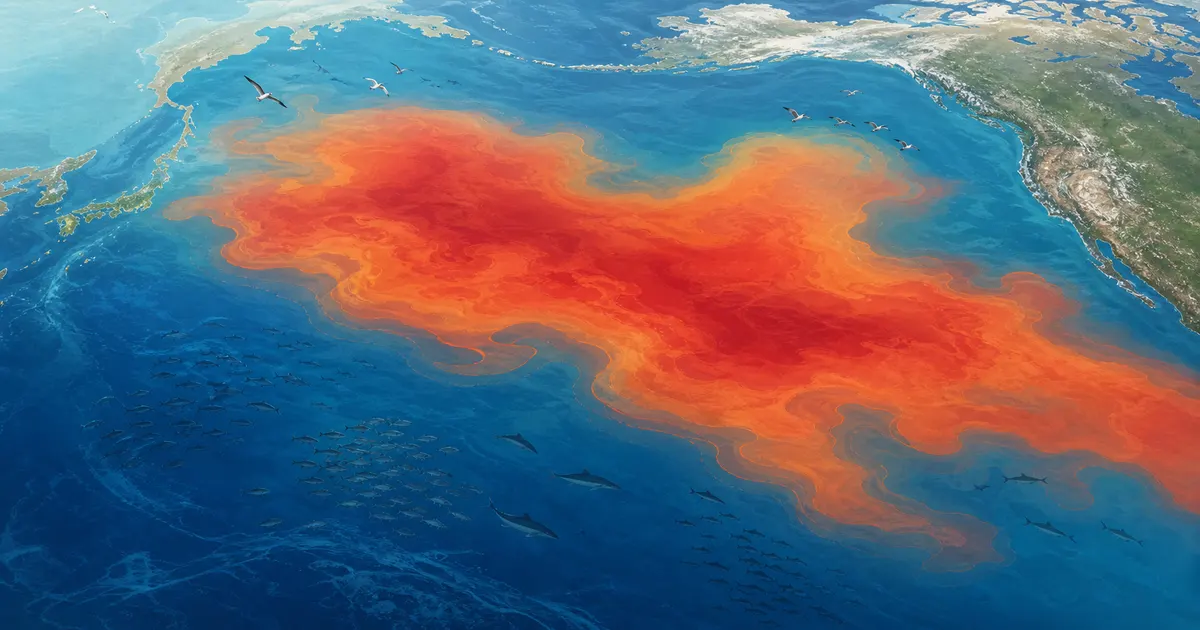
The source of this heat was a massive pool of warm water called "The Blob," which covered the Northeast Pacific from late 2013 through 2016. At its peak, it spanned roughly 4 million square kilometers—about ten times the area of the Japanese archipelago—with sea temperatures up to 3-4°C above normal.
Beneath the surface, the food web collapsed from the bottom up, invisibly: cod stocks were devastated and sea lion pups starved on the shore.
The basic definition and mechanics of marine heatwaves are covered in a separate article, "What Is a Marine Heatwave?" This article goes a step further, using the iconic case of the Blob to trace, based on primary sources from NOAA, the Japan Meteorological Agency, the Fisheries Agency of Japan, and the IPCC, how marine heatwaves kill fish, shift species distributions, devastate aquaculture, and leave lasting scars on ecosystems.
What you will learn in this article
- What "the Blob" was—the full picture of the record-setting marine heatwave that covered the Northeast Pacific for nearly four years
- The mechanism by which marine heatwaves raise sea surface temperatures several degrees above normal (weakened winds, stratification, suppressed upwelling)
- How the collapse of the food web, from plankton to seabirds and marine mammals, leads to mass die-offs
- The distribution shifts already changing Japan's dinner table, including the northward advance of yellowtail and poor catches of Japanese flying squid and Pacific saury
- The damage and countermeasures occurring on the front line of aquaculture, exemplified by the record die-off of scallops in Mutsu Bay
- The background behind marine heatwaves becoming the "new normal," and the regime shifts that leave lasting scars on ecosystems
The Blob—A "Giant Mass of Heat" Appears in the Pacific
In the winter of 2013, warm water spread like a giant stain off the coast of the Gulf of Alaska. Oceanographers called it "The Blob." Initially thought to be a temporary phenomenon, this pool of warm water not only failed to disappear but grew, expanding as it drifted south along the west coast of North America through 2014 and 2015. It remained lodged in the Northeast Pacific until mid-2016—nearly three years in total.
According to observations by NASA and NOAA, sea surface temperatures within the Blob exceeded normal by as much as roughly 3°C, and locally by over 4°C. At its peak, it stretched thousands of kilometers both east-west and north-south, reaching an area of about 4 million square kilometers. This is among the largest marine heatwaves on record, and later research found it coincided with the strong El Niño of 2015-2016, pushing North Pacific sea surface temperatures to historic highs.
Despite its endearing name, the Blob's true nature was extremely destructive to ecosystems. The warm water extended not only across the surface but, in places, to depths exceeding 100 meters, heating even the mid-water layers where fish would normally retreat to find cooler refuge. Having lost any place to escape, marine life was subjected for a prolonged period to a double burden: the heat itself, and the food shortage described below. When a marine heatwave is "wide, deep, and long" all at once, the damage becomes disproportionately severe. The Blob was the textbook example.
Defining an "Ocean Heatwave" in Numbers
A marine heatwave is not a matter of impression but is defined by clear criteria. Under the widely used Hobday definition, a marine heatwave occurs when the daily sea surface temperature in a given ocean region exceeds the 90th percentile (the top 10% of values) for the same period over roughly the past 30 years, for five or more consecutive days. Intensity is classified into four categories—"moderate," "strong," "severe," and "extreme"—based on the departure from the normal value.
Viewed through this lens, the Blob was not simply "a hot year" but an anomalous event in which heatwaves of multiple categories persisted over a long period and a vast area. Whereas heatwaves on land typically end within a few days, the ocean readily stores heat and cools slowly, so once a marine heatwave begins it can last from several months to several years. This persistence is precisely why it inflicts such deep damage on ecosystems.

Why Focus on the Blob Alone?
Marine heatwaves occur all over the world, but what makes the Blob special is that its scale, duration, and impact on ecosystems were meticulously documented by science. Mass seabird die-offs, starving marine mammals, the collapse of fishery resources, massive red tide outbreaks—there is no other example in which the chain of damage from a single heatwave has been tracked in such detail. The Blob is the "textbook" that teaches us what a marine heatwave does to an ecosystem.
And this story does not end on the far side of the Pacific. Similar high water temperatures are becoming frequent in the waters around Japan as well, and as described later, they are beginning to have serious effects on fish distribution and aquaculture. Readers who want an overview of changes in the marine environment as a whole should also read the article on rising sea temperatures and fisheries, which will help place this article in context.
Key points of this section
- The Blob was a massive marine heatwave that covered the Northeast Pacific from 2013 to 2016, reaching roughly 4 million km² with temperatures up to +4°C above normal
- A marine heatwave is defined as a high water temperature that exceeds the 90th percentile of the normal range for five or more consecutive days
- Because the ocean readily stores heat, heatwaves can last months to years, inflicting greater damage on ecosystems
Why Does the Ocean Get So Hot?—The Mechanism Behind Marine Heatwaves
For the sea to warm by several degrees Celsius requires a "mechanism" capable of storing a huge amount of heat. In the case of the Blob, multiple factors combined to keep the sea surface at an abnormally high temperature. At the center of it all was a weakening of atmospheric circulation.
Weaker Winds Mean the Ocean Stops Mixing
During the winter of 2013-2014, a persistent high-pressure system sat over the North Pacific, weakening the strong winds and storms that would normally stir the sea surface. When winds are weak, the warmed surface water fails to mix properly with the colder water below. As a result, heat absorbed from the sun kept accumulating at the surface, and because winter cooling never fully set in, the warm water carried over into the following year.
Furthermore, wind-driven upwelling—the flow that brings cold, nutrient-rich water from the depths up to the surface—also weakened. Upwelling not only cools the sea surface but is also a lifeline that delivers nutrients to phytoplankton. Its cessation was also the trigger for the collapse of the food web described later. It is important to note that a marine heatwave is not simply a phenomenon of "the ocean warming"—it is also a phenomenon in which "the circulation of ocean nutrients grinds to a halt."
It helps to compare this with heatwaves on land. Because air heats and cools quickly, land heatwaves usually end within a few days. Water, however, has a vastly greater heat capacity than air and does not easily release the heat it has absorbed. That is why marine heatwaves can last from months up to, as with the Blob, several years. For marine life, this means being forced into a "long war" with no end in sight, no matter how far they flee. This sheer duration is the biggest reason marine heatwaves inflict deeper damage on ecosystems than heatwaves on land.

Stratification—When the Ocean Splits into Two Layers
This state, in which warm, light surface water and cold, dense deep water become clearly separated, is called "stratification." As stratification strengthens, the ocean becomes a two-layer structure that resists vertical mixing—the surface warms even further while nutrients from the deep layer become harder to reach. Because global warming itself pushes the ocean toward stronger stratification, warming is laying the groundwork that makes marine heatwaves both more likely and longer-lasting.
In the case of the Blob, this stratification was especially strong and long-lasting. In the marine heatwave observed off Sanriku, Japan in 2023, unprecedented high temperatures were recorded down to a depth of 300 meters—showing that a marine heatwave is not merely a "surface phenomenon" but a three-dimensional event that stores heat down into the mid-water layers.
Atmosphere-Ocean Interaction Amplifies the Heatwave
High water temperatures feed back further into the atmosphere. When the sea surface is warm, low clouds become less likely to form, allowing more sunlight to reach the surface and push temperatures even higher. In addition, water vapor evaporating from the warm ocean strengthens the greenhouse effect, helping to sustain the high-pressure system above—a positive feedback loop. Research from the University of Tokyo and others points out that this interaction between the marine heatwave and the atmosphere likely contributed significantly to the record-breaking heat that hit northern Japan in the summer of 2023. Ocean heatwaves are connected to heatwaves on land as well.
| Factor | Mechanism | Impact on ecosystems |
|---|---|---|
| Weaker winds and storms | Surface and deep layers fail to mix, warm water accumulates | High temperatures persist and organisms lose places to escape |
| Suppressed upwelling | Cold, nutrient-rich deep water fails to reach the surface | Phytoplankton become nutrient-deficient |
| Stronger stratification | The ocean splits into two layers, trapping heat | Mid-water layers warm and become nutrient-poor |
| Atmosphere-ocean feedback | Fewer clouds and more water vapor sustain the heating | The heatwave lasts longer and spreads to heatwaves on land |
Terms worth remembering
- Upwelling: The flow of cold, nutrient-rich deep water rising to the surface. It sustains the ocean's productivity
- Stratification: A state in which warm surface water and cold deep water fail to mix and separate into two layers
- Positive feedback: A chain reaction in which a change reinforces itself further. It prolongs heatwaves
The Food Web Collapses from the Bottom Up—Plankton and the Chain of Prey
The true terror of a marine heatwave lies less in the high temperature itself than in the "chain reaction" it triggers. Especially fatal is the collapse that begins at the very bottom of the food web—with phytoplankton.
Without Nutrients, Phytoplankton Decline
When upwelling is suppressed and stratification strengthens, the nutrient salts (nitrogen and phosphorus) that phytoplankton need for photosynthesis stop reaching the surface. The ocean's food web is built up entirely from this foundation of phytoplankton. If production at the base falls, every layer above it grows leaner. How phytoplankton support the ocean's oxygen and food web is explained in detail in the article on phytoplankton and ocean oxygen.
During the Blob, phytoplankton in the North Pacific not only declined in quantity but also changed in "kind." Low-nutrient, nutrient-poor plankton species that favor warm water came to dominate. It was as if the sea changed from a lush, green pasture into a lean wasteland. Even if it still looks "green," its capacity to sustain the life that depends on it is entirely different. This "degradation in quality" is harder to see than a decline in quantity, and the damage tends to go unnoticed until it surfaces.
"Fatty Prey" Disappears
This change also spread to the next layer up: zooplankton. Lipid-rich copepods, common in cold water, declined, replaced by lower-fat, southern small species. Zooplankton are the staple food of forage fish such as sardines and krill. As high-calorie prey was replaced by low-calorie prey, the overall "nutritional density" of the ocean thinned out.

Both the "Quantity" and "Quality" of Small Fish Decline Simultaneously
Adding insult to injury was the rise in sea temperature itself. Ectotherms such as fish become more metabolically active as water temperature rises, requiring more energy. In other words, under a heatwave, the worst possible combination arises: the quantity and quality of prey decline while the calories needed actually increase. Forage fish such as sardines grew thin from malnutrition, and both their numbers and quality declined.
When the base of the food web collapses, the effects ripple out to every organism that depends on it. As the next section shows, this "collapse of prey" was the direct trigger for the mass die-offs of seabirds and marine mammals, and the collapse of commercial fish stocks. Disruption in the ocean always begins at its weakest foundation.
This chain reaction is also why we are slow to notice changes in the ocean. A decline in phytoplankton is visible only via satellite, and changes in the quality of zooplankton can only be understood by waiting for expert surveys. Beneath a seemingly calm ocean that is merely a few degrees warmer at the surface, the foundation of the ecosystem has already begun to crumble. By the time seabirds wash up on the shore and the public finally notices, the damage has long since spread. This is precisely why continuous monitoring of water temperature itself, to catch early signs of disruption, is becoming ever more important.
An easily overlooked chain reaction
The damage from a marine heatwave is not simply a matter of "fish dying from high heat." In most cases, organisms die from "starvation" caused by the collapse of the base of the food web. A change in plankton that is invisible to the eye appears months later as a mass die-off of seabirds and marine mammals on the shore.
Fish Vanish, Birds Fall—The Reality of Mass Die-Offs
The collapse of the food web eventually manifested as a visible tragedy on the shore. The mass die-offs that occurred in the Northeast Pacific during the Blob shook scientists with their sheer scale.
About One Million Seabirds Starved to Death
From the summer of 2015 through the spring of 2016, the carcasses of roughly 62,000 common murres washed up on shores from California to Alaska. Most were extremely emaciated, and the cause of death was starvation. Given that only a small fraction of birds that die at sea ever wash ashore, researchers estimated the total death toll at about one million. In late 2014, a species of auklet (Cassin's auklet) also washed up in mass numbers along the Pacific Northwest. As a single-heatwave seabird die-off, it ranks among the largest on record.
The seabirds starved because the quantity and quality of their staple food—small forage fish—declined. The food web collapse described in the previous section erupted, with a lag of a few months, as starvation among these winged predators. The common murre is a fuel-inefficient bird that must eat a substantial portion of its body weight in fish every day just to survive. Even a slight drop in prey density is enough to make it abandon breeding and eventually perish. Indeed, breeding failures were reported at colonies across the region during this period, and the mass die-off left its mark on population numbers for years afterward.

Sea Lion Pups, and Whales Too
The damage was not limited to seabirds. Between 2013 and 2016, as many as an estimated 4,000 emaciated California sea lion pups washed up on the coast of California, prompting NOAA to declare an "Unusual Mortality Event" for the species. This is believed to have occurred because mother sea lions could not obtain enough food to nurse their pups. Whale deaths also increased during this period, with marine mammals as a whole coming under pressure from food shortages.
The Collapse of Cod Stocks—The First-Ever Fishery Closure
The species that suffered the greatest commercial blow was Pacific cod. Having been in good shape before the Blob, cod stocks in the Gulf of Alaska plummeted by nearly 80% between 2013 and 2017 (a 2017 bottom trawl survey found roughly 46,000 tons—the lowest level on record). This is believed to be because juveniles could not survive the high temperatures, and adults could not obtain enough food to keep up with their increased metabolic demands.
As a result, the Gulf of Alaska's Pacific cod fishery was effectively closed heading into the 2020 fishing season. This marked the first time this fishery had been closed since the enactment of the Magnuson-Stevens Fishery Conservation and Management Act in 1976. A marine heatwave had shut down an entire fishery and the regional economy that depended on it.
What should not be overlooked is that this damage was not a series of "separate incidents" but a single connected chain. Weakened winds halted upwelling, nutrient deficiency starved phytoplankton, the quantity and quality of forage fish declined, and downstream, seabirds starved, sea lion pups went hungry, and cod juveniles failed to grow, collapsing the stock. The Blob demonstrated, more vividly than any other example, how a single episode of high water temperature can topple the ocean's food web like a row of dominoes, end to end. Grasping the damage from a marine heatwave as a "chain" rather than isolated "points" is the key to understanding its true terror.
| Species affected | Nature of the damage | Primary cause |
|---|---|---|
| Common murre (seabird) | Estimated ~1 million starved to death | Starvation from decline in quantity and quality of forage fish |
| California sea lion | Up to ~4,000 pups weakened and washed ashore / Unusual Mortality Event declared | Malnutrition and failed nursing among mother animals |
| Pacific cod | Stock down ~80% vs. 2013 / first-ever fishery closure | Lower juvenile survival, increased metabolic demand |
| Salmon, walleye pollock | Lower recruitment, higher mortality | Deteriorating food environment and distribution shifts |
Key points of this section
- During the Blob, roughly one million common murre seabirds and up to about 4,000 sea lion pups died or were weakened
- Most died of "starvation" caused by the collapse of prey, rather than the heat itself
- Pacific cod stock in the Gulf of Alaska fell by about 80%, forcing the fishery's first-ever closure
Distribution Shifts—The Change in the Sea Striking Japan's Dinner Table
A marine heatwave does not just kill wildlife—it also "relocates" the fish that survive. As water temperatures rise, fish that prefer cold water flee north or into deeper water, and warm-water fish follow in their wake. This shift in distribution is not a story confined to the distant Pacific—it is unfolding right now in Japan's seas and on Japan's dinner table.
Fish Heading North
According to the Climate Change Adaptation Platform (A-PLAT) and the Japan Fisheries Research and Education Agency, yellowtail, a warm-water fish, has expanded its distribution and migratory range from Tohoku to Hokkaido, and catches are increasing. Spanish mackerel, once considered a "western" fish, has also moved north through the Sea of Japan, passed through the Tsugaru Strait, and expanded its range as far as the Sanriku coast. The sight of yellowtail being landed in Hokkaido—unthinkable not so long ago—has become reality.
Meanwhile, fish that prefer cold water are struggling. The distribution of Japanese flying squid in the Sea of Japan has shifted north, moving fishing grounds into waters off South Korea and Russia. Pacific saury has also stopped approaching Japanese waters due to high temperatures, and catches have remained at record lows. The fish have not "disappeared"—they have "moved" out of reach of Japan's fishing fleets.
Distribution shifts do not end with the fish simply relocating. When spawning grounds and migration timing shift, a mismatch can arise between when juveniles hatch and when the plankton they feed on bloom, reducing the number of offspring that survive. This is called a "mismatch." Marine heatwaves increase this kind of misalignment, creating a situation in which even if the parent fish are present, the next generation fails to grow well. Behind the northward shift in distribution, this kind of reproductive stumble is quietly progressing.

Why Are the Seas Around Japan Especially Vulnerable?
Sea surface temperatures around Japan are rising at a rate of +1.33°C per 100 years—more than twice the global average. Moreover, the annual average sea surface temperature in 2023 was the highest since records began in 1908, and 2024 broke that record again. Because a marine heatwave is layered on top of a rising baseline average temperature, the seas around Japan have become a "hotspot" prone to extreme high temperatures. Readers interested in the richness and vulnerability of Japan's biodiversity should also read the article on marine biodiversity in Japan.
In the summer of 2023, sea surface temperatures off northern Japan were the highest since 1985, and in September, an extreme high-temperature zone appeared with anomalies of +4°C southeast of Hokkaido and east of Honshu, and +3°C in the Sea of Japan. This means a marine heatwave comparable in scale to North America's Blob was occurring right off the coast of Japan.
Ripple Effects on the Dinner Table and Fishery Management
Distribution shifts directly shake up fisheries and the dinner table. Regions that have long caught a particular fish lose their landings, and even regions newly visited by fish cannot turn that into profit without the fishing methods, distribution, and processing infrastructure in place. Soaring fish prices, shifting production regions, seasonal foods becoming unavailable—a marine heatwave is not a distant natural phenomenon but an issue directly connected to what we eat every day. The full impact on fisheries is covered comprehensively in the article on rising sea temperatures and fisheries.
Fish on the rise, fish in decline (trends in waters around Japan)
- Rising trend: Warm-water fish such as yellowtail and Spanish mackerel moving north into Tohoku and Hokkaido
- Declining/relocating trend: Cold-water fish such as Japanese flying squid and Pacific saury retreating north or offshore
- Background: Sea temperatures around Japan are rising at +1.33°C per 100 years, more than twice the global average pace
The Front Line of Aquaculture—The Record Die-Off of Scallops in Mutsu Bay
Unlike fish that can swim away, farmed shellfish, raised fixed in one place, cannot escape a marine heatwave. That is exactly why aquaculture has become the "front line" where the damage from high water temperatures appears in its sharpest form. The symbol of this is the scallop farmed in Mutsu Bay, Aomori Prefecture.
A Mortality Rate Over 90%—The Worst Since 1985
According to a survey by Aomori Prefecture, the record high water temperatures beginning in 2023 caused 93.3% of about one-and-a-half-year-old young scallops farmed in Mutsu Bay (versus a normal-year rate of 16.0%) and 80.4% of juvenile scallops (versus a normal-year rate of 13.4%) to die off. Both figures are the worst on record since the current survey method began in 1985. In the Wakinosawa district, the mortality rate for young scallops reached 100%, with 99.7% in Mutsu City and 99.4% in Yokohama Town—effectively "total loss" for some fishing cooperatives.
Scallops suffer serious harm to their growth once water temperatures exceed 23°C, and that year saw the longest period on record with temperatures above 23°C continuing. Similar high-temperature damage has spread to other regions, including oyster farming in Hiroshima, showing that marine heatwaves are threatening Japan's entire aquaculture industry.
The severity of this damage cannot be measured in monetary terms alone. Mutsu Bay scallops are a signature seafood product of Aomori Prefecture, supporting the livelihoods of many fishery workers and a regional economy that extends to processing, distribution, and export. When juvenile shellfish are nearly wiped out, the impact extends not only to the year of the die-off but also to the harvests that should have come one to two years later. The damage from a marine heatwave is also a "delayed blow" in which a single mass die-off robs years' worth of future production. The ocean's disruption is directly shaking the livelihoods of fishing communities and Japan's food supply.

Why Is Aquaculture So Vulnerable?
There is a reason farmed shellfish are so vulnerable to marine heatwaves. First, they cannot flee. Scallops and oysters suspended in a warm layer of water cannot move to a cooler place and remain exposed to the heat continuously. Second, stocking density is high. Because large numbers are raised in a confined space, oxygen depletion and disease spread easily. Third, high water temperatures also degrade the quality of the plankton they feed on, so bivalves lose strength from malnutrition, and the combination of heat and low oxygen delivers the final blow to their already weakened state.
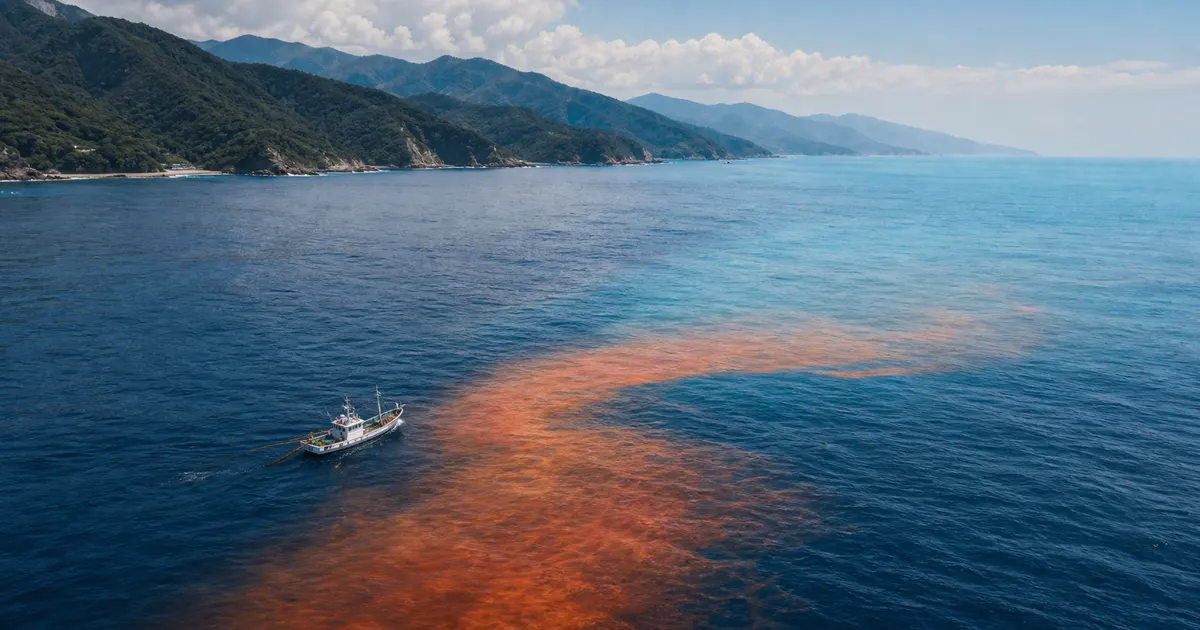
High water temperatures also tend to trigger red tides and low-oxygen water masses, which further amplify aquaculture damage. Marine heatwaves, eutrophication, and low oxygen often occur together. The mechanism of red tides is explained in detail in the article on red tides and eutrophication.
Countermeasures Do Exist—Adaptation Through Submerged Aquaculture
There is no shortage of hope. In Mutsu Bay, when surface water temperature exceeds 25°C, a method called "submerged aquaculture" has been introduced, in which farming cages are lowered to a relatively cool layer at a depth of 15 meters or more. This approach has allowed some fishery operators to keep mortality rates below 30%, even during a record heatwave—far lower than under conventional methods. Selecting heat-tolerant varieties and individual shellfish, and reviewing production timing, are among the efforts already underway on the ground to "adapt" to climate change.
The rise in sea temperature began in 2023, and this summer the period during which water temperatures exceeded 23°C—a level that affects scallop growth—was the longest on record.
— From a report by Aomori Prefecture on the scallop die-off situation (as reported in the media)
Adaptations already underway in aquaculture
- Submerged aquaculture: Lowering cages into a cool, deep layer during the high-temperature summer period (significantly reduces mortality rates)
- Selecting and introducing heat-tolerant varieties and individuals
- Spreading risk by reviewing stocking density and production timing
- Minimizing damage through water temperature monitoring and early warning
Why Are Marine Heatwaves Becoming the "New Normal"?—The Background of Increasing Frequency
The damage from the Blob and Mutsu Bay was not simply an unlucky, one-off event. Marine heatwaves are unquestionably becoming more frequent, longer, and stronger on a global scale. Behind this lies human-caused global warming.
Frequency Has Doubled, Duration Is at a Record High
According to IPCC assessments, the frequency of marine heatwaves worldwide roughly doubled between 1982 and 2016. The number of marine heatwave days (days exceeding the 99th percentile) doubled from about 2.5 days per year to about 5 days per year. Furthermore, recent research reports that maximum intensity has increased by +0.15°C and spatial extent has expanded by as much as 66%, meaning heatwaves are becoming more frequent, more intense, and more widespread.
This trend is accelerating. The global average number of marine heatwave days keeps increasing year after year, with record-high water temperatures being renewed almost annually. Marine heatwaves are no longer an "anomaly"—they are becoming the new "normal." What was once a once-in-decades "event" of high water temperature has now become an annual "routine" occurring somewhere in the ocean.
What makes this increasing frequency especially serious is that it robs ecosystems of the "breathing room" they need to recover. After a single heatwave, wildlife might restore its numbers over the course of several years. But if heatwaves repeat every few years, the next blow arrives before recovery is complete. It is like a boxer taking punch after punch without a chance to rest—eventually unable to stand. The same thing is happening to ocean ecosystems. The increase in frequency is not merely a matter of numbers—it is a matter of the ecosystem's "limit of endurance."

The Ocean Has Absorbed 90% of the Heat from Global Warming
Why is the ocean getting so much hotter? At the root of it is the fact that the ocean has become the "heat sink" of global warming. According to the IPCC, the ocean has absorbed roughly 90% of the excess heat generated by global warming. The ocean has served as a giant buffer that has stabilized the climate, but as a consequence, the ocean itself is steadily warming, raising the baseline average temperature that underlies marine heatwaves.
The IPCC has concluded with high confidence that human influence is the main driver of ocean warming since the 1970s. In other words, the increasing frequency of marine heatwaves is not a natural fluctuation but a direct consequence of anthropogenic climate change. One study estimates that Blob-scale, multi-year events, which would have occurred only once every few hundred to a few thousand years in pre-industrial times, are now more than ten times as likely under the roughly 1°C of warming seen today.
Future Projections—The Future Diverges Depending on Emissions
Climate models project that under a high-emissions scenario with no countermeasures (RCP8.5), the frequency of marine heatwaves in 2081-2100 will reach about 50 times pre-industrial levels. Under a low-emissions scenario that curbs emissions (RCP2.6), it would remain at about 20 times. Both figures are severe, but the gap between them shows just how much our choices can shape the future of the ocean. Reading the article on blue carbon ecosystems alongside this one helps illustrate the significance of decarbonization in three dimensions.
Key points of this section
- The frequency of marine heatwaves roughly doubled worldwide between 1982 and 2016, with intensity and extent also expanding
- The ocean has absorbed roughly 90% of the excess heat from global warming, raising the baseline temperature that underlies heatwaves
- Under a high-emissions scenario, frequency is projected to reach about 50 times by the end of this century; even under low emissions, about 20 times
Long-Term Scars on Ecosystems—Regime Shifts and the Wall of Recovery
Even after a marine heatwave passes, the ocean does not immediately return to normal. Rather, the heatwave carves long-lasting "scars" into the ecosystem, sometimes transforming the character of the sea into something else entirely. This may be the most serious aspect of marine heatwaves.
No Return—Regime Shifts
The irreversible shift of an ecosystem from one stable state to another stable state is called a "regime shift." A marine heatwave can be the trigger that flips this switch. A sea where a rich kelp forest is lost and replaced by other dominant organisms; a sea that shifts from one sustained by fatty prey to one that has grown lean—once the switch flips, it does not easily reverse even if water temperature drops.
A typical example occurred in the waters off southeastern Australia, in Tasmania. Due to a marine heatwave and the southward advance of a warm current (the East Australian Current), more than 90% of the massive kelp forests (large brown algae) in this region were lost. Kelp forests are home to many organisms and also play a role in storing carbon dioxide, so their loss is a major setback for both the ecosystem and the climate. After kelp disappears, a barren "urchin barren" sea, dominated solely by sea urchins, often spreads in its place.
What makes this troubling is that such urchin barrens tend to "stabilize." Once sea urchins reach a state where they consume kelp sprouts as fast as they appear, the kelp forest does not easily regenerate even if water temperature falls. Often it will not return to its original state without human intervention, such as removing the urchins. This is the essence of a regime shift—the ocean does not return to its former state even after the heatwave subsides; instead it becomes locked into a new, "impoverished stability." Urchin barrens are becoming a serious problem in coastal areas of Japan as well, and this is by no means someone else's problem.

Coral Reefs—A Sea of Repeated Bleaching
Another stage where marine heatwaves leave long-term scars on ecosystems is coral reefs. On Australia's Great Barrier Reef, large-scale bleaching events have repeated in 2016, 2017, 2020, and 2022 over the past decade, and the 2016-2017 bleaching alone is estimated to have killed at least 50% of shallow-water reef-building corals. If the next heatwave arrives before recovery from bleaching is complete, coral reefs are robbed of the time they need to recover and continue to decline. The mechanism of bleaching is explained in detail in the article on the mechanism of coral bleaching.
Carbon Sinks Turning into Carbon Sources
What is often overlooked is that the collapse of ecosystems worsens climate change itself. Kelp forests, seagrass meadows, and tidal flats are the bearers of "blue carbon," absorbing carbon dioxide from the atmosphere and storing it on the seafloor. When a marine heatwave destroys these habitats, the carbon they had stored is released back into the atmosphere, accelerating warming. The heatwave destroys the ecosystem, and that destruction invites further heatwaves—a negative cycle begins to spin. Readers should also check the article on tidal flat conservation regarding the carbon absorption of coastal ecosystems.
Recovery Takes a Long Time
Collapsed stocks often take many years to recover. Pacific cod in the Gulf of Alaska showed some recovery after the second heatwave in 2019, but a full return of the stock to its former level requires time spanning multiple generations. If heatwaves repeat every few years, ecosystems never gain the reprieve needed to recover and instead grow gradually leaner. This is precisely why the best way to prevent the damage is to reduce the heatwaves themselves—that is, to curb global warming.
When considering the long-term effects of marine heatwaves, we tend to focus only on short-term figures such as "damage costs" or "poor catches." But what is truly frightening is the irreversible change in which kelp forests disappear, coral reefs collapse, and rich fishing grounds are replaced by an impoverished sea. Once a sea has flipped into a different state, restoring it takes many times more time and effort than it took to lose it. A marine heatwave quietly borrows against the richness of the sea that future generations were supposed to inherit.
The frightening nature of long-term effects
The damage from a marine heatwave does not end when the heatwave passes. The loss of kelp forests, the decline of coral reefs, and the collapse of fishery resources trigger "regime shifts" that do not easily reverse even after water temperatures fall. Furthermore, the collapse of ecosystems releases stored carbon, creating a negative cycle that accelerates warming.
Conclusion: Making the Ocean's Changes Personal
The Blob in the Northeast Pacific taught us what a marine heatwave does. Roughly one million seabirds, starving sea lion pups, collapsed cod stocks—these are tragedies of a distant sea, but at the same time, they are also a preview of what is already repeating in Japan's own seas and on Japan's own dinner table, in the form of yellowtail moving north, poor catches of Pacific saury, and the death of 90% of Mutsu Bay's scallops.
Rather than the high heat itself, marine heatwaves leave deep and lasting scars on ecosystems through the starvation caused by food web collapse, shifts in distribution, and irreversible regime shifts. And their increasing frequency is a direct consequence of global warming. That is precisely why decarbonization to curb the foundation of these heatwaves, wise adaptation such as submerged aquaculture, and continued attention to the changes in the ocean are the realistic steps we can take right now.
What any one of us can do may seem small. But reducing greenhouse gas emissions through energy conservation and the choice of renewable energy, staying informed about news of the ocean's changes, and choosing to support the seafood of fishery workers who are striving to adapt to high water temperatures—these accumulated actions shape the frequency and severity of future heatwaves. The ocean is not a distant presence; it is connected to our everyday choices.
Readers who want to revisit the basic definition and mechanism of marine heatwaves should turn to the article "What Is a Marine Heatwave?", and those who want to learn more about the broader impact on fisheries and marine ecosystems should proceed to rising sea temperatures and fisheries or marine biodiversity in Japan. Paying attention to the invisible heatwaves of the ocean is the starting point for protecting the future of the sea and ourselves.
Summary of this article
- The Blob was a massive marine heatwave that covered the Northeast Pacific from 2013 to 2016, reaching roughly 4 million km² with temperatures up to +4°C above normal
- The damage stems less from the heat itself than from "starvation caused by food web collapse"—roughly one million seabirds starved, and cod stocks fell by about 80%, forcing the first-ever fishery closure
- Waters around Japan are also warming at +1.33°C, more than twice the global average, and yellowtail's northward advance, poor Pacific saury catches, and a mortality rate over 90% for Mutsu Bay scallops have become reality
- The frequency of marine heatwaves has roughly doubled globally, and is projected to reach about 50 times under a high-emissions scenario by the end of this century
- The damage persists after the heatwave—the loss of kelp forests and the decline of coral reefs trigger regime shifts, and carbon release accelerates warming
- The keys to countermeasures are decarbonization to reduce heatwaves, and advancing on-the-ground adaptation such as submerged aquaculture
References and Sources
- Japan Meteorological Agency – Climate Change in Japan 2025 — Observation and Projection Assessment Report on the Atmosphere, Land, and Ocean — (Chapter 8: Ocean)
- Japan Meteorological Agency – Marine Diagnostic Tables: Long-Term Trend of Sea Surface Temperature (waters around Japan / +1.33°C per 100 years)
- Fisheries Agency of Japan – FY2024 White Paper on Fisheries: Changes in the Marine Environment in Waters Around Japan
- The University of Tokyo, Research Center for Advanced Science and Technology – Further Evidence That Marine Heatwaves Contributed to Northern Japan's Record Hot Summer of 2023
- JAMSTEC (Japan Agency for Marine-Earth Science and Technology) – Kuroshio-Oyashio Watch: Marine Heatwave and Cold Wave Monitoring
- IPCC – Special Report on the Ocean and Cryosphere in a Changing Climate (SROCC), Chapter 6: Extremes, Abrupt Changes and Managing Risks
- NOAA Fisheries – Looking Back At The Blob: Record Warming Drives Unprecedented Ocean Change
- NASA Earthdata – The Blob (an explanation of the Northeast Pacific marine heatwave)
- Nature (Communications Earth & Environment) – A global overview of marine heatwaves in a changing climate
- Climate Change Adaptation Platform (A-PLAT / National Institute for Environmental Studies) – Adaptation in fisheries to the northward shift in distribution of migratory fish and shellfish
* Listed in order of reliability: government and academic institutions > peer-reviewed papers > specialized organizations > reputable media