⚡ The answer in 30 seconds
- Water quality has improved, but a shortage of nitrogen and phosphorus in some areas is affecting fishery resources.
- The 2021 law amendment created a system shifting nutrients from "regulation" to "management" (effective April 2022).
- Based on prefectural plans, nutrients are supplied by sea area and season, for example through seasonal sewage plant operation.
- Falling catches are not caused by nutrients alone; rising water temperatures and loss of seagrass beds and tidal flats also play a part.
The Seto Inland Sea has recovered greatly from being called a "dying sea," yet in some areas a shortage of nutrients has become a new issue. Pale nori and falling catches are said to be signs of it.
This "too clean sea" problem arose precisely because wastewater regulation succeeded. With the 2021 amendment, the Ministry of the Environment shifted nutrients from regulation to management.
This article organizes the substance of the problem, how the system works, field efforts, and remaining issues, based on primary sources.
What you will learn
- What the "too clean sea" problem in the Seto Inland Sea really means
- What happens to fisheries and nori when nutrients decline
- The 2021 amended law and how the nutrient management system works
- Field efforts: sewage plants, irrigation ponds, and seabed tilling
- Why management is hard, and why seagrass beds and tidal flats matter
What the "too clean sea" problem really means in the Seto Inland Sea
From a "dying sea" to a "nutrient-poor sea"
In the 1970s the Seto Inland Sea suffered frequent red tides and was called a "dying sea." Nitrogen and phosphorus in factory and household wastewater flowed into the sea, causing eutrophication and abnormal growth of phytoplankton. The national government and coastal prefectures therefore pursued wastewater regulation and total load reduction. As a result, water quality improved greatly.
In recent years, however, another problem has been pointed out. A shortage of nutrients such as nitrogen and phosphorus is causing pale nori and falling catches. Ministry of the Environment materials also state that in parts of the Seto Inland Sea, together with environmental changes such as rising water temperatures due to climate change, the effects of nutrient shortage on fishery resources and the loss of seagrass beds and tidal flats have become issues.
This is the "too clean sea" problem. Even if the water is clear, a sea lacking the nutrients to grow fish, shellfish, and seaweed is not necessarily rich for living things.
Key points of this section
- Regulation succeeded in reducing red tides, but nutrient shortage has become a new issue in some areas
- "Improved water quality" and "a rich sea" do not mean the same thing
Terms: what are nutrients?
Nutrients are components such as nitrogen and phosphorus that phytoplankton and seaweed need to grow. They are like fertilizer for land plants. Too much brings red tides and oxygen-poor water; too little lowers production. The issue is therefore not the amount itself but whether the "right amount" can be maintained.
- Nitrogen (such as dissolved inorganic nitrogen, DIN): directly tied to the growth of phytoplankton and nori
- Phosphorus: affects production through its balance with nitrogen
- Silicon: needed for diatom growth; species composition changes if river supply falls
Scope of this article
This article covers how nutrients declined, the effects on nori and fisheries, the new system created by the 2021 amendment, efforts in Hyogo and other prefectures, and remaining issues. Figures and systems are based on published materials from the Ministry of the Environment, the Fisheries Agency, and prefectures. See also Red tides, blue tides and eutrophication for the mechanisms, and Where do nitrogen and phosphorus reach the sea from? for loads from watersheds.
Features of the Seto Inland Sea and the history of water quality improvement
An enclosed inland sea
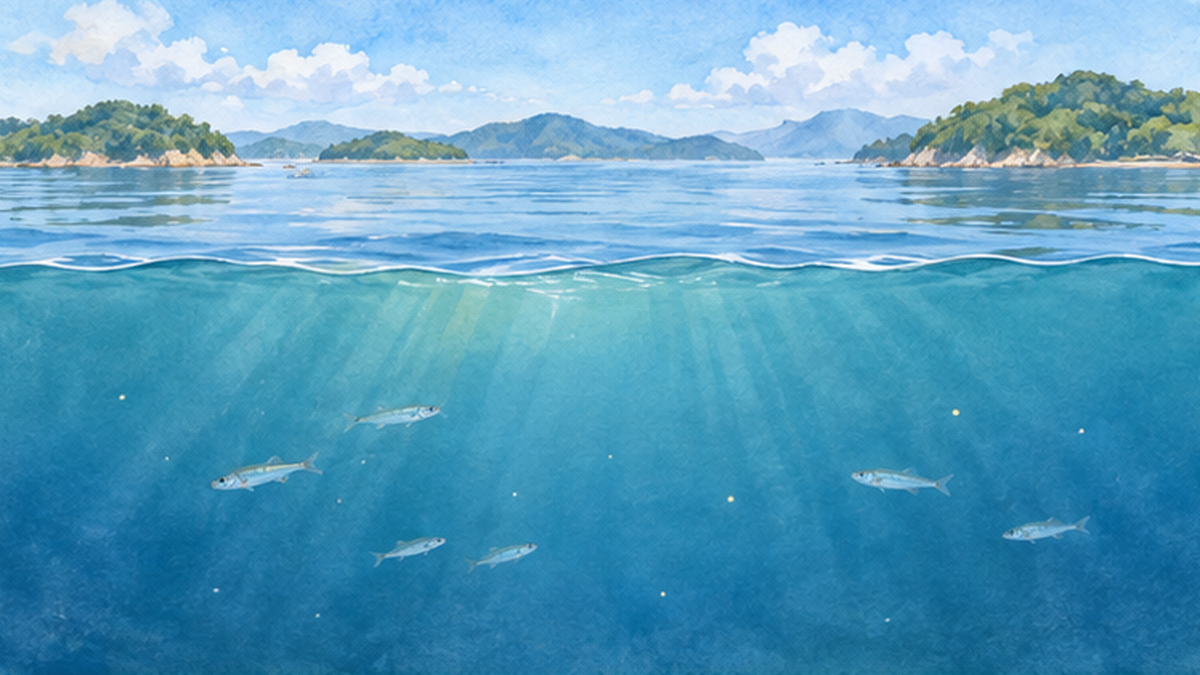
The Seto Inland Sea is a shallow inland sea with many islands, surrounded by Honshu, Shikoku, and Kyushu. Together with Tokyo Bay and Ise Bay, it is regarded as one of Japan's three major enclosed water bodies. Because water exchange with the open ocean is limited, substances entering from watersheds tend to stay in the sea.
This trait once made eutrophication serious. The same trait is why the sea now strongly reflects both "too much" and "too little" nutrient input.
History of regulation
- 1973: The Law Concerning Interim Measures for Conservation of the Environment of the Seto Inland Sea is enacted, starting regulation of industrial wastewater and more
- 1978: It becomes a permanent law, the Law Concerning Special Measures for Conservation of the Environment of the Seto Inland Sea
- 1979: Total pollutant load control begins, targeting chemical oxygen demand (COD)
- Afterwards: nitrogen and phosphorus are added to the load reduction targets, and sewerage and wastewater treatment advance
- 2015: Law amended; a supplementary provision calls for considering how to manage nutrients
- 2021: Law amended; the nutrient management system is created and takes effect in April 2022
The timeline lists main milestones. Detailed timing and when target items were added differ by planning period.
Trivia
- The 2021 amendment of the Seto Inland Sea law is "Act No. 59 of Reiwa 3." It took effect on April 1, 2022.
"Regulation only," born of success
Wastewater regulation reduced red tides and made the sea remarkably cleaner. Because it succeeded, the system was long operated in the direction of "reducing incoming nutrients." The Ministry of the Environment also says nutrients need to shift from "discharge regulation" alone to careful "management."
A sea with greater clarity
When nutrients decrease, phytoplankton also decrease. With fewer particles in the water, the sea looks transparent. This is often welcomed for tourism and scenery, but it means the base of the food chain is getting thinner.
Why do fewer nutrients affect fish and nori?
Nutrients as the base of the food chain
Marine production begins with phytoplankton that use nutrients. Zooplankton eat them, followed by small fish and then large fish. In theory, if the nutrient base declines, organisms higher in the chain also tend to decline.
Professor Tamiji Yamamoto of Hiroshima University has said that although water quality improved through reduced inflow loads, this led to oligotrophication and fish and shellfish production has fallen sharply. Okayama Prefecture's fisheries research institute materials also point out that a decline in dissolved inorganic nitrogen (DIN) is related to the fall in fisheries production.
Representative species such as sand lance
In the eastern Seto Inland Sea, poor catches of sand lance (ikanago, "shinko"), a harbinger of spring, have drawn attention. Several factors are thought to be involved, including rising water temperatures, spawning and nursery habitat, and fewer prey plankton. It cannot necessarily be explained by nutrients alone, but a link with oligotrophication is under discussion.
Caution: there is more than one cause
- Several factors overlap in falling catches: rising water temperatures, loss of seagrass beds and tidal flats, fewer fishers, and resource management. The effect of nutrients should be assessed carefully as one part of this.
Current catch levels
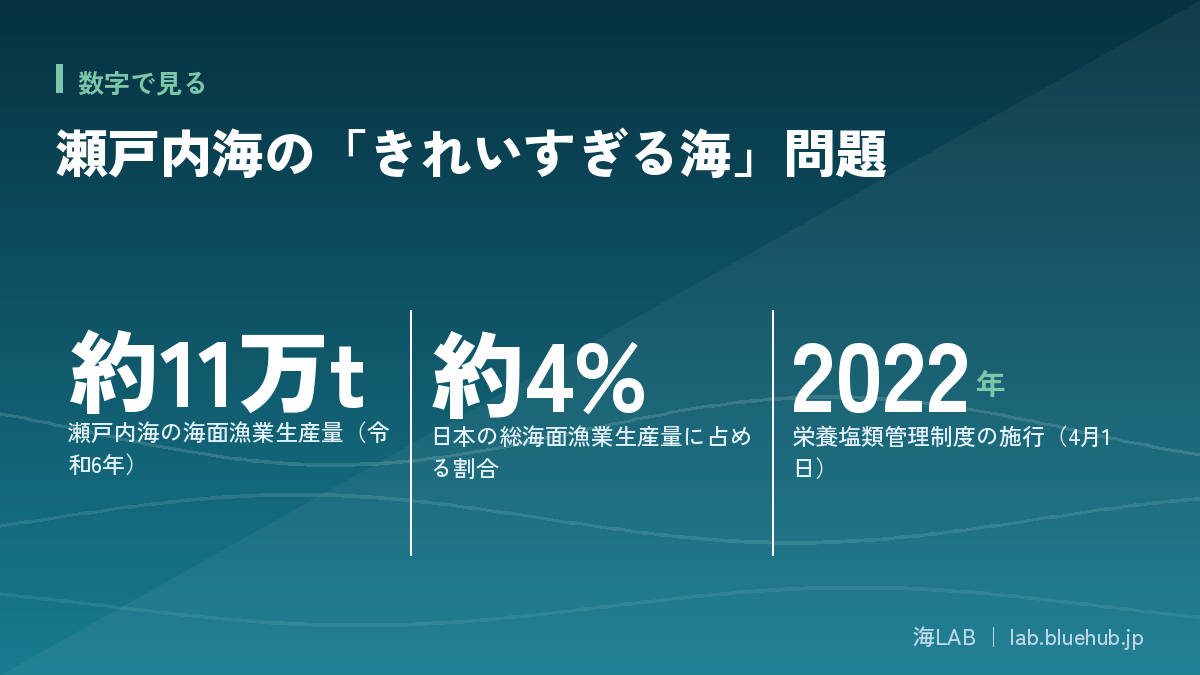
According to the Fisheries Agency, marine fisheries production in the Seto Inland Sea is about 110,000 tons, around 4% of Japan's total marine fisheries production (2024 fishery and aquaculture production statistics). The Ministry of the Environment has compiled total catches since 1965 by bay and sea area and by species, so long-term changes can be checked in published data.
What cannot simply be called a "decline"
Circumstances differ by species; some fish are increasing while others are decreasing. To study the effect of nutrients, changes in water temperature, seagrass beds, and fishing effort must be separated. Research on this is still under way.
Pale nori: where nutrient shortage is most visible
What is nori discoloration?
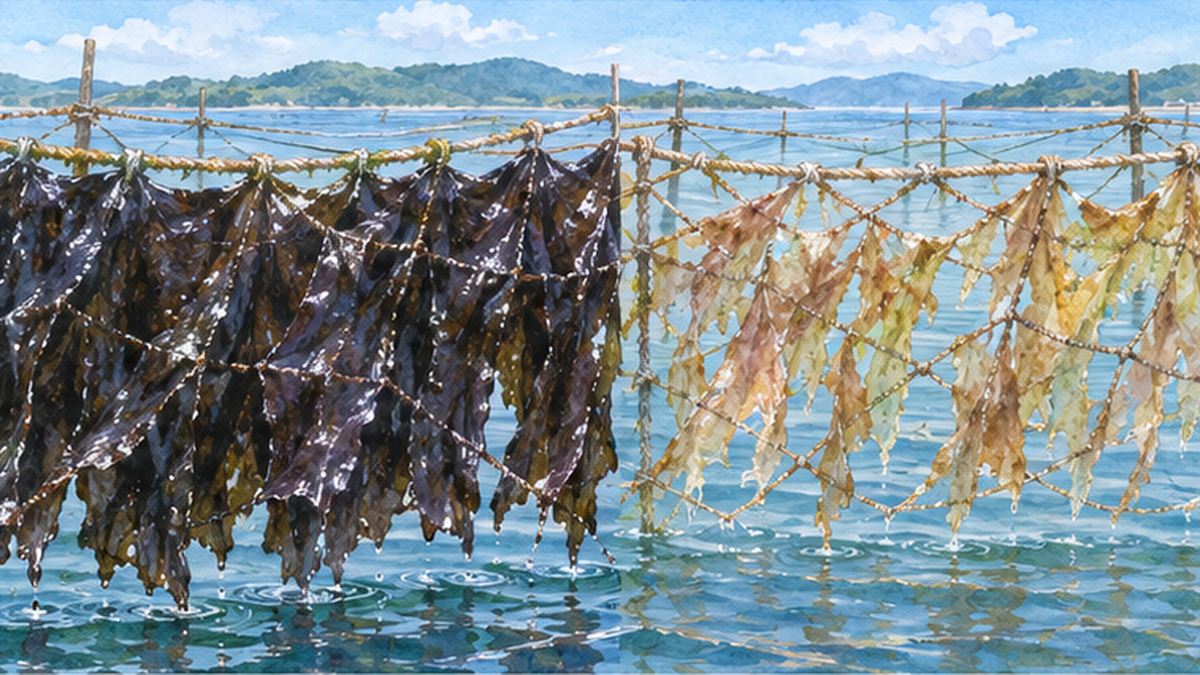
Nori discoloration is a phenomenon in which the pigment of the nori blade fades when nutrients, especially nitrogen, are short. High-quality black, glossy nori turns brown or yellowish, lowering its grade and price. In aquaculture, nutrient shortage directly hits income.
Hyogo Prefecture materials explain that discoloration became frequent in the eastern nori aquaculture area from the late 1990s. The prefecture's boat-fishery catches turned downward from around the mid-1990s, and declining nutrient concentrations have been pointed to as a factor.
The double effect of rising water temperature
Nori farming waits for autumn sea temperatures to fall before seeding. In recent years temperatures fall later, and the start of farming tends to be delayed. Also, under high temperatures phytoplankton that use nutrients keep growing longer, which can reduce the nutrients available to nori. The overlap of warming and oligotrophication makes the problem harder.
The relationship between nori and water temperature, and food loss, is explained in Nori discoloration and rising water temperature.
Key point
- Pale nori is "the sign of nutrient shortage that people on site notice first." Nori quality has become one indicator of the sea's nutrient state.
Relation to diatom blooms
In the winter nori season, when large diatoms multiply they can use up the nutrients in seawater, leaving nori undernourished. Not only the total amount of nutrients but also when and which organisms use them matters.
The 2021 law amendment: from "regulation" to "management"
Overview of the amendment
The amended law enacted in 2021 took effect on April 1, 2022. The purpose now includes taking special measures concerning nutrient management for ensuring biodiversity and productivity. For the first time, nutrients are positioned not only as something to "reduce" but as something to "manage appropriately."
What is the nutrient management system?
At the center of the system, the governors of the relevant prefectures can draw up plans for nutrient management. In harmony with conservation of the surrounding environment, nutrients are supplied to some sea areas and carefully managed by area and season. The Ministry of the Environment says that enabling supply according to local needs will contribute to securing diverse fishery resources.
- Target: sea areas short of nutrients (judged by each region)
- Methods: adjusting discharge concentrations at sewage plants, managing irrigation ponds, seabed tilling, and others
- Feature: careful management by sea area and season is possible
- Premise: harmony with conservation of the surrounding environment
Plans by prefecture
Hyogo Prefecture drew up its nutrient management plan in October 2022. It is explained that a 2019 amendment of the prefectural ordinance set a lower limit of 0.2 mg/L for total nitrogen. Kagawa Prefecture has also published its own plan. Where and how to supply is left to prefectural judgment and local agreement.
How the system works
- The national government sets a basic policy and prefectures draw up management plans. Following those plans, nutrient supply can be adjusted by season and sea area.
"Just increase them" is not the answer
The system does not aim to increase nutrients for its own sake. The idea is to deliver the needed amount, at the needed time and place, while keeping the risk of red tides and oxygen-poor water low. Continuous monitoring is essential.
Field efforts: sewage plants, irrigation ponds, seabed tilling
Seasonal operation of sewage plants
Sewage plants remove nitrogen and phosphorus before discharge. Operation that relaxes nitrogen removal only during the winter nori season to raise the nitrogen concentration of discharged water is called "seasonal operation (managed operation)." Hyogo Prefecture is promoting efforts to raise nitrogen concentrations in winter effluent.
Sewage plants must maintain equipment and meet discharge standards. How far operation can be changed therefore differs by plant type and surroundings.
Draining irrigation ponds ("kaibori")
Mud on the bottom of irrigation ponds contains nitrogen and phosphorus. Kaibori, draining the pond and drying the bottom to manage the mud, is expected not only to improve water quality but also to send nutrients downstream. In 2013 Hyogo Prefecture began considering managed operation of sewage facilities and kaibori within its plan for healthy material circulation in the sea (Healthy Plan).
Seabed tilling
This method plows seabed mud to return accumulated nutrients to the seawater. Okayama Prefecture's fisheries research institute materials also explain that seabed tilling and managed operation of sewage facilities are being carried out as measures to increase nutrients.
Oyster shells and other materials
There are also efforts using local resources, such as improving sediment with oyster shells. The circulation of oyster shells in the Seto Inland Sea is introduced in The complete guide to oyster shell recycling.
Comparing approaches
- Sewage plants: supply is easy to adjust, but operation and standards impose limits / Irrigation ponds: close to nature, but limited in range / Seabed tilling: local, with visible effects, but must be continued
Why nutrient management is difficult, and perspectives to reconsider
The "right concentration" differs by sea area
In the Seto Inland Sea, depth, currents, inflowing rivers, and use differ by bay and sea area. Some areas lack nutrients while others still have an excess. The whole sea cannot be increased uniformly.
Monitoring is a prerequisite
Supplying nutrients is close to the risk of red tides and oxygen-poor water. A mechanism is therefore needed to keep checking water quality, plankton, catches, and nori quality after supply and revise plans. Improving numerical models that predict effects before supply is also an issue.
Agreeing on what a "rich sea" means
Fishers, local governments, researchers, and residents want different things from a "rich sea." Which takes priority: catches, nori quality, clarity, scenery, or biodiversity? The system assumes discussion in each region.
- Fishers: emphasize catches and nori quality
- Local governments: want to meet water quality standards while sustaining industry
- Researchers: want to separate cause and effect scientifically
- Residents and tourism: emphasize clarity, scenery, and bathing water quality
Climate change as an external factor
Climate factors that affect nutrient movement, such as rising water temperatures, frequent heavy rain, and typhoon strength, cannot be controlled by people. That is why the Ministry of the Environment lists the combination of warming water and nutrient shortage as an issue.
Caution
- Nutrient management will not solve every poor catch or nori discoloration. It must be combined with measures against rising water temperatures and the loss of seagrass beds and tidal flats.
| Perspective | Concern | Needed response |
|---|---|---|
| Environment | Return of red tides and oxygen-poor water | Monitoring and plan review |
| Fisheries | Pale nori and declining resources | Supply limited in time and place |
| Climate | Rising water temperature | Adjusting farming timing and heat tolerance |
| Society | Consensus building | Local discussion |
Seagrass bed and tidal flat restoration, and nutrient balance
Not only "adding" nutrients but also "retaining" them
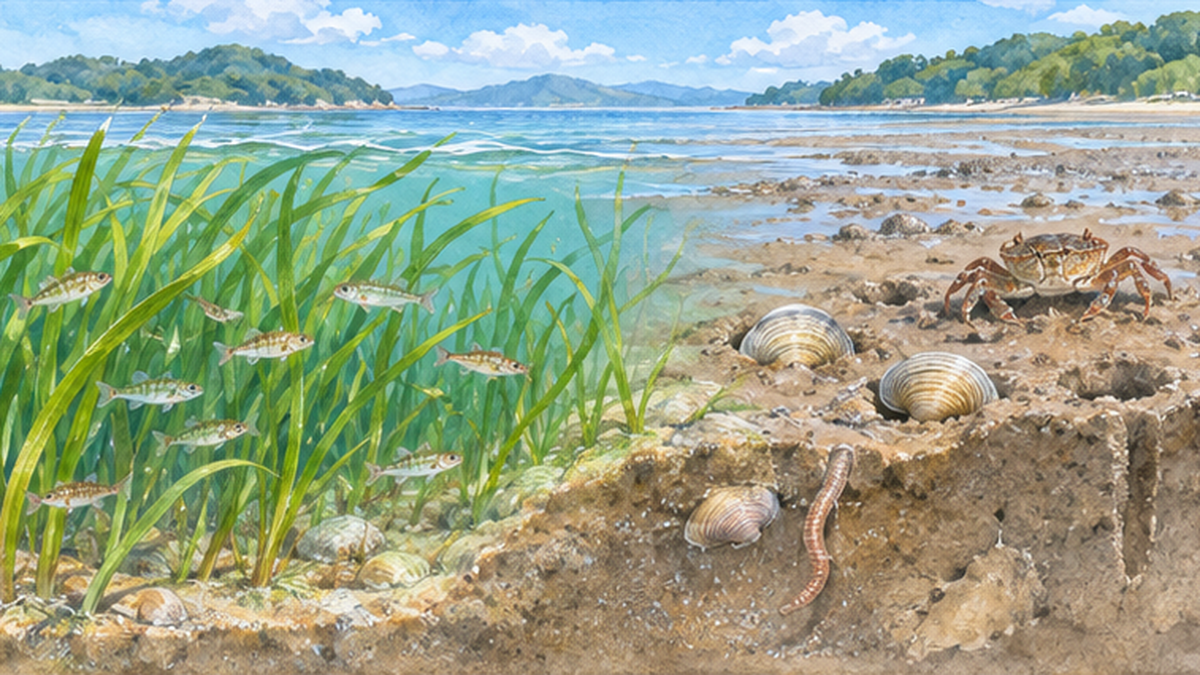
Seagrass beds and tidal flats take up nutrients, provide nurseries for juvenile fish, and store carbon. Ministry of the Environment materials also list the loss of seagrass beds and tidal flats through development as an issue. Alongside nutrient supply, it is important to restore habitat for living things.
The role of seagrass beds
- Provide shelter and spawning grounds for juvenile fish and small organisms
- Absorb nitrogen and phosphorus from the water and balance seawater nutrients
- Take in carbon dioxide through photosynthesis (blue carbon)
For seagrass restoration, see also the article Seaweed beds and blue carbon.
What tidal flats do
Tidal flats are "natural purifiers" that decompose and circulate nutrients through microbes and shellfish in the mud. It has been pointed out that reclamation reduced tidal flats and weakened the sea's self-purification.
Watershed and satoumi perspectives
Nutrients cycle through rivers, rice fields, irrigation ponds, towns, and the sea. Rather than looking only at the sea, the idea of "satoumi," designing circulation across the whole watershed, is needed.
What we can do, and the future of the Seto Inland Sea
Know and choose local products
Choosing nori, oysters, sand lance, and other products from the Seto Inland Sea supports local fisheries. Knowing the producing areas and seasons also helps us notice changes in the sea.
Changing how we view the sea
The view that "a transparent sea is a good sea" is half right and half insufficient. A sea's richness is measured not only by clarity but by the abundance of life and the blessings reaching our tables.
Issues ahead
- Can the effect of nutrient supply be verified through catches and nori quality?
- Will application to other bays (Tokyo Bay, Ise Bay) advance?
- How should a "target sea" be defined amid climate change?
- How should data disclosure and dialogue with residents and fishers proceed?
Summary
- The Seto Inland Sea has greatly improved in water quality since being called a "dying sea," but nutrient shortage has become a new issue in some areas. The nutrient management system in force since 2022 allows supply by season and sea area under prefectural plans. Verifying effects, restoring seagrass beds and tidal flats, and responding to climate change will be key.
Closing
A clean sea and a rich sea are not the same. The experience of the Seto Inland Sea shows that environmental policy is moving from "reducing bad things" to "maintaining just the right state." Results of each prefecture's plan will be published going forward. We will watch changes in the sea while checking the latest materials from the Ministry of the Environment and prefectures.
References and sources
- Ministry of the Environment: Conservation of the Seto Inland Sea – Law on special measures for the Seto Inland Sea and nutrient management
- Ministry of the Environment: materials on the nutrient management system – Overview of the law amendment
- Fisheries Agency: Fisheries of the Seto Inland Sea – Statistics such as catches
- Fisheries Agency: Countermeasure technologies for fishery damage from nutrient shortage – FY2023 project materials
- Hyogo Prefecture: Nutrient management plan – Toward restoring a rich and beautiful Seto Inland Sea
- Kagawa Prefecture: Nutrient management plan – Aiming for a rich sea
- Okayama Prefecture: Fisheries research institute materials – Nutrient concentration and fisheries production
- Sasakawa Peace Foundation: Ocean Newsletter – A new system for a rich Seto Inland Sea
* Listed in order of reliability: government and academic institutions > peer-reviewed papers > specialist organizations > reliable media