⚡ The answer in 30 seconds
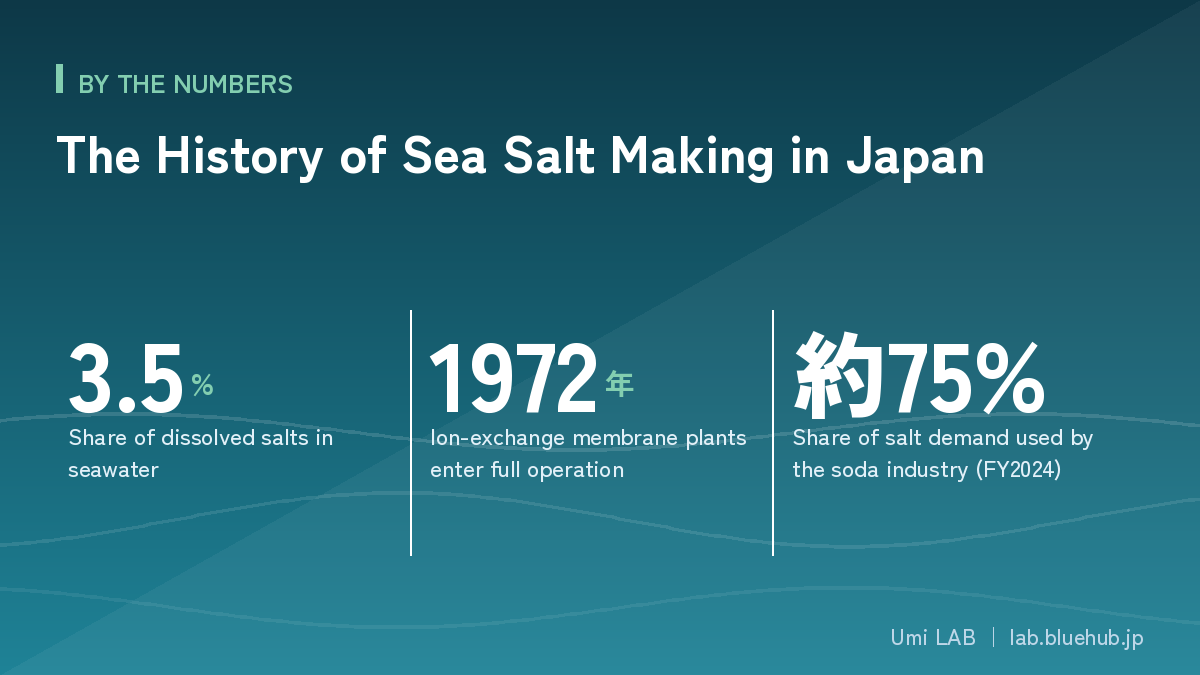
- About 3.5% of seawater is dissolved salts, so salt making means removing the other roughly 96.5%, which is water.
- Japanese salt making moved from moshio-yaki and irihama and ryuka salt fields to ion-exchange membrane factory production from 1972.
- Of about 7.8 million tons of salt demand in FY2024, about 75% was for the soda industry and only about 1.5% for households.
The salt we use every day comes from just 3.5% of what is dissolved in seawater. How do you remove the 96.5% that is water? Japanese people have refined answers to this question for more than a thousand years.
From ancient moshio-yaki, to irihama salt fields on the Seto Inland Sea, to ryuka-style fields with bamboo branch towers, and finally to the factory-based ion-exchange membrane method that began in 1972, changes in salt making mirror changes in how people live with the sea.
This article follows seawater composition, the history of salt making and FY2024 supply and demand data, based on public information from the Ministry of Finance and research institutes.
What you will learn in this article
- What seawater contains and why salt making is about "removing water"
- The history from moshio-yaki to irihama and ryuka salt fields
- Why Japan shifted to the ion-exchange membrane method in 1971–72
- The diverse salts that spread after the monopoly ended (1997)
- FY2024 salt supply and demand, and how much salt is not eaten
What does it mean to make salt from seawater?
The truth behind the 35 g in 1 kg of seawater
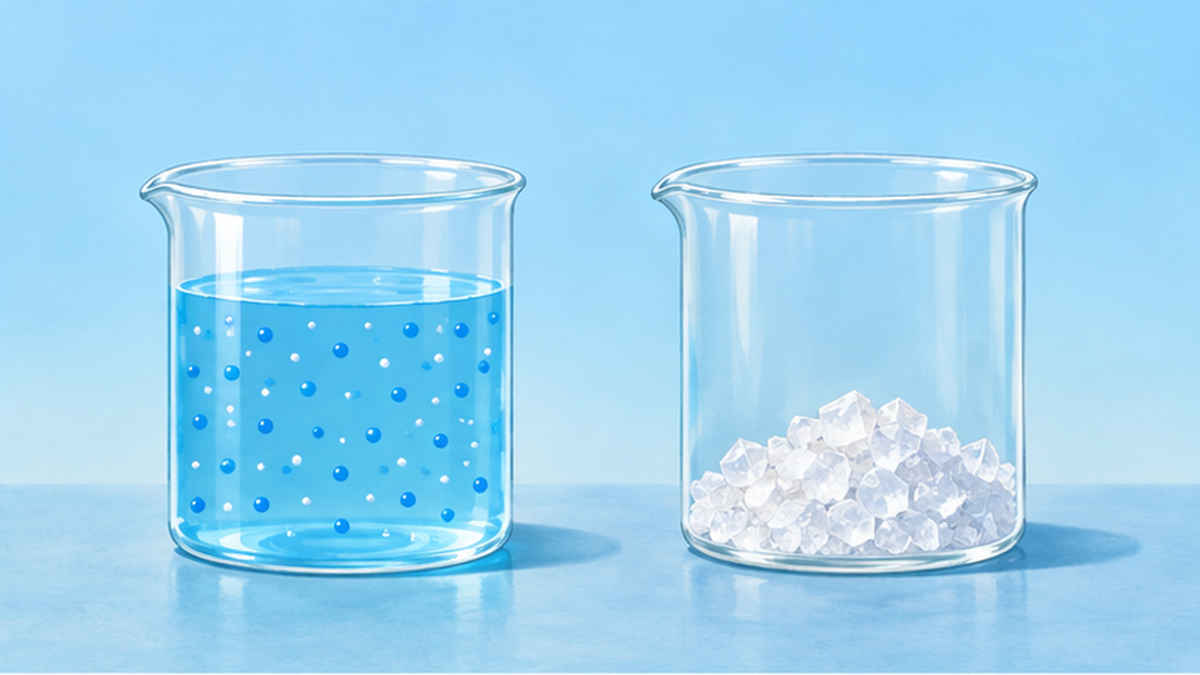
About 96.5% of seawater by mass is water, and the remaining about 3.5% is salts. Per kilogram, that is 965 g of water and 35 g of dissolved salts. The 35 g breaks down into about 19.3 g of chloride, about 10.8 g of sodium, about 2.7 g of sulfate, about 1.3 g of magnesium, about 0.4 g of calcium and about 0.4 g of potassium. The sodium chloride we call "salt" is chloride and sodium bound together.
So making salt from seawater is the task of efficiently removing the 96.5% that is water and extracting the 35 g of salts. The history of Japanese salt making is a history of ways to "reduce the water": boiling it with fire, evaporating it with sun and wind, or collecting only the salt with membranes. The methods changed, but the goal never did.
| Component | Per 1 kg of seawater (approx.) | Share of salts (approx.) |
|---|---|---|
| Water | about 965 g | — |
| Chloride ion | about 19.3 g | about 55% |
| Sodium | about 10.7 g | about 30.6% |
| Sulfate | about 2.7 g | about 7.7% |
| Magnesium | about 1.3 g | about 3.7% |
| Calcium | about 0.42 g | about 1.2% |
| Potassium | about 0.39 g | about 1.1% |
Components other than sodium chloride shape the taste
About 85% of the salts are chloride and sodium; the rest is magnesium, calcium, potassium, sulfate and others. These are also the core of what is called "nigari" (bittern). When seawater is concentrated and sodium chloride is crystallized out, a liquid rich in magnesium and others remains, and that is nigari. How much of it stays in the salt changes its flavor: mellowness, bitterness and the sense of umami.
Key points
- Standard seawater is about 3.5% salt (about 35 g per kg)
- Most of the salts are chloride and sodium
- Magnesium and others act as "nigari" components and influence the taste of salt
Why Japan lacked rock salt
Many countries mine rock salt from underground deposits. Japan, however, has few minable rock salt resources, so since ancient times it has relied on seawater for most of the salt essential to daily life. Japan is also rainy and humid, so evaporating 3.5% seawater to crystals by sunlight alone is not easy. This constraint is the background to Japan's distinctive salt field technology and later industrial salt making.
Salinity varies by place
The standard 3.5% is an average guide. Actual salinity differs by sea area: it is lower at river mouths and coasts where a lot of river water flows in, and higher where evaporation is strong. Around Japan too, salinity differs between the Sea of Japan, the Seto Inland Sea and the Pacific side. The quality of the seawater a salt works draws also varies a little by location, so even the same method can yield a different taste.
Besides salinity, seawater is also described by chlorinity, based on the amount of chloride ions. Chlorinity is related to salinity by a factor of about 1.8, and oceanography has long used it as a basic indicator of seawater properties.
From ancient moshio-yaki to salt fields
Moshio-yaki, the oldest recorded method
The oldest salt making recorded in Japan is said to be moshio-yaki. Seaweed is used to collect salt, then burned to make ash salt. Rather than boiling large amounts of seawater itself, it lets seaweed hold and concentrate the salt, a clever way to get salt with limited fuel and tools. In Shiogama, Miyagi Prefecture, a "Moshio-yaki ritual" named after this method is still handed down.
6th–8th centuries: boiling brine in earthenware
By the 6th–7th centuries, seaweed was dipped in seawater and dried in the sun to raise its saltiness, and the strongly salty liquid (kansui, or brine) obtained from it was boiled in earthenware pots. Around the 8th century, the method shifted to extracting brine from sand to which salt had adhered. From seaweed to sand: the change in the medium for collecting strong brine made it possible to produce more salt, more reliably.
Agehama and irihama: two kinds of salt fields divided by the tide
Salt field methods that spread from the 9th century onward fall broadly into agehama and irihama. Agehama is used where the tidal range is small: people draw up seawater and spread it on sand. Irihama is used where the tidal range is large: the force of the rising tide guides seawater into the salt field.
From the early Edo period, many irihama salt fields were built along the Seto Inland Sea. The sea is calm, the rainfall is low and broad, shallow sandy shores are easy to find. Together these conditions made the Seto Inland Sea the center of Japanese salt making for a long time.
| Method | Approximate period | Features |
|---|---|---|
| Moshio-yaki | Oldest on record | Salt is gathered on seaweed and burned to make ash salt |
| Boiling in earthenware | 6th–7th centuries | Strong brine made with seaweed is boiled in earthenware pots |
| Extracting brine from sand | Around the 8th century | Brine is obtained from sand with adhering salt |
| Agehama and irihama | From the 9th century (irihama expanded from the early Edo period) | Salt field methods used according to the tidal range |
Note
The dates of each method vary by source and region, and are generally expressed as "around" or "said to be". Here they are organized based on explanations such as those of the Ocean Policy Research Institute of the Sasakawa Peace Foundation.
How a salt field works: sand as a concentrator
The basics of an irihama salt field are to soak sand with seawater, let sun and wind drive off the water, and collect strong brine from the sand with adhering salt. Sand acts as a "large concentrator" that spreads seawater thinly to gain evaporation area. The brine collected is boiled in pans to make salt. Fuel such as firewood and coal was a heavy burden, and salt making was a fight on two fronts: the "process of reducing water" and the "fuel for boiling."
Summary of this chapter
- The oldest method was moshio-yaki, gathering salt on seaweed
- Salt fields using sand made brine more reliably available
- The Seto Inland Sea thrived as the center of irihama salt fields
Culture carried by salt
Because salt is essential for flavoring and preserving food, it has been a valuable trade good since ancient times. Routes that carried salt to inland mountain areas were called "salt roads" and are remembered in many regions. Salt is also a symbol of purification, appearing in Shinto rites, sumo, funerals and the piles of salt placed at entrances. Some places, such as the Mishiodono ritual at Ise Grand Shrine, keep salt making itself alive as a sacred rite.
Life in the Seto Inland Sea supported by irihama salt fields
Broad sandy shores and a design that uses the tide
The feature of an irihama salt field is that it uses the rise and fall of the tide as motive power. Embankments were built along the coast, and at high tide seawater soaked naturally into the layer beneath the field through sluice gates and channels, then rose to the sand surface by capillary action. People needed to carry less heavy seawater upward, so the labor was lighter than with agehama.
As water evaporated from the sand surface under sun and wind, the salt that rose adhered to the sand grains. This sand was collected and washed with seawater to obtain brine. Repeating this work on one salt field made continuous salt production possible.
What salt fields gave to their regions
Salt making was not just a way to obtain salt. Many jobs grew up around it: procuring large amounts of firewood and coal as fuel, shipping the salt by sea, and merchants and artisans who handled it. Some port towns along the Seto Inland Sea prospered with salt shipments. Salt was an important commodity that linked sea and land, producer and consumer.
- Salt field labor: heavy work such as gathering sand, making brine and tending the boiling pans, tied to the seasons and weather
- Securing fuel: obtaining firewood and coal for boiling was a major challenge
- Logistics: contributed to the growth of coastal cargo ships and port towns that carried salt to many places
A weakness tied to the weather
The biggest weakness of irihama salt fields was dependence on weather. If rain continues, the salt on the sand is washed away and production falls. They needed large areas of land and many workers. There was a structural limit to supplying large amounts of salt reliably. This problem led to the development of new salt making methods after the war.
Challenges of salt fields
- Output swings greatly with rain and humidity
- Large land areas and many workers are needed
- Quality and output are hard to control
A year on the salt field
Work on a salt field changed with the seasons. From spring to summer, when sunlight is strong and the air is dry, brine making advanced most. The rainy season and autumn rains were tough enemies that interrupted work. Boiling continued day and night, and including securing fuel, bagging salt and shipping, the whole community moved to the rhythm of salt making. A salt field was a huge outdoor factory that worked only when the rhythm of nature and human ingenuity meshed.
Memories of this life remain today in museums, salt field ruins and place names. Walking among place names that include characters such as "hama" (shore), "shio" (salt) or "kama" (pan), and among stone walls and channel remains of salt fields, you can imagine how salt fields once filled the coastline.
Ryuka-style salt fields and branch towers: a step toward efficiency
Ryuka-style fields that spread in the 1950s
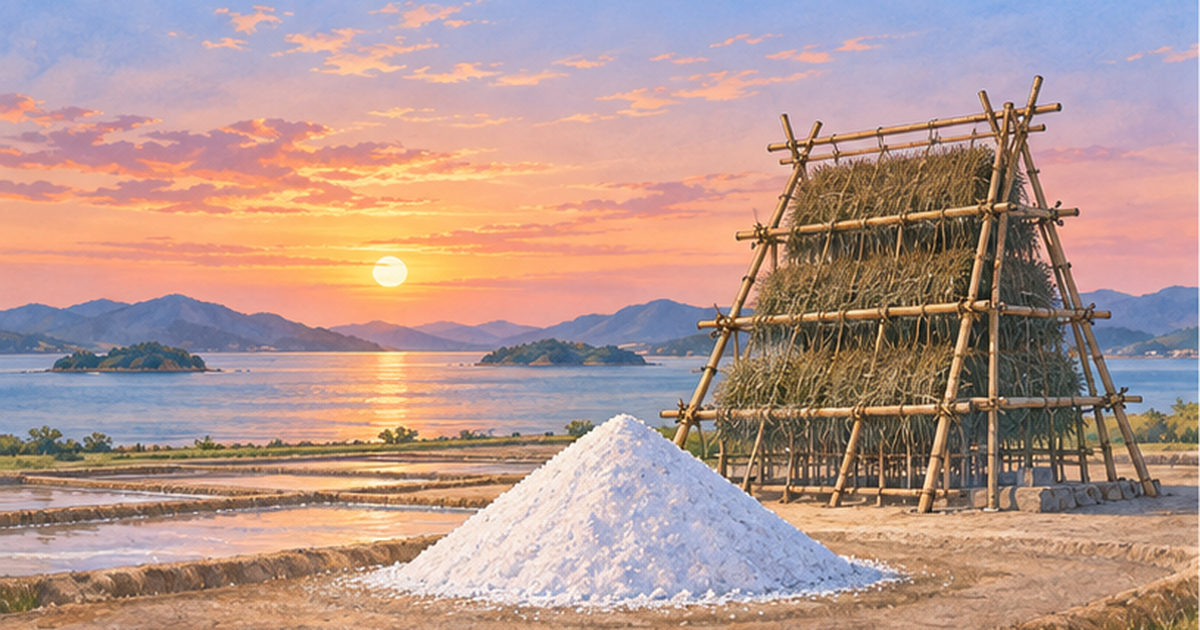
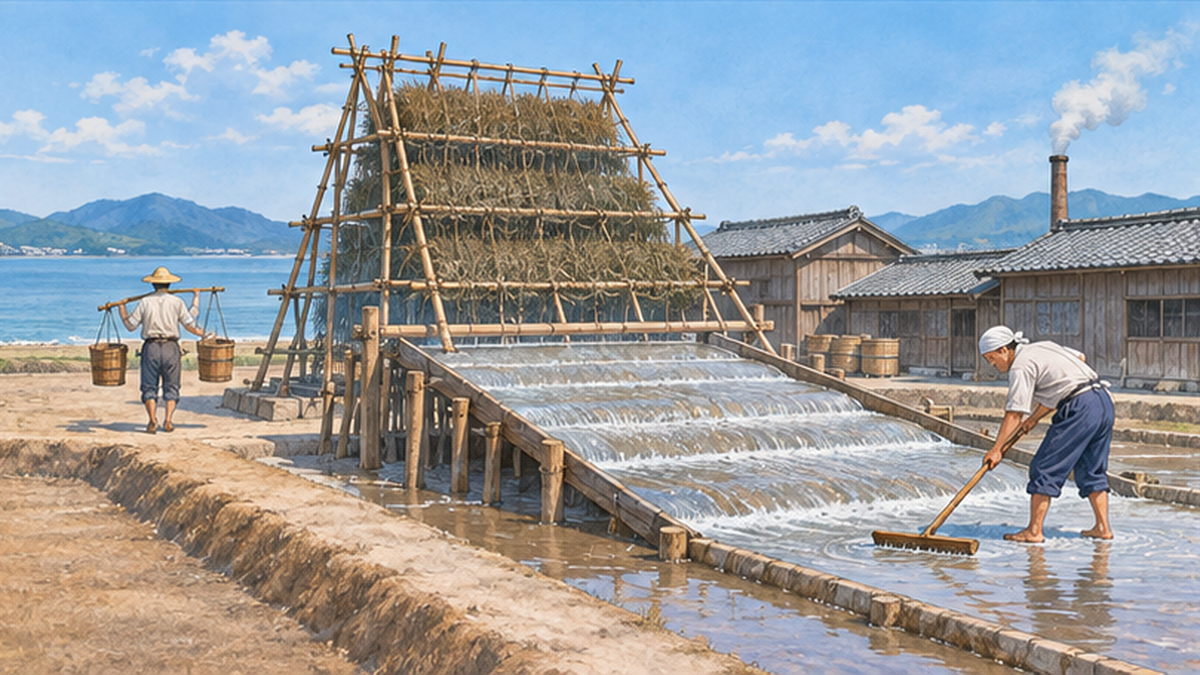
After the war, efforts to make salt fields more efficient advanced. What spread in the 1950s was the ryuka-style salt field. Instead of using all of the sand as in irihama, seawater is run over an inclined base (ryuka-ban) and evaporated by sun and wind. By also letting seawater trickle down shijoka (branch towers) built of bamboo branches, the surface area increased dramatically and strong brine could be obtained in less time.
The role of the branch tower
A branch tower is a facility where seawater is poured over piled-up bamboo branches. Because seawater touches the many fine branches evenly, water evaporates as wind passes through and the salt becomes concentrated. The heavy work of carrying, washing and re-laying sand decreased, and brine making became much less labor-intensive. Steam-heated boiling pans also appeared, raising the efficiency of salt making as a whole.
Organizing the differences from irihama
| Item | Irihama salt field | Ryuka-style field + branch tower |
|---|---|---|
| Taking in seawater | Uses the rise and fall of the tide | Pumped up and run over the field |
| Concentration medium | Sand | Inclined ryuka-ban and bamboo branch towers |
| Work | Heavy work such as hauling and washing sand | Labor saving advanced |
| Weakness | Dependence on weather and large land | Weather effects remain |
Even so, the ryuka style had limits. As long as it relied on natural conditions of sun and wind, output could not be stable in rainy Japan. Large sites were still needed. Then a technology appeared that changed the very idea of salt making.
Why branch towers work
Seawater evaporates faster the larger the area exposed to air and the more wind it receives. A branch tower creates a thin film of water over countless fine branch surfaces and lets wind pass through, artificially creating conditions that favor evaporation. It handles more seawater per unit area than an irihama field, where water is spread thinly on sand, and raises concentration efficiency. A two-stage setup was also common: first-stage concentration on the ryuka-ban and finishing concentration on the branch tower.
This idea connects to the later ion-exchange membrane method. Rather than going straight to crystals, first reduce the water to make strong brine, then boil it. Separating concentration from crystallization has been handed down as the foundation of salt making technology.
The ion-exchange membrane method: from salt fields to factories
Collecting only the salt from seawater with membranes
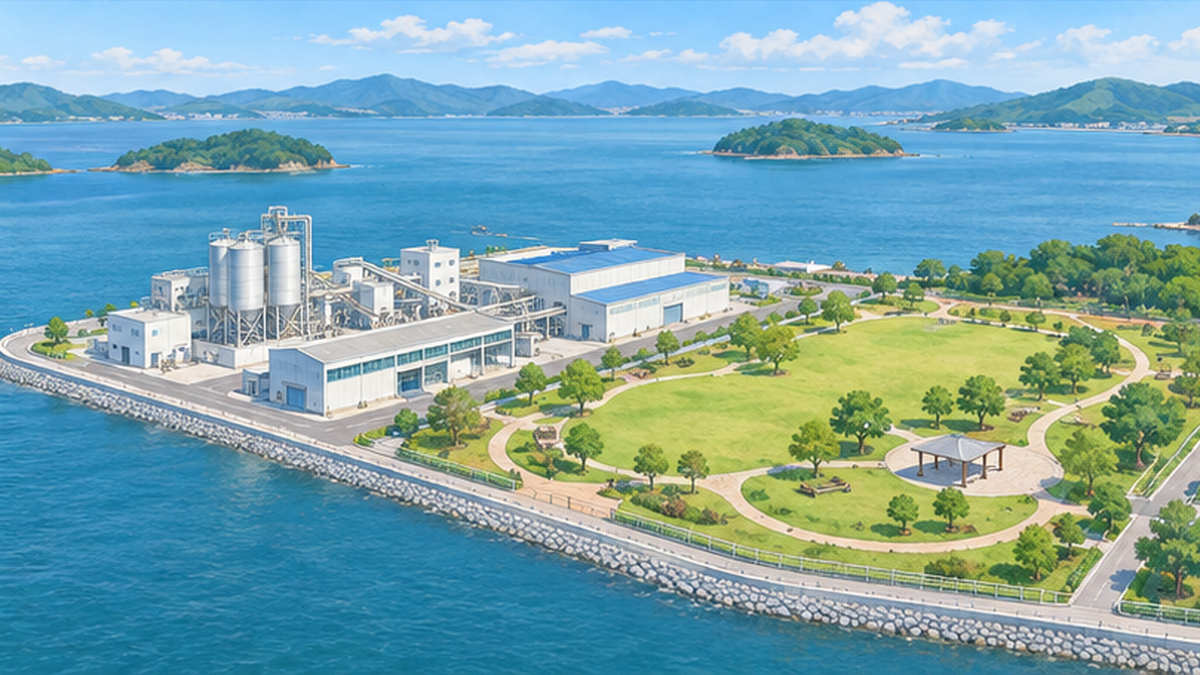
As the Japan Monopoly Corporation (established in 1949) pursued research into new salt making methods after the war, development of the ion-exchange membrane method began in 1955. The method uses electricity to draw ions in seawater through special membranes called ion-exchange membranes, collecting only the salt in concentrated form. Boiling the resulting strong brine in a vacuum pan (a vacuum multiple-effect crystallizer) produces salt crystals.
The big difference is that salt can be concentrated continuously inside a factory, without relying on sun or wind. Because it is unaffected by weather, output and quality are easy to manage, and a large amount of salt can be made even on a small site.
The 1971 law and the 1972 shift
In 1971, the "Act on Temporary Measures for the Rationalization and Modernization of the Salt Industry" took effect, setting a policy of consolidating salt field production and moving to a new technology. Businesses that abandoned salt field production are said to have received grants. In 1972, seven plants with an annual capacity of 200,000 tons each entered full operation, and Japanese salt making swung decisively from salt fields to the ion-exchange membrane method.
The impact of the shift in numbers
- One plant of 200,000 tons a year equals about 5,000 hectares of irihama salt fields (about 1,100 Tokyo Domes)
- Labor productivity rose more than 100-fold between 1945 and 1985
- Salt field production ended in the early 1970s
This much salt from so little land
That one plant can produce the salt of 5,000 hectares of irihama fields means vast salt fields were no longer needed. The sites that once filled the coastline turned into factories, housing, parks and farmland. At the same time, efforts to pass on the scenery and techniques of salt fields remain in various places.
Features of the ion-exchange membrane method
- Concentrates salt from seawater with electricity and membranes
- Stable production all year round, unaffected by weather
- Mass production on a small site, with easy quality control
The electrodialysis mechanism in more detail
In the ion-exchange membrane method, membranes that pass only cations and membranes that pass only anions are arranged alternately, and electricity is applied while seawater flows between them. Cations such as sodium are drawn one way and anions such as chloride the other, passing through the membranes. As a result, the chambers divided by membranes alternate between "strong brine chambers" and "dilute brine chambers," and only the strong brine is collected. This concentrate is boiled in a vacuum pan to form salt crystals.
A vacuum multiple-effect crystallizer lowers the pressure to reduce the boiling point, evaporating water with little heat. The heat of the vapor produced is also used to heat the next pan, so energy is used efficiently. Energy saving in salt making is also an answer to the fuel struggles of the salt field era.
The end of the monopoly and an era of diverse salts
1997: anyone can make salt
Salt long had its supply, demand and price stabilized under a monopoly system. But in 1997 the salt monopoly system was abolished, and anyone could manufacture and sell salt. The Salt Business Act (Act No. 39 of 1996) was put in place as a framework for stable supply of good salt and development of the domestic salt industry.
Right after liberalization there were seven large producers with seven plants making domestic salt; after closures and withdrawals, there are now four companies with five plants. All of them make salt by the ion-exchange membrane method.
The spread of distinctive salts
After the monopoly ended, distinctive table salts began to be produced and sold across the country: salts made by original methods using seawater, salts that combine sun-drying and boiling, and salts cooked slowly in pans. Some products keep nigari for a mellow taste and some put local seawater in front. It has become an age in which differences between seas can be enjoyed as differences in taste.
- Renewed attention to agehama and flat-pan production
- Regional brand salts (highlighting features of an island, bay or sea area)
- Table salts and mineral-adjusted salts that make use of nigari
The meaning of preserving traditional techniques
Even now that industrial salt is the mainstream, there are places where you can experience traditional salt field methods and salt works that continue time-honored pan boiling. It is not only about efficiency; it also means handing culture, scenery and technique to the next generation. In Japan's food culture, salt has played an important role alongside traditional sea foods such as katsuobushi. For katsuobushi, see also The Craft and Culture of Katsuobushi.
Points on choosing salt
Many salts with different methods and origins line the shelves. Labels often state the raw material (seawater, rock salt, etc.), the production method and whether nigari is included, so comparing them with the taste can be fun. What matters is not "which salt is correct" but using them according to cooking and preference. In an age that calls for less sodium, being aware of the amount you use is also important for health.
Japan's salt in numbers: only 1.5% reaches the table
FY2024 supply and demand
According to the Ministry of Finance's salt supply and demand results (FY2024), domestic production was about 813,000 tons and imports were about 7.066 million tons, for a total supply of about 7.879 million tons. Demand was about 7.802 million tons. Comparing domestic and foreign supply simply, domestic production is only about one tenth of total supply. Note that the foreign figure also includes salt made in Japan from imported salt.
| Category | FY2024 (thousand tons) | Share of total demand (approx.) |
|---|---|---|
| Household use | 115 | about 1.5% |
| Commercial use | 1,867 | about 23.9% |
| Soda industry use | 5,819 | about 74.6% |
| Total demand | 7,802 | 100% |
Most salt is "salt we do not eat"
It may be surprising, but about 75% of demand is for the soda industry. The soda industry uses salt as a raw material to make caustic soda (sodium hydroxide), chlorine and more, which are basic materials for a wide range of fields such as paper and pulp, chemicals and water treatment. Household salt is only about 1.5% of total demand.
Looking at the breakdown of the 1,867 thousand tons of commercial use: food industry 628 thousand tons, general industry 148 thousand tons, snow and ice melting (such as road de-icing) 941 thousand tons, livestock 74 thousand tons and pharmaceutical 67 thousand tons, among others. It is striking that the salt spread on roads as de-icer exceeds that for the food industry.
The relationship between domestic production and imports
Industrial salt is needed in large quantities and mostly relies on foreign sources. Imported salt is mainly made in vast solar salt fields in places such as Australia and shipped in. Salt made in Japan is mainly for food and specific uses, and domestic output is roughly one ninth of imports. Japan's sea salt making cannot match imports in volume, but it plays an important role in supporting the dining table and the food industry.
A note on reading the numbers
Because the foreign figure includes salt made in Japan from imported salt, "domestic" cannot simply be read as salt made in Japan from seawater. The percentages are approximations based on the Ministry of Finance table.
Where road salt goes
Salt for snow and ice melting was about 940,000 tons in FY2024, exceeding that for the food industry. While it supports safe winter traffic, care is also needed because it flows with snowmelt into rivers, groundwater and soil. Precisely because salt is used everywhere, we need to consider both how it is used and its environmental impact.
The future of the sea and salt making
The responsibility of an industry that uses seawater
In the ion-exchange membrane method, seawater that was not concentrated remains after salt is collected. Managing intake and discharge and caring for water temperature and salinity are important for protecting the coastal environment. Efforts to check water quality and impact on organisms in the sea areas where salt works are located also continue. Since seawater is used as a resource, keeping the sea healthy is a precondition for the industry.
Research that makes use of seawater components
Japan has institutions that study seawater components, including the Seawater Research Institute of the Salt Industry Center of Japan. Work continues on uses of components other than sodium chloride, such as magnesium and potassium, and on energy-saving salt making technology. Seawater is a treasure house of resources besides salt, including nigari, magnesium and bromine.
Salt is essential in disasters too
Salt is not only for seasoning and preserving food but is also indispensable for keeping the body's fluid balance. Maintaining a stable supply system underpins daily life. The meaning of having production bases at home and maintaining stockpiles is reviewed each time a disaster or a change in international affairs occurs.
What you can do close to home
- Taste salts of different origins and methods, and learn the differences between seas by flavor
- Visit salt field sites and salt museums to experience the history
- Pay attention to the environmental impact of salt such as de-icing agents
Summary
- About 3.5% of seawater is salts; the effort to reduce water is the core of salt making history
- Moshio-yaki → irihama salt fields → ryuka style → ion-exchange membrane method
- With the 1972 shift, salt fields disappeared and factory production became mainstream
- About 75% of current salt demand is for the soda industry and only about 1.5% for households
The history of salt making from seawater is also a record of how people have lived with the sea. The next time you pick up salt, think of the long road that one grain took from sea to table. For the bigger picture of the sea's bounty, also read Traditional Fishing Culture in Japan and Seaweed Farming and Carbon.
References and sources
- Ministry of Finance, "Salt Supply and Demand Results" FY2024 – Domestic production, imports and demand by use
- Ocean Policy Research Institute, Sasakawa Peace Foundation, Ocean Newsletter No. 355 – History of salt making (from moshio-yaki to salt fields and the ion-exchange membrane method)
- Ocean Encyclopedia (main components of seawater) – Main components per 1 kg of seawater
- House of Representatives, Act on Temporary Measures for the Rationalization and Modernization of the Salt Industry – The 1971 law
- e-Gov Laws, "Salt Business Act" – Framework after the end of the monopoly
- Tokyo Foundation, Disappearance and Revival of Natural Salt – The disappearance and revival of natural salt
- Mitsui & Co. salt business – Industrial salt is about 80% of demand
* Ordered by reliability: government and academic institutions > peer-reviewed papers > specialist organizations > trusted media