⚡ The answer in 30 seconds
- The poor squid catches are thought to result from changing ocean conditions such as temperature and currents combined with a decline in spawning stock.
- Catch fell from over 300,000 tons in the 2000 season to 18,000 tons in 2024, and the 2025 quota was down 76% year on year.
- In 2025 the Pacific-side stock rose about 2.6 times as the Kuroshio large meander ended, but the Sea of Japan side remains weak.
Japanese flying squid is Japan's most familiar squid, but landings have plummeted in recent years and prices keep rising.
Because it lives only about a year, changes in the ocean affect the stock almost immediately. What lies behind the poor catches?
Based on government materials and news reports, this article organizes the causes, impacts and signs of recovery.
What you will learn
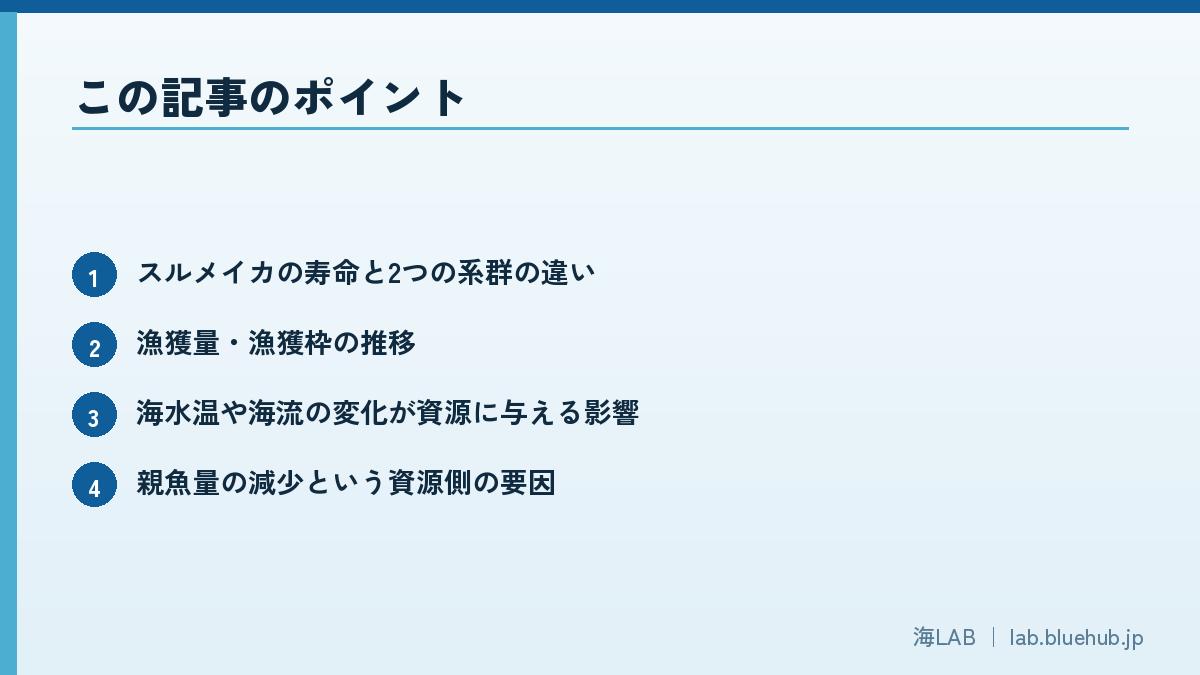
- The lifespan of Japanese flying squid and the difference between its two stocks
- Trends in catch volume and catch quotas
- How changes in sea temperature and currents affect the stock
- Declining spawning stock as a resource-side factor
- Impacts on fisheries and regional economies
- Signs of recovery and future measures
What Is Japanese Flying Squid? A One-Year Lifespan and Two Stocks
Basic facts about Japan's most familiar squid
Japanese flying squid is a squid with a mantle length of about 30 cm, widely distributed around Japan and deeply rooted in the Japanese diet as sashimi, grilled squid, shiokara and surume (dried squid). In fisheries too, it has been targeted by squid jigging, offshore trawling, set nets and many other methods, long supporting the fishing industry and regional economies.
In recent years, however, Japanese flying squid has become hard to catch. Supermarket squid is smaller and pricier, and landings are shrinking in squid towns such as Hakodate and Sanriku. This article focuses on two factors cited as causes of the decline, namelyrising sea temperaturesanda decrease in the stock (the number of parents), and, drawing on government materials and news reports, explains what is happening and how it affects fisheries and daily life.
About one year of life, ending after spawning
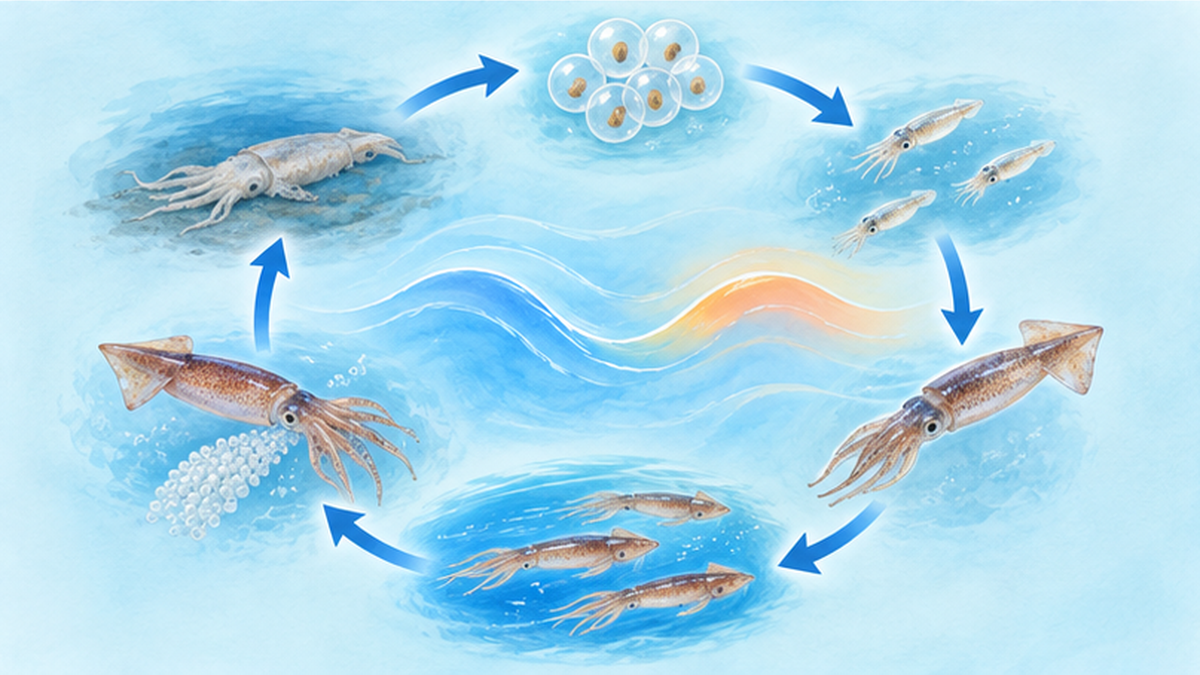
The defining feature of Japanese flying squid is its short lifespan of about one year. It grows during the year it is born and dies after spawning. Each year's stock is therefore largely determined bythe number of parents that survived and spawned the previous yearandthe environment in which the hatched juveniles grow. Unlike long-lived fish, even one bad year hits the next year's stock directly, which is what makes managing squid resources difficult.
Winter-spawned and autumn-spawned stocks
Japanese flying squid around Japan are assessed as two main groups (stocks) depending on when they are born. According to the Fisheries Agency, the winter-spawned stock is born in winter in areas such as the East China Sea, grows while migrating north mainly along the Pacific side, and migrates south through the Sea of Japan in autumn and winter as it matures. The autumn-spawned stock spawns in autumn (around October to December) from the Hokuriku coast to the East China Sea.
| Item | Winter-spawned stock | Autumn-spawned stock |
|---|---|---|
| Main birth season | Winter | Autumn (around Oct–Dec) |
| Main spawning grounds | East China Sea, etc. | Hokuriku coast to East China Sea |
| Growth areas | Migrates north in the Pacific, south in the Sea of Japan in autumn and winter | Mainly the Sea of Japan |
| Link to poor catches | Worsening temperature conditions on spawning grounds are cited as one factor | Declining trend continuing since around 2000 |
Key points of this chapter
- Japanese flying squid live about one year and die after spawning
- Stock assessments are made separately for the winter-spawned and autumn-spawned stocks
- Each year's stock is set by "the number of parents" and "the ocean environment where juveniles grow"
The Numbers Behind the Decline: From Over 300,000 Tons to the 10,000-Ton Range
How far the catch has fallen
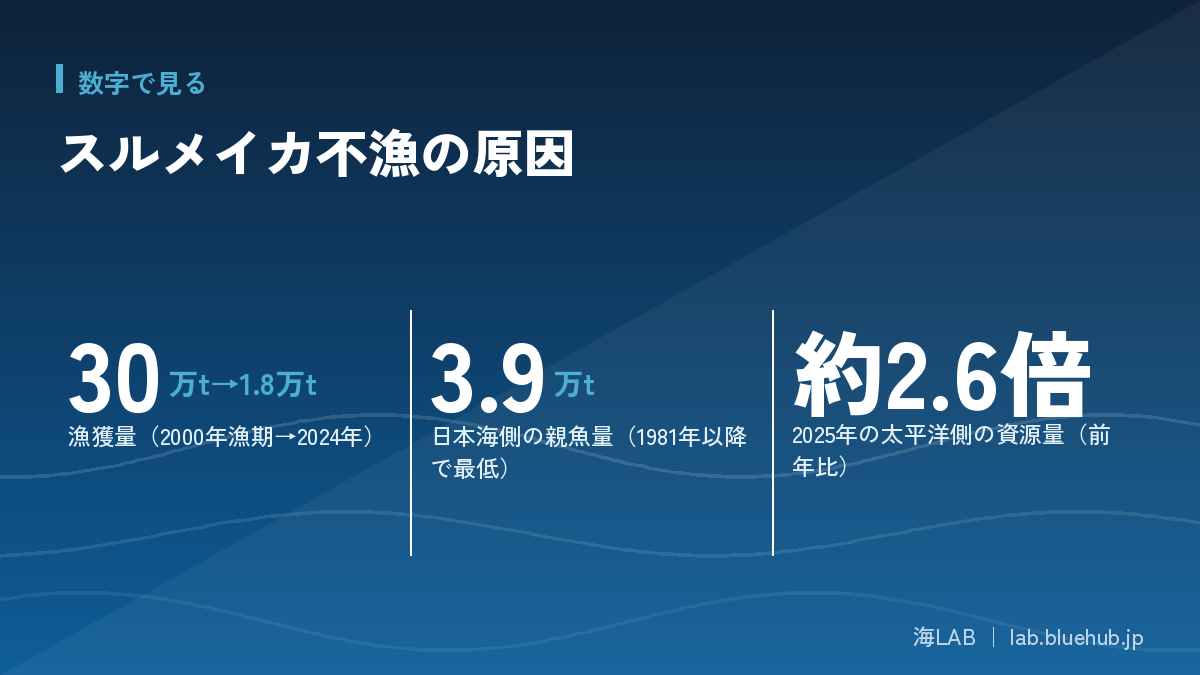
According to news reports, the combined catch of Japanese flying squid on the Pacific and Sea of Japan sides exceeded 300,000 tons in the 2000 season but fell to 18,000 tons in 2024. In just over 20 years, that is less than one-sixth.
Materials from the Iwate Prefectural Fisheries Technology Center also state that Iwate's catch once reached 30,000 tons a year at its peak, but has stayed below 3,000 tons since 2017. The mornings that once bustled with squid landings at Sanriku ports have changed greatly within one generation.
Catch quotas (TAC) cut sharply
Japanese flying squid is subject to the Total Allowable Catch (TAC) system. The Fisheries Agency manages the two stocks together within the total of their Allowable Biological Catch (ABC), excluding catches by foreign vessels. According to reports, the 2025 season catch quota was set at 19,200 tons, down 76% from the previous year. If fishing continued despite low stocks, parents would decline further and recovery would slip away, so the volume caught itself has had to be cut.
Stocks below the management benchmarks
Stock management uses benchmarks to judge whether a resource is healthy. Fisheries Agency materials showed, for the winter-spawned stock, a target management benchmark (the spawning stock needed to achieve maximum sustainable yield) of 234,000 tons, a limit management benchmark (below which recovery measures are required) of 132,000 tons, and a fishing-ban level of 14,000 tons. The benchmarks have since been revised (the proposed target for the winter-spawned stock is 255,000 tons), and Ibaraki Prefecture's materials summarize that in the national assessment for fiscal 2024 the stock level was below both the target and limit benchmarks, with a flat trend.
| Indicator | Figure | Source type |
|---|---|---|
| Catch (Pacific + Sea of Japan combined) | 2000 season: over 300,000 t → 2024: 18,000 t | News report (Sakigake Shimpo) |
| Iwate Prefecture catch | Peak 30,000 t → below 3,000 t since 2017 | Iwate Prefectural Fisheries Technology Center |
| 2025 season catch quota | 19,200 t (down 76% year on year) | News report (Sakigake Shimpo) |
| Limit benchmark, winter-spawned stock | 132,000 t (old benchmark) | Fisheries Agency materials |
Points to note when reading the numbers
- Catch volume is not the stock itself; it is also affected by quotas, fishing-ground formation, fuel prices and decisions to go out
- Benchmarks are revised as assessments are updated, so check the latest values in resources such as the FRA ABC Handbook
Cause 1: Rising Sea Temperatures and Changing Ocean Conditions
Spawning-ground temperatures no longer suitable
The factor given most weight in the poor catches is changing ocean conditions. Research institutes' analysis says that in the 2015 and 2016 seasons, temperature conditions on spawning grounds from the Sea of Japan to the East China Sea became unsuitable for the winter-spawned stock, contributing to the decline in stock level. Squid eggs and juveniles are sensitive to water temperature, and when the suitable temperature range narrows or shifts, the number born and surviving is thought to fall.
Effects of the Kuroshio large meander
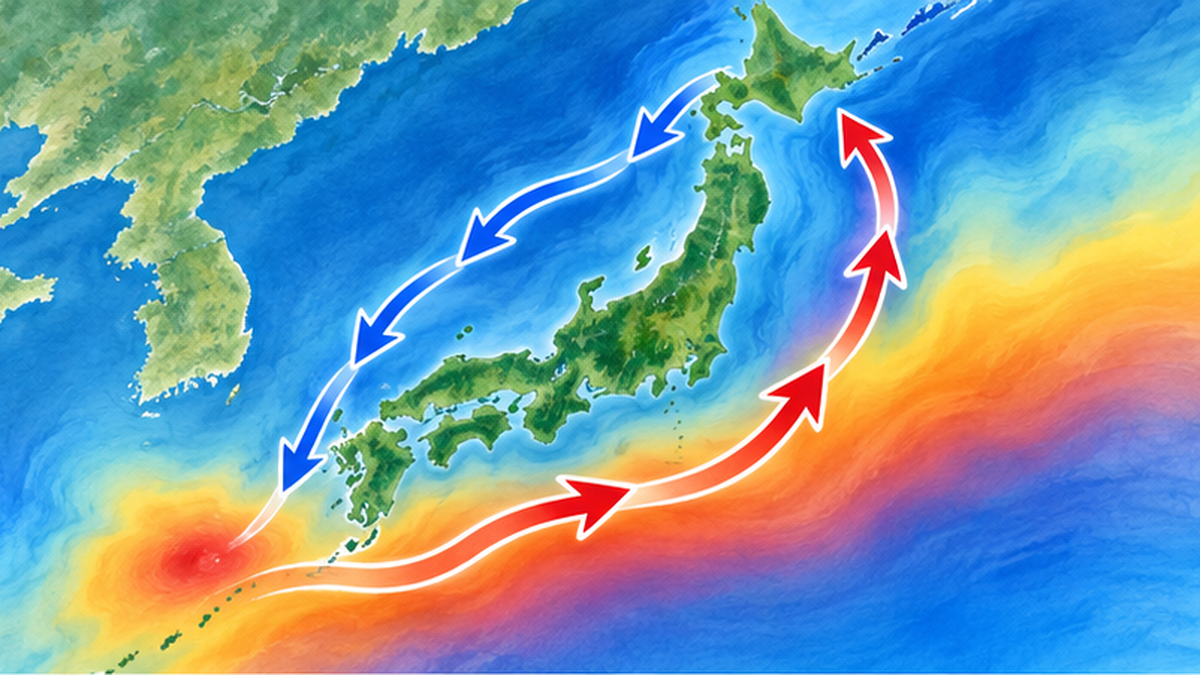
The Kuroshio large meander that began in 2017 greatly changed how currents flow along Japan's southern coast. According to reports, the end of the large meander in 2025 is analyzed as one factor behind the recovery on the Pacific side. In other words, the arrangement of currents can affect the stock through the location of spawning grounds and how juveniles are carried. The mechanism of the Kuroshio large meander itself is explained in a related article.
Related article:What Is the Kuroshio Large Meander? Causes and Effects on Fisheries and Weather
Yamagata research: fishing grounds failed to form
Yamagata Prefecture research analyzes that fishing grounds failed to form along the coast in 2015 because of currents and low water temperatures, and in 2016 because of currents and high water temperatures. Even among "poor catches", there are years when the water is too cold and years when it is too warm, showing a complexity that cannot be explained by the simple equation "warming = high temperatures".
Warming and marine heatwaves in the background
Long-term sea temperature rise and marine heatwaves, in which the sea suddenly becomes abnormally hot, are pointed out as affecting the distribution and survival of fishery resources. While it is difficult to attribute squid declines to warming alone, distribution changes have also been reported in other species such as Pacific saury, so changing ocean conditions are thought to be the backdrop for fisheries as a whole.
Related article:Fish Disappear as Seas Warm: Saury and Squid Declines and the Future of Japan's Fisheries/What Is a Marine Heatwave?
"Warming is the only cause" cannot be asserted
- There are cases where both too-warm and too-cold years led to poor catches
- Changes in currents, spawning-ground locations and food conditions are thought to combine as a complex of factors
Cause 2: Fewer Parents, a Resource-Side Factor
Spawning stock in the Sea of Japan at record-low levels
Another major factor is the decline in the number of spawning parents themselves. According to reports, the parent stock on the Sea of Japan side is estimated at 39,000 tons, the lowest since 1981, and poor catches are expected to continue in 2026. With few parents, fewer juveniles are born, and fewer juveniles grow into even fewer parents, making a vicious cycle easy to fall into.
Not just overfishing: both environment and stock
The Fisheries Agency's Study Group on Poor Catches (2021) cited changing ocean conditions as one cause of the poor catches and pointed to the need for medium- to long-term measures. Fishing pressure naturally also contributes to stock decline. If fishing continues as usual while the environment deteriorates, recovery may be delayed. Separating the effects of environment and fishing is important in stock management.
Related article:Why Does Overfishing Collapse Fish Stocks?
A shift toward smaller sizes
Fishers also point to smaller squid being caught. The Iwate Prefectural Fisheries Technology Center is analyzing changes in body size and age in days to examine the causes of smaller sizes. Survey reports around Hakodate also suggest that the arrival of southbound schools from eastern Hokkaido in autumn has been delayed, and body sizes were smaller than the previous year. More small individuals make it harder for the same landing volume to earn money and also affect processing uses.
Key points of this chapter
- Spawning stock in the Sea of Japan is estimated at 39,000 tons, the lowest since 1981
- Worsening environment and declining stock overlap, and catch quotas continue to shrink
- Changes on site have been reported, such as smaller sizes and delayed arrivals
Impacts on Fisheries and Livelihoods: Hakodate and Sanriku Today
Landings down to one-thirtieth, prices up sixfold
According to reports, in Hakodate, Hokkaido, known as a squid town, market volume has fallen to nearly one-thirtieth of its peak about 15 years ago, and prices have risen sixfold amid shortages. With recovery uncertain because of warming seas and changing currents, research into new fishing grounds has begun.
The Hakodate Fisheries Research Institute announced that no squid could be confirmed in its 2026 Sea of Japan survey, and experts pointed out that severe conditions may continue after summer.
Impacts spreading to squid jigging, processing and tourism
The impact does not stop at fishing boats. It ripples through the regional economy in the following ways.
- Squid jigging boats: with smaller landings that cannot cover fuel and labor costs, more boats refrain from going out
- Seafood processing: raw material is hard to secure, and production of shiokara, surume and frozen products shrinks
- Distribution and retail: sales space shrinks as prices rise, and a shift to substitute species advances
- Tourism and dining: it becomes hard to maintain signature local offerings such as morning markets and squid sashimi
Combined with a shortage of fishing successors, how to sustain local fisheries has become an issue.
Related article:Why Is the Shortage of Fishing Successors So Serious?

| Affected area | Specific changes | Direction of response |
|---|---|---|
| Squid jigging fishery | Smaller landings, fewer trips | Exploring grounds, switching to other species |
| Seafood processing | Raw material shortage | Using imported materials and other squids |
| Distribution and retail | Higher prices, shortages | Stronger sales of substitute species |
| Region and tourism | Hard to maintain signature dishes | Rebuilding the local brand |
The poor catches are "not only a squid problem"
- Poor catches continue in other species such as Pacific saury and salmon, affecting the revenue structure of the fishing industry as a whole
Signs of Recovery? The 2025 Season
Pacific-side stock up about 2.6 times
There is also good news. According to reports, in the Fisheries Agency's 2025 season assessment, the stock of squid migrating north on the Pacific side rose to about 2.6 times the previous year. Analysts cite the end of the Kuroshio large meander improving juvenile survival, and the formation of a spawning ground on the Pacific side. It shows that when ocean conditions are right, a one-year squid stock can grow in a short time.
Sea of Japan side remains weak
However, stocks on the Sea of Japan side remain weak. Recovery on the Pacific side and poor catches on the Sea of Japan side are progressing at the same time, and assessments differ by sea area and stock. It cannot be lumped together as "recovered".
Do not overestimate the recovery
- Even if the stock grows, it is not yet known whether it will stabilize above the benchmarks
- Because of the short lifespan, it may fall again depending on next year's environment
The pitfall when stocks rebound
If stocks increase temporarily, fishing pressure may rise and cut off the budding recovery. It is important to set catch quotas based on scientific assessments and to leave parents behind.
Measures Ahead: Stock Management, Fishing-Ground Exploration and What We Can Do
Science-based stock management
Japanese flying squid is managed under a framework in which the Fisheries Research and Education Agency assesses the stock and the Fisheries Agency sets the TAC. Precisely because it is a species whose stock swings widely with environmental change, continuing juvenile surveys by research vessels and temperature observation of spawning grounds to improve assessment accuracy is essential.
Exploring fishing grounds and smarter operations
Research into new fishing grounds has begun around Hakodate. Saving fuel and operating efficiently using temperature and current information are important ways to protect business even during poor catches.
Related article:What Is Smart Fisheries? The Front Line of IoT, AI and Drones Transforming Fishing and Aquaculture
What we can do at the table
- Enjoy a variety of seafood, including squids other than Japanese flying squid and unused fish
- Take an interest in changes in the ocean through changes in price
- Choose products from fishers and production areas working on stock management
- Bring actions to protect the marine environment, such as climate action, into daily life
Related article:How Unused Fish Utilization Is Changing the Table and Fisheries
What you can do from today
- Check "origin", "size" and "price" at the supermarket to learn about changes in the ocean
- Choose seafood other than squid too, to avoid burdening a particular resource
Why Squid Stocks Fluctuate So Much: The Fate of Short-Lived Animals
"Regime shifts" and species replacement
Fishery resources around Japan are known to rise and fall over decades as sardines, mackerel, Japanese flying squid and others replace one another. The phenomenon of the marine environment switching greatly is called a "regime shift", and eras favorable and unfavorable to particular species are thought to alternate. That periods of high and low squid stocks exist has been observed in the past too.
However, it has been pointed out that the recent poor catches may involve a new element, global sea temperature rise, on top of long-term natural variation. If warming is added to natural cycles, stocks may find it harder to return.
Short-lived animals are more sensitive to the environment
Japanese flying squid, living one year, have only a single chance for the parent generation to produce the next. Fish that mature over several years and spawn repeatedly can make up for a bad year in another year, but squid carry the effect of an unfavorable year straight into the next. Conversely, in a favorable year the stock may grow rapidly, and the Pacific-side movement in 2025 can be seen as one example.
- Long-lived fish: multiple generations coexist, so stocks fluctuate gradually
- Squids: generations turn over in one, so environmental effects appear within a year
- For this reason, squid stock assessment requires annual surveys and updates
How stock assessment works
- The Fisheries Research and Education Agency estimates stock size by combining research-vessel surveys, catch statistics and egg-and-larva surveys
- Results are presented as ABC (Allowable Biological Catch), which the Fisheries Agency uses to set the TAC
Poor Catches, International Affairs and Imports: Squid Is a Shared Global Resource
Not only a matter of Japan's surrounding seas
Japanese flying squid and its close relatives are caught worldwide, and Japan is both a catching and a consuming country. When poor catches continue at home, dependence on other squids imported as processing material can rise. World squid stocks also fluctuate with climate, so it is not as simple as being safe by relying on imports.
Relations with foreign vessels
Fisheries Agency materials describe the TAC as the total of both stocks' ABC excluding catches by foreign vessels. In waters used by multiple countries such as the Sea of Japan, managing only Japan's catch is not sufficient, and international cooperation in resource management is an issue.
Related article:What Is IUU Fishing? How Illegal Fishing Takes 26 Million Tons of Fish a Year
Substitute species and changing food culture
When Japanese flying squid becomes hard to obtain, retail and restaurants shift to other squids and other fish. This spreads to home tables too, and the premise of food culture, "squid means Japanese flying squid", is changing.
| Perspective | What is happening | Impact on us |
|---|---|---|
| Resource | Decline in domestic stock | Higher prices, smaller sizes |
| Imports | Reliance on other squids | Effects of exchange rates and the other country's catch |
| Food culture | Shift to other species | Diversified tables, changes in traditional foods |
A Multifaceted Approach to Overcoming the Poor Catches
Systems supporting fishers' businesses
Poor catches deal a major blow to fishing businesses. Researchers' management analyses examine the impact on small squid jigging businesses and the role of fishery mutual aid. When income becomes unstable, mutual aid and subsidy systems are pointed out as important supports for fishers' businesses.
Investing in research
To raise the accuracy of stock forecasts, basic surveys such as ocean observation, juvenile distribution surveys and spawning-ground environmental analysis must continue. Fisheries research institutes in Iwate, Hokkaido and elsewhere continue analyzing body size and age in days and tracking arrivals, and the results feed into fishers' operating decisions and better stock management.
A long-term view of protecting the marine environment
The fundamental measures are mitigating global warming and conserving the marine environment from coast to offshore. Decarbonization may seem distant, but it comes back to fishery resources in the form of rising sea temperatures. Decarbonizing fisheries and conserving seaweed beds and tidal flats also help build the foundations that nurture marine life.
Related article:Fish Distributions Shift North: How Warming Changes the Origins and Tables of Yellowtail, Spanish Mackerel and Saury
- Scientific stock assessment and precautionary catch quotas
- Mutual aid and support systems for fishers' businesses
- Fishing-ground exploration and efficient operations based on temperature and currents
- Climate action and marine environment conservation
- Diverse seafood choices by consumers
Overall picture of measures
- It is important to act in five directions: stock, business, research, environment and consumption
Answering Common Questions: Squid Decline Q&A
Q. Isn't overfishing the cause?
The effect of fishing is not zero, but research institutes and study groups see changing ocean conditions as an important factor. Because the effect of fishing becomes relatively larger when the environment is deteriorating, reducing quotas and leaving parents behind is emphasized.
Q. Will we be able to catch squid next year?
Japanese flying squid turn over in one year, so next year's stock depends on this year's spawning and next year's ocean environment. Signs of recovery can appear, as in 2025, but the Sea of Japan side remains weak and short-term prediction is difficult.
Q. Is there anything I can do at home?
Rather than relying on Japanese flying squid alone, choosing a variety of seafood, taking an interest in origin and seasonal information, and sharing marine environmental issues as familiar topics are small but certain steps.
Q. Where can I check the information?
Official stock assessment information is published by the FRA ABC Handbook, quotas and policy by the Fisheries Agency, and local conditions by each prefecture's fisheries research institute. Going to primary sources, not just news reports, gives you the full picture.
Summary: What the Squid Decline Teaches Us
The squid decline is thought to result from environmental factors such as rising sea temperatures and changing currents combined with a resource-side factor, declining spawning stock. Catch volume fell from over 300,000 tons in the 2000 season to 18,000 tons in 2024, and although signs of recovery appeared on the Pacific side in 2025, the Sea of Japan side remained weak.
Japanese flying squid, living one year, act like a "sensor of the sea" reflecting changes in the ocean environment. Understanding what is happening in the sea behind the news of poor catches is the first step toward protecting fishery resources and local livelihoods.
Summary of this article
- Japanese flying squid live about one year and are strongly affected by the environment
- Catch fell from over 300,000 tons in the 2000 season to 18,000 tons in 2024
- The causes combine environmental changes such as temperature and a decline in spawning stock
- In 2025 the Pacific side rose about 2.6 times, but the Sea of Japan side remained weak
- Scientific stock management and our attention support recovery
References and Sources
- Pacific Japanese flying squid up 2.6 times in the 2025 season as Kuroshio large meander ends (Sakigake Shimpo) – News report on the 2025 season stock assessment
- Fisheries Agency, FY2024 White Paper on Fisheries (poor catch issues) – Summary of poor-catch issues
- Fisheries Agency, Japanese flying squid stock management materials – Management benchmarks and the TAC approach
- Ibaraki Prefecture, materials on Japanese flying squid stock – Summary of the FY2024 stock assessment
- Iwate Prefectural Fisheries Technology Center, research presentation materials – Iwate's catch and analysis of smaller sizes
- Possible poor squid catch: first time no catch confirmed in Sea of Japan survey (Hokkaido Shimbun) – News report on the Hakodate survey
- Kamiyama and Miyata, Small-scale squid jigging business management amid the poor catch problem and the role of fishery mutual aid – FRA repository
- FRA ABC Handbook – Official stock assessment information
* Ordered by reliability: government and academic institutions > peer-reviewed papers > specialist organizations > reliable media