⚡ In short
Fish skin is about 2% of a fish's weight. After degreasing and tanning it becomes leather in about a month. Ocean Leather in Kochi, Nissui's test sales, the skin-collection barrier and chrome vs vegetable tannin, from public information.
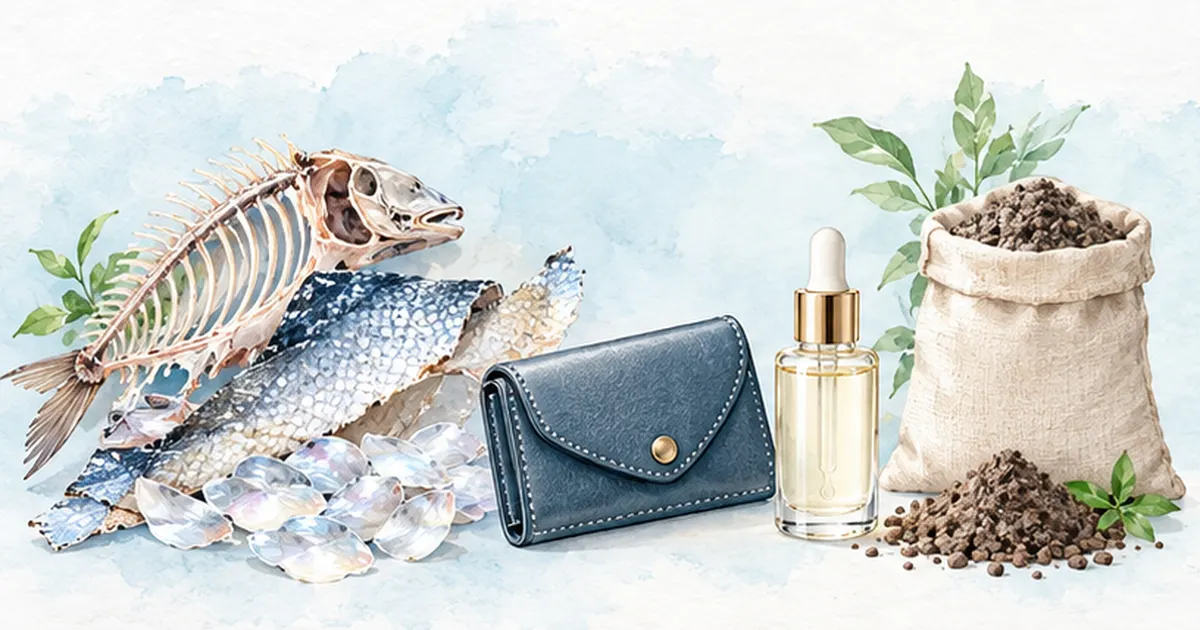
The skin left after filleting has generally gone into fishmeal and fertilizer, or been discarded. Efforts to use that skin as leather are starting to spread in Japan.
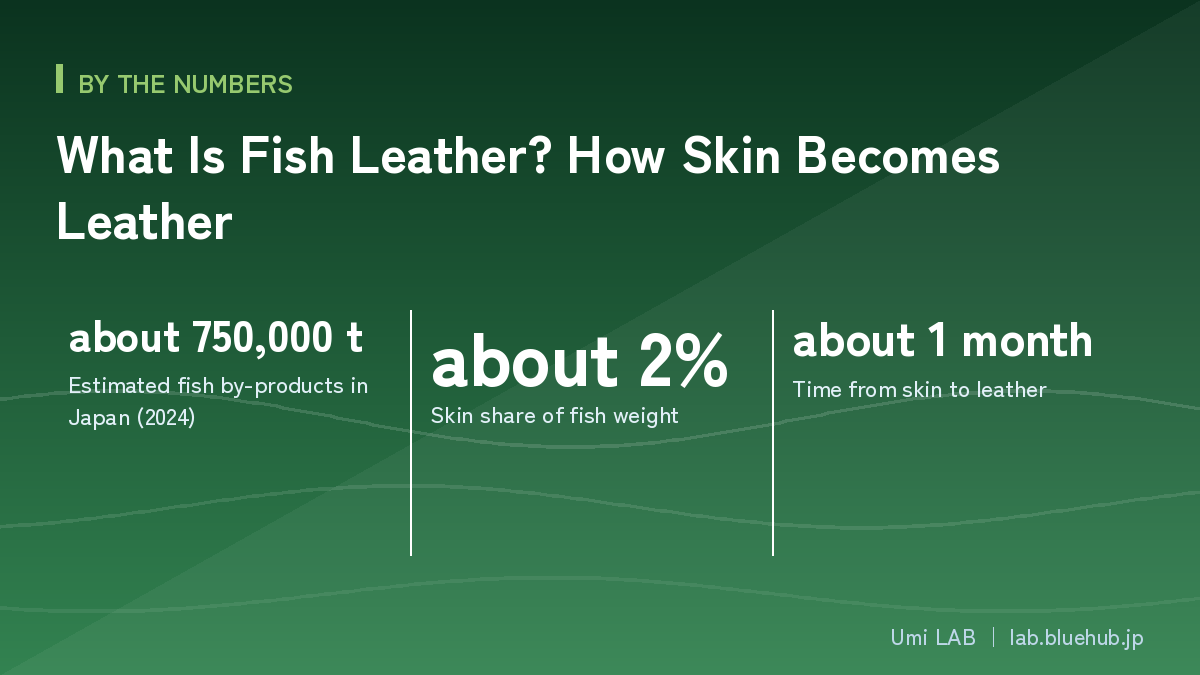
Fish by-products are estimated at about 750,000 tonnes a year in Japan, but skin is only about 2% of a fish's weight. Even so, a material with scale patterns and a lateral line is valued for a texture nothing else offers.
This article summarizes the manufacturing steps, tanning methods, Japanese cases and barriers to spread, based on public information. Figures and cases cite sources, and unconfirmed points are not asserted.
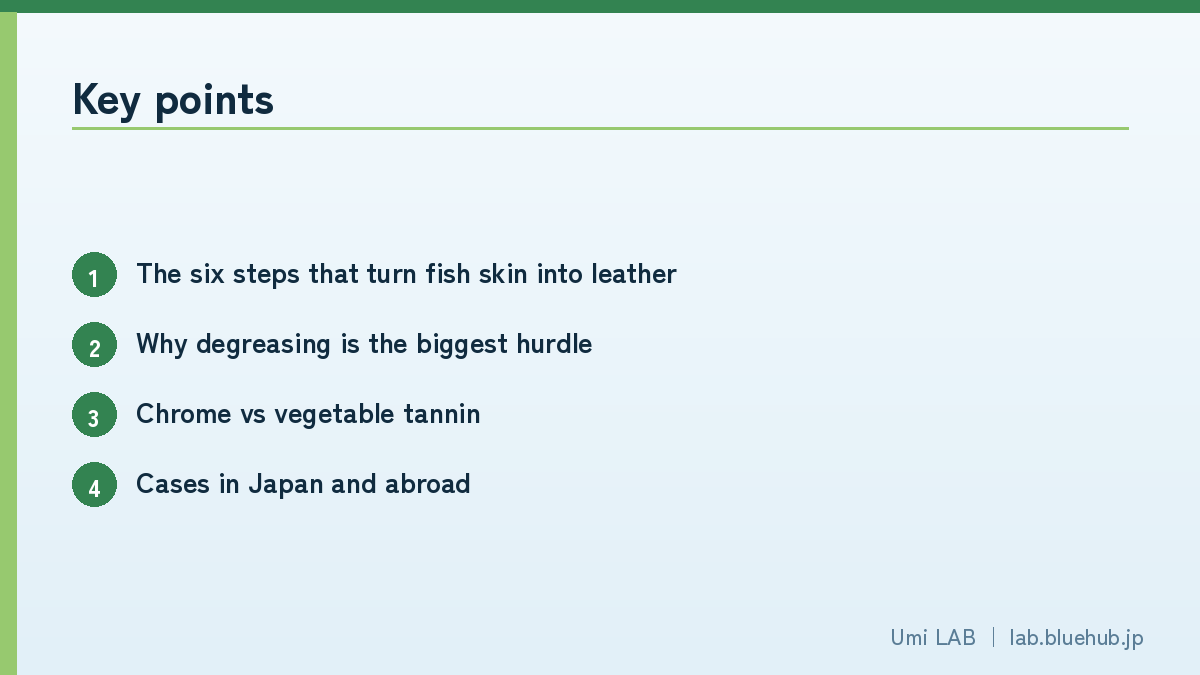
What you'll learn in this article
- The six steps that turn fish skin into leather
- Why degreasing is the biggest hurdle
- Chrome vs vegetable tannin
- Cases in Japan and abroad
- Three barriers to spread
- Checkpoints when buying
Why fish skin was treated as waste
The skin: a by-product of filleting
Filleting leaves heads, bones, viscera, skin and scales behind. According to the Ocean Newsletter of the Ocean Policy Research Institute, Japan's domestic fish and shellfish supply in 2024 was 1.62 million tonnes (excluding shellfish and seaweed). Assuming an edible yield of 54%, fish by-products ('aramono') come to roughly 750,000 tonnes. About 74% of that (about 550,000 tonnes) goes to fishmeal companies and ends up as feed and fertilizer.
Skin is a small but distinctive part of that stream. The makers of the Kochi-based fish leather brand Ocean Leather explain that fish skin is about 2% of a fish's weight. That is small per fish, but across the many fish processed every day it adds up.
Where skin has mostly gone: feed, fertilizer and food
Like other by-products, skin has mainly gone into fishmeal and fish oil. Salmon skin is fried and eaten as chips, and collagen extracted from skin is used in pharmaceuticals, health foods and cosmetics. So it is closer to the truth to say skin went to cheap, high-volume uses than that it was simply thrown away.
- Fishmeal and fish oil: feed for farmed fish and livestock, and fertilizer (the largest outlet)
- Food: salmon-skin chips, processed foods and surimi-type products
- Materials: collagen and gelatin for cosmetics and health foods
- Leather: tanning the skin itself into a material — the subject of this article
Leather as a new outlet
Using the skin as a material is what fish leather is about. Scale patterns and the lateral line (the organ that senses water flow) stay visible, so it is valued not as a cheap substitute but as a texture only fish can offer. This article explains how skin becomes leather, what the challenges are, and what is happening in Japan and abroad, based on published information.
Key points of this section
- Japan's fish by-products are estimated at about 750,000 tonnes a year, about 74% of which go to fishmeal companies
- Skin is about 2% of fish weight: small in volume, but leather is a high-value outlet
- See also using fish processing residue for by-products in general
What is fish leather? Characteristics of the material
Definition: leather made from fish skin
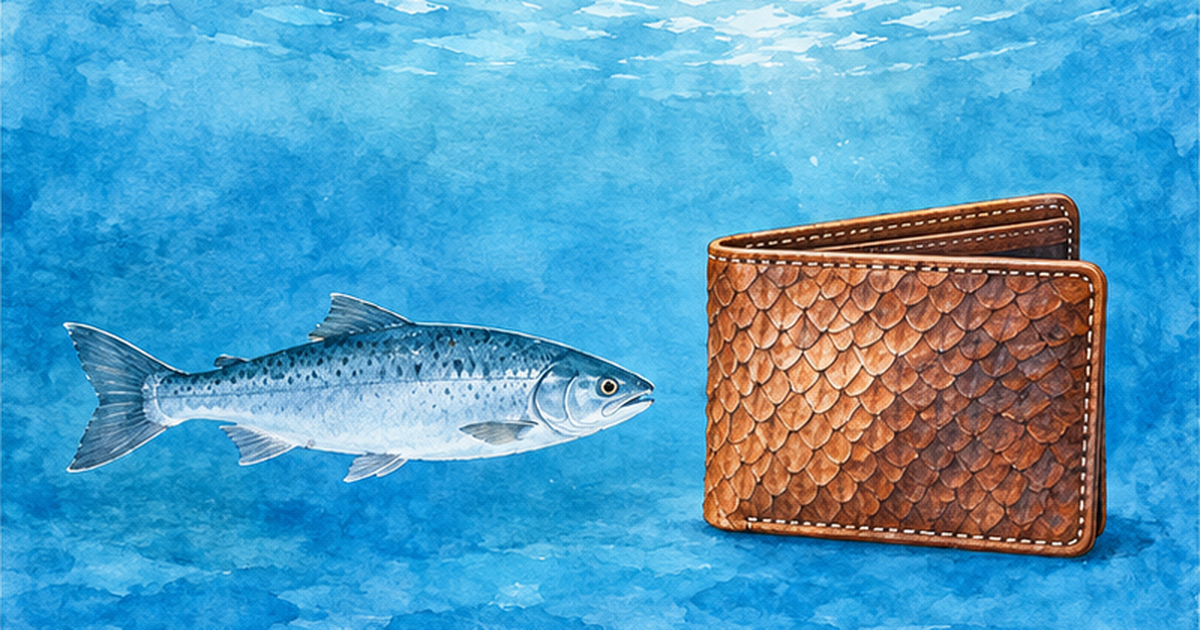
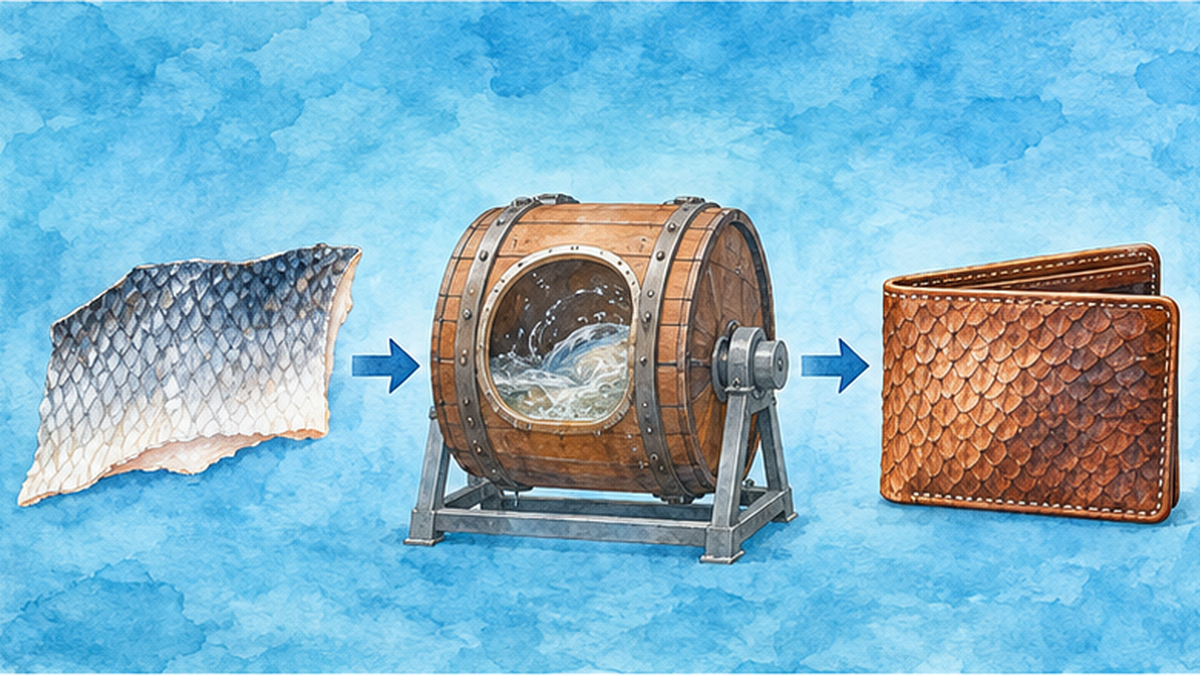
Fish leather is fish skin turned into a material that does not rot, through tanning. The idea is the same as for cow or pig leather. Raw skin hardens when dry and rots when wet. Tanning binds chemicals to the collagen fibers to keep the skin soft and durable.
Look: scale patterns and the lateral line
According to Ocean Leather, sea bream has translucent, deep scale patterns; yellowtail has fine patterns and a smooth feel, and its clear lateral line makes it easy to recognize as fish leather. Mahi-mahi has very fine scales. Only one lateral line can be taken per piece of leather, and because of injuries and scale arrangement, no two pieces are alike, the brand says.
Strength: surprisingly durable, varying by species
Fish skin is thin but is said to be strong because its fibers cross and overlap. In an interview article about Koyo Freeze, the five main species rank, from strongest, sturgeon, mahi-mahi, salmon, yellowtail and sea bream. Some staff products have reportedly been used for over three years without tearing.
| Species | Features (from Ocean Leather) | Strength |
|---|---|---|
| Sturgeon | Quite thick skin | Strongest |
| Mahi-mahi | Very fine scales, clear lateral line | Strong |
| Salmon | Familiar farmed fish, easy to process | Medium |
| Yellowtail | Delicate pattern, smooth feel, clear lateral line | Somewhat weaker |
| Sea bream | Translucent, deep scale pattern | Most delicate |
Honest weaknesses: water and size
Fish leather is a kind of genuine leather and is weak against water. Because skin has the shape of one side of a filleted fish, large single sheets like cowhide are not available. Large products require joining several skins, which adds steps and raises the price. Knowing these limits, it is best chosen for small goods and decoration.
Key points of this section
- Fish leather is fish skin tanned into a material that does not rot
- Scale patterns and the lateral line give it character; no two are alike
- Limits: no large sheets, weak against water
How it is made: about one month from skin to leather
Overview: from preparation to finishing
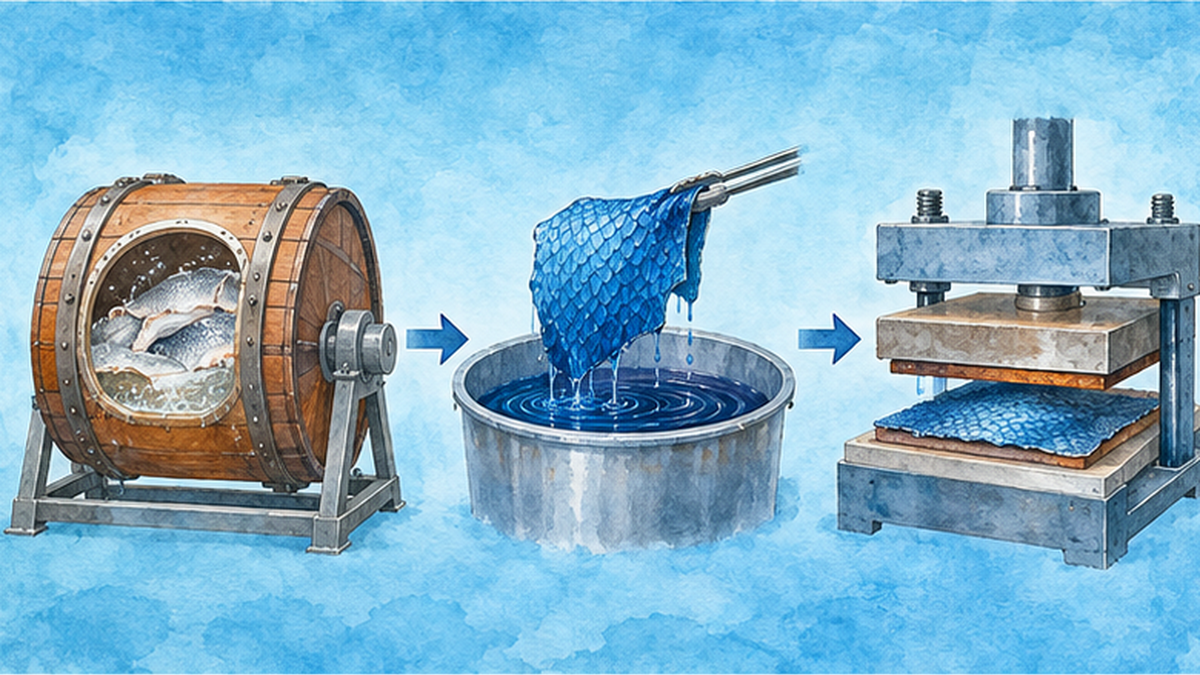
According to an article in Daily, Ocean Leather, run by Koyo Freeze (Kochi Prefecture, founded 1985) since 2021, takes about one month to complete. The brand says there are more than 20 steps. Broadly, there are six stages.
- Preparation: check and prepare the skins received
- Flesh removal: scrape off remaining meat
- Degreasing: soak in an alkaline solution and tumble in a drum for about 7–10 days (scales also come off)
- Tanning: use plant-derived tannin in a drum for about one week to turn skin into leather
- Dyeing: let dye penetrate into the leather
- Finishing: basically a clear coating, using three kinds of paint and about five hot presses
The biggest hurdle: degreasing
Fish skin is oily. Leftover fat affects tanning and dyeing and also causes fishy smells, so degreasing takes more than a week. Fat content differs by species, so chemicals and water temperature must be adjusted for each fish. The company says it explores methods by trial and error for each new species.
Why no pigment in the finish
The finish is basically clear and uses no pigment, because pigment would hide the scale pattern. The look of the material itself is the value, so finishing is designed not to hide it.
Over 50 species tried — some dissolved
The company has tried more than 50 species, including sea bass, spangled emperor, giant trevally, amberjack, rainbow trout and tuna. Some dissolved during processing and were never completed. Skin properties differ greatly by species; not every fish can become leather.
Note: what is tanning?
- A treatment that binds chemicals to the collagen fibers to prevent rot and hardening
- In fish leather, much of the time goes into degreasing as pre-treatment, unlike cowhide
- See uses of fish bones, skin and scales for the comparison with collagen use
Tanning methods: chrome vs vegetable tannin and the environment
Over 80% of the world's leather is chrome-tanned
There are two main families of tanning. More than 80% of the world's leather is chrome-tanned and vegetable tanning is about 10-odd percent. Chrome tanning is efficient and can make everything from soft to fairly stiff leather. Chrome-tanned leather is typically bluish, vegetable-tanned leather brownish.
Issues with chrome tanning
Trivalent chromium can turn into hexavalent chromium under certain conditions, and major markets legally regulate residual hexavalent chromium in textile and leather end products. Wastewater treatment is also a burden, and research aims at using fewer chemicals or chrome-free tanning, which has its own technical challenges.
| Item | Chrome tanning | Vegetable tannin tanning |
|---|---|---|
| Share of world leather | Over 80% | About 10-odd percent |
| Method | Processed in drums | Traditionally soaked in pits (drums are also used for fish leather) |
| Color | Bluish | Brownish |
| Suited products | Wide range, including thin glove leather | Thin, flexible leather is difficult |
| Environmental issues | Hexavalent chromium rules, wastewater | How the plant material is sourced |
Fish leather often uses vegetable tannin
Ocean Leather uses vegetable tannin and says that, because no chromium or other heavy metals are used, the environmental load is low. It also says its tannin comes from managed plantations, not primary forest. However, environmental load is not determined by the tanning method alone: water use, energy and transport distance matter too. It is not accurate to say 'plant-based means fully eco-friendly'.
Abroad: an Icelandic tannery using geothermal energy
Iceland is one country with a long fish leather history. Reports say Atlantic Leather (Sjávarleður) has tanned fish skin since 1994, uses geothermal energy and has equipment that reuses water 8–9 times. One report mentions around 10,000 skins, nearly a tonne, per month. Reports disagree on company names and client brands, so check each company's official information.
Caution: read environmental claims carefully
- Check whether 'eco-friendly' refers to chemicals, water, energy or raw materials
- Fish skin is a food by-product, so no extra fish need to be caught — the key advantage
- Long-distance transport or heavy use of chemicals and water can erase that advantage
Efforts in Japan: Ocean Leather and Nissui's test sales
From Kochi: Ocean Leather (Koyo Freeze)
Koyo Freeze Co., Ltd., a seafood processor in Kochi Prefecture, launched the fish leather brand Ocean Leather in 2021. Its representative is Mr. Takahashi. Its concept is 'the sea in your hands', and it says it does everything from tanning to sewing by hand in Japan. Products include ID pass cases, pen cases and notebook-style smartphone cases, sold via crowdfunding on Makuake in January 2023.
According to the interview article, prices range from 32,000 to 70,000 yen for wallets and 14,000 to 33,000 yen for card cases. That is more expensive than cowhide, reflecting the effort of handling small skins one by one.
Nissui's fish leather test sales (2025)
Nissui, a major seafood company, was reported in March 2025 (IntraFish, Undercurrent News) to plan test sales of fish leather to manufacturers in the US and Europe, as a way to use by-products of its whitefish aquaculture. The question is whether a major company's entry will help build a system for collecting skins reliably. Species and details cannot be fully confirmed from the reports, so official announcements should be awaited.
Other species and regions
A wallet made with yellowtail skin from Himi, Toyama has also been introduced, and product development tied to local seafood appears in various places. There are also efforts with salmon and shark skin, but scale and continuity differ greatly. When researching a case, check the operator's official announcements as primary sources.
Key points of this section
- The center in Japan is Kochi's Ocean Leather (since 2021)
- Nissui was reported to start test sales to the US and Europe in 2025
- A major company's entry could be the key to stable skin supply
Barriers to spread: size, collection and cost
Barrier 1: small size
Skin has the shape of one side of a filleted fish, so large single sheets like cowhide are not available. Joining several skins is possible but adds steps and cost. This is why products concentrate on wallets, card cases and other small goods.
Barrier 2: collecting clean skin is hard
The interview article says that collecting clean skin reliably is the barrier to mass production. The reasons:
- Processing machines aim to extract meat efficiently and do not assume the skin must remain undamaged
- For large, unblemished fish, skin and meat are sometimes separated with a single knife, which takes effort
- Freshwater fish are often grilled and eaten with the skin, so less skin goes to leather
- Because the focus has been on getting more meat and processing quickly, techniques for taking skin out cleanly are not well developed
Barrier 3: conditions differ by species
Skin properties differ by species, so chemicals and water temperature must be explored each time. This makes it hard to put on a mass-production line and tends toward small batches of many varieties, which also pushes up cost.
| Challenge | Cause | Possible response |
|---|---|---|
| Small size | Only one fillet side per fish | Specialize in small goods / design joining several skins |
| Collecting skin | Machines not designed to preserve skin | Link plants with workshops; develop skin-preserving methods |
| Species conditions | Different skin properties | Focus on main species; build trial data |
| Weak against water | Nature of genuine leather | Water-resistant finishes; choose uses wisely |
Supply side: by-products themselves are decreasing
The Ocean Newsletter points out that the supply of fish by-products is falling year by year, because of less domestic consumption, falling domestic production due to ageing fishers and climate change, and imported seafood being filleted overseas so the by-products arise abroad. For those collecting skins, raw material supply carries a risk of shrinking.
Caution: 'using waste' alone is not enough
- Collecting, transporting and storing skin (it spoils easily) takes effort and cost
- Without design value and a story to support the price, it will not last
- Small-market businesses also tend to be unstable
How to build a skin collection system: linking plants and workshops
Freshness and storage decide success
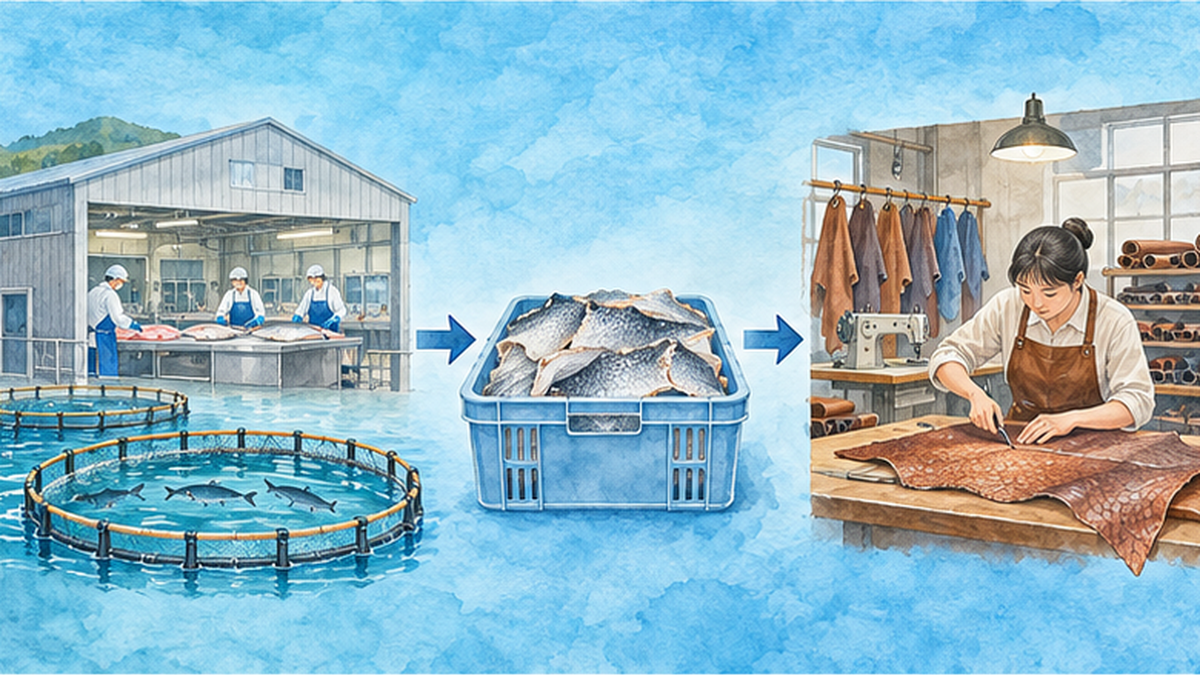
Skin is oily and wet and spoils with time. To obtain clean skin, you need steps such as washing right after filleting, storing it salted or frozen, and sending it to a workshop once there is enough. For a processing plant this is extra work on top of its main job, and it will not continue unless paid enough.
The idea of processing without damaging the skin
As the interview article says, current machines aim to extract meat efficiently and do not assume skin stays undamaged. To use skin for leather you need ways of cutting that spare it or a separate line to take it out. For large unblemished fish, a single knife is sometimes used, so human hands support the parts that are hard to mechanize.
- Processing plants: add steps to separate, wash and store skin
- Leather workshops: degrease and tan by species in small lots with quality control
- Brands and sellers: support the price with story and design, and return fair payment to plants
Thinking about collaboration models
Farmed fish are shipped in batches of similar size and condition, so skin may be easier to collect than from wild fish. This may relate to why aquaculture operators like Nissui try test sales. This, however, is the author's own summary, not an official explanation of any company's intentions.
In practice, partners should agree in advance on volume, quality, price and delivery time. Without expected volume a workshop cannot invest in equipment, and if the buying price is low, plants will not join. Precisely because the market is small, conditions that both sides can sustain are key.
Key points of this section
- Clean skin depends on freshness control and storage effort
- Plants, workshops and sellers need to share the value fairly
- Farmed fish may be easier to collect, but this is a summary, not an official explanation
Common misconceptions
Misconception 1: 'Using discarded skin means zero waste'
Much skin may already have gone into fishmeal or fertilizer. Sending it to leather reduces what flows to other uses. It is more accurate to see it as choosing a higher-value outlet than as producing zero waste.
Misconception 2: 'Vegetable tannin is fully eco-friendly'
Avoiding chromium is an advantage, but water use, energy, raw material sourcing and transport distance also matter. Check each business's explanation to judge how far a given product goes.
Misconception 3: 'Fish leather is weak and tears easily'
Strength differs by species; sturgeon and mahi-mahi are said to be strong. Some products have been used for over three years without tearing. It is weak against water, though, so handling changes lifespan.
Misconception 4: 'Any fish can be made into leather'
More than 50 species were tried and some dissolved during processing. Whether skin suits leather depends on the species, and trial and error is essential.
| Misconception | Reality |
|---|---|
| Discarded skin means zero waste | Fishmeal and other flows shrink; it's a higher-value outlet |
| Vegetable tannin is fully eco | Water, energy and transport also matter |
| Fish leather is weak | Varies by species; handling affects lifespan |
| Any fish works | Some species dissolve and never finish |
Key points of this section
- Avoid absolute claims like 'fully eco' or 'any fish works'
- Check evidence through stated processes, species and sources
What we can do: choose, learn, use long
Checkpoints when buying
- Is it explained which fish the skin came from and which plant's by-product it is?
- Is the tanning method (vegetable tannin, chrome, etc.) stated?
- Is the basis for 'eco' or 'sustainable' given in concrete numbers or processes?
- Is care covered, since it is sensitive to water and sweat?
How to use it for a long time
Fish leather is genuine leather, so the basics are to avoid water, friction and strong drying. If it gets wet, wipe with a soft cloth and dry in the shade away from direct sunlight or a hair dryer. The brand says it gains character with use, but without care it also deteriorates faster. Follow each product's instructions.
Eating fish is the first step of using by-products
For skin to reach leather, the fish must first be eaten and the skin removed cleanly. Choosing local fish, including unmarketed or undersized ones, raises the value of seafood overall. In the national fish processing statistics, edible processed product output in 2025 (Reiwa 7) was 1,241,499 tonnes, down 3% from the previous year. As production falls, ways to use every fish fully matter more.
What you can do today
- Look up local fish and processors' efforts and check their official sites
- When buying, check the material, tanning and care instructions
- When eating fish, try cooking that lets you eat the skin too
References and sources
- Ocean Newsletter (Ocean Policy Research Institute): fish by-product volume and uses – About 750,000 t of by-products etc.
- Daily: the little-known world of fish leather – Process, challenges, prices
- Makuake: Ocean Leather project – Method, species, skin share
- IntraFish: Nissui fish leather test sales – Report on Nissui's test sales
- Undercurrent News: Nissui upcycled fish leather – Report on Nissui fish leather
- MAFF: fish processing statistics (Reiwa 7) – Output of edible processed products
- Atlas Obscura: fish leather in Iceland – Overseas case
- Tokyo Metropolitan Consumer Center: leather product guide – Chrome tanning etc.
Listed in order of reliability: government and academic institutions > peer-reviewed papers > specialist organizations > reliable media