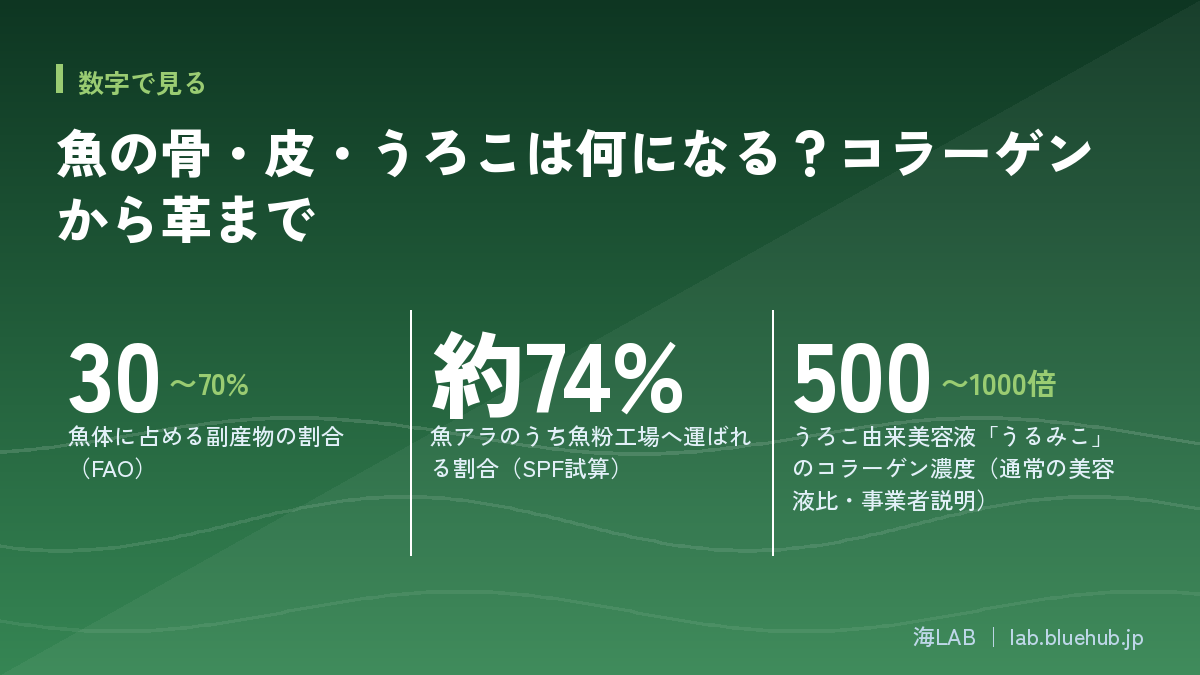
⚡ The answer in 30 seconds
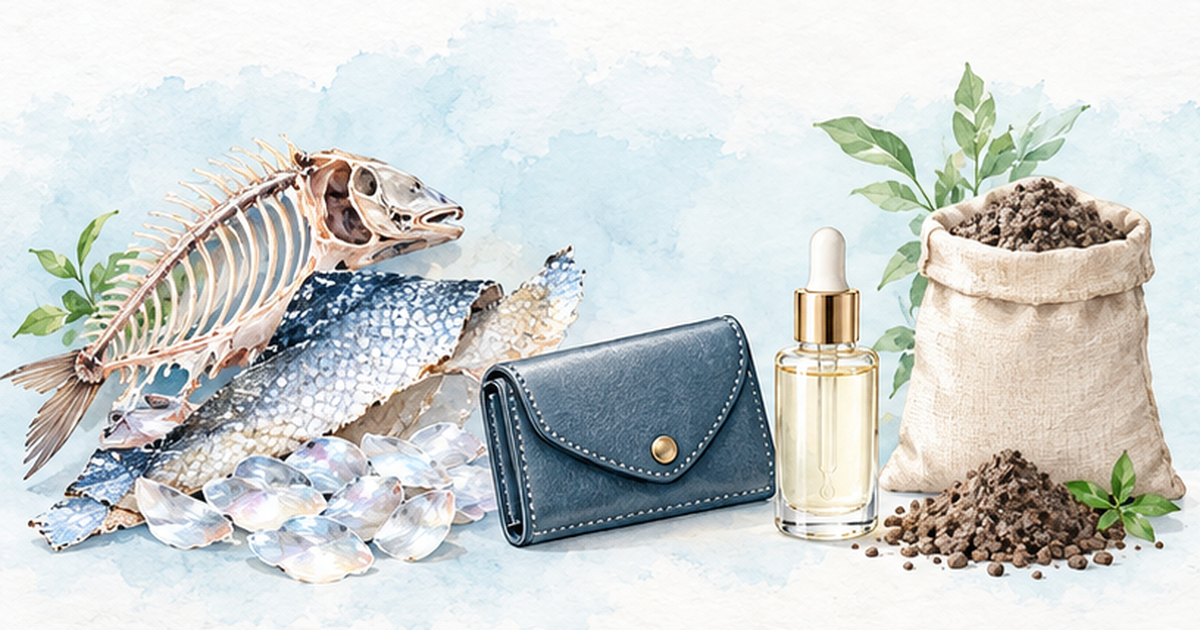
- Fish by-products make up 30–70% of a fish (FAO), and each part suits different uses. Bones go to fishmeal, fertilizer and calcium materials, skin to collagen and leather, and scales to low-odor collagen.
- Japan has examples too: a scale-derived serum (Taki Chemical's "Urumiko") and leather made by tanning fish skin with plant tannin (Ocean Leather).
- Most by-products flow to the basic outlets of fishmeal, fertilizer and feed. High-value materials are small in volume and face barriers of freshness, quality, cost and regulation.
- A realistic order of priority: eat it first, then feed and fertilizer, and only then high-value materials.
Behind the fillets on supermarket shelves, large amounts of bones, skin and scales are generated. The FAO explains that such by-products account for 30–70% of a whole fish. Once a waste that cost money to dispose of, they are now starting to become fertilizer, feed, and even collagen and leather.
This article looks at what each part — bones, skin and scales — is being reborn as. Based on published information, it covers scale-derived serum, fish-skin leather, and the foundational outlets of fertilizer and feed.
The hurdles of keeping materials fresh, cost and regulation are also large. We hope you will look at the limits as well as the promise, and think about what makes a truly useful cycle.
What You Will Learn
- Rough share of fish weight taken by bones, skin and scales
- What bones, skin and scales are each best suited for
- Japanese cases of scale-collagen serum and fish leather
- The role of fertilizer and feed as high-volume outlets
- Freshness, cost and regulatory barriers to turning by-products into materials
- How to choose products and look at labels in daily life
How much of one fish is the part we do not eat?
When we buy a fillet at the supermarket, we see only part of the fish. Head, viscera, bones, skin and scales are "by-products" that always come out of seafood processing, and they were often thrown away at a disposal cost. The Food and Agriculture Organization (FAO) explains that these by-products account for 30–70% of the whole fish. The range is wide because the amount left over changes greatly with the species and the way it is processed (sold whole or filleted).
Looking at the share by part
A 2025 review paper (Waqar et al.) summarizes rough shares of each part of the fish body. These values vary with species, season, feed and the basis of calculation (fresh weight or dry weight), so please read them only as a rough sense of scale.
| Part | Rough share of body weight | Main destinations |
|---|---|---|
| Head | About 10–20% | Fishmeal, broth, feed |
| Viscera | About 12–18% | Feed, fertilizer, fish sauce |
| Bones (backbone and frame) | About 10–15% | Fishmeal, fertilizer, calcium materials |
| Skin | About 8–10% | Collagen, gelatin, leather |
| Scales | About 2–5% | Collagen, craft materials |
The share of skin differs by source. A leather brand in Kochi Prefecture states that fish skin weighs "around 2%" of the fish. The number changes with skin thickness and what is counted as skin, so it is safest to understand that "there is a range depending on species and the method of calculation."
This is a different matter from "food loss"
The bones, skin and scales discussed here are parts people do not normally eat. They are distinct from "food loss," which is edible food that gets thrown away. For the overall picture of fish-processing residue in Japan and outlets such as fishmeal and biogas, see Turning Seafood Processing Residue into Resources: the Front Line of Using 2.32 Million Tonnes of Fish Offal. This article changes the viewpoint and looks at what each "part" — bones, skin and scales — is reborn as.
Key points of this chapter
- By-products are a wide 30–70% of fish weight (FAO)
- Bones, skin and scales each have different strengths
- Numbers vary by species and calculation basis, so read them as rough guides
Bones: turning a calcium store into materials
Fish bone is made of protein (mainly collagen) and calcium-phosphate minerals. The Waqar et al. review reports that bone contains 60–70% calcium phosphate and hydroxyapatite on a dry-weight basis (a table in the same paper gives 40–60%, so the figure differs with the basis). In other words, simply "crushing bones into powder" already gives a good base as a calcium source.
The most realistic outlets are fishmeal and fertilizer
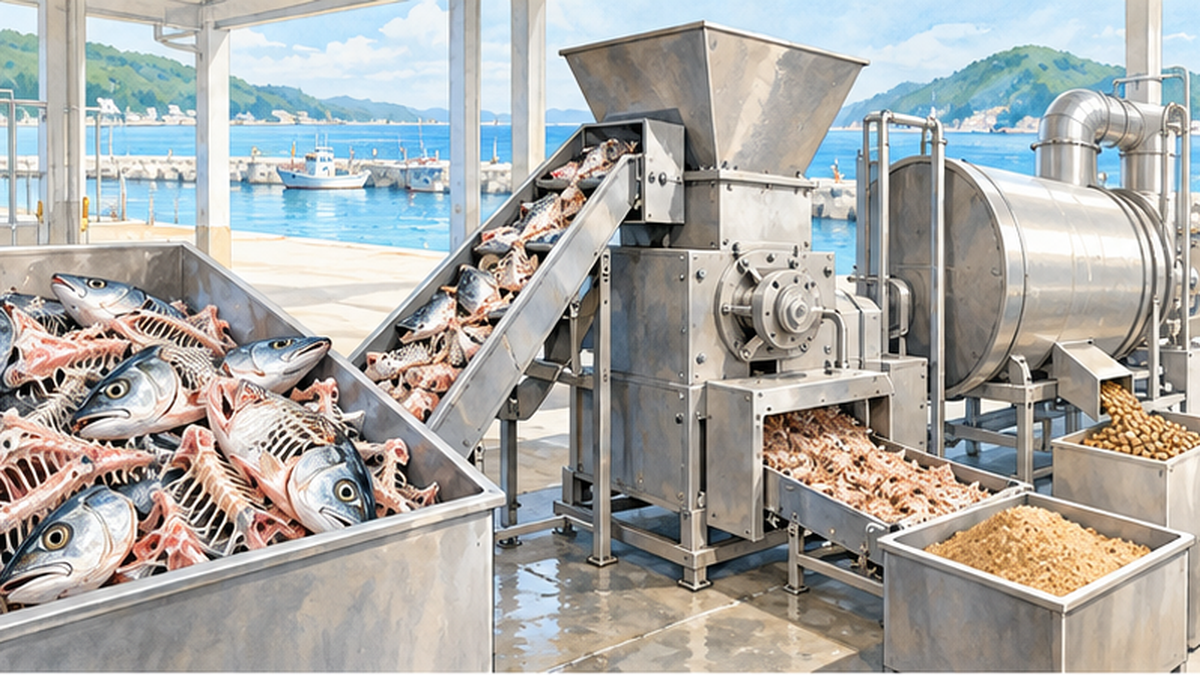
Bones go most often to fishmeal and fertilizer. According to the author's estimate in the Ocean Newsletter of the Ocean Policy Research Institute (Sasakawa Peace Foundation), about 74% of Japan's fish offcuts (roughly 750,000 tonnes a year) are carried to fishmeal plants. Fishmeal is used as feed for farmed fish and livestock and as agricultural fertilizer. Heavy bones and heads realistically flow first to outlets that can absorb large volumes.
Hydroxyapatite, studied for medical and materials uses
Research is also advancing on extracting bone minerals at high purity. A method has been reported that combines alkaline hydrolysis and calcination to obtain nano-sized hydroxyapatite (HAp) from salmon bone waste, said to give high crystallinity and excellent biocompatibility. HAp is a substance of interest in medicine, for example as bone-graft material, and fish bone is studied as "a candidate to replace bovine- or porcine-derived materials." However, most of this is laboratory-scale work and cannot yet be called widely used in products.
Not every bone suits every use
Not all bones easily become resources. A study of blue shark central skeleton reports that fishmeal made from shark skeleton has low protein (under 60%) and high ash (minerals, over 25%), so fishmeal plants tend to avoid it. At the same time, the same skeleton contains useful components such as chondroitin sulfate and bioapatite, and research is under way to recover them. It shows that even "bones unsuited to fishmeal" can open another path once you focus on their components.
- High-volume, low-price outlets: fishmeal and fertilizer (where most bones and heads go)
- Mid-volume, mid-price outlets: calcium materials, broth, pet food
- Low-volume, high-price outlets: hydroxyapatite, chondroitin and similar (mostly at research and development stage)
Trivia: collagen and minerals in bone
- Fish bone is a structure in which minerals are deposited on collagen fibers. For that reason, both "softening it so it can be eaten" and "separating out its components" depend on how this structure is loosened.
Skin: from collagen source to "leather"
Fish skin is rich in collagen. It has therefore been studied as a raw material for collagen and gelatin for cosmetics and foods. Skin ranges from a little under 10% to a few percent of body weight, but once the volume is gathered it becomes a usable raw material.
Skin as a collagen and gelatin source
Fishy odor has long been a problem for collagen, so low-temperature extraction and purification methods have been refined. In Norway, research institutes such as SINTEF Ocean are developing technology to make collagen and gelatin from fish skin. Applications in pharmaceuticals and cosmetics are expected, but obtaining high-purity material stably is hard and cost remains an issue.
Making leather from fish skin: the Ocean Leather example
Apart from collagen, there is a way to use the "shape" of skin. Ocean Leather, a Kochi Prefecture brand that began in 2021, makes fish leather, and its sales agent is Koyo Freeze Co., Ltd., a seafood processor founded in 1985. According to its press release, the raw material is skin from fish landed in Kochi that would normally be discarded, including red sea bream, yellowtail and mahi-mahi.
- Tanning: uses plant tannin rather than heavy metals such as chromium. The tannin is said to come from planted forests
- Process: about one month in six steps. Degreasing takes one week to ten days, tanning about a week, and coating uses three kinds of paint with heat pressing repeated about five times
- Strength: said to run from sturgeon, mahi-mahi, salmon and yellowtail to red sea bream, strongest first. More than 50 species were tried, and some dissolved during processing and could not become leather
Prices are 32,000–70,000 yen for a wallet and 14,000–33,000 yen for a card case, not cheap even compared with cowhide goods (Daily Sports, interview article of October 11, 2026). Fish skin cannot yield one large sheet, and collecting clean skin consistently is also hard, so the company says "mass production is difficult." Fish leather is therefore a material that gains value from rarity and story, not from volume.
Not something to call simply "eco-friendly"
- Turning skin into leather also uses water, chemicals and energy. Using skin that would otherwise be discarded is a real advantage, but the overall environmental load of the product has to be checked process by process.
Scales: the low-odor "hidden gem" of collagen
Scales are only about 2–5% of body weight, far less than bones or skin. But because they are low in the proteins and oils that cause fishy smell, high-purity collagen is easier to extract. The review paper also cites a report of procollagen obtained from carp scales at a 13.6% yield.
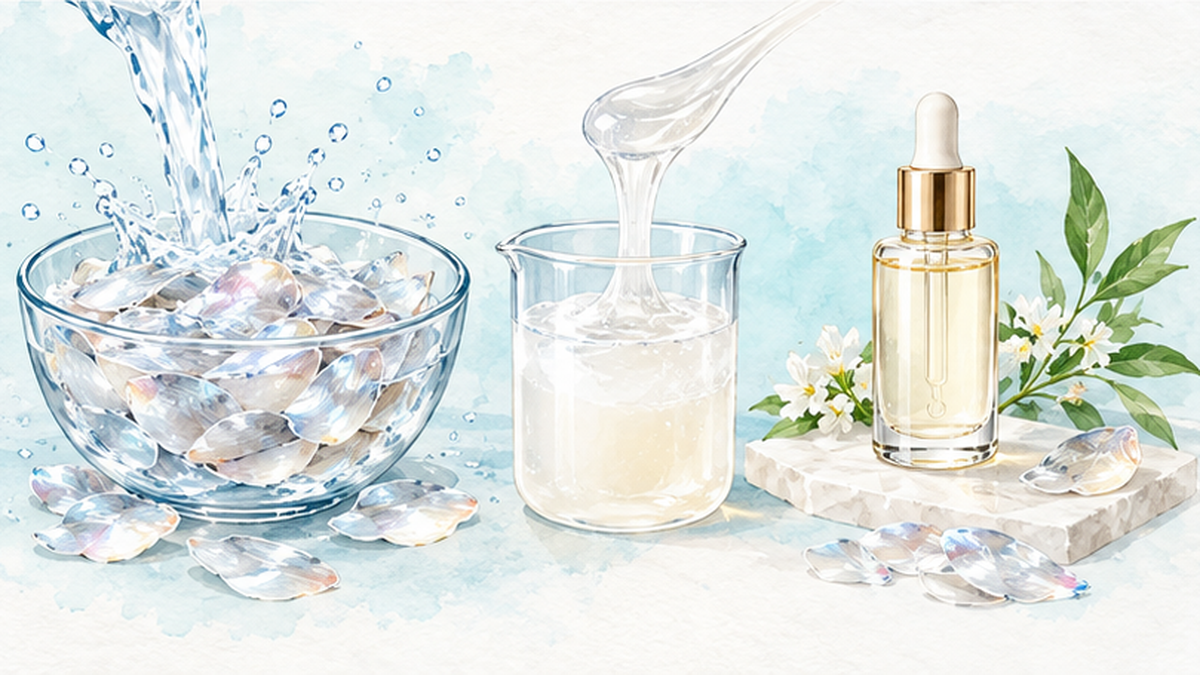
A Japanese case: Taki Chemical's "Urumiko"
Taki Chemical of Kakogawa, Hyogo Prefecture, known originally as a fertilizer maker, has also produced moisturizing agents for cosmetics makers for about ten years. It extracted high-concentration collagen from fish scales and launched the serum "Urumiko" in April 2023. According to the Kobe Shimbun, the raw material is scales of farmed tilapia, imported from China.
- Uses a proprietary technique that extracts collagen without breaking its triple-helix structure
- Freeze-dried into a sponge shape and dissolved in a dedicated lotion just before use
- Described as containing 500–1,000 times the collagen of ordinary serums
- A set with a 24-use dedicated lotion cost 7,920 yen (at time of reporting, Rakuten)
One caution here: these scales are not necessarily "from a Japanese seafood processing plant." The raw material is a by-product of fish farmed for food overseas, so it does not directly reduce marine waste in Japan. It is a good example of technology that turns by-products into value, but the viewpoint of "where the by-product arose and where it is used" also matters.
Collagen yield differs among skin, bone and scales
In research, even for the same fish, the amount and odor of collagen obtained differ by part. Collagen from scales is said to have less fishy smell than that from bone or skin, while in some cases skin gives a larger amount. Which part to use is decided by the balance of quality and quantity a product needs.
Each part's specialty
- Bones: minerals (calcium, HAp)
- Skin: amount of collagen, and shape as leather
- Scales: high-purity collagen with little odor
Collagen vs. gelatin, and moves around the world
"Collagen" and "gelatin," which have appeared repeatedly, are in fact two forms of the same substance. Collagen is a fibrous protein found in skin, bone and scales, with a triple-helix structure. Heating it to loosen it partly gives gelatin, used in jelly and as a setting agent in foods. Roughly, collagen with its structure intact suits cosmetics and medical materials, while gelatin suits adjusting food texture.
Features of fish-derived collagen
Collagen is also made from bovine and porcine skin and bone, but fish-derived collagen has been discussed as having other advantages. The review paper notes the high biocompatibility of collagen from fish by-products and says it is widely used in skincare products. On the other hand it is harder to handle, with fishy odor to remove and, compared with land-animal collagen, lower heat resistance, so purification suited to each use is essential.
International bodies also back "high-value use of by-products"
The FAO has published a technical report on turning fish skin, bone and viscera into high-value products (FAO Fisheries and Aquaculture Technical Paper No. 720, Li and Meng, 2024). A 2024 study in five countries by the FAO and the international seafood trade information body INFOFISH is also reported to have shown that by-products can be valued and that there is market demand. Using up the fish we catch appears to be becoming a policy issue worldwide.
Efforts in Northern Europe
The Norwegian research institute SINTEF Ocean is running a project that makes collagen and gelatin from fish skin for nutritional supplements and cosmetics. In the seafood nations of Northern Europe, processing plants and research institutes are cooperating to build systems that turn by-products into raw materials, which is a useful reference for Japanese seafood-processing zones.
- Collagen: with the triple-helix structure kept. For cosmetics and medical materials
- Gelatin: collagen denatured by heating. Used as a setting agent in foods, etc.
- Collagen peptides: broken down further. For drinks and supplements
A caution
- Claimed benefits such as "collagen is good for the skin" are mostly studied at test-tube or cell level, and solid clinical evidence in humans is limited. When choosing products, look at the raw material and the evidence rather than the advertising wording.
Barriers to becoming materials: freshness, cost and regulation
Many barriers stand between fish bones, skin and scales being "trash" and being "materials." The issues the review paper lists match what people on the ground feel.
Barrier 1: freshness is vital, and by-products spoil quickly
By-products are moist and perishable. Unless they are chilled and processed right after leaving the plant, odor and quality problems arise. To keep quality, they must be processed right next to the plant or moved with refrigeration or freezing equipment. The smaller the plant, the heavier this up-front investment.
Barrier 2: components vary with species, season and feed
Even "salmon skin" differs in collagen and fat content by season and feed. Unstable quality as an industrial raw material is one reason large manufacturers hesitate to adopt it.
Barrier 3: cost and infrastructure
Extraction may use enzymes, ultrasound or high-pressure processing, and equipment and energy costs are high. Methods that work in the laboratory often stall at the stage of scaling up to factory size.
Barrier 4: regulation and evidence
For food, cosmetic and medical uses, rules on raw-material safety and labeling are strict. The review paper points out that most evidence of bioactivity (health effects) comes from test-tube or cell studies, with few clinical trials in humans. We need to avoid overtrusting a product's effects and look at the level of evidence.
| Barrier | Specific trouble | Direction of countermeasures |
|---|---|---|
| Freshness | Spoils quickly and cannot be moved | Process or freeze near the plant |
| Quality variation | Components change with season and species | Regional cooperation focused on fewer species |
| Cost | Equipment and energy are expensive | Shared processing facilities and subsidies |
| Regulation and evidence | Safety and labeling standards | Accumulate test data and choose uses carefully |
Summary of this chapter
- Even with the technology, four barriers — freshness, quality, cost and regulation — block mass production
- "Start small and circulate within the region" tends to be the realistic breakthrough
Fertilizer and feed: the foundational outlets that absorb volume
Premium materials get the attention, but most bones, skin and scales actually flow to the "foundational" outlets of fishmeal, feed and fertilizer. Unglamorous as they are, they are the most important route for not wasting most of the by-products.
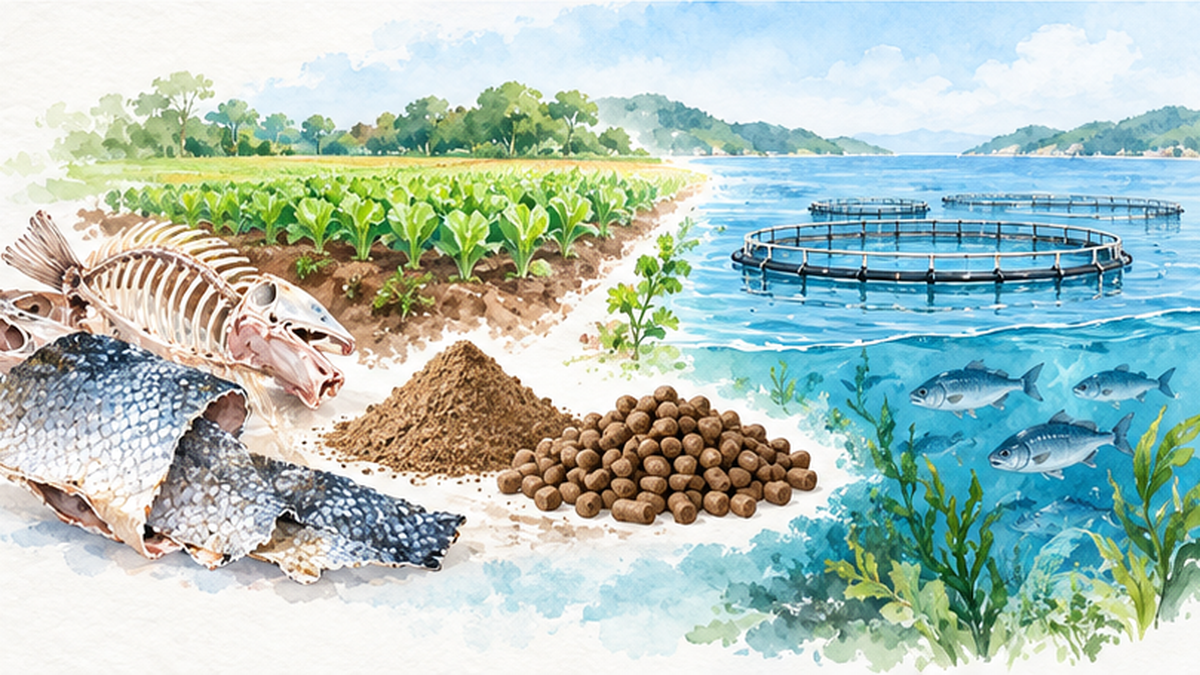
Fishmeal is used in a "staircase of quality"
Fishmeal is sorted by quality: fresh, good-quality meal goes to feed for farmed fish, next to livestock feed, and lower quality to agricultural fertilizer. A document from a Shizuoka Prefecture research institute likewise explains that viscera and other residue from seafood processing are mainly processed for feed and fertilizer, and that processors want wider uses and higher added value.
How it differs from oyster shells and other shells
Shells differ from fish bone in being almost entirely calcium carbonate. Oyster shells are increasingly used for soil improvement and road materials. For details see The Complete Guide to Oyster Shell Recycling. Fish bone contains organic matter (collagen), so its uses differ somewhat from those of shells.
Moves to make fish offcuts into food and pet food
There are also moves to send still-edible parts of heads and bones into food. Efforts to turn discarded fish into products are also covered in Ways to Turn Bycatch into Food and Using Unused Fish. Not only "selling at a high price" but "eating and using it all up locally first" is also a worthy kind of resource recovery.
- Feed: food for farmed fish and livestock (bones, heads, viscera)
- Fertilizer: agricultural fertilizer and soil improvement (bones, heads, shells)
- Food: broth, fish paste products, calcium materials
- Materials: collagen, leather, HAp and others (small volume, high price)
What using by-products brings to the sea and to communities
The meaning of using bones, skin and scales goes beyond "less garbage."
Less disposal cost and environmental load
Treating by-products costs money. In seafood-processing zones, the cost of treating and transporting by-products can itself be a management problem. Effective use reduces disposal costs and also the amount that must be treated as waste.
Using up the "value" of seafood
If the value from one fish extends beyond the flesh to skin and scales, income for fishing and processing may rise even at the same catch. An approach that raises the value of the fish already caught, rather than relying on overfishing, also supports sustainable use of fishery resources. Use of by-products is drawing international attention as a way to raise the revenue of the fishing industry as a whole.
Local jobs and stories
Like fish leather, skin from fish landed locally can be sold as a local brand. Even with few employees, a product with a story attracts consumers and can be a way to learn about local fisheries. It is also an effective entry point for communicating ocean sustainability.
Priorities for "using it all"
- A realistic order is: ① eat it first (reduce food loss), ② send it to feed and fertilizer, ③ make it a high-value material. Premium materials are limited in volume, so they work only in combination with the foundational outlets.
This theme also overlaps with recycling and the circular economy. For the overall framework, see also What Is the Circular Economy?.
What we can do: how to choose and how to look
It may seem a story for laboratories and specialist companies, but it connects to our shopping and tables.
Enjoy the whole fish
Fish-bone soup, crispy fried bones and fried fish skin — you can "use it all up" at home too. Using bones and skin as food is the easiest form of resource recovery.
Look at the "raw material" and "evidence" of products
When you buy fish-derived collagen or fish leather, check ① which part of which fish, ② where the by-product arose, and ③ what the evidence for the effect is. Even if a label says "uses discarded skin," the material may be imported. Reading labels and choosing with understanding supports a cycle that truly means something.
Take an interest in local efforts
Many regions have seafood-processing zones and fishery cooperatives working on by-product use. Through hometown-tax gifts and local events there are chances to see such efforts. Supporting them helps small businesses continue.
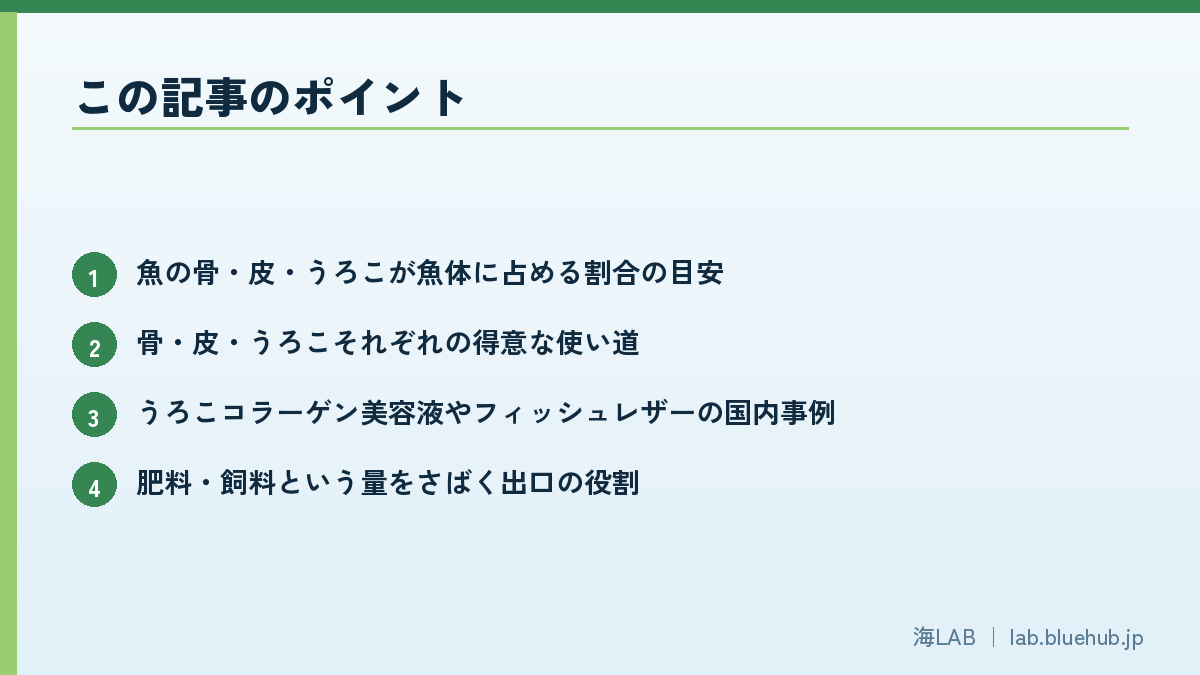
Summary
- By-products are 30–70% of fish weight, and bones, skin and scales each have their own strengths
- Bones suit fishmeal, fertilizer and calcium materials, skin suits collagen and leather, and scales suit low-odor collagen
- Japan has cases of fish leather and scale collagen, but freshness, cost and regulation block mass production
- A realistic order: eat it all first, then feed and fertilizer, then high-value materials
References and Sources
- FAO: Fish by-products utilization – Getting more benefits from fish processing – The finding that by-products are 30–70% of fish weight
- Waqar et al. (2025) Fish By-Products Utilization in Food and Health – Review of shares by part, collagen and HAp (PMC)
- Efficient Hydroxyapatite Extraction from Salmon Bone Waste – Hydroxyapatite extraction from salmon bone waste (PMC)
- Optimal Recovery of Valuable Biomaterials from Central Skeleton Wastes of Blue Shark – Recovery of chondroitin sulfate and bioapatite from shark skeleton (PMC)
- Ocean Newsletter, Ocean Policy Research Institute, Sasakawa Peace Foundation – Estimate of fish offcut volume and share sent to fishmeal plants
- Kobe Shimbun: Taki Chemical's new brand extracted from fish scales (April 2023) – Development of the serum "Urumiko"
- Newswitch: Taki Chemical's scale-collagen serum – Report on the proprietary extraction technique and price
- Daily Sports: The world of fish leather (October 11, 2026) – Ocean Leather's process, prices and challenges
- @Press: New fish leather products made from discarded fish skin – Ocean Leather press release (2022)
* Listed in order of reliability: government and academic bodies > peer-reviewed papers > specialist organizations > reliable media