⚡ The answer in 30 seconds
- Fish have an inner ear hidden inside the head, and otoliths that lag behind sound-induced motion let them sense underwater sound.
- The swim bladder picks up sound pressure like a drum, and the lateral line senses nearby water movement, supporting hearing.
- Fish with a Weberian apparatus hear a wide range, and some herring-family fish can sense ultrasound.
- Ship noise overlaps the low frequencies fish hear best and can cause masking and stress, though effects vary by species and sound.
Fish have no ear flaps or ear openings, yet they live by listening to underwater sound. How do fish hear?
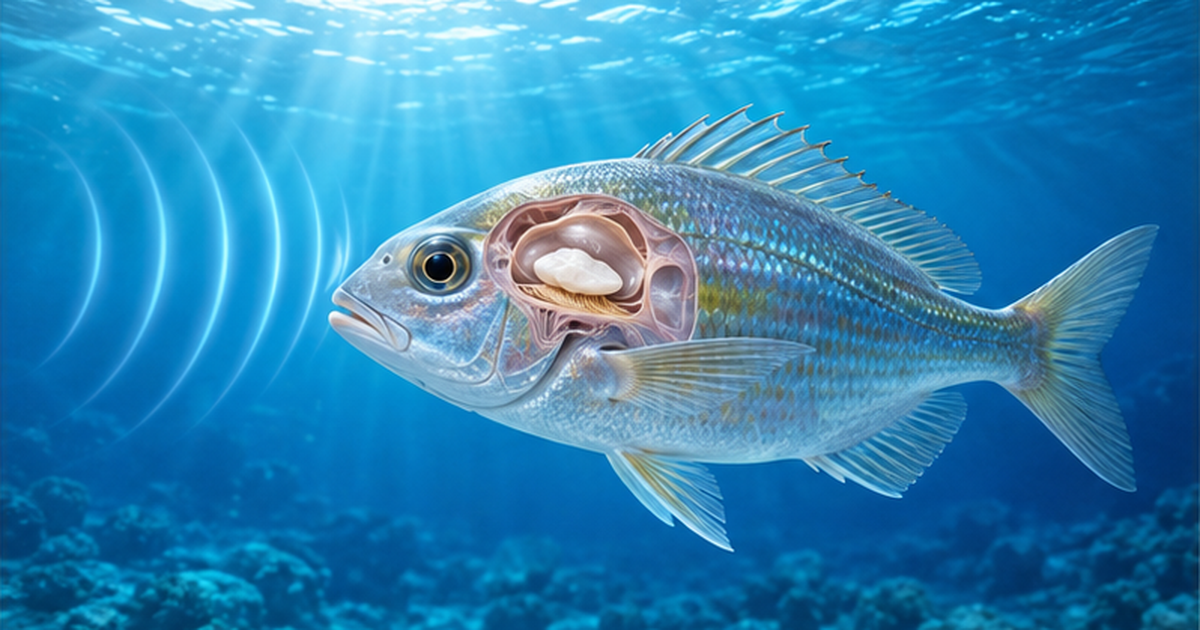
The answer lies inside the head. The otoliths of the inner ear, the swim bladder and the lateral line each sense water motion and sound in a different way.
This article explains how fish hearing works, how sound is used in behavior, and the effects of ship noise, based on research reports.
What you will learn
- Why a fish's ear is inside its head
- How otoliths turn sound into sensory hair movement
- Roles of the swim bladder, lateral line and Weberian apparatus
- How fish tell friends from predators by sound
- Effects of ship noise on fish and countermeasures
Do fish have ears? Hearing organs hidden inside the head
The inner ear is the basic organ
Look at a fish from the side and you will see no ear flap or ear opening. Yet fish do have ears: a pair of inner ears inside the skull, close to the brain. They need no eardrum or ear canal because sound passes almost straight through the fish's body. Most of a fish is water, with a density close to that of the surrounding sea, so sound waves travel through it easily.
This difference comes from how sound behaves in water and in air. In air, sound travels mainly as pressure changes. In water, the particle motion, the back-and-forth movement of water particles themselves, also matters a great deal, and many fish detect it directly with the inner ear.
How it differs from the human ear
| Point | Humans (land mammals) | Fish |
|---|---|---|
| Visible ear | Pinna and ear canal | None (usually no external opening) |
| How sound is received | Eardrum receives air pressure changes | The body shakes and otoliths in the inner ear lag behind |
| Main quantity sensed | Sound pressure | Particle motion (and pressure in some species) |
| Sense of balance | Semicircular canals and otolith organs | Semicircular canals and otolith organs (same inner ear) |
The inner ear of a fish also handles balance. One organ system tells the fish when it tilts or accelerates and also detects sound. It helps to think of sound as a kind of body vibration for fish.
Key points
- A fish's ear is an inner ear inside the head, invisible from outside
- In water, particle motion matters, and fish can sense it directly
- The inner ear serves both hearing and balance
How otoliths work: a stone that lags behind to sense sound
Three pairs of otoliths and sensory hairs
A fish's inner ear contains hard bodies made mainly of calcium carbonate called otoliths. Each inner ear holds three: the sagitta, lapillus and asteriscus. Each sits in a sac above a sensory epithelium lined with hair cells that carry sensory hairs.
The principle is inertia. When sound shakes the fish, the sensory epithelium moves with the body. The dense otolith, however, lags behind because of its inertia. The offset bends the sensory hairs, which produces electrical signals sent to the brain, where they are perceived as sound.

Otoliths also record growth
Otoliths have another role. Thin layers are added every day, so like tree rings they serve as a record of a fish's age. Fisheries surveys count these rings to estimate age and assess stocks. The organ of hearing is also a recorder of the fish's life.
The swim bladder as a sound collector
Otoliths alone sense only particle motion. Many fish also use the swim bladder to respond to sound pressure. Gas in the bladder compresses more easily than water, so it expands and contracts with pressure changes. This vibration reaches the inner ear and moves the otolith, so the bladder acts like a drum inside the body that raises sensitivity.
The closer the bladder is to the inner ear, or the more it is linked to it, the wider and more sensitive the hearing tends to be. Sharks and flatfish, which lack a swim bladder, are thought to rely mainly on particle motion.
Fun facts
- An otolith is a small stone of calcium carbonate; each inner ear has three
- The swim bladder works like a drum that picks up pressure and improves hearing
The lateral line and Weberian apparatus: two helpers for hearing
The lateral line is a remote sense of touch
Along the side of many fish runs a line from head to tail: the lateral line. It holds small sensors called neuromasts that detect water flow and fine vibrations. According to DOSITS, it works at short range, about one to two body lengths, and at low frequencies. If the ear hears distant sound, the lateral line feels nearby water movement, like skin touch.
Fish such as sardines and mackerel can turn together in a school partly because they feel, through this line, the water movement made by neighbors, in addition to using vision (see Why do fish school?). The ear and lateral line are close in structure and nerves, and are sometimes grouped as the acousticolateralis system.
The Weberian apparatus raises performance
Fish in the group Otophysi, including carp, goldfish, catfish and loaches, have a Weberian apparatus, a chain of small bones linking the swim bladder to the inner ear. Pressure vibrations picked up by the bladder pass efficiently along the bones to the ear, so they hear a wide frequency range with high sensitivity.
| Example | Feature | Approximate hearing range |
|---|---|---|
| Goldfish (Weberian apparatus) | Bladder linked to inner ear by bones | Up to about 3 kHz; best at 500–800 Hz (DOSITS) |
| Herring family | Gas ducts run from bladder to ear | Most detect up to 3–4 kHz (DOSITS) |
| American shad (herring family) | Specialized inner ear structure | Detects ultrasound above 180 kHz (DOSITS) |
| Mullet (no Weberian apparatus) | Weak bladder–ear link | Up to about 1.5 kHz (older report) |
Researchers roughly classify fish as generalists (generally hearing up to about 1–1.5 kHz) and specialists (hearing higher sounds). This is only a rule of thumb, not a strict taxonomy.

Key points
- The lateral line senses nearby water motion; the ear handles sound; they complement each other
- Fish with a Weberian apparatus hear a wide range with high sensitivity
- Some herring-family fish can sense ultrasound
What range do fish hear, and what do sounds mean to them?
Most fish favor low sounds
Species differ, but many fish are good at low sounds, from tens of hertz up to about 500–1,500 Hz, and only some hear above 3,000 Hz. Humans hear about 20 Hz to 20 kHz, so fish concentrate on a somewhat narrower low range.
This bias relates to the environment. Low-frequency sound attenuates little in water and travels far, which suits gathering information from a distance.
Recognizing friends and avoiding enemies
- Communication: croakers and toadfish vibrate muscles on the swim bladder to make sounds used in courtship and territory defense.
- Detecting predators: fish sense the water motion and sound of an approaching predator and flee.
- Finding prey: some fish locate food by faint sounds from small fish and crustaceans.
- Choosing a home: experiments show that coral reef larvae use reef sounds, such as snapping shrimp and fish calls, as a cue for where to settle.

Coral reefs are surprisingly noisy places. See also the science of natural sounds. Sound is also drawing attention as a possible factor in larval settlement that supports the diversity of reef fishes.
Fish that call, fish that listen
People often think fish are silent, but many species around the world make sound by vibrating the swim bladder, rubbing bones or teeth, or plucking tendons in the pectoral fin. Where some fish call, others listen: sound is an important communication channel in fish society.
Summary
- Many fish favor low frequencies that carry far
- Sound is used for courtship, alarm, feeding and homing
How does ship noise affect fish?
Low-frequency noise overlaps the fish's best range
The low band that fish hear well overlaps with sound from merchant ship engines and propellers, so ship noise is easy for fish to hear and therefore easy to be affected by. In busy shipping waters noise can cover the sounds fish make to each other, a phenomenon called masking.
We covered effects on whales in ocean noise pollution and whale song; research on fish is also accumulating.
What studies have found
- Masking: a 2007 toadfish study reported that ship noise reduced the ability to detect conspecific calls.
- Stress: a study of European freshwater fish reported that cortisol rose with ship noise but not with Gaussian noise.
- Habituation: a 2016 study exposing coastal fish to motorboat noise for 11 days found cortisol no longer elevated afterwards, suggesting they got used to it.
- Physical effects: very intense sound, such as seismic airguns, can cause temporary hearing loss, tissue damage and sometimes death.
Effects depend on the type of sound (ship noise or airgun), the level reaching the fish, and how well the fish hears it. It is neither accurate to say ship sound harms all fish nor that fish cannot hear it so it has no effect.


Much remains unknown
Fish are said to number over 30,000 species, but hearing has been studied in only a small fraction. Sound travels differently in lab tanks than in the sea, so results cannot always be applied outdoors. How noise affects populations and reproduction in the long run is still under study.
Countermeasures and what we can do
International efforts
The International Maritime Organization (IMO) has issued guidelines to reduce underwater radiated noise from merchant ships, recommending hull design, propeller improvements and operational changes. The 2014 guidelines were later revised.
- Better propellers: shapes that suppress cavitation bubbles cut noise.
- Slower sailing: lower speed tends to reduce underwater noise as well as fuel use.
- Vibration isolation: reduce engine vibration passing from the hull into the water.
- Route planning: avoid spawning grounds and nursery areas, or set seasonal measures.
Slower, more efficient operation overlaps with decarbonization, so noise control and decarbonizing international shipping may be combined.
From our own perspective
When using an outboard motor for fishing or marine leisure, slowing down over shallow spawning grounds and nursery habitat and avoiding unnecessary idling are small but meaningful acts. Watching fish react to sound in an aquarium also shows that fish really do listen.
What you can do today
- Remember that fish are listening and act quietly near water
- Slow your boat in shallows where young fish live
- Talk with family and friends about underwater noise
The future of fish hearing research
Advances in measurement
Passive acoustic monitoring with underwater microphones is spreading. Recording fish calls and identifying species allows distribution and spawning seasons to be studied without nets, which helps resource management.
Standards and remaining challenges
To evaluate effects of sound on fish, exposure criteria have been developed, mainly in Europe and North America. Because hearing varies by species, criteria are set by grouping fish types. In Japan, as offshore wind power and other marine development grow, understanding the effects of underwater sound on fishery species is becoming an issue.
- Filling the gaps in species-level hearing data
- Considering how sound travels in the wild compared with experimental tanks
- Clarifying the long-term meaning of habituation to noise
- Understanding combinations of noise, warming and fishing
Research on fish hearing is changing our view of the underwater world as silent. The sea is full of sound, and fish live listening to it with otoliths and lateral lines.
Summary
Fish combine otoliths, swim bladders, lateral lines and the Weberian apparatus to sense underwater sound. Ship noise overlaps their best low-frequency range and cannot be ignored. Effects vary with the sound and species, habituation has been reported, and much is still unknown. Building solid knowledge to protect a quieter sea is important.
Article summary
- A fish's ear is the inner ear; otoliths lag to sense sound
- Swim bladder, lateral line and Weberian apparatus extend and sharpen hearing
- Ship noise overlaps the low frequencies fish hear well and can cause masking and stress
- Effects vary by sound and species; research is still developing
References and sources
- DOSITS (Discovery of Sound in the Sea) – How fish sense sound
- DOSITS: Criteria for effects of anthropogenic sound on fishes – Criteria for Effects of Anthropogenic Sound on Fishes
- Popper & Hawkins (2019) J. Fish Biology – Overview of fish bioacoustics and effects of anthropogenic sound
- International Maritime Organization (IMO) – Guidelines to reduce underwater radiated noise from commercial ships
- Japan Fisheries Research and Education Agency – Fish age determination and stock assessment using otoliths
- Ministry of the Environment, Japan – Marine environment conservation initiatives
* Listed in order of reliability: government and academic institutions > peer-reviewed papers > specialist organizations > reliable media