⚡ In short
Humpback whale song is a long vocalization with a layered structure. This article explains the 2024 Nature finding on the larynx, the eastward cultural spread across the Pacific, language-like statistics and the impact of ocean noise, based on primary sources.
A low, undulating string of sounds lasting for hours under the sea. The humpback whale's "song" still holds many mysteries after more than half a century of research.
Who sings, how, and why? And why does the same song spread across ocean basins? This article organizes recent peer-reviewed findings to answer these questions.
It also covers a growing concern: ship noise threatening the world of whale song.
この記事で学べること
- The hierarchical structure of song, and that singers are mainly males
- How baleen whales produce sound with the larynx (Nature, 2024)
- How song is thought to relate to breeding and social life
- How song spreads culturally across the Pacific
- What song shares with language, and why it is not language
- How ocean noise affects song and what we can do
What Is Whale Song? The Basics of Humpback Song
Mainly Male Humpbacks Sing
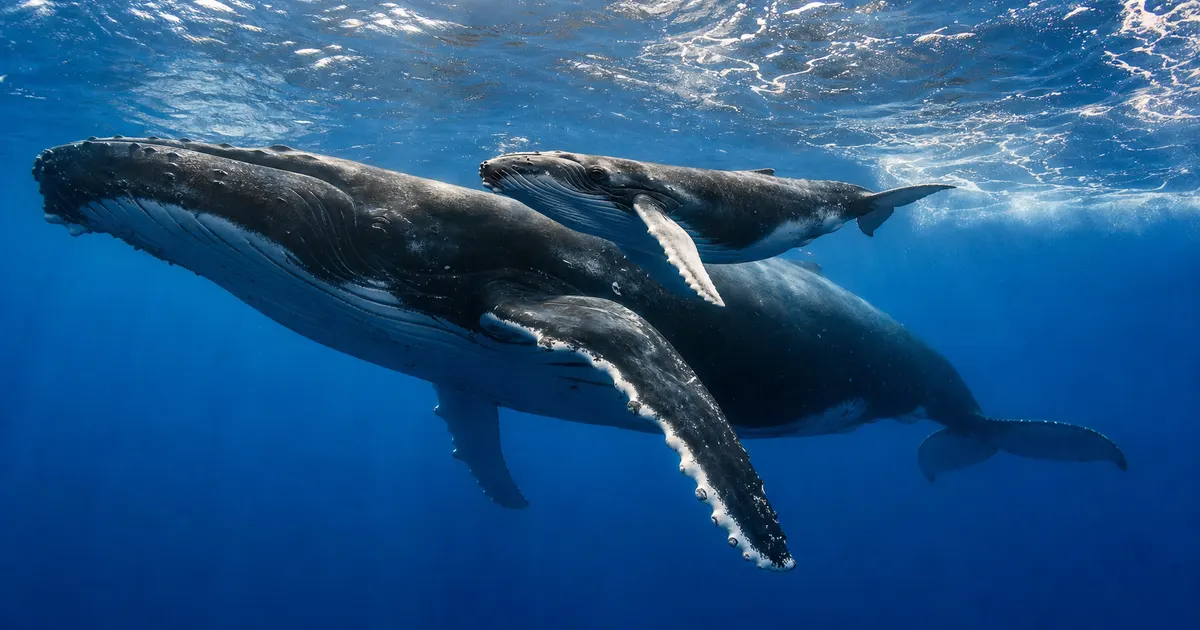
Low, rolling moans, clear whistle-like notes and growls are repeated in a set order. This is the "song" of the humpback whale (Megaptera novaeangliae). So far, the only animals confirmed singing are males, and song is thought to be closely tied to breeding.
Still, "song" is a metaphor borrowed from human music. We do not know whether whales sing "for enjoyment" as we do. Scientifically, the word refers to a long vocal pattern with a fixed structure that is repeated and shared within a population.
Serious Research Began in 1971
Humpback song became widely known to science through a 1971 paper in Science by Roger Payne and Scott McVay. It showed that song has a hierarchy: units, phrases, themes and the song itself. The same theme is repeated several times, and several themes in a fixed order make one song.
| Level | Content | Analogy |
|---|---|---|
| Unit | One continuous sound (a moan, a whistle, etc.) | Note |
| Phrase | A short group of several units | Short melody |
| Theme | A phrase repeated several times | Musical passage |
| Song | The whole, with several themes in a fixed order | One piece |
| Song session | A stretch of singing in which the song is repeated without a break | One live set |
Song length varies by report. A 2005 paper by Suzuki and colleagues, citing Payne and McVay, gives a range of 7 to 30 minutes. A "song session" in which one individual repeats the song without pause may last for hours.
Key points
- Confirmed singers are mainly males
- Song has a hierarchy (unit → phrase → theme → song)
- One song lasts minutes to about 30 minutes, and singing can continue for hours

How Is Song Different from Other Calls?
Whales also make short calls, clicks and bubble sounds. Song refers to the long, regular and repeated vocalization. Short calls used for contact within a group or as feeding signals are generally treated separately.
How Is the Sound Made? Vocal Mechanics Without Vocal Cords
The Long-Standing Mystery of the Throat
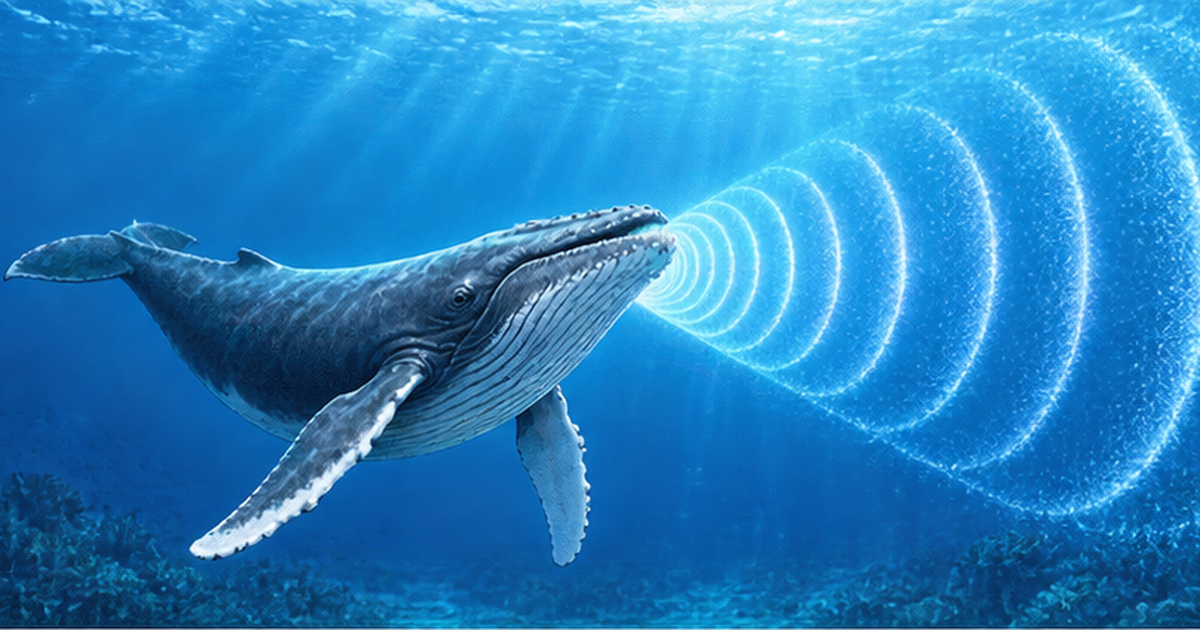
Whales can keep singing without exhaling lung air, singing for hours underwater. Where and how the sound is made was long a mystery.
Toothed whales (dolphins, etc.) are known to produce sound with "phonic lips" in the nasal passage (see dolphin echolocation). Baleen whales, including humpbacks, were thought to make sound with the larynx deep in the throat, but no experiment had directly confirmed it.
What the 2024 Nature Paper Showed
In February 2024, an international team including Coen Elemans, Tecumseh Fitch and Magnus Wahlberg published a paper in Nature (vol. 627, pp. 123–129). The team passed air through larynges removed from three baleen whale species and, combined with anatomy and computational models, directly showed that the larynx can phonate.
According to the paper, the baleen whale larynx has unique structures not found in other mammals. They let large animals produce low-frequency, frequency-modulated sound. The mechanism may have been present in the common ancestor of baleen whales.
Key points of the mechanism
- Baleen whales make sound with a specialized larynx (Elemans et al. 2024)
- Toothed whales use phonic lips in the nasal passage
- The structure is described as an evolutionary solution for producing low-frequency, frequency-modulated sound in a large body
Constraints Created by the Structure
The same paper also notes that this structure may constrain frequency range and sound production at depth. It may be hard to change pitch greatly to cope with ship noise, which could narrow how far the sound carries. This connects directly to the ocean noise issue discussed later.
How Far Does the Sound Travel?
Sound travels much faster and farther in water than in air. In the ocean, sound can be refracted by depth and trapped in layers that carry it far. Low-frequency whale sound is often said to travel tens of kilometers or more under good conditions. Actual range, however, depends heavily on temperature, salinity, depth, waves and ship noise, so no single figure applies.
The Role of Song: Why Do Males Sing?
The Leading Hypothesis: A Link to Breeding
Humpback song is heard mainly in warm, low-latitude breeding grounds from winter to spring. In Japan, a study by Koki Tsujii of Hokkaido University (doctoral thesis, 2023) off Chichijima in the Ogasawara Islands showed that singing males (singers) were most numerous in February and common in February–March. Singers were also more frequent before sunrise and after dusk than during the day.
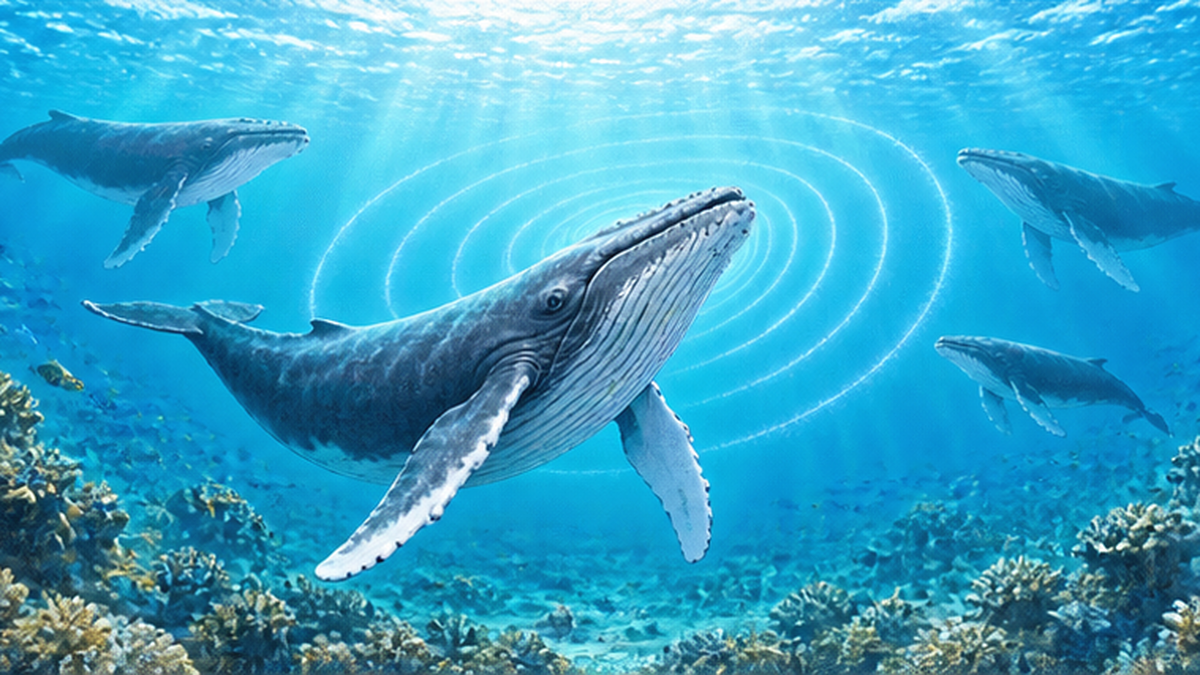
Because of this seasonality, song has been thought to involve appeals to females and relationships among males. Whether song attracts females, threatens or spaces out other males, or does both is still debated.
| Hypothesis | Content | Status |
|---|---|---|
| Courtship of females | Song quality and endurance signal a male's strength | Leading idea, but direct evidence is limited |
| Regulating male–male relations | Keeps distance from other males and avoids competition | Partly supported |
| Navigation and positioning | Echoes help sense seafloor topography and position | One hypothesis; evidence is insufficient |
| A venue for social learning | Sharing song maintains group bonds | Linked to cultural-transmission research |
Song Is Heard Outside Breeding Grounds Too
It was once thought that song belonged to breeding grounds, but recent work shows it is also recorded along migration routes and on high-latitude feeding grounds. A study around Iceland (Magnúsdóttir & Lim, PLOS ONE, 2019), for example, reported that singing peaked in January–February, overlapping the Northern Hemisphere breeding season. By comparing with songs from Cape Verde and the West Indies, it suggested that singing on feeding grounds may help song spread across the North Atlantic.
A study from western South Africa (Hawkey et al., African Zoology, 2020) also reported that songs recorded off Cape Town were shared among individuals, suggesting singers belong to the same breeding stock. It also showed that song changes gradually over the season and that some whales may keep singing past the recognized breeding season.
Do Not Jump to Conclusions
Recent studies make clear that "song = courtship song" is too simple. Because song is recorded outside the breeding season, it may have multiple roles, or roles we do not yet know.
What the Timing and Place of Singing Tell Us
In the Ogasawara study, many males sang before sunrise and in the evening, and in western waters the pattern was also linked to the tide. This suggests that song is not just a matter of time or mood but may be adjusted to environmental and social conditions. The thesis states that song is thought to play an important role in male breeding strategy and that an environment where human noise does not disturb singing is needed.
Song Spreads as "Culture": A Hit Song Crossing the Pacific
Song Changes Gradually, and Sometimes All at Once
Humpback song is not fixed; it changes a little each year. Males in the same region sing nearly the same song. In other words, song is not innately set for each individual but is thought to be shared by learning from other whales' songs.
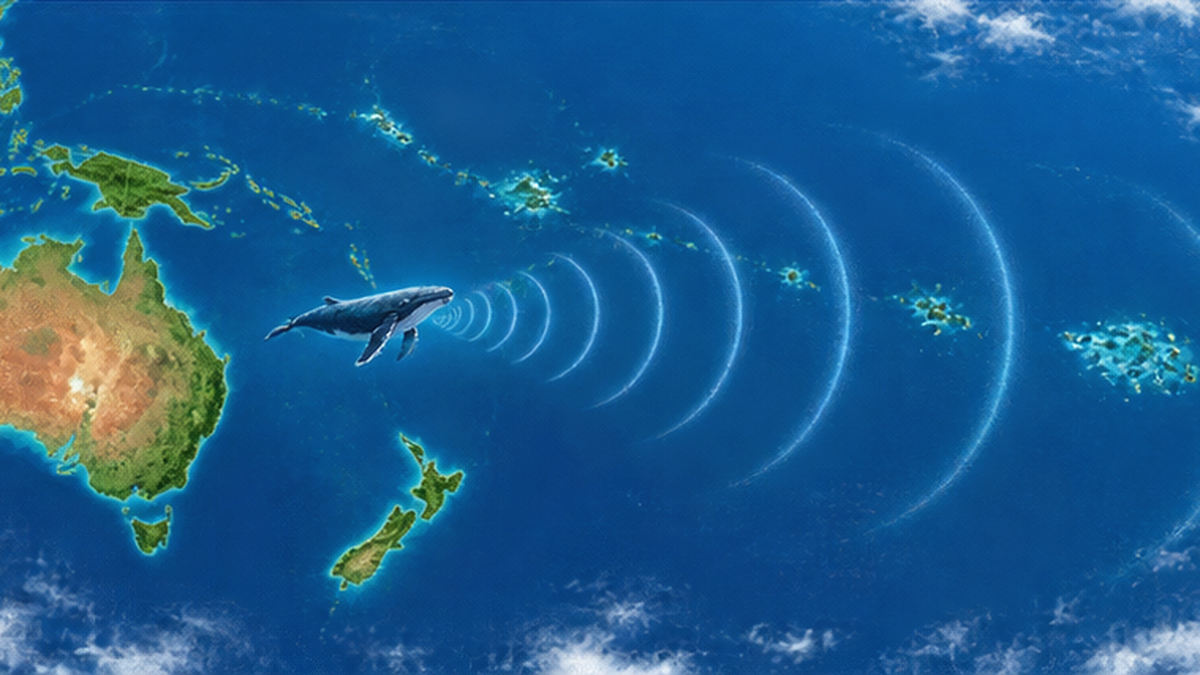
In 2011, Ellen Garland and colleagues reported in Current Biology an analysis of 775 songs recorded over about 11 years from six neighboring populations in the South Pacific. Eleven song types were identified. Many arose in the eastern Australian population and spread step by step eastward as far as French Polynesia. A song typically took about two years to cross the whole region.
| Item | Content |
|---|---|
| Paper | Garland et al. 2011, Current Biology |
| Subject | Six neighboring South Pacific populations |
| Period | About 11 years |
| Songs analyzed | 775 songs, 11 song types |
| Spread | From eastern Australia eastward to French Polynesia, step by step |
| Speed | About two years to spread across the region |
"Cultural Revolution" and "Evolution"
Garland describes song change as of two kinds: evolutionary change, which accumulates slowly over time, and revolutionary change, in which males switch en masse to a completely new song. The study also noted that spread was almost entirely eastward. One suggested reason is that the eastern Australian population is the largest in the region and so more influential.
This pattern resembles the spread of hit songs and slang in human society. Researchers consider routes such as whales learning songs on shared migration routes, or some individuals moving between populations and carrying songs. Note, however, that the claim in press reports of "the first large-scale cultural exchange outside humans" is the researchers' own view, not a settled judgment by third parties.
Is Song a "Language"? What Statistics Reveal
The 2025 Science Paper: Zipf's Law

In 2025, a team led by Inbal Arnon, with Ellen Garland and Simon Kirby among the authors, published a notable paper in Science. Analyzing humpback song recorded over eight years in New Caledonia, they found statistically cohesive subsequences in the song whose frequency follows Zipf's law.
Zipf's law is the universal pattern in human language in which a few words are used very often and most words are used rarely. The team also found that more frequent subsequences tend to be shorter, following Zipf's law of brevity.
What is Zipf's law?
- An empirical rule: when the frequency rank doubles, the frequency falls to about half
- Observed in nearly all human languages
- Also found in music and in the vocalizations of some animals
Not Necessarily Language: The Researchers' Own Caution
It is too hasty to read this as "whales are speaking." The researchers stress that whale song is not equivalent to human language and that why this pattern arises, and how meaningful it is, is still debated. Rather than a system for conveying meaning (vocabulary and grammar), song may be a sequence of sounds organized so that it is easy to learn and remember.
Such statistical structure is being studied from the perspective of how infants pick out groups of sounds when learning to speak. Whale song may offer clues to the origins of human language.
| Aspect | Whale song | Human language |
|---|---|---|
| Hierarchy | Unit → phrase → theme → song | Phoneme → word → sentence → discourse |
| Learning | Learned by hearing others' songs (social learning) | Acquired by hearing the surrounding language |
| Frequency distribution | Zipf-like tendency reported | Zipf-like (universal) |
| Meaning and grammar | Not confirmed | Present |
Not Only Humpbacks: Songs of Other Great Whales
Blue and Fin Whales: Infrasonic Voices
Humpbacks are not the only whales with song. Among baleen whales, blue and fin whales produce infrasonic calls that are almost inaudible to the human ear. Such sounds are thought to travel extremely far through the sea.
Interestingly, it has been reported that the pitch of blue whale song has been gradually falling over decades. According to a NOAA-linked explainer (DOSITS), in the North Pacific the fundamental frequency fell from 21.9 Hz in 1963 to 15.2 Hz in 2008. A 2009 study by McDonald and colleagues could not fully explain the cause but raised the hypothesis that the recovery of whale numbers after whaling is involved: with more whales, there is less need to project the voice far, and a trade-off between loudness and pitch may favor lower sounds.
A 2018 study in the Indian Ocean (Leroy et al.) also reported that calls of Antarctic blue and fin whales have been getting lower year by year. Many explanations have been proposed, including climate change, ocean acidification (which changes how well sound travels in seawater) and population recovery, and the question remains unsettled.
Bowhead Whales Sing "Jazz"
Bowhead whales of the Arctic Ocean are also known to sing from winter to spring. Rather than repeating one song strictly like humpbacks, they are reported to have a freer style in which the repertoire changes greatly from year to year. Even among baleen whales, singing styles differ widely by species.
How This Differs from Toothed-Whale "Language"
Toothed whales such as dolphins and orcas communicate in a different way from humpbacks. They use clicks and whistles, and bottlenose dolphins, for example, are known to have signature whistles that work like "names." The sound-producing organ and the way sound is used are entirely different from those of singing baleen whales. The vocal world of cetaceans is this diverse.
Noise That Drowns Out Song: When Whale Voices No Longer Carry
Ships, Sonar and Construction Fill the Water
The underwater sound world that whale song depends on has been transformed by human noise. Engine and propeller noise from large ships, military and survey sonar, seabed resource exploration and offshore wind construction all produce low-frequency sound that overlaps the frequencies whales use. As explained in detail in our ocean noise pollution article, such noise causes "masking," which drowns out voices.
Because song is thought to be an important breeding behavior for males, there is concern that if noise stops song from carrying, or forces males to change where and when they sing, breeding success could be affected. The Ogasawara study introduced earlier also pointed to the need for an environment where human noise does not disturb singing.
A Larynx Structure That May Make Escape Harder
The 2024 Nature paper notes that the structure of the baleen whale larynx may constrain the frequency range of the voice and sound production at depth. If it is hard to change pitch greatly to suit noise, baleen whales would be poorly adapted to noise. The researchers argue that this constraint may reduce the ability to avoid ship noise or to communicate at depth, shrinking the range over which the voice carries (the active communication range).
If song stops carrying?
- Fewer opportunities for courtship and social interaction
- Contact on feeding grounds and migration routes may become harder
- Some individuals may change the areas they use to escape noise
What We Can Do
Noise measures include slowing ships, using quieter propeller designs and adjusting routes in areas with many whales. Whale-watching boats also have guidelines requiring operators to keep distance from whales and observe speed limits. Reading our whale migration article alongside this one shows why waters where song can be heard deserve protection.
Searching for Song in Japan's Seas: Ogasawara, Okinawa and the Research Frontier
Where Song Can Be Heard in Japan
Japan has several breeding grounds for humpback whales that are known worldwide. From winter to spring they visit the seas of Okinawa, Ogasawara and Amami, and singing males have been recorded with hydrophones. The Okinawa Churashima Foundation has surveyed arrivals for about 30 years since 1991. In joint research with the certified NPO Everlasting Nature, the Ogasawara Whale Watching Association, the Amami Whale and Dolphin Association and others, fluke photographs of 3,532 whales taken in four sea areas (Okinawa, Ogasawara, Amami and Hokkaido) were matched. The results suggested that humpbacks visiting the four Japanese areas may form one shared group, published in PLOS ONE (this study mainly matched fluke photos and did not analyze song).
A 2001 doctoral thesis at Nagasaki University also dealt with the acoustic characteristics of humpback song (vocalizations) in Okinawan waters, showing that song research has accumulated in Japan as well.
Studying Whales with Underwater Microphones: Passive Acoustic Monitoring
Song research often uses underwater recorders (hydrophones) placed in the sea to record sound over long periods. Even without spotting a whale, hearing song shows that a male is there, so a wider area and longer period can be studied than by searching from a boat. In the Ogasawara study, underwater recorders off Chichijima were used to examine singers' occurrence cycles.
- Hearing song is a clue that a singing male is present
- Surveys are possible at night and in bad weather
- Long-term data reveal seasonal and daily patterns
- The whales need not be approached, so the burden on them is small
Meeting Song on a Whale-Watching Trip
Whale-watching boats sometimes let passengers listen to song through a hydrophone. You may even feel a low vibration through the hull. When watching, follow the guidelines: keep an appropriate distance, do not block the whales' path and avoid unnecessary engine noise. Protecting an environment where song can be heard is also the responsibility of those who watch.
What You Can Do Starting Today
- Choose operators that follow whale-watching guidelines
- Learn about underwater sound and noise problems and tell others
- Learn about groups working on marine conservation
- Read the science of natural sounds to widen your interest in sound environments

Summary: What Song Tells Us About Whale Society and Our Role
Looking Back at the Mechanism, Role and Culture of Song
Humpback song is a long, hierarchically built sound pattern sung mainly by males. A specialized larynx makes low sounds that carry far underwater. Song is tied to breeding, but because it is also recorded outside breeding grounds, its role is not yet fully understood.
Song is also a culture that is learned, passed on and changed among populations. In the South Pacific it was caught spreading eastward within a few years, and statistics have revealed language-like properties. Meanwhile ship noise threatens this world of sound.
Summary of This Article
- Song has a hierarchy and is sung mainly by males
- Baleen whales make sound with a specialized larynx (Nature, 2024)
- Song is learned and spreads culturally at Pacific scale (2011)
- Song has language-like statistical properties (Science, 2025) but is not language
- Ocean noise may make song harder to carry
Future Research and Us
Research on whale song advances precisely because so much is still unknown. The next time you hear a whale story by the sea, remember the long tale behind that voice.
参考文献・出典
- Elemans et al. (2024) Evolutionary novelties underlie sound production in baleen whales, Nature 627 – Sound production by the baleen whale larynx
- University of Vienna press release: Baleen whales evolved a unique larynx to communicate – Announced February 2024
- Garland et al. (2011) Dynamic Horizontal Cultural Transmission of Humpback Whale Song at the Ocean Basin Scale, Current Biology – University of Queensland announcement
- Magnúsdóttir & Lim (2019) PLOS ONE: humpback whale song in Iceland – Song on feeding grounds and cultural transmission
- Arnon et al. (2025) Science: Zipf's law in humpback whale song – Eight years of recordings in New Caledonia
- DOSITS: Changes in Baleen Whale Vocalizations – Decline in blue whale song frequency
- McDonald et al. (2009) Worldwide decline in tonal frequencies of blue whale songs – Endangered Species Research
- Suzuki, Buck & Tyack (2005) Information entropy of humpback whale song, JASA – Song length and structure
- Hokkaido University: Koki Tsujii doctoral thesis (humpback whales of Ogasawara) – Occurrence cycle of singing males
- Okinawa Churashima Foundation press release – Matching of humpback whales in four Japanese sea areas
* Ordered by reliability: government and academic institutions > peer-reviewed papers > specialist bodies > reliable media