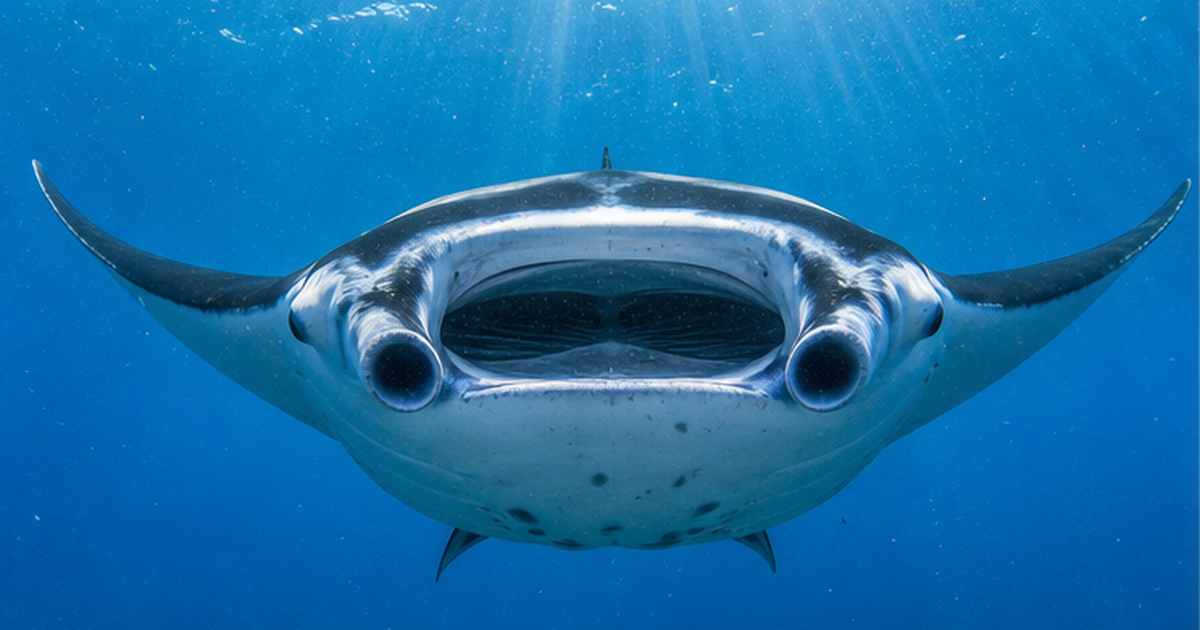
A body six metres across and weighing close to two tonnes, living entirely on plankton just one to three millimetres long. The manta ray is one of the ocean's most extreme examples of the large eating the small. What makes it possible is filter feeding: channelling seawater from the mouth through to the gills and separating out only the food.
For a long time, however, this mechanism contained a puzzle. The pores in a manta's filter measure a few hundred micrometres depending on the species. Yet the zooplankton mantas actually eat include a great many items smaller than those pores — sizes that would pass straight through an ordinary sieve. What is more, pushing hundreds of cubic metres of seawater a day through a fine filter ought to clog it almost immediately.
The answer came in 2018, when a US research team described a new filtration mechanism they named "ricochet separation". Building on that discovery, this article works through the anatomy of a manta, the diversity of feeding behaviour observed in the Maldives and the seas of Japan, and the plastic that ends up inside that filter — following the primary sources throughout.
What you will learn
- That "manta ray" refers to two species, and that in 2017 the genus Manta was merged into Mobula
- The structure of a manta's filtering apparatus and the path water takes: cephalic fins, mouth, gill plates, gill slits
- How "ricochet separation", discovered in 2018, captures small prey while avoiding clogging
- Eight feeding strategies (five solo, three group) and the prey density that switches between them
- How far mantas range in pursuit of food, from deep dives to the seas around Japan
- The microplastics that enter a manta's filter, and the economics behind conservation and tourism
There Is No Single "Manta" — Two Species, and a Name That Changed
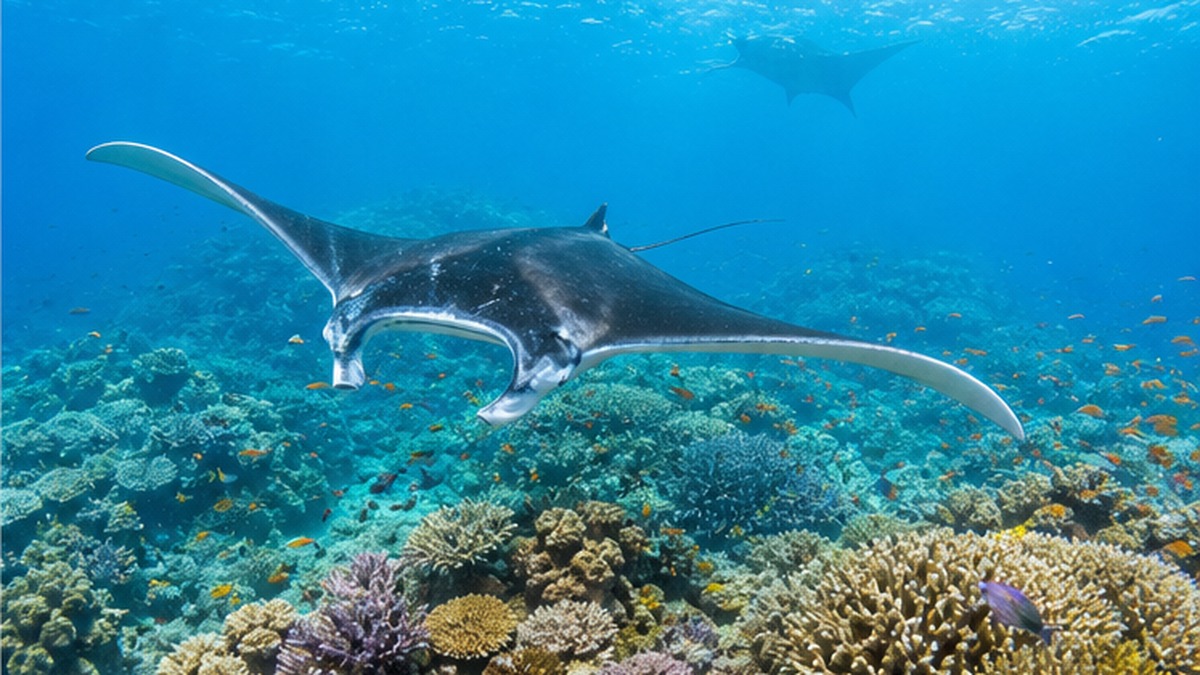
The fish we call the manta ray is in fact two closely related species: the giant manta ray, or oceanic manta ray (Mobula birostris), which ranges widely across the open ocean, and the reef manta ray (Mobula alfredi), which lives mainly in coastal waters such as coral reefs. They were long treated as one species, but detailed comparison of morphology and distribution separated them.
Both are among the largest of all rays, swimming by beating their diamond-shaped pectoral fins like wings. The species guide of the Okinawa Churaumi Aquarium likewise describes the reef manta as "one of the largest kinds of ray; once considered the same species as the giant manta ray, it has recently been classified as distinct."
Different Sizes, Different Homes
The two species differ clearly in body size and in where they live. Set the figures side by side and it becomes obvious that, despite the shared name, these are rather different animals.
| Metric | Giant manta ray (M. birostris) | Reef manta ray (M. alfredi) |
|---|---|---|
| Disc width (average) | About 4.0–5.0 m | About 3.0–3.5 m |
| Disc width (maximum recorded) | About 6.8 m | About 4.3 m |
| Weight (maximum) | About 2,000 kg (NOAA cites up to about 2,400 kg) | About 844 kg |
| Lifespan (estimated) | About 40 years (NOAA cites up to 45) | About 40 years |
| Main habitat | Wide-ranging in the open ocean; also appears inshore | Resident in coral reefs and coastal waters |
| Confirmed dive depth | Dives beyond 1,200 m recorded | Maximum 672 m (New Caledonia) |
| IUCN Red List | Endangered | Vulnerable |
In 2017, the Genus "Manta" Ceased to Exist
The two species were once known as Manta birostris and Manta alfredi. As molecular phylogenetic analysis advanced, however, it became clear that the two species placed in Manta actually nest among the species of the devil ray genus (Mobula). The rules of taxonomy require the genera to be merged in such a case, and so in 2017 the genus Manta was absorbed into Mobula. The valid names today are Mobula birostris and Mobula alfredi.
Older field guides and websites still carry the name Manta birostris. It is less an error than a former name, and searching the literature under both will save you from missing papers.
The Clue Is on the Belly
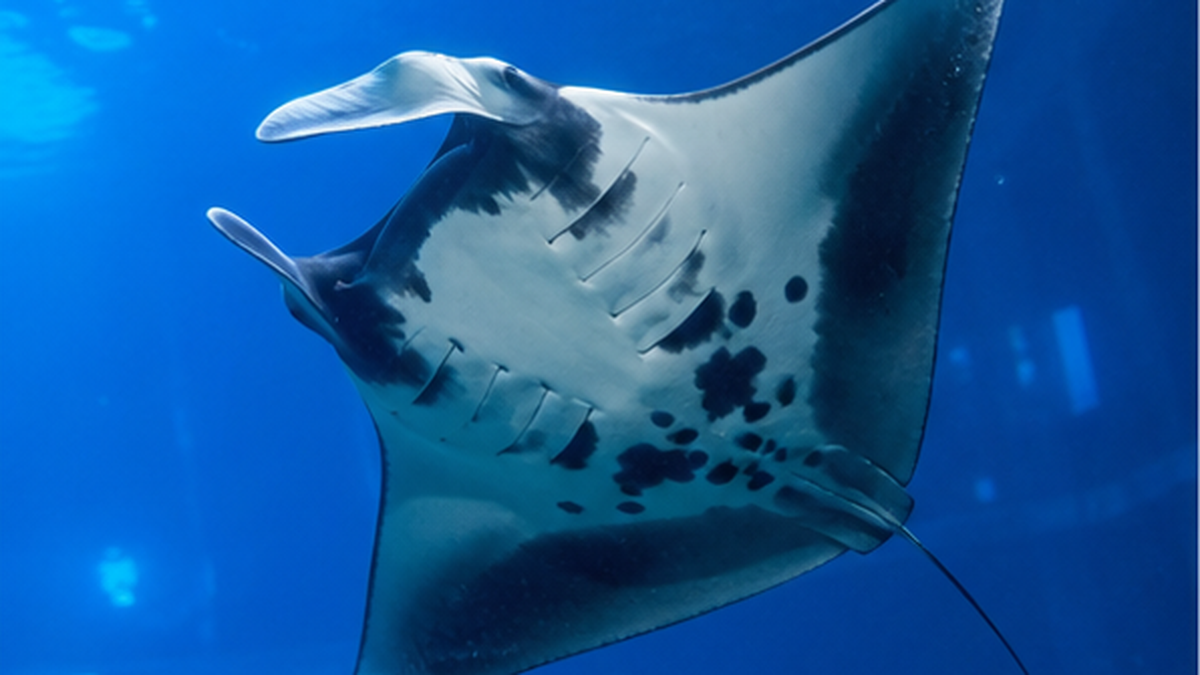
Telling the two species apart underwater takes practice, though the way colour appears on various parts of the body differs. What matters more is that the arrangement of black spots on the underside differs between individuals, making it usable like a human fingerprint for identifying individuals. The Okinawa Churaumi Aquarium notes that mantas "can be identified individually by the black markings on the belly", and manta research worldwide is built on this property.
- The pattern of belly spots barely changes over a lifetime, so a single photograph can identify an individual
- Citizen science, in which divers submit their photographs to research databases, works in many parts of the world
- Finding that the same individual returns to the same waters year after year has revealed migration routes and residency periods
- Almost entirely black individuals, known as "black mantas", also occur; these are colour variants, not a separate species
Key points so far
- "Manta" refers to two species: the giant manta ray and the reef manta ray
- In 2017 the genus Manta was merged into Mobula; the current names are Mobula birostris and Mobula alfredi
- The oceanic species is larger, dives deeper and faces a higher extinction risk
- Belly spots are unique to each individual and allow photographic identification
From Cephalic Fins to Gills — The Filter and the Path of Water
For a manta, eating is all but synonymous with swimming. Move forward with the mouth open and that forward speed itself becomes the power that draws water in. Rather than pumping seawater, the animal pushes water in by advancing — a method known as ram filter feeding, shared with other large filter feeders such as whale sharks and basking sharks.
The Cephalic Fins Are Funnels, Not Horns
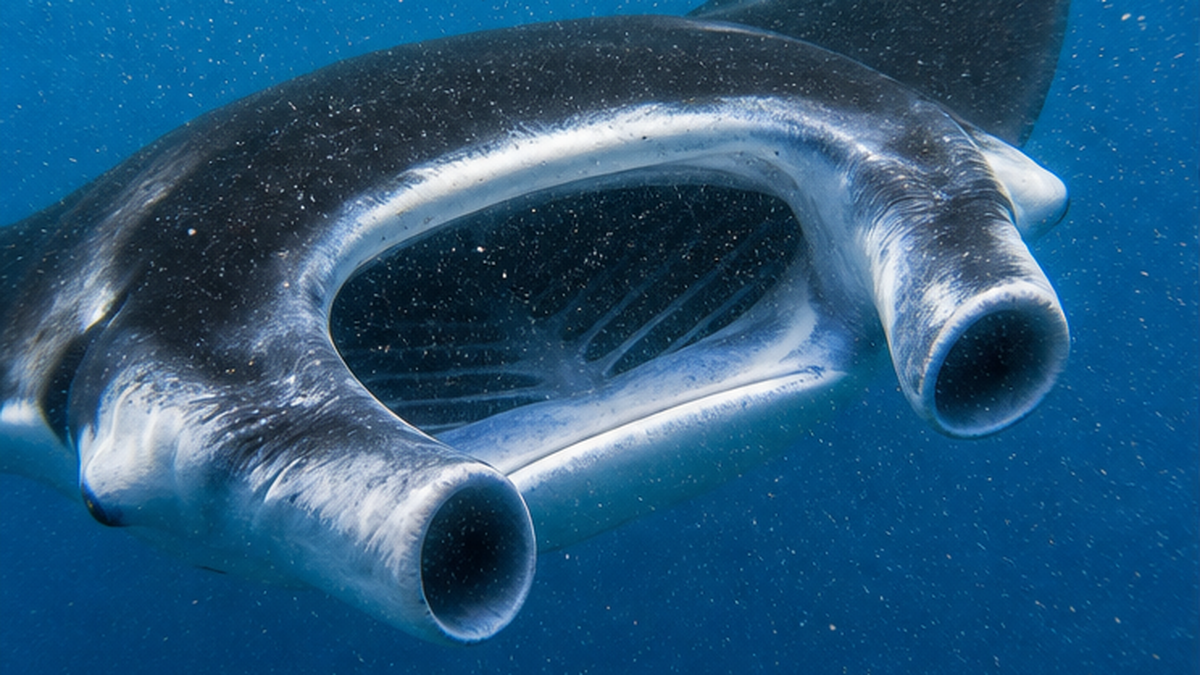
The pair of fins projecting forward from either side of a manta's head are called cephalic fins. Normally rolled into tubes, they open wide forward during feeding and act as funnels that concentrate the flow of water towards the mouth. The Okinawa Churaumi Aquarium describes manta feeding as "extending the fins on the head (cephalic fins) so that food is channelled into the mouth".
How far these fins are rolled or unrolled is adjusted finely according to prey density and swimming conditions. Where food is thin they stay rolled to reduce drag; on entering a dense patch they open out to maximise the intake. In an experiment in which a captive manta was shown a mirror, rolling and unrolling of the cephalic fins was observed more than ten times as often as without the mirror, suggesting this organ may serve purposes beyond feeding alone.
Mouth to Gill Slits — The Route Water Takes
Seawater taken in through the mouth exits through five pairs of gill slits on the underside of the body. Along that route sit the gill plates, the filtering apparatus itself. Step by step, the sequence runs as follows.
- The manta swims with cephalic fins spread, gathering food-laden water in front of the mouth
- Seawater flows into the buccal cavity through the widely opened mouth
- At the back of the cavity the water divides into the passages leading to the gill slits
- Water passes at speed over the gill plates arrayed at the entrance of those passages
- Food particles are carried backwards along the plates and gathered towards the oesophagus
- Only the water, stripped of food, leaves through the five pairs of gill slits
The Filter Is a Row of Ridges
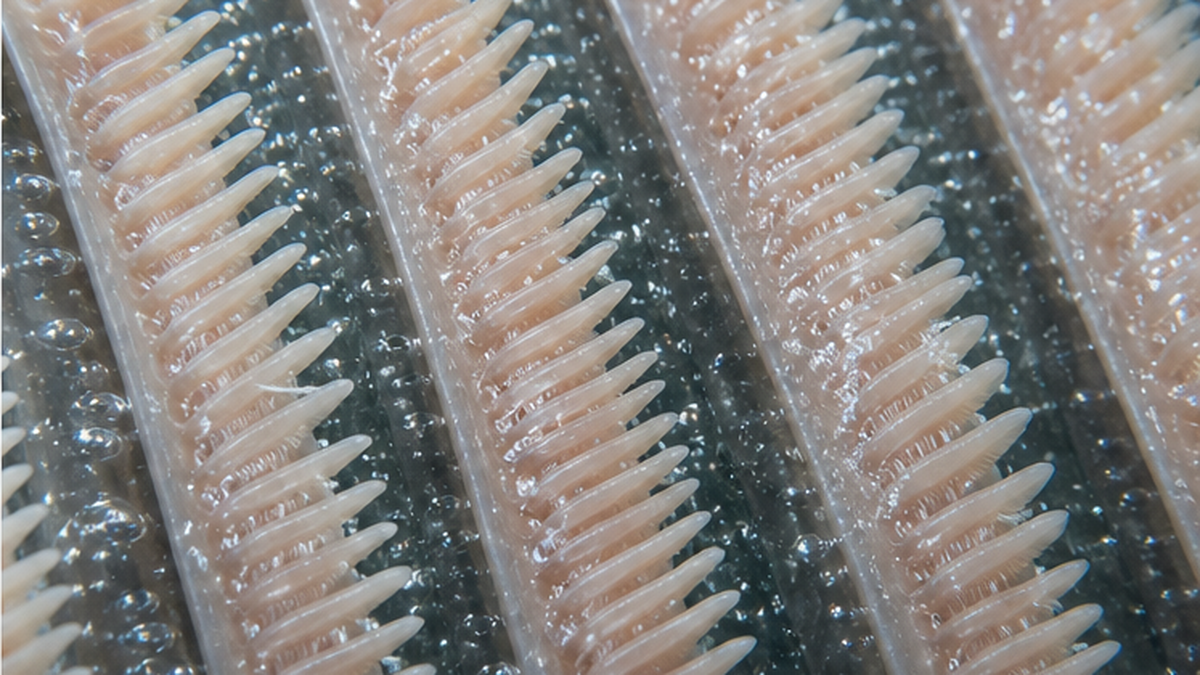
A gill plate consists of many long, narrow plates arrayed in parallel, each carrying finer projections (lobes) that jut out, giving a feather-like structure. The gap between adjacent plates is the filter's "pore", and its size varies between species. The 2018 study measured about 340 micrometres in the giant manta ray and about 1,100 micrometres in the related sicklefin devil ray (Mobula tarapacana).
Here the puzzle from the opening comes into focus. With gaps of only 340 micrometres — 0.34 millimetres — the zooplankton a manta eats nonetheless includes many smaller items, such as copepod larvae. Treated as a simple sieve, most of that food should wash straight back out through the gill slits.
Gill plates are also a traded commodity
- Dried gill plates are traded in Chinese-speaking markets as "gill rakers", and this is the single biggest reason manta rays are targeted
- In other words, mantas are killed for the very organ that keeps them alive
- The scale of that trade and the international regulations covering it are discussed later, in "The Economics of Protection"
A Filter That Never Clogs — "Ricochet Separation", Found in 2018
On 26 September 2018, Raj V. Divi of California State University, Fullerton, James A. Strother of Oregon State University and E. W. Misty Paig-Tran of CSU Fullerton reported in Science Advances (vol. 4, no. 9, article eaat9533) that mantas feed using a novel, non-clogging filtration mechanism they called ricochet separation. It answered a long-standing puzzle from the direction of fluid dynamics.
The Existing Explanations Did Not Add Up
Filtration in aquatic animals has generally been sorted into two types. One is sieve filtration, straining particles out with a fine mesh. The other is cross-flow filtration, in which water runs along the filter surface and particles are concentrated as they slide across it. The latter, known in some fishes, has drawn attention as a method resistant to clogging.
Yet the shape of a manta's gill plates — plates set at an angle to the incoming flow, with their tips projecting upstream — fitted neither explanation well. The research team built enlarged models based on real gill plates, visualised the flow and particle motion in a flow tank, and reproduced the same conditions in computational fluid dynamics (CFD) for comparison.
| Filtration method | How it works | Weakness |
|---|---|---|
| Sieve filtration | Retains only particles larger than the pores | Prey smaller than the pores escapes; clogs quickly |
| Cross-flow filtration | A flow parallel to the surface concentrates particles as they slide along it | Particles remain in contact with the surface, so it can still clog under some conditions |
| Ricochet separation (manta) | Particles strike the tips of the filter lobes, bounce back into the main flow and are carried to the oesophagus | Requires fast flow — it works poorly if the animal stops swimming |
The Numbers from the Experiments
Model experiments and numerical simulation revealed the following conditions. The flow a manta generates inside its mouth while swimming turns out to be surprisingly fast, and surprisingly precise.
- Filter pore size: about 340 μm in the giant manta ray, about 1,100 μm in the sicklefin devil ray
- Free-stream velocity inside the buccal cavity: roughly 570 mm/s (about 57 cm per second)
- Cross-flow over the filter surface: about 57 mm/s, roughly one tenth of the free-stream velocity
- Reynolds number: about 1,075 in the giant manta ray — a flow dominated by inertia rather than viscosity, prone to eddies
- Capture efficiency rises markedly once particle diameter exceeds about 200 μm
Particles enter the mouth, ricochet off the filter surface and back toward the oesophagus, while the water takes a different path and exits out the gill slits.
― Explanation by the research team (California State University, Fullerton news release, September 2018)
Why Prey Smaller Than the Pores Is Still Caught
In ricochet separation, particles are not sorted by whether they can pass through a gap. Instead, they strike the tip of a lobe, bounce back and are pushed into the main flow before ever entering the gap. Particles with greater inertia — heavier and faster — deviate more readily from the streamlines and hit the tips, so prey larger than roughly 200 μm is retained efficiently by a principle quite separate from pore size.
And the method carries a decisive advantage. Because particles never adhere to the filter surface, it does not clog in principle. Inside a dense cloud of plankton that would block a sieve almost at once, a manta can keep swimming with its mouth open. That is what allows it to remain in a rich patch for hours and process enormous volumes of seawater.
The research team notes that the mechanism is also valuable from an engineering standpoint. A filter that never clogs is a filter that needs neither replacement nor cleaning. Water purification in places where maintaining equipment is difficult, industrial liquid filtration, and devices to remove microplastics from the sea — a form refined by mantas over tens of millions of years could serve directly as a design template.
Ricochet separation in brief
- Particles are retained not because they cannot pass the gap, but because they are bounced away
- That is why prey smaller than the filter's pores is still captured
- Because particles never settle on the surface, it does not clog — allowing hours of continuous feeding
- It does, however, depend on fast flow; the separation works poorly when the animal stops swimming
- Non-clogging filtration holds promise for water purification and microplastic recovery
Eight Ways to Eat — From Somersaults to Cyclones
However good the filter, swimming with the mouth open through a thin sea costs more energy than it returns. So mantas change where and in what posture they feed according to circumstances. Guy Stevens, founder of the international manta research NGO the Manta Trust, and colleagues have organised observed manta feeding behaviour into eight strategies: five performed alone and three requiring coordination between individuals.
Five Solo Strategies
- Straight feeding: swimming straight through with the mouth open — the most basic method
- Surface feeding: skimming prey concentrated at the surface, back breaking the water
- Bottom feeding: taking in prey drifting above the sediment near the seabed
- Sideways feeding: rolling onto one side to match the mouth to the thickness of the prey layer
- Somersault feeding: repeated backward somersaults that keep the animal within a dense patch, passing through the same spot again and again
Somersaulting is the best known image of manta feeding. Prey drifts in the water as "clouds" a few metres across, and swimming straight through takes only seconds to clear them. By turning over and over on the spot, the animal can pass through the same rich patch repeatedly. Somersaults may continue for several consecutive rotations, and not every individual performs them equally well.
Three Group Strategies
- Chain feeding: several individuals form a single file, each following the one ahead through the same band of prey
- Piggyback feeding: one individual swims stacked above another, the pair sharing the prey in the same spot at two levels
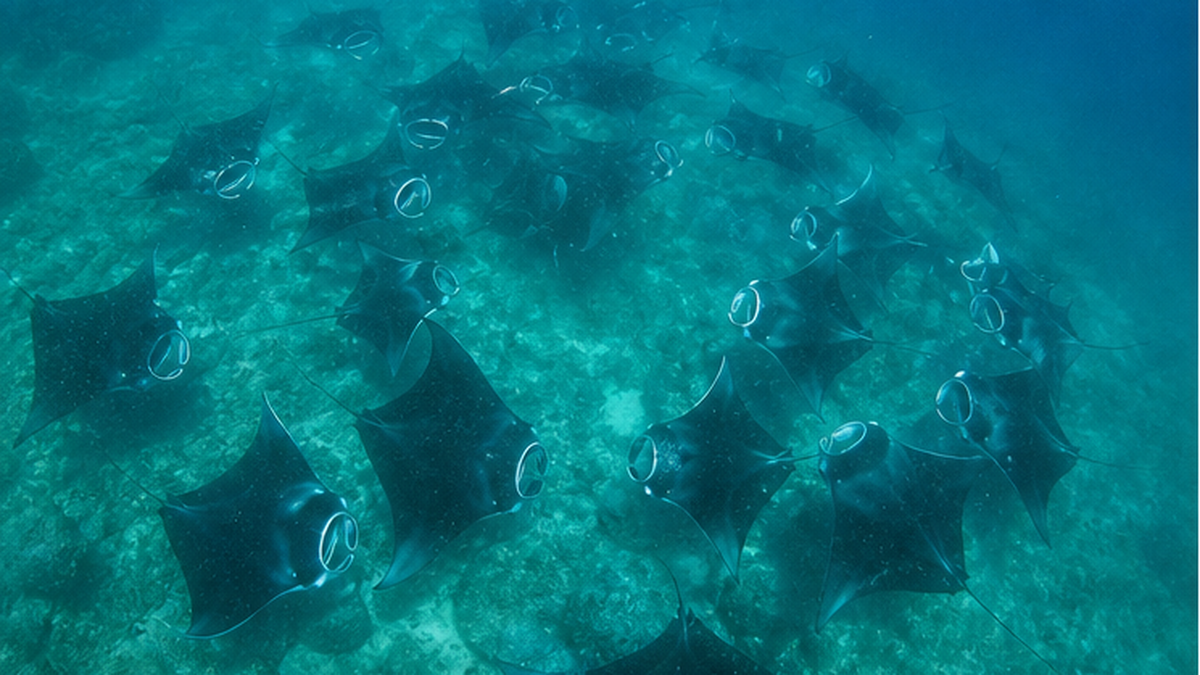
- Cyclone feeding: many individuals circle continuously, forming a large swirling aggregation
Cyclone Feeding Is Evidence of Density
Cyclone feeding is especially famous from Hanifaru Bay in the Maldives, where under the right conditions large numbers of individuals gather in a single bay. It is more than a spectacle: it is also a biological indicator that prey at that spot is extraordinarily dense. As the next section shows, group feeding becomes dominant once prey concentration passes a certain level.
Circling may do more than simply keep the animals in place. It has been argued that the churning produced by many individuals turning together makes the prey cloud less likely to disperse, or helps retain prey at the centre of the group. The difficulty of observation means this point has yet to be tested quantitatively.
The eight strategies, summarised
- Solo: straight / surface / bottom / sideways / somersault
- Group: chain / piggyback / cyclone
- Which strategy is used depends on how dense the prey is and at what depth the layer sits
- Somersaults and cyclones are devices for not leaving a dense patch of prey
The Switch That Starts Feeding — Prey Density, Tides and the Deep
Mantas do not keep their mouths open at all times. Filter feeding costs energy too, so where prey is thin it pays not to feed. How dense, then, must it be before feeding begins? That boundary was measured directly in a study at Hanifaru Bay in the Maldives (PeerJ, vol. 9, article e11992, 2021).
A Bay Where the Tide Stores Food
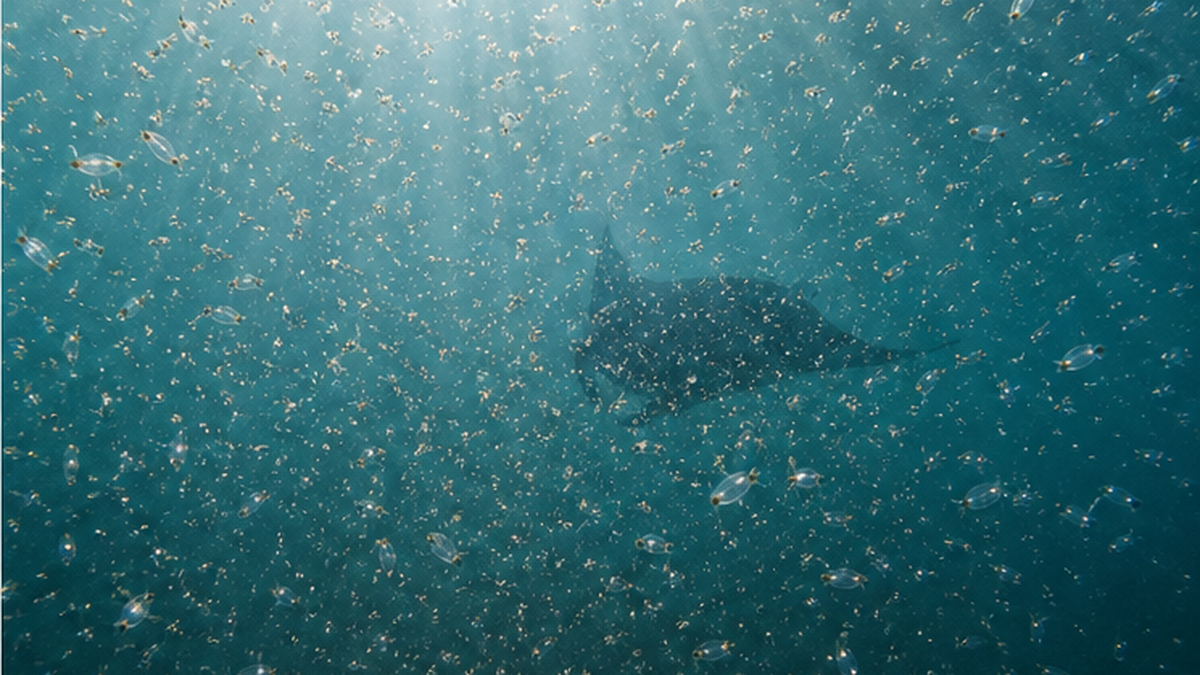
The survey ran for nine days, from 13 to 21 August 2017, repeatedly sampling zooplankton inside the bay through the tidal cycle while simultaneously recording manta numbers and behaviour. The dominant organism was Undinula vulgaris, a large-bodied calanoid copepod that blooms in oceanic waters. In other words, the food was not produced inside the bay: it was carried in by the tide and concentrated by the shape of the bay.
Zooplankton abundance tracked the tide closely, peaking just after high water. Expressed as dry mass, density averaged 90.7 milligrams per cubic metre. The variation, however, was enormous, ranging from 0.7 to 643.1 milligrams — a spread of nearly 900-fold. A feeding ground is not simply present or absent; it appears and vanishes over time.
The Boundary at 53.7 mg/m³
The study's most important finding was that the threshold density at which mantas switch into feeding behaviour could be pinned down. Statistical modelling put it at 53.7 milligrams dry mass per cubic metre. Intriguingly, that is more than twice the requirement estimated theoretically from metabolic cost (25.2 milligrams).
| Measure | Value | Meaning |
|---|---|---|
| Zooplankton density (mean) | 90.7 mg dry mass/m³ | Average prey density in the bay over the study period |
| Range | 0.7–643.1 mg/m³ | Nearly 900-fold variation driven by the tide |
| Feeding threshold | 53.7 mg/m³ | Above this, mantas switch into feeding behaviour |
| Theoretical requirement | 25.2 mg/m³ | The minimum density needed to cover metabolic cost |
| Density where group feeding dominates | Above 200 mg/m³ | Chain, cyclone and other group strategies increase |
That mantas begin feeding only at more than double the break-even point shows they are not simply filling their stomachs but choosing feeding grounds that reliably pay. Over a lifetime, moving on in search of a dense patch evidently beats nibbling away at a thin one. For how zooplankton shifts depth over the course of a day, see our article on the diel vertical migration of plankton.
Diving Deep in Pursuit of Food
The search for dense prey extends vertically as well as horizontally. A satellite-tagging study of reef manta rays in New Caledonia (PLOS ONE, 2020) found more frequent and deeper dives at night, recording a maximum of 672 metres. The animals appear to be reaching the layer of organisms spread through the mesopelagic zone at times when surface prey is scarce.
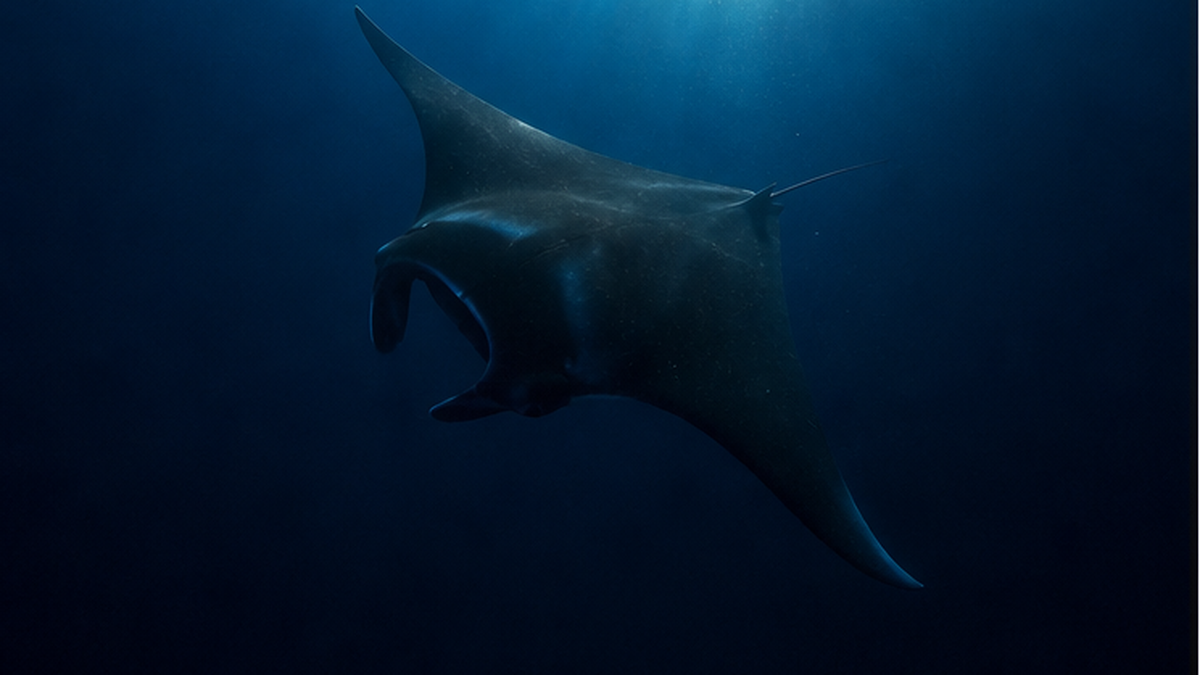
The oceanic giant manta ray goes deeper still. Analysis of satellite tag data from animals in Indonesia, Peru and New Zealand (Frontiers in Marine Science, 2025) confirmed dives beyond 1,200 metres — descending into a lightless world well below 10°C, and enduring the drop in body temperature.
Is food the only reason to dive deep?
- Access to mesopelagic prey, such as the deep layers of crustaceans, is the leading hypothesis
- Links to sensing ocean structure, or to navigation using cues such as temperature and topography, are also debated
- The deeper they go, the more exposed they become to deep-set fishing gear and environmental change
- Dive depth differs greatly between the coastal and oceanic species, despite the shared name
Mantas in Japanese Waters — Okinawa, and the Breeding Puzzle an Aquarium Solved
Mantas are not confined to distant tropical seas; Japan is one of the world's leading places to see them. The global survey of manta-watching tourism published in PLOS ONE in 2013 identified manta tourism in 23 countries, and listed Japan first among the top ten countries that together accounted for about 93 per cent of revenue (the others being Indonesia, the Maldives, Mozambique, Thailand, Australia, Mexico, the United States, the Federated States of Micronesia and Palau).
Reef Mantas of Okinawa and the Yaeyama Islands
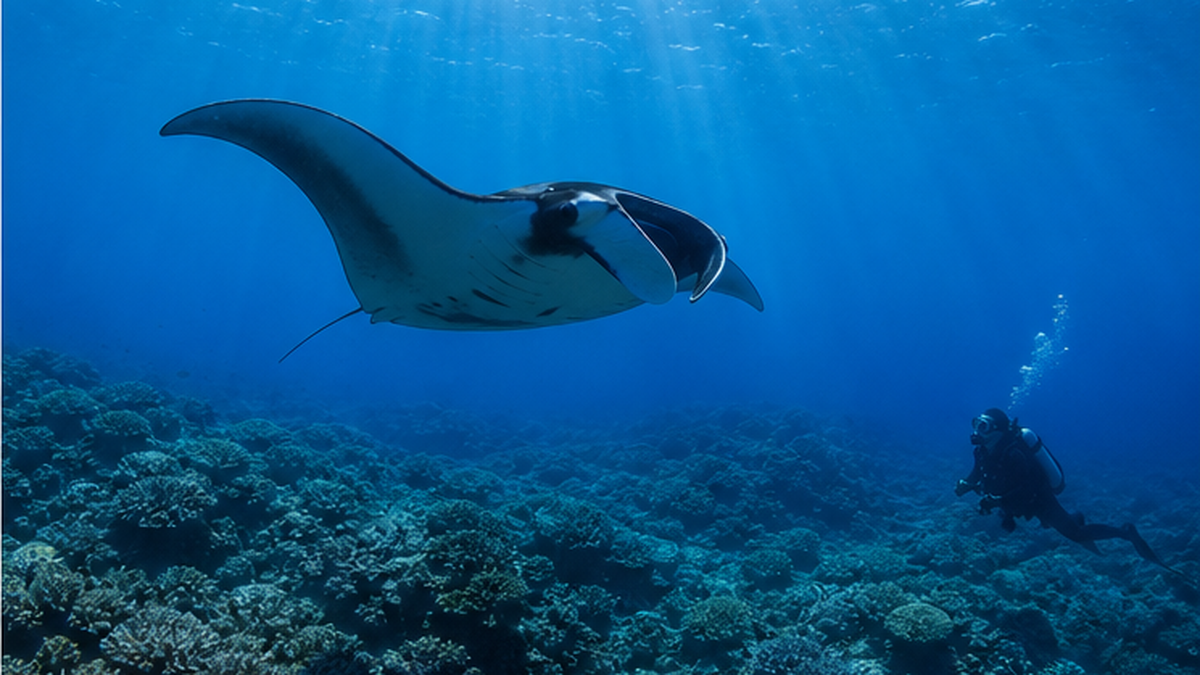
Most mantas seen in Japan are reef manta rays. The Okinawa Churaumi Aquarium species guide gives the range as "mainly south of Okinawa, in the tropical and temperate waters of the Indo-Pacific", and Okinawa even has a local name for the animal, gamaaka manta. Parts of the Yaeyama Islands are known for waters where many individuals gather seasonally, and these are a central resource for the diving industry.
Given the feeding ecology described above, such gatherings are no accident. Mantas return again and again to places where currents deliver prey and the topography holds it. The reverse also follows: if the water quality or the currents of such an area change, the mantas may stop coming. The value of these places as destinations rests on the ocean productivity that supports their plankton.
What the World's First Captive Breeding Revealed
Manta reproduction has been extremely difficult to observe in the wild. The Okinawa Churaumi Aquarium filled that gap. In June 2007 it achieved the world's first captive breeding of the reef manta ray, recording ten births in total by June 2013. In the process, basic reproductive data that had previously been guesswork were confirmed directly.
- Gestation lasts about one year
- The animals bear live young rather than laying eggs, with a single pup per birth
- A newborn already measures about 1.8 metres across the disc and weighs an estimated 60 kilograms
- Ultrasound imaging was used to monitor foetal growth, and research was carried out on respiration and nutrition inside the uterus
- On 5 August 2024 the aquarium also achieved the world's first birth of a melanistic individual — a "black manta" — with mother and pup put on display from December that year
For wild giant manta rays, NOAA likewise states that females give birth to only one pup every two to three years. This slow reproduction is decisive for conservation. Unlike prolific fishes, mantas cannot bounce back quickly from fishing pressure, so once a population declines, recovery takes decades. That life history lies behind the IUCN's assessment of the giant manta ray as Endangered.
A Single Photograph Becomes Research Data
Identifying individuals by their belly spots is not a technique reserved for research institutions. When divers and snorkellers submit photographs of a manta's underside to regional databases, a record accumulates of which individual was where and when. Showing that the same animal returns to the same waters for years becomes an argument for protecting those waters. The precondition is that photography must not burden the animal: do not chase, do not touch, do not block its path.
How to behave around mantas
- Do not chase. Do not block the direction of travel — a manta swimming past is usually feeding
- Do not touch. The mucus layer on the skin is a barrier against infection
- Avoid repeated flash photography and keep your distance
- If you get a photograph of the underside, consider submitting it to a local survey group or research database
- Above all, follow local rules and the instructions of your guide
One of the Largest Brains Among Fishes — Why Would a Filter Feeder Be Clever?
An animal that strains its food from the water would seem to need less brainpower than a hunter chasing prey. In fact the opposite holds: mantas are known for having remarkably large brains for fishes. Measured as brain mass relative to body size — the encephalisation quotient — they rank at the very top among fishes.
What Is All That Brain For?
One leading explanation lies in the nature of the food described above. Zooplankton appears and disappears over time, and its location shifts with tides and seasons. A manta must predict when and where prey will bloom, and travel across a wide ocean to get there first. Add the coordination required to swim in order without colliding when several individuals feed in the same place, and the demands — learning, memory, spatial cognition, social behaviour — turn out to be considerable.
A Manta in Front of a Mirror
In 2016, an experiment in which captive giant manta rays were shown a mirror was reported in the Journal of Ethology. The animals swam back and forth in front of the mirror for unusually long periods, made movements that appeared to check parts of their own bodies, rolled and unrolled their cephalic fins more than ten times as often as when no mirror was present, and were observed blowing bubbles at the mirror.
Reading this as "mantas recognise themselves" goes too far, however. The researchers themselves note carefully that mirror self-recognition has never been demonstrated in any elasmobranch. What is established is that the animals showed exploratory, sustained responses to a novel stimulus. Everything beyond that awaits further testing.
Remoras are a familiar sight riding along with mantas. For the relationship between large swimming animals and the small fishes that hitch a ride, see our article on why remoras ride on sharks.
A note on the word "clever"
- A large brain is not in itself proof of intelligence in the human sense
- The mirror experiment gets only as far as "does not rule out self-recognition"
- That said, observations pointing to learning, spatial memory and social behaviour continue to accumulate
- In conservation debates, the decisive issue is not cleverness but a life history that recovers slowly
The Plastic That Enters the Filter
Ricochet separation is a mechanism for efficiently delivering high-inertia particles to the oesophagus. It does not distinguish food from anything else. That is where the modern ocean presents a problem. Plastic broken down to the same size as plankton behaves, as far as a manta's filter is concerned, exactly like food.
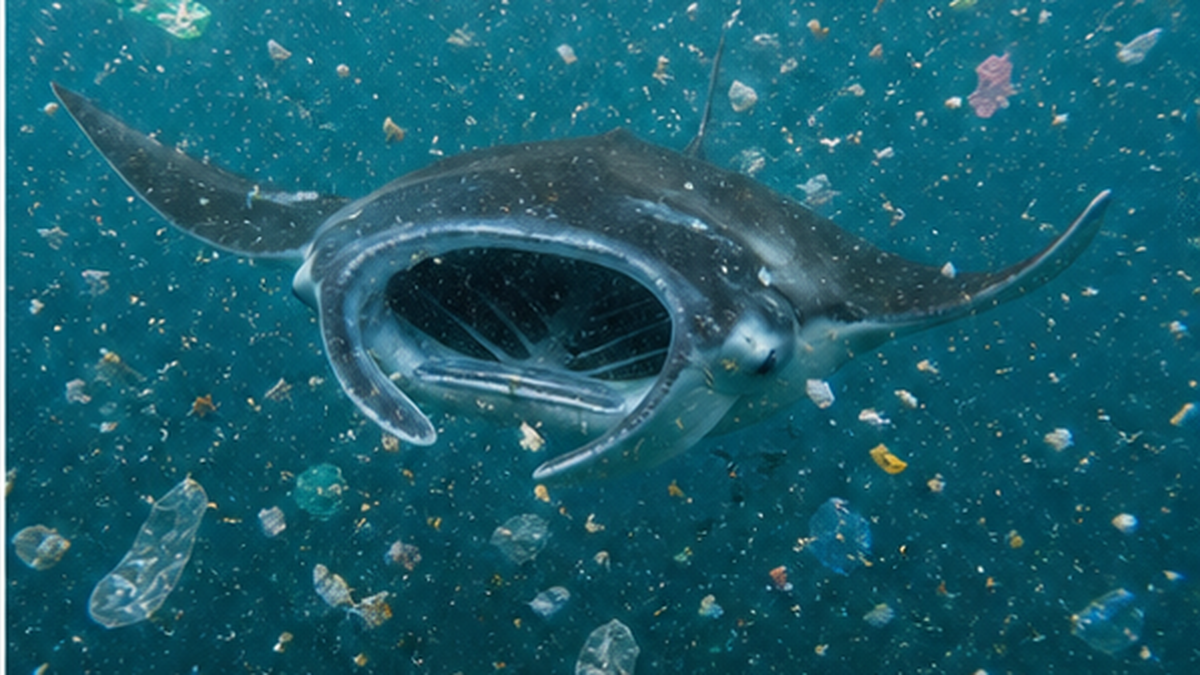
Up to 63 Pieces per Hour of Feeding
A survey in Indonesian waters (Frontiers in Marine Science, 2019) put numbers to the problem. It measured plastic densities at Nusa Penida and Komodo National Park — both major manta feeding grounds — and estimated ingestion from the volume of water a manta processes.
- Reef manta rays may swallow up to 63 pieces of plastic per hour of feeding
- For whale sharks in the same region, the estimate reached up to 137 pieces per hour
- About 80 per cent of the plastic recorded was microplastic smaller than 5 millimetres
- Thin film fragments from single-use bags and wrappers, together with hard fragments, made up more than half the total
- Filter feeders process hundreds to thousands of cubic metres of seawater a day, so even minute concentrations accumulate
Why "It's Only Dilute" Does Not Hold
A few fragments per cubic metre of seawater is one thing for most animals and quite another for one that processes hundreds of cubic metres daily. Worse, the places mantas favour are precisely those where currents and topography gather floating material — meaning the places where plankton concentrates are also the places where drifting plastic concentrates. The better the feeding ground, the higher the exposure: an unfortunate overlap.
Beyond the physical effects of the plastic itself, there is concern about chemicals adsorbed onto it transferring into the body. In an animal that lives around 40 years and grows and breeds slowly, long-term accumulation becomes the issue. For the wider debate including effects on human health, see our article on microplastics and human health.
The double burden on filter feeders
- ① The volume of water processed is orders of magnitude greater, so even dilute pollution accumulates
- ② Denser prey means denser debris — the best feeding grounds carry the highest risk
- ③ Slow growth and reproduction mean recovery at the population level takes a long time
- ④ The source is mostly single-use plastic on land, so offshore protected areas alone cannot prevent it
The Economics of Protection — The Gill Plate Trade and the Value of a Living Manta
The greatest threat mantas face is deliberate fishing and bycatch. The reason they are targeted is the subject of this article itself: the gill plates that do the filtering. Dried, they are traded in Chinese-speaking markets as a health food. Mantas are being killed for the very tool that keeps them alive.
The Scale of the Trade
A study that quantified the trade through interviews with traders (Aquatic Conservation, 2017) found Guangzhou, China, to be its centre, accounting for about 99 per cent of the estimated total market volume. Estimated market volume of dried gill plates stood at about 60.5 tonnes in 2011 and about 120.5 tonnes in 2013 — a doubling in a short span.
A single manta yields only a small quantity of gill plate. Volumes measured in tonnes therefore mean a corresponding number of individuals lost. International assessments have estimated global annual catches of giant manta rays in the thousands, concentrated largely in the fisheries of particular countries. As we have seen, for an animal that produces one pup every two to three years, fishing pressure on that scale is incompatible with maintaining a population.
International Regulation and Assessment
| Year | Event |
|---|---|
| March 2013 | The 16th Conference of the Parties to CITES votes to list manta rays in Appendix II |
| September 2014 | The listing enters into force, bringing international trade under regulation |
| 2017 | On molecular phylogenetic evidence, the genus Manta is merged into Mobula |
| 22 January 2018 | NOAA lists the giant manta ray as Threatened under the US Endangered Species Act |
| November 2019 | The IUCN assesses the giant manta ray as Endangered |
| Present | The reef manta ray is Vulnerable on the IUCN Red List; both species are listed in CITES Appendix II |
Worth Far More Alive
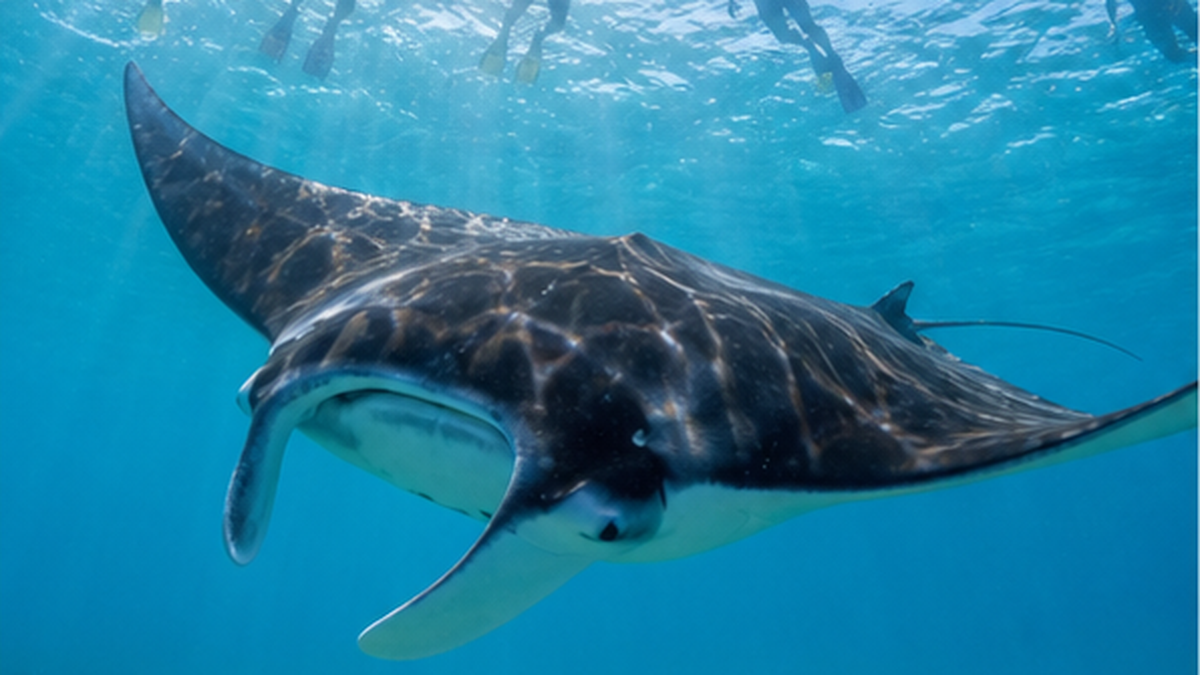
What moved the conservation debate was not only ecology but economics. The global survey published in PLOS ONE in 2013 produced the first worldwide estimate of manta-watching tourism. Direct revenue to diving and snorkelling operators exceeded US$73 million a year, and direct economic impact including associated accommodation and travel came to about US$140 million annually.
By contrast, income from fishing for gill plates has been estimated at a fraction of that figure. Killed, a manta yields a one-off return; alive, the same individual keeps drawing visitors for decades. Being able to show concretely, through individual identification, that a particular animal has returned to the same waters for years is what gave that argument its force.
What We Can Do
- Cut single-use plastic, especially thin film bags and wrappers — the main source of what gets swallowed
- When you meet a manta while travelling, do not chase it, touch it or block its path
- If you photograph the underside, consider offering it to a local survey group or identification database
- Do not buy products derived from manta or devil rays, such as gill plates of unclear origin
- Take an interest in protecting the coastal systems — coral reefs, seagrass meadows, tidal flats — that sustain nutrients and currents
Summary of this article
- There are two mantas — the giant and the reef manta ray — merged into the genus Mobula in 2017
- Cephalic fins gather water; gill plates separate out food as it flows from mouth to gill slits
- Ricochet separation, described in 2018, bounces particles away, so it never clogs and catches prey smaller than its pores
- Feeding switches on with prey density: 53.7 mg/m³ at Hanifaru Bay, with group feeding dominant above 200 mg/m³
- The same mechanism takes in plastic — up to an estimated 63 pieces per hour of feeding
- The gill plate trade is the greatest threat, while living mantas generate about US$140 million in tourism a year
References and sources
- Science Advances – Divi RV, Strother JA, Paig-Tran EWM (2018) Manta rays feed using ricochet separation, a novel nonclogging filtration mechanism. Science Advances 4(9): eaat9533
- PeerJ – Armstrong AO et al. (2021) Reef manta rays forage on tidally driven, high density zooplankton patches in Hanifaru Bay, Maldives. PeerJ 9: e11992
- NOAA Fisheries – Giant Manta Ray species profile: size, lifespan, reproduction and the 2018 ESA listing
- Frontiers in Marine Science – Germanov ES et al. (2019) Microplastics on the Menu: Plastics Pollute Indonesian Manta Ray and Whale Shark Feeding Grounds
- PLOS ONE – O'Malley MP, Lee-Brooks K, Medd HB (2013) The Global Economic Impact of Manta Ray Watching Tourism. PLoS ONE 8(5): e65051
- PLOS ONE – Diving behavior of the reef manta ray (Mobula alfredi) in New Caledonia: More frequent and deeper night-time diving to 672 meters (2020)
- Frontiers in Marine Science – Deep diving behaviour in oceanic manta rays and its potential function (2025): dives beyond 1,200 m in the giant manta ray
- Aquatic Conservation – O'Malley MP et al. (2017) Characterization of the trade in manta and devil ray gill plates in China and South-east Asia through trader surveys
- Manta Trust – Reef Manta Ray (Mobula alfredi) species guide: size, lifespan, IUCN status and feeding strategies
- Okinawa Churaumi Aquarium – Species guide entry for the reef manta ray: range, feeding, individual identification and captive breeding
Listed in order of reliability: government and academic institutions > peer-reviewed papers > specialist organisations > trusted media