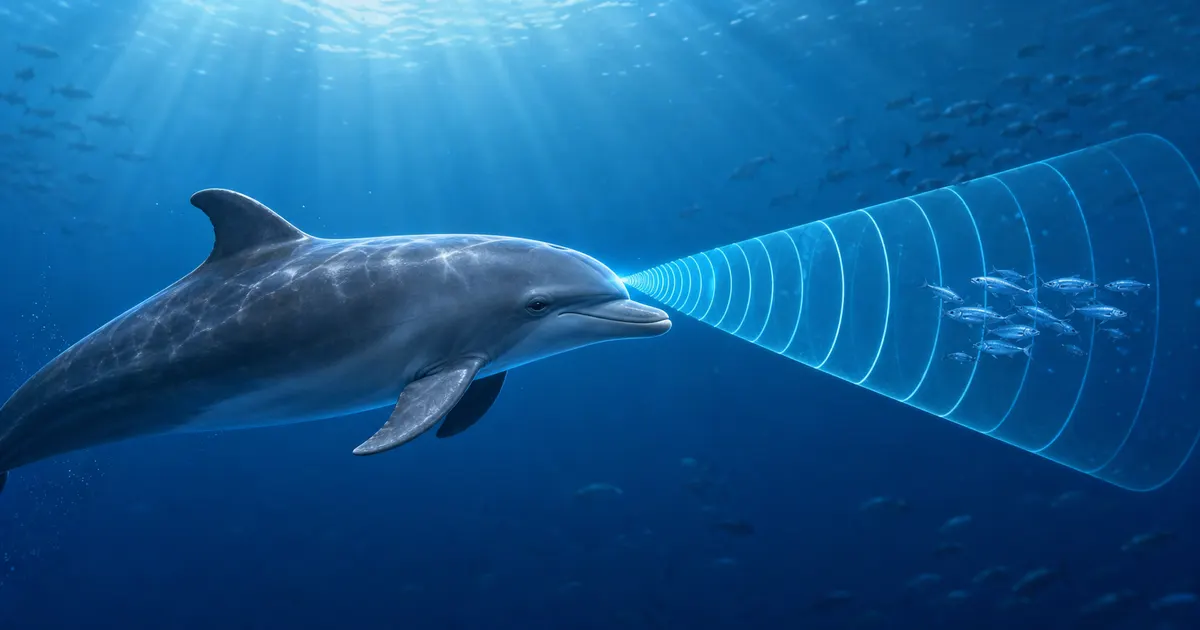
Close your eyes in a pitch-black room, clap your hands, and try to guess the position of the furniture using only the echo—for a human, this is an almost impossible feat. But dolphins do exactly this as a matter of course in the sea. They emit ultrasonic sound themselves, listen to the echoes that bounce back off objects, and read the position, distance, and size of their prey—even its "contents," whether it's a fish or a piece of metal. This ability is called echolocation (biosonar).
Dolphin echolocation is every bit as precise as our own sense of sight, and it works even in murky water or the deep sea where no light reaches. The star of this ability is an organ made of fat inside the forehead, called the "melon." This article breaks down the sequence of producing, projecting, and receiving sound, drawing on familiar examples and the latest research.
In the latter half, we'll go further into how river dolphins hunt in muddy water, and how the "underwater noise" that humans have introduced into the sea is threatening this delicate world of sound. Let's take a look together at the seascape that dolphins draw with sound.
What You'll Learn in This Article
- The overall picture of echolocation — how dolphins emit ultrasound and "see" their surroundings through echoes
- How the sound-producing phonic lips and the melon organ, which focuses sound into a beam, work
- The receiving mechanism, in which echoes are picked up by acoustic fat in the lower jaw and carried to the inner ear via bone conduction
- The three-stage hunting tactic, in which click speed changes across the search, approach, and kill phases
- Why dolphins can hunt in murky rivers or the pitch-black deep sea, and how river dolphins have adapted
- The reality that underwater noise and ocean acidification are threatening the world of sound that dolphins depend on
Dolphins That "See" With Sound — The Superpower of Echolocation
The ocean is often said to be not a "world of light" but a "world of sound." Underwater, light weakens rapidly after just a few dozen meters, and turbidity or plankton reduce visibility even further. Sound, however, travels roughly 4.5 times faster than in air (about 1,500 meters per second) and carries far without losing much strength. Dolphins and other toothed whales have evolved to make maximum use of this property of the ocean—that sound travels well.
Echolocation is the ability of an animal to emit sound itself and listen to the echo that bounces back off an object, thereby learning the object's distance, direction, size, shape, and more. It works on the same principle that lets bats fly in the dark, and dolphins do this underwater. Dolphins have realized, using nothing but their own bodies, the exact same concept as the "sonar" used by ships and submarines—and they have been doing so for tens of millions of years.
Using "Ultrasound" That Humans Cannot Hear
The sound dolphins use for echolocation is a very short pulse of sound called a click. Its frequency ranges from roughly 20kHz to 150kHz, reaching as high as 200kHz in some species. Since the upper limit of human hearing is about 20kHz, most of the sound dolphins produce falls in a range of ultrasound that feels like "silence" to us. The hearing of the bottlenose dolphin covers an extraordinarily wide range, from about 75Hz to 150kHz.
Why use such high-pitched sound? The answer is "to distinguish fine detail." The higher the frequency—meaning the shorter the wavelength—the better the sound bounces off small objects, capturing fine outlines. Just as increasing a magnifying glass's resolving power reveals finer detail, ultrasound delivers a "high-definition image" of the sea to dolphins. Just how remarkably diverse the senses that marine creatures have evolved can be, is well illustrated by looking across Japan's marine biodiversity.
Key Points of Echolocation
- Dolphins emit ultrasonic clicks themselves and grasp their surroundings from the returning echoes
- The sound used is 20-150kHz ultrasound, far exceeding the human hearing range (up to ~20kHz)
- Higher frequencies (shorter wavelengths) allow finer discrimination of small objects
- It functions even in lightless water—essentially a "sound radar"
A Familiar Analogy: "Measuring Distance by the Echo of Your Voice"
If you shout in a tunnel or a gymnasium, the echo comes back a moment later. The farther the wall, the later the return—by measuring this "time from making the sound to hearing it return," you can work out the distance to the wall. Dolphins apply this principle hundreds of times per second, even using the tiny time differences received by the left and right ears and lower jaw. It may help to picture it this way: what we do with our eyes when focusing, dolphins do with their ears (or more precisely, their lower jaw and inner ear).
Here's another familiar analogy. Have you ever searched for your phone in a pitch-dark room by listening for its notification sound? We unconsciously estimate where a sound is coming from and how far away it is, using our ears. Dolphins do this by "making the sound themselves," and not just once—through hundreds of high-speed measurements per second, continuously updating the position of a moving prey. Once you consider that dolphins have honed, as a primary life-sustaining sense, an ability that humans use only occasionally—"measuring position with sound"—its sheer sophistication becomes easier to appreciate.

This article's protagonist is the dolphin, but other toothed whales, such as the sperm whale, also possess powerful biosonar. The mechanism by which whales communicate through sound as they travel across the vast ocean can be understood in three dimensions when read alongside our article on the mystery of whale migration.
"Clicks" and "Whistles" Serve Different Roles
The sounds dolphins make are not all of one kind. The short, crackling click is used for echolocation. Separately, there is the piping whistle (a sound like a whistle), used for conversation with other dolphins, and each has its own distinct role. Each individual has its own unique "signature whistle" (a sound like a name), used to call to companions in the pod or to announce its own presence. In other words, dolphins skillfully switch, depending on the situation, between clicks as a "radar" for probing their surroundings and whistles as a "voice" for conversation. The echolocation discussed in this article is primarily concerned with the mechanism of the former, the click.
What's interesting is that dolphins sometimes swim while emitting clicks and cooperate as a pod to herd schools of fish. The sight of several dolphins coordinating with sound to encircle a school of fish shows that sound is used not only to "see" but also to "share" information. That marine mammals rely on sound to this extent is an evolutionary inevitability for surviving in a world that light cannot reach.
The Organs That Make Sound — How the Phonic Lips and Melon Work
So how do dolphins "make" ultrasound? Humans produce voice using the vocal cords in the throat, but dolphins generate sound in a completely different place—a specialized organ deep inside the nose. And rather than letting that sound leak out through the mouth or nose, they focus it into a forward-facing beam using a lens of fat in the forehead. This two-step process of "generation" and "focusing" underpins the precision of echolocation.
The Sound Source: the "Phonic Lips (Monkey Lips)" Deep in the Nose
A dolphin's click is produced by a pair of folds called the phonic lips, located in the nasal passage (the airway connecting to the blowhole at the top of the head). In English, this part is also called the "monkey lips" because of its appearance. When a dolphin pushes air through the gap in these folds, the folds vibrate at high speed, producing a short, snapping click. Picture it as the "lip trembling" we do when we press our lips together and make a "brrr" sound, but at ultra-high speed and ultra-high frequency.
What's clever is that dolphins can produce sound without exhaling. Because they can circulate and reuse the air within their bodies, they can continue rapid-firing clicks for extended periods without having to surface to breathe. This "clicking without pausing for breath" structure is critically important for continuing to hunt while diving.
The Origin of the Name "Melon"
The fatty organ in the forehead is called the "melon" because its appearance resembles the fruit of the same name. It's a scientific term, but its origin is delightfully simple. It's found widely across cetaceans (toothed whales), and species with a larger, more developed melon tend to be more skilled at echolocation.
The Melon Is an "Acoustic Lens" That Focuses Ultrasound
The click produced by the phonic lips passes straight through the melon in front of it before being released into the water. The melon is a mass of fatty tissue, but it's no ordinary fat. The composition of the fat (and thus the speed sound travels through it) varies slightly from place to place, so sound refracts differently at the center versus the periphery. This unevenness bends sound waves in much the same way a lens bends light, focusing sound that would otherwise scatter in all directions into a narrow, sharp beam.
Just as a flashlight uses a reflector to gather light from the bulb and direct it forward, the melon acts as an "acoustic lens" that focuses sound generated inside the body forward. The narrower the beam, the higher the resolution of information obtained from the targeted direction, with less risk of being confused by extraneous reflections. When a dolphin turns its head to "scan" its surroundings, it is sweeping this beam back and forth.

- Sound source = the phonic lips (monkey lips) in the nasal passage. Air is pushed through, vibrating the folds to generate a click
- Because air can be recirculated without exhaling, clicks can be sustained continuously even while diving
- The melon = fat in the forehead. Differences in composition refract sound, focusing it into a beam like an acoustic lens
- By turning its head, the dolphin sweeps the beam to scan its surroundings
The Narrower the Beam, the Higher the "Resolution"
The more the melon focuses the sound, the higher the resolution of a dolphin's sonar. Just as narrowing a flashlight beam makes the illuminated spot appear more sharply, a narrower sound beam allows the dolphin to strongly receive only the echo from the targeted direction, without being confused by extraneous reflections from the sides. Research has shown that dolphins even use advanced techniques such as slightly shifting the beam's direction to trace along the "edge" of a target, capturing its outline more precisely. Taking such care over exactly how the sonar beam is aimed is truly the mark of a "professional at seeing with sound."
Dolphins also adjust the volume (intensity) of sound depending on the situation. Louder when probing something far away, and softer once they've closed in—automatically controlling their own output volume so that the echo doesn't become too "blinding" near their ears. This corresponds to what artificial sonar calls "gain control" (sensitivity adjustment), and it demonstrates the delicate control that living creatures have acquired over the course of long evolution.
This sharp beam proves its worth when cornering prey such as squid and fish. Fast, clever prey are harder to catch, and when facing off against the intelligence of cephalopods (squid and octopus), for example, a dolphin's high-precision sonar and agility are truly put to the test.
Listening to the Echo — The Receiving System of the Lower Jawbone and Acoustic Fat
Just as interesting as how sound is produced is the question of "where it's received" once the echo returns. We take in sound through our outer ears (earlobes and ear canal), but a dolphin's ear openings are extremely small and barely functional. So where do they listen? The surprising answer is the lower jaw.
The Echo's Entry Point Is the "Lower Jaw"
An echo bouncing off prey or another object enters the dolphin's body from the rear of the lower jawbone. The inner surface of the lower jawbone is thin, forming something like an "acoustic window," and the interior is filled with a special fat called acoustic fat. The density of this fat is very close to that of seawater, allowing it to transmit sound energy with almost no reflection or attenuation. As a result, echoes entering from outside are efficiently guided all the way to the inner ear.
Vibrations reaching the inner ear are converted into electrical signals and sent to the brain. The dolphin's brain processes the "time difference" and "difference in intensity" of the echoes received by the left and right lower jaw, determining in three dimensions whether the sound source is to the right or left, above or below. In effect, the dolphin constructs a picture of the underwater scene from sound, much as we construct an image from what we see with our eyes. The mechanism by which bone conduction through the lower jawbone carries information about a sound source's location has been experimentally investigated by research teams in France and elsewhere.
A dolphin's lower jawbone has a large hollow through which the mandibular nerve passes, filled with acoustic fat that transmits sound well. Because the density of the fat is close to that of seawater, vibration attenuation is minimal, so echoes are efficiently conveyed to the inner ear.
— Summarized from various anatomical and acoustic studies
Acoustic Fat "Used to Be Muscle"
Recent research has revealed a surprising origin for this acoustic fat. A research group including Hokkaido University has found that, at the level of gene activity, a dolphin's acoustic fat body has properties intermediate between "fat" and "muscle." Tracing the evolutionary path, a story emerges in which facial muscle transformed by accumulating fat—like marbled meat—and eventually became an acoustic fat body that transmits sound well.
In other words, dolphins gave up facial muscle used for "chewing" in exchange for acquiring hearing that functions at a highly advanced level underwater. In the process of becoming a mammal that left land to live in the sea, various parts of the body have been remade for the sake of sound—echolocation is one culmination of this thoroughgoing evolution. The remaking of bodies to adapt to the darkness of the deep sea is a theme that connects with deep-sea creature adaptation as well.

Why Listen With the "Jaw" Instead of the Ear Canal
Underwater, an ear canal filled with air is useless. Passing sound through acoustic fat with a density close to seawater carries it to the inner ear without losing energy. Dolphins evolved to "listen with their jaw" because it was the most efficient receiving route underwater.
The Left and Right Ears Are "Separated" by Bone
To accurately determine direction, the left and right ears need to capture sound independently. In humans, sound travels around through the skull bone and bleeds from one side to the other, but a dolphin's inner ear (a mass of ear bones) is isolated from the skull by bone tissue, floating as it were, and surrounded by tissue containing air pockets. Thanks to this structure, the left and right ears each receive sound independently, allowing the dolphin to clearly distinguish the "tiny time difference" between echoes reaching the right lower jaw and the left. It is because of this thoroughgoing "separation of the left and right ears" that dolphins can determine the direction of a sound source in three dimensions.
This precise hearing structure also means, conversely, that it is highly susceptible to the effects of human activity. It has been suggested that damage to auditory tissue is one factor involved in "stranding," in which cetaceans exposed to strong impact sounds wash up on shore. Precisely because their bodies depend so heavily on sound, the damage is severe when the sound environment is disrupted. This point connects deeply with the discussion of "underwater noise" in the latter half of this article.
The Three Stages of the Click — Searching, Approaching, and the Kill
Echolocation is not simply a matter of leaving the sound running continuously. Dolphins skillfully switch the speed (repetition rate) of their clicks depending on the distance to their prey. Much like a camera's autofocus refining its focus more finely as it approaches its subject, dolphins increase the frequency of information updates at each phase of the hunt.
Search Phase: Scanning Slowly and Broadly
During the search phase, before prey has been located, clicks occur at roughly 10 to 20 times per second. Click once, wait for the echo to return, then click again—at a relatively slow pace, the dolphin scans broadly across a wide area. When probing something far away, it takes time for sound to make the round trip, so it makes sense to deliberately space out the clicks.
Approach Phase: Locking On and Checking in Detail
Once something resembling prey is detected, the click rate jumps sharply to 100 to 200 times per second. As the distance to the target closes and echoes return quickly, rapid-fire clicking at short intervals no longer causes confusion. The dolphin tracks its target's movement in fine detail, determining whether it's really an edible fish and how quickly it might flee.
Terminal Buzz: The Final Push at 600 Clicks per Second
As the prey closes to within about 1 meter, the click rate switches to a furious rate of 300 to 600 times per second. This phase is called the terminal buzz, and because it is so fast, it sounds to humans like a continuous buzzing sound (like a buzzer). Through this nearly unbroken stream of information, the dolphin maintains its focus right up to the final instant, closing in and seizing the swiftly fleeing fish.
| Phase | Click rate (per second) | Purpose |
|---|---|---|
| Search | About 10-20 | Slowly scan a broad area, looking for prey |
| Approach | About 100-200 | Lock on to the target, confirm its identity and movement |
| Terminal buzz | About 300-600 | Continuously track at close range for a reliable kill |
This staged tactic is inseparable from the distribution and movement of the fish that serve as prey. If changes in sea water temperature shift where fish are located, dolphins' hunting grounds shift as well. The effects of ocean warming on fish, fisheries, and predators are covered in detail in our article on ocean warming and fisheries.

Hunting Is a Matter of Controlling "Information Update Frequency"
- Far away = slow (spacing out the clicks because the echo takes time to make the round trip)
- Close = fast (since the echo returns quickly, rapid-fire clicking allows fine tracking of movement)
- The terminal buzz, at 600 clicks per second, is effectively real-time tracking, like "video"
- Working backward from the speed of sound, distance is read with a precision of under 100 microseconds
Why Is It Necessary to "Space Out" the Clicks?
It might seem that clicking as fast as possible would always be better, but that isn't actually the case. If the next click is fired before the previous echo has had time to return, it becomes impossible to tell "which click does this returning echo belong to." To probe something 10 meters away, the round trip of sound takes roughly one-hundredth of a second or more. That's precisely why, in the search phase for probing distant objects, it's necessary to deliberately space out the clicks and "check the answer" one shot at a time. Conversely, at close range, the echo returns almost instantly, so no matter how fast the dolphin fires, there's no risk of mixing up which echo belongs to which click. The fact that the terminal buzz is used only at close range is rooted in exactly this physical constraint.
In this way, dolphins choose the optimal rhythm for each situation, as if they understand the physical law of the speed of sound in their very bodies. Predicting the direction a fish will flee and getting ahead of it, then singling out one individual within a school and continuing to track it—echolocation is not merely a "distance sensor" but also a sophisticated tracking system for pursuing a moving target. The speed at which toothed whales use this ability to react to fast-moving fish has been reported with astonishment even in the latest research.
How Much Can They "See"? — The Astonishing Precision of Echolocation
Even calling it "seeing with sound," how finely can dolphins actually perceive things? Experiments using trained dolphins have reported a precision that far exceeds our imagination. A dolphin's sonar doesn't simply tell it "something is there"—it can distinguish an object's size, shape, thickness, and even differences in material.
Millimeter-Level Distance, Sub-1mm Thickness Discrimination
Research has shown that dolphins can distinguish distances at 1 meter away with a resolution of about 0.9 cm, at 3 meters with about 1.5 cm, and at 7 meters with about 2.8 cm. There are even reports that a blindfolded bottlenose dolphin was able to distinguish, using echoes alone, targets with a thickness difference of less than 1mm. Dolphins analyze, with astonishing precision in their brains, the tiny time differences in returning sound and differences in the quality of the echo.
This precision is underpinned by measuring the time from making a sound to the echo's return with a precision of under 100 microseconds (one hundred-thousandth of a second). If the speed of sound is known, distance can be accurately calculated backward from the time difference. A dolphin's brain performs this calculation in real time, an enormous number of times—it is, in effect, a living high-speed computer.
Fish or Metal? Distinguishing Even the "Contents"
The most astonishing aspect of echolocation is that it can discern not just external shape but the contents (material) of an object. Even objects of the same size and shape—whether metal, plastic, or fish flesh—reflect sound differently (in terms of reflection strength and frequency-dependent response). Dolphins use this difference as a clue to distinguish a fish hidden in the sand from a pebble, and to sort out edible prey from mere obstacles. Dolphins routinely accomplish the "identification of material" that artificial sonar still struggles with today.
| Distance to target | Distance resolution (discernible difference) |
|---|---|
| 1m | About 0.9cm |
| 3m | About 1.5cm |
| 7m | About 2.8cm |

The "Eye for Material" That Artificial Sonar Can't Match
Ship and submarine sonar can measure the position and size of an object, but it's not good at determining "whether it's a fish or metal." Because dolphins can read even the material of an object from the fine characteristics of the reflected sound, biosonar remains, to this day, a model for artificial sonar research.
The Swim Bladder Serves as a "Marker"
One reason dolphins can efficiently find fish is the swim bladder that many fish possess. The swim bladder is a sac filled with air, and because it reflects sound very differently from the surrounding water or the fish's flesh, it strongly reflects ultrasound. For a dolphin, it's as if the fish carries a marker that "glows" in the darkness. Even when hidden in sand or mud, the dolphin can quickly detect the presence of prey using the strong echo from this swim bladder as a clue. The fact that echolocation goes beyond mere distance measurement to tell "what is there" is precisely because it also reads such physical features of the target.
In other words, dolphins synthesize multiple clues—the "strength," "timing," and "frequency-dependent response" of the returning echo—to gauge not just the distance to a target but its size, shape, contents, and even species, all at once. Just as we can tell "that's an apple" at a single glance, a dolphin can instantly judge "that's an edible fish" from a series of echoes—echolocation is, in that sense, a form of "sound-based vision" rich with information.
What Comparison With Bats and Humans Reveals
Echolocation is not an ability unique to dolphins. Bats flying through the night sky also catch insects using ultrasound, and there are known cases of blind humans grasping their surroundings using the echo of tongue clicks. However, because sound travels about 4.5 times faster underwater than in air and carries far without losing much strength, dolphin echolocation can cover a wider range and greater distance than that of bats. Even though both are "seeing with sound," the range and resolution vary greatly depending on whether the stage is the sea or the sky. The fact that a dolphin's biosonar is considered among the very best in the animal kingdom in terms of spatial awareness precision owes something to this underwater environment.
And we must not forget the sheer intelligence of the dolphin's brain, which processes this vast amount of information in real time. Instantly analyzing enormous numbers of echoes, tracking a moving prey, and coordinating with companions—echolocation only comes together as a complete system when the sensory organ is paired with the intelligence that interprets it. It is thought that this need to process sound-based information underlies why dolphins are considered among the most intelligent of marine mammals.
Incidentally, in sea areas where sand or mud is stirred up and visibility is poor, sight is of almost no use. Even in waters clouded by red tide or eutrophication, such as in red tide and eutrophication, dolphins can keep hunting as long as sound can travel.
Why Dolphins Can Hunt in Murky Water and the Pitch-Black Deep Sea
The greatest strength of echolocation is that it doesn't rely on light at all. Whether in crystal-clear water, a river turned brown and murky with mud, or the lightless deep sea, echolocation functions the same way as long as sound can travel. The creatures that have taken this "hunting even in an environment where you can't see" trait to its extreme are the dolphins that live in rivers.
River Dolphins That Are Nearly Blind
The Ganges river dolphin, found in the great rivers of India and Bangladesh, is functionally almost blind. Its eyeball is little more than a pinhole, and it even lacks the lens needed to form an image. Even so, they swim freely through muddy, turbid rivers, catching fish and making a living. This is an extreme case of evolution, in which sight has been almost entirely abandoned in favor of relying entirely on short-range echolocation.
The Amazon river dolphin (boto) of South America's Amazon River likewise has very little eyesight, and probes for prey in muddy water using biosonar emitted from its large, well-developed melon. What's more, its neck bones are flexible, allowing it to turn its head nearly 180 degrees, so it can swim as if weaving through submerged tree roots and branches while chasing down prey by sound. To survive in the "unseeable world" of a murky river, the body itself has been optimized for hunting by sound.
The eyes of the Ganges river dolphin lack a lens and cannot form an image. Its preference for highly turbid habitats matches a way of life that depends not on sight, but on short-range echolocation.
— WWF and others (summarized)
Sound Still Reaches Through the Darkness of the Deep Sea
Dolphins and toothed whales in the open ocean sometimes dive to depths where light doesn't reach, in pursuit of prey. Down there, it's pitch dark even during the day, but this poses no problem at all for echolocation. If anything, one could argue that with no extraneous light or visual information to be distracted by, they can focus entirely on sound. Just how dark and unusual an environment the deep sea is can be readily imagined by reading our articles on deep-sea bioluminescence and deep-sea creature adaptation.

- Because echolocation doesn't depend on light, it functions in murky water, the deep sea, and at night
- The Ganges river dolphin has no lens in its eye, and relies on echolocation while nearly blind
- The Amazon river dolphin (boto) catches prey in muddy water using a well-developed melon and a flexible neck
- Echolocation is such a reliable sense that some species have given up sight entirely to rely on sound-based hunting
"Invisibility" Is Not a Handicap
- Underwater, sound travels farther and more accurately than light
- Turbidity and darkness are not major obstacles for echolocation
- River dolphins are the ultimate example of adaptation to sound, having given up sight almost entirely
Adaptations for the "Difficult Stage" of a Shallow River
River dolphins live not only in muddy, turbid water but in an acoustically very complex environment, with shallow depths and reflections (echoes) coming in from all directions off the riverbed, banks, and submerged trees. If they emit a strong sound, reflections from the riverbed or bank return before the echo from the prey, causing confusion rather than clarity. For this reason, river dolphins are thought to have developed an echolocation specialized for relatively short distances, adapting to efficiently pick up only the echoes from nearby prey. Even though it's the same echolocation, the "way it's used" differs subtly between open-ocean dolphins and river dolphins.
Many of these river dolphins are now at risk of extinction. Pollution of their river habitats, fragmentation caused by dam construction, and bycatch in fishing nets have combined to reduce their numbers. For creatures that perceive the world through sound, the deterioration of the river environment itself is a serious problem that shakes the very foundation of their lives. That the conservation of creatures in waterways, including rivers as well as the ocean, is now being called into question is a point that should not be overlooked, viewed also from the perspective of biodiversity.
Looking at Japan's coastline, river mouths and inner bays become significantly turbid after rain, for example. The fact that familiar cetaceans such as bottlenose dolphins and finless porpoises can still make a living in such waters is precisely because they have the ability to perceive their environment through sound rather than relying entirely on sight. Remembering that such "residents of a world of sound" live in the seas close to us should change, if only slightly, how we see the ocean.
Parallels With Human Technology, and the Threat Now Facing the Ocean
Dolphin echolocation is deeply connected to human science and technology as well. Much of the technology we use to "see with sound," whether inside the ocean or inside the body, is essentially an application of exactly what dolphins and bats have been doing all along. At the same time, this very human activity is now quietly threatening the world of sound that dolphins depend on.
Medical Ultrasound and Fish Finders Are Both "Echolocation"
Ultrasound examinations (echo) used in hospitals are a technology that applies ultrasound to the body and images the condition of internal organs or a fetus from the reflected sound. Fishing boats' fish finders and ship sonar work on exactly the same principle as dolphins: emitting sound and capturing a target through the echo. Humans have realized these using machines, but in terms of precision and material identification, it's said there is still much to learn from a dolphin's biosonar. Applying the mechanisms of living creatures to technology is one of the great values of marine biology research.
Underwater Noise Blocks Dolphins' "Ears"
Meanwhile, the sound humans have introduced into the ocean continues to increase year after year. Ship propeller and engine noise, seismic surveys probing the seabed for resources, pile driving associated with offshore wind farm construction, military sonar, and more—this underwater noise (ocean acoustic pollution) often overlaps with the frequencies used by dolphins and whales, interfering with their communication and hunting. The U.S. National Oceanic and Atmospheric Administration (NOAA) has also pointed out that increasing underwater noise from ships, sonar, and drilling has complex adverse effects on marine life.
Amid strong noise, "masking" occurs, in which a dolphin's echo is buried in background noise and becomes difficult to hear. Prolonged exposure to strong sound can also cause temporary or permanent hearing loss (TTS/PTS), and dolphins believed to have lost their hearing have been reported. For dolphins, sound is a lifeline for catching food, bonding with companions, and avoiding danger. Noise that blocks this lifeline can inflict damage equivalent to having their eyes covered.
The Ocean's "Sound Environment" Is at Risk
- Underwater noise from shipping, seismic surveys, pile driving, sonar, and more overlaps with the frequencies dolphins use
- "Masking," in which echoes are buried in noise, interferes with hunting and communication
- Strong noise risks causing temporary or permanent hearing loss (TTS/PTS)
- As ocean acidification progresses, seawater absorbs sound less, potentially allowing noise to travel even farther
Furthermore, bycatch from fishing gear is also a serious threat to dolphins. Accidents in which dolphins become entangled in nets or ropes lost at sea occur worldwide, and the problem of ghost gear (abandoned fishing equipment) overlaps with cases in which dolphins, who perceive the world through sound, fail to notice a physical trap. The fact that climate change is itself altering the marine environment around Japan is a theme worth understanding alongside marine heatwaves.


What We Can Do to Make the Ocean "Quieter"
Because underwater noise is invisible, it tends to be underestimated, but countermeasures are gradually progressing. Examples include the development of "quiet ships" with improved propellers and engines to reduce noise generation, efforts to slow ship speeds in congested waters, and the use of bubble curtains during offshore wind construction to suppress the transmission of pile-driving noise. These don't stand out the way air pollution or ocean plastic does, but for cetaceans, they carry great significance in "restoring the sound environment." When thinking about ocean issues, we tend to focus on visible pollution, but it's worth keeping in mind that there is also an invisible problem: "noise pollution."
What's more, global warming and ocean acidification are complicating this issue further. It has been pointed out that as the ocean acidifies, seawater becomes less able to absorb sound, meaning the same level of noise could travel even farther. In other words, an issue that seems unrelated at first glance—carbon dioxide emissions—could, through a chain of consequences, worsen the "world of sound" that dolphins perceive. The theme of echolocation reminds us once again that ocean problems are a complex tangle of living creatures, pollution, and climate change.
What We Can Do
- Pay attention to ocean news through the lens of "underwater noise / ocean acoustic pollution" as well
- Reduce the leakage of plastic and fishing gear to lower the risk of bycatch (countering ghost gear)
- Work toward decarbonization to slow the progress of ocean acidification and warming
- When observing dolphins or whales, avoid overstimulating them with engine noise or excessive approach
Conclusion — A Message From Dolphins, Who Paint the World With Sound
Dolphin echolocation is a masterpiece of evolution that has remade the entire body for the sake of sound: generating ultrasound with the phonic lips deep in the nose, focusing it into a beam with the melon, receiving the returning echo through the acoustic fat of the lower jaw, and painting a picture of the seascape in the brain. With hundreds of clicks per second, dolphins can discern distances down to the millimeter and differences in material, and still carry out a hunt in murky water or the deep sea where no light reaches.
This delicate sense serves as a model for our own medical ultrasound and sonar technology, while at the same time being threatened by the noise humans have introduced into the ocean. Protecting a "quiet ocean" for dolphins is nothing less than protecting their freedom to see the world through sound. The next time you spot a dolphin in the sea, remember that inside its head, a map of the ocean made entirely of sound is unfolding.
Once you understand echolocation, the sea starts to look like an entirely different place. To us, the ocean is a "landscape of blue, shimmering water," but to a dolphin, it is a "three-dimensional map made of sound." Living in the very same sea through utterly different senses—this fact invites us to a larger question about how each living creature perceives its own world. Dolphin echolocation is, at once, a demonstration of marine life's remarkable adaptability, and a perfect gateway to understanding the importance of protecting the invisible "sound environment."
Article Summary
- Echolocation = the ability to emit ultrasound and read distance, size, and even material from the returning echo
- Sound is generated by the phonic lips in the nose, focused into a beam by the melon (a lens of fat), and projected outward
- Echoes travel from the lower jaw's acoustic fat, via bone conduction, to the inner ear. The acoustic fat used to be muscle
- Clicks switch from 10-20 per second during search, to 100-200 during approach, to 600 during the terminal buzz
- Dolphins can distinguish about 0.9cm at 1m, and thickness differences under 1mm. It works in murky rivers and the deep sea
- The principle behind medical ultrasound and sonar is the same. Underwater noise and ocean acidification are threatening this world of sound
Just how diverse a range of senses and lifestyles marine creatures have evolved will feel all the more compelling if you also read our articles on Japan's marine biodiversity and the mystery of whale migration.
References & Sources
- Hokkaido University Faculty of Science – A Dolphin's Acoustic Fat Used to Be Muscle (Press Release)
- NOAA Fisheries – Ocean Noise (Underwater Noise and Its Effects on Marine Life)
- NOAA Fisheries – Understanding Sound in the Ocean
- WWF (World Wildlife Fund) – Ganges River Dolphin (Species Information)
- J-GLOBAL (Japan Science and Technology Agency) – Bone-Conducted Sound in the Dolphin Lower Jaw: An Experimental Study of Elastic Waves Related to Sound Source Location
- Yume Navi (Lecture Introductions by University Professors) – A World of Sound Unfolds for Dolphins
- Dolphin Research Center – Acoustics (An Explanation of Dolphin Acoustics and Echolocation)
- United Parks & Resorts (SeaWorld) – All About Bottlenose Dolphins - Communication & Echolocation
* Listed in order of reliability: government/academic institutions > peer-reviewed papers > specialized organizations > reliable media