On the Day of the Ox in midsummer (26 July in 2026), grilled eel appears on dinner tables across Japan. Yet for most of human history nobody knew where that fish was born. However carefully people searched rivers and lakes, they never found eel eggs, nor an eel in the act of spawning.
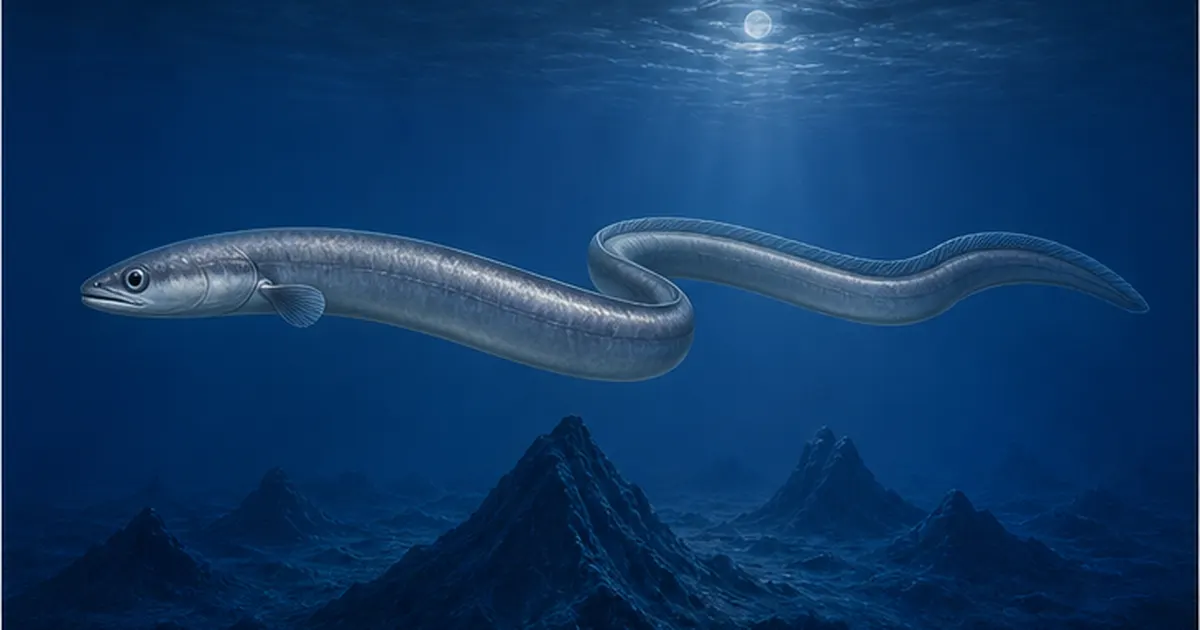
The answer lay thousands of kilometres away, in the middle of the western Pacific. After spending several years to well over a decade in Japanese rivers, the Japanese eel turns silver, stops eating altogether, and swims for about six months to the area near the southern end of the West Mariana Ridge, where it is believed to spawn on a new moon. Its offspring become transparent, willow-leaf-shaped larvae that ride ocean currents back to the rivers of East Asia.
This article sets out how a spawning ground that had been a mystery for two thousand years was finally located, what kind of journey the larvae make, and what now threatens that journey, drawing on primary sources from the Fisheries Agency of Japan, the Japan Fisheries Research and Education Agency, and the University of Tokyo's Atmosphere and Ocean Research Institute.
What you’ll learn in this article
- The century-long search that pinned the Japanese eel's spawning ground to the West Mariana Ridge
- Why the three clues of seamounts, new moons and the salinity front narrowed the search to a single spot
- How leptocephalus larvae feed on marine snow and switch onto the Kuroshio to reach Japan
- How El Nino and shifts in the North Equatorial Current sway the number of glass eels arriving each winter
- How far the stock has actually declined, and where full-cycle aquaculture and international management now stand
Where does the eel on your plate come from?
Before chasing the mystery of spawning, it is worth being clear about what kind of fish we are actually eating. Once that is settled, the story of the spawning ground stops being distant academic news and becomes a story about our own dinner table.
Even farmed eel starts life as a wild juvenile
Almost all eel sold in Japan is farmed. According to the stock assessment published by the Fisheries Agency and the Japan Fisheries Research and Education Agency, farmed eel production peaked at 39,704 tonnes in 1989, has hovered around 20,000 tonnes since 1997, and came to 16,159 tonnes in 2024. The domestic catch of wild eel (the yellow eel stage described below) has kept falling, reaching 52 tonnes in 2024, the lowest figure since statistics began in 1894.
But eel farming does not mean raising fish from eggs. Juveniles weighing about 0.2 grams, known as glass eels, are caught as they arrive at river mouths in winter and then fattened in ponds for several months to a year. In other words, farmed eel still begins as a life born in the wild ocean. That is precisely why what happens at the spawning ground matters to the future of the industry.
A fish that changes shape again and again
The Japanese eel is a catadromous migrant: it spawns at sea and grows in fresh and brackish water. Each stage of its life has a completely different appearance and a different name. Here are the terms that appear in news reports and official documents.
| Stage | Name | Main location | Characteristics |
|---|---|---|---|
| 1 | Egg | 150-200 m depth near the West Mariana Ridge | About 1.6 mm across; hatches at around 25°C |
| 2 | Preleptocephalus | Around the spawning ground | The larva from hatching until it begins to feed |
| 3 | Leptocephalus | North Equatorial Current to the Kuroshio | Transparent and shaped like a willow leaf; feeds on marine snow |
| 4 | Glass eel | Coasts and estuaries of East Asia | About 0.2 g; arrives inshore as a slender transparent juvenile |
| 5 | Elver | Estuaries and lower rivers | Pigment appears and the body darkens as it takes up life on the bottom |
| 6 | Yellow eel | Rivers, lakes, estuaries, coastal waters | The belly takes on a yellowish tint; the long growth phase that fills most of its life |
| 7 | Silver eel | From rivers out to the open ocean | The eyes enlarge and the flanks turn metallic; the spawning migration begins |
Three words worth remembering
- Leptocephalus - the transparent, flattened leaf-like larval stage unique to eels. The larva is carried by currents in this form
- Glass eel - the slender transparent juvenile that a leptocephalus metamorphoses into; this is what is caught as farming seed
- Silver eel - a mature eel descending the river to spawn. At this stage it is thought to stop feeding entirely

For two thousand years, nobody knew where eels spawned
The hunt for the eel's spawning ground is one of the longest searches in the history of biology. Rivers were full of eels, yet no one ever found an egg-bearing individual or witnessed spawning. That puzzle troubled people from antiquity onwards.
A mystery that began in ancient Greece
The ancient Greek philosopher Aristotle is said to have concluded that eels had no sexes and arose spontaneously from mud. That sounds absurd today, but it was a reasonable inference given what could be observed at the time: nowhere in any river or lake could anyone find eggs or testes. The very idea that an eel might swim far out to sea to spawn simply did not exist.
Atlantic eels were born in the Sargasso Sea
The first real clue came in the twentieth century. The Danish marine biologist Johannes Schmidt collected eel larvae (leptocephali) across the Atlantic and traced a pattern: the smaller the individual, the further west it was found. In the 1920s he concluded that the European eel spawned in the Sargasso Sea of the North Atlantic. The method of following ever-smaller larvae upstream became the basic strategy for later Japanese eel surveys as well.
1991: the 10 mm larvae found by the Hakuho Maru
The same approach was applied to the Japanese eel. In July 1991 the research vessel Hakuho Maru of the University of Tokyo's Ocean Research Institute (now the Atmosphere and Ocean Research Institute) collected around 1,000 Japanese eel leptocephali roughly 10 mm in total length, narrowing the spawning ground to around 15°N, 140°E, in the seamount area of the southern West Mariana Ridge. A spawning ground previously known only to within hundreds of kilometres suddenly shrank to a realistic survey area.
2005: catching larvae just after hatching
In June 2005 a survey west of the Mariana Islands, again using the research vessel Hakuho Maru, succeeded in collecting large numbers of preleptocephali that had only just hatched. Genetic analysis confirmed they were Japanese eels, and it was the first time anywhere in the world that eel preleptocephali had been collected in quantity. Counting the daily rings in their otoliths to work back to their birthdays showed that hatching had occurred two days before the new moon, with spawning two days earlier still. The results were published in the journal Nature in 2006.
2009: at last, 31 wild eggs
Then in May 2009 a joint survey by the University of Tokyo's Ocean Research Institute and the Fisheries Research Agency (now the Japan Fisheries Research and Education Agency) collected fertilised eggs about 1.6 mm in diameter at a depth of roughly 160 m near the southern end of the West Mariana Ridge. Genetic analysis confirmed that 31 of them were wild Japanese eel eggs. It was the first time humans had ever laid eyes on a wild egg of this species, and it was decisive evidence of both the location and the timing of spawning.
| Year | Event | Significance |
|---|---|---|
| Antiquity | Aristotle is said to have concluded eels arose from mud | No spawning had ever been observed; the starting point of the mystery |
| 1920s | Schmidt places the Atlantic eel's spawning ground in the Sargasso Sea | Established the method of tracing ever-smaller larvae |
| 1991 | The Hakuho Maru collects about 1,000 leptocephali around 10 mm long | Narrowed the spawning ground to the southern West Mariana Ridge |
| 2005 | Newly hatched preleptocephali collected in quantity (published in Nature, 2006) | Confirmed that spawning clusters around the new moon |
| 2009 | 31 wild eggs collected at about 160 m near the southern West Mariana Ridge | Decisive proof of the spawning ground and its timing |

New moons, seamounts and a salinity front: three hypotheses that narrowed the search
How was it possible to aim at a pinpoint like the southern end of the West Mariana Ridge in such a vast ocean? The research teams combined three hypotheses to shrink the search area step by step.
The seamount hypothesis: a landmark on the seafloor
The open ocean has no signposts. Around seamounts rising from the seabed, however, currents are disturbed into distinctive eddies and upwellings, and the properties of the water mass change. The seamount hypothesis holds that eels arriving separately from all over East Asia need exactly this kind of physical landmark if they are to meet and spawn. The area identified as the spawning ground does in fact contain a chain of seamounts including the Suruga, Arakane and Pathfinder seamounts.
The new moon hypothesis: choosing a moonless night
When birthdays were calculated backwards from the otoliths of collected larvae, spawning dates clustered around the new moon. Spawning is thought to occur between April and August, and is considered likely to centre on the new moon. A dark, moonless night makes spawning adults and freshly released eggs and larvae harder for predators to see, and at the same time provides a shared signal that lets everyone synchronise on the same date.
The salinity front hypothesis: gathering along a boundary in the sea
In tropical seas, a band called the salinity front marks where waters of high and low rainfall meet and salinity changes abruptly. It normally sits around 15°N but can shift far to the south. Research suggests that the spawning ground lies southwest of where the seamount chain intersects the salinity front. Seamounts as a landmark, and the salinity front as a boundary between water masses: the point where the two cross appears to serve as the meeting place.
Profile of the spawning ground
- Location: near the southern end of the West Mariana Ridge, west of the Mariana Islands
- Timing: April to August, thought to concentrate in the few days around a new moon
- Eggs: about 1.6 mm across; hatch at 150-200 m depth and around 25°C
- Spawning behaviour itself has still never been directly observed in the wild
One caveat deserves emphasis: spawning behaviour has never been directly observed in the wild. The location and timing are inferred backwards from eggs and larvae, which are the results of spawning rather than the act itself. That said, genetic analysis of preleptocephali collected near the spawning ground indirectly indicates that eels mate repeatedly with different partners over several days, and laboratory work also suggests group spawning.

The silver eel departs: six months of swimming without a single meal
Once the spawning ground is known, the next question follows immediately. How does a single eel living in a Japanese river actually get there?
From yellow eel to silver eel
After several years to well over a decade in rivers, lakes, estuaries and coastal waters, the yellow eel rebuilds its body. The eyes enlarge and the flanks take on a metallic silver sheen, producing the silver eel. Ages estimated from otoliths of silver eels range from 4 to 17 years, with an average of eight for females. The spawning migration is thought to take about six months, from which the generation time is estimated at 8.5 years. In other words, the eel stock is one that can only recover, or deteriorate, on a timescale approaching a decade.
500-800 m by day, shallower than 300 m by night
Satellite and acoustic tagging has revealed that Japanese eels on their spawning migration perform diel vertical migration. By day they swim at depths of 500-800 m where no light penetrates; at night they rise above 300 m. Studies also report that the brighter the moon, the deeper the night-time swimming depth - in other words, the brighter the night, the deeper they dive.
| Time of day | Approximate swimming depth | Suggested reason |
|---|---|---|
| Daytime | 500-800 m, below the reach of light | Avoiding visual predators such as tuna and sharks |
| Night | Shallower than 300 m | Darkness offers cover; depth increases on brighter moonlit nights |
Eels of the genus Anguilla are believed to stop feeding once the spawning migration begins. This vertical movement is therefore interpreted not as foraging but as behaviour to avoid predators. The fish covers thousands of kilometres while fasting, shuttling hundreds of metres up and down between day and night.
Do they navigate by the sun?
There are intriguing observations. Eels released into the Kuroshio near Japan tended to head south despite the current, while individuals released near the spawning ground off Guam tended to head north. Distinctive clockwise or anticlockwise swimming behaviour was seen around local noon, leading researchers to suggest that eels may orient themselves using the sun. This is not a settled conclusion, and further research is called for.
Regional differences also appear. Individuals released on the Sea of Japan coast and on the Pacific coast differed in route and vertical behaviour, and a fish tagged in the Sea of Japan did not show typical diel vertical migration, probably because of the sharply cooling temperature structure there. On both coasts, eels were observed never to enter deep water below 4°C.

The leptocephalus: a strange transparent infant
The offspring that hatch at the spawning ground look nothing like their parents. All eels of the genus Anguilla pass through a distinctive larval stage called the leptocephalus.
A body like a willow leaf, clear as glass
A leptocephalus is transparent and flat, shaped like a willow leaf. Its body is largely gelatinous and even its blood lacks red pigment. Being so transparent, it is thought to be hard for predators to spot. In this form it is carried west through waters dominated by the North Equatorial Current and the mesoscale eddies to its north, then rides the Kuroshio northward near the western boundary, metamorphosing into a glass eel along the way.
Marine snow for dinner
What leptocephali eat was long unknown. They have teeth, yet their gut contents remained stubbornly unclear. Today the widely supported view is that they feed on marine snow, the suspended particles of dead plankton and other organic matter drifting down through the water. Growing on sinking organic particles in a nutrient-poor open ocean appears to be closely tied to the strategy of spawning in the middle of the sea.
The diet from the glass eel to the elver stage, meanwhile, has still not been established. Familiar as eel is on our plates, a substantial part of its life remains scientifically unexplained.
Larvae, too, change depth between day and night
Leptocephali also perform diel vertical migration, drifting in deeper water by day and in the shallow surface layer at night. The night-time depth becomes shallower as they grow, and individuals reaching about 40 mm in total length are distributed mainly around 50 m at night. Because the wind-driven Ekman layer lies above about 70 m, larvae are thought to come under the influence of Ekman transport once they exceed about 20 mm in length. In short, the depth a larva occupies determines where it is carried.


Catching the Kuroshio: the fork in the road that decides everything
Larvae do not swim from the spawning ground to Japan under their own power. They ride ocean currents like a conveyor belt. And that conveyor belt has a major fork in it.
Where the North Equatorial Current splits
Larvae that hatch at the spawning ground are first carried west by the North Equatorial Current as far as the waters off the Philippines. There the current divides into the northward Kuroshio and the southward Mindanao Current. To reach East Asian habitats, a Japanese eel must transfer onto the Kuroshio. Swept into the Mindanao Current, it will never see a Japanese river. For more on the role the Kuroshio and Oyashio play in the richness of Japan's seas, see our article on the marine biodiversity of Japan.
El Nino makes the transfer harder
Simulation studies indicate that in El Nino years the trade winds weaken and the point where the North Equatorial Current bifurcates into the Mindanao Current and the Kuroshio shifts northward. Larvae are then more easily carried into the Mindanao Current, and the probability of successfully transferring onto the Kuroshio falls. El Nino also drives the salinity front southward. When the front drops below 10°N, the North Equatorial Current in that region feeds into the Mindanao Current, making northward transport still harder.
The wider picture of how El Nino and La Nina affect Japanese fisheries is covered in our article on El Nino, La Nina and fisheries.
The current itself may be weakening
There are more far-reaching findings. One simulation study suggested that a weakening of the North Equatorial Current may be behind the decline in glass eel recruitment over the past two decades. Other analyses suggest that typhoons and volcanic eruptions may influence larval survival and recruitment through their effects on ocean productivity. Eel arrivals are shaped not only by fishing and river conditions but by physical processes on a Pacific-wide scale.
| Environmental change | What happens to larvae | Possible consequence |
|---|---|---|
| Trade winds weaken in an El Nino year | The bifurcation point of the North Equatorial Current shifts north | Lower success rate in transferring onto the Kuroshio |
| Salinity front drops below 10°N | Larvae more easily enter the Mindanao Current | Recruitment to East Asia becomes difficult |
| Weakening of the North Equatorial Current | Transport itself becomes unstable | Possible decline in glass eel arrivals |
| Changes in the Kuroshio's path or temperature | Timing and volume of inshore arrival shift | Regional arrival patterns swing widely from year to year |
All of these come from simulations and statistical analyses; none is an established causal relationship. In fact, much about the transport patterns and ecology of leptocephali and glass eels remains unexplained, and clarifying it through a variety of approaches is regarded as necessary if stock management is to advance.

After reaching Japanese rivers, and the numbers that kept falling
Larvae that make it onto the Kuroshio metamorphose into glass eels as they approach the coasts of Japan, Taiwan, China and Korea. From here on, we are directly involved.
The winter arrival of a 0.2 gram juvenile
Glass eels reaching coastal waters weigh only about 0.2 grams. In Japan they generally arrive at river mouths from December to April and are caught with hand nets and set nets. In December 2020, eel juveniles of 13 cm or less were designated a specified aquatic species under the Fisheries Act (applied from December 2023), making collection without a licence or fishing right prohibited in principle. Because they remain indispensable as farming seed, however, collection continues in the prefectures where it has traditionally taken place, under gubernatorial permits that restrict season, gear and location.
Once in the river, glass eels darken into elvers and eventually become yellow eels with a yellowish belly. They spread from the lower reaches to the headwaters and into lakes, favouring waters near the bank and using mud, gaps between rocks, and vegetation as shelter. They are omnivorous, eating small fish, crustaceans, polychaetes, molluscs and aquatic insects, as well as terrestrial creatures such as earthworms.
What the numbers say
The problem is that those numbers have fallen over the long term. Here are the key figures from the Fisheries Agency and Japan Fisheries Research and Education Agency's stock assessment.
| Indicator | Former level | Recent level |
|---|---|---|
| Wild yellow eel catch (Japan) | 3,000-4,000 t from 1915 to 1943; over 600 t in the early 2000s | Below 100 t since 2015; 52 t in 2024, the lowest since records began |
| Juvenile (glass eel and similar) collection | Over 100 t before 1966 | Below 100 t from 1971, below 20 t in 1990, 5.2 t in 2024 |
| Farmed eel production | Peak of 39,704 t in 1989 | Around 20,000 t since 1997; 16,159 t in 2024 |
| World Japanese eel catch (excluding China) | 3,619 t in 1969 | 90 t in 2023, of which Japan accounted for 55 t |
These figures need careful reading, however. The decline in yellow eel catches is thought to reflect not only stock size but also a fall in fishing effort: the number of management bodies running eel-focused lake fisheries fell from 231 in 1983 to 69 in 2013. Juvenile collection statistics also carry a collection bias, and the rate of decline from the 1960s to recent years may be overestimated.
It is not only happening at sea
Cited causes of the decline include changes in the ocean environment, excessive fishing of both adults and glass eels, and habitat degradation, but assessing how much each contributes remains difficult. Bank revetment and fragmentation of rivers by weirs and dams, water pollution, disease from parasites, and increased predation are also raised, and understanding of how these factors interact is still at an early stage.
A study using environmental DNA to map Japanese eel distribution across 265 rivers nationwide found high concentrations in Pacific-side rivers but almost none on the Sea of Japan side, and especially not in Hokkaido. The pattern of ocean transport is reflected directly in the species' distribution within Japan.
Where the stock assessment stands
- The Japanese eel was listed as Endangered (EN) on Japan's Ministry of the Environment Red List in 2013
- The IUCN listed it as Endangered in 2014 and did not change that assessment on reassessment in 2020
- On the other hand, analysis using IUCN criterion E, which calculates extinction probability quantitatively, reports a probability below the threshold for a threatened species
- Genetic estimates of effective population size (Ne) suggest a stable figure of around 20,000 individuals since 2019
- Because the picture changes with the method used, it is important not to draw conclusions from a single number

What remains unsolved, and how far research has come
Even with the spawning ground located, unknowns about the Japanese eel are piled high. And that uncertainty feeds directly back into the practical question of how to protect the stock. Here is what is being debated at the research frontier.
Why be born at sea and grow up in a river?
A life history like the eel's, spawning at sea and growing in fresh water, is called catadromous migration - the exact reverse of the anadromous salmon, born in rivers and grown at sea. The common ancestor of the genus Anguilla is thought to date back about 20 million years, and within that group the Japanese eel belongs to the Indo-Pacific lineage and has one of the oldest divergence dates. This seemingly inefficient journey took hold over a very long evolutionary span.
There is still no definitive explanation for why this life history is advantageous. The nutrient-poor open ocean also has fewer predators, so eggs and larvae may survive better there; a river is productive enough to let a fish grow large before investing in reproduction. Both remain hypotheses.
A record of population size that survived the ice ages
Genomic analysis has recently made it possible to read past fluctuations in population size. Whole-genome-level estimates suggest that effective population size (Ne) declined from four million to one million years ago, then rose steadily from about 22,000-30,000 years ago until roughly 10,000 years ago, reaching a peak of about 80,000 individuals. Another estimate puts the figure at about 60,000 during the Last Glacial Maximum, showing that the Japanese eel has repeatedly passed through bottlenecks.
More recent genomic work finds that Ne rose until 10,000 years ago and has declined steadily since, with Ne a century ago estimated at about 2,000. Ongoing research using single-nucleotide polymorphism data and linkage disequilibrium analysis, on the other hand, indicates that Ne since 2019 has been stable at around 20,000 individuals, a value large enough from a conservation-biology standpoint. The figures look contradictory because the methods and the timescales differ; reality is being approached by comparing multiple estimates.
Is the Japanese eel a single population?
Whether the Japanese eel forms a single population matters for setting the unit of stock management. Earlier studies proposed a split into northern and southern populations, and one found individuals from the Kuma River estuary to be genetically distinct, but more comprehensive genomic analyses found only limited genetic differentiation among populations along the coasts of Japan and China. Most studies now indicate that the Japanese eel is a single randomly mating population and should be managed accordingly - a conclusion consistent with a spawning ground concentrated in one place.
Building indicators that do not depend on catch statistics
The means of tracking the stock are widening too. Environmental DNA makes it possible to determine whether eels are present simply by sampling river water, entirely independently of fishing. Estimates of effective population size likewise offer an abundance indicator independent of catch data. Meetings of scientists from Japan, China, Korea and Chinese Taipei have agreed a roadmap covering the collection and organisation of long time-series data including fishery-independent data, exchange of tagging technology to trace migration routes to the spawning ground, and analysis and assessment of both.
What researchers are aiming for next
- Direct observation of spawning behaviour in the wild, which nobody has yet achieved
- Clarifying the transport patterns of leptocephali and glass eels
- Identifying the diet from the glass eel to the elver stage
- Establishing stock indicators such as environmental DNA and effective population size that do not rely on catch statistics
- Quantifying how much each cause of decline - ocean environment, fishing, habitat - actually contributes

Does solving the mystery help protect the eel?
What have we gained from locating the spawning ground? One answer is the technology to raise eels from eggs: full-cycle aquaculture.
How far full-cycle aquaculture has come
Research on the spawning ground and early life history feeds directly into artificial rearing from the egg. The biggest obstacles are feed for the leptocephalus stage and production cost. According to the Japan Fisheries Research and Education Agency, the cost of producing a single glass eel fell from about 40,000 yen in fiscal 2016 to roughly 1,800 yen in fiscal 2023. In July 2025 the agency announced, together with Yanmar Holdings and Marino-Forum 21 under a Fisheries Agency commissioned project, that it had developed a new mass-production tank and succeeded in producing about 1,000 glass eels per tank.
Full-cycle aquaculture will not replace the wild stock overnight, however. Developing affordable larval feed and breeding faster-growing strains remain outstanding challenges, and displacing wild glass eel collection at commercial scale will take time yet. Technological progress and stock management are not alternatives but two wheels of the same cart.
Where the international debate landed
In June 2025 the EU and Panama proposed listing all species of the genus Anguilla in Appendix II of CITES, citing extinction risk for the Japanese and American eels and their similarity to the European eel, already listed in Appendix II. In August 2025 the expert advisory panel of the Food and Agriculture Organization (FAO) published an assessment concluding that eel species including the Japanese eel met neither the biological nor the look-alike listing criteria.
The proposal was debated at the 20th Conference of the Parties to CITES (CoP20), held in Samarkand, Uzbekistan from 24 November to 5 December 2025, and was rejected by 35 votes to 100, with 8 abstentions. At the same time a resolution on the trade, conservation and management of the genus Anguilla, calling for stronger management measures, was adopted. The form of regulation may have changed, but international attention has not gone away.
Regional efforts continue as well. Under the informal consultations on international eel resource protection and management among Japan, China, Korea and Chinese Taipei, which Japan initiated in September 2012, an upper limit is set on the volume of glass eels stocked into ponds. For the season from November 2025 to October 2026 the limit was confirmed at 21.7 tonnes for Japan, unchanged from the previous season. For the full picture of conservation measures, see our article on the front line of Japanese eel conservation.
What eaters can do
Debate about eel tends to be framed as a binary choice between eating and abstaining, but the stance taken in the stock assessment documents is more practical. For the Japanese eel, conservation effort and stock management are needed for the sake of a sustainable fishery rather than to avert extinction, and Japan has pursued domestic and international measures on the precautionary principle: that where leaving a problem unaddressed risks serious and irreversible harm, action should be taken even without full proof of causation.
What you can do today
- Choose shops and products that display origin, fishing method and traceability
- Treat eel as a seasonal food to savour rather than something to eat cheaply and often
- Take an interest in local river issues such as revetment, weirs and river clean-ups
- Know that unlicensed collection of glass eels is prohibited by law
- Get into the habit of checking where the numbers come from in news about aquaculture and stock management
It took more than a century of survey work to locate the Japanese eel's spawning ground. Even so, nobody has ever watched it spawn in the wild. How the larvae are transported, what glass eels eat - the list of unknowns runs long. We go on eating, every year, a fish whose life we largely do not understand. Holding on to that fact is the first step towards imagining the ocean behind the grilled eel on the plate.
Summary of this article
- The Japanese eel's spawning ground lies near the southern end of the West Mariana Ridge; larvae were collected in 1991, newly hatched larvae in 2005, and 31 wild eggs in 2009
- Spawning is thought to occur from April to August, centred on the new moon, southwest of where the seamount chain meets the salinity front
- Silver eels migrate for about six months without feeding, swimming at 500-800 m by day and above 300 m at night
- Leptocephalus larvae feed on marine snow and transfer from the North Equatorial Current to the Kuroshio to reach East Asia
- Japan's wild eel catch fell to a record low of 52 tonnes in 2024; the causes combine ocean environment, fishing and habitat, and their relative weight is hard to assess
- Full-cycle aquaculture has brought the cost per glass eel down to about 1,800 yen; CITES CoP20 rejected the Appendix II proposal and adopted a resolution on stronger management

References and sources
- Fisheries Agency of Japan / Japan Fisheries Research and Education Agency – Status of International Fishery Resources, Fiscal 2025, No. 83 Japanese Eel (primary source on life history, migration, stock status and management)
- Atmosphere and Ocean Research Institute, the University of Tokyo – The first wild eel eggs ever seen by humankind: solving a 2,000-year mystery of the eel spawning ground (2011)
- The University of Tokyo – Research result: discovery of the Japanese eel spawning site (the course of the search and new-moon synchronised spawning)
- International Coastal Research Center, AORI, the University of Tokyo – Leptocephalus: an explanation of the form and ecology of eel larvae
- Fisheries Agency of Japan – Information on eels (official material on management measures, pond stocking volumes and international consultations)
- Japan Fisheries Research and Education Agency – Development of a new mass-production tank that greatly reduces the cost of producing glass eels (8 July 2025)
- Ministry of the Environment, Japan – Red List and Red Data Book (the Japanese eel's Endangered listing)
- WWF Japan – Fifty years on: the role of CITES and Japan's responsibility, after CoP20
- The University of Tokyo – To meet you one day: a record of the eel spawning ground surveys
* Listed in order of reliability: government and academic institutions > peer-reviewed papers > specialized organizations > reputable media